
Ethoxylates Market Size and Share
Market Overview
| Study Period | 2022 - 2032 |
|---|---|
| Market Size (2027) | USD 13.55 Billion |
| Market Size (2032) | USD 15.85 Billion |
| Growth Rate (2027 - 2032) | 3.18 % |
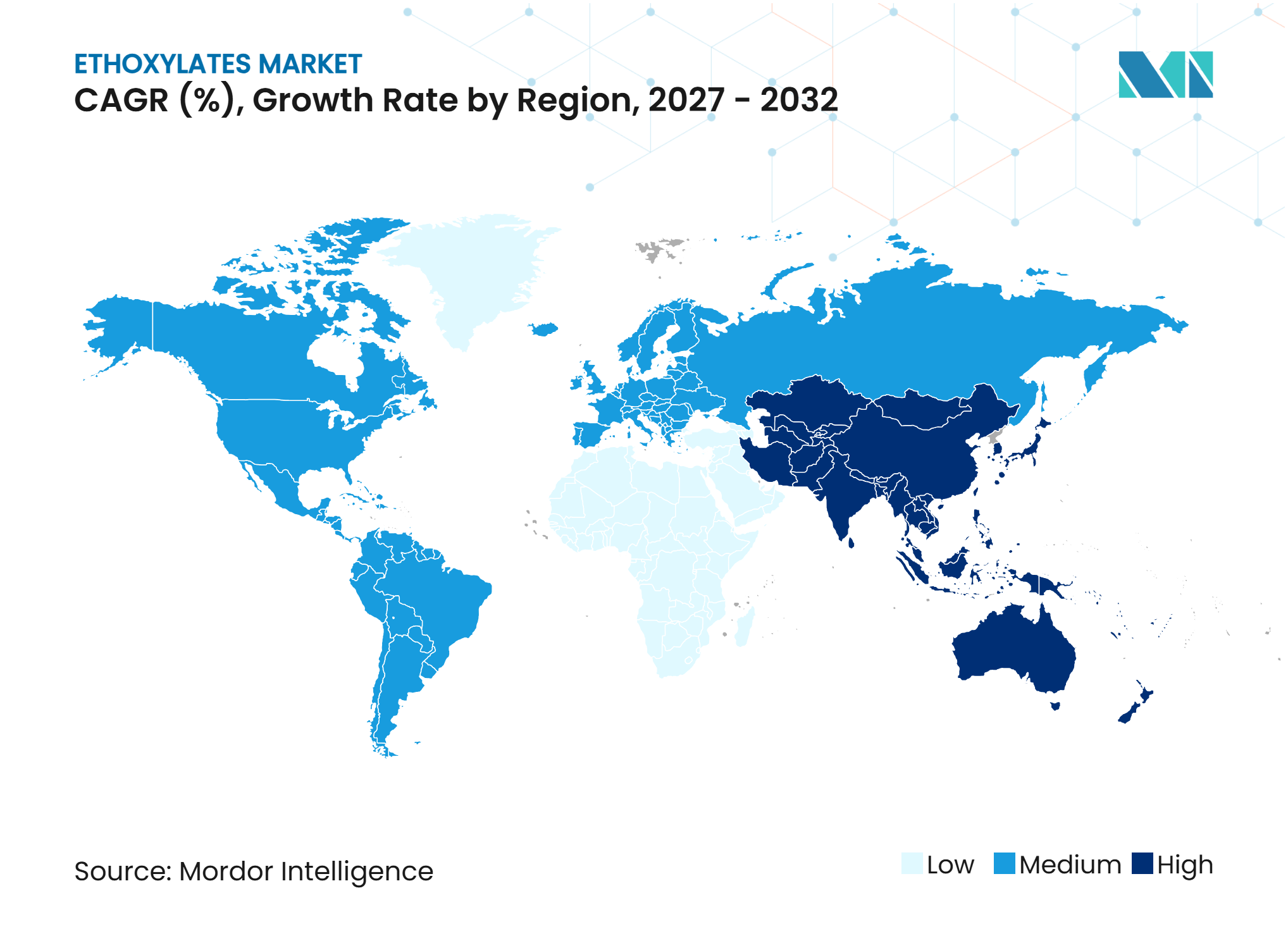
| Fastest Growing Market | Asia-Pacific |
| Largest Market | Asia-Pacific |
| Market Concentration | Low |
Major Players *Disclaimer: Major Players sorted in no particular order Image © Mordor Intelligence. Reuse requires attribution under CC BY 4.0. | |
Ethoxylates Market Analysis by Mordor Intelligence
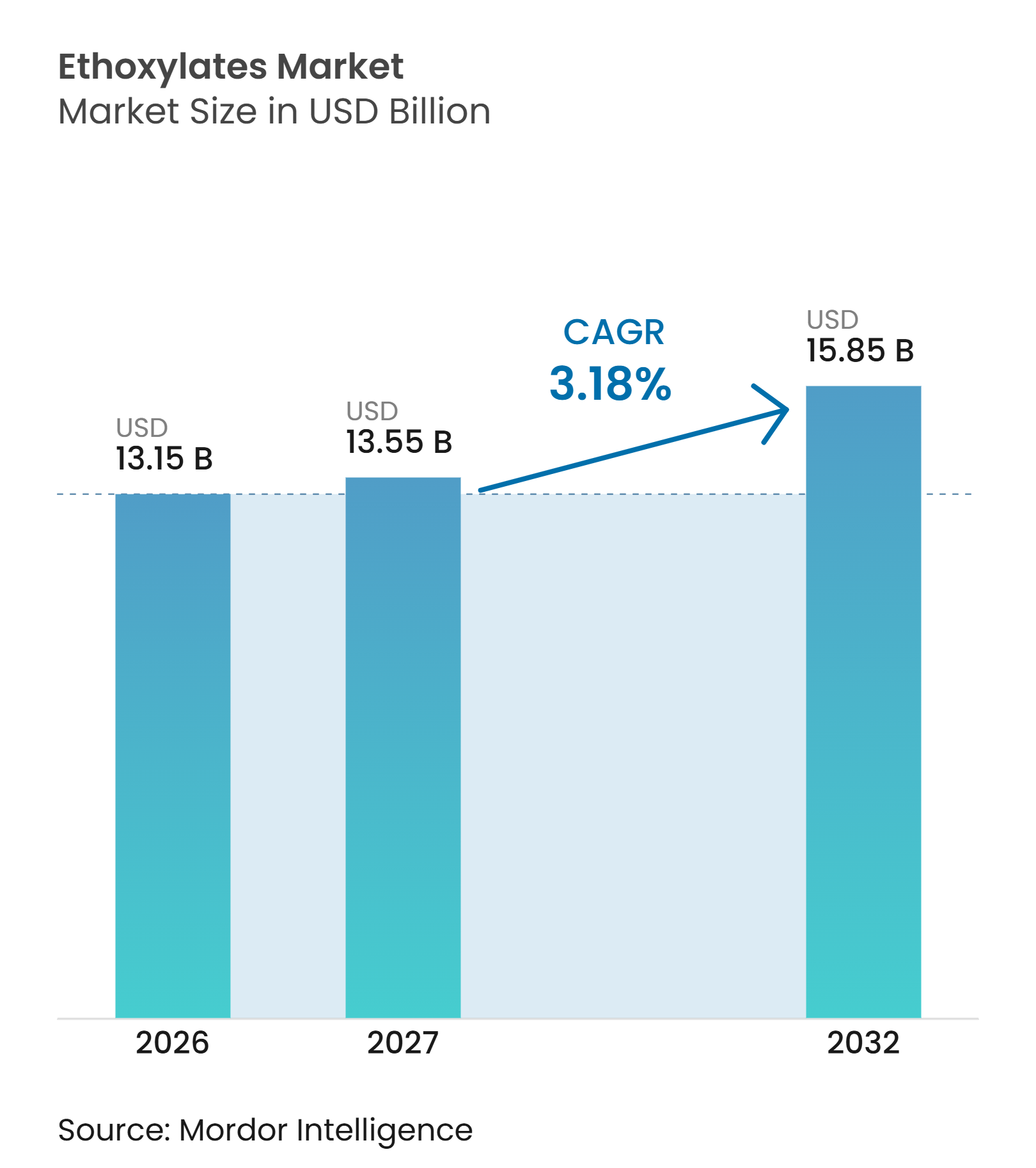
The ethoxylates market size was valued at USD 13.15 billion in 2026 and is estimated to grow from USD 13.55 billion in 2027 to USD 15.85 billion by 2032, at a CAGR of 3.18% during the forecast period (2027-2032). The ethoxylates market connects commodity chemical production with specialty formulation demand across markets with large installed manufacturing capacity and tightly specified performance requirements. This structure exposes suppliers to feedstock price cycles while supporting use across detergents, agrochemicals, pharmaceuticals, industrial cleaners, and other formulated consumer products. Product mix is shifting toward narrow-distribution, certified bio-based, and mass-balance grades, which carry higher value and more demanding qualification requirements than standard commodity grades. Certifications such as International Sustainability & Carbon Certification (ISCC) PLUS and Roundtable on Sustainable Palm Oil (RSPO), along with low 1,4-dioxane process design, are becoming important for premium formulations in Europe and North America. Integrated Asian producers with captive ethylene oxide supply compete in export markets, while producers without captive supply face greater feedstock exposure. Environmental regulations and evolving biodegradability requirements may increase reformulation and compliance costs, even as underlying demand remains supported by consumer and industrial applications.
Key Report Takeaways
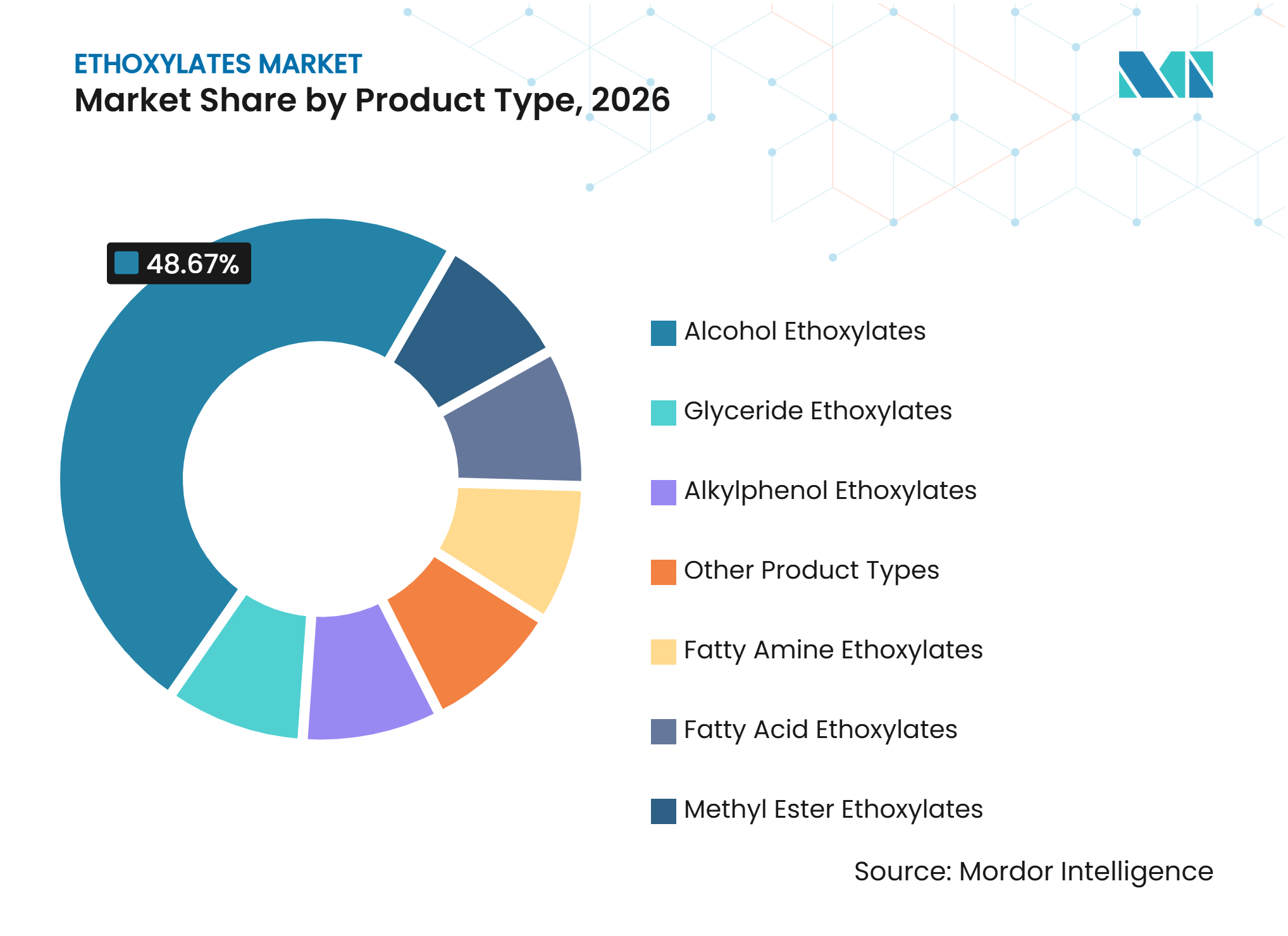
- By product type, Alcohol Ethoxylates held 48.67% of segment revenue in 2026, while Methyl Ester Ethoxylates are forecast to grow at a CAGR of 4.23% through 2032.
- By form, Liquid Ethoxylates held 69.17% of segment revenue in 2026, while Paste and Solid Ethoxylates are forecast to grow at a CAGR of 4.67% through 2032.
- By feedstock source, Petrochemical-Derived Ethoxylates held 57.42% of segment revenue in 2026, while Bio-Based and Oleochemical Ethoxylates are forecast to grow at a CAGR of 4.55% through 2032.
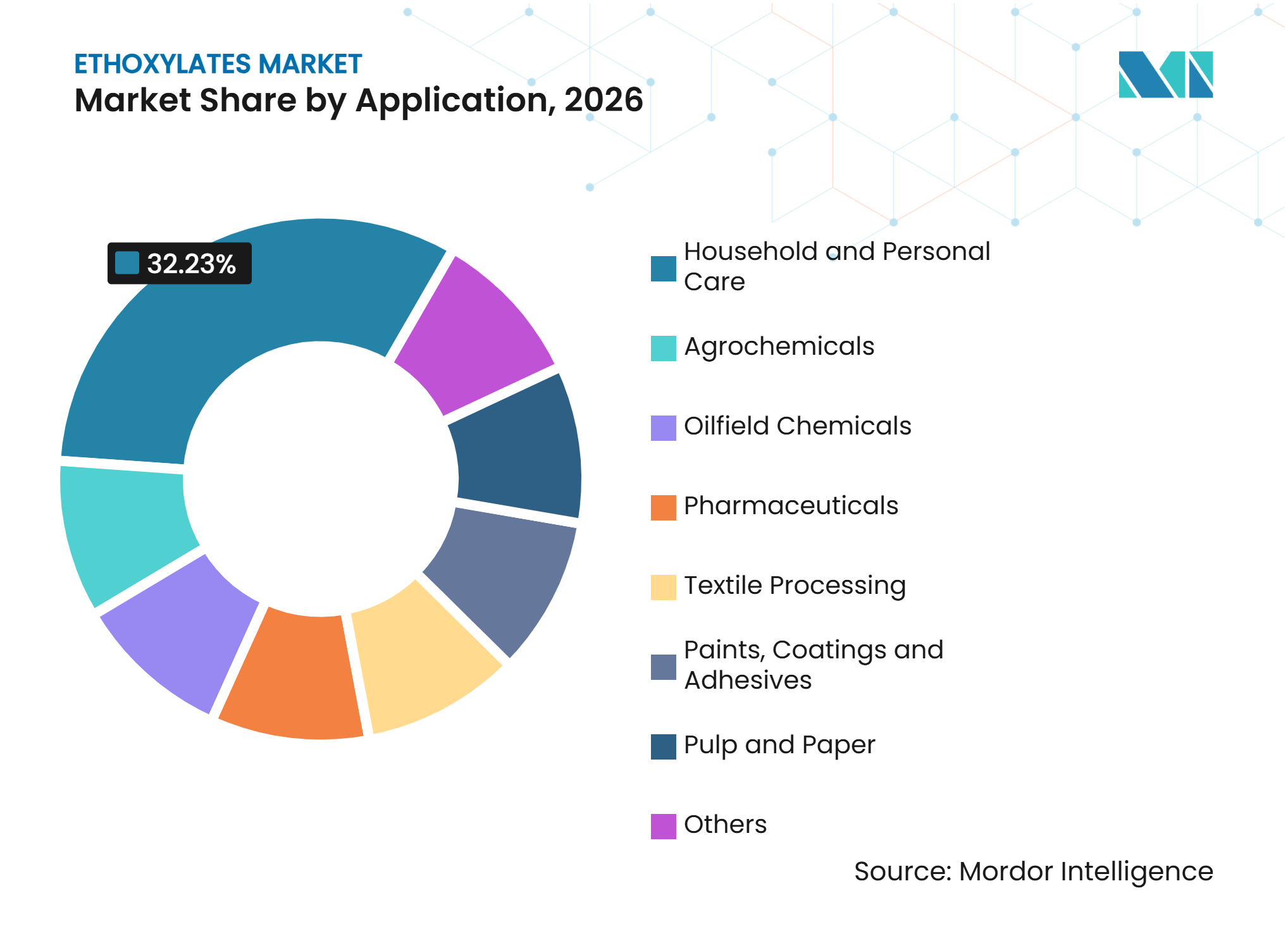
- By application, Household and Personal Care accounted for 32.23% of the ethoxylates market size in 2026, while Pharmaceuticals is forecast to grow at a CAGR of 5.48% through 2032.
- By geography, Asia-Pacific held 40.59% of global revenue in 2026 and is forecast to grow at a CAGR of 5.09% through 2032.
Note: Market numbers in this report are based on Mordor Intelligence's proprietary estimation framework, which combines nine months of actuals with Q4 projections for base year 2026.
Market Trends and Insights
Drivers Impact Analysis of Ethoxylates Market*
| Drivers | (~) % Impact on CAGR Forecast | Geographic Relevance | Impact Timeline |
|---|---|---|---|
| Expansion of Household and Personal Care Formulations | +0.8% | Global, with Asia-Pacific and North America as primary contributors | Medium term (2-4 years) |
| Substitution of Alkylphenol Ethoxylates with Alcohol Ethoxylates | +0.6% | Europe and North America, with progressive adoption in Asia-Pacific | Long term (≥ 4 years) |
| Growth in Agrochemical Adjuvants and Precision Formulations | +0.5% | North America, Brazil, Southeast Asia | Medium term (2-4 years) |
| Certified Bio-Based and Mass-Balance Feedstock Adoption | +0.4% | Europe, North America, with spillover to Asia-Pacific and Middle East and Africa | Long term (≥ 4 years) |
| Narrow-Range Ethoxylates for Low-Temperature and Concentrated Cleaning | +0.3% | Europe and North America, with spillover to Asia-Pacific and Middle East and Africa | Short term (≤ 2 years) |
| Source: Mordor Intelligence | |||
Expansion of Household and Personal Care Formulations
Household surfactant use is being shaped by premiumization and evolving product formats, rather than population growth alone. Concentrated liquid detergents and unit-dose capsules require surfactants with tighter ethylene oxide distributions and lower free polyethylene glycol content than older broad-range grades. Stepan reported that surfactants accounted for 71% of its USD 2.33 billion in consolidated net sales in 2025. Its North American surfactant revenue rose 7% year over year, supported by improved product mix and the pass-through of higher raw material costs. These conditions favor the ability to perform controlled ethoxylation over standard production. Personal care formulators also seek mild grades for sulfate-free shampoos and body washes, which supports demand for narrow-range fatty alcohol ethoxylates in the ethoxylates market.
Substitution of Alkylphenol Ethoxylates with Alcohol Ethoxylates
The replacement of alkylphenol ethoxylates (APEs) with alcohol ethoxylates remains a major source of structural transfer. In 2025, the European Commission issued only limited, time-bound authorizations for specified industrial uses of 4-tert-OPnEO and 4-NPnEO under REACH Annex XIV[1]. China also maintained controls on nonylphenol, including limits on its use as a precursor for nonylphenol ethoxylates. Alcohol ethoxylates may require higher dosages to match cloud point and emulsification performance in complex formulations, which can boost demand for alcohol ethoxylates even when total surfactant use does not increase at the same pace. Qualification cycles remain longer in oilfield chemistry, where narrow-range ethoxylates based on linear alcohols are being evaluated as substitutes for NPEs in the ethoxylates market.
Growth in Agrochemical Adjuvants and Precision Formulations
Agrochemical demand is being shaped by biological crop protection and precision application methods. These uses require adjuvants that manage droplet size, evaporation, and foliar uptake without damaging plant cells. Standard alcohol ethoxylates were often used as wetting and spreading agents in conventional herbicide products. Biological and reduced-dose synthetic actives require more controlled performance from the adjuvant system. Indovinya reported growth in agrochemical crop solutions during the third quarter of 2025, supported by seasonal demand in Brazil and a favorable product mix. Its SURFOM ETHOS range was introduced for biological formulations, indicating a shift toward higher-value precision applications within the ethoxylates market.
Certified Bio-Based and Mass-Balance Feedstock Adoption
Bio-based and mass-balance credentials are becoming supply chain requirements for multinational consumer goods companies. In December 2025, Syensqo received International Sustainability and Carbon Certification (ISCC) PLUS mass-balance certification for its on-pipe ethoxylation at the Moerdijk site. The certification supports a verified chain of custody for bio-circular feedstocks used in Rhodasurf B7 UP. In March 2025, Kao agreed to purchase an alternative palm oil material from Future Origins for fatty alcohol derivatives. Certification of ethylene oxide, rather than only the fatty alcohol input, is increasingly important as it can reduce the carbon footprint of the finished ethoxylate. BASF's Zhanjiang site adds integrated nonionic surfactant capacity in China, reinforcing the relevance of feedstock integration as demand for certified grades grows in the ethoxylates market.
Restraints Impact Analysis of Ethoxylates Market*
| Restraints | (~) % Impact on CAGR Forecast | Geographic Relevance | Impact Timeline |
|---|---|---|---|
| Ethylene Oxide and Fatty Alcohol Price Volatility | -0.9% | Global, most acute in regions dependent on merchant ethylene oxide, including South and Southeast Asia | Short term (≤ 2 years) |
| Tightening Aquatic-Toxicity and Biodegradability Requirements | -0.6% | Europe and North America, with progressive spillover to South America and Asia-Pacific | Medium term (2-4 years) |
| Qualification Delays for Reformulated or Bio-Based Grades | -0.4% | Global, most pronounced in pharmaceutical and food-contact applications | Medium term (2-4 years) |
| Source: Mordor Intelligence | |||
Ethylene Oxide and Fatty Alcohol Price Volatility
Ethylene oxide is the central reactant in ethoxylation, and its cost is driven by ethylene margins, feedstock pricing, cracker utilization, and regional energy costs. Producers without a captive ethylene oxide supply are directly exposed when input prices rise. Formulators may resist immediate price pass-through under short-cycle contracts, which pressures producers' margins. Fatty alcohols add another source of volatility, as oleochemical grades track palm kernel oil and coconut oil markets, logistics conditions, weather, and certification premiums. Indovinya identified higher costs of oleochemical raw materials as a headwind for home and personal care margins in Asia-Pacific and South America in 2025. Producers with integrated ethylene oxide supply, including Saudi Kayan-linked operations, can limit this exposure and retain a cost advantage over merchant buyers in the ethoxylates market.
Tightening Aquatic-Toxicity and Biodegradability Requirements
Biodegradability and aquatic hazard standards are becoming stricter in major consuming regions. These requirements can affect longer ethylene oxide chain grades and specialty products with slower degradation profiles. The Council of the European Union and the European Parliament reached a provisional agreement in June 2025 on revised detergent rules that allow stricter biodegradability criteria for surfactants. Germany withdrew its intention to restrict 1,4-dioxane in surfactants in August 2025 while its assessment continued, but the US Environmental Protection Agency continued work on related risk management[2]. Stepan reported an investment to modify manufacturing processes and reduce the level of 1,4-dioxane in ethoxylated surfactants. These requirements favor narrower-distribution grades and suppliers with robust biodegradability documentation, while increasing the compliance burden on broad-range production in the ethoxylates market.
*Our forecasts treat driver/restraint impacts as directional, not additive. The impact forecasts reflect baseline growth, mix effects, and variable interactions.
Ethoxylates Market Segment Analysis
By Product Type:
Alcohol Ethoxylates Lead, While Methyl Ester Grades Gain GroundAlcohol ethoxylates accounted for 48.67% of the ethoxylates market share in 2026, reflecting broad use in household cleaning, personal care, and industrial formulations. Compatibility with anionic and cationic co-surfactants, along with tunable hydrophilic-lipophilic balance, supports use across many formulation systems. Established clearance under REACH, TSCA, and China's Inventory of Existing Chemical Substances (IECSC) registry makes these materials a common starting point in product development. Shell Chemicals' NEODOL range and BASF's Lutensol portfolio are widely used commercial product families for cleaning and industrial applications.
Methyl ester ethoxylates are expected to record a 4.23% CAGR from 2027 to 2032, the fastest rate in this product group. Low free polyethylene glycol content, cold-water detergency, and suitability for concentrated liquids support demand where ethanol-soluble by-products are undesirable. Fatty amine and fatty acid ethoxylates serve fabric-softening, textile-auxiliary, and personal-care emulsification uses, while glyceride ethoxylates serve smaller pharmaceutical and food-grade applications. Alkylphenol ethoxylates continue to lose market share as authorization limits and nonylphenol controls narrow their use to regulated industrial applications, with longer qualification cycles. The ethoxylates industry is moving toward alternatives that meet both performance and regulatory requirements.



By Form:
Liquid Grades Retain Scale, While Solid Formats Build DemandLiquid ethoxylates accounted for 69.17% of segment revenue in 2026, supported by ease of processing and compatibility with installed liquid formulation lines. Detergent and personal care manufacturers use pumpable, inline-dosable surfactant inputs in continuous production. Liquid grades range from low-viscosity materials for hard-surface cleaners to higher-viscosity, paste-like grades. Integration into manufacturing plants makes replacement with other forms difficult, giving this segment a durable position in the ethoxylates market.
Paste and solid ethoxylates are projected to grow at a 4.67% CAGR through 2032. Demand is linked to concentrated powders, solid bars, and unit-dose tablet formats that require dry or semi-dry active systems. These formats reduce transport weight and packaging use per kilogram of active ingredient, making form selection relevant to supply chain sustainability objectives. Nouryon introduced Ethylan X4 and X6 in October 2025 as low-foaming, narrow-range surfactants for hard-surface cleaning that reduce water and energy use. This development indicates that performance and sustainability considerations are differentiating liquid products and supporting solid-format growth.
By Feedstock Source:
Petrochemical Grades Lead as Bio-Based Supply ExpandsPetrochemical-derived ethoxylates accounted for 57.42% of the ethoxylates market in 2026. Large petrochemical crackers and integrated ethoxylation units provide cost advantages and dependable supply. Synthetic fatty alcohols, including Shell NEODOL and Sasol linear alcohol products, offer consistent purity and controlled carbon-chain distributions valued by industrial formulators. Asia and the Middle East set a competitive cost benchmark through gas-based and naphtha-based ethylene oxide chains, making integrated assets central to the ethoxylates industry.
Bio-based and oleochemical ethoxylates are forecast to expand at a 4.55% CAGR from 2027 to 2032. Consumer goods companies are increasing demand for renewable carbon content and Roundtable on Sustainable Palm Oil (RSPO)-certified inputs. Regulatory and customer requirements for verified renewable-content disclosures may reinforce demand for such disclosures in detergent formulations. Sasol launched LIVINEX IO 7 in October 2025, a palm-free, deforestation-free C12-14 alcohol ethoxylate derived from black soldier fly larvae oil. Recycled-carbon and mass-balance products remain at an earlier stage, but Syensqo's International Sustainability and Carbon Certification (ISCC) PLUS certification provides a route toward broader commercialization.
By Application:
Household Care Supports Output, While Pharmaceuticals Grow FasterHousehold and personal care accounted for 32.23% of the ethoxylates market size in 2026. Daily-use detergents, shampoos, and surface-cleaning products generate reliable output, with expanding middle-class populations in Asia-Pacific adding to demand. Alcohol ethoxylates remain common in liquid detergents and surface-care formulations, supporting baseline operating rates at large facilities. Per-unit value growth is limited by commodity pricing and retailer bargaining power in private-label supply chains.
Pharmaceuticals are forecast to grow at a 5.48% CAGR from 2027 to 2032. Polyethylene glycol-based ethoxylates support solubilization, emulsification, and drug-delivery systems for poorly water-soluble active ingredients. Demand is connected to Glucagon-like Peptide-1 (GLP-1) treatments, oncology biologics, and oral lipid nanoparticle delivery applications. Croda reported its sixth consecutive quarter of sales growth in the third quarter of 2025 at constant currency rates, with strength in healthcare ingredients. Agrochemicals, oilfield chemicals, and textile processing are tied to agriculture, hydrocarbon production, and fiber activity, while paints, coatings, adhesives, and pulp and paper use ethoxylates as dispersants, wetting agents, and defoamers.

Geography Analysis
Asia-Pacific
Asia-Pacific held 40.59% of the ethoxylates market share in 2026 and is projected to expand at a 5.09% CAGR through 2032. China supports regional output through integrated petrochemicals and consumer goods manufacturing, and BASF inaugurated its world-scale Zhanjiang Verbund site in 2026. India has renewable ethylene oxide routes, while ASEAN economies are adding consumer goods capacity that uses local surfactant systems. Japan is focused on higher-value pharmaceutical and personal care applications, while Chinese nonylphenol controls support the use of alcohol ethoxylate alternatives. These compliance factors and new integrated capacity support better-documented, higher-value grades in the regional ethoxylates market.
North America
North America is supported by producers that combine linear alpha-olefin and fatty alcohol assets with adjacent ethoxylation capacity for cleaning and agricultural applications. Stepan expanded its Pasadena, Texas, alkoxylation plant to an annual capacity of 75,000 metric tons for ethoxylates and propoxylates. U.S. EPA work on 1,4-dioxane and New York limits are pushing manufacturers and brand owners toward lower-impurity processes and formulations. Huntsman added an E-GRADE high-purity amine purification unit in Conroe, Texas, in May 2025, reflecting the regional focus on higher-value derivative streams. The ethoxylates market in the region is balancing feedstock integration with stronger compliance and specialty-product requirements.
Europe, South America, and Middle East and Africa
Europe is shaped by REACH requirements, detergent reform, and continued attention to 1,4-dioxane, which increase the value of regulatory documentation. The revised EU detergent framework will strengthen biodegradability requirements for surfactants. Clariant expanded ethylene oxide derivative and mild surfactant capacity at Daya Bay in November 2025 to serve Chinese demand and export markets. South America, especially Brazil, benefits from bio-based inputs and agricultural demand for crop solutions, while the Middle East and Africa combine integrated ethylene economics with rising agrochemical and personal care manufacturing.
Competitive Landscape
Market Concentration
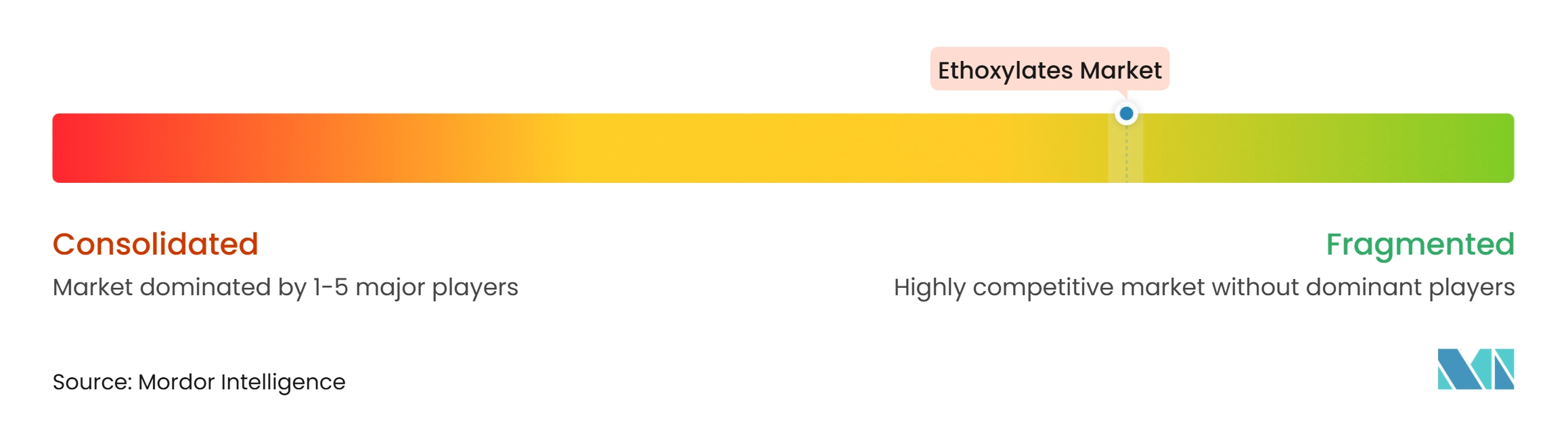
The ethoxylates market is fragmented. Capital requirements for the safe handling of ethylene oxide create a barrier to entry for large-scale operations. Regional specialty producers can purchase ethylene oxide and serve local demand at a smaller scale. Large suppliers seek captive feedstock, certified specialty grades, and stronger margins in regulated segments of the ethoxylates market. Capacity investment is increasingly directed toward Asia-Pacific rather than Europe, driven by regional demand growth and the availability of integrated feedstocks.
Syensqo's ISCC PLUS certification at Moerdijk supports the supply of bio-circular Rhodasurf B7 UP to customers seeking documented lower-carbon inputs. In October 2025, Nouryon introduced Roundtable on Sustainable Palm Oil (RSPO)-certified, performance-focused cleaning ingredients, reflecting how sustainability credentials are used in business-to-business supply relationships. BASF's integrated Zhanjiang investment illustrates how suppliers are positioning themselves close to Asian feedstocks and customer demand. These developments indicate that differentiation in the ethoxylates market is increasingly tied to integrated supply, certification, and product performance, with supply relationships favoring companies that meet customers' documentation requirements.
Dow disclosed a process for alcohol ethoxylates and alkyl ether sulfates designed to reduce 1,4-dioxane formation under elevated-temperature processing. SABIC disclosed a single-stage process for blending straight-chain and branched-chain fatty alcohols to improve detergency with lower ethylene oxide loading. Pharmaceutical-grade ethoxylates, carbon-dioxide-derived carbonate ethoxylates, and narrow-range methyl ester grades remain areas where technical specialists can compete with larger commodity producers. Registration, Evaluation, Authorization and Restriction of Chemicals (REACH) and Toxic Substances Control Act (TSCA) requirements give suppliers with complete biodegradability and environmental documentation a faster path to regulated applications in the ethoxylates market.
Ethoxylates Industry Leaders
-
BASF
-
Dow
-
Sasol
-
Shell plc
-
Nouryon
- *Disclaimer: Major Players sorted in no particular order
Ethoxylates Market Companies Covered in this Report
- BASF
- CLARIANT
- Croda International Plc
- Dow
- Evonik Industries AG
- Huntsman International LLC
- India Glycols Limited
- Indorama Ventures Public Company Limited
- Kao Corporation
- Nouryon
- SABIC
- Sasol
- Shell plc
- Stepan Company
- Syensqo
Recent Industry Developments in Ethoxylates Market
- August 2026: Shell plc received non-binding bids from ExxonMobil, LyondellBasell, Apollo Global Management, and Kuwait Petroleum for its US chemicals business, including NEODOL linear alcohol ethoxylate operations across four sites in Louisiana, Texas, and Pennsylvania, valued at up to USD 8 billion. If completed, the transaction would transfer ownership of a notable alcohol ethoxylate production base.
- February 2026: Syensqo launched Rhodasurf B7 UP, a laureth-7 ethoxylate surfactant produced at its ISCC PLUS-certified ethoxylation facility in Moerdijk, Netherlands, using bio-circular ethylene oxide feedstocks. The product reduces net CO₂ emissions by more than 90% compared with conventional petrochemical-based ethoxylates, targeting formulators of laundry detergents and hard-surface care products.
Global Ethoxylates Market Report Scope
Ethoxylates are nonionic surfactants produced by reacting ethylene oxide with hydrophobic substrates such as fatty alcohols, phenols, acids, or amines. The reaction, known as ethoxylation, adds ethylene oxide units to the hydrophobic substrate, resulting in a molecule with both hydrophilic and hydrophobic properties.
The ethoxylates market is segmented by product type, form, feedstock source, application, and geography. By product type, the market is segmented into alcohol ethoxylates, fatty amine ethoxylates, fatty acid ethoxylates, methyl ester ethoxylates, glyceride ethoxylates, alkylphenol ethoxylates, and other product types. By form, the market is segmented into liquid ethoxylates and paste and solid ethoxylates. By feedstock source, the market is segmented into petrochemical-derived ethoxylates, bio-based and oleochemical ethoxylates, and recycled-carbon and mass-balance ethoxylates. By application, the market is segmented into household and personal care, agrochemicals, oilfield chemicals, pharmaceuticals, textile processing, paints, coatings and adhesives, pulp and paper, and others. The report also covers market sizes and forecasts for ethoxylates across 15 countries in major regions. The market sizes and forecasts are provided in terms of value (USD).
Segmentation Overview
| Alcohol Ethoxylates |
| Fatty Amine Ethoxylates |
| Fatty Acid Ethoxylates |
| Methyl Ester Ethoxylates |
| Glyceride Ethoxylates |
| Alkylphenol Ethoxylates |
| Other Product Types |
| Liquid Ethoxylates |
| Paste and Solid Ethoxylates |
| Petrochemical-Derived Ethoxylates |
| Bio-Based and Oleochemical Ethoxylates |
| Recycled-Carbon and Mass-Balance Ethoxylates |
| Household and Personal Care |
| Agrochemicals |
| Oilfield Chemicals |
| Pharmaceuticals |
| Textile Processing |
| Paints, Coatings and Adhesives |
| Pulp and Paper |
| Others |
| Asia-Pacific | China |
| India | |
| Japan | |
| South Korea | |
| ASEAN Countries | |
| Rest of Asia-Pacific | |
| North America | United States |
| Canada | |
| Mexico | |
| Europe | Germany |
| United Kingdom | |
| France | |
| Italy | |
| NORDIC Countries | |
| Rest of Europe | |
| South America | Brazil |
| Argentina | |
| Rest of South America | |
| Middle East and Africa | Saudi Arabia |
| South Africa | |
| Rest of Middle East and Africa |
| By Product Type | Alcohol Ethoxylates | |
| Fatty Amine Ethoxylates | ||
| Fatty Acid Ethoxylates | ||
| Methyl Ester Ethoxylates | ||
| Glyceride Ethoxylates | ||
| Alkylphenol Ethoxylates | ||
| Other Product Types | ||
| By Form | Liquid Ethoxylates | |
| Paste and Solid Ethoxylates | ||
| By Feedstock Source | Petrochemical-Derived Ethoxylates | |
| Bio-Based and Oleochemical Ethoxylates | ||
| Recycled-Carbon and Mass-Balance Ethoxylates | ||
| By Application | Household and Personal Care | |
| Agrochemicals | ||
| Oilfield Chemicals | ||
| Pharmaceuticals | ||
| Textile Processing | ||
| Paints, Coatings and Adhesives | ||
| Pulp and Paper | ||
| Others | ||
| By Geography | Asia-Pacific | China |
| India | ||
| Japan | ||
| South Korea | ||
| ASEAN Countries | ||
| Rest of Asia-Pacific | ||
| North America | United States | |
| Canada | ||
| Mexico | ||
| Europe | Germany | |
| United Kingdom | ||
| France | ||
| Italy | ||
| NORDIC Countries | ||
| Rest of Europe | ||
| South America | Brazil | |
| Argentina | ||
| Rest of South America | ||
| Middle East and Africa | Saudi Arabia | |
| South Africa | ||
| Rest of Middle East and Africa | ||
Key Questions Answered in the Report
What is current market size of Ethoxylates Market?
The ethoxylates market size was valued at USD 13.15 billion in 2026 and is estimated to grow from USD 13.55 billion in 2027 to USD 15.85 billion by 2032, at a CAGR of 3.18% during the forecast period (2027-2032).
Which product category has the largest share of ethoxylates demand?
Alcohol Ethoxylates lead product demand with a 48.67% share in 2026, supported by use in cleaning, personal care, and industrial formulations.
Which ethoxylate application is growing the fastest?
Pharmaceuticals are projected to grow at a 5.48% CAGR through 2032, driven by the use of polyethylene glycol-based ethoxylates in solubilization, emulsification, and drug delivery.
Which region leads global ethoxylates demand?
Asia-Pacific leads with a 40.59% share in 2026 and is projected to expand at a 5.09% CAGR through 2032.