
ESports Streaming Market Size and Share
Market Overview
| Study Period | 2020 - 2031 |
|---|---|
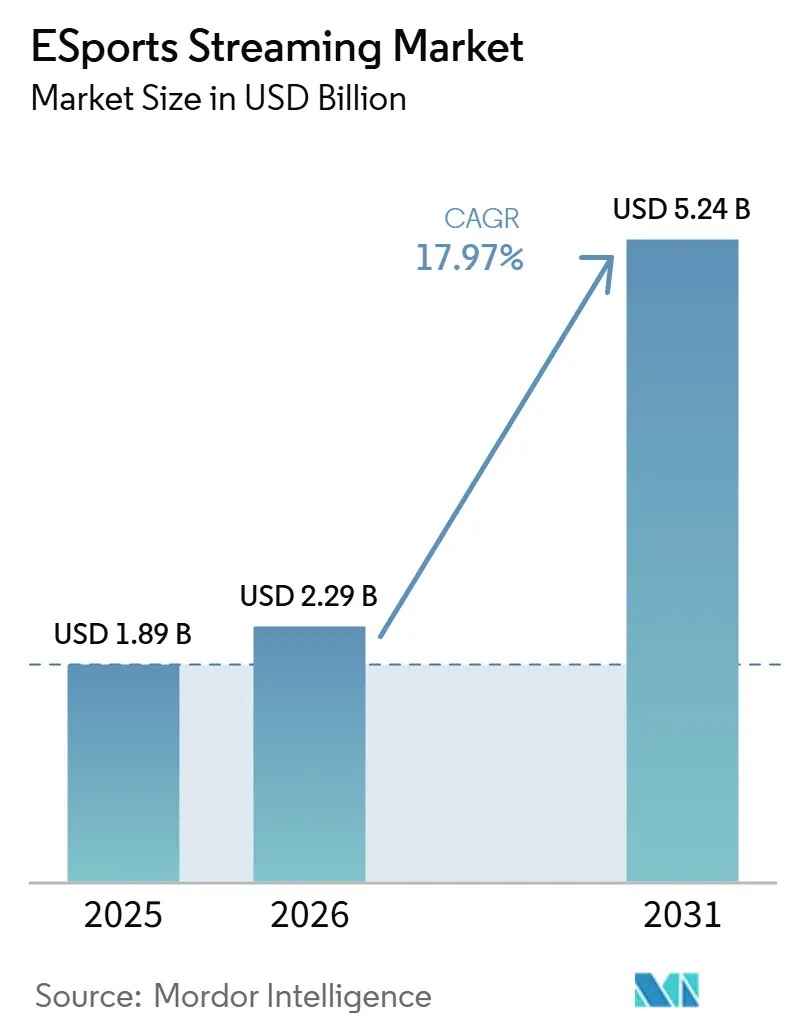
| Market Size (2026) | USD 2.29 Billion |
| Market Size (2031) | USD 5.24 Billion |
| Growth Rate (2026 - 2031) | 17.97 % |
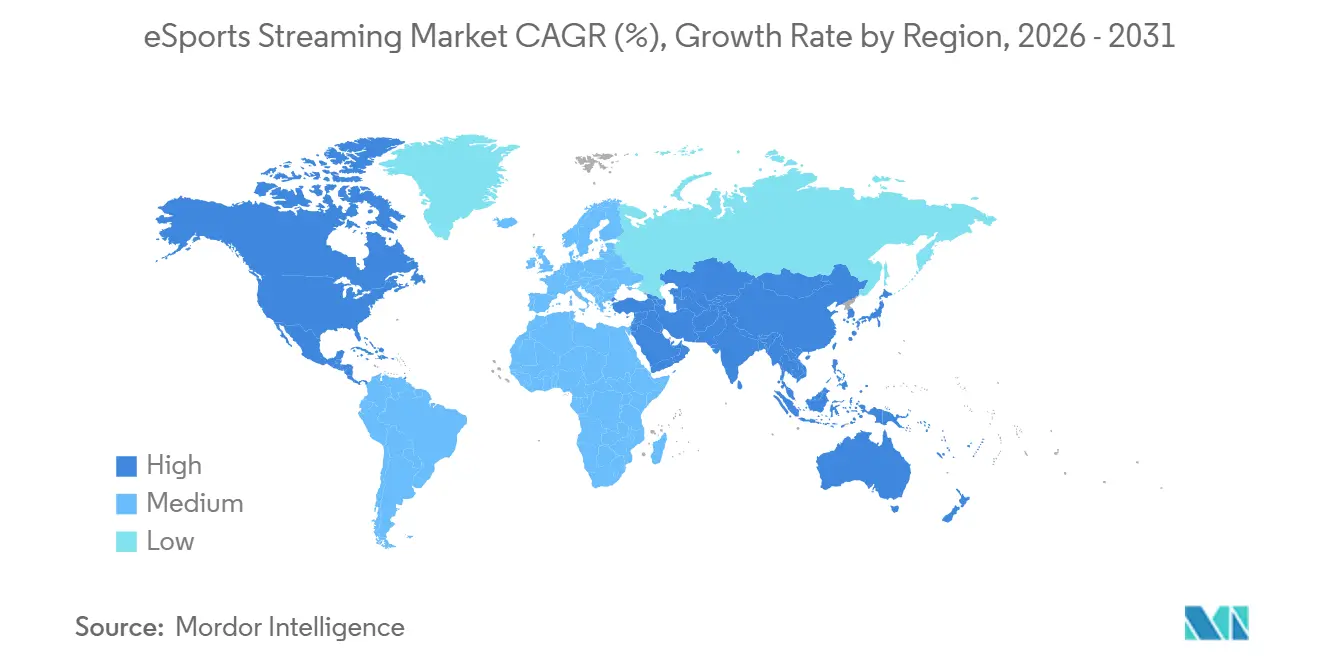
| Fastest Growing Market | Asia-Pacific |
| Largest Market | North America |
| Market Concentration | Medium |
Major Players *Disclaimer: Major Players sorted in no particular order Image © Mordor Intelligence. Reuse requires attribution under CC BY 4.0. | |
ESports Streaming Market Analysis by Mordor Intelligence
The eSports streaming market size is projected to be USD 1.89 billion in 2025, USD 2.29 billion in 2026, and reach USD 5.24 billion by 2031, growing at a CAGR of 17.97% from 2026 to 2031. The current growth phase is being shaped by stronger broadband networks, more organized tournament calendars, and the rise of challenger platforms that are spreading audiences across a wider set of viewing destinations. The eSports streaming market is also moving beyond an earlier model that leaned heavily on sponsorships, because platforms and event operators are now pushing subscription offers, in-stream commerce, and broader media tie-ins. Competitive pressure is increasing as co-streaming becomes more central to audience expansion and as publishers, platforms, and tournament operators renegotiate how premium content is distributed. The eSports streaming market is also seeing a higher operating threshold, as larger prize pools and higher production standards are forcing participants to invest more to stay relevant. Platforms and organizers that build stable multi-source revenue models before the next ad slowdown are likely to capture a larger share of future growth in the eSports streaming market.
Key Report Takeaways
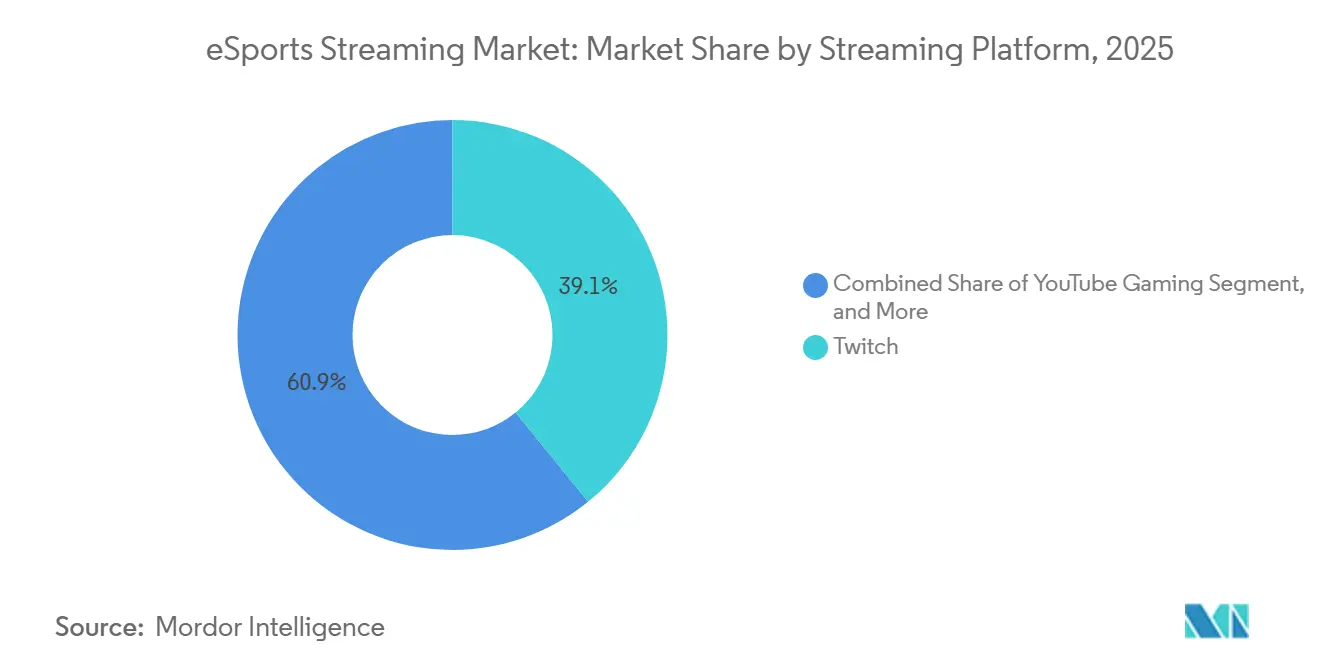
- By streaming platform, Twitch held 39.14% of the eSports streaming market share in 2025, while Kick is projected to expand at an 18.02% CAGR through 2031.
- By device type, smartphones and tablets accounted for 51.62% of the eSports streaming market in 2025, while gaming consoles are projected to grow at an 18.56% CAGR through 2031.
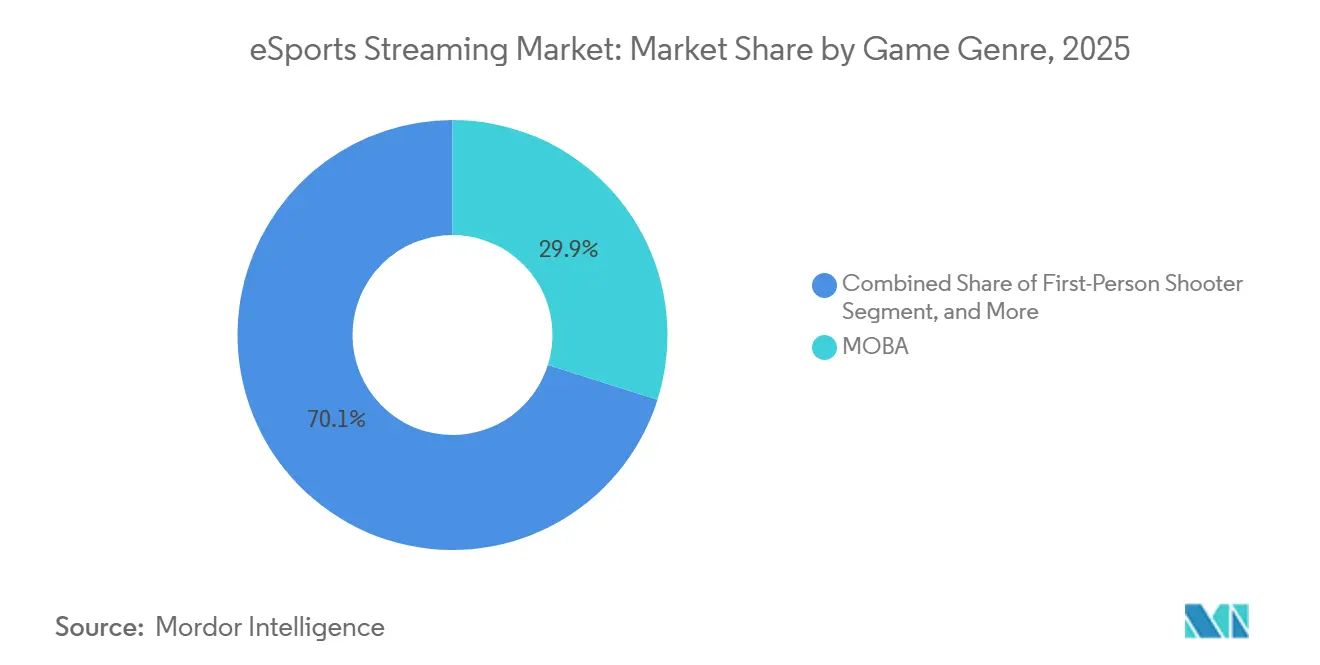
- By game genre, MOBAs accounted for 29.87% of the eSports streaming market in 2025, while first-person shooters are projected to expand at a 18.73% CAGR through 2031.
- By geography, Asia-Pacific held 41.59% of the eSports streaming market share in 2025, while North America is projected to advance at a 19.38% CAGR through 2031.
Note: Market size and forecast figures in this report are generated using Mordor Intelligence’s proprietary estimation framework, updated with the latest available data and insights as of January 2026.
Market Trends and Insights
Drivers Impact Analysis of ESports Streaming Market*
| Driver | (~) % Impact on CAGR Forecast | Geographic Relevance | Impact Timeline |
|---|---|---|---|
| Rising 5G and Fiber Penetration for Low-Latency Mobile Viewing | +3.5% | Global, with concentrated gains in Asia-Pacific, Middle East, and South America | Short term (≤ 2 years) |
| Expansion of Media Rights and Premium Broadcast Deals | +3.2% | North America and Europe core, with spillover to Asia-Pacific and Middle East | Medium term (2-4 years) |
| Franchise League Monetization and Structured Tournament Calendars | +2.8% | North America, Europe, and South Korea | Medium term (2-4 years) |
| Government Backing for Esports Arenas and Digital Infrastructure | +2.3% | Asia-Pacific core, Middle East, and Europe | Long term (≥ 4 years) |
| AI-Powered Personalized Viewing and Training Experiences | +1.8% | Global, with North America and Asia-Pacific as early adopters | Medium term (2-4 years) |
| Saudi-Led Mega Prize Pools Expanding Global Event Circuits | +1.5% | Global reach, originating in the Middle East and extending into Europe and Asia-Pacific | Short term (≤ 2 years) |
| Source: Mordor Intelligence | |||
Rising 5G and Fiber Penetration Enabling Low-Latency Mobile Viewing
Mobile broadband improvements are changing how audiences access the eSports streaming market, especially in regions where smartphones remain the main viewing device. Veloce Media Group's 2026 submission through the GSMA Open Gateway framework set a clear performance benchmark by calling for sub-10 millisecond latency and zero-jitter connectivity for broadcast-grade mobile esports viewing. Deutsche Telekom launched its 5G+ Gaming service with NVIDIA GeForce NOW in late 2025, using L4S and network slicing to deliver low-latency gameplay on smartphones at a national scale across Europe.[1]Deutsche Telekom, “Gamescom 2025, Telekom Presents the Ultimate Mobile Cloud Gaming Experience with 5G, Powered by NVIDIA,” Deutsche Telekom, telekom.com At the Esports World Cup 2025, stc deployed 27 advanced 5G towers and more than 1,295 antennas, while maintaining 99.9% network availability throughout the event. As this network quality spreads further across Asia-Pacific and other mobile-first regions, the eSports streaming market can convert casual viewers into more regular users who are easier to monetize through subscriptions and commerce.
Expansion of Media Rights and Premium Broadcast Deals
The eSports streaming market is moving closer to the structure of traditional sports broadcasting as media rights become more formal and more valuable. Riot Games confirmed a five-year exclusive deal with Naver and SOOP for League of Legends Champions Korea from 2026 through 2030, removing LCK live content from YouTube in Korea and resetting local viewing habits. DAZN's decision to stream the Esports World Cup 2026 free globally showed that premium sports platforms now see esports as a meaningful audience category rather than a side offering. France Télévisions also secured exclusive domestic rights to the Esports World Cup 2026, extending esports exposure across national television and streaming in France. As rights values rise, the eSports streaming market faces a new cost layer, because platforms that once relied on easier access to publisher content increasingly need to compete for premium inventory.
Franchise League Monetization and Structured Tournament Calendars
A more predictable event calendar is helping the eSports streaming market attract advertisers, partners, and broadcasters that need recurring audience peaks rather than isolated spikes. BLAST reported EUR 114.6 million (USD 123.8 million) in revenue for fiscal year 2025 and posted its first annual net profit, demonstrating that structured tournament operations can reach commercial viability at scale. Riot Games also stated that League of Legends esports is very close to break-even, while the company disclosed that more than USD 100 million in digital item sale revenue had already been shared with teams in the VALORANT ecosystem. When leagues move closer to break-even, they gain more room to fund creator programs, better production systems, and broader international circuits without depending as heavily on publisher support. Riot's planned 2027 tournament-first global tour across 16 international cities adds to that signal and suggests that the eSports streaming market is entering a more durable operating phase.
Government Backing for Esports Arenas and Digital Infrastructure
Government-backed infrastructure is becoming a long-term growth driver for the eSports streaming market, especially in countries seeking to position themselves as digital entertainment hubs. Maharashtra announced a 50-acre digital and esports hub near Navi Mumbai International Airport, under a policy outlay of INR 3,268 crore (USD 391 million), tied to wider investment and employment goals. Singapore opened its national esports training center at GR.iD mall after formal recognition of gaming as a sport, with attention already shifting to the Asian Games in Nagoya. Nexon also secured 40-year rights to build South Korea's largest esports arena in Jamsil, with completion targeted by 2032. These projects raise the long-run capacity of the eSports streaming market by improving venue quality, event production readiness, and the institutional base that supports professional competition.
Restraints Impact Analysis of ESports Streaming Market*
| Restraint | (~) % Impact on CAGR Forecast | Geographic Relevance | Impact Timeline |
|---|---|---|---|
| Sponsorship Spend Compression in Cyclical Ad Markets | -2.5% | Global, most acute in North America and Europe | Short term (≤ 2 years) |
| Fragmented Intellectual Property Rights and Publisher Control | -1.8% | Global | Long term (≥ 4 years) |
| Player Salary Inflation and Talent Retention Pressure | -1.2% | North America, Europe, and South Korea | Medium term (2-4 years) |
| Regulatory Scrutiny on Loot Boxes, Gambling, and Youth Access | -0.8% | Europe and Asia-Pacific core, with expansion into North America | Medium term (2-4 years) |
| Source: Mordor Intelligence | |||
Sponsorship Spend Compression in Cyclical Ad Markets
Sponsorship remains a core revenue pillar in the eSports streaming market, which makes advertising softness especially disruptive when partner budgets tighten. The current pressure is most visible in the gap between strong audience activity and weaker monetization, because rising hours watched do not automatically translate into stronger ad income. The eSports streaming market is therefore under pressure to develop more stable revenue streams, including direct subscriptions, commerce formats, and deeper platform integrations. This challenge is particularly important for tournament broadcasts that depend heavily on pre-roll and mid-roll inventory tied to sponsor demand. Until those newer revenue lines scale further, the eSports streaming market will remain exposed to swings in discretionary brand spending.
Fragmented Intellectual Property Rights and Publisher Control
Publisher control remains one of the deepest structural limits on the eSports streaming market, because every platform, organizer, and broadcaster depends on the owner of each game title's permission. WIPO's 2026 overview explained that game publishers hold exclusive rights to competitive broadcasts, co-streams, and highlights under international copyright law.[2]World Intellectual Property Organization, “Intellectual Property and Esports, An Overview of the Game,” WIPO, wipo.int A 2025 peer-reviewed study in Frontiers in Sports and Active Living also found that major esports titles remain fully controlled by publishers, who keep final authority over tournament organization, licensing, and broadcast conditions. The Esports World Cup Foundation's broad three-year agreement with Amazon still required separate licensing negotiations with all participating publishers, underscoring how difficult scale can be even for well-funded operators. This structure keeps legal and operating costs high and makes long-term investment in the eSports streaming market more uncertain than in traditional sports media.
*Our forecasts treat driver/restraint impacts as directional, not additive. The impact forecasts reflect baseline growth, mix effects, and variable interactions.
ESports Streaming Market Segment Analysis
By Streaming Platform:
Challenger Platforms Compress The Incumbent's MoatTwitch held 39.14% of the eSports streaming market share in 2025, maintaining its leading position even as platform loyalty weakened. The platform still entered the year under pressure, because the broader audience shift in the eSports streaming market favored creator portability over older exclusivity models. Kick is the fastest-growing platform segment, with a projected 18.02% CAGR through 2031, and it reached 100 million registered users by April 10, 2026. The same source reported 1.27 billion hours watched on Kick in Q1 2026, representing 65.35% year-over-year growth and demonstrating how quickly newer platforms can scale when discovery improves. This shift is forcing the eSports streaming industry to compete more aggressively on creator economics and platform reach.
Riot Games strengthened that momentum when it expanded esports distribution with Kick across League of Legends, VALORANT, and Teamfight Tactics beginning with MSI 2026, with coverage aimed at audiences in Europe, the Middle East, and South America. The eSports streaming market is therefore becoming less centered on a single dominant destination and more shaped by multi-platform viewing behavior. YouTube Gaming remains the second-largest platform in the category, which shows that audience scale is not disappearing from the market so much as shifting across services. Chinese operators such as Huya and DouYu also follow a broader distribution model that extends esports content across social and messaging ecosystems rather than relying solely on stand-alone streaming apps. That broader redistribution of attention suggests the eSports streaming market will reward platforms that can connect live viewing, social reach, and creator-led co-streaming into a single user journey.



By Device Type:
Mobile Dominance Tested By Console ResurgenceSmartphones and tablets accounted for 51.62% of the eSports streaming market in 2025, underscoring that mobile remained the primary access point for viewers across large regional audiences. The eSports streaming market has benefited from this pattern because mobile viewing lowers the barrier to entry for casual consumption and supports more frequent session behavior. GameSquare's Stream Hatchet data showed that mobile esports tournaments averaged 42,400 viewers per event in 2025, above the 38,300 average for non-mobile events. KRAFTON India also reported more than 930 million cumulative views for its BGMI esports ecosystem, supported by INR 4 crore (USD 0.46 million) prize pools and a direct route to a global championship. These examples show why the eSports streaming market continues to benefit from mobile-first viewing habits in Asia-Pacific and other fast-growing markets.
Gaming consoles are the fastest-growing device segment, with the eSports streaming market size for this category projected to advance at an 18.56% CAGR through 2031. Console growth matters because these devices serve as both viewing endpoints and creator tools, broadening their role in the eSports streaming industry. Native platform integrations across leading console ecosystems are reducing friction for live broadcasting and making content creation easier for players operating within the gaming environment. Premium esports content providers also value consoles because they bring high-engagement users who already sit inside paid digital ecosystems. As a result, the eSports streaming market is seeing a more balanced device mix, even while mobile remains the larger revenue contributor.
By Game Genre:
MOBA Volume Meets FPS VelocityMOBA titles accounted for 29.87% of the eSports streaming market in 2025, keeping the genre in the leading position by value. The scale of that leadership reflects how strongly League of Legends and other flagship multiplayer titles still anchor the eSports streaming market. League of Legends and Counter-Strike together accounted for 45% of the 2.7 billion esports hours watched across 1,900 tracked events in 2025, underscoring how concentrated audience demand remains around a limited set of major titles. Mobile MOBAs are also gaining support from better network design, including the use of 5G slicing in competitive cloud-based deployment models. This gives the eSports streaming market a combination of established audience depth and improving technical support for mobile competition.
First-person shooters are the fastest-growing genre, with the eSports streaming market size for the segment projected to expand at an 18.73% CAGR through 2031. ESL FACEIT Group reported that IEM Cologne Major 2026 became the most-watched Counter-Strike tournament in history, with more than 100 million hours watched and a peak of 2,750,000 concurrent viewers. VALORANT Masters Bangkok 2026 also reached a record 4.3 million peak viewers and 187 million total hours watched, reinforcing the rapid growth of the FPS audience. Battle royale, sports, racing, and fighting games still matter to the eSports streaming market, but current momentum is strongest where FPS titles combine elite competition, publisher support, and strong co-streaming behavior. That pattern suggests the eSports streaming market will continue to reward genres that can deliver both repeat event calendars and very high live engagement.
Geography Analysis
APAC ESports Streaming Market
Asia-Pacific held 41.59% of the eSports streaming market share in 2025, which made it the largest regional contributor by value. The region's strength comes from China's scale, South Korea's established competitive landscape, and the rapid growth of the mobile gaming market in India and Southeast Asia. Tencent Esports and the Olympic Council of Asia formalized a 10-year strategic partnership in January 2026, with Tencent designated as the OCA's official esports technology partner.[3]Tencent, “OCA and Tencent Esports Launch Decade-Long Strategic Partnership to Forge a New Era for Asian Esports,” Tencent, tencent.net.cn Japan's domestic esports sector reached JPY 16.1 billion (USD 106.4 million) in 2024, and JESU reported that the streaming and merchandise categories recorded the strongest growth rates in that market. JESU also projected that Japan's esports sector would surpass JPY 20 billion (USD 136.05 million) by 2026, suggesting continued headroom for the eSports streaming market across the region.
North America and Europe ESports Streaming Market
North America is the fastest-growing regional segment in the eSports streaming market, with a projected 19.38% CAGR through 2031. Much of that growth is tied to stronger monetization structures, especially where media rights, creator-led distribution, and commerce formats are developing together. The Esports World Cup Foundation and Amazon agreed to a three-year collaboration that connects Twitch, Prime Video, Alexa, and Wondery around a single esports property, which shows how the region is building more layered distribution models. Amazon Ads also launched Twitch's first shoppable in-stream element with e.l.f. Cosmetics in October 2025, giving the eSports streaming market a direct example of how live viewing can support transaction-based monetization. Europe remains important because it combines structured tournament operations with national-level broadcast partnerships and a large premium audience base.
MEA and South America ESports Streaming Market
The Middle East is shifting from a viewing market to a funding and hosting hub for eSports streaming. The Esports World Cup Foundation announced a USD 75 million prize pool for the 2026 edition, which raised the investment bar for global event operators. The foundation also reported that the 2025 event in Riyadh reached 750 million viewers and generated 350 million hours watched across 28 platforms, 97 broadcast partners, and more than 800 channels in 35 languages. South America is gaining attention through localized creator ecosystems and platform partnerships, while Africa remains an earlier-stage opportunity supported by improving mobile internet access and local event culture.

Competitive Landscape
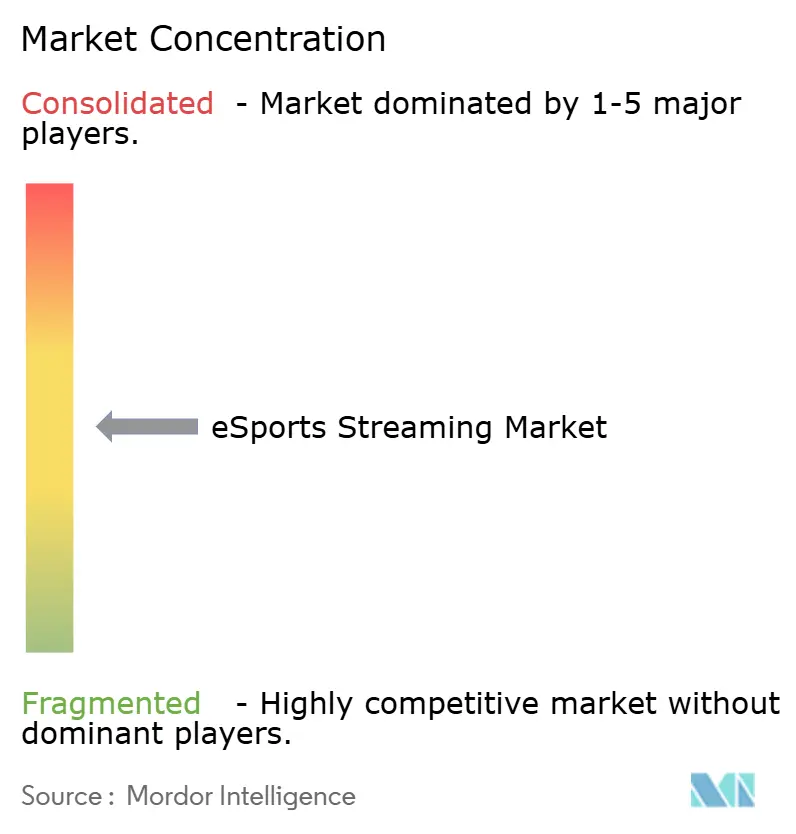
The eSports streaming market is moderately fragmented, with Amazon through Twitch, Alphabet through YouTube Gaming, and Tencent-linked assets forming the leading platform tier. Even so, the eSports streaming market is no longer defined solely by platform exclusivity, as publishers and organizers now prefer to distribute content across multiple viewing destinations. Riot Games and Kick expanded that approach in 2026 by bringing League of Legends, VALORANT, and Teamfight Tactics esports content to the platform for audiences across Europe, the Middle East, and South America. ESL FACEIT Group also signed a long-term global partnership with Kick in April 2026, making Kick the exclusive English-language home of the ESL Challenger League and a distributor for major Counter-Strike and Dota 2 events.[4]ESL FACEIT Group, “ESL FACEIT Group and KICK Announce Strategic Global Partnership to Accelerate Esports Growth and Audience Expansion,” ESL FACEIT Group, eslfaceitgroup.com These moves show that the eSports streaming market is becoming more open, regionalized, and reliant on flexible distribution arrangements.
Co-streaming has become one of the most important strategic levers in the eSports streaming market. GameSquare's Stream Hatchet report showed that co-streaming accounted for 52.9% of all esports hours watched in 2025, which means creator relationships now matter as much as official broadcast channels in many cases. That shift has helped newer platforms compete by offering creators stronger economics and more direct audience ownership. The eSports streaming market is therefore rewarding services that can combine official rights, creator access, and platform discovery in a single ecosystem. It also explains why creator payout structures have become an important part of the platform competition.
Monetization strategy is the other major battleground in the eSports streaming market. Amazon and the Esports World Cup Foundation created one of the broadest cross-platform esports partnerships in the sector by linking live broadcasts, video programming, voice integration, and podcast storytelling under a single event brand. Twitch then added a shoppable in-stream format with e.l.f. Cosmetics, which gave the eSports streaming market an early model for converting viewer attention into direct purchases during live sessions. Platforms that can balance creator-led reach, premium event access, and new commerce tools are likely to build the most resilient positions as the eSports streaming market matures. The same pressure is raising the standard for smaller competitors, because they now need both distribution scale and commercial depth to remain relevant.
ESports Streaming Industry Leaders
Tencent Holdings Limited
Amazon.com, Inc.
Alphabet Inc.
Microsoft Corporation
Electronic Arts Inc.
- *Disclaimer: Major Players sorted in no particular order
ESports Streaming Market Companies Covered in this Report
- Tencent Holdings Limited
- Amazon.com, Inc.
- Alphabet Inc.
- Microsoft Corporation
- Sony Group Corporation
- Activision Blizzard, Inc.
- Electronic Arts Inc.
- Epic Games, Inc.
- Valve Corporation
- Riot Games, Inc.
- Huya Inc.
- DouYu International Holdings Limited
- Soop Co., Ltd.
- ESL FACEIT Group
- G2 Esports GmbH
- Fnatic Ltd.
- Cloud9 Esports, Inc.
- Team Liquid Enterprises B.V.
- 100 Thieves LLC
- Krafton, Inc.

Recent Industry Developments in ESports Streaming Market
- July 2026: The IEM Cologne Major 2026 became the most-watched Counter-Strike tournament in history, recording over 100 million hours watched and a peak concurrent viewership of 2.75 million, eclipsing all previous records for the title. The event was sold out at the LANXESS Arena in Cologne, with Team Falcons defeating FURIA 3-0 in the Grand Final to claim the USD 1.25 million prize, establishing the Cologne Major as the definitive benchmark for FPS esports viewership.
- July 2026: GameSquare's Stream Hatchet published its annual Esports Live Streaming Trends Report on July 8, 2026, revealing that 2.7 billion hours of esports tournament content were watched in 2025 across 1.9K tracked events, with co-streaming accounting for 52.9% of total esports hours, marking the first time co-streaming accounted for the majority of all esports viewership.
- July 2026: Nexon secured 40-year operational rights to develop and operate South Korea's largest esports arena, situated within the Jamsil Sports and MICE complex in Songpa-gu, Seoul. Groundbreaking is targeted within 2026 following government review, with completion expected by 2032. The facility will anchor South Korea's esports infrastructure and production capability for the next 4 decades.
- June 2026: Valorant Masters Bangkok 2026 shattered all previous Valorant esports records with 4.3 million peak concurrent viewers during the Grand Final between Sentinels and T1, a 52% increase over Masters 2025. Total hours watched reached 187 million, making it the most-watched tactical FPS esports event in the title's history.


Global ESports Streaming Market Report Scope
The eSports Streaming market comprises digital platforms and services that enable the live and on-demand streaming of esports tournaments, competitive gaming events, gameplay, and related interactive content over the internet. These platforms connect professional players, teams, tournament organizers, game publishers, and content creators with global audiences through real-time broadcasts and video-on-demand experiences. Revenue within the market is generated through advertising, subscriptions, donations, sponsorships, media rights, virtual gifting, and other platform monetization mechanisms associated with esports content consumption.
The eSports Streaming Market Report is Segmented by Streaming Platform (Twitch, YouTube Gaming, Facebook Gaming, Huya, DouYu, Kick, and Other Streaming Platforms), Device Type (Smartphones and Tablets, Smart TVs, Laptops and Desktops, Gaming Consoles, and Other Device Types), Game Genre (MOBA, First-Person Shooter, Battle Royale, Sports and Racing, Fighting, and Other Game Genres), and Geography (North America, Europe, Asia-Pacific, South America, Middle East, and Africa). The Market Forecasts are Provided in Terms of Value (USD).
| Twitch |
| YouTube Gaming |
| Facebook Gaming |
| Huya |
| DouYu |
| Kick |
| Other Streaming Platforms |
| Smartphones and Tablets |
| Smart TVs |
| Laptops and Desktops |
| Gaming Consoles |
| Other Device Types |
| MOBA |
| First-Person Shooter |
| Battle Royale |
| Sports and Racing |
| Fighting |
| Other Game Genres |
| North America | United States |
| Canada | |
| Mexico | |
| South America | Brazil |
| Argentina | |
| Chile | |
| Rest of South America | |
| Europe | Germany |
| United Kingdom | |
| France | |
| Italy | |
| Spain | |
| Rest of Europe | |
| Asia-Pacific | China |
| Japan | |
| India | |
| South Korea | |
| Australia | |
| Rest of Asia-Pacific | |
| Middle East | Saudi Arabia |
| United Arab Emirates | |
| Qatar | |
| Rest of Middle East | |
| Africa | South Africa |
| Egypt | |
| Nigeria | |
| Rest of Africa |
| By Streaming Platform | Twitch | |
| YouTube Gaming | ||
| Facebook Gaming | ||
| Huya | ||
| DouYu | ||
| Kick | ||
| Other Streaming Platforms | ||
| By Device Type | Smartphones and Tablets | |
| Smart TVs | ||
| Laptops and Desktops | ||
| Gaming Consoles | ||
| Other Device Types | ||
| By Game Genre | MOBA | |
| First-Person Shooter | ||
| Battle Royale | ||
| Sports and Racing | ||
| Fighting | ||
| Other Game Genres | ||
| By Geography | North America | United States |
| Canada | ||
| Mexico | ||
| South America | Brazil | |
| Argentina | ||
| Chile | ||
| Rest of South America | ||
| Europe | Germany | |
| United Kingdom | ||
| France | ||
| Italy | ||
| Spain | ||
| Rest of Europe | ||
| Asia-Pacific | China | |
| Japan | ||
| India | ||
| South Korea | ||
| Australia | ||
| Rest of Asia-Pacific | ||
| Middle East | Saudi Arabia | |
| United Arab Emirates | ||
| Qatar | ||
| Rest of Middle East | ||
| Africa | South Africa | |
| Egypt | ||
| Nigeria | ||
| Rest of Africa | ||


Key Questions Answered in the Report
What is the current and forecast value of the eSports streaming space?
The eSports streaming market was valued at USD 1.89 billion in 2025, stands at USD 2.29 billion in 2026, and is projected to reach USD 5.24 billion by 2031 at a 17.97% CAGR.
Which streaming platform currently leads global esports viewing value?
Twitch led in 2025 with 39.14% share, although competitive pressure has increased as Kick and YouTube Gaming gained traction.
Which device category drives the largest share of viewing value?
Smartphones and tablets held 51.62% of 2025 value, reflecting strong mobile-first viewing behavior across major growth regions.
Which game genre is growing the fastest through 2031?
First-person shooters are projected to expand at an 18.73% CAGR through 2031, supported by record tournament audiences for Counter-Strike and VALORANT.
Which region is expanding the fastest over the forecast period?
North America is forecast to grow at a 19.38% CAGR through 2031, helped by stronger media rights monetization, creator economics, and commerce-based viewing formats.
What is the biggest structural challenge for platforms and event operators?
Fragmented publisher control remains the deepest constraint, because access to broadcasts, co-streams, and tournament content depends on title-by-title licensing approval.
Page last updated on:





