
Electronic Load Market Size and Share
Market Overview
| Study Period | 2021 - 2031 |
|---|---|
| Market Size (2026) | USD 4.48 Billion |
| Market Size (2031) | USD 6.06 Billion |
| Growth Rate (2026 - 2031) | 6.23 % |
| Fastest Growing Market | Asia-Pacific |
| Largest Market | North America |
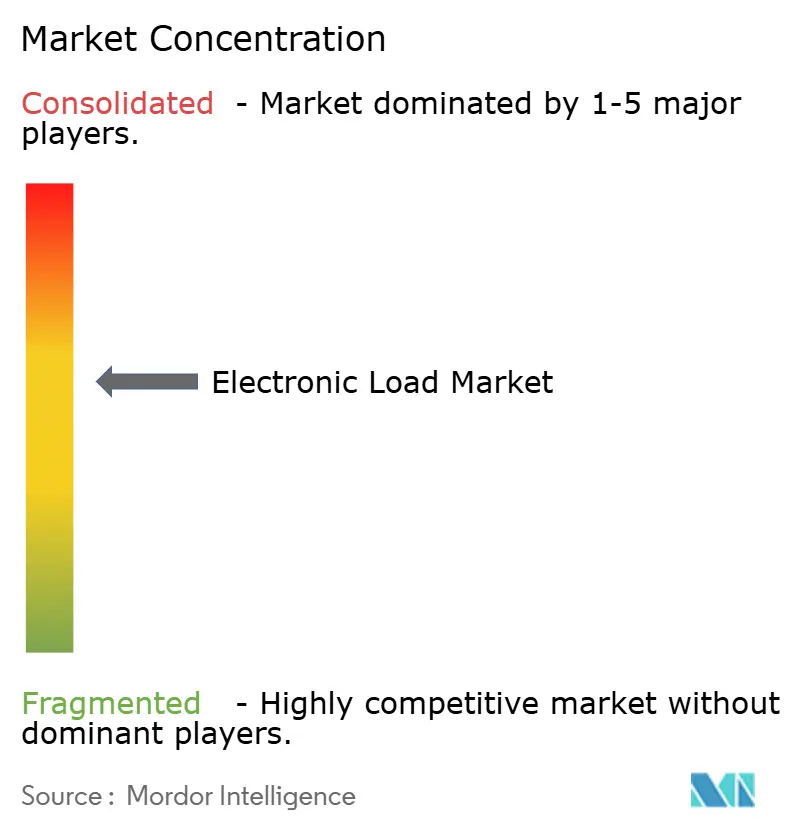
| Market Concentration | Medium |
Major Players *Disclaimer: Major Players sorted in no particular order Image © Mordor Intelligence. Reuse requires attribution under CC BY 4.0. | |
Electronic Load Market Analysis by Mordor Intelligence
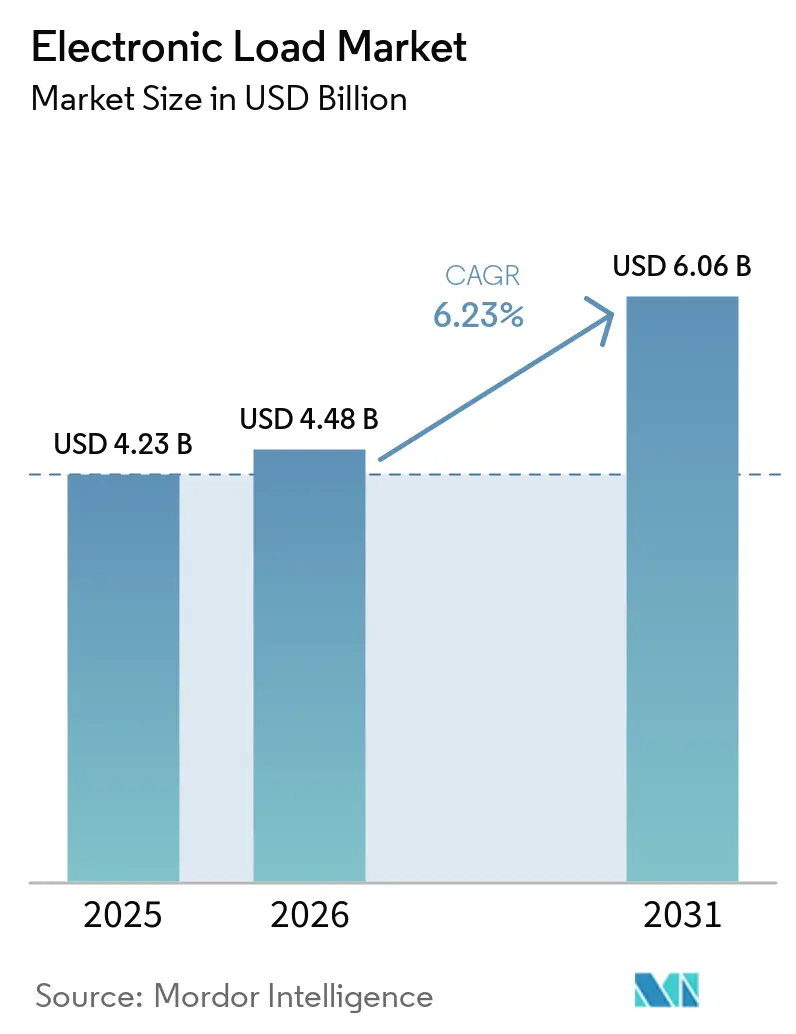
The electronic load market size is expected to grow from USD 4.23 billion in 2025 to USD 4.48 billion in 2026 and reach USD 6.06 billion by 2031, at a CAGR of 6.23% during the forecast period (2026-2031). Concurrent investments in electric vehicle powertrains, grid-scale battery storage, and high-voltage direct-current (HVDC) data center infrastructure are shaping the market, as these applications require larger and more capable validation systems. These applications are advancing simultaneously, expanding procurement across automotive, utility, and hyperscale data center budgets while reducing reliance on a single end-use category or test-equipment procurement cycle. Validation requirements increasingly demand higher voltages, faster current response, greater power ranges, automated operation, and repeatable test sequences that support both development and production environments without requiring manual setup changes between test cycles. Compliance requirements for energy storage and military power systems also increase the testing required for each program, even when equipment spending slows or project approval timelines lengthen, as testing remains essential before final qualification. Vendors that offer high power density, regenerative operation, software-controlled testing, and reliable calibration support are better positioned to meet these broader technical and operational requirements across laboratories, manufacturing sites, and specialized qualification facilities.
Key Report Takeaways
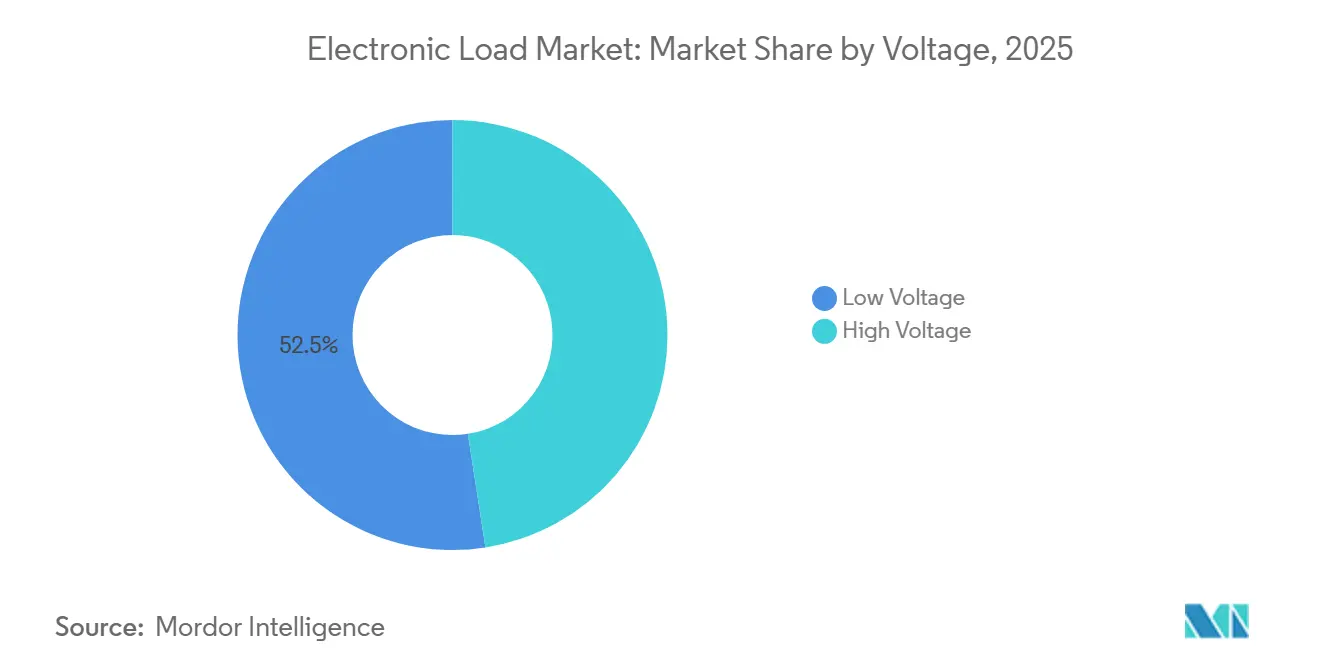
- By voltage, low-voltage loads held 52.45% of the electronic load market share in 2025, while high-voltage loads are forecast to grow at a 7.13% CAGR through 2031.
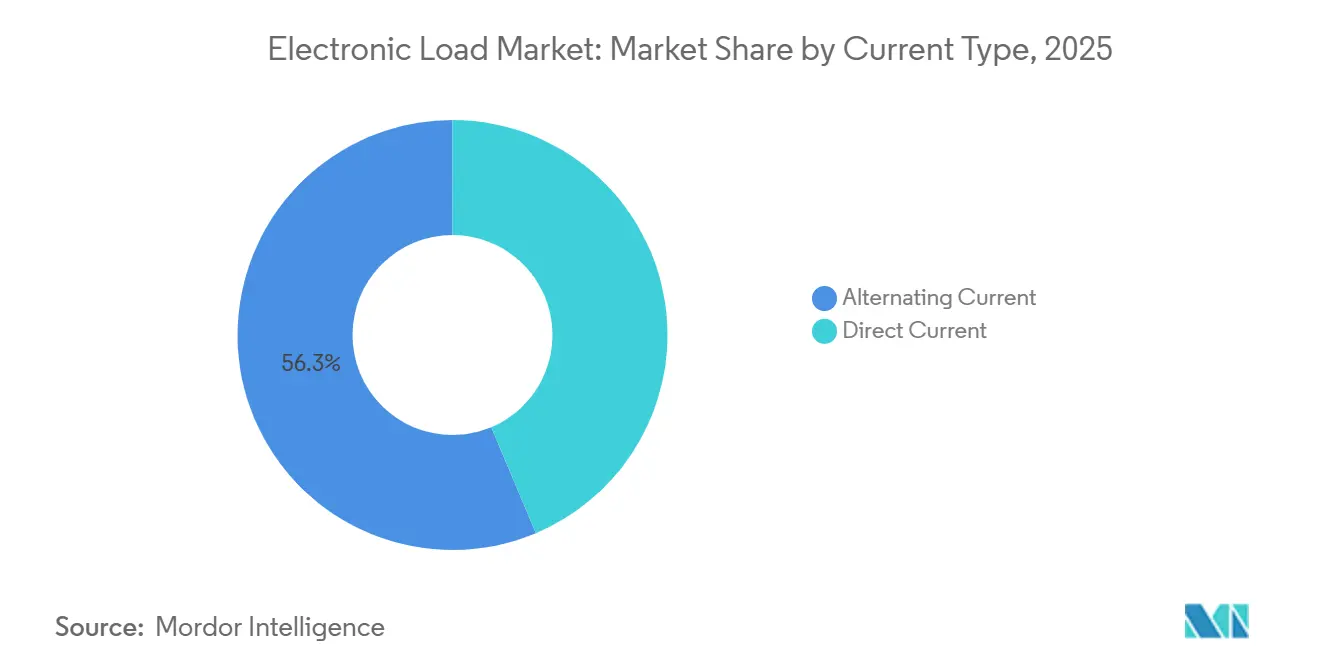
- By current type, direct current loads held 56.34% of the electronic load market share in 2025 and are projected to grow at a 7.32% CAGR through 2031.
- By application, wireless communications and infrastructure held 31.28% of revenue in 2025, while energy is forecast to expand at a 7.67% CAGR through 2031.
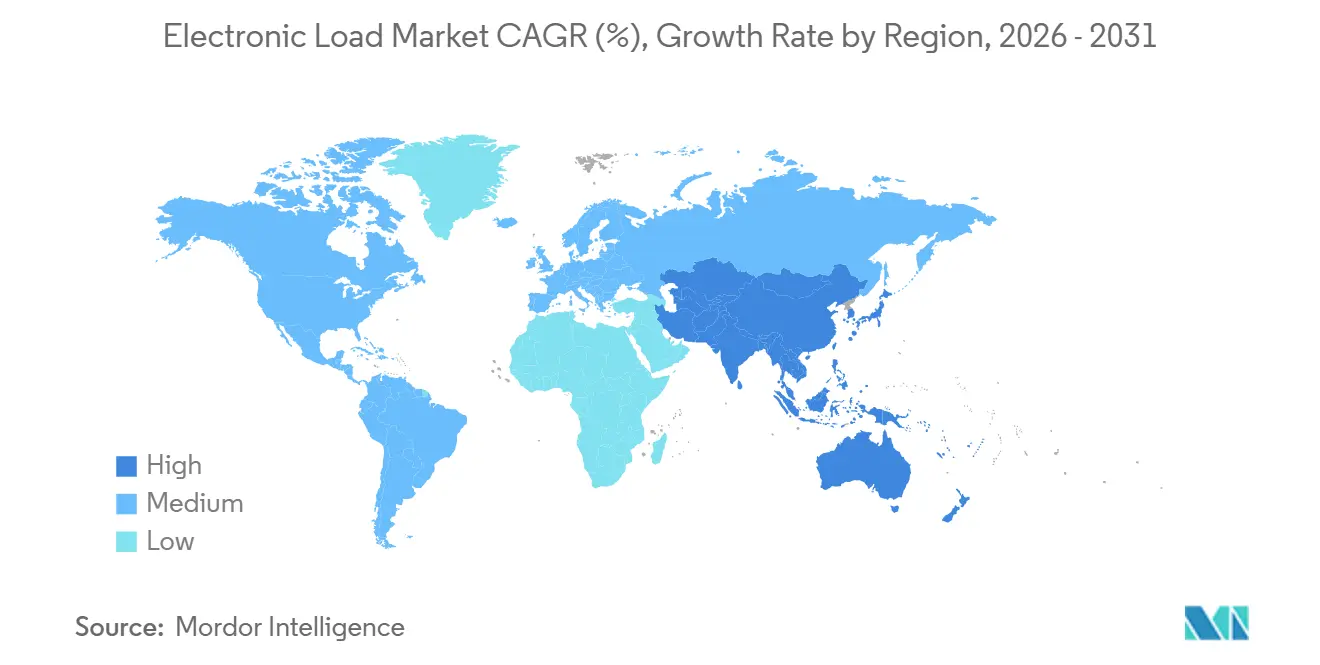
- By geography, North America held 30.68% of revenue in 2025, while Asia-Pacific is forecast to expand at a 7.11% CAGR through 2031.
Note: Market size and forecast figures in this report are generated using Mordor Intelligence’s proprietary estimation framework, updated with the latest available data and insights as of January 2026.
Market Trends and Insights
Drivers Impact Analysis of Electronic Load Market*
| Driver | (~) % Impact on CAGR Forecast | Geographic Relevance | Impact Timeline |
|---|---|---|---|
| Electric Vehicle and Battery Validation Demand | +1.9% | Global, core in Asia-Pacific, North America, and Europe | Medium term (2-4 years) |
| Renewable Energy and Grid-Storage Testing | +1.3% | Global, strongest in Europe, China, and North America | Long term (≥ 4 years) |
| Automated High-Power Test Adoption | +0.9% | Global, with North America and Asia-Pacific leading | Medium term (2-4 years) |
| Aerospace and Defense Power-Electronics Qualification | +0.7% | North America and Europe, with spillover to Asia-Pacific | Long term (≥ 4 years) |
| AI Data-Center HVDC Validation | +1.2% | Global, core in North America and Asia-Pacific | Short term (≤ 2 years) |
| Source: Mordor Intelligence | |||
Electric Vehicle and Battery Validation Demand
Electric vehicle powertrain electrification has made battery pack testing a major application for high-power DC electronic loads in development laboratories and production validation environments. Original equipment manufacturers and Tier 1 suppliers must validate cells, modules, and complete battery packs against discharge profiles, overcurrent protection thresholds, and dynamic loads that replicate driving cycles. These tests require programmable loads that operate at 150–1,200 V DC and deliver millisecond-level current slew responses during repeated test sequences. The transition from 400 V to 800 V battery architectures has rendered many 600 V-rated test benches inadequate, prompting equipment replacement decisions among laboratories with established installed systems. The electronic load market benefits as higher-voltage programs require equipment capable of replicating demanding discharge conditions, protection events, and dynamic current profiles.
Renewable Energy and Grid-Storage Testing
Utility-scale wind and solar projects incorporating battery energy storage systems require pre-commissioning validation of inverters, power conversion systems, and grid-forming controls before connecting assets to operational networks. Electronic loads and power hardware-in-the-loop systems simulate the load profiles required for this validation in controlled testing environments. In 2025, Fraunhofer ISE developed a standardized test procedure for grid-forming inverters under the GFM Benchmark project for four German transmission system operators. Informed by VDE FNN standards, the procedure requires test environments to replicate grid frequency and voltage disturbances. In 2025, the Energy Systems Integration Group (ESIG)[1]Energy Systems Integration Group, “Testing the Performance of Grid-Forming Resources,” Energy Systems Integration Group, esig.energy also established quantitative performance metrics for testing grid-forming resources. Therefore, the electronic load market benefits from both the increasing deployment of energy storage systems and the introduction of more formal performance requirements for grid-connected systems.
Automated High-Power Test Adoption
The transition from manual bench testing to automated high-power systems reduces the time required to complete validation programs and enables more repeatable test procedures. These systems support long-duration battery cycling, state-of-charge emulation, and transient replication in a software-controlled environment. Automated power suites integrate these functions into a controlled software process that customers can consistently repeat across detailed validation sequences. Regenerative loads return absorbed energy to the grid rather than dissipating it as heat, thereby reducing operating costs for high-power laboratories. This capability makes continuous battery cycling more practical, as conventional resistive load banks result in higher energy expenses and greater thermal management requirements. The electronic load market benefits from the replacement of older resistive equipment with programmable regenerative systems that can integrate with test software.
Aerospace and Defense Power-Electronics Qualification
Aerospace and defense programs require power electronics to meet qualification standards that exceed those of many commercial applications. Test systems must replicate transient faults, variable-frequency (“wild-frequency”) alternating-current buses ranging from 360 Hz to 800 Hz, and sustained thermal conditions. NASA plans to conduct high-voltage direct-current power-quality verification at a nominal 630 V DC in 2025 to support future electric propulsion initiatives. ISO 24065 establishes general performance requirements for high-power solid-state power controllers used in aircraft primary distribution systems [2]International Organization for Standardization, “ISO 24065:2023 Aerospace, High-Power Solid-State Power Controller, General Performance Requirements,” International Organization for Standardization, iso.org . Keysight identifies regenerative electronic loads as tools for emulating solar-array inputs, battery handovers, and changing payload demand during satellite qualification. Applications requiring controlled load-based verification across broad power and frequency ranges provide the electronic load market with a durable source of demand.
Restraints Impact Analysis of Electronic Load Market*
| Restraint | (~) % Impact on CAGR Forecast | Geographic Relevance | Impact Timeline |
|---|---|---|---|
| High System and Integration Costs | -0.6% | Global, most acute in South America and Middle East and Africa | Long term (≥ 4 years) |
| Calibration and Skilled-Operator Burden | -0.4% | Global, with the greatest effect in emerging markets | Medium term (2-4 years) |
| Silicon-Carbide and High-Current Thermal Bottlenecks | -0.3% | Global, particularly in high-power segments | Medium term (2-4 years) |
| Source: Mordor Intelligence | |||
High System and Integration Costs
Megawatt-scale automotive and battery storage validation systems require more than electronic load hardware. They also require cooling loops, high-current direct current cabling, load-frame integration, facility preparation, and automation software licenses. These requirements can increase the landed cost of load hardware by up to three times. This cost burden is particularly significant for mid-tier test laboratories and Tier 2 automotive suppliers, which cannot distribute these expenses across large validation volumes. In addition, sites that acquired 600 V load banks before the transition to 800 V platforms may operate equipment that cannot be economically upgraded or repurposed for advanced programs. Consequently, the electronic load market may experience longer procurement cycles, as regulated customers must assess infrastructure costs and extended capital payback periods.
Calibration and Skilled-Operator Burden
Programmable electronic loads with waveform generation, multi-channel synchronization, and sub-millisecond dynamic response require more specialized calibration and operation than conventional benchtop instruments. Test organizations require engineers who can configure and maintain high-power systems, interpret test requirements, and operate automated test software. Limited availability of these skills can delay installations outside established test-and-measurement centers. In February 2026, AMETEK Programmable Power appointed Transcat as its exclusive United States distributor, certified calibration partner, and rental provider. This arrangement highlights that access to calibration services can be as important as equipment availability in supporting customer adoption and continued system use. The electronic load market also faces greater operational complexity as AI data center testing requires dynamic profiles that meet OCP ORV3-related qualification requirements.
*Our forecasts treat driver/restraint impacts as directional, not additive. The impact forecasts reflect baseline growth, mix effects, and variable interactions.
Electronic Load Market Segment Analysis
By Voltage:
High-Voltage Loads Gain Share as 800 V Platforms ScaleHigh-voltage loads are projected to grow at a CAGR of 7.13% during 2026-2031, representing the fastest growth rate within the voltage segmentation. Low-voltage loads accounted for 52.45% of revenue in 2025, providing the largest revenue base in this segment. The electronic load market for low-voltage loads is supported by wireless telecommunications testing, consumer electronics production lines, and 48 V mild-hybrid automotive subsystems. These applications benefit from a broad installed base and shorter replacement cycles. This installed base provides a stable revenue foundation even as demand for higher-voltage equipment accelerates.
The voltage threshold distinguishing low- and high-voltage systems is evolving as testing requirements increase. Equipment previously classified as high voltage at 400 V now falls closer to the mid-range for AI rack systems and vehicle programs transitioning to 800 V architectures. Higher-voltage vehicle and data center systems require load equipment capable of supporting higher direct current bus voltages at the test interface. This transition reduces the relevance of entry-level high-voltage equipment for advanced applications while expanding the premium category for systems that can validate 800 V platforms and higher-voltage direct current power rails.



By Current Type:
DC Dominance Reflects the Structural Shift from AC DistributionDirect current (DC) loads accounted for 56.34% of revenue in 2025 and are projected to grow at a CAGR of 7.32% through 2031. Their leading position reflects the increasing adoption of DC architectures in data centers, electric vehicles, and grid-connected energy storage systems. Alternating current (AC) loads remain essential for aviation power testing, industrial drive validation, and renewable energy inverter characterization. These applications provide a stable demand base for AC equipment, although growth remains slower than for DC loads. DC systems also drive demand for regenerative load technology, as sustained multi-megawatt testing would otherwise generate significant heat and operating costs.
Tektronix indicates that 800 V DC data center subsystems require dynamic, regenerative electronic loads that replicate rack-level power behavior while recovering energy. Standards for DC microgrids and electric vehicle charging continue to expand test coverage requirements, creating compliance-driven demand for DC load equipment. Fuel-cell validation for hydrogen mobility programs in Europe and Asia also relies on DC output and requires controlled current profiles. Consequently, the electronic load industry serves a broad range of DC applications that require both precision and energy recovery.
By Application:
Energy Segment Acceleration Outpaces Established VerticalsWireless communications and infrastructure are projected to account for 31.28% of revenue in 2025, remaining the largest application area. The energy segment is forecast to register a CAGR of 7.67% through 2031, the highest among application categories. The electronic load market for energy applications is expanding as grid-scale battery storage systems require pre-commissioning validation. Continued 5G network densification sustains power supply testing requirements for each base station deployment. Automotive testing is also generating replacement demand, as 800 V vehicle platforms make earlier test benches less suitable.
Aerospace, defense, and government services require loads that simulate complex mission power profiles in compliance with RTCA/DO-160 and MIL-STD-704 requirements. Keysight notes that programmable electronic loads can serve as battery pack emulators for fault-injection and protection testing, reducing the need to use physical batteries in hazardous overcurrent scenarios. Electronics manufacturing remains linked to semiconductor and consumer electronics production volumes, creating a broad demand base for benchtop and medium-power equipment. The others category includes medical devices, maritime systems, and railway traction, where equipment is often configured to meet application-specific requirements, such as IEC 60601 and EN 50155.
Geography Analysis
North America Electronic Load Market
North America is projected to account for 30.68% of revenue in 2025, making it the largest regional contributor. The region benefits from a dense customer base of defense prime contractors, hyperscale data center operators, and semiconductor original equipment manufacturer (OEM) testing facilities. US requirements for military power systems, data center power delivery, and electric vehicle charging create a compliance-driven procurement base. Aerospace and defense programs that require specialized power electronics qualification further support the North American electronic load market.
Europe Electronic Load Market
Europe is projected to be the second-largest regional market in 2025. Germany’s automotive sector demonstrates how electronic load systems have evolved into purpose-built production assets rather than solely instrument-grade tools. Smart Testsolutions and Valeo developed a modular load box that can simulate up to 150 loads in a single setup for electromagnetic compatibility (EMC) zone-controller validation. The Nordic countries and the United Kingdom further contribute to demand through offshore wind battery storage commissioning programs that use power hardware-in-the-loop testing.
APAC, South America and MEA Electronic Load Market
Asia-Pacific is forecast to grow at a CAGR of 7.11% during 2026–2031, the fastest rate among all regions. China is increasing procurement of high-voltage direct current (HVDC) loads, driven by electric vehicle production, battery storage deployment, and renewable power additions. Japan serves as both a consumer and supplier of high-accuracy equipment, with Kikusui Electronics and Matsusada Precision supporting domestic automotive and industrial electronics validation. India is generating additional demand through electric vehicle component manufacturing under the Production Linked Incentive scheme and its semiconductor fabrication ambitions. South America and the Middle East and Africa remain smaller but emerging markets. Brazil’s renewable energy and storage assets, along with Saudi Arabia’s data center and electric vehicle charging plans, are creating initial demand. Although these regions face greater system integration and calibration barriers, demand is expected to strengthen as local electric vehicle and renewable energy programs advance.

Competitive Landscape
The electronic load market is moderately concentrated, with Keysight Technologies, Chroma ATE, ITECH Electronic, and Kikusui Electronics holding leading positions. Their product portfolios cover multiple voltage ranges, dynamic response requirements, and software integration capabilities. Larger test and measurement companies are expanding their power electronics capabilities through acquisitions. Rohde & Schwarz plans to acquire ZES ZIMMER Electronic Systems GmbH in July 2025 to expand its power measurement portfolio for electromobility and renewable energy applications. The transaction is expected to add more than 40 years of high-precision power measurement expertise to its test and measurement division.
Anritsu is expected to approve the acquisition of DEWETRON GmbH in April 2025. The company identifies opportunities to combine DEWETRON’s high-speed power measurement technology with TAKASAGO charge and discharge test equipment for electric vehicles, solar, wind, and industrial applications. Teradyne and Infineon are also expected to announce a partnership in January 2025, including Teradyne’s acquisition of a portion of Infineon’s automated test equipment team in Regensburg. The collaboration will focus on silicon carbide and gallium nitride power semiconductor qualification.
Competition centers on power density, regenerative energy recovery, and software-defined automation. In 2025, Chroma plans to upgrade models in its 63224A series with peak power capabilities of up to 200% of the rated load for 100 milliseconds. AMETEK Programmable Power’s arrangement with Transcat expands distribution, calibration, and rental access for customers in the aerospace, automotive, semiconductor, data center, and renewable energy industries. Patent activity related to regenerative load circuits and real-time dynamic profiling is increasing across the competitive landscape. As hardware performance converges, software capabilities and calibration access may play a greater role in customer purchasing decisions.
Electronic Load Industry Leaders
Keysight Technologies
Chroma ATE Inc.
ITECH ELECTRONIC CO.,LTD.
AMETEK Programmable Power Inc.
TEKTRONIX, INC.
- *Disclaimer: Major Players sorted in no particular order
Electronic Load Market Companies Covered in this Report
- Ainuo Instrument Co., Ltd.
- AMETEK Programmable Power Inc.
- B&K Precision Corporation
- Chroma ATE Inc.
- Good Will Instrument Co., Ltd.
- ITECH ELECTRONIC CO.,LTD.
- Keysight Technologies
- KIKUSUI ELECTRONICS CORP.
- Magna-Power Electronics, Inc.
- MATSUSADA PRECISION Inc.
- NF Corporation
- NH Research, Inc.
- RIGOL TECHNOLOGIES CO., LTD.
- SIGLENT TECHNOLOGIES
- TEKTRONIX, INC.

Recent Industry Developments in Electronic Load Market
- February 2026: AMETEK Programmable Power appointed Transcat, Inc. as its exclusive United States distributor, certified calibration partner, and rental provider for its programmable power and electronic load portfolio under the Sorensen, Elgar, and California Instruments brands, covering aerospace, automotive, semiconductor, data-center, and renewable-energy markets across the United States and South America.
- July 2025: Rohde & Schwarz acquired ZES ZIMMER Electronic Systems GmbH, adding over 40 years of high-precision power-measurement capability across electromobility, industrial electronics, and renewable energy to its T&M portfolio; ZES ZIMMER's Oberursel, Hesse facility was retained and fully integrated into the Rohde & Schwarz Test & Measurement Division.


Global Electronic Load Market Report Scope
An electrical load is any component, device, or circuit part that consumes electrical power and changes it into another form of energy, such as light, heat, or motion. It is the part of a circuit that receives power from a source like a battery or generator.
The electronic load market is segmented by voltage, current type, application, and geography. By voltage, the market is segmented into low voltage and high voltage. By current type, the market is segmented into alternating current and direct current. By application, the market is segmented into aerospace, defense and government services, automotive, energy, wireless communications and infrastructure, electronics manufacturing, and others. By geography, the market is segmented into Asia Pacific, North America, Europe, South America, and Middle East, and Africa. The report also covers the aluminum fluoride market size and forecasts for the aluminum fluoride market in 16 countries across major regions. For each segment, the market sizing and forecasts have been done on the basis of value (USD).
| Low Voltage |
| High Voltage |
| Alternating Current |
| Direct Current |
| Aerospace, Defense and Government Services |
| Automotive |
| Energy |
| Wireless Communications and Infrastructure |
| Electronics Manufacturing |
| Others |
| Asia-Pacific | China |
| India | |
| Japan | |
| South Korea | |
| ASEAN Countries | |
| Rest of Asia-Pacific | |
| North America | United States |
| Canada | |
| Mexico | |
| Europe | Germany |
| United Kingdom | |
| France | |
| Italy | |
| NORDIC Countries | |
| Rest of Europe | |
| South America | Brazil |
| Argentina | |
| Rest of South America | |
| Middle-East and Africa | Saudi Arabia |
| South Africa | |
| Rest of Middle-East and Africa |
| By Voltage | Low Voltage | |
| High Voltage | ||
| By Current Type | Alternating Current | |
| Direct Current | ||
| By Application | Aerospace, Defense and Government Services | |
| Automotive | ||
| Energy | ||
| Wireless Communications and Infrastructure | ||
| Electronics Manufacturing | ||
| Others | ||
| By Geography | Asia-Pacific | China |
| India | ||
| Japan | ||
| South Korea | ||
| ASEAN Countries | ||
| Rest of Asia-Pacific | ||
| North America | United States | |
| Canada | ||
| Mexico | ||
| Europe | Germany | |
| United Kingdom | ||
| France | ||
| Italy | ||
| NORDIC Countries | ||
| Rest of Europe | ||
| South America | Brazil | |
| Argentina | ||
| Rest of South America | ||
| Middle-East and Africa | Saudi Arabia | |
| South Africa | ||
| Rest of Middle-East and Africa | ||


Key Questions Answered in the Report
How large is the electronic load market in 2026?
The electronic load market was USD 4.48 billion in 2026 and is forecast to reach USD 6.06 billion by 2031 at a 6.23% CAGR. The overall value is increasing as several high-power validation uses advance at the same time across major customer groups in automotive, energy storage, aerospace, and data-center applications.
Which voltage category is expanding fastest?
High-voltage loads are forecast to grow at a 7.13% CAGR through 2031 as 800 V electric vehicle platforms and high-voltage direct current data-center systems expand. The electronic load market needs higher-voltage equipment because earlier test benches may not cover current system requirements.
Which application is forecast to grow fastest?
The energy application segment is forecast to grow at a 7.67% CAGR through 2031 because battery energy storage systems need validation before commissioning. The electronic load market serves this work by simulating load profiles for inverters, power conversion systems, and grid-forming controls.
Which region is expanding fastest?
Asia-Pacific is forecast to grow at a 7.11% CAGR through 2031, supported by electric vehicle adoption, 5G infrastructure, and electronics manufacturing growth. China, Japan, and India contribute demand from automotive power, energy storage, and industrial electronics validation programs, where higher voltage and automated testing needs are becoming more common across the region’s technical manufacturing base and supplier ecosystem.
Page last updated on:





