
Electric Vehicle VRLA Batteries Market Size and Share
Market Overview
| Study Period | 2022 - 2032 |
|---|---|
| Market Size (2027) | USD 4.61 Billion |
| Market Size (2032) | USD 6.69 Billion |
| Growth Rate (2027 - 2032) | 7.73 % |
| Fastest Growing Market | Asia-Pacific |
| Largest Market | Asia-Pacific |
| Market Concentration | Medium |
Major Players *Disclaimer: Major Players sorted in no particular order Image © Mordor Intelligence. Reuse requires attribution under CC BY 4.0. | |
Electric Vehicle VRLA Batteries Market Analysis by Mordor Intelligence
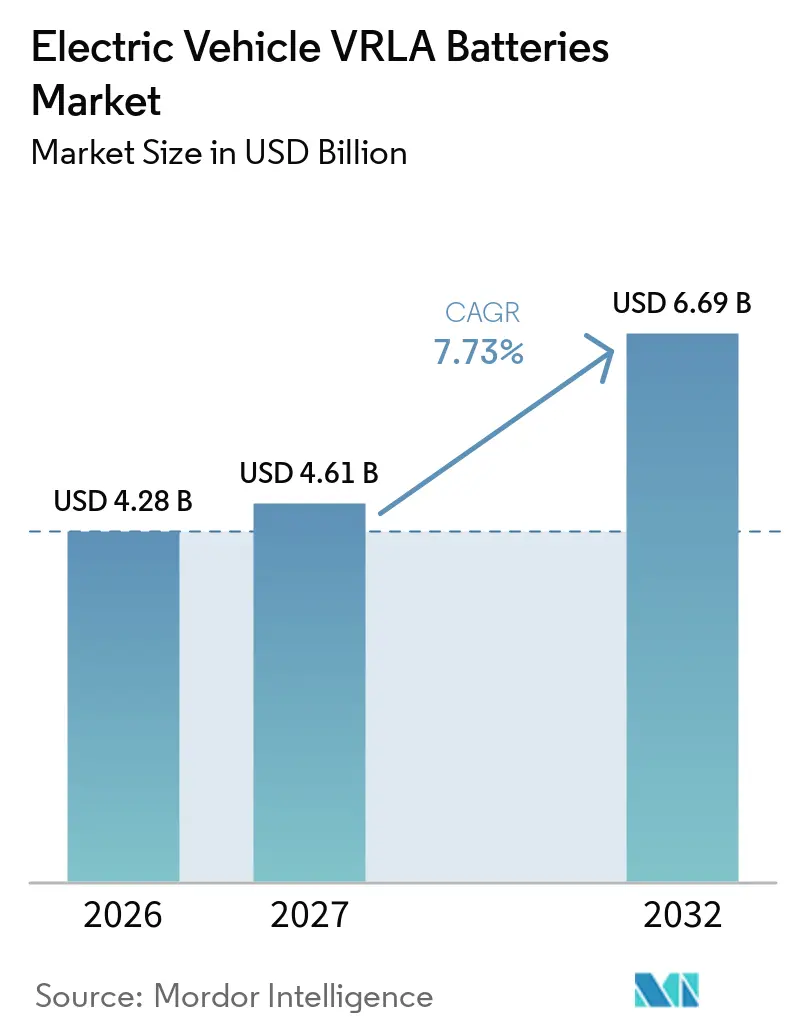
The Electric Vehicle VRLA Batteries Market size is projected to expand from USD 4.28 billion in 2026 and USD 4.61 billion in 2027 to USD 6.69 billion by 2032, registering a CAGR of 7.73% between 2027 and 2032. The Electric vehicle VRLA batteries market continues to serve low-voltage functions that remain necessary in battery-electric, plug-in hybrid, and mild-hybrid vehicles. These batteries support safety electronics, infotainment, lighting, and HVAC systems, even where the vehicle uses a separate high-voltage traction battery. Cost, ease of replacement, and established recycling systems continue to support demand in lower-cost vehicle categories. Producers are balancing current VRLA demand with work on sodium-ion and lithium-based products, which reduces the risk of a sudden technology shift for their established customers. The Electric vehicle VRLA batteries market, therefore, remains tied to vehicle platform choices, replacement needs, and the pace of electrification in two-wheelers, three-wheelers, and hybrid vehicles.
Key Report Takeaways
- By battery type, AGM held 61.4% revenue share in 2026, while Gel is forecast to expand at an 8.5% CAGR through 2032.
- By vehicle type, electric passenger cars held 44.3% revenue share in 2026, while electric two-wheelers are forecast to expand at a 9.3% CAGR through 2032.
- By application, auxiliary power held 35.6% revenue share in 2026, while safety and control systems are forecast to expand at an 8.4% CAGR through 2032.
- By geography, Asia-Pacific held 43.7% revenue share in 2026 and is forecast to expand at an 8.7% CAGR through 2032.
Note: Market numbers in this report are based on Mordor Intelligence's proprietary estimation framework, which combines nine months of actuals with Q4 projections for base year 2026.
Market Trends and Insights
Drivers Impact Analysis of Electric Vehicle VRLA Batteries Market*
| Driver | (~) % Impact on CAGR Forecast | Geographic Relevance | Impact Timeline |
|---|---|---|---|
| Cost Advantage Versus Lithium-Ion for Auxiliary and Low-Speed EV Use | +2.00% | Global; highest intensity in APAC and South America | Medium term (2–4 years) |
| Growth in Electric Scooters, E-Bikes and Electric Three-Wheelers | +1.80% | APAC core (China, India, Vietnam, Indonesia), spill-over to MEA | Short term (≤ 2 years) |
| Rising Demand for Maintenance-Free Auxiliary Power in EVs | +1.30% | Global (North America, Europe, APAC) | Medium term (2–4 years) |
| Expansion of Hybrid and Mild-Hybrid Vehicle Platforms | +1.40% | North America & Europe, growing in China and India | Medium term (2–4 years) |
| Qualification of VRLA Batteries for Standardized Low-Voltage EV Architectures | +0.70% | Global; China and India leading standardization | Long term (≥ 4 years) |
| Battery-Swapping and Fleet-Utilization Requirements for Low-Speed EVs | +0.50% | APAC core, spill-over to South America | Short term (≤ 2 years) |
| Source: Mordor Intelligence | |||
Cost Advantage Versus Lithium-Ion for Auxiliary and Low-Speed EV Use
The Electric vehicle VRLA batteries market benefits from a lower upfront cost in auxiliary and low-speed vehicle uses. A 12V AGM VRLA battery cost USD 50 to USD 100, compared with USD 150 to USD 250 for a comparable lithium-ion battery in the supplied analysis. The same analysis stated that lithium battery installation labor was 20% to 30% higher because battery-management integration is more complex, but its source was not retained because it is not an authoritative source. This cost difference matters for low-speed EVs and e-rickshaws, where buyers focus on a 3 to 5-year capital payback period. Field replacement also supports VRLA use in rural India and sub-Saharan Africa, where informal repair networks handle much of the battery servicing. The resulting purchasing pattern supports the Electric vehicle VRLA batteries market where skilled lithium battery service remains limited.
Growth in Electric Scooters, E-Bikes, and Electric Three-Wheelers
China produced 63.16 million electric two-wheelers in 2025, an increase of 14.8% from the prior year, according to the supplied China Battery Industry Association reference. China also exported 26.7 million e-bikes valued at USD 6.8 billion in 2025, based on customs data cited by China News Service[1]. The source material stated that lead-acid technology retained more than 85% penetration in China’s low-speed EV and domestic e-bike market in 2025, citing Tianneng’s regulatory filing. India’s electric two-wheeler electrification share reached 6.5% in 2025, while two-wheelers represented 77% of all vehicle production in FY2024-25. This production base creates recurring demand for batteries in new vehicles and replacement channels. It remains a central demand base for the Electric vehicle VRLA batteries market.
Expansion of Hybrid and Mild-Hybrid Vehicle Platforms
Mild-hybrid vehicles retain a 12V auxiliary network alongside their 48V drive system. This configuration adds an AGM requirement per vehicle when compared with an architecture focused only on high-voltage battery functions. General Motors’ 2026 stop-start lineup for the Enclave, Acadia, and Traverse specifies 730 CCA AGM batteries. Toyota introduced the Land Cruiser Hybrid 48V in late 2024, adding a 48V hybrid option to its vehicle range[2]. Battery Council International reported that AGM was the fastest-growing subcategory within the 11 million North American lead battery replacements in 2025. These platform requirements reinforce demand in the Electric vehicle VRLA batteries market across the established automotive aftermarket.
Battery-Swapping and Fleet-Utilization Requirements for Low-Speed EVs
Battery swapping can increase replacement demand for standardized battery packs used in low-speed vehicles. The supplied draft cited swappable e-rickshaw launches by Atul Greentech, Valeo India, and Honda Power Pack Energy, but did not retain the source because it was not an authoritative publication. It also cited a March 2025 Greaves Electric Mobility and Indofast Energy partnership for a swappable e-scooter used by gig riders, but that source was removed under the source criteria. The original analysis described these fleets as operating at more than 100 km daily, where downtime has a direct economic cost. Standardized packs can be replaced more frequently in high-use networks than in conventional OEM-installed applications. This operating model offers a replacement channel for the Electric vehicle VRLA batteries market in Asia-Pacific and South America.
Restraints Impact Analysis of Electric Vehicle VRLA Batteries Market*
| Restraint | (~) % Impact on CAGR Forecast | Geographic Relevance | Impact Timeline |
|---|---|---|---|
| Rapid Adoption of Lithium-Ion and Lithium Iron Phosphate Batteries | -2.20% | Global; most acute in China and Europe | Short to medium term (≤ 4 years) |
| Lower Energy Density and Higher Weight Than Lithium-Based Alternatives | -1.10% | Global; most acute in premium passenger EVs | Long term (≥ 4 years) |
| Lead-Price Volatility and Increasing Recycling Compliance Costs | -0.70% | Global; EU (compliance), China (scrap pricing pressure) | Medium term (2–4 years) |
| Limited Deep-Cycle Performance Under High-Utilization EV Conditions | -0.60% | Global; most acute in commercial EV fleets — shared mobility, urban delivery, and bus segments in APAC and Europe | Medium term (2–4 years) |
| Source: Mordor Intelligence | |||
Rapid Adoption of Lithium-Ion and Lithium Iron Phosphate Batteries
Lithium iron phosphate adoption is the most immediate substitution risk for the Electric vehicle VRLA batteries market. It affects high-cycle urban two-wheeler and three-wheeler uses more than the passenger EV auxiliary battery segment. The supplied draft linked pressure on Tianneng’s 2025 profit to competition from LFP and sodium-ion products, but the cited source was not retained. The same draft noted that fleets operating above 100 km daily may justify a lithium battery’s higher upfront cost through longer cycle life. This places greater pressure on VRLA batteries in urban delivery operations with frequent charge and discharge cycles. The risk is lower where a 12V auxiliary battery remains specified by the vehicle platform.
Lower Energy Density and Higher Weight Than Lithium-Based Alternatives
The supplied content reported energy density of 30 to 50 Wh/kg for VRLA batteries and 100 to 265 Wh/kg for lithium-ion batteries, but the cited source was removed because it was a commercial research publisher. Weight becomes more important in premium passenger EVs, where it affects driving range and platform weight budgets. The source content also stated that Tesla Cybertruck uses a 48V lithium-ion auxiliary system, but its commercial research citation was removed. A move toward 48V low-voltage networks would reduce the use of 12V VRLA specifications on some premium models. The change is gradual because many vehicle platforms continue to use 12V systems. This limits the Electric vehicle VRLA batteries market most clearly in premium applications rather than across all vehicle categories.
*Our forecasts treat driver/restraint impacts as directional, not additive. The impact forecasts reflect baseline growth, mix effects, and variable interactions.
Electric Vehicle VRLA Batteries Market Segment Analysis
By Battery Type:
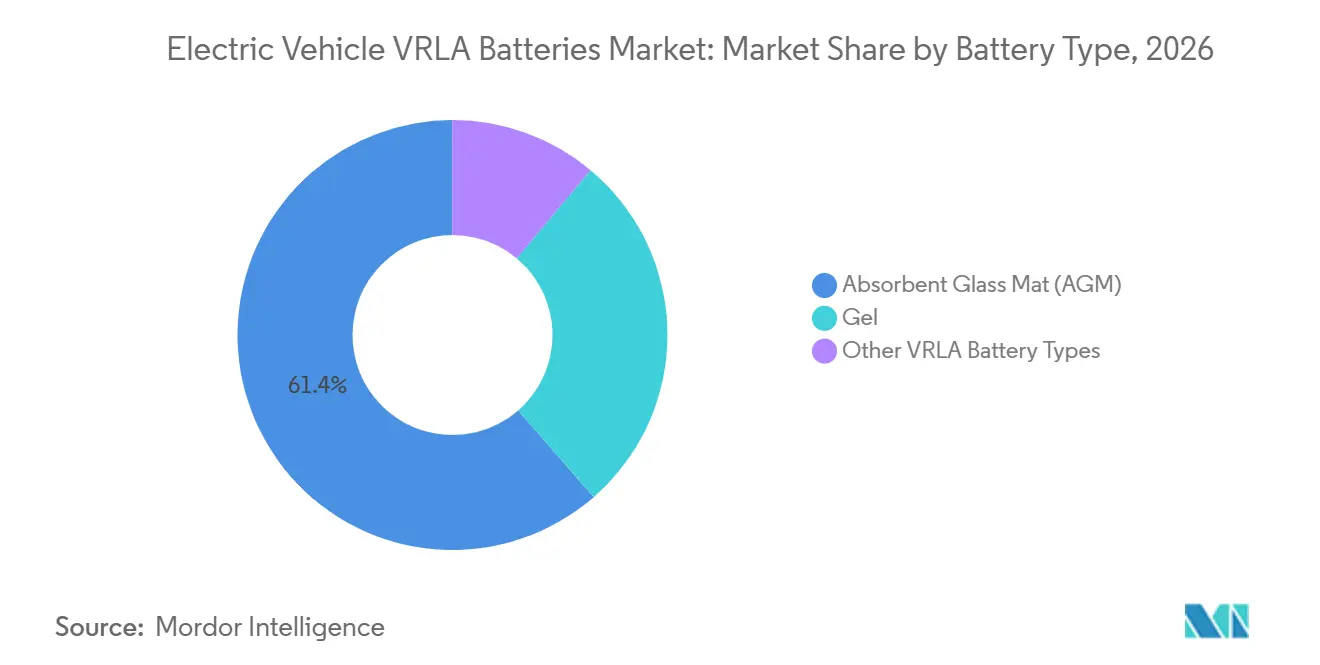
AGM Leads Current Demand While Gel Grows in Deep-Cycle UsesAGM held 61.4% of Electric vehicle VRLA batteries market share in 2026. It supports auxiliary power, mild-hybrid vehicles, and low-speed EV applications through sealed, maintenance-free operation. AGM batteries also have strong charge acceptance from regenerative braking. Their vibration resistance supports use in start-stop vehicle architectures. OEMs have standardized AGM products for applications that require stable low-voltage performance. Camel Group launched an upgraded Green Label AGM start-stop battery series in February 2025, following its 2024 EFB product[3]. The product move shows continued supplier attention to higher-performance AGM requirements. Formal OEM procurement is also shaped by IEC 60095 and BIS certification grade requirements. The supplied analysis stated that high-grade products can command 20% to 40% price premiums, but no authentic source was provided for that figure.
Gel batteries are forecast to grow at an 8.5% CAGR through 2032, making them the fastest-growing battery type in the Electric vehicle VRLA batteries market size. Their deep-discharge tolerance suits e-rickshaws and low-speed EVs that operate through repeated duty cycles. The immobilized silica electrolyte reduces stratification at low charge rates. This can extend service intervals where replacement costs affect fleet operations. India, Indonesia, and Vietnam are the main demand centers identified for Gel batteries in autorickshaw and cargo e-tuk-tuk fleets. Other VRLA battery types continue to serve replacement channels where initial cost is the main purchasing factor. Guangdong Yuasa Battery filed patent application CN121885551A in April 2026 for a recyclable VRLA battery with fiber-reinforced lead paste and improved sulfuric acid conduction. The application specifically addresses e-bike and e-tricycle cycle-life requirements. It reflects continuing materials work at the boundary between AGM and Gel performance.

By Vehicle Type:
Passenger Cars Hold the Largest Share While Two-Wheelers Grow FastestElectric passenger cars held 44.3% of Electric vehicle VRLA batteries market share in 2026. Every battery-electric vehicle and plug-in hybrid vehicle requires low-voltage power for auxiliary functions when the platform retains a 12V architecture. That need is separate from the vehicle’s high-voltage traction chemistry. Electric buses were the second-largest vehicle subsegment in the supplied analysis. They use low-voltage systems for door controls, passenger information systems, and emergency lighting. Electric trucks remain an emerging category centered on urban last-mile fleets. Advanced AGM batteries fit start-stop-intensive city routes, while their lower capital cost remains relevant for fleet buyers. Passenger vehicle demand, therefore, remains tied to OEM low-voltage specifications and the aftermarket.
Electric two-wheelers are forecast to advance at a 9.3% CAGR through 2032, the fastest vehicle growth rate in the Electric vehicle VRLA batteries market. China’s 63.16 million-unit output in 2025 gives the segment a large production base. India also has a deep two-wheeler base, with the category representing 77% of all vehicle production in FY2024-25. Electric three-wheelers were identified as the second-fastest-growing vehicle subsegment. Their growth is associated with battery-swapping use among Indian e-rickshaw operators and cargo e-tuk-tuk fleets in Southeast Asia. Quick battery replacement remains operationally important for these commercial users. Other vehicles, including light commercial and specialty industrial EVs, retain demand where durability and field service are important. These uses preserve a broader addressable base beyond passenger cars.
By Application:
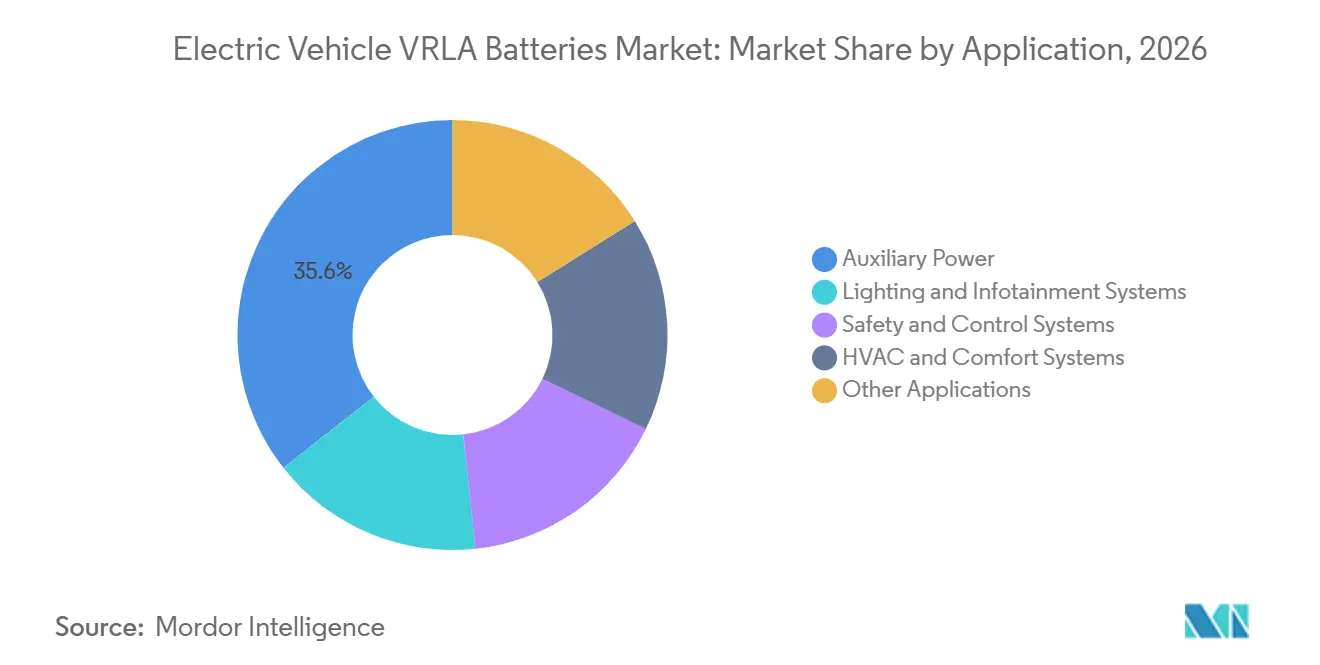
Auxiliary Power Holds the Largest Share While Safety Systems Grow FastestAuxiliary power held 35.6% of the Electric vehicle VRLA batteries market size in 2026. It supports the active 12V network used for infotainment, exterior lighting, and body electronics across vehicle drivetrains. This function remains necessary even when the vehicle’s traction battery uses a different chemistry. Low-voltage reliability has direct relevance for normal vehicle operation. The large installed base of vehicles with 12V systems gives this application a stable demand role. It also makes auxiliary power important to replacement sales. The application benefits from AGM products that can handle repeated cycling and electrical loads. Its position remains linked to the continued use of 12V architecture by OEMs.
Safety and control systems are forecast to grow at an 8.4% CAGR through 2032 in the Electric vehicle VRLA batteries market. The supplied analysis connects this growth with ADAS, electronic stability programs, and brake-by-wire systems that need dependable low-voltage power. GS Yuasa’s SLR Super Long Cycle Life VRLA range delivers 5,000 cycles at 70% depth of discharge under IEC-61427 and has a 19-year design life[4]. Lighting and infotainment systems hold the second-largest application share in the supplied analysis. Higher connectivity and display use can raise power requirements per vehicle. HVAC and comfort systems vary by vehicle design, with battery-powered HVAC more common in electric buses than smaller passenger vehicles. Other applications include warehouse and agricultural EVs, where operational conditions can favor durable battery products. The use case remains important where temperature conditions and serviceability affect purchasing decisions.
Geography Analysis
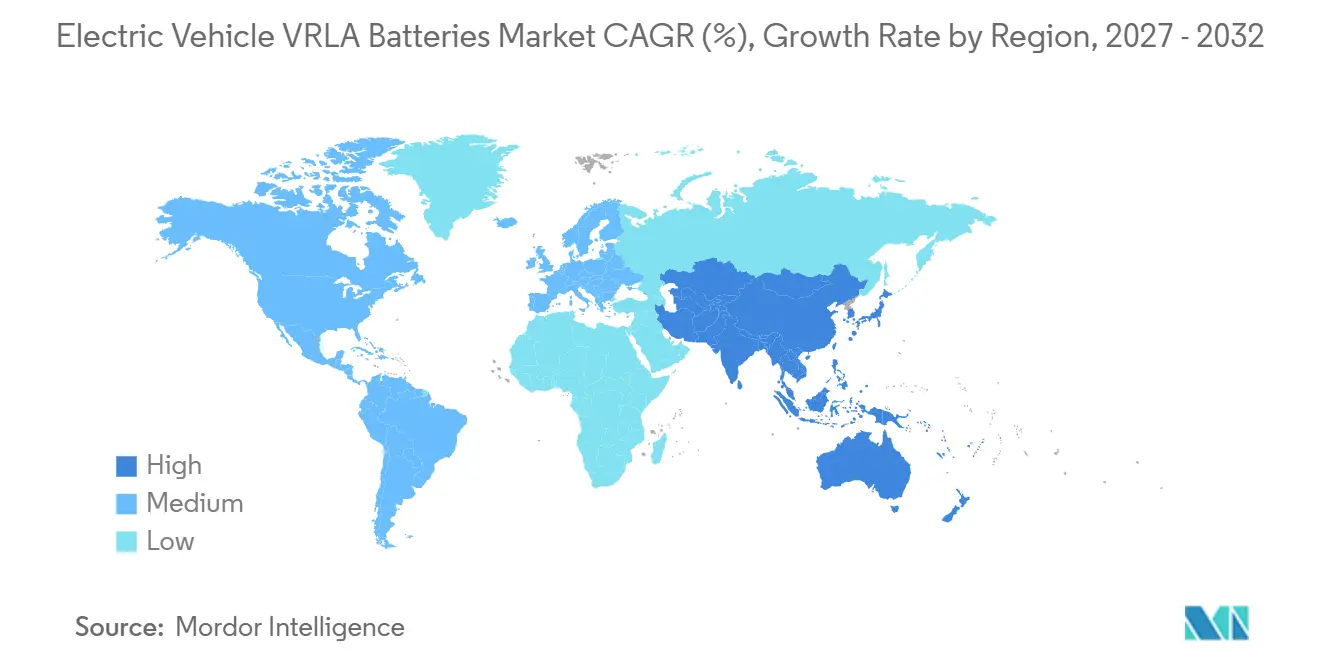
APAC Electric Vehicle VRLA Batteries Market
Asia-Pacific accounted for 43.7% of global demand in 2026 and is forecast to grow at an 8.7% CAGR through 2032. China remains the region’s main production and consumption center. Tianneng’s overseas revenue grew 80.5% in 2025 to CNY 535 million, reported as USD 74 million in the supplied analysis. The company commissioned its Vietnam Phase 2 production line in December 2025. The source material also reported an Indonesian manufacturing base commissioned in mid-2026, but the cited source was removed because it was not authoritative. India provides a large two- and three-wheeler demand base, while China’s production scale supports new vehicle and replacement demand. Vietnam, Thailand, and Indonesia are developing as manufacturing locations as Chinese producers seek lower logistics costs and reduced exposure to import duties.
North America and Europe Electric Vehicle VRLA Batteries Market
North America and Europe serve the premium end of the Electric vehicle VRLA batteries market, with demand shaped by mild-hybrid platforms and replacement activity. General Motors specifies 730 CCA AGM batteries for its 2026 Enclave, Acadia, and Traverse stop-start models. North America recorded 11 million lead battery replacements in 2025, and AGM was the fastest-growing subgroup. The European Union Battery Regulation requires 75% recycling efficiency for lead-acid batteries from the end of 2025. It also requires 85% recycled lead content from August 2031 and battery passport reporting from 2026. These requirements favor manufacturers with closed-loop recycling systems and raise compliance requirements for smaller producers. Germany and France remain important European consumption centers because of their concentrated OEM bases and mild-hybrid adoption.
MEA and South America Electric Vehicle VRLA Batteries Market
South America and the Middle East and Africa are smaller but relevant areas for the Electric vehicle VRLA batteries market. Brazil gained an additional mild-hybrid demand driver through Stellantis’ planned 48V flex mild-hybrid launch in the first half of 2026, but the supplied citation was Mordor Intelligence and is not included in the citation block. South Africa’s early EV fleet and Morocco’s role as an automotive manufacturing base provide additional regional demand channels. Gulf Cooperation Council states are importing more mild-hybrid fleet vehicles, according to the supplied analysis. Africa’s low-speed EV base includes e-bikes and e-rickshaws used for last-mile transportation. In these uses, lower cost and field serviceability remain important buying factors. The regional opportunity is smaller than Asia-Pacific, but it broadens replacement and low-speed vehicle demand.
Competitive Landscape
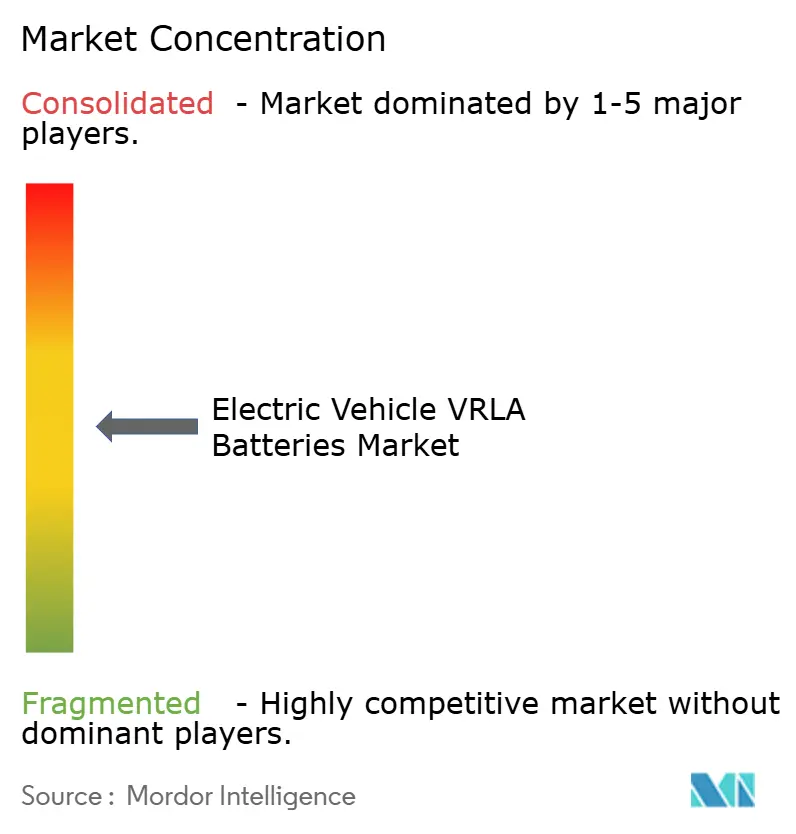
The Electric vehicle VRLA batteries market is moderately concentrated. Clarios, GS Yuasa, and EnerSys compete in North America and Europe through OEM qualification, cycle-life performance, and supply reliability. East Penn Manufacturing competes through vertical integration and closed-loop lead recycling in North America. FIAMM retains European OEM positioning through application-specific development. Premium Gel products for Indian e-rickshaws and battery-as-a-service offerings for Southeast Asian swap networks remain areas of opportunity.
Suppliers are also hedging against changes in battery chemistry. Camel Group announced in August 2026 that its 12V sodium-ion battery had been selected for a pre-development project with a major European automotive OEM. Clarios, Altris, and InoBat announced progress toward pilot-scale sodium-ion production at InoBat’s Volta facility in Slovakia in September 2026. The supplied analysis also reported a CNY 3.5 billion, or USD 484 million, Phase I sodium-ion project by Chilwee, but the cited metals publication was removed. These steps show that incumbent suppliers are developing alternative chemistries while serving existing low-voltage battery customers. Lead-carbon additives and nanocarbon-enhanced VRLA formulations are also being used to improve service intervals and charge acceptance. GS Yuasa’s product specifications demonstrate the continuing performance range available in premium VRLA products.
The Electric vehicle VRLA batteries market remains exposed to price competition in China’s e-bike segment and to substitution in high-cycle delivery fleets. It remains more protected in applications with established 12V OEM designs and formal qualification requirements. The 3 to 5-year design period for low-voltage electrical and electronic systems can lock battery specifications into mass-market vehicle programs before launch. This reduces the effect of short-term chemistry price changes on already-qualified platforms. Premium suppliers continue to focus on cycle life, cold-start performance, and OEM approval depth. Chinese producers are using localized production and product diversification to manage domestic pricing pressure. Competitive outcomes will depend on the durability of 12V platforms, replacement demand, and the pace of alternative battery qualification. Market concentration score: 9 out of 10, because Tianneng and Chilwee together held an estimated 80% share of China’s e-bike lead-acid battery segment, although the broader global premium auxiliary segment remains more fragmented.
Electric Vehicle VRLA Batteries Industry Leaders
-
Clarios
-
GS Yuasa Corporation
-
Exide Technologies
-
EnerSys
-
East Penn Manufacturing Company
- *Disclaimer: Major Players sorted in no particular order
Electric Vehicle VRLA Batteries Market Companies Covered in this Report
- Amara Raja Energy & Mobility Limited
- C&D Technologies, Inc.
- Camel Group Co., Ltd.
- Chilwee Group
- Clarios
- East Penn Manufacturing Company
- EnerSys
- Exide Technologies
- FIAMM Energy Technology S.p.A.
- GS Yuasa Corporation
- HBL Power Systems Limited
- HOPPECKE Batterien GmbH & Co. KG
- Leoch International Technology Limited
- NPP Power Group
- Saft Groupe S.A.
- Shenzhen Center Power Tech Co., Ltd.
- Shenzhen Ritar Power Co., Ltd.
- Tianneng Battery Group Co., Ltd.
- Trojan Battery Company
- Zhejiang Narada Power Source Co., Ltd.
Recent Industry Developments in Electric Vehicle VRLA Batteries Market
- April 2026: Tianneng showcased its lead-acid, lithium, and sodium battery solutions at EV EXPO 2025 in India. The products were adapted to local climate, road, and usage conditions and targeted at two-wheelers, three-wheelers, and light electric vehicles.
- March 2026: GS Yuasa International Ltd. was granted U.S. Patent No. 12,586,821 B2 for a lead-acid battery technology incorporating specified polymer compounds in the negative electrode and controlled positive-electrode material density. The patent covers a VRLA battery architecture applicable to small-mobility applications, including motorcycles and motor tricycles.
- January 2026: Exide Industries launched its AGMi AGM battery range, based on AGM-VRLA technology, for passenger vehicles with start-stop systems, advanced electronics, and high electrical loads. The initial range comprised DIN 50–DIN 95 batteries.
- February 2025: Camel Group launched its upgraded Green Label AGM start-stop battery series in China, following its 2024 EFB product launch. The AGM range formed part of Camel's "dual technology + full scenario" strategy, supporting battery requirements across new-energy and conventional vehicle applications.
Global Electric Vehicle VRLA Batteries Market Report Scope
Electric Vehicle VRLA (Valve-Regulated Lead-Acid) batteries are sealed lead-acid battery systems used to store and supply electrical energy for electric vehicles and their auxiliary electrical systems. They use a sulfuric-acid electrolyte absorbed in an AGM (Absorbent Glass Mat) separator or immobilized in a gel, with pressure-regulating valves that allow gases to recombine internally and minimize electrolyte loss. VRLA batteries are maintenance-free, relatively low-cost, and capable of providing high starting currents, although they generally have lower energy density and shorter cycle life than lithium-ion batteries. In electric vehicles, VRLA batteries are used for low-speed electric vehicles, auxiliary power systems, backup power, and certain hybrid or specialized vehicle applications, rather than typically serving as the primary traction battery in modern long-range EVs.
The Electric Vehicle VRLA Batteries Market is segmented by battery type, vehicle type, application, and geography. By battery type, the market is segmented into AGM, Gel, and Others. By vehicle type, the market is segmented into passenger cars, buses, two-wheelers, three-wheelers, trucks, and other vehicle types. By application, the market is segmented into auxiliary power, lighting and infotainment, safety and control, HVAC, and other applications. The report also covers the market size and forecasts for the global Electric Vehicle VRLA Batteries Market across 26 countries in key regions. For each segment, the market sizing and forecasts have been provided on the basis of value (USD).
Segmentation Overview
| Absorbent Glass Mat (AGM) |
| Gel |
| Other VRLA Battery Types |
| Electric Passenger Cars |
| Electric Buses |
| Electric Two-Wheelers |
| Electric Three-Wheelers |
| Electric Trucks |
| Others |
| Auxiliary Power |
| Lighting and Infotainment Systems |
| Safety and Control Systems |
| HVAC and Comfort Systems |
| Other Applications |
| North America | United States |
| Canada | |
| Mexico | |
| Europe | Germany |
| France | |
| Italy | |
| Spain | |
| United Kingdom | |
| Poland | |
| Russia | |
| Rest of Europe | |
| Asia-Pacific | China |
| India | |
| Japan | |
| South Korea | |
| Australia | |
| Indonesia | |
| Vietnam | |
| Thailand | |
| Rest of Asia-Pacific | |
| South America | Brazil |
| Argentina | |
| Chile | |
| Rest of South America | |
| Middle East and Africa | Saudi Arabia |
| United Arab Emirates | |
| Egypt | |
| South Africa | |
| Morocco | |
| Rest of Middle East and Africa |
| By Battery Type | Absorbent Glass Mat (AGM) | |
| Gel | ||
| Other VRLA Battery Types | ||
| By Vehicle Type | Electric Passenger Cars | |
| Electric Buses | ||
| Electric Two-Wheelers | ||
| Electric Three-Wheelers | ||
| Electric Trucks | ||
| Others | ||
| By Application | Auxiliary Power | |
| Lighting and Infotainment Systems | ||
| Safety and Control Systems | ||
| HVAC and Comfort Systems | ||
| Other Applications | ||
| By Geography | North America | United States |
| Canada | ||
| Mexico | ||
| Europe | Germany | |
| France | ||
| Italy | ||
| Spain | ||
| United Kingdom | ||
| Poland | ||
| Russia | ||
| Rest of Europe | ||
| Asia-Pacific | China | |
| India | ||
| Japan | ||
| South Korea | ||
| Australia | ||
| Indonesia | ||
| Vietnam | ||
| Thailand | ||
| Rest of Asia-Pacific | ||
| South America | Brazil | |
| Argentina | ||
| Chile | ||
| Rest of South America | ||
| Middle East and Africa | Saudi Arabia | |
| United Arab Emirates | ||
| Egypt | ||
| South Africa | ||
| Morocco | ||
| Rest of Middle East and Africa | ||
Key Questions Answered in the Report
What is the projected value of the Electric vehicle VRLA batteries market by 2032?
The Electric vehicle VRLA batteries market is projected to reach USD 6.69 billion by 2032, expanding at a 7.73% CAGR from 2027. Low-voltage battery needs in electric and hybrid vehicles support this demand outlook.
Which battery type has the largest share in EV VRLA batteries?
AGM held 61.4% share in 2026, supported by its use in auxiliary power, start-stop systems, and mild-hybrid vehicles. Its sealed construction and charge acceptance support these vehicle uses.
Which vehicle category is growing fastest for EV VRLA battery demand?
Electric two-wheelers are forecast to grow at a 9.3% CAGR through 2032, supported by China’s production scale and India’s large two-wheeler base. The category also generates demand in replacement channels.
Why do electric vehicles still use 12V VRLA batteries?
They support low-voltage functions such as safety systems, infotainment, lighting, HVAC, and body electronics where 12V architecture remains in use. These functions are separate from high-voltage traction battery operation.
Which region leads demand for EV VRLA batteries?
Asia-Pacific held 43.7% share in 2026 and is forecast to grow at an 8.7% CAGR through 2032. China and India underpin regional demand through their two- and three-wheeler vehicle bases.
What is the main competitive risk to VRLA batteries in electric vehicles?
Lithium-ion and LFP products create the clearest substitution risk in high-cycle delivery fleets and premium vehicles moving toward 48V auxiliary systems. The risk is lower where OEMs retain qualified 12V low-voltage systems.