
Electric Submersible Pumps (ESP) Market Size and Share
Market Overview
| Study Period | 2021 - 2031 |
|---|---|
| Forecast Data Period | 2026 - 2031 |
| Historical Data Period | 2021 - 2024 |
| Growth Rate | 5.98% CAGR |
| Fastest Growing Market | North America |
| Largest Market | North America |
| Market Concentration | Medium |
Major Players *Disclaimer: Major Players sorted in no particular order Image © Mordor Intelligence. Reuse requires attribution under CC BY 4.0. | |
Electric Submersible Pumps (ESP) Market Analysis by Mordor Intelligence
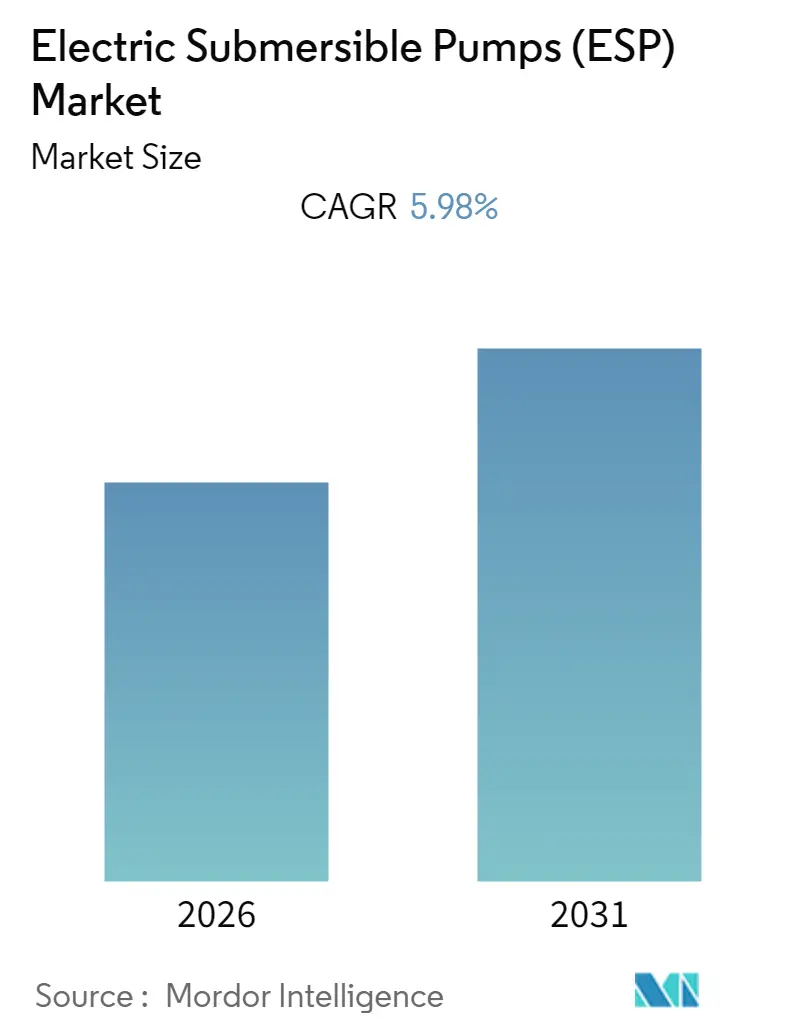
The Electric Submersible Pumps (ESP) Market size is expected to register a CAGR of greater than 5.98% during the forecast period (2026-2031).
- The onshore sector accounts for the largest share in the electric submersible pumps market, owing to the increasing number of mature fields in the sector.
- Developments of potential shale reserves around the world are expected to create significant opportunities for ESPs in the future.
- North America dominated the market across the world, with the majority of the demand coming from the United States.
Note: Market size and forecast figures in this report are generated using Mordor Intelligence’s proprietary estimation framework, updated with the latest available data and insights as of 2026.
Global Electric Submersible Pumps (ESP) Market Trends and Insights
Onshore Location of Deployment to Dominate the Market
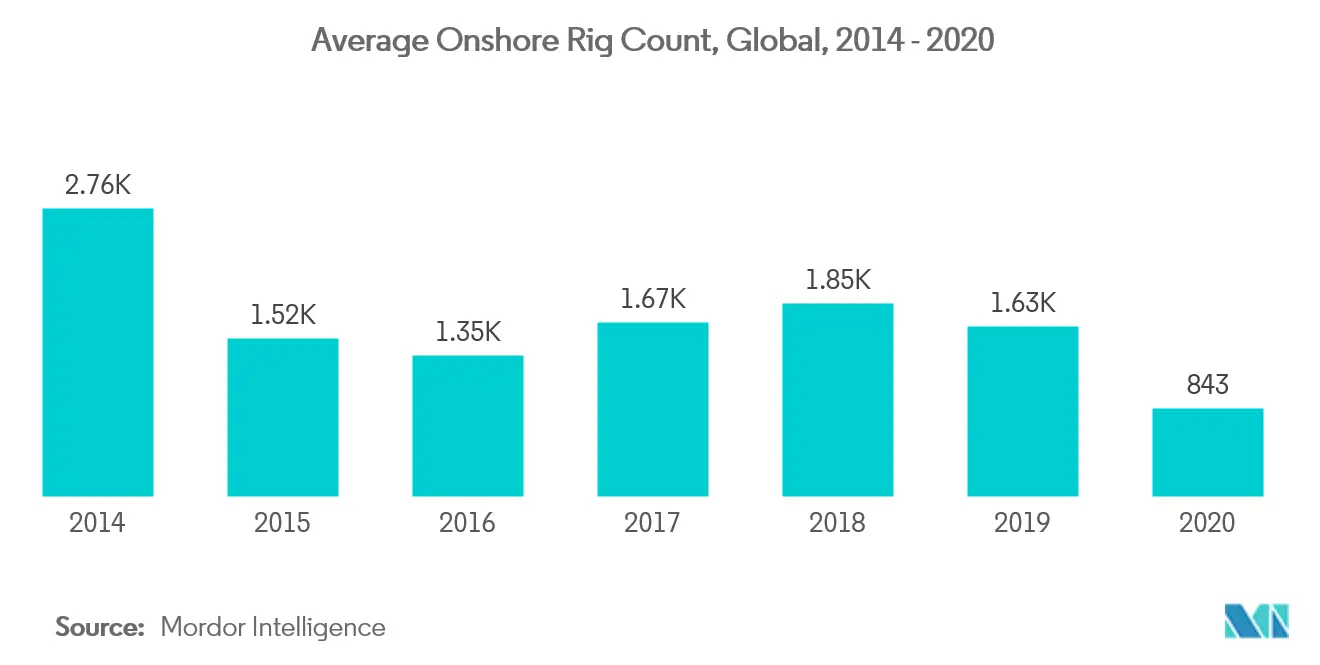
- The onshore oil and gas sector accounts for the largest share in the electric submersible pumps market. In 2020, the average global onshore rig count reached 843 rigs, representing a decrease of almost 51.5% from 1,629 in 2019 over the previous year. This was primarily due to production cut by OPEC plus and reduction in prices of oil; however, with the increase in prices, the number of ESPs is set to increase, especially on the onshore deployment, as they require fewer prices to be profitable.
- Also, a growing focus on heavy oil reservoirs, coupled with the requirement of ESP systems in shale reservoirs, is expected to drive business growth.
- The marginal/stripper wells, which produce less than 10 barrels of oil or 60,000 cubic feet of natural gas per day, require additional technological aid to increase their production. Factors such as the increasing number of marginal and stripper wells and the growing demand to produce oil at the minimum cost are likely to drive the demand for ESPs in the coming years.
- Increasing adoption of new technologies is also expected to aid the market. For instance, in December 2021, Brunei Shell Petroleum Company and AccessESP completed a trial project using GoRigless ESP System technology. The GoRigless ESP System is a slickline-retrieval technology for AccessESP high-performance permanent magnet motors and industry-standard ESP pumps. It avoids the cost and complexity of a heavy workover rig required for traditional tubing-deployed ESP system interventions.
- Therefore, the increase in the number of wells drilled, along with the demand for low-cost production solutions, is expected to augment the demand for ESPs in the onshore sector over the forecast period and keep it as the dominant location of deployment in the forecast period.


North America to Dominate the Market
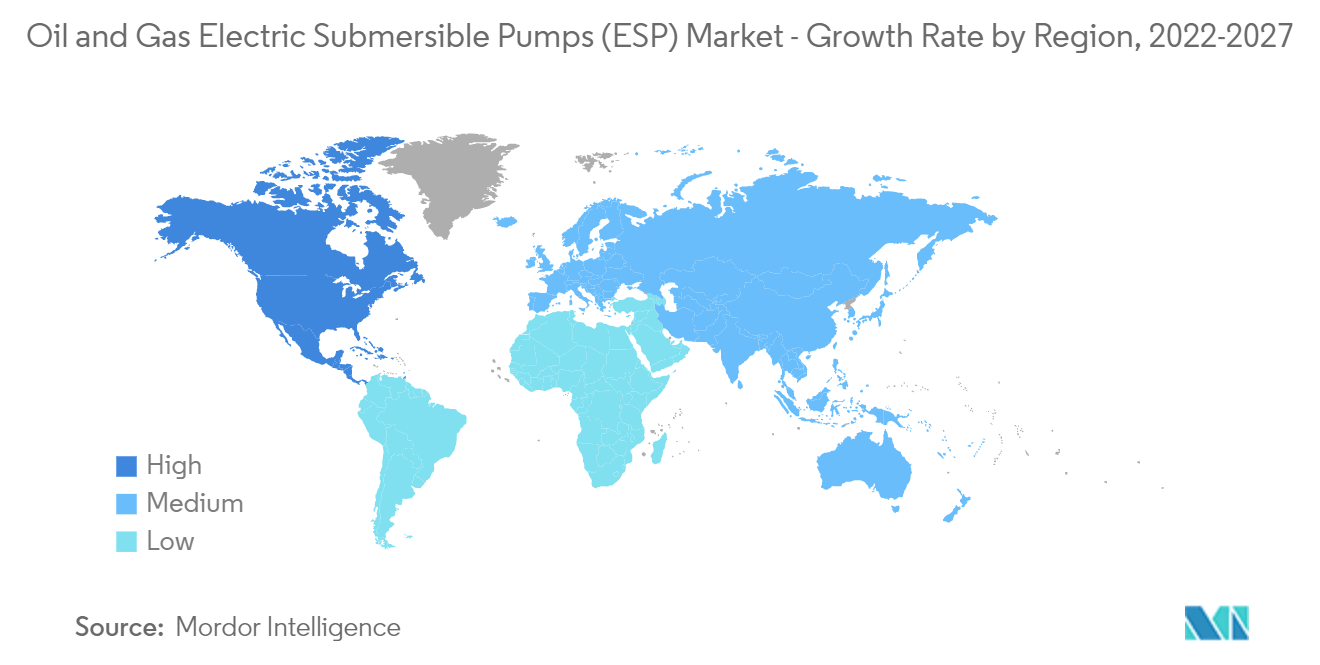
- In 2021, North America was estimated to be the largest market among the regions studied. This is primarily due to the shale gas plays in the United States, which have supported the country to become the largest producer of crude oil in the world.
- The oil and gas industry in the United States is projected to provide a huge impetus to the ESP market on account of widespread investments lined up in oil and gas projects for the coming years.
- According to Baker Hughes, as of February 2022, 753 rigs were online in the country, with the Permian Basin having the largest share. These wells are expected to be completed in the coming years, creating ample instances for the usage of ESPs system suppliers in the forecast period.
- On the other hand, In Canada, the sand oil available is of high density and has high sand particle content, due to which oil transport from the bottom hole of the oil well to the surface requires high pressure. Hence, there is high demand and, in turn, assistance from artificial lifts. However, the usage of electric submersible pumps (ESP) for pumping the sand oil is very difficult due to the oil's high viscous nature. This, in turn, is expected to limit the demand for ESP in Canada.
- On the Mexican side of the Gulf of Mexico (GoM), PEMEX has made several discoveries. PEMEX has issued contracts for the development of these fields. Hence, in the long run, the demand for electric submersible pumps is likely to emanate from this region.
- Hence, the region is expected to dominate the market due to the type of crude oil produced in the region and the large-scale deployment of private investment to develop the wells.

Regulatory Landscape
Electric submersible pump (ESP) design and qualification increasingly point to formal equipment standards and regulated operating requirements across key producing regions. ISO 15551:2023 sets requirements for the design, verification/validation, manufacturing, and data control of tubing-deployed ESP systems, which provides a common framework used in procurement and quality assurance for global deployments. In offshore US operations, compliance obligations also extend into project execution and operations control documentation, including requirements under 30 CFR 250.875 for subsea pump systems to align with approved development and operations coordination documentation.
Environmental and facility oversight policies also influence ESP selection, monitoring, and site practices. In the United States, EPA rules targeting oil and natural gas sector emissions, including 40 CFR Part 60 Subpart OOOOb, tighten expectations for methane/VOC control for equipment at production sites, which can drive upgrades that reduce fugitive emissions and improve integrity management. At the state level, California Public Utilities Commission actions such as Resolution ESRB-13 (General Order 167-C) reinforce maintenance and operational standards for electric generating facilities and energy storage. Similar safety and network management rulemaking activity in Australia (New South Wales, 2026 Regulatory Impact Statement for the Electricity Supply (Safety and Network Management) Regulation) highlights continued attention on electrical safety compliance relevant to ESP-associated surface power and control infrastructure.
Value Chain Analysis
The ESP value chain spans upstream materials and specialized electrical components through integrated system assembly and lifecycle services. Key inputs include high-strength and corrosion-resistant alloys for pump stages and shafts, specialized cables, motors (induction and permanent magnet), and surface control equipment such as variable frequency drives and digital surveillance software. System design, integration, and qualification are typically carried out by major oilfield service providers and OEMs (including SLB, Baker Hughes, and Halliburton) together with specialized manufacturers (including Borets and Novomet), with configuration and testing tied closely to well conditions such as depth, temperature, solids, and gas fraction, as well as intervention constraints.
Downstream, the chain is increasingly service-led, with providers packaging equipment supply alongside installation, monitoring, optimization, repair, and workover support, often under multi-year agreements that emphasize uptime. Recent industry actions reflect this bundling trend, including Baker Hughes work that integrates automation platforms (Leucipa) with ESP hardware under multi-year supply frameworks, and SLB introductions that pair compact ESP systems with live surveillance and production optimization. Bottlenecks tend to cluster around high-performance motors and power cables, as well as regional localization needs that move assembly, repair, and test capacity closer to operating basins to shorten lead times and meet in-country value expectations.
Competitive Landscape
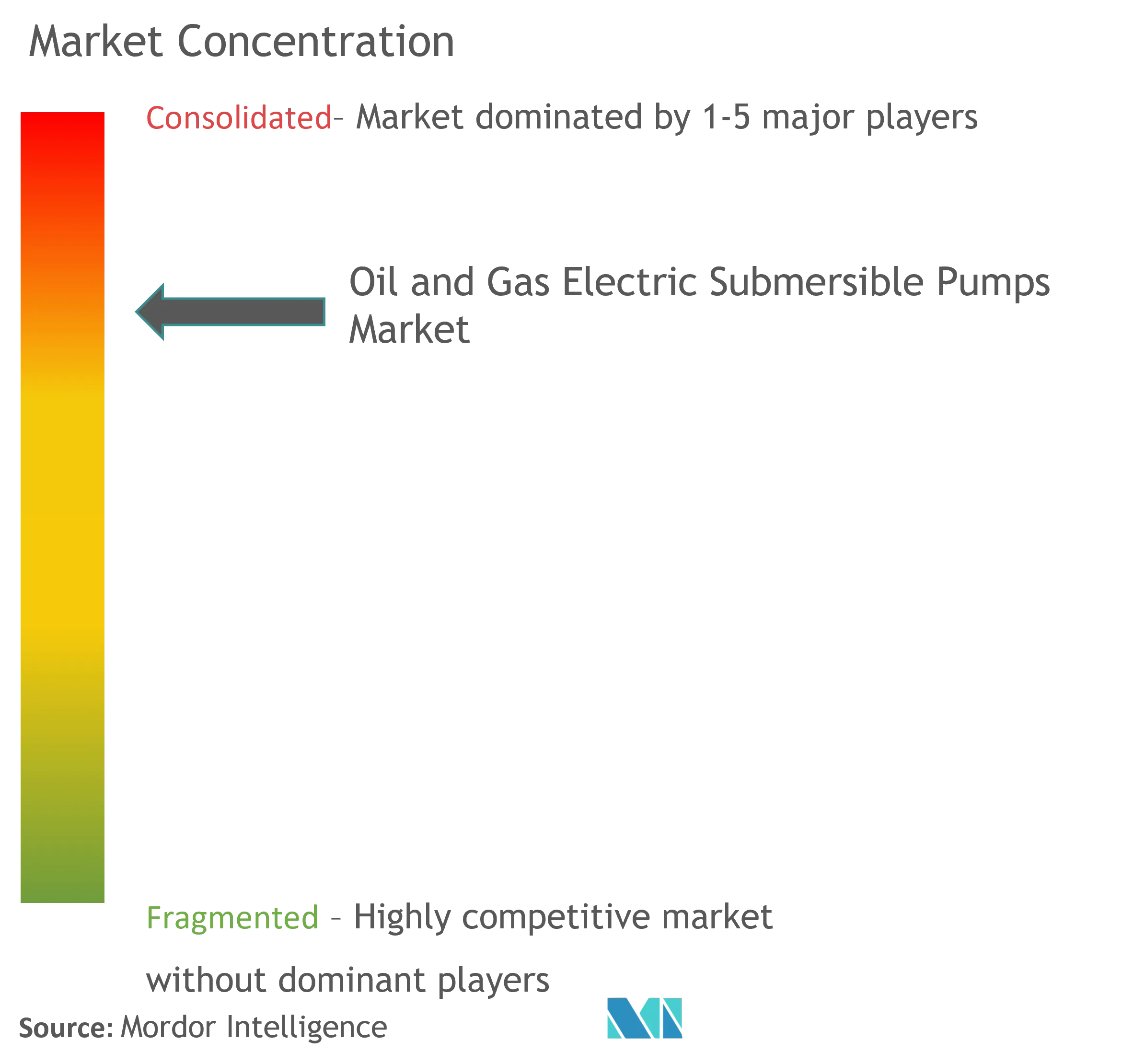
The oil and gas electric submersible pumps market is partially consolidated. Some of the major companies include Baker Hughes, Schlumberger Limited, Borets International Limited, Novomet, and Halliburton Company.
Electric Submersible Pumps (ESP) Industry Leaders
Schlumberger Limited
Borets International Limited
Novomet
Halliburton Company
Baker Hughes Company
- *Disclaimer: Major Players sorted in no particular order

Market Opportunities and Future Outlook
Incremental value in ESP programs is increasingly linked to reliability, flow assurance, and automation, not pump hardware alone, creating room for solutions that reduce failure drivers in gassy, scaled, corrosive, or HPHT wells. In 2026, SLB released an autonomous chemical optimization approach for ESPs that digitalizes workflows using edge and cloud intelligence to manage flow assurance and asset integrity risks. This is aligned with operator needs to reduce intervention frequency and stabilize run life. Field validation activity is also moving beyond monitoring into closed-loop control, including a data-driven model predictive control (DDMPC) approach reported for subsea ESP operations that improved production while maintaining safety constraints, reinforcing the shift toward performance-managed artificial lift.
Motor efficiency and intervention logistics are additional opportunity areas where operator programs and field studies show traction. Petroleum Development Oman has implemented machine-learning-based predictive failure detection workflows for ESP wells, indicating practical readiness to operationalize predictive analytics in daily lift management. Separately, field work in the Gulf of Thailand highlighted efficiency gains from permanent magnet motor ESPs versus induction motor designs, supporting adoption where power consumption and diesel logistics are material cost and emissions levers. Rigless and rapid-deployment concepts, including cable-deployed and tubing-retrievable approaches validated in the field, also broaden the addressable set of mature and constrained wells by reducing non-productive time and limiting reliance on heavy workover equipment.
Recent Industry Developments
- March 2026: SLB OneSubsea was awarded an integrated EPC contract for a deepwater project that includes delivery of dual electric submersible pump (ESP) systems. Including ESPs within an integrated subsea scope ties artificial lift more directly to subsea system delivery and lifecycle execution. This supports deeper standardization of subsea ESP integration, commissioning, and long-term service models.
- January 2025: Novomet announced the release of its size 5U electric submersible pump (ESP) system for wells with 127 mm casing inner diameters, incorporating a displacement module to transmit torque with offset shaft axes. The launch expands addressable wellbore sizes for ESP deployments where space constraints limit traditional configurations. It also strengthens differentiation in niche well geometries that require compact lift systems.
- November 2024: Novomet commenced in-house production of submersible power cables for ESPs, covering operating voltages up to 5000V AC and temperatures up to 232 degrees Celsius. Bringing cable manufacturing in-house increases control over a critical failure-prone component and can reduce qualification and lead-time risks for high-temperature applications. It also supports tighter integration between cable design, motor performance, and field reliability programs.


Research Methodology Framework and Report Scope
Market Definition and Coverage
This market covers revenue generated from electric submersible pump systems used to lift liquids from below the surface in oil and gas wells, including associated surface and downhole equipment sold as part of the ESP setup.
Scope exclusions: Hand-operated pumps, non-electric lift systems, and general-purpose submersible water pumps used only for residential or municipal water supply are excluded.
Segmentation Overview
- Location of Deployment
- Onshore
- Offshore
- Geography
- North America
- Europe
- Asia-Pacific
- South America
- Middle-East and Africa
Data Sources, Market Sizing, and Validation
Desk Research
Desk work starts by building a fact base on drilling and production activity, since ESP demand is closely tied to well counts and artificial lift intensity. We refer to public datasets such as the US EIA, the IEA, OPEC statistical publications, national oil and gas regulators, and offshore activity releases that track rigs, wells, and field developments.
To convert activity into a workable demand pool, we also review sources such as customs and trade statistics, patent filings for ESP-related designs, peer-reviewed petroleum engineering literature, and selected company filings and investor presentations that discuss artificial lift exposure. For pricing and shipment direction checks, we selectively use paid subscriptions that compile company financials, import and export shipment records, and patents. These examples are illustrative only, and many other public and paid sources were also reviewed for data collection, cross-checking, and clarification.
Primary Interviews and Surveys
Primary work focuses on validating what portion of producing wells realistically run ESPs, how replacement cycles behave, and how service and equipment pricing is being contracted in the current year. We speak with participants across manufacturing, oilfield services, operators, and distribution so assumptions on deployment mix (onshore versus offshore), failure rates, and lead times can be stress-tested across APAC, EMEA, and the Americas.
Distribution of primary research fieldwork respondents
| Company type | Respondent position | Region |
|---|---|---|
| Top tier: 33% | CXOs: 13% | APAC: 49% |
| Mid tier: 51% | Functional/Unit leaders: 29% | EMEA: 29% |
| Smaller Players: 16% | Managers: 58% | Americas: 22% |
Market-Sizing & Forecasting
The core model uses a top-down build where production and well activity data are used to reconstruct the addressable artificial lift pool, which is then filtered into ESP-suitable wells based on depth, flow requirements, and operating conditions. Once that demand pool is formed, we apply adoption rates and replacement timing to estimate annual unit needs, and then apply average selling prices that reflect equipment plus typical installation and related services.
To keep totals realistic, the outputs are corroborated with selective bottom-up checks, such as rolling up sampled supplier revenues, channel discussions on unit shipments, and ASP times volume calculations in a few key basins before final totals are locked. Inputs that matter in this market include active rig counts, new well completions, producing well counts, offshore project start-ups, workover intensity, and oil price linked capex plans, which together explain year-to-year swings. Forecasting is done using scenario analysis supported by trend smoothing, where our assumptions for activity, adoption, and pricing are aligned to what interviewees expect under base-case oil and gas development plans. Where local data is thin, we fill gaps by using region-level proxies and then recheck the implied per-well spend so that the results do not overstate smaller producing areas.
Data Validation & Update Cycle
Validation is done by comparing the modeled revenue with independent signals such as regional drilling budgets, production guidance, and the implied spend per producing well in key markets. When outliers appear, the drivers are rechecked, including adoption rates, replacement cycles, and price progression, and then the assumptions are revised and documented before sign-off.
Each estimate is reviewed in multiple steps by analysts, including a final variance check across regions and deployment locations so the totals add up cleanly and behave logically over time. Reports are refreshed annually, and interim updates are made when material events occur, such as sharp shifts in oil price expectations, major offshore project delays, or policy changes that impact upstream spending. Before delivery, a fresh pass is completed so the numbers reflect the latest public releases and field feedback.
Mordor Intelligence's Electric Submersible Pumps Market Sizing Compared With Other Published Estimates
Published market sizes for electric submersible pumps can look far apart because the scope line is drawn differently, and the demand pool is not always tied back to clear upstream activity indicators. Differences also come from how firms treat service revenue, how they handle onshore versus offshore weighting, and how quickly pricing assumptions are refreshed.
The main gap comes from mixing oil and gas ESP demand with general-purpose water and wastewater pump demand, where Mordor Intelligence counts revenues only for ESP systems deployed for oil and gas lift and keeps the forecast anchored to well activity, replacement cycles, and basin-level capex signals. Some estimates also lean on a single base year and apply a straight CAGR across regions, which can miss the step changes caused by offshore project timing and the uneven pace of workovers.
Benchmark comparison
| Source | Market Size | Gaps in Research Methodology |
|---|---|---|
| Mordor Intelligence | USD 4.00 B (2026) | |
| Global Consultancy A | USD 8.90 B (2023) | Uses a broader ESP definition that includes multiple end uses like agriculture and municipal water, which inflates totals versus an oil and gas only scope. The base year is earlier, and pricing and replacement assumptions are less visibly tied to well-level activity shifts. |
| Industry Publisher B | USD 10.40 B (2023) | Combines several industrial end-user buckets and mixes application terminology, so oil and gas lift is not isolated cleanly. A longer forecast window with a single growth path can underweight short-cycle effects like workovers and offshore project slippage. |
The table shows that the spread is mainly explained by scope and demand-driver selection, not by arithmetic. When the demand pool is built from upstream activity signals and then checked with realistic ASP and replacement behavior, the result is easier to reproduce and simpler to audit year by year.


Key Questions Answered in the Report
What is the current Oil and Gas Electric Submersible Pumps Market size?
The Oil and Gas Electric Submersible Pumps Market is projected to register a CAGR of 5.98% during the forecast period (2026-2031)
Who are the key players in Oil and Gas Electric Submersible Pumps Market?
Schlumberger Limited, Borets International Limited, Novomet, Halliburton Company and Baker Hughes Company are the major companies operating in the Oil and Gas Electric Submersible Pumps Market.
Which is the fastest growing region in Oil and Gas Electric Submersible Pumps Market?
North America is estimated to grow at the highest CAGR over the forecast period (2026-2031).
Which region has the biggest share in Oil and Gas Electric Submersible Pumps Market?
In 2025, the North America accounts for the largest market share in Oil and Gas Electric Submersible Pumps Market.
What years does this Oil and Gas Electric Submersible Pumps Market cover?
The report covers the Oil and Gas Electric Submersible Pumps Market historical market size for years: 2020, 2021, 2022, 2023 and 2024. The report also forecasts the Oil and Gas Electric Submersible Pumps Market size for years: 2026, 2027, 2028, 2029, 2030 and 2031.
Page last updated on:






