
Electric Crawler Crane Market Size and Share
Market Overview
| Study Period | 2020 - 2032 |
|---|---|
| Market Size (2027) | USD 320.82 Million |
| Market Size (2032) | USD 519.27 Million |
| Growth Rate (2027 - 2032) | 10.11 % |
| Fastest Growing Market | Europe |
| Largest Market | Asia-Pacific |
| Market Concentration | Medium |
Major Players *Disclaimer: Major Players sorted in no particular order Image © Mordor Intelligence. Reuse requires attribution under CC BY 4.0. | |
Electric Crawler Crane Market Analysis by Mordor Intelligence
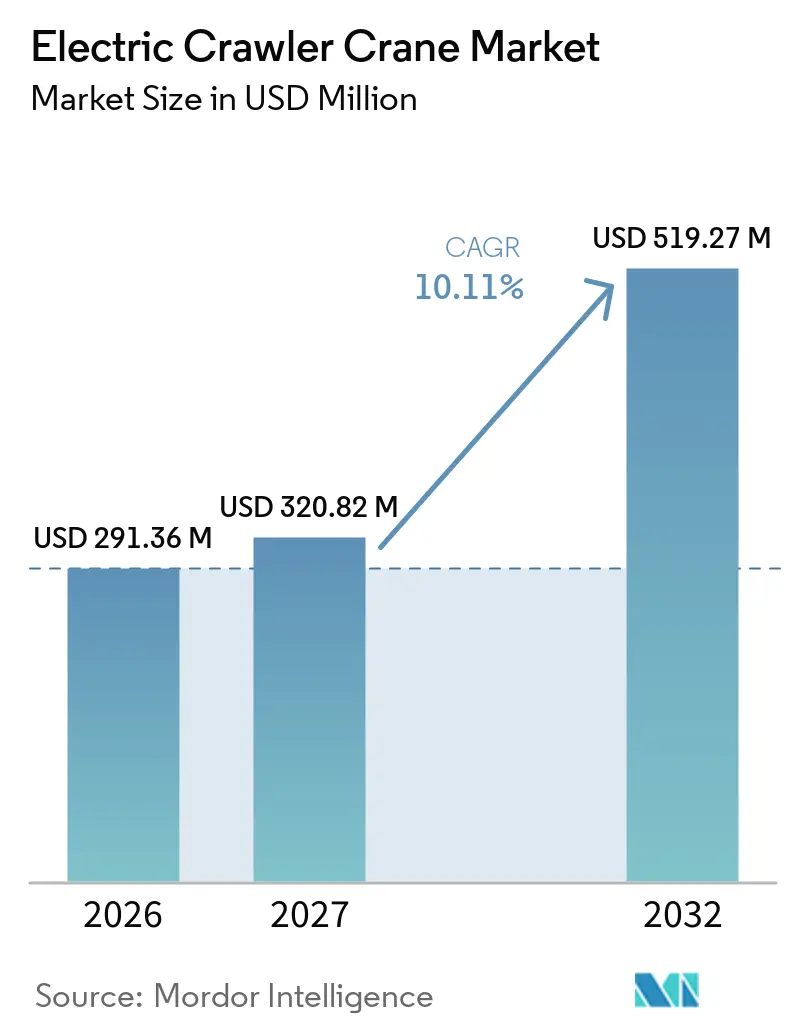
The electric crawler crane market size was valued at USD 291.36 million in 2026 and is expected to grow from USD 320.82 million in 2027 to USD 519.27 million by 2032, at a CAGR of 10.11% during 2027-2032. The electric crawler crane market is being shaped by public construction specifications that increasingly require zero-emission equipment. Renewable energy and grid projects are also increasing demand for lifting equipment that can operate with lower on-site emissions. These requirements change fleet purchasing decisions because access to public projects can depend on the equipment selected. Manufacturers are responding with battery-electric and dual-power machines, while buyers continue to weigh purchase cost, charging access, and operating requirements. The electric crawler crane market therefore has room to grow in urban construction, renewable energy, and fixed industrial settings, although the transition is expected to vary by site conditions, utilization, and local fleet economics.
Key Report Takeaways
- By lifting capacity, the 50 to 250 tons segment held a 43.62% share in 2026, while below 50 tons is projected to grow at a 12.47% CAGR through 2032.
- By power source, hybrid (diesel-electric) held a 48.27% share in 2026, while battery-electric is projected to grow at a 14.83% CAGR through 2032.
- By boom type, lattice boom held a 64.38% share in 2026, while telescopic boom is projected to grow at an 11.26% CAGR through 2032.
- By application, infrastructure held a 34.16% share in 2026, while energy is projected to grow at a 12.18% CAGR through 2032.
- By end user, crane rental companies held a 56.42% share in 2026, while industrial and utility owners are projected to grow at an 11.37% CAGR through 2032.
- By geography, Asia-Pacific held a 51.37% share in 2026, while Europe is projected to grow at a 12.06% CAGR through 2032.
Note: Market numbers in this report are based on Mordor Intelligence's proprietary estimation framework, which combines nine months of actuals with Q4 projections for base year 2026.
Market Trends and Insights
Drivers Impact Analysis of Electric Crawler Crane Market*
| Driver | (~) % Impact on CAGR Forecast | Geographic Relevance | Impact Timeline |
|---|---|---|---|
| Zero-Emission Construction Requirements | +3.2% | North America and Europe primary, Asia-Pacific accelerating | Short term (≤ 2 years) |
| Renewable-Energy and Grid Projects | +2.8% | Global, Asia-Pacific core, with Europe and North America | Medium term (2–4 years) |
| Lower Operating Costs and Fleet Electrification | +1.6% | Global, strongest in high-utilization Asia-Pacific and European markets | Medium term (2–4 years) |
| Urban, Indoor, and Sensitive-Site Access | +1.1% | Europe, North America, and Asia-Pacific urban centers | Short term (≤ 2 years) |
| Battery, Power-Electronics, and Telematics Improvements | +0.9% | Global | Long term (≥ 4 years) |
| Electrification of Rental and Contractor Fleets | +0.7% | Europe and North America | Medium term (2–4 years) |
| Source: Mordor Intelligence | |||
Zero-Emission Construction Requirements
Public procurement rules are making electric equipment a practical requirement on a growing number of construction projects. The policy shift moves fleet planning closer to the contract-award stage, where equipment availability can influence a contractor’s bid. California’s Clean Construction Program requires zero-emission equipment on qualifying state-funded projects where eligible models are commercially available, a framework that could extend to larger lifting equipment as the eligible list expands. These requirements matter because contractors and rental fleets may need electric alternatives to remain eligible for funded work. European engine requirements also continue to influence equipment choices, as Regulation (EU) 2016/1628 sets emission limits for non-road mobile machinery and Regulation (EU) 2025/14 sets approval rules for non-road mobile machinery circulating on public roads[1]. The electric crawler crane market benefits when compliance expectations are written into tender documents rather than treated as voluntary corporate targets.
Renewable-Energy and Grid Projects
Wind and grid construction create sustained demand for cranes used in installation, lifting, and related civil works. The global wind sector added 165 GW of capacity in 2025, taking cumulative installed capacity to 1,299 GW across 138 countries[2]. Larger wind installations require equipment capable of supporting demanding lift plans while meeting stricter emissions requirements at the project site. Transmission and substation work also requires lifting equipment as electricity networks expand. The electric crawler crane market is exposed to this activity through direct wind construction and the grid investment needed to integrate new generation. This link provides demand with a broader base than a single project cycle, because generation and transmission must develop together.
Lower Operating Costs and Fleet Electrification
Electric equipment can become more attractive when a crane is used frequently and charging can be planned. Rental fleets, foundation work, and long infrastructure contracts are examples where high utilization can strengthen the operating case. Lower noise can also improve access to nighttime and dense urban work where diesel equipment may face restrictions. Fleet electrification decisions are increasingly shaped by expected tender access as well as fuel, maintenance, and logistics costs. A rental provider can spread the use of a compliant crane across several customers, making utilization a central commercial consideration. The electric crawler crane market is therefore likely to see earlier adoption among fleets that undertake repeatable work and can manage charging across active projects.
Urban, Indoor, and Sensitive-Site Access
Electric and grid-connected cranes can serve work sites where exhaust emissions and noise are direct operating limits. Indoor industrial maintenance, tunnel support, metro construction, and heritage-site renovation are examples where diesel machines can be difficult to deploy. Compact equipment is especially relevant where access routes are narrow or lifting needs are modest. Zero-emission operation can enable a constrained work location to support a practical crane application. California’s official zero-emission equipment list includes commercially available battery-powered equipment across construction categories, reinforcing the relevance of procurement-ready equipment. This gives the electric crawler crane market an access-based demand driver, rather than only a product-feature advantage.
Restraints Impact Analysis of Electric Crawler Crane Market*
| Restraint | (~) % Impact on CAGR Forecast | Geographic Relevance | Impact Timeline |
|---|---|---|---|
| High Acquisition Cost and Battery Replacement Uncertainty | -1.8% | Global, most acute in South America, Middle East and Africa, and South and Southeast Asia | Short term (≤ 2 years) |
| Charging and High-Voltage Power Constraints | -1.2% | Remote sites globally, including Middle East and Africa, South America, and parts of Asia-Pacific | Medium term (2–4 years) |
| Limited Heavy-Lift Service Networks and Operator Familiarity | -0.8% | Emerging markets globally and underserved heavy-lift locations | Medium term (2–4 years) |
| Residual-Value and Used-Equipment Liquidity Risk | -0.5% | Global | Long term (≥ 4 years) |
| Source: Mordor Intelligence | |||
High Acquisition Cost and Battery Replacement Uncertainty
The purchase premium for battery-electric cranes remains a central barrier for smaller contractors and price-sensitive buyers. Buyers must consider the equipment price, the likely replacement path for battery systems, and the availability of suitable finance terms. This concern is greater where fleets do not operate enough hours to recover the premium through fuel and maintenance savings. It also affects rental suppliers, which must set rates before a long record of used-equipment transactions is available. Standard measures for battery condition and residual value are still developing, which makes fleet-life forecasts less certain. As a result, hybrid machines remain a practical option where buyers want lower-emission capability without fully changing their operating model.
Charging and High-Voltage Power Constraints
Remote and mobile projects can lack the grid connection needed for dependable electric crane operations. High-voltage supply approvals, temporary power equipment, and charging schedules can add planning work before a project begins. A site may also need mobile energy storage when the local network cannot support the required load. This can add logistics and cost that weaken the operational advantage of battery-electric equipment on short-duration projects. It is especially relevant where a crane must move regularly between sites with different electrical capacity. These constraints slow adoption in the electric crawler crane market, where work is remote, temporary, or exposed to frequent movement between locations.
*Our forecasts treat driver/restraint impacts as directional, not additive. The impact forecasts reflect baseline growth, mix effects, and variable interactions.
Electric Crawler Crane Market Segment Analysis
By Lifting Capacity:
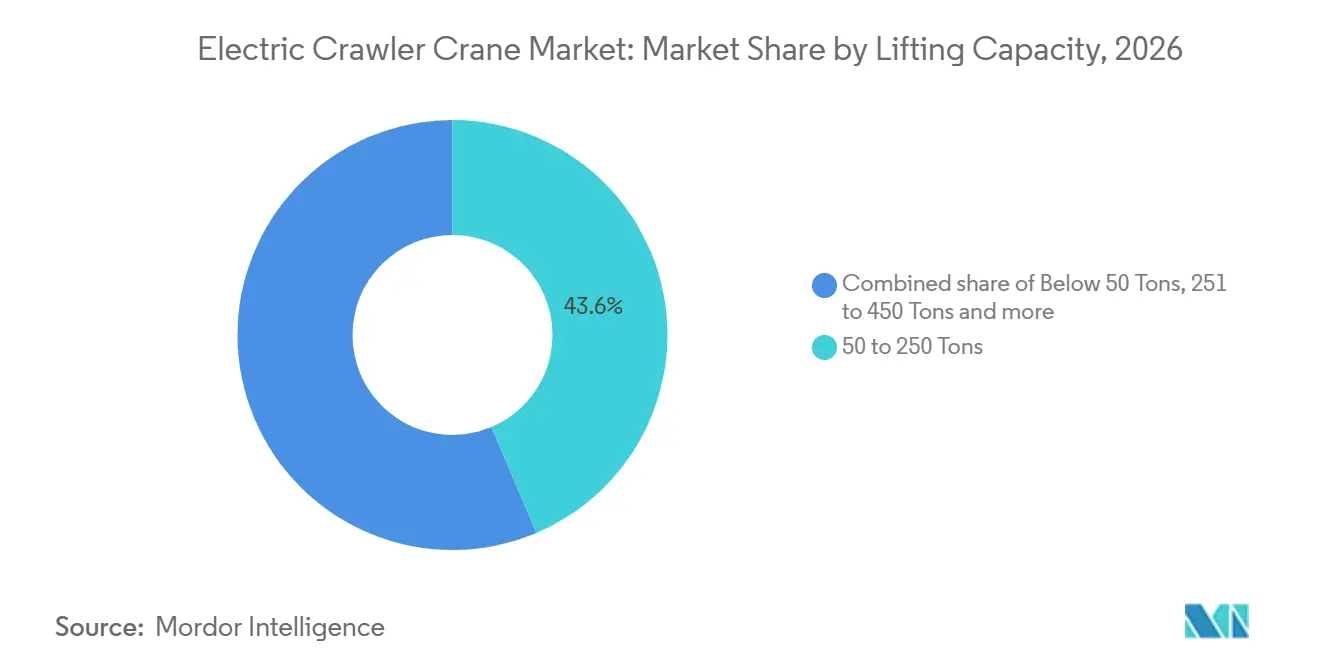
Mid-Range Cranes Anchor Revenues as Light Class ElectrifiesThe 50 to 250 tons segment held 43.62% of the electric crawler crane market revenues in 2026. Its position reflects broad use across infrastructure construction, general heavy lifting, and a portion of wind-related work. This class fits projects that need meaningful capacity without the operating complexity of the largest crawler cranes. Equipment suppliers can address this range with electric, hybrid, and conventional power arrangements. The category also benefits from a large installed base of rental and contractor users. These conditions make it a central replacement market as fleets review their emissions exposure.
Below 50 tons is forecast to grow at a 12.47% CAGR through 2032, the fastest rate among lifting-capacity classes. Compact cranes serve confined-access, urban, and indoor projects where noise and exhaust constraints can be decisive. Electrification expands the types of work these machines can perform, rather than merely replacing diesel. China has issued national standards to support the transformation and upgrading of construction machinery, including standards for electric machinery. Procurement confidence should improve where technical standards provide clearer requirements. The electric crawler crane market can therefore draw growth from smaller machines that address new access conditions.

By Power Source:
Hybrids Hold Market Share as Battery-Electric Rewrites the Growth CurveHybrid diesel-electric equipment held 48.27% of electric crawler crane market revenues in 2026. Hybrid systems provide an intermediate option for operators that need electric-mode capability but also work in locations with uncertain power access. This arrangement can reduce the operational change required for established fleets. It is particularly relevant to contractors that move equipment between urban and remote sites. The existing familiarity of diesel-based systems also supports near-term adoption. For many buyers, the hybrid configuration remains the bridge between compliance needs and operational continuity.
Battery-electric equipment is forecast to grow at a 14.83% CAGR through 2032. This segment benefits from better battery control systems, charging equipment, and interest in eliminating on-site exhaust emissions. It is most compelling when charging can be planned, and utilization is high. Fixed industrial locations and predictable rental work are favorable examples. The move toward battery-electric equipment also increases the importance of power planning, technician training, and battery value assessment. This growth path gives the electric crawler crane market a clear technology-led expansion route while retaining a role for hybrid systems.
By Boom Type:
Lattice Configurations Lead; Telescopic Growth Unlocks New ApplicationsLattice boom configurations held 64.38% of the electric crawler crane market revenues in 2026. Their design supports work that requires long reach, high lift capacity, and demanding civil engineering capability. Infrastructure, wind-related work, and large projects continue to support their use. Lattice cranes also align with heavy-lift applications, where fleet replacement decisions can have the greatest effect on emissions. Their operational role means that electrification must preserve lift performance and duty-cycle reliability. The large installed user base gives manufacturers a defined market for compliant replacement models.
Telescopic boom configurations are forecast to grow at an 11.26% CAGR through 2032. These machines are well suited to pick-and-carry work, limited-access locations, and projects that require quick repositioning. A battery-powered telescopic crawler can be more useful inside facilities and in noise-sensitive urban zones. The California zero-emission equipment list provides visibility into commercially available battery-powered construction equipment. This application flexibility helps extend demand beyond traditional heavy lifting. It also provides the electric crawler crane market with a route into smaller, more specialized projects.
By Application:
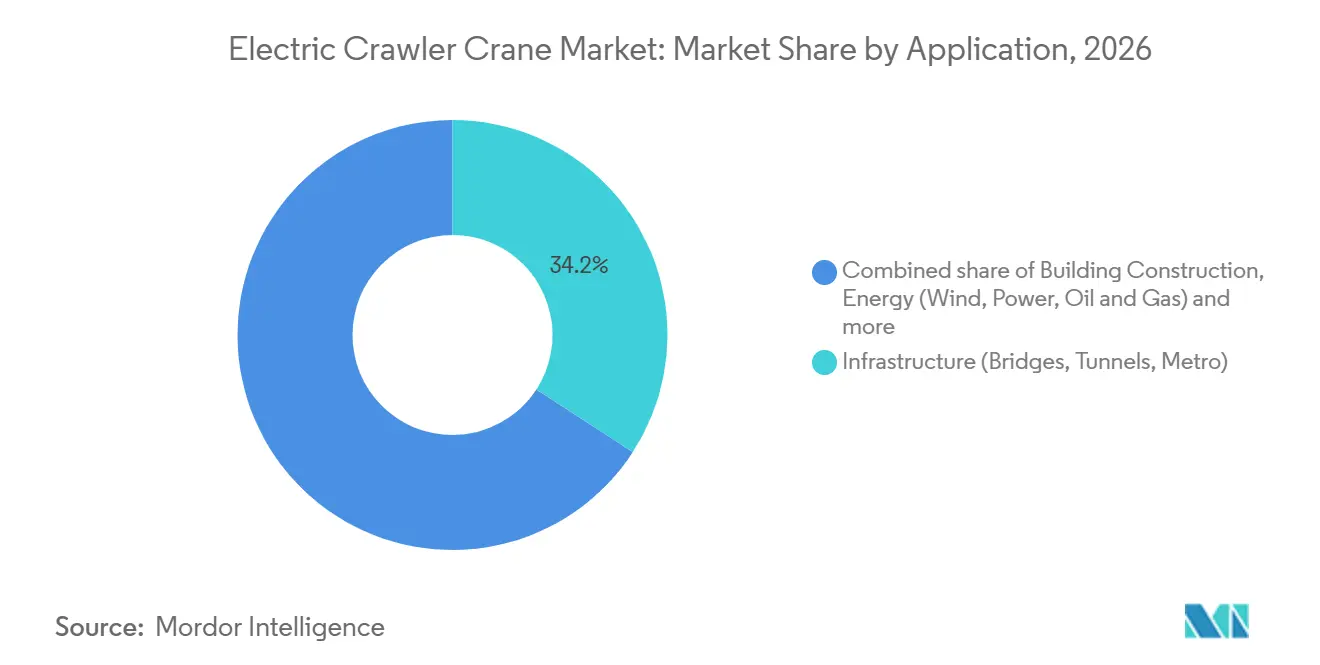
Infrastructure Anchors Demand; Wind Energy Rewrites the Growth OutlookInfrastructure, including bridges, tunnels, and metro projects, held 34.16% of electric crawler crane market revenues in 2026. Public works create steady demand for lifting equipment across civil construction phases. Urban metro and tunnel projects are important because noise and emissions limits can be strict and enforceable. Electrified equipment is therefore relevant both to project access and contractor compliance. Building construction also provides demand, especially where urban rules limit diesel operation. Mining and industrial work remains relevant but can face more difficult charging conditions at remote sites.
Energy, including wind, power, and oil and gas, is forecast to grow at a 12.18% CAGR through 2032. Wind development is a major source of demand because turbines and related infrastructure need planned lifting work. The 165 GW installed globally in 2025 shows the current scale of wind deployment. Grid projects extend this demand to substations and transmission infrastructure. Energy work can favor higher-capacity equipment, although site power availability remains a practical constraint. These conditions support the longer-term opportunity for the electric crawler crane market.
By End User:
Rental Fleets Drive Adoption; Industrial Owners Set the Fastest PaceCrane rental companies held 56.42% of the electric crawler crane market revenues in 2026. Their buying decisions influence equipment availability across many contractors and project types. Rental fleets must balance customer demand, operating cost, utilization, and the residual value of new technology. They also need charging and service plans that work across multiple customer sites. This makes rental companies a key channel for practical market adoption. As tender requirements become more common, fleet availability can become a competitive factor for rental suppliers.
Industrial and utility owners are forecast to grow at an 11.37% CAGR through 2032. These users often operate in fixed facilities or planned infrastructure programs where power access is more predictable. They may also have stronger incentives to reduce diesel use in enclosed or regulated locations. Utility work supports demand through transmission, substation, and grid-hardening programs. Industrial users can link crane deployment to established site energy and maintenance planning. This user group offers a favorable setting for the electric crawler crane market because utilization patterns can be more consistent.
Geography Analysis
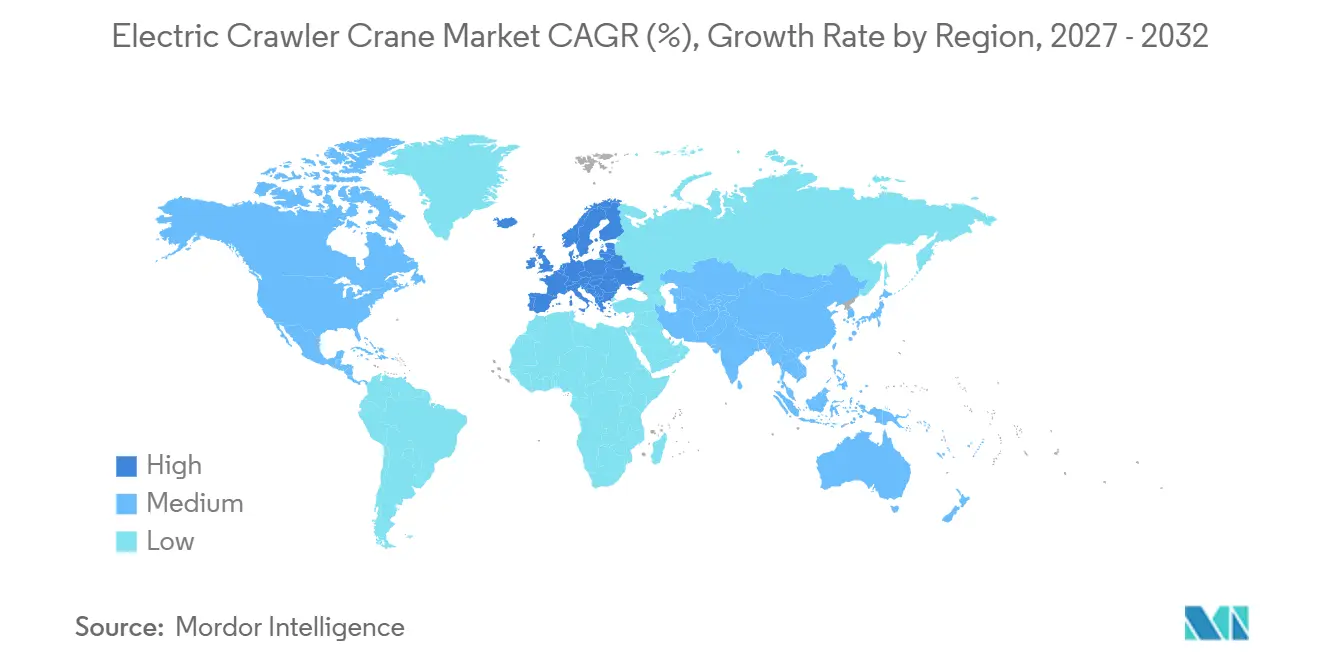
Asia-Pacific held 51.37% of the electric crawler crane market revenues in 2026. China supports regional demand through its large construction base and its position in electric construction machinery manufacturing. National standards work is helping to create a clearer framework for the procurement and technical development of electric construction equipment. Regional infrastructure activity includes metro systems, expressways, ports, energy facilities, and urban redevelopment. These projects create a broad use case for crawler cranes across capacity classes. The region also has a wide mix of site conditions, which supports continued demand for both hybrid and battery-electric equipment.
Europe is forecast to grow at a 12.06% CAGR through 2032. The region combines stricter equipment-emissions rules with public procurement expectations that increasingly consider environmental performance. EU rules for non-road mobile machinery provide a regulatory basis for continuing pressure on diesel equipment choices. Offshore wind development and dense urban construction also provide settings where large cranes and lower-emission operation are both relevant. European buyers may be better placed to deploy electric equipment where charging access and service coverage are established. The electric crawler crane market in Europe is therefore supported by both demand conditions and regulatory direction.
North America has a moderate growth profile, with renewable energy and grid investment supporting equipment demand. Public agencies and municipalities are increasingly considering zero-emission equipment in procurement programs. California’s Clean Construction Program shows how zero-emission equipment requirements are being written into public construction contracts. South America and the Middle East and Africa remain more constrained by grid availability, upfront cost, and the earlier stage of zero-emission procurement. Renewable projects can still support selected hybrid and electric deployments in these regions. Adoption is expected to depend heavily on site power, finance access, and service support.
Competitive Landscape
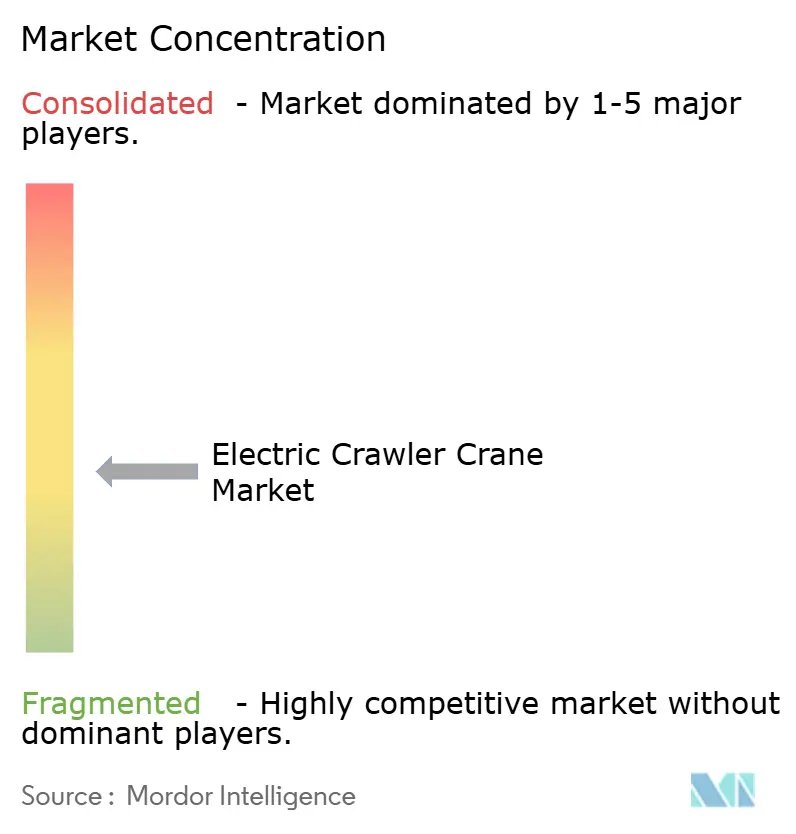
The electric crawler crane market is moderately concentrated, with a group of established manufacturers holding meaningful positions while specialist suppliers compete in niche capacity and power classes. Competition includes large Chinese manufacturers, established European and Japanese engineering groups, and smaller electric-focused suppliers. SANY Heavy Industry, XCMG Group, Zoomlion, Liebherr Group, and Kobelco hold prominent positions in the market. These companies compete through product breadth, lifting capability, technology development, distribution, and service support. The moderately concentrated structure leaves room for differentiated suppliers that can meet specific site, capacity, or power requirements.
Manufacturers are pursuing several practical strategies. Major OEMs are extending electric and dual-power product lines to address tender requirements and fleet decarbonization needs. Suppliers are also improving battery management, regenerative operating functions, charging options, and telematics to reduce operating uncertainty. Chinese manufacturers use broad equipment portfolios and manufacturing scale to strengthen their position in domestic and export markets. European and Japanese manufacturers emphasize engineering performance, documented operating efficiency, and support for demanding lifting work. These approaches mean the electric crawler crane market competes on whole-life usability, not only on the initial equipment price.
Service coverage, battery assessment, and mobile charging remain important competitive gaps. Heavy-lift electric equipment requires both structural engineering capability and high-voltage technical support. Suppliers that can offer dependable maintenance and operator support can reduce a major buyer concern, particularly outside established markets. Standard battery health measures could also improve lease pricing and used-equipment confidence. Interoperable mobile charging would make electric cranes more practical for projects without permanent grid access. These needs create opportunities for current suppliers while raising the difficulty for new entrants that lack field-service networks.
Electric Crawler Crane Industry Leaders
-
Liebherr Group
-
SANY Heavy Industry Co., Ltd.
-
XCMG Group
-
Zoomlion Heavy Industry Science and Technology Co., Ltd.
-
Kobelco Construction Machinery Co., Ltd.
- *Disclaimer: Major Players sorted in no particular order
Electric Crawler Crane Market Companies Covered in this Report
- Liebherr Group
- SANY Heavy Industry Co., Ltd.
- XCMG Group
- Zoomlion Heavy Industry Science and Technology Co., Ltd.
- The Manitowoc Company, Inc.
- Kobelco Construction Machinery Co., Ltd.
- Tadano Ltd.
- Sumitomo Heavy Industries, Ltd.
- Maeda Seisakusho Co., Ltd.
- SENNEBOGEN Maschinenfabrik GmbH
- Fuwa Heavy Industry Machinery Co., Ltd.
- Guangxi LiuGong Machinery Co., Ltd.
- Jekko S.r.l.
- Marchetti Autogru S.p.A.
- PV-E Crane B.V.
- Terex Corporation
- Hitachi Construction Machinery Co., Ltd.
Recent Industry Developments in Electric Crawler Crane Market
- 2026: Liebherr's battery-powered LR 1130.1 unplugged crawler crane was deployed on sheet-pile works at a sluice lock project in the Netherlands.
- May 2026: At its 8th International Customer Festival in Xuzhou, XCMG launched its M-Series crawler cranes and demonstrated an all-electric unmanned crane among more than 20 flagship crane models.
- May 2026: Jekko launched the JF1050 articulated crawler crane, featuring dual diesel-electric operation, a 22-ton lifting capacity, and a 34.5 m tip height, targeting confined industrial and data center applications.
- February 2026: Sarens added a SANY SCC2000A-EV, a fully electric 200-ton lattice-boom crawler crane with a 422 kWh battery and up to eight hours of runtime, to its fleet.
Global Electric Crawler Crane Market Report Scope
The electric crawler crane market is segmented by Lifting Capacity, Power Source, Boom Type, Application, End User, and Geography. By Lifting Capacity, the market is segmented into Below 50 Tons, 50 to 250 Tons, 251 to 450 Tons, and Above 450 Tons. By Power Source, the market is segmented into Battery-Electric, Grid-Connected (Cable/Plug-In) Electric, and Hybrid (Diesel-Electric). By Boom Type, the market is segmented into Lattice Boom and Telescopic Boom. By Application, the market is segmented into Building Construction, Infrastructure (Bridges, Tunnels, Metro), Energy (Wind, Power, Oil and Gas), Mining and Industrial, and Others. By End User, the market is segmented into Crane Rental Companies, Construction Contractors, and Industrial and Utility Owners. By Geography, the market is segmented into North America (United States, Canada, and Mexico), Europe (Germany, United Kingdom, France, Italy, Spain, Russia, and Rest of Europe), Asia-Pacific (China, Japan, India, South Korea, Southeast Asia, Australia, and Rest of Asia-Pacific), South America (Brazil, Argentina, Chile, and Rest of South America), and Middle East and Africa (Saudi Arabia, United Arab Emirates, Turkey, Israel, South Africa, Egypt, and Rest of Middle East and Africa). Market forecasts are provided in terms of Value (USD) and Volume (Units).
Segmentation Overview
| Below 50 Tons |
| 50 to 250 Tons |
| 251 to 450 Tons |
| Above 450 Tons |
| Battery-Electric |
| Grid-Connected (Cable/Plug-In) Electric |
| Hybrid (Diesel-Electric) |
| Lattice Boom |
| Telescopic Boom |
| Building Construction |
| Infrastructure (Bridges, Tunnels, Metro) |
| Energy (Wind, Power, Oil and Gas) |
| Mining and Industrial |
| Others |
| Crane Rental Companies |
| Construction Contractors |
| Industrial and Utility Owners |
| North America | United States |
| Canada | |
| Mexico | |
| Europe | Germany |
| United Kingdom | |
| France | |
| Italy | |
| Spain | |
| Russia | |
| Rest of Europe | |
| Asia-Pacific | China |
| Japan | |
| India | |
| South Korea | |
| Southeast Asia | |
| Australia | |
| Rest of Asia-Pacific | |
| South America | Brazil |
| Argentina | |
| Chile | |
| Rest of South America | |
| Middle East and Africa | Saudi Arabia |
| United Arab Emirates | |
| Turkey | |
| Israel | |
| South Africa | |
| Egypt | |
| Rest of Middle East and Africa |
| By Lifting Capacity | Below 50 Tons | |
| 50 to 250 Tons | ||
| 251 to 450 Tons | ||
| Above 450 Tons | ||
| By Power Source | Battery-Electric | |
| Grid-Connected (Cable/Plug-In) Electric | ||
| Hybrid (Diesel-Electric) | ||
| By Boom Type | Lattice Boom | |
| Telescopic Boom | ||
| By Application | Building Construction | |
| Infrastructure (Bridges, Tunnels, Metro) | ||
| Energy (Wind, Power, Oil and Gas) | ||
| Mining and Industrial | ||
| Others | ||
| By End User | Crane Rental Companies | |
| Construction Contractors | ||
| Industrial and Utility Owners | ||
| By Geography | North America | United States |
| Canada | ||
| Mexico | ||
| Europe | Germany | |
| United Kingdom | ||
| France | ||
| Italy | ||
| Spain | ||
| Russia | ||
| Rest of Europe | ||
| Asia-Pacific | China | |
| Japan | ||
| India | ||
| South Korea | ||
| Southeast Asia | ||
| Australia | ||
| Rest of Asia-Pacific | ||
| South America | Brazil | |
| Argentina | ||
| Chile | ||
| Rest of South America | ||
| Middle East and Africa | Saudi Arabia | |
| United Arab Emirates | ||
| Turkey | ||
| Israel | ||
| South Africa | ||
| Egypt | ||
| Rest of Middle East and Africa | ||
Key Questions Answered in the Report
What is the expected value of the electric crawler crane market by 2032?
The electric crawler crane market is projected to reach USD 519.27 million by 2032, from USD 320.82 million in 2027. The outlook is based on adoption across infrastructure, energy, rental, and fixed industrial applications.
What is driving demand for electric crawler cranes?
Zero-emission procurement requirements, renewable-energy projects, grid construction, and low-noise site access are supporting adoption. The effect is strongest where project specifications make emissions performance a condition of participation.
Which lifting-capacity segment leads electric crawler crane demand?
The 50 to 250 tons segment held 43.62% share in 2026, supported by its use in infrastructure and general heavy lifting. It serves a broad set of projects and provides a practical bridge between smaller access-focused cranes and ultra-heavy equipment.
Which power source is growing fastest?
Battery-electric equipment is forecast to grow at a 14.83% CAGR through 2032 as charging and battery systems improve. Its use is most practical where utilization is predictable and dependable power can be arranged.