
Earbuds Market Size and Share
Market Overview
| Study Period | 2020 - 2031 |
|---|---|
| Market Volume (2026) | 0.5 Billion units |
| Market Volume (2031) | 1.21 Billion units |
| Growth Rate (2026 - 2031) | 19.33 % |
| Fastest Growing Market | Asia Pacific |
| Largest Market | Asia Pacific |
| Market Concentration | Medium |
Major Players *Disclaimer: Major Players sorted in no particular order Image © Mordor Intelligence. Reuse requires attribution under CC BY 4.0. | |
Earbuds Market Analysis by Mordor Intelligence
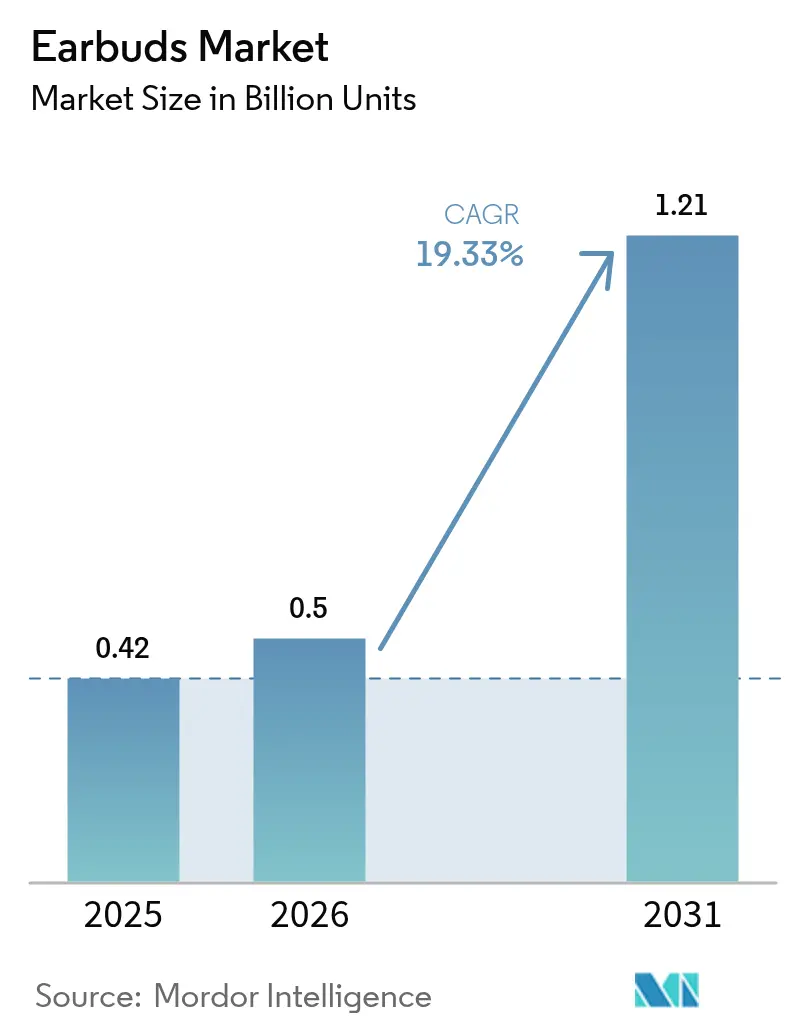
The earbuds market size is expected to grow from 0.42 billion units in 2025 to 0.5 billion units in 2026 and is forecast to reach 1.21 billion units by 2031 at 19.33% CAGR over 2026-2031. Growth reflects rising demand for wellness-centric features, enterprise-grade communications, and premium acoustics woven into compact form factors. Fitness tracking, hybrid-work audio needs, and faster smartphone replacement cycles create multiple tailwinds. Manufacturers leverage Asia Pacific’s supply-chain depth to scale component integration while simultaneously reshoring strategic battery sub-assemblies. Competitive rivalry intensifies as smartphone brands, legacy audio players, and direct-to-consumer specialists introduce advanced noise cancellation, MEMS speakers, and AI-driven personalization, prompting steady feature migration from premium to value tiers.
Key Report Takeaways
- By feature, truly wireless earbuds led with 73.55% earbuds market share in 2025, and the segment is projected to grow at 19.92% CAGR through 2031.
- By geography, Asia Pacific contributed 36.80% of the earbuds market size in 2025 and is expected to expand at 19.15% CAGR to 2031.
- By distribution channel, online channels controlled 59.10% of sales in 2025 and are projected to advance at 19.25% CAGR through 2031.
- By price tier, the mid-price band (USD 50-150) captured 45.05% revenue share in 2025, while the low-price band (below USD 50) posts the fastest 21.34% CAGR over the same horizon.
- By application, fitness and sports accounted for the highest growth, moving at a 19.21% CAGR from 2026-2031.
Note: Market size and forecast figures in this report are generated using Mordor Intelligence’s proprietary estimation framework, updated with the latest available data and insights as of 2026.
Global Earbuds Market Trends and Insights
Drivers Impact Analysis*
| Driver | (~) % Impact on CAGR Forecast | Geographic Relevance | Impact Timeline |
|---|---|---|---|
| Rising fitness-centric audio consumption | +3.2% | Global, early uptake in North America and Europe | Medium term (2-4 years) |
| Shorter replacement cycles for wired earphones | +2.8% | Asia Pacific core, spill-over to global markets | Short term (≤ 2 years) |
| Smartphone and 5G penetration boost | +4.1% | Global, accelerating in Asia Pacific and emerging markets | Medium term (2-4 years) |
| Premium features filtering into low-price tiers | +3.7% | Global, pronounced in price-sensitive markets | Long term (≥ 4 years) |
| Battery component reshoring in Asia Pacific | +2.3% | Asia Pacific manufacturing hubs, global supply impact | Long term (≥ 4 years) |
| Enterprise adoption for hybrid-work audio | +2.9% | North America and Europe, expanding globally | Short term (≤ 2 years) |
| Source: Mordor Intelligence | |||
Rising Fitness-Centric Audio Consumption
The shift toward preventive health elevates earbuds from passive listening devices to active biometric monitors. Nokia Bell Labs’ OmniBuds research platform illustrates the trajectory with integrated 9-axis IMUs, multi-wavelength PPG, and medical-grade temperature sensors that enable continuous heart-rate variability, SpO₂, and cuff-less blood-pressure tracking.[1] Commercial pipelines mirror the laboratory: Synseer targets late-2025 FDA clearance for HealthBuds, pairing ultrasonic in-ear sensing with privacy-preserving edge processing. These capabilities dovetail with the USD 4.4 trillion global wellness economy, supporting a 19.73% CAGR in fitness applications by transforming earbuds into indispensable workout companions and round-the-clock health sentinels.
Smartphone and 5G Penetration Boost
Global 5G rollouts and higher smartphone refresh rates unlock new audio workloads. Qualcomm’s S7 Pro XPAN platform enables high-resolution 96 kHz/24-bit streams over Wi-Fi with Bluetooth-like power draw, first commercialized in Xiaomi’s 2025 Buds 5 Pro press release. Low-latency, high-bandwidth links support spatial audio, real-time translation, and cloud-assisted AI soundscapes. Regulatory tailwinds reinforce the trend: the U.S. Federal Communications Commission mandates 100% hearing-aid compatibility for handsets by 2028, prompting tighter handset-earbud integration.
Premium Features Filtering into Low-Price Tiers
Cost curves on ANC chips, MEMS speakers, and spatial-audio DSPs allow sub-USD 50 models to match yesterday’s flagships. QCY’s partnership with USound will embed MEMS drivers in 2025 mass-market launches, improving phase response and Hi-Res certification while maintaining entry-level pricing.[2]Skullcandy’s EcoBuds combine 65% recycled plastics with battery-free charging cradles at USD 26.99, proving that sustainability and advanced acoustics can coexist in value segments. The democratization enables the low-price tier’s 22.07% growth despite macro-economic uncertainties.
Enterprise Adoption for Hybrid-Work Audio
Remote and hybrid work patterns elevate professional earbud demand. EPOS ADAPT E1 integrates AI-driven ear-fit analysis built on 500,000 ear scans, earning Microsoft Teams certification and embedding device-management APIs critical for IT fleet deployments.[3] Lenovo’s global accessory partnership with EPOS embeds unified-communications audio stacks into ThinkPad and ThinkBook arrays, broadening enterprise exposure. Jabra’s psycho-acoustic research under its BrainAdapt program documents reduced cognitive load in video meetings when optimized spatial cues are present. These developments help accelerate enterprise procurement cycles, especially in banking, consulting, and telehealth verticals.
Restraints Impact Analysis*
| Restraint | (~) % Impact on CAGR Forecast | Geographic Relevance | Impact Timeline |
|---|---|---|---|
| Ergonomic limits for long-hour wear | -2.1% | Global, particularly affecting professional users | Medium term (2-4 years) |
| Hearing-health compliance tightening | -1.8% | North America and Europe regulatory focus | Long term (≥ 4 years) |
| Counterfeit low-cost product influx | -2.4% | Global, concentrated in emerging markets | Short term (≤ 2 years) |
| Rare-earth magnet supply volatility | -1.9% | Global supply chains, Asia Pacific manufacturing impact | Long term (≥ 4 years) |
| Source: Mordor Intelligence | |||
Counterfeit Low-Cost Product Influx
Customs agencies report rising seizures of fake branded earbuds that undercut legitimate players and expose consumers to safety risks. U.S. Customs and Border Protection valued recent confiscations at USD 62.6 million, representing nearly 360,000 counterfeit units, underscoring the scale of illicit trade. E-commerce marketplaces remain the primary conduit. Brand owners respond with blockchain-anchored authenticity tags and machine-vision scrapers that recognize infringements at listing upload, though the solutions are viable mainly for mid- and premium price tiers where margins offset compliance costs.
Rare-Earth Magnet Supply Volatility
Earbuds rely on neodymium-iron-boron micro-drivers for compact high-output sound. The European Commission notes that 98% of EU demand for rare-earth magnets was sourced from China in 2024, heightening exposure to geopolitical shocks. U.S. Department of Energy road-maps outline domestic extraction initiatives, yet commercial volumes remain modest. Emerging alternatives such as iron-nitride compositions from Niron Magnetics promise 70% lower lifecycle CO₂ while sidestepping rare-earth reliance, but mass-production readiness lies beyond the forecast period. Supply tightness translates into fluctuating driver costs and weighs on gross margins, especially for low-price SKUs.
*Our forecasts treat driver/restraint impacts as directional, not additive. The impact forecasts reflect baseline growth, mix effects, and variable interactions.
Segment Analysis
By Feature - Truly Wireless Dominance Accelerates
Truly wireless models represented 73.55% of 2025 shipments, and their 19.92% CAGR positions them as the backbone of the earbuds market. Earbuds market size for truly wireless types is on track to double by 2031 as innovations in solid-state batteries, reverse-charging cases, and low-power Wi-Fi chipsets enhance user convenience. HMD Global’s 1,600 mAh Amped Buds case triples average pack capacity without increasing thickness, underlining progress in energy density. Continuous removal of 3.5 mm ports across smartphones hastens wired attrition, concentrating R&D on untethered designs.
The technology roadmap pivots toward shape-flexible solid-state cells and ultra-wideband (UWB) radios that bolster location services. Samsung’s pilot lines for oxide-based solid-state modules forecast 20% energy-density gains, foundational for sub-4 gram earbud shells. While legacy neckband styles retain a foothold in developing markets where 30-hour runtime remains compelling, their share erodes as truly wireless bill-of-materials costs fall below USD 12.


By Price Range - Mid-Tier Stability amid Low-End Acceleration
The mid-price band maintained 45.05% of the earbuds market share in 2025 owing to equilibrium between feature depth and affordability. Earbuds market size for this tier is projected to grow at a steady clip as ANC, spatial audio, and PPG sensors migrate downward. JLab’s GO Pods ANC provide hybrid noise cancellation and 26-hour playtime at USD 36.99, demonstrating the squeeze on mid-tier differentiation.
Low-price models surge at 21.34% CAGR as component commoditization collides with emerging-market demand. Meanwhile, premium units above USD 150 face slower growth even though Apple’s AirPods line generated USD 18 billion in 2024 revenue. Sustained premium traction now depends on breakthroughs such as camera-equipped stems or AI-led adaptive acoustics rather than incremental codec upgrades. Designers therefore segment portfolios with eco-friendly materials and wellness analytics to uphold price ceilings.
By Distribution Channel - Online Momentum Builds
Digital channels accounted for 59.10% of 2025 shipments, expanding at 19.25% CAGR as vertically integrated brands favor direct-to-consumer logistics. Algorithms leverage first-party sales data for rapid SKU iteration, while web-based fit tests, such as Audiodo’s 3-minute hearing assessment embedded in CMF by Nothing’s Buds 2 Plus, mitigate “try before buy” friction. Subscription models offering periodic upgrades further lock in lifetime value.
Physical retail, however, still influences premium conversion through experiential listening booths and instant gratification. Flagship stores and pop-up kiosks integrate QR-coded journeys that feed consumers back into brand apps, illustrating omnichannel fusion rather than a binary choice. The balance favors online in markets with high logistics reliability and digital payments penetration, notably North America, Western Europe, and Korea.

By Application - Fitness Transformation Drives Growth
Music and general entertainment remain core at 40.85% share, but fitness usage is the fastest climber, reaching a 19.21% CAGR. Earbuds’ multi-sensor arrays capture heart-rate and movement data while delivering coaching cues, a combination that wearables on wrists or arms cannot match for proximity to the carotid artery. Continuous physiologic sampling also feeds telemedicine dashboards, widening addressable revenue beyond hardware sales.
Professional communication benefits from hybrid work, as unified-communications certifications unlock enterprise procurement budgets. AI beam-forming and adaptive ANC improve speech intelligibility, reducing fatigue in back-to-back calls.
Gaming and esports stay niche yet lucrative, demanding sub-45 ms latency and spatial accuracy that justify premium DSPs.
Geography Analysis
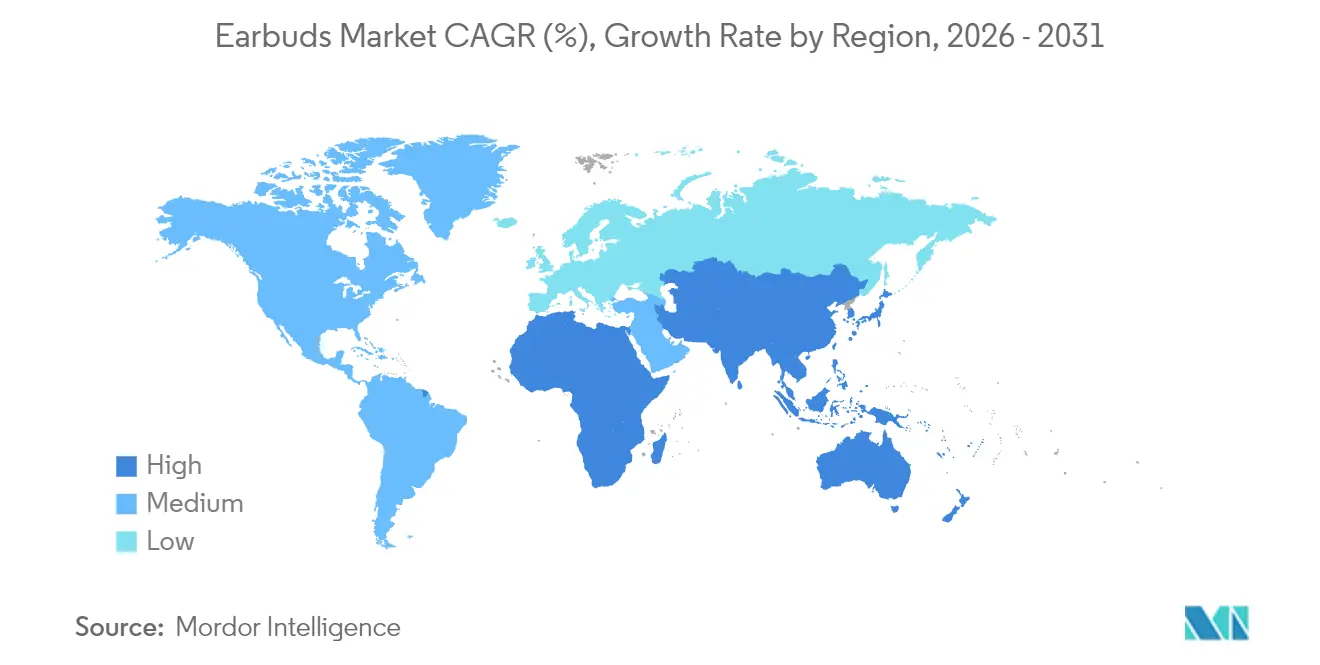
Asia Pacific leads with 36.80% share and sustains a 19.15% CAGR through 2031. Earbuds market size in the region reflects deep contract-manufacturing clusters and rising middle-class spending. Goertek’s USD 280 million Vietnam expansion adds 30 million annual earphone units for Samsung and Apple. India’s offline audio market reached INR 5,000 crore (USD 600 million) in 2024, logging 61% volume growth and signaling robust appetite for true wireless formats.
North America maintains high premium penetration, propelled by accessory attach rates among smartphone flagships. Policy-driven inclusivity also shapes demand: the FCC’s 2028 hearing-aid compatibility mandate fosters new SKUs with ambient-sound amplification and self-fitting audiogram apps. Sustainability preferences steer European consumers toward recycled-plastic housings; Sony reports earbuds using 85% recycled ABS polymers.
Latin America, the Middle East, and Africa register double-digit unit growth off a smaller base, aided by value-tier models embedding ANC and MEMS speakers. Counterfeit infiltration remains acute, prompting customs partnerships and regional warranty centers to reinforce brand trust. Infrastructure gaps in last-mile logistics and digital payments moderate online channel expansion, but smartphone uptake paves the way for accelerated adoption as economic conditions improve.
Regulatory Landscape
Earbuds regulation is tightening around interoperability, product safety, and accessibility. In the European Union, the common charging requirement under the Radio Equipment Directive update (Directive (EU) 2022/2380) applies from 28 December 2024, which pushes USB Type-C alignment for earbuds and charging cases sold in the EU and reinforces expectations for cross-brand charging compatibility.
Safety and accessibility compliance also shape design and test plans across key markets. IEC 62368-1:2023 (Edition 4) is a key global safety baseline for audio/video and ICT equipment, with updated coverage relevant to wearables and battery charging. In the United States, the FCC hearing aid compatibility framework under 47 CFR 20.19 sets an all-model requirement for wireless handsets, with effective dates published for the 100% mandate starting 14 December 2026; while handset-scoped, it raises integration expectations for Bluetooth audio accessories used with compliant smartphones.
Value Chain Analysis
The earbuds value chain runs from component inputs, including audio SoCs and radios, lithium-ion cells, MEMS microphones and speakers, drivers with rare-earth magnets, PCBs, and packaging, through module integration such as SiP and antenna tuning, to final assembly. Asia Pacific remains the production hub through large EMS/ODM ecosystems, followed by brand software stacks (apps, personalization, and device management) and multi-channel distribution led by online channels. Contract manufacturers and ODMs handle most high-volume output, while specialized suppliers differentiate through ANC DSPs, sensors, and next-generation transducers such as solid-state MEMS speakers.
Supply resilience has become a recurring value chain theme, especially rare-earth magnet exposure and China export controls affecting dysprosium and neodymium availability, both of which can disrupt production schedules and pricing. Brands and ecosystem players are adding manufacturing and sub-assembly capacity in Vietnam and India. OnePlus started local manufacturing of TWS earbuds and wireless neckbands in India via Optiemus Electronics (June 2025), and India is also building upstream capability through partnerships such as Infineon and Kaynes Semicon for MEMS microphones and advanced packaging (September 2025). Component innovation partnerships, including USound collaborations for MEMS loudspeakers and boAt working with HrdWyr and Tata Electronics on a local wireless-audio chip (Indus 1011, targeting mid-2026 rollout), point to tighter silicon-to-acoustics integration and more localized supply options.
Competitive Landscape
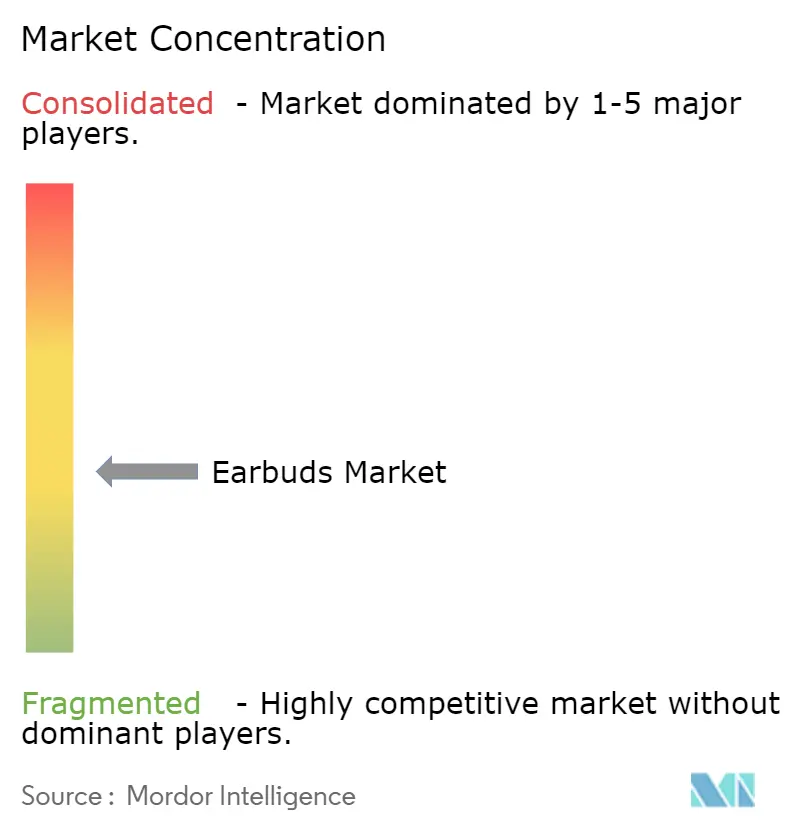
Competitive intensity is moderate, with the top five vendors controlling an estimated 55% of shipments. Apple anchors the premium pole position through vertical integration of H2 audio silicon, seamless iOS pairing, and Find My network lock-in, translating into a USD 18 billion AirPods franchise. Xiaomi and Huawei exploit smartphone ecosystems and aggressive domestic pricing, dominating mid-price volumes across China and Southeast Asia. Sony and Bose defend audiophile niches via LDAC and proprietary noise-reduction algorithms.
Emerging challengers pursue differentiation in health tech and translation. Shokz touts bone-conduction safety for outdoor athletes, while HONOR introduced Earbuds Open with embedded AI translation across 15 languages. The supply side is consolidating: Syntiant’s USD 150 million acquisition of Knowles’ consumer MEMS microphones unit brings edge-AI neural processors under one roof, compressing the sensor-to-model stack for next-gen earables.
Investment flows spotlight hearing-enhancement convergence. Patient Square Capital injected USD 100 million into the Eargo-hearX merger, birthing LXE Hearing and magnifying scale in the over-the-counter hearing-aid category. As technical barriers rise around onboard AI and medical compliance, scale players with chipset design, regulatory expertise, and cloud ecosystems will extend their moat, while boutique labels succeed by targeting micro-niches in sports, sustainability, or fashion.
Earbuds Industry Leaders
-
Apple, Inc.
-
Xiaomi Corporation
-
BBK Electronics Corp. Ltd.
-
Samsung Electronics Co. Ltd.
-
Imagine Marketing Ltd. (boAt)
- *Disclaimer: Major Players sorted in no particular order
Market Opportunities and Future Outlook
A key whitespace is the convergence of consumer earbuds with hearing-health and regulated hearing-device use cases. As priorities shift toward self-fitting audio, ambient amplification, and clinical-grade modes that still fit everyday form factors, the earbuds value proposition moves closer to regulated hearing experiences.
In the US, the FCCs published timeline for the 100% hearing aid compatibility requirement for wireless handsets starting 14 December 2026 increases interoperability and accessibility expectations for the smartphone-plus-earbud experience, which supports tighter coupling between handset audio pathways and wireless peripherals. Industry consolidation is another near-term opportunity area, with Amplifon S.p.A.s March 2026 agreement to acquire GN Hearing from GN Store Nord A/S for DKK 17 billion, bringing hearing-device manufacturing closer to large-scale retail distribution and service networks. Technology roadmaps also support migration into smaller shells and lower price tiers, including Bluetooth LE Audio and highly integrated System-in-Package approaches, such as ASE Technology positioning SiP modules that combine radios, audio compute, MEMS microphones, and biometric sensing in very small footprints. In Europe, sustainability and right-to-repair pressures create room for modular architectures and serviceable battery concepts alongside the EUs push toward more circular electronics designs.
Recent Industry Developments
- May 2026: boAt partnered with HrdWyr and Tata Electronics to develop the Indus 1011 semiconductor chip for wireless audio devices, targeting commercial rollout in mid-2026. The partnership supports more local silicon sourcing and design control for mass-market earbuds and can reduce reliance on imported chipsets for core audio functions.
- September 2025: Infineon Technologies and Kaynes Semicon formed a partnership to produce MEMS microphones and advanced semiconductor packaging in India. Strengthening local availability of key acoustic components shortens lead times for India-assembled earbuds and supports deeper verticalization beyond final assembly.
- June 2025: OnePlus began local manufacturing of TWS earbuds and wireless neckbands in India through Optiemus Electronics. This added India capacity for branded audio wearables and aligns production footprints with local sourcing incentives and faster regional fulfillment.
Research Methodology Framework and Report Scope
Market Definition and Coverage
For this study, the earbuds market covers in-ear audio devices designed for listening and calling, sold through offline and online channels to consumer and institutional buyers across major regions.
Scope exclusions: We exclude over-ear and on-ear headphones, standalone Bluetooth speakers, and hearing aids or clinical in-ear devices.
Segmentation Overview
- By Feature
- Wired Earbuds
- Wireless Earbuds
- Truly Wireless
- Other Wireless Earbuds
- By Price Range
- Premium (> USD 150)
- Mid (USD 50 - 150)
- Low (< USD 50)
- By Distribution Channel
- Offline
- Online
- By Application
- Fitness and Sports
- Gaming and Esports
- Professional and Office
- Music and General Consumer Entertainment
- By Geography
- North America
- United States
- Canada
- Mexico
- South America
- Brazil
- Argentina
- Rest of South America
- Europe
- Germany
- United Kingdom
- France
- Italy
- Rest of Europe
- Asia Pacific
- China
- Japan
- India
- South Korea
- Australia and New Zealand
- Rest of Asia Pacific
- Middle East
- Saudi Arabia
- United Arab Emirates
- Turkey
- Rest of Middle East
- Africa
- South Africa
- Nigeria
- Kenya
- Rest of Africa
- North America
Data Sources, Market Sizing, and Validation
Desk Research
Desk research starts by mapping the demand pool and the product rules so we do not mix earbuds with adjacent audio categories. Public sources such as ITU connectivity indicators, World Bank income and demographics series, OECD household spending data, and UN Comtrade trade flows were used to frame device adoption and import intensity by region.
We also reviewed guidance and papers from bodies such as IEEE on Bluetooth and audio standards behavior, along with retailer disclosures, company annual reports, and product launch information to understand replacement cycles and feature-driven pricing steps. For cross-checking company scale and shipment narratives, we used paid subscriptions for company financials and news screening, and a patent database to track feature intensity over time. The sources named here are illustrative, and many other public documents and datasets were also consulted to collect, validate, and clarify inputs.
Primary Interviews and Surveys
Primary interviews were used to stress-test assumptions on how earbuds are bought, bundled, and priced, including the pace of true wireless replacing wired models in different regions. Discussions covered brands, component-side contacts, distributors, large retail channel participants, and institutional procurement voices across the Americas, EMEA, and APAC, so gaps from public data could be filled and then checked again.
Distribution of primary research fieldwork respondents
| Company type | Respondent position | Region |
|---|---|---|
| Top tier: 34% | CXOs: 16% | APAC: 44% |
| Mid tier: 49% | Functional/Unit leaders: 26% | EMEA: 34% |
| Smaller Players: 17% | Managers: 58% | Americas: 22% |
Market-Sizing & Forecasting
The core model uses top-down demand reconstruction, where smartphone installed base, Bluetooth accessory attach rates, and replacement cycles are used to estimate annual earbuds shipment volume by region, and then split by buying patterns such as online versus offline and wired versus wireless. To keep the results grounded, totals are corroborated with selective bottom-up checks like sampled SKU price points by region, channel mix checks from retailers, and supplier-side conversations on component availability.
Inputs for earbuds were treated as variable drivers rather than fixed constants, including average selling price progression by price tier, shifts toward true wireless, the share of models with active noise cancellation, seasonality around major shopping periods, and currency timing for cross-region conversion. Where public signals are thin in smaller markets, proxy ratios anchored to similar markets are applied, then re-tested through primary feedback so the roll-up does not drift.
For forecasting, scenario analysis is used because pricing and feature adoption can move quickly when new codecs, battery improvements, or phone port changes accelerate upgrades. The scenario weights are adjusted using expert consensus gathered in interviews, and the final path is reconciled back to shipment logic so the outlook remains traceable to specific drivers.
Data Validation & Update Cycle
Validation uses multi-step triangulation, where model outputs are compared with independent signals such as trade movement direction, channel inventory commentary, and the implied units-per-smartphone trajectory. Any sharp variance triggers an anomaly review that checks whether the issue came from a one-time promotion effect, a regional pricing distortion, or a misread of the wired to wireless mix.
Before sign-off, the work is reviewed by another analyst and then re-checked with a small set of re-contact calls when key assumptions change. Reports are refreshed annually, and interim updates are made when material events occur, such as major regulatory changes on wireless standards or sudden supply constraints. Right before delivery, a final pass is done to ensure the latest public disclosures are reflected in the numbers.
Mordor Intelligence's Earbuds Market Size Versus Other Published Estimates
Published numbers for earbuds often differ because the product definition is not always consistent, and because some studies emphasize value, while others emphasize units shipped. Differences also come from how pricing is treated across online versus offline channels and whether forecasts assume aggressive feature up-trading.
Over-ear headphones are outside Mordor Intelligence's scope, which reduces totals versus estimates that roll all personal audio into one figure, and it also changes the implied ASP path because earbuds price tiers behave differently. The spread can also come from using retail revenue with markups instead of end-market shipments, from mixing true wireless with broader wireless earphones, and from refresh timing when fast-moving codec, battery, and ANC adoption changes the slope.
Benchmark comparison
| Source | Market Size | Gaps in Research Methodology |
|---|---|---|
| Mordor Intelligence | USD 0.50 B (2026) | |
| Trade Journal A | USD 5.85 B (2024) | Uses a broader wireless earphones basket and reports value that appears to reflect retail revenue, which can lift totals through markup and category overlap. |
| Industry Brief B | USD 18.20 B (2022) | Focuses on a consumer earbuds definition in value terms, with limited clarity on whether wired models, institutional demand, and regional coverage are handled consistently. |
Looking across the figures, the biggest driver is whether the estimate is unit-based or revenue-based, followed by whether adjacent audio devices are grouped in. When the scope and the pricing logic are spelled out and then re-checked with channel and supply-side inputs, the final market size becomes easier to reconcile and repeat year after year.
Key Questions Answered in the Report
What is the expected shipment volume for earbuds in 2031?
Global shipments are projected to reach 1.21 billion units by 2031, reflecting a 19.33% CAGR from 2026 levels.
Which region will contribute the most incremental units through 2031?
Asia Pacific leads additions due to manufacturing scale and rising disposable incomes, sustaining a 19.15% CAGR.
Why are truly wireless models growing faster than other types?
Continuous battery innovations, elimination of smartphone headphone jacks, and compact charging-case designs drive the 19.92% CAGR for truly wireless units.
How are counterfeit products impacting legitimate brands?
Customs agencies seized counterfeit earbuds worth USD 62.6 million recently, which diverts revenue and imposes brand-protection costs.
Which price tier is expanding the fastest?
The sub-USD 50 band leads with a 21.34% CAGR as ANC, MEMS speakers, and recycled materials become affordable at entry levels.
How will regulatory policies influence future designs?
The FCC's 2028 hearing-aid compatibility mandate accelerates development of earbuds with ambient amplification and self-fit audiograms, especially for the U.S. market.