
Document Verification Market Size and Share
Market Overview
| Study Period | 2020 - 2031 |
|---|---|
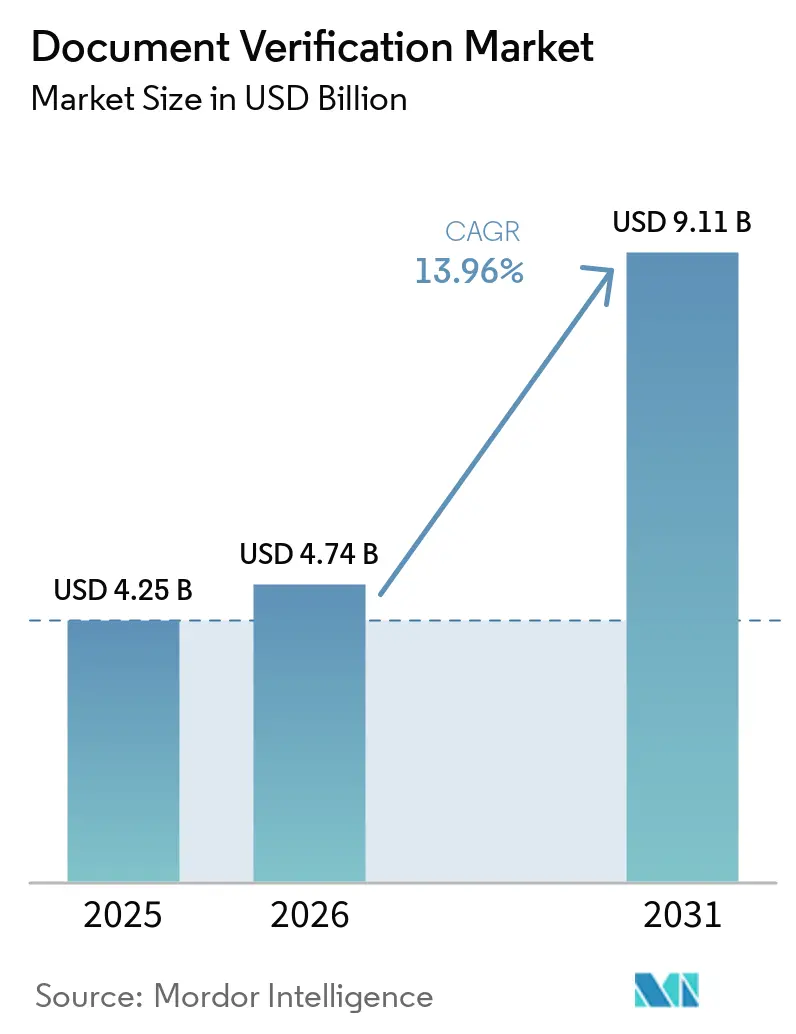
| Market Size (2026) | USD 4.74 Billion |
| Market Size (2031) | USD 9.11 Billion |
| Growth Rate (2026 - 2031) | 13.96 % |
| Fastest Growing Market | Asia-Pacific |
| Largest Market | North America |
| Market Concentration | Medium |
Major Players *Disclaimer: Major Players sorted in no particular order Image © Mordor Intelligence. Reuse requires attribution under CC BY 4.0. | |
Document Verification Market Analysis by Mordor Intelligence
The document verification market is projected to expand from USD 4.25 billion in 2025 and USD 4.74 billion in 2026 to USD 9.11 billion by 2031, registering a CAGR of 13.96% between 2026 to 2031. The document verification market is moving beyond a one-time onboarding check toward ongoing identity assurance across the customer relationship, including later authentication events, account changes, and higher-risk transactions. Higher volumes of synthetic identity fraud are increasing demand for document forensics, liveness detection, deepfake detection, and cryptographic document authentication. Remote onboarding is broadening the addressable customer base among banks, gaming operators, digital lenders, cryptocurrency platforms, public agencies, and other services that need reliable digital registration without an in-person visit. Regulatory changes are also shifting product requirements toward reusable digital credentials and privacy-preserving verification. Vendors are responding by combining document checks with fraud intelligence, screening, transaction monitoring, and post-onboarding risk monitoring.
Key Report Takeaways
- By verification method, fully automated verification held 66.43% of the document verification market share in 2025 and is projected to expand at a 16.72% CAGR through 2031.
- By deployment mode, cloud-based deployment accounted for 63.79% of revenue in the document verification market in 2025 and is expected to grow at an 18.91% CAGR through 2031.
- By end user, government and public administration held 31.82% revenue share within the document verification market in 2025, while gaming, gambling, and digital entertainment is projected to record a 19.47% CAGR through 2031.
- By organization size, large enterprises accounted for 68.91% of revenue in the document verification market in 2025, while small and medium-sized enterprises are projected to expand at a 19.84% CAGR through 2031.
- By geography, North America held 36.79% of revenue in the document verification market in 2025, while Asia-Pacific is projected to grow at an 18.21% CAGR through 2031.
Note: Market size and forecast figures in this report are generated using Mordor Intelligence’s proprietary estimation framework, updated with the latest available data and insights as of January 2026.
Global Document Verification Market Trends and Insights
Drivers Impact Analysis*
| DRIVER | (~) % IMPACT ON CAGR FORECAST | GEOGRAPHIC RELEVANCE | IMPACT TIMELINE |
|---|---|---|---|
| Rising Digital Fraud and Synthetic Identity Attacks | +3.2% | Global, with concentrated exposure in North America and Europe | Short term (≤ 2 years) |
| Expansion of Remote KYC, KYB and Digital Onboarding | +2.9% | Global, led by Asia-Pacific and Europe | Medium term (2-4 years) |
| Increasing Regulatory Requirements for Verifiable Identity Proofing | +2.5% | North America and Europe, with spillover to Asia-Pacific | Medium term (2-4 years) |
| Growth of Cross-Border Digital Transactions | +2.0% | Global, especially Asia-Pacific and Middle East | Long term (≥ 4 years) |
| Government Digital Identity and E-Government Programs | +1.6% | Asia-Pacific, Middle East, and Europe | Medium term (2-4 years) |
| NFC-Enabled Documents and Cryptographic Verification | +1.1% | Europe, Asia-Pacific, and North America | Long term (≥ 4 years) |
| Source: Mordor Intelligence | |||
Rising Digital Fraud and Synthetic Identity Attacks
AI-generated fraud is changing the requirements placed on the document verification market. Sumsub reported that sophisticated fraud attempts rose 180% year over year in 2025, while digitally presented synthetic media was 300% more likely to be AI-generated than in earlier cycles.[1] Fraud now extends beyond a forged document submitted at onboarding and can involve manipulated images, compromised accounts, synthetic identities, and attempts to exploit trusted sessions after the initial verification. Attackers can re-enter verified sessions and introduce manipulated selfies during later authentication events. In July 2026, AU10TIX and Reality Defender partnered to add real-time multimodal deepfake detection to document forensics and cross-customer fraud intelligence. This approach adds contextual risk signals rather than relying on a simple pass-or-fail decision, allowing organizations to escalate suspicious cases while avoiding unnecessary friction for lower-risk users. The document verification market, therefore, rewards providers that combine document analysis with network-level fraud signals.
Expansion of Remote KYC, KYB, and Digital Onboarding
Remote onboarding has become a customer-acquisition tool for regulated digital services. Jumio stated that 60% of previously verified users could complete re-verification with a selfie alone through its selfie.DONE service. Its early Asia-Pacific deployments reported a 20% increase in verification completion rates. Reusable identity can turn an institution-specific KYC process into a credential that users can present across multiple participating services, subject to user consent and the participation model used by the service providers. This model gives providers with large, consented identity graphs a way to reduce friction from repeat verification. Sumsub introduced Workforce Verification in September 2026 to place document checks and biometric liveness within enterprise identity and access management workflows. The document verification market is benefiting as remote processes spread across consumer, employee, and contractor onboarding.
Increasing Regulatory Requirements for Verifiable Identity Proofing
Regulatory requirements are moving digital identity products from policy discussions into operational implementation. Regulation (EU) 2024/1183 requires EU member states to make a European Digital Identity Wallet available by November 2026.[2] The European Union also adopted Implementing Regulation (EU) 2026/798 in April 2026 to set technical requirements for remote onboarding to digital identity wallets. These rules increase the need for systems that can process cryptographically secured credentials as well as conventional document images, while retaining evidence and decision records that fit regulated onboarding processes. Financial institutions with older onboarding systems may need to change how they receive and validate identity evidence. This supports demand in the document verification market for wallet-ready workflows, NFC reading, and higher-assurance credential verification.
Growth of Cross-Border Digital Transactions
Cross-border digital services must operate across different document types, assurance levels, privacy rules, and data-residency requirements. This creates a practical need for a single integration capable of handling many national documents and digital identity schemes. In 2026, Jumio reported that it had extended digital identity support to more than 60 countries through a single integration. Such coverage matters to banks, marketplaces, travel providers, gaming operators, and digital platforms that serve users in multiple countries. It also raises the value of document libraries that are regularly updated and verified for local requirements, including changes to document formats, national identity schemes, and acceptable proofing routes. The document verification market benefits when firms seek to reduce the cost of maintaining separate verification stacks by country. Providers that can serve multiple jurisdictions with a consistent workflow are better positioned to retain multinational customers.
Restraints Impact Analysis*
| RESTRAINT | (~) % IMPACT ON CAGR FORECAST | GEOGRAPHIC RELEVANCE | IMPACT TIMELINE |
|---|---|---|---|
| Fragmented Regional Regulation and Assurance Requirements | -0.9% | Global, with sharpest impact on cross-border operators | Medium term (2-4 years) |
| Privacy, Data Sovereignty and Biometric Consent Constraints | -0.7% | Europe, Asia-Pacific, Global | Long term (≥ 4 years) |
| False Rejection and Customer-Abandonment Risk | -0.5% | Global | Short term (≤ 2 years) |
| Integration Complexity Across Legacy Onboarding Systems | -0.3% | North America and Europe, established financial hubs | Medium term (2-4 years) |
| Source: Mordor Intelligence | |||
Fragmented Regional Regulation and Assurance Requirements
Different national assurance frameworks complicate cross-border deployments in the document verification market. The European Union uses eIDAS assurance levels, while the United States has NIST identity assurance guidance, and Japan is moving toward IC chip reading for remote account opening. Japan's OpenID Foundation published private-sector digital identity verification guidelines in August 2026 that address the country-specific framework.[3] A method that meets one jurisdiction's requirements may not satisfy another's technical or evidentiary standard. Enterprises may therefore favor larger orchestration providers that have invested in multi-jurisdiction certification and document coverage. This preference can make it harder for smaller providers to compete for global contracts. It may also reduce the number of independent point-solution providers serving the same customer.
Privacy, Data Sovereignty, and Biometric Consent Constraints
Biometric data is subject to strict requirements regarding consent, storage, and cross-border transfer in many jurisdictions. Brazil's ITI Normative Instruction No. 36, effective May 5, 2026, requires biometric matching against national databases and deepfake-prevention protocols for the issuance of remote digital certificates. These requirements can increase implementation costs, require changes to consent and data-retention processes, and limit the use of centrally stored biometric data. The resulting constraints are encouraging providers to consider selective-disclosure credentials and other privacy-preserving verification designs. Such designs allow a relying party to validate an attribute without receiving all personal data used in the check. The document verification market must therefore balance automation, assurance, and privacy in each product architecture.
*Our forecasts treat driver/restraint impacts as directional, not additive. The impact forecasts reflect baseline growth, mix effects, and variable interactions.
Segment Analysis
By Verification Method: Automated Verification Supports Scaled Identity Decisions
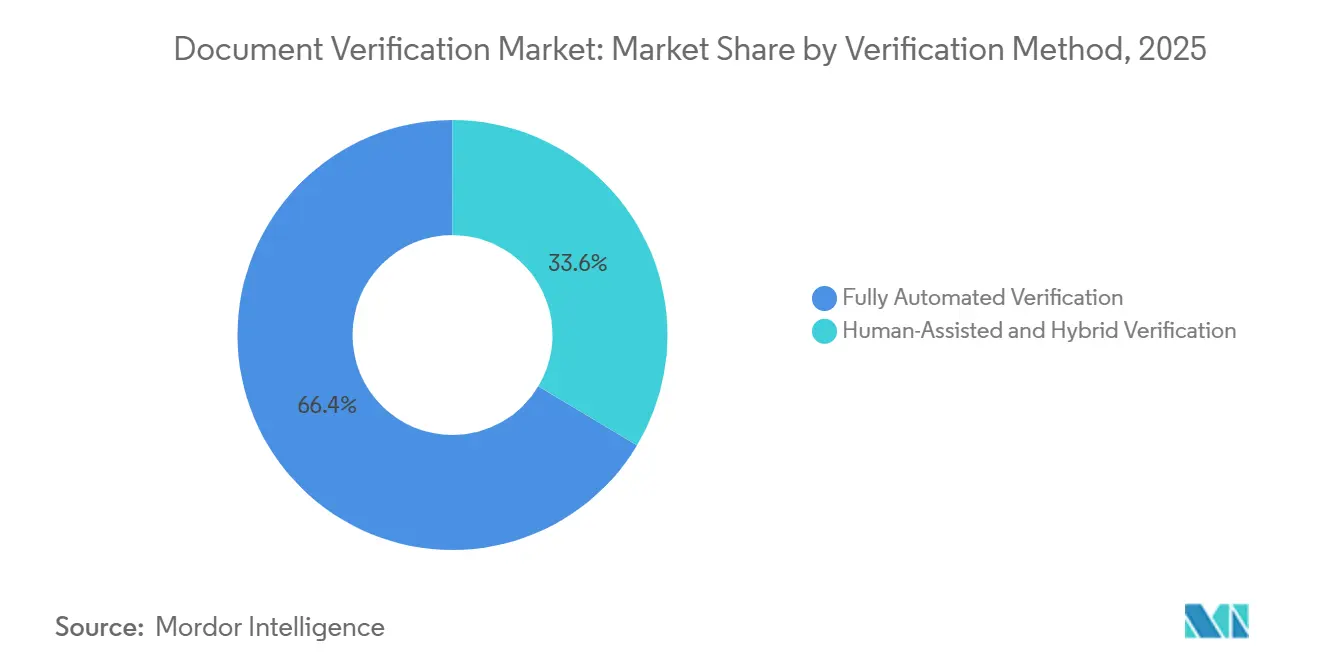
Fully automated verification held 66.43% revenue share within the document verification market in 2025 and is projected to grow at a 16.72% CAGR through 2031. This position reflects wider use of AI-based document forensics and passive liveness detection in regulated onboarding. Automated workflows can process high volumes while applying consistent decision rules, capturing evidence, and recording each step for later review by operational and compliance teams. They are useful where businesses need quick registration, repeatable controls, clear audit trails, and consistent treatment of routine identity evidence across large applicant volumes. The continuing growth rate indicates that some transactions still need alternative review paths.
Human-assisted and hybrid verification remains relevant where organizations need an expert-reviewed decision. In September 2025, IDnow and DocuSign introduced a German solution that combined eID-based identity proofing with electronic signatures for anti-money laundering obligations.[4] The model shows that automation and human oversight can operate together in high-assurance settings. Providers can direct lower-risk cases to automated flows and reserve specialist review for elevated-risk signals. This approach reduces routine processing work while maintaining a path for unfamiliar documents, unusual user circumstances, and cases that require a clear explanation of the decision.
By Deployment Mode: Cloud Delivery Broadens Access to Verification Tools
Cloud-based deployment accounted for 63.79% of revenue in the document verification market in 2025 and is projected to grow at an 18.91% CAGR through 2031. Cloud platforms provide document verification through application programming interfaces, regularly updated models, centralized administration, and configurable integrations, all without the need to maintain dedicated local hardware. They simplify deployment across multiple countries without requiring customers to build local technical infrastructure for each rollout. These benefits matter to digital-native firms and businesses entering regulated online services. Continuous software updates can support new document templates, changing fraud patterns, evolving compliance needs, and product improvements that customers can adopt without a full software replacement.
On-premises deployment continues to matter for government entities, defense-related users, and financial institutions with strict data-sovereignty requirements. These customers may not be able to transmit sensitive biometric information outside national or internal environments. On-premises projects can involve customized installation, configuration, security review, internal infrastructure coordination, and ongoing lifecycle support from the provider and the customer's technology team. This creates a different commercial model from cloud services, which charge based on verification volume or subscription. The document verification market continues to require both deployment approaches to serve customers with different operational and data-control requirements.
By End User: Government Leads Demand While Gaming Expands Quickly
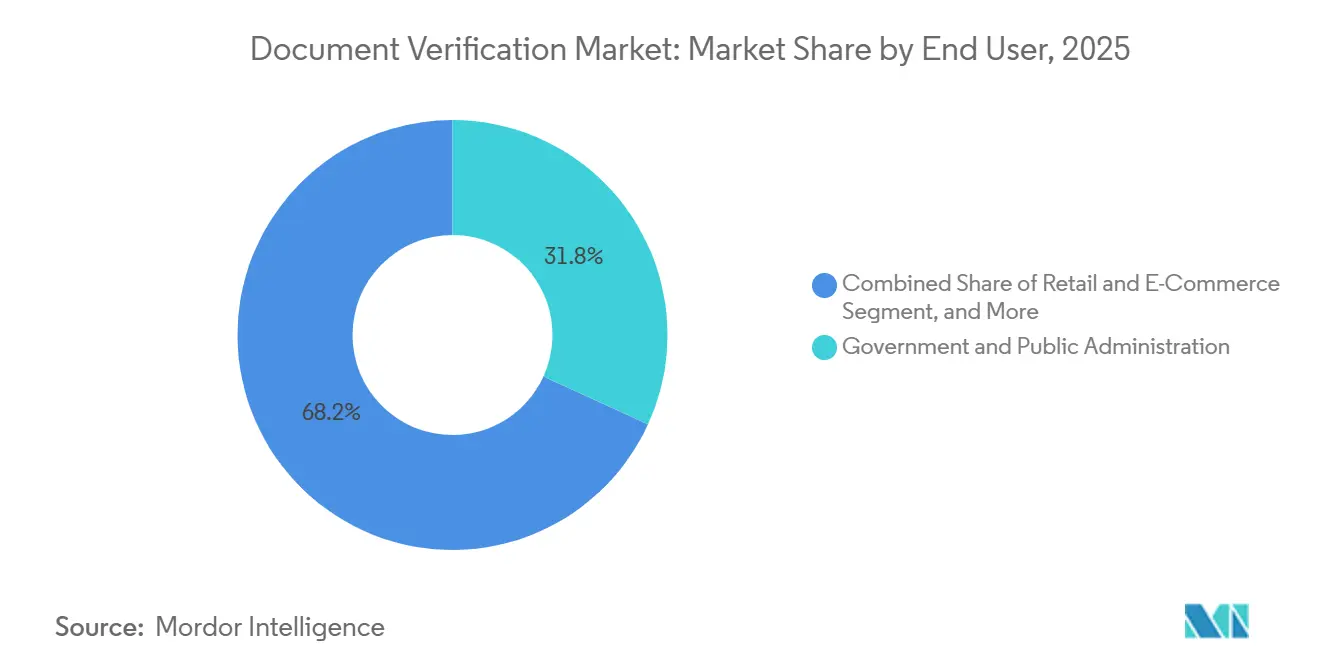
Government and public administration accounted for 31.82% of the revenue share in the document verification market in 2025. National digital identity programs, e-government services, immigration processes, and benefits enrollment often require high-assurance checks. These applications can involve NFC chip reading and cryptographic document authentication. Public-sector purchasing also requires documented controls for security, reliability, and compliance. Government use cases can provide large implementation volumes, long customer relationships, and demanding procurement requirements that test the security and reliability of a provider's offering.
The gaming, gambling, and digital entertainment industry is projected to grow at a 19.47% CAGR through 2031. Online operators need reliable identity and age checks before account access and financial activity. The UK Gambling Commission requires operators to verify customer information against credit reference data and the electoral roll to verify identity and age.[5] This increases demand for low-friction onboarding that still meets regulatory requirements and avoids unnecessary abandonment during registration or before a user can access a service. Healthcare, retail, education, cryptocurrency, mobility, and shared-economy services also use verification for patient onboarding, fraud prevention, remote examinations, and account security.

By Organization Size: Small and Medium-Sized Businesses Increase Adoption
Large enterprises accounted for 68.91% of revenue in the document verification market in 2025. Their transaction volumes, compliance obligations, and established vendor relationships support this position. Banks, multinational firms, and major government contractors often need service-level commitments, custom integration support, coverage across several jurisdictions, and clear controls for internal audit and compliance reviews. These needs favor providers with mature document libraries and regulatory certifications. Large customers may also use multiple identity products, including screening and transaction monitoring.
Small and medium-sized enterprises are projected to grow at a 19.84% CAGR through 2031. Cloud-based application programming interfaces, self-service onboarding, pay-per-verification pricing, and prebuilt compliance templates lower the adoption barrier for organizations without large technical or compliance teams. This is relevant for smaller cryptocurrency exchanges, buy-now-pay-later providers, online gaming operators, and similar businesses entering regulated digital activities. In July 2026, Sumsub introduced an integrated platform combining identity verification, anti-money laundering screening, transaction monitoring, fraud signals, case management, and compliance reporting. Consolidated platforms can reduce the number of separate tools a smaller company needs to operate.
Geography Analysis
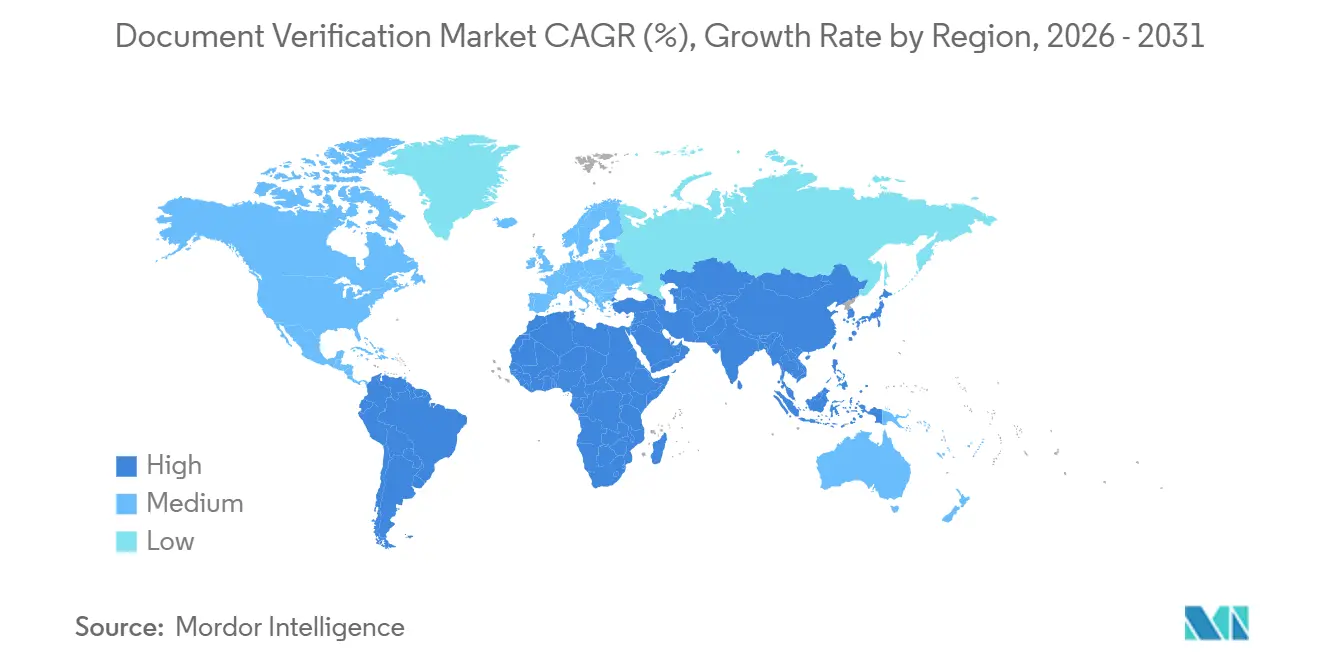
North America accounted for 36.79% of revenue in the document verification market in 2025. The region has demand from financial KYC requirements, healthcare credentialing, gaming compliance, and government identity-proofing programs. The United States is moving toward wider acceptance of verifiable digital credentials in financial services onboarding. This supports investment in systems that validate cryptographically anchored credentials, conventional document images, biometric signals, and the associated evidence needed for regulated onboarding decisions. South America is also generating demand through regulated sports betting and other online services that require KYC, anti-money laundering, and age verification.
Europe is a major regulatory center for the document verification market. EU member states must make the European Digital Identity Wallet available by November 2026, pursuant to Regulation (EU) 2024/1183.[6] Implementing Regulation (EU) 2026/798 sets technical requirements for remote onboarding to these wallets, including NFC-based document chip reading as an identity-proofing route. Different eID adoption levels in Germany, the United Kingdom, France, Italy, and Spain support demand for offerings that work with document scans, national eIDs, and wallet-native credentials during the transition.
Asia-Pacific is projected to be the fastest-growing region at an 18.21% CAGR through 2031. India’s Aadhaar and Singapore’s SingPass each have adoption above 97% of their national populations, creating trust anchors for enterprise identity integrations. Vietnam introduced biometric face matching for online banking accounts in January 2026, while Japan is expected to require IC chip reading of the My Number Card for remote account opening from April 2027. Indonesia’s IKD platform surpassed 20.5 million users in 2026, according to the supplied material. The Middle East is expanding e-government services that embed identity verification into public service access, while Africa offers longer-term potential as smartphone use and mobile-first fintech services extend remote onboarding to previously underserved users.
Competitive Landscape
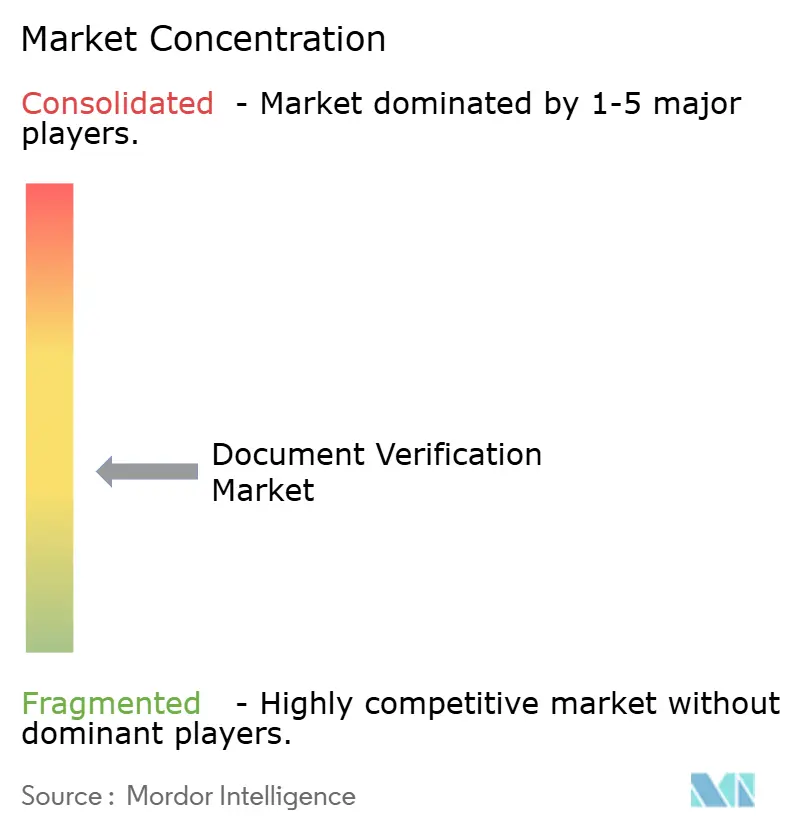
The document verification market is moderately fragmented because no provider has a dominant disclosed revenue position in the supplied material. Pure-play specialists include Jumio, Veriff, AU10TIX, Intellicheck, iDenfy, ComplyCube, Shufti Pro, HyperVerge, IDfy Solutions, Smile Identity, AuthenticID, and FacePhi Biometría. Full-stack providers include Sumsub, Persona, Trulioo, and IDnow. Hybrid data and document providers include LexisNexis Risk Solutions, GB Group, Experian, Mitek Systems, Entrust, Thales, and IDEMIA. Specialists focus on document coverage, verification accuracy, straightforward integration, and the ability to process a broad range of identity documents within a single customer workflow.
Competitive strategies are shifting from a one-time onboarding product toward continuing risk monitoring. Jumio launched Jumio Watch in April 2026 to analyze cross-customer identity-risk signals after the initial onboarding event. Sumsub's integrated platform combines verification with screening, monitoring, fraud signals, case management, and reporting. These approaches can increase provider relevance after an account has opened because fraud, account changes, and new compliance events can occur well beyond the initial identity check. They can also increase switching costs when multiple compliance workflows operate through a single platform.
Physical self-service environments are another area of product development. In August 2026, AU10TIX and NEO partnered to place document verification, biometric matching, and age assurance in terminals for gaming, hospitality, and travel locations. The partners reported live deployments with Australian gaming operators and planned expansion to Asia, the United States, and Europe. NFC chip-based verification and automated compliance-review tools are also competing for investment as customers seek higher assurance, stronger privacy controls, and lower manual handling requirements.
Document Verification Industry Leaders
-
Jumio
-
Entrust
-
Mitek Systems, Inc.
-
Veriff OÜ
-
Sumsub
- *Disclaimer: Major Players sorted in no particular order
Recent Industry Developments
- September 2026: Proof launched its Verifiable Digital Credential, a portable, reusable identity anchored to a Kantara-certified NIST IAL2 proofing process and issued by a WebTrust-audited certificate authority, enabling consumers to verify identity once and reuse it across participating financial institutions. The launch followed multi-agency FinCEN guidance on September 8, 2026, formally authorizing banks and credit unions to use verifiable digital credentials for Customer Identification Program compliance.
- September 2026: Jumio extended its reusable identity solution, selfie.DONE, across Asia-Pacific, covering markets including Singapore, Australia, and Japan, following earlier rollouts in South America and North America in 2026. The platform leverages a consented identity graph of more than 75 million entries, with early APAC deployments reporting a 20% increase in verification completion rates.
- September 2026: Sumsub launched Workforce Verification, embedding identity document checks, biometric liveness detection, and background screening directly into enterprise IAM and HR platforms, targeting AI-powered impersonation fraud affecting employee and contractor onboarding at scale.
- August 2026: AU10TIX and NEO partnered to embed real-time identity verification, age assurance, and fraud prevention into NEO's physical self-service terminals, with live customer deployments at Australian gaming and hospitality venues. The partnership targets operators seeking to complete identity and age verification within high-volume, in-person self-service environments up to 10 times faster than manual workflows.
Global Document Verification Market Report Scope
The document verification market includes software, hardware, and services that authenticate the legitimacy and accuracy of physical and digital documents, such as government-issued identity documents (e.g., passports, driver's licenses, and national ID cards), financial statements, legal certificates, educational credentials, and business registration documents. These solutions use technologies such as optical character recognition (OCR), machine learning-based anomaly detection, biometric liveness verification, cryptographic document analysis, and forensic validation of security features, including holograms, microprinting, color-shifting inks, and MRZ, barcode, and QR code validation. The market supports digital identity verification and Know Your Customer (KYC) compliance across different sectors by helping organizations prevent document fraud, reduce manual errors, accelerate onboarding, and comply with regulations such as AML/CFT, eIDAS, the ESIGN Act, and GDPR.
The Document Verification Market Report is Segmented by Verification Method (Fully Automated Verification, and Human-Assisted and Hybrid Verification), Deployment Mode (Cloud-Based, and On-Premises), End User (Banking, Financial Services, and Insurance (BFSI), Government and Public Administration, Healthcare and Life Sciences, Retail and E-Commerce, IT and Telecommunication, Gaming, Gambling and Digital Entertainment Companies, Education and Research Institutions, and Other End Users), Organization Size (Large Enterprises, and Small and Medium-Sized Enterprises), and Geography (North America, South America, Europe, Asia-Pacific, Middle East, and Africa). The Market Forecasts are Provided in Terms of Value (USD).
| Fully Automated Verification |
| Human-Assisted and Hybrid Verification |
| Cloud-Based |
| On-Premises |
| Banking, Financial Services, and Insurance (BFSI) |
| Government and Public Administration |
| Healthcare and Life Sciences |
| Retail and E-Commerce |
| IT and Telecommunication |
| Gaming, Gambling and Digital Entertainment Companies |
| Education and Research Institutions |
| Other End Users |
| Large Enterprises |
| Small and Medium-Sized Enterprises |
| North America | United States |
| Canada | |
| South America | Brazil |
| Argentina | |
| Mexico | |
| Rest of South America | |
| Europe | Germany |
| United Kingdom | |
| France | |
| Italy | |
| Spain | |
| Rest of Europe | |
| Asia-Pacific | China |
| India | |
| Japan | |
| South Korea | |
| Rest of Asia-Pacific | |
| Middle East | United Arab Emirates |
| Saudi Arabia | |
| Rest of Middle East | |
| Africa | South Africa |
| Rest of Africa |
| By Verification Method | Fully Automated Verification | |
| Human-Assisted and Hybrid Verification | ||
| By Deployment Mode | Cloud-Based | |
| On-Premises | ||
| By End User | Banking, Financial Services, and Insurance (BFSI) | |
| Government and Public Administration | ||
| Healthcare and Life Sciences | ||
| Retail and E-Commerce | ||
| IT and Telecommunication | ||
| Gaming, Gambling and Digital Entertainment Companies | ||
| Education and Research Institutions | ||
| Other End Users | ||
| By Organization Size | Large Enterprises | |
| Small and Medium-Sized Enterprises | ||
| By Geography | North America | United States |
| Canada | ||
| South America | Brazil | |
| Argentina | ||
| Mexico | ||
| Rest of South America | ||
| Europe | Germany | |
| United Kingdom | ||
| France | ||
| Italy | ||
| Spain | ||
| Rest of Europe | ||
| Asia-Pacific | China | |
| India | ||
| Japan | ||
| South Korea | ||
| Rest of Asia-Pacific | ||
| Middle East | United Arab Emirates | |
| Saudi Arabia | ||
| Rest of Middle East | ||
| Africa | South Africa | |
| Rest of Africa | ||
Key Questions Answered in the Report
What is the document verification market size?
The document verification market is projected to expand from USD 4.25 billion in 2025 and USD 4.74 billion in 2026 to USD 9.11 billion by 2031, registering a CAGR of 13.96% between 2026 to 2031.
Which verification method has the largest share?
Fully automated verification held 66.43% of revenue in 2025 and is projected to grow at a 16.72% CAGR through 2031.
Why are companies adopting document verification platforms?
Companies use these platforms to support remote onboarding, meet KYC and age-assurance obligations, and address synthetic identity and deepfake fraud.
Which deployment model is growing fastest?
Cloud-based deployment accounted for 63.79% of revenue in 2025 and is projected to expand at an 18.91% CAGR through 2031.
Which end users are creating the strongest demand?
Government and public administration held the largest share in 2025, while gaming, gambling, and digital entertainment is projected to grow fastest at a 19.47% CAGR.
Which region is expected to expand fastest?
Asia-Pacific is projected to grow at an 18.21% CAGR through 2031, supported by digital identity programs and banking modernization.