
Document Fraud Detection Market Size and Share
Market Overview
| Study Period | 2020 - 2031 |
|---|---|
| Market Size (2026) | USD 3.58 Billion |
| Market Size (2031) | USD 9.16 Billion |
| Growth Rate (2026 - 2031) | 20.70 % |
| Fastest Growing Market | Asia-Pacific |
| Largest Market | North America |
| Market Concentration | Low |
Major Players *Disclaimer: Major Players sorted in no particular order Image © Mordor Intelligence. Reuse requires attribution under CC BY 4.0. | |
Document Fraud Detection Market Analysis by Mordor Intelligence
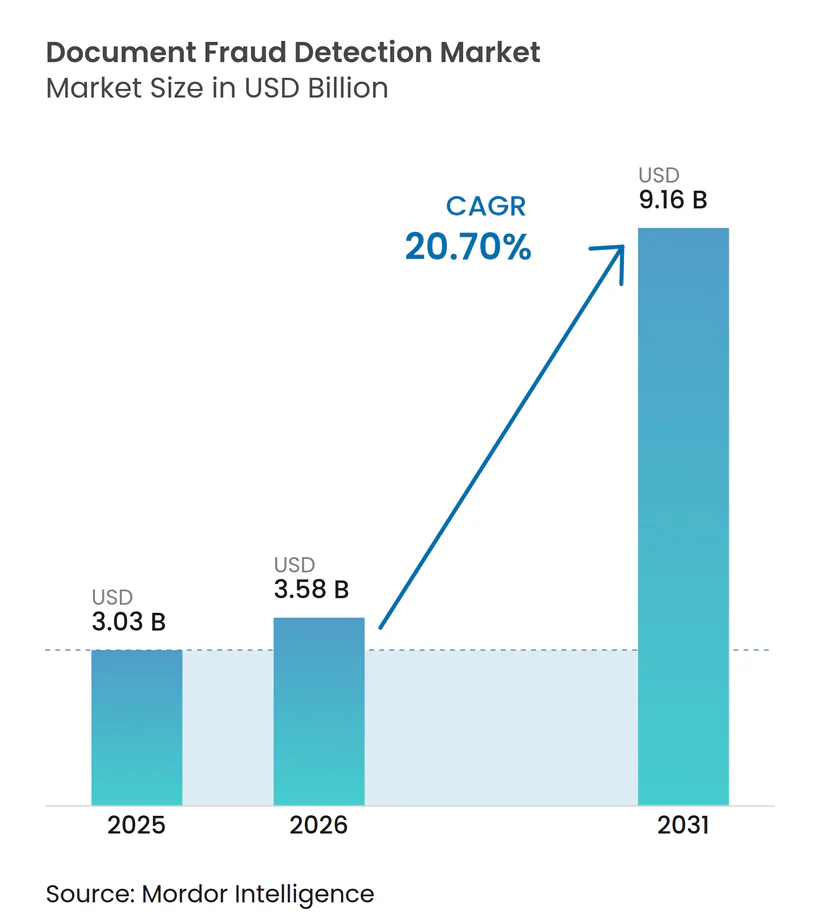
The Document Fraud Detection Market size is projected to expand from USD 3.03 billion in 2025 to USD 3.58 billion in 2026, and to USD 9.16 billion by 2031, registering a CAGR of 20.70% between 2026 and 2031. Remote onboarding is making reliable document checks a core requirement for banks, public agencies, and digital platforms. Generative AI has also made forged documents and synthetic identities easier to create at scale. Buyers are therefore looking for systems that combine document analysis, data extraction, liveness checks, and clear case decisions. Regulatory changes in the United States and Europe are connecting digital credentials more directly to customer identification rules. These conditions favor providers that can update their models quickly and connect with existing verification workflows.
Key Report Takeaways
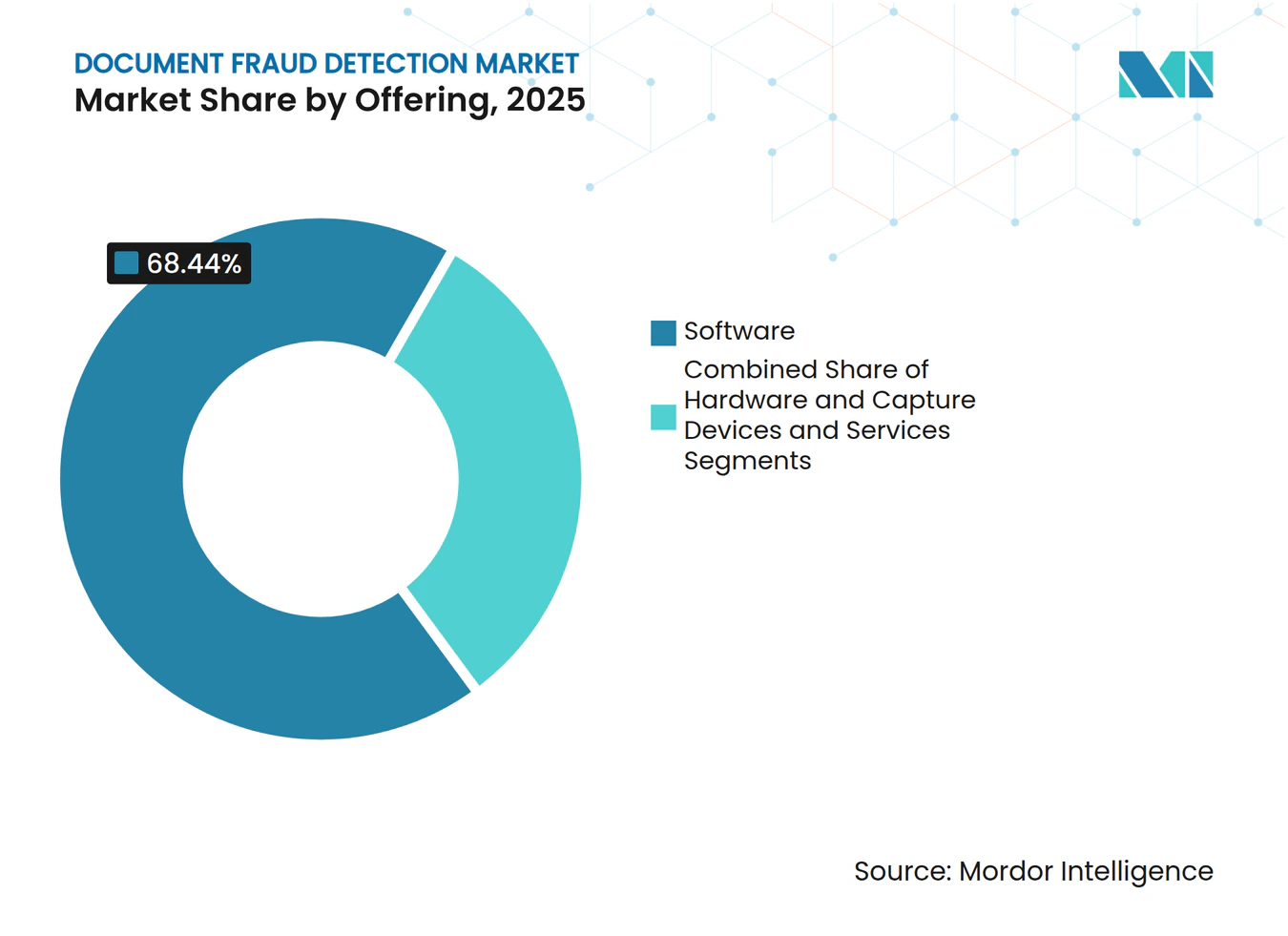
- By offering, software held 68.44% of the Document Fraud Detection market share in 2025, while services are projected to expand at a CAGR of 21.98% through 2031.
- By deployment, cloud-based systems accounted for 65.21% of the Document Fraud Detection market in 2025, while hybrid deployment is projected to expand at a CAGR of 22.36% through 2031.
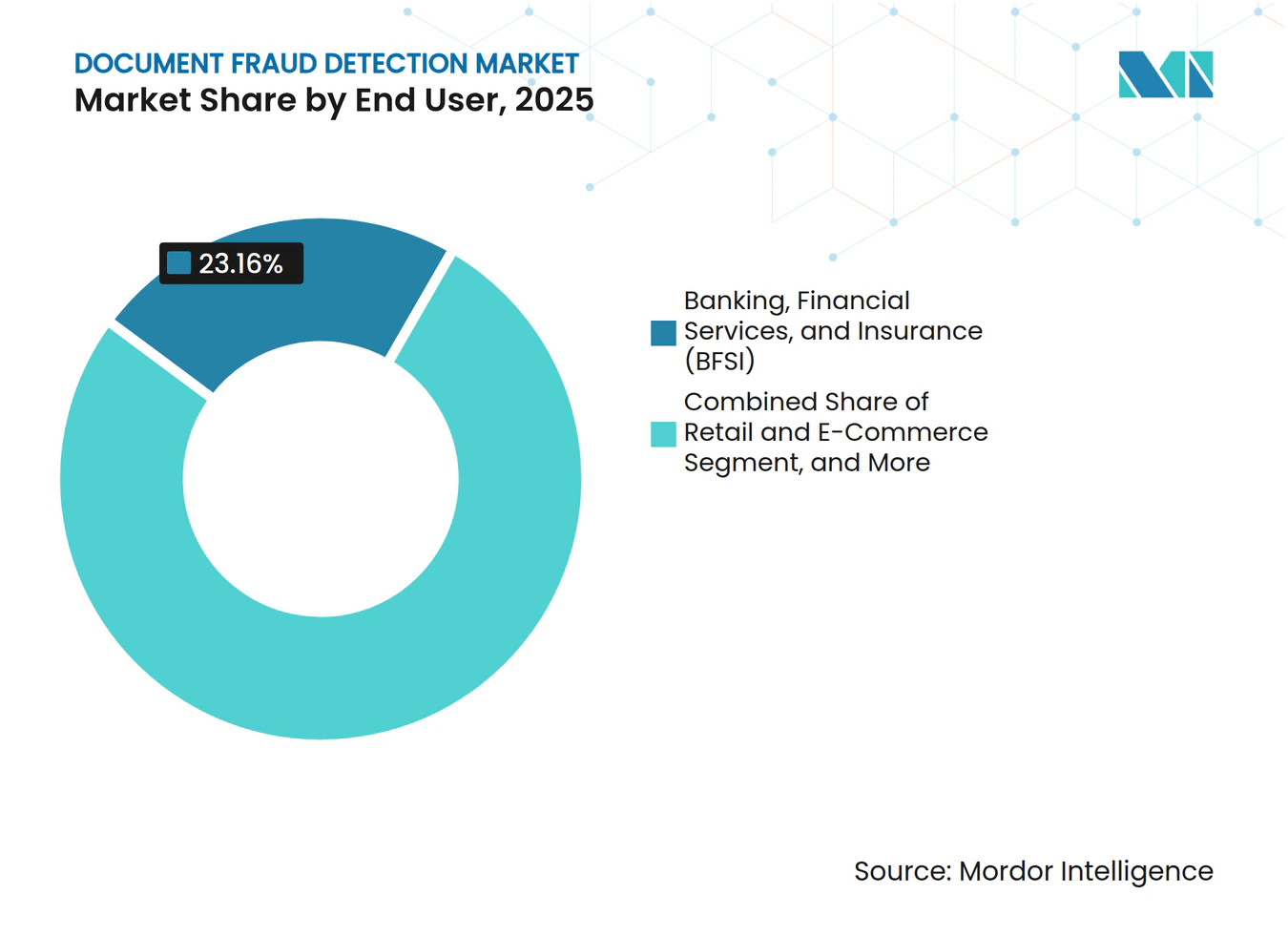
- By end user, banking and financial services held 23.16% of the Document Fraud Detection market share in 2025, while government and public administration are projected to expand at a CAGR of 21.33% through 2031.
- By organization size, large enterprises held 70.18% of the Document Fraud Detection market in 2025, while small and medium-sized enterprises are projected to expand at a CAGR of 22.71% through 2031.
- By geography, North America held 36.19% of the Document Fraud Detection market in 2025, while Asia-Pacific is projected to expand at a CAGR of 21.65% through 2031.
Note: Market size and forecast figures in this report are generated using Mordor Intelligence’s proprietary estimation framework, updated with the latest available data and insights as of January 2026.
Market Trends and Insights
Drivers Impact Analysis of Document Fraud Detection Market*
| Driver | (~) % Impact on CAGR Forecast | Geographic Relevance | Impact Timeline |
|---|---|---|---|
| Remote Digital Onboarding and KYC Workflows | +5.8% | Global, concentrated in North America, Europe, and Asia-Pacific fintech hubs | Medium term (2-4 years) |
| Identity, AML, and Fraud-Prevention Requirements | +4.2% | Global, strongest in Europe, the United Kingdom, North America, and Southeast Asia | Long term (≥ 4 years) |
| Generative AI Forgery and Synthetic Identities | +3.8% | Global, concentrated in crypto, fintech, and e-commerce hubs | Short term (≤ 2 years) |
| Manual Review Costs and Fraud Losses | +2.5% | North America and Europe | Medium term (2-4 years) |
| Cross-Border Digital Financial and Platform Services | +1.6% | Asia-Pacific, Europe, South America, and Middle East and Africa | Long term (≥ 4 years) |
| Document Liveness and Injection-Attack Detection | +1.2% | Global, with early demand from financial services and crypto | Short term (≤ 2 years) |
| Source: Mordor Intelligence | |||
Expansion of Remote Digital Onboarding and KYC Workflows
Remote onboarding has moved beyond a service feature and now supports routine account opening, lending, payments, and customer verification across digital channels. Fenergo reported that 70% of surveyed financial institutions lost clients in the prior year due to slow or inefficient onboarding. The same report placed average annual AML and KYC operating costs at USD 72.9 million per firm. This creates pressure to reduce manual document handling in the Document Fraud Detection Market without weakening fraud controls, customer service standards, or internal audit documentation. Document Fraud Detection Market providers can address both needs through automated classification, optical character recognition, extraction, and authenticity scoring. The European Digital Identity Wallet rollout also supports longer-term demand in the Document Fraud Detection Market for certified remote verification systems, as participating organizations must link credential acceptance to documented identity checks and onboarding records.
Tightening Global Identity, AML, and Fraud-Prevention Requirements
Regulators are aligning rules for financial crime controls, digital identity, and AI governance, bringing several compliance obligations into a single operating process. The OCC and other federal agencies issued Bulletin 2026-44 on September 8, 2026, describing how banks may use verifiable digital credentials under the Customer Identification Program Rule.[1] The EU AMLR is scheduled to apply from July 2027 and requires acceptance of the European Digital Identity Wallet in relevant onboarding processes. In the United Kingdom, KYC and AML compliance was the leading use case for 53% of digital identity providers in 2024/25. These overlapping rules make document authentication a continuing compliance requirement across many operating regions, and the Document Fraud Detection Market must support institutions that operate under more than 1 regulatory framework simultaneously. They also reward Document Fraud Detection Market vendors that can show clear controls, reliable audit records, and support for changing credential formats.
Rapid Adoption of Generative AI for Forged Documents and Synthetic Identities
Generative AI is reducing the time and specialist skills once needed to create convincing forged documents. Shufti Pro found that AI-powered document fraud accounted for 80.10% of AI-enabled fraud attempts in the first half of 2026. Its data also showed that 65.68% of linked fraud attempts reused a forged document previously seen at another institution. These attacks can exploit model confidence scores rather than visible errors that a reviewer might notice during a conventional document review process. Detection systems need to assess document structure, metadata, compression artifacts, and consistency across submitted data. In January 2025, France's anti-money laundering guidance identified AI-assisted document fraud as a high-risk issue. This threat is strengthening demand for layered Document Fraud Detection Market tools that can be updated as forgery methods change.
Increasing Cost of Manual Review and Fraud Losses
Manual review has become costly when document volumes rise, documents vary by country, and fraud methods become harder to identify consistently. Entrust and DocuSign found that identity fraud caused average annual direct losses of USD 7 million for the surveyed organizations. Organizations with more than 5,000 employees reported average annual losses of USD 13 million. TransUnion reported that surveyed companies lost 7.7% of annual revenue to fraud during the preceding year. Automated review can focus human investigators on higher-risk cases and limit the need for repeated document checks. The Document Fraud Detection Market benefits when buyers view automation as a way to contain operating losses rather than as a separate technology cost, since improved routing can reserve trained reviewers for unusual cases that need judgment.
Restraints Impact Analysis of Document Fraud Detection Market*
| Restraint | (~) % Impact on CAGR Forecast | Geographic Relevance | Impact Timeline |
|---|---|---|---|
| Data Privacy, Transfers, and Biometric Consent | -1.8% | Europe, California, and Asia-Pacific data-localization jurisdictions | Long term (≥ 4 years) |
| Legacy Onboarding and Fraud Stack Integration | -1.4% | North America and Europe | Medium term (2-4 years) |
| Adversarial Model Drift from Generative AI Attacks | -1.0% | Global, especially crypto, fintech, and digital lending | Short term (≤ 2 years) |
| Limited Data for Local Documents and Scripts | -0.7% | Middle East and Africa, South America, South Asia, and Southeast Asia | Long term (≥ 4 years) |
| Source: Mordor Intelligence | |||
Data Privacy, Cross-Border Data Transfer, and Biometric Consent Constraints
Biometric and document data are subject to restrictive privacy rules in many jurisdictions, especially when facial images and identity attributes are processed together. GDPR Article 9 treats biometric facial templates as special-category data and requires an appropriate legal basis. Spain's AEPD imposed EUR 950,000 (USD 1.03 million) in fines in March 2026 for biometric template processing and bundled consent. These rules can lengthen implementation efforts and limit the cross-border transfer of fraud signals. Data-localization requirements in China, India, and Russia can also restrict centralized cloud processing. Document Fraud Detection Market suppliers may need separate regional infrastructure for local processing, creating additional work across system architecture, data retention, access controls, and local operational support. This raises operating complexity and can slow deployments for multinational customers.
Integration Complexity Across Legacy Onboarding and Fraud Stacks
Large organizations often use separate systems for document capture, KYC, fraud decisions, case management, customer records, and compliance reporting. Fenergo found that the use of AI in KYC and AML increased from 42% in 2024 to 82% in 2025. Yet periodic KYC review automation remained limited, indicating that adoption does not always lead to connected, real-time processes. Legacy systems can require custom integration and longer testing before a new tool is used in production. This is especially difficult for buyers without dedicated integration teams. Mitek's March 2026 connection with Ping Identity's PingOne DaVinci platform addressed this issue through a no-code orchestration option. Such connectors may reduce deployment effort, but integration remains a restraint for the Document Fraud Detection Market when customer records, AML screening, case queues, and decision rules must be synchronized across several systems.
*Our forecasts treat driver/restraint impacts as directional, not additive. The impact forecasts reflect baseline growth, mix effects, and variable interactions.
Document Fraud Detection Market Segment Analysis
By Offering:
Software Leads Revenue While Services Build Client RelationshipsSoftware held 68.44% of the Document Fraud Detection Market share in 2025. This position supported scalable cloud delivery, subscription pricing, and the ability to embed detection without dedicated hardware purchases or local installation. Software subscriptions can provide document authentication engines, OCR classification, explanation features, and workflow controls within a single environment for distributed operational teams. Continuous updates help customers respond to new forgery methods without on-site release cycles. These capabilities support routine onboarding across banks, identity platforms, and regulated digital services, which remain important demand centers within the Document Fraud Detection Market.
Hardware and capture devices remained the smallest category of offerings. NFC authentication of eMRTD passports and current identity cards can validate government-signed chip data. A fabricated image cannot reproduce that cryptographic payload. Services are projected to grow at a CAGR of 21.98% through 2031. Managed document forensics, model retraining, and case management allow customers to seek outcome-based support. Veridas introduced an injection-attack detection managed layer in early 2025, reflecting the role of service-led detection support.



By Deployment:
Cloud Leads, While Hybrid Supports Regulated WorkflowsCloud-based deployment accounted for 65.21% of the market in 2025, reflecting its established role in high-volume digital verification operations. Fintechs, neobanks, and digital platforms use cloud infrastructure to handle high onboarding volumes without investing in servers. Centralized model updates can help platforms respond more quickly to adversarial changes to the model, new document formats, and emerging fraud patterns. This approach is suitable where data-transfer rules permit cloud processing, and it remains a central deployment choice within the Document Fraud Detection Market. It also supports common controls across distributed digital channels.
On-premise deployment remains relevant for governments, large financial institutions, and healthcare payers. Data-sovereignty rules in China, Russia, and some Middle East markets can limit cloud processing of citizen identity data. Hybrid deployment is projected to expand at a CAGR of 22.36% through 2031. It allows sensitive biometric and document data to remain on-site while non-sensitive workflows use cloud analytics. IDnow launched its Trust Platform in March 2026, offering document verification, biometric authentication, and QEAAs via a single API. The model provides regulated buyers with a practical balance between local controls and operational efficiency, while allowing compliance teams to keep sensitive information within environments designed to meet their national and sector-specific requirements.
By End User:
Financial Services Leads, While Government Demand AcceleratesBanking and financial services accounted for 23.16% of the Document Fraud Detection Market in 2025. Account opening, lending, insurance applications, and crypto-asset onboarding have direct identity proofing requirements that create a sustained need for reliable checks. Veriff reported that financial services' net fraud exceeded 5.5% of online identity verification attempts in 2026. It also reported a 38% year-on-year rise in net fraud rates across crypto and lending platforms. These conditions keep document integrity central to risk controls in the sector and sustain the banking role within the Document Fraud Detection Market.
Socure reported USD 364 million in total ARR during the second quarter of 2026, with 63% year-on-year growth. Academic credentials accounted for 38% of confirmed forgeries in the first quarter of 2026. This adds education institutions, employers, recruitment platforms, and credential issuers to the addressable user base, where trusted records can influence admissions and hiring decisions. Government and public administration are projected to grow at a CAGR of 21.33% through 2031. Federal Login.gov requirements support demand for certified verification infrastructure across public services.

By Organization Size:
Large Enterprises Lead Spending, While SMEs Gain AccessLarge enterprises held 70.18% of the market share in 2025. They face higher regulatory exposure, greater fraud losses, more complex customer journeys, and greater capacity for enterprise technology integration across regions. Among organizations with more than 10,000 employees, 20% reported annual identity fraud costs above USD 50 million. Large banks, insurers, global platforms, and public agencies can support multiregion deployments. Their procurement processes often require security certifications, governance controls, explainable decision records, vendor reviews, and testing procedures that validate system behavior before adoption across customer-facing workflows.
Small and medium-sized enterprises are projected to expand at a CAGR of 22.71% through 2031. API-first SaaS tools reduce the capital requirements, specialist staffing needs, and internal engineering needs associated with traditional enterprise deployments for smaller operating teams. The United Kingdom's trust framework can help SMEs identify certified digital verification providers.[2] Mitek's PingOne DaVinci integration illustrates this approach for resource-constrained buyers. This broader accessibility is expanding the Document Fraud Detection Market beyond the largest institutions, including firms that use external service providers for onboarding and compliance operations.
Geography Analysis
North America Document Fraud Detection Market
North America held 36.19% of the Document Fraud Detection Market share in 2025. The region has a large concentration of regulated financial institutions, digital service providers, and established KYC controls across banking and related sectors. OCC Bulletin 2026-44 clarified the treatment of verifiable digital credentials for federal customer identification rules. The clarification places digital document authentication closer to routine bank compliance processes. The White House also required covered federal agencies to deploy Login.gov within 2 years, which increases the relevance of certified identity proofing in the Document Fraud Detection Market. Socure's 5-year USD 163 million federal contract provides a related identity-proofing example.
Europe Document Fraud Detection Market
Europe is the second-largest regional area in the Document Fraud Detection Market, where common rules are making cross-border compliance capability more valuable. AMLR, eIDAS 2.0, and EU AI Act obligations are shaping identity verification requirements, model governance processes, and the evidence needed for customer onboarding decisions. The EU AI Act includes transparency requirements for certain AI-generated content from August 2026.[3] The United Kingdom's digital identity sector generated GBP 1.037 billion (USD 1.3 billion) in gross value added in 2024/25. KYC and AML compliance was reported as the leading use case among 53% of UK providers. Spain's biometric enforcement is also increasing the need for privacy-by-design processes in verification deployments.
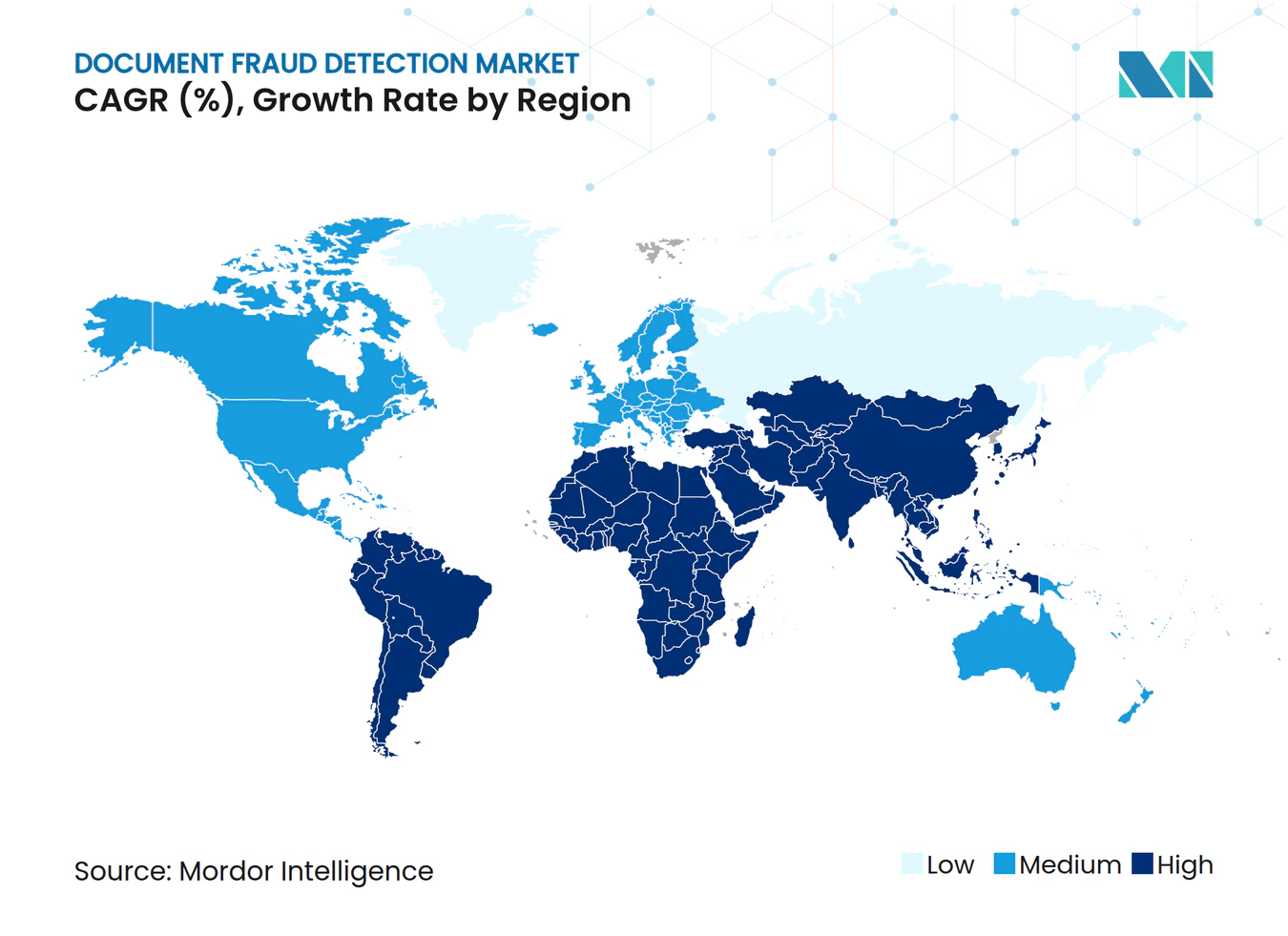
APAC, South America and MEA Document Fraud Detection Market
Asia-Pacific is projected to expand at a CAGR of 21.65% through 2031. Digital financial service growth and national identity programs are increasing the need to support a wide range of document formats, languages, local identity rules, and cross-border user journeys. Malaysia's MyDigital ID covered 114 government online services by June 2026. South America is supported by fintech growth in Brazil and digital banking expansion in Argentina. At the same time, the Middle East and Africa show different conditions: Gulf markets benefit from government digital programs and fintech licensing regimes. At the same time, other countries face constraints in infrastructure, connectivity, document coverage, and training data.
Competitive Landscape
Market Concentration
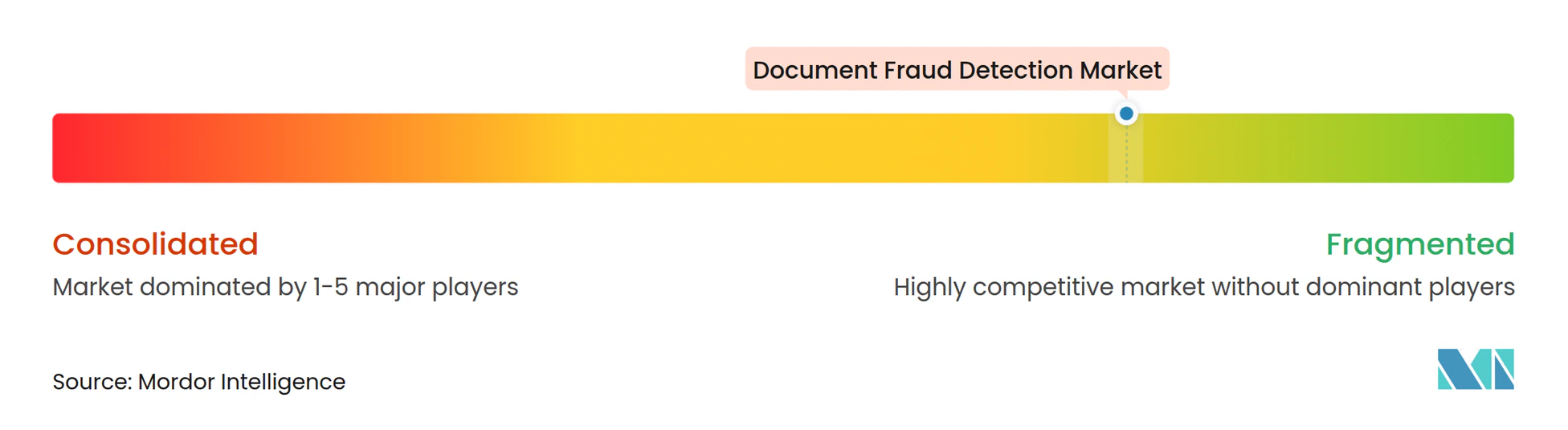
The Document Fraud Detection Market includes AI-native identity verification specialists, forensic document providers, and broader risk platforms. Jumio, Veriff, Socure, AU10TIX, and Incode Technologies compete with providers including Regula, Resistant AI, LexisNexis Risk Solutions, and GBG. Competition centers on detection quality, document coverage, workflow integration, regulatory support, and the ability to provide decisions that compliance teams can examine. Vendors are also extending their products into biometrics, liveness checks, case management, and fraud decisioning. This creates broader platforms rather than stand-alone document review tools, and it changes how buyers compare providers in the Document Fraud Detection Market.
Socure raised USD 156 million at a USD 5.2 billion valuation in August 2026. It also acquired Fravity to automate fraud investigation workflows within RiskOS. Entrust partnered with Google in February 2026 to combine identity verification with Google Cloud and Gemini AI models.[4] Mitek integrated with PingOne DaVinci in March 2026 to make liveness detection and face comparison available within no-code journeys. These moves show the importance of platform breadth and access to established enterprise systems.
Opportunities remain in managed document forensics for smaller organizations and non-financial users that need specialist support without maintaining their own fraud investigation teams. Education, healthcare, and HR technology require reliable checks but may not have extensive internal fraud teams. Cross-border use cases also need better support for local document templates and local rules. Regula and Indicio partnered in July 2025 to issue verification results as Verifiable Credentials. Reusable credentials could reduce repeated point-in-time checks if regulators accept them more widely, while document verification providers could focus on trusted issuance, credential refresh, and proof of the initial assessment. Providers that become trusted issuers may find new revenue opportunities within this evolving credential model.
Document Fraud Detection Industry Leaders
-
Jumio Corporation
-
Veriff OÜ
-
GBG Plc
-
Persona Identities, Inc.
-
LexisNexis Risk Solutions Inc.
- *Disclaimer: Major Players sorted in no particular order
Document Fraud Detection Market Companies Covered in this Report
- Jumio Corporation
- Entrust Corporation
- Mitek Systems, Inc.
- Veriff OÜ
- Regula Forensics, Inc.
- AU10TIX Ltd.
- Sum and Substance Ltd.
- Trulioo Information Services Inc.
- Socure, Inc.
- Microblink Ltd.
- Resistant AI s.r.o.
- Shufti Pro Limited
- Incode Technologies, Inc.
- ID-Pal Limited
- iDenfy UAB
- Veridas Digital Authentication Solutions, S.L.
- LexisNexis Risk Solutions Inc.
- GBG Plc
- Persona Identities, Inc.
- IDEMIA Identity and Security France SAS
Recent Industry Developments in Document Fraud Detection Market
- September 2026: The White House Office of Management and Budget issued Memorandum M-26-18, mandating federal agencies to deploy Login.gov as a universal government sign-on within 2 years. Socure's 5-year, USD 163 million contract to provide identity-proofing technology for Login.gov was confirmed as the technical foundation, establishing a federal procurement precedent for certified document and biometric verification at a population scale.
- September 2026: Binance. US selected Socure to provide identity verification, document and selfie verification, liveness detection, and watchlist screening for its mobile-first US onboarding experience, making Socure the platform of choice for 4 of the 5 largest US crypto exchanges and reinforcing the sector's consolidation around AI-native verification infrastructure.
- September 2026: Veriff and Instructure announced a partnership to embed identity verification into Parchment Transcript Services, the world's largest academic credential network connecting more than 6,200 higher education institutions with 6,700 K-12 schools. A pilot was already running, and general availability for identity-gated transcript requests was planned for November 2026 in the United States.
- August 2026: Socure raised USD 156 million at a USD 5.2 billion valuation and acquired Fravity, an agentic AI startup with more than 70 AI agents that automate fraud investigation workflows. Integration into RiskOS as RiskOS_Agents reduced per-case investigation time by 80% and accelerated case resolution 5-fold in early production deployments.
Global Document Fraud Detection Market Report Scope
The Document Fraud Detection Market comprises software, hardware, and services that enable organizations to detect, analyze, authenticate, and prevent fraudulent, altered, forged, counterfeit, manipulated, or synthetic documents used during onboarding, verification, compliance, transaction processing, and identity-proofing activities. These solutions utilize technologies such as optical character recognition (OCR), computer vision, artificial intelligence, machine learning, forensic document analysis, biometric matching, and authenticity verification to identify document tampering, forgery attempts, synthetic identities, and other forms of document-based fraud.
The Document Fraud Detection Market Report is Segmented by Offering (Software, Hardware and Capture Devices, and Services), Deployment (Cloud-Based, On-Premise, and Hybrid), End User (Banking, Financial Services, and Insurance [BFSI], Government and Public Administration, Retail and E-Commerce, IT and Telecommunication, Healthcare and Life Sciences, and Other End Users), Organization Size (Large Enterprises, and Small and Medium-Sized Enterprises), and Geography (North America, South America, Europe, Asia-Pacific, and Middle East and Africa). The Market Forecasts are Provided in Terms of Value (USD).
Segmentation Overview
| Software |
| Hardware and Capture Devices |
| Services |
| Cloud-Based |
| On-Premise |
| Hybrid |
| Banking, Financial Services, and Insurance (BFSI) |
| Government and Public Administration |
| Retail and E-Commerce |
| IT and Telecommunication |
| Healthcare and Life Sciences |
| Other End Users |
| Large Enterprises |
| Small and Medium-Sized Enterprises |
| North America | United States | |
| Canada | ||
| South America | Brazil | |
| Mexico | ||
| Rest of South America | ||
| Europe | Germany | |
| United Kingdom | ||
| France | ||
| Italy | ||
| Rest of Europe | ||
| Asia-Pacific | China | |
| Japan | ||
| India | ||
| South Korea | ||
| Rest of Asia-Pacific | ||
| Middle East and Africa | Middle East | Saudi Arabia |
| United Arab Emirates | ||
| Rest of Middle East | ||
| Africa | South Africa | |
| Rest of Africa | ||
| By Offering | Software | ||
| Hardware and Capture Devices | |||
| Services | |||
| By Deployment | Cloud-Based | ||
| On-Premise | |||
| Hybrid | |||
| By End User | Banking, Financial Services, and Insurance (BFSI) | ||
| Government and Public Administration | |||
| Retail and E-Commerce | |||
| IT and Telecommunication | |||
| Healthcare and Life Sciences | |||
| Other End Users | |||
| By Organization Size | Large Enterprises | ||
| Small and Medium-Sized Enterprises | |||
| By Geography | North America | United States | |
| Canada | |||
| South America | Brazil | ||
| Mexico | |||
| Rest of South America | |||
| Europe | Germany | ||
| United Kingdom | |||
| France | |||
| Italy | |||
| Rest of Europe | |||
| Asia-Pacific | China | ||
| Japan | |||
| India | |||
| South Korea | |||
| Rest of Asia-Pacific | |||
| Middle East and Africa | Middle East | Saudi Arabia | |
| United Arab Emirates | |||
| Rest of Middle East | |||
| Africa | South Africa | ||
| Rest of Africa | |||
Key Questions Answered in the Report
What is the Document Fraud Detection Market size?
The Document Fraud Detection Market is projected to grow from USD 3.58 billion in 2026 to USD 9.16 billion by 2031 at a CAGR of 20.70%.
What is driving demand for document fraud detection?
Remote onboarding, stricter KYC and AML obligations, generative AI forgery, and the cost of manual review are increasing demand.
Which offering type leads document fraud detection spending?
Software held 68.44% share in 2025, supported by cloud delivery, model updates, and automated document analysis.
Which deployment model is growing fastest?
Hybrid deployment is projected to expand at a CAGR of 22.36% through 2031 because it supports local data controls and cloud analytics.
Which customer group is expected to grow fastest?
Small and medium-sized enterprises are projected to expand at a CAGR of 22.71% through 2031 as API-first SaaS tools reduce deployment barriers.
Which region is expected to grow fastest?
Asia-Pacific is projected to expand at a CAGR of 21.65% through 2031, supported by digital financial services and national identity programs.