
Verifiable Credentials Market Size and Share
Market Overview
| Study Period | 2021 - 2032 |
|---|---|
| Market Size (2027) | USD 1.43 Billion |
| Market Size (2032) | USD 4.78 Billion |
| Growth Rate (2027 - 2032) | 27.30 % |
| Fastest Growing Market | Asia-Pacific |
| Largest Market | North America |
| Market Concentration | Low |
Major Players *Disclaimer: Major Players sorted in no particular order Image © Mordor Intelligence. Reuse requires attribution under CC BY 4.0. | |
Verifiable Credentials Market Analysis by Mordor Intelligence
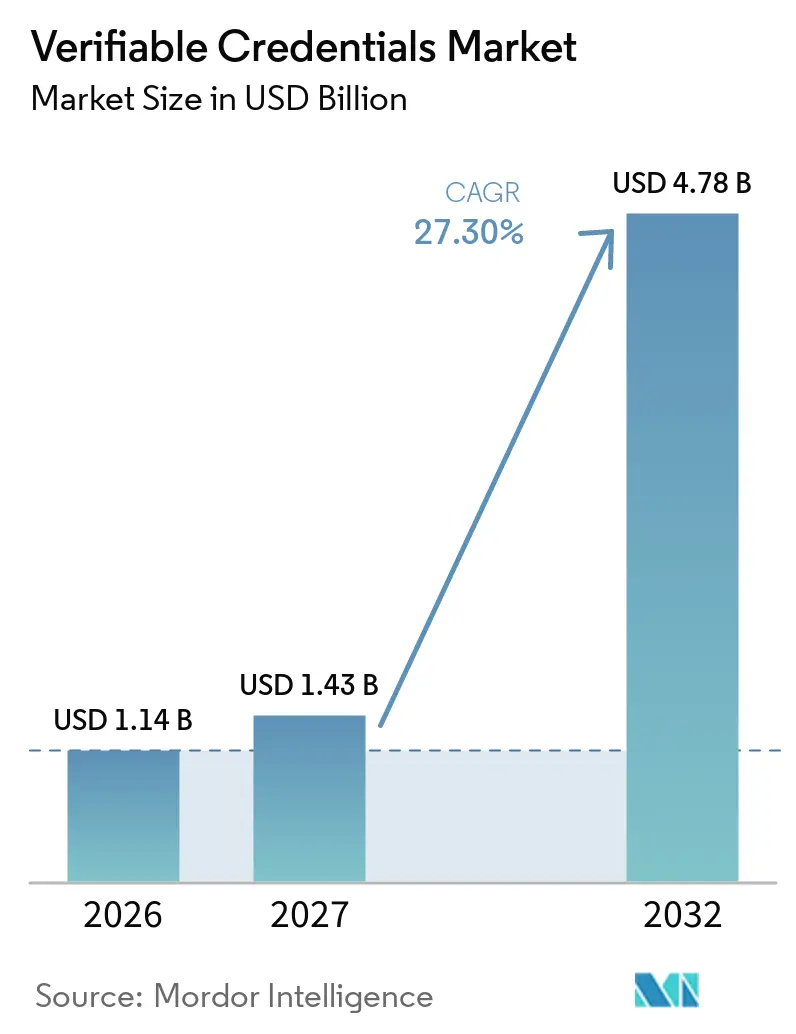
The Verifiable Credentials Market size was valued at USD 1.14 billion in 2026 and estimated to expand from USD 1.43 billion in 2027 to reach USD 4.78 billion by 2032, at a CAGR of 27.30% during the forecast period (2027-2032). Regulatory implementation, standards maturity, and identity fraud are moving verifiable credentials from limited pilots into enterprise and public-sector programs. The W3C recommendation for Verifiable Credentials Data Model 2.0 gives issuers and verifiers a common technical basis for credentials, selective disclosure, and multiple encoding approaches. The European Digital Identity framework creates a clear implementation timetable for wallets and trusted services across EU member states. Enterprise buyers are also seeking reusable proofing that can reduce repeated document collection without exposing unnecessary personal data. These conditions favor providers that can work across established identity systems, wallet formats, and regulated workflows.
Key Report Takeaways
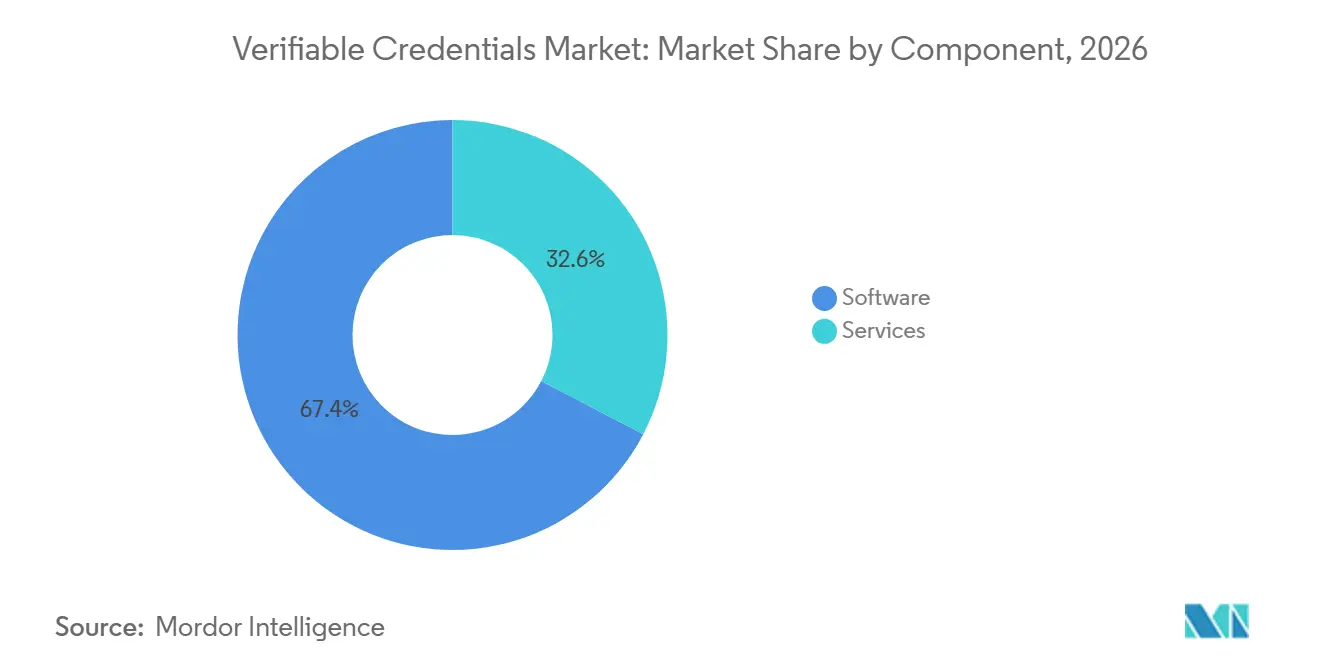
- By component, software held 67.31% of the Verifiable Credentials Market share in 2026, while services are projected to expand at a 28.43% CAGR through 2032.
- By deployment mode, cloud held 64.33% of revenue in 2026, while hybrid deployment is expected to expand at a 29.87% CAGR through 2032.
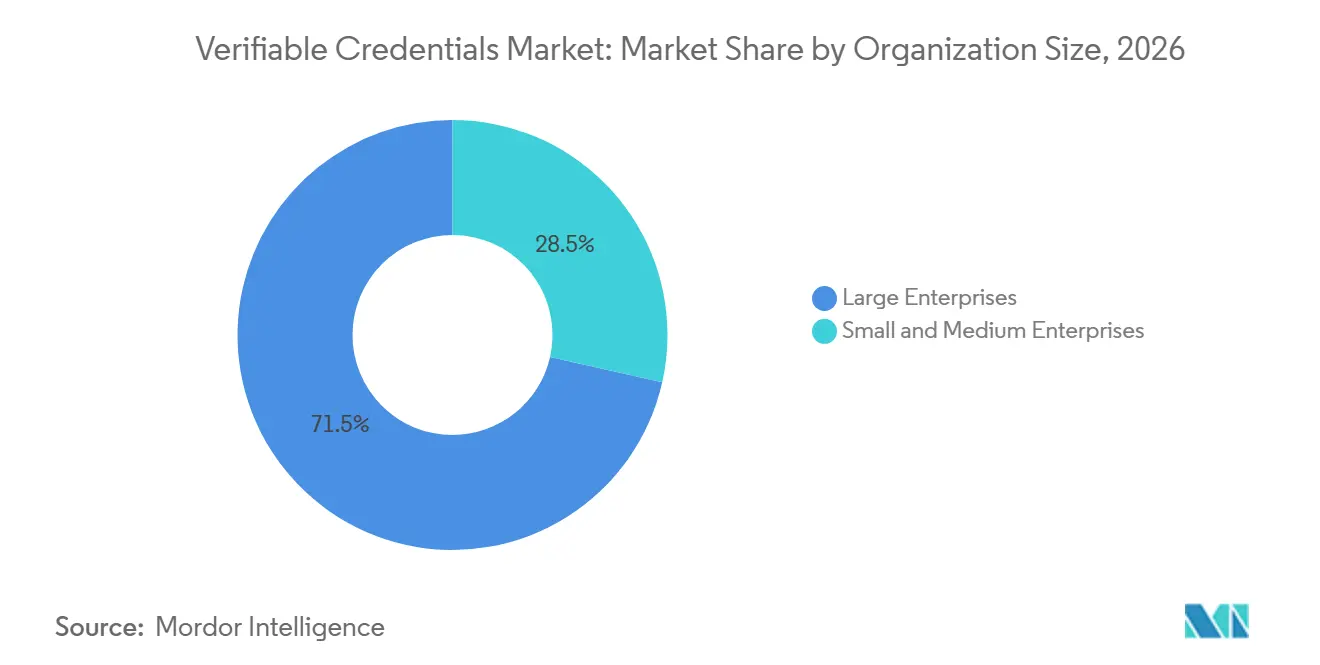
- By organization size, large enterprises accounted for 71.47% of revenue in 2026, while small and medium enterprises are projected to expand at a 30.17% CAGR through 2032.
- By credential type, identity credentials held 38.61% of revenue in 2026, while professional credentials are projected to expand at a 29.57% CAGR through 2032.
- By application, identity verification held 43.19% of revenue in 2026, while payments and financial transactions are projected to expand at a 30.19% CAGR through 2032.
- By end user, government agencies held 31.57% of revenue in 2026, while healthcare providers are projected to expand at a 30.27% CAGR through 2032.
- By geography, North America held 36.23% of the Verifiable Credentials Market share in 2026, while Asia-Pacific is projected to expand at a 29.93% CAGR through 2032.
Note: Market numbers in this report are based on Mordor Intelligence's proprietary estimation framework, which combines nine months of actuals with Q4 projections for base year 2026.
Global Verifiable Credentials Market Trends and Insights
Drivers Impact Analysis*
| Driver | (~) % Impact on CAGR Forecast | Geographic Relevance | Impact Timeline |
|---|---|---|---|
| Regulatory Mandates for Digital Identity Wallets and Credential Acceptance | +6.2% | Europe, North America, Asia-Pacific | Short term (≤ 2 years) |
| Enterprise Demand for Reusable, Privacy-Preserving Identity Verification | +4.8% | Global, with early concentration in North America and Europe | Medium term (2-4 years) |
| Rising Identity Fraud and Need for Cryptographically Verifiable Claims | +4.5% | Global, with highest urgency in North America and Asia-Pacific | Short term (≤ 2 years) |
| Expansion of Digital Education, Workforce and Professional Credentials | +3.5% | North America, Europe, Asia-Pacific | Medium term (2-4 years) |
| Interoperable Standards Maturing Across Wallets, Issuers and Verifiers | +3.0% | Global | Medium term (2-4 years) |
| Credential Utility Expanding Into Supply Chain, Healthcare and Device Identity | +2.5% | North America and Europe | Long term (≥ 4 years) |
| Source: Mordor Intelligence | |||
Regulatory Mandates for Digital Identity Wallets and Credential Acceptance
EU rules require member states to make European Digital Identity Wallets available by the end of 2026, creating a defined adoption path for the Verifiable Credentials Market. Implementing measures defines technical requirements for wallets and relying parties, reducing uncertainty for issuers and service providers. Japan established an expert panel on governance for verifiable credentials in 2025, which places credential use cases within a national policy process. In the United States, pharmaceutical trading partners are adopting credentials to support Drug Supply Chain Security Act compliance. The Open Credentialing Initiative reported that its ecosystem covered more than 10,000 U.S. pharmacy locations in January 2025. These different policy paths require vendors to balance government wallet capabilities with sector-specific offerings.
Enterprise Demand for Reusable, Privacy-Preserving Identity Verification
The Verifiable Credentials Market addresses a recurring enterprise problem, where customers and employees repeatedly provide the same documents to different services. Selective disclosure is part of the W3C Verifiable Credentials 2.0 design, which supports privacy-preserving proof sharing. Microsoft has continued to add capabilities and partners to Entra Verified ID, placing credential issuance and verification within enterprise identity programs. Okta announced its Verifiable Digital Credentials platform in September 2025, with planned availability in FY27. These platforms make credential programs easier to consider for firms that already use enterprise identity services. The resulting demand is strongest where identity checks are frequent, personal data is sensitive, and delays affect conversion or service access.
Rising Identity Fraud and Need for Cryptographically Verifiable Claims
Identity fraud remains a material concern for organizations that rely on remote onboarding and document review. The FBI recorded USD 20.9 billion in reported cybercrime losses during 2025, with identity theft complaints reaching 31,675.[1] A signed verifiable credential allows a verifier to check the issuer, holder binding, and credential status without treating an image of a document as proof. This distinction is relevant as synthetic media and manipulated images increase the difficulty of remote verification. The Verifiable Credentials Market, therefore, has a role in fraud controls as well as in digital service design. Credentials can provide a more durable proof layer after a trusted issuer has completed strong initial proofing.
Expansion of Digital Education, Workforce and Professional Credentials
Education providers and employers need records that can move between institutions, hiring systems, and professional bodies. The Digital Credentials Consortium at MIT Open Learning launched a generative AI badge-authoring tool project for Open Badges 3.0-compatible learning and employment records. Credential Engine identified more than 1.8 million distinct credentials from more than 134,000 U.S. providers in its 2025 report. A common format makes it easier to verify qualifications that would otherwise require manual review. The DC4EU program documented rules for education and professional qualifications within the European digital identity framework. Professional credentials are projected to be the fastest-expanding credential type through 2032.
Restraints Impact Analysis*
| Restraint | (~) % Impact on CAGR Forecast | Geographic Relevance | Impact Timeline |
|---|---|---|---|
| Fragmented DID, Wallet and Credential Ecosystems | -3.2% | Global, most acute in cross-border enterprise scenarios | Medium term (2-4 years) |
| Unclear Liability and Legal Recognition Across Jurisdictions | -2.5% | Global, with highest risk outside Europe | Long term (≥ 4 years) |
| Legacy-System Integration and Specialist Implementation Burden | -1.8% | Global, most acute in healthcare and financial services | Medium term (2-4 years) |
| Low User Awareness and Limited Everyday Wallet Acceptance | -1.2% | Asia-Pacific, South America, and Africa | Long term (≥ 4 years) |
| Source: Mordor Intelligence | |||
Fragmented DID, Wallet, and Credential Ecosystems
The Verifiable Credentials Market still includes several DID methods and credential formats that may be used by different issuer communities. GS1 describes a technical environment that includes decentralized identifiers, verifiable credentials, and varied implementation choices. A verifier may need to support ISO mobile document formats, SD-JWT credentials, and JSON-LD credentials in parallel. That requirement increases engineering work and can lengthen deployment schedules. The W3C Digital Credentials API is intended to give browsers a common interface for privacy-preserving credential exchange.[2] It does not remove the need for shared trust registries or consistent issuer policies. Outside Europe, interoperability remains an operational consideration for organizations that accept credentials across borders.
Unclear Liability and Legal Recognition Across Jurisdictions
Legal recognition is more mature within the EU framework than in many cross-border settings. The World Bank stated that legal recognition and consistent form factors are important conditions for trusted digital identity use in fast payments. Organizations may need to decide who bears responsibility when a credential is revoked after a relying party has acted on it. This can add legal review to high-value business and government programs. The issue is particularly important when issuers, holders, and verifiers operate under different legal systems. Wider statutory recognition and clearer contractual models would reduce this friction over time.
*Our forecasts treat driver/restraint impacts as directional, not additive. The impact forecasts reflect baseline growth, mix effects, and variable interactions.
Segment Analysis
By Component: Software Platforms Anchor Recurring Revenue
Software accounted for 67.31% of revenue in 2026. It includes issuance engines, wallet software development kits, cryptographic libraries, status registries, and verification interfaces. These functions are central to every credential lifecycle. Software also supports recurring revenue because issuers must manage issuance, presentation, suspension, and revocation on an ongoing basis. Common exchange protocols can make platforms easier to integrate with a broader set of wallets and relying parties. The W3C standard supports several encoding approaches and privacy functions that software providers must operationalize. This makes technical flexibility an important purchasing criterion. Providers that simplify administration for issuers can strengthen customer retention while reducing the operating burden on credential administrators. Credential volume creates ongoing demand for dependable platform operations. Issuers also need clear tools to manage permissions and credential status.
Services are projected to expand at a 28.43% CAGR through 2032. Integration work remains necessary when organizations connect credentials with legacy identity, access, records, or compliance systems. Service providers can help define trust frameworks, credential schemas, issuance procedures, and status handling. This need is most evident in regulated programs that cannot replace existing identity systems at once. IBM introduced containerized Verify Digital Credentials in December 2025 for public cloud, private cloud, on-premises, and hybrid environments. Such product packaging can reduce implementation effort while preserving demand for advisory and integration support. Vertical use cases also require specialist knowledge of the underlying records and controls. The Verifiable Credentials Market industry benefits when services translate standards into deployable operating models. Providers must also help teams test credential flows with external partners. Training and governance support can remain valuable after an initial launch, especially when participating teams have different approval responsibilities.
By Deployment Mode: Hybrid Architecture Reflects Regulated-Industry Constraints
Cloud deployment held 64.33% of revenue in 2026. Managed cloud platforms can reduce infrastructure administration and provide scalable verification capacity. They are attractive to organizations that want faster deployment and do not need to retain every element in a local environment. Cloud systems can also simplify updates to credential rules and APIs. This is valuable when wallet and protocol requirements evolve. The Verifiable Credentials Market relies on reliable, available verification services for many transaction types. Providers must still address key protection, data residency, and audit requirements. Those obligations limit the suitability of a fully centralized design for some organizations. Service continuity is also important when credentials support high-volume customer interactions. Clear operational controls can improve confidence in managed platforms for issuers that need repeatable oversight of credential services.
Hybrid deployment is projected to expand at a 29.87% CAGR through 2032. A hybrid model can retain sensitive key management or records within a controlled environment while using cloud capacity for verification and scaling. This arrangement is relevant for health, financial services, government, and defense-related programs. It also helps organizations adopt credentials without abandoning established security architecture. On-premises deployment remains relevant for air-gapped or tightly controlled environments. IBM's containerized offering reflects demand for flexible deployment choices across these settings. System integrators can play a significant role in connecting local controls with cloud-based verification services. The Verifiable Credentials Market can gain from hybrid adoption where compliance obligations prevent a simple cloud migration. This approach allows adoption teams to phase changes across existing systems. It can also preserve local control over sensitive operational assets that cannot be moved into a shared cloud environment.
By Organization Size: Large Enterprises Lead, Managed Platforms Enable SME Entry
Large enterprises accounted for 71.47% of revenue in 2026. They often have dedicated identity teams, established governance processes, and higher exposure to fraud or compliance requirements. These capabilities make it easier to sponsor an early credential program. Large firms also operate across more partners, employees, and customer channels. That scale increases the value of issuing a reusable claim instead of repeating verification. The Verifiable Credentials Market is therefore closely linked to enterprise identity and access management programs. Large organizations can also influence partner adoption through procurement requirements. Their deployments may provide a starting point for a wider credential ecosystem. Their resources can support detailed testing before a wider rollout. This can make them early adopters of new credential workflows that later extend across their partner and supplier networks.
Small and medium enterprises are projected to expand at a 30.17% CAGR through 2032. Managed platforms reduce the need for a company to operate its own cryptographic infrastructure. Open-source tools can also lower entry costs for organizations with capable technical teams. The World Bank has described digital public infrastructure approaches that support trusted, interoperable digital services. For smaller firms, credentials can support vendor checks, business verification, and secure sharing of company records. Adoption depends on simple onboarding and clear value for routine transactions. No-code tools and managed issuance services can be important distribution routes. The Verifiable Credentials Market industry can broaden when smaller organizations join networks already used by larger customers or public agencies. These companies need straightforward processes for issuing and receiving claims. Trusted service providers can make those processes easier to adopt for smaller teams with limited specialist identity resources.
By Credential Type: Identity Credentials Dominate, Professional Credentials Accelerate
Identity credentials held 38.61% of revenue in 2026. They provide a foundational claim that supports access, age assurance, onboarding, and presentation of additional credentials. Government identity documents and mobile driver's licenses are important examples. A trusted identity credential can also support the linkage of professional, academic, health, or financial claims. This gives identity credentials a central role in the Verifiable Credentials Market. Their value depends on the authority of the issuer and the reliability of original identity proofing. Wallet compatibility and acceptance by relying parties are also necessary. Programs that combine government-issued identity with enterprise use can create broad utility. A useful identity credential must be easy for a holder to present. Verifiers must also be able to establish trust in the issuer before accepting identity claims in a specific service or transaction.
Professional credentials are projected to expand at a 29.57% CAGR through 2032. Employers and licensing bodies need efficient ways to verify skills, licenses, and work-related records. Structured credentials can reduce reliance on self-reported résumés or manual document checks. The DC4EU rulebook provides an example of how education and professional qualifications can be addressed in a cross-border framework. Academic credentials are also developing through learning and employment record programs. Health credentials can serve patient identity, consent, practitioner licensing, and facility verification needs. Device and supply-chain credentials are earlier-stage categories with more specialized requirements. The Verifiable Credentials Market can expand as issuers define reliable schemas for these different records. Employers need current status information for regulated qualifications. Issuers therefore need dependable procedures for amendment and revocation when a qualification changes, expires, or no longer applies.
By Application: Identity Verification Anchors Deployments, Payments Leads Growth
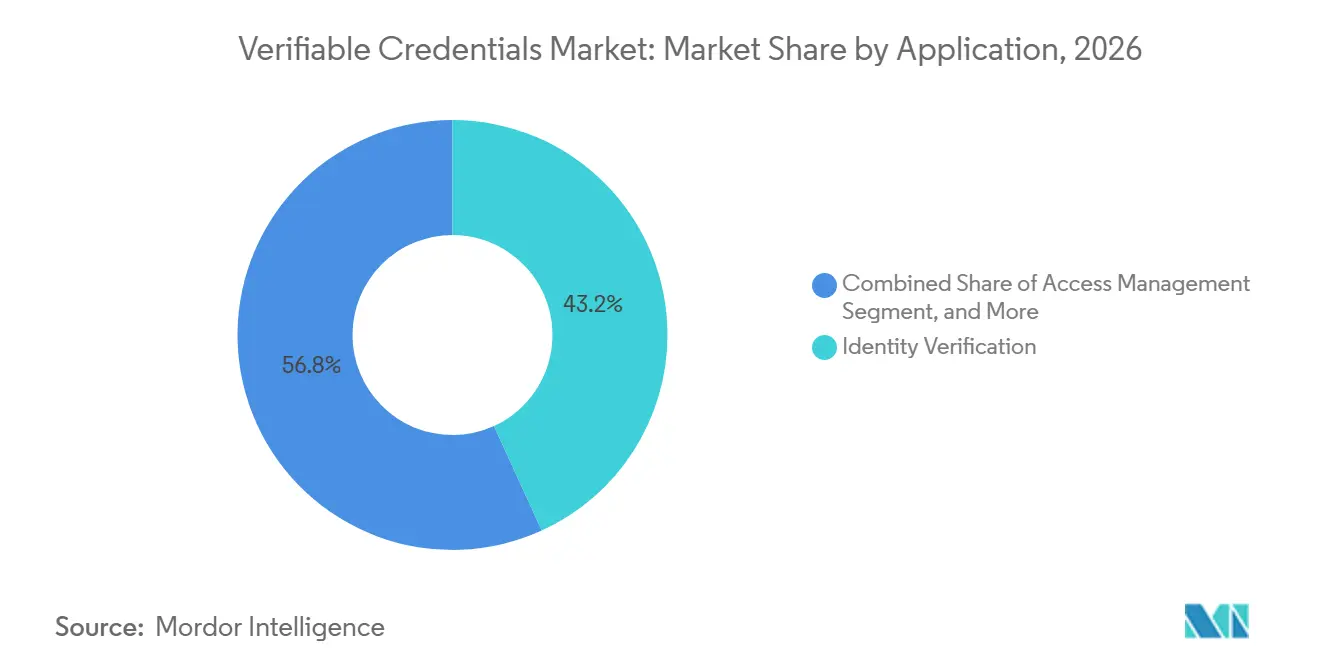
Identity verification accounted for 43.19% of application revenue in 2026. It is commonly the starting use case because organizations already need to confirm who is accessing a service. Credential-based verification can avoid repeated document submission when a suitable credential is available. The approach also supports access management, health consent, and financial identity use cases. This makes identity verification a practical entry point for the Verifiable Credentials Market. Enterprise identity providers are embedding credential capabilities into their platforms, which can lower adoption barriers. Microsoft and Okta both have announced or expanded related credential offerings. Strong issuer assurance remains essential because credential technology cannot compensate for a weak original check. Organizations also need verification policies that fit the risk of each transaction. This allows them to request only the claims that are necessary for each service decision in the Verifiable Credentials Market.
Payments and financial transactions are projected to expand at a 30.19% CAGR through 2032. Financial institutions need higher assurance for payer and payee identities, especially when transactions are fast or cross-border. The World Bank's Payments Identity Credential framework considers how digital identity can support trusted and inclusive fast payments. Cryptographically verifiable claims can reduce the need for direct bilateral data exchanges among every participant. Access management remains another significant application because employers must confirm employee and contractor attributes. Healthcare identity and consent can support selective sharing of sensitive information. The Verifiable Credentials Market can benefit when payment, access, and consent programs rely on interoperable issuer trust. Each application requires clear governance for credential issuance and revocation. Payment participants need timely status checks for the claims they accept. Their implementation choices must also align with applicable financial controls and the operating rules of the Verifiable Credentials Market.

By End User: Government Anchors the Market, Healthcare Leads Growth
Government agencies held 31.57% of end-user revenue in 2026. They issue foundational identity records and administer many professional, educational, and licensing credentials. Public programs can also establish the rules that private-sector verifiers follow. The EU digital identity framework makes government participation especially important in Europe. Governments in Japan and other countries are examining governance arrangements for verifiable credentials. Educational institutions are another substantial group because they issue records with long-lived value. The Verifiable Credentials Market is supported when authoritative public issuers make credentials useful beyond a single agency transaction. Public authorities can set common standards for issuers and verifiers. This can make credentials more useful across administrative and commercial services while reducing repeated proof requests for the holder.
Healthcare providers are projected to expand at a 30.27% CAGR through 2032. The sector needs reliable identity, consent, staff licensing, and supply-chain verification. U.S. pharmaceutical programs illustrate a practical path where credentials support verification of authorized trading partners. OCI stated that its ecosystem included more than 10,000 pharmacy locations in January 2025. BFSI organizations are assessing reusable credentials for onboarding and payment-related identity checks. IT and telecommunications users can apply credentials to workforce and device identity. Retail and consumer services have possible uses in age assurance and loyalty programs, though acceptance is less established. The Verifiable Credentials Market can gain volume when consumer wallet use becomes more routine across these settings. Healthcare deployments must fit established privacy and consent practices. Supply-chain programs also need trusted status information for trading partners before credentials are accepted within regulated transaction workflows.
Geography Analysis
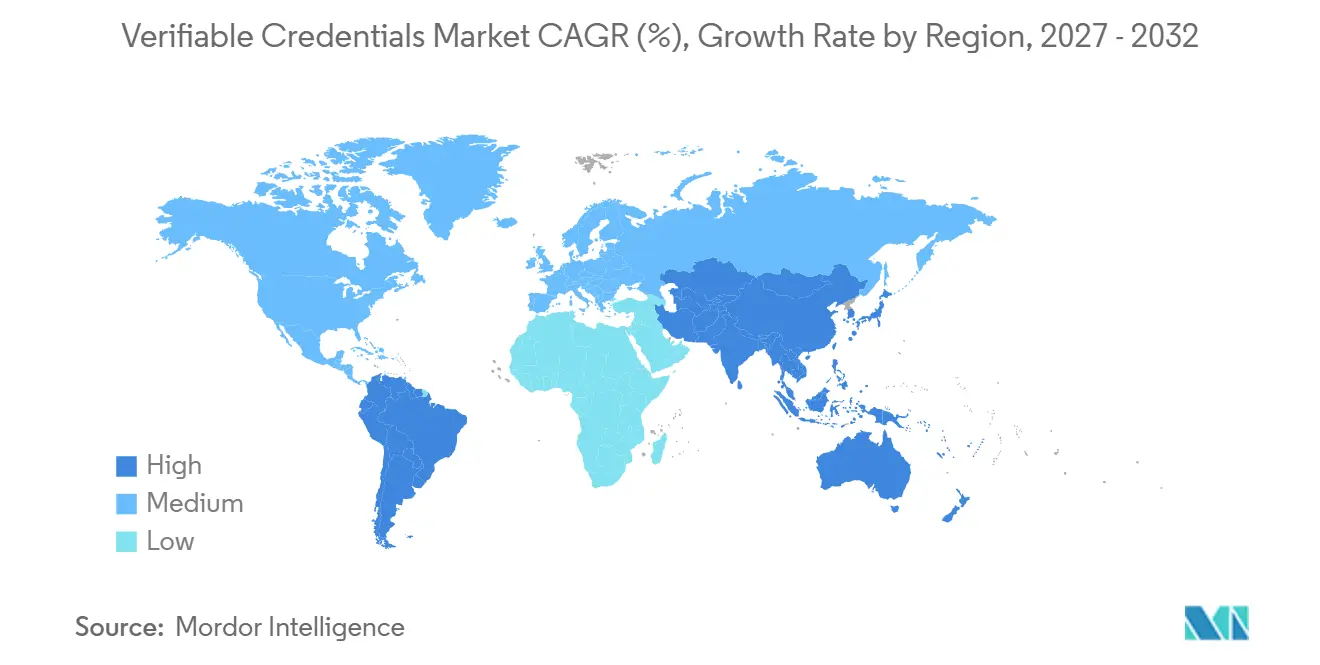
North America held 36.23% of regional revenue in 2026. The region combines enterprise identity platform adoption with sector-specific pharmaceutical supply-chain requirements. U.S. organizations are deploying credentials through identity and access management relationships rather than a single national identity law. The Open Credentialing Initiative reported participation from more than 10,000 pharmacy locations in January 2025. Mobile driver's license programs and established identity platforms create multiple procurement channels for the region.
Europe is defined by the scheduled rollout of the European Digital Identity Wallet. The legal framework requires member states to provide wallets by the end of 2026. Implementing rules can improve technical consistency among issuers and relying parties. The DC4EU work on qualification rules demonstrates a sectoral route for cross-border credentials. National readiness differs, while the United Kingdom and South America follow different, earlier-stage paths.
Asia-Pacific is projected to expand at a 29.93% CAGR through 2032. India, Japan, Singapore, and other markets are building digital identity systems that can provide a base for credential services. Japan's Digital Agency has established governance work focused on verifiable credentials.[3] Regional alignment, as well as digital identity investment in Saudi Arabia and the UAE, can support broader credential acceptance.
Competitive Landscape
The Verifiable Credentials Market is moving from a fragmented specialist field toward more structured competition. Enterprise identity providers have an advantage because they already manage customer directories, access policies, and identity workflows. Microsoft has expanded Entra Verified ID capabilities and partner options. Okta announced a verifiable digital credentials offering planned for FY27 availability. IBM launched Verify Digital Credentials in December 2025, bringing a containerized solution to cloud, on-premises, and hybrid settings.
Spherity has developed a focused position in pharmaceutical supply-chain credentials, where compliance needs create a defined use case. It works with R&S Northeast, applying credentials and authorized trading partner verification to pharmaceutical distribution. MATTR partnered with FrankieOne to bring verifiable government-issued credentials into identity orchestration workflows. IDEMIA became a launch partner for Microsoft Entra Verified ID after a successful pilot. These partnerships show how proofing, workflow access, and vertical records can shape a defensible role.
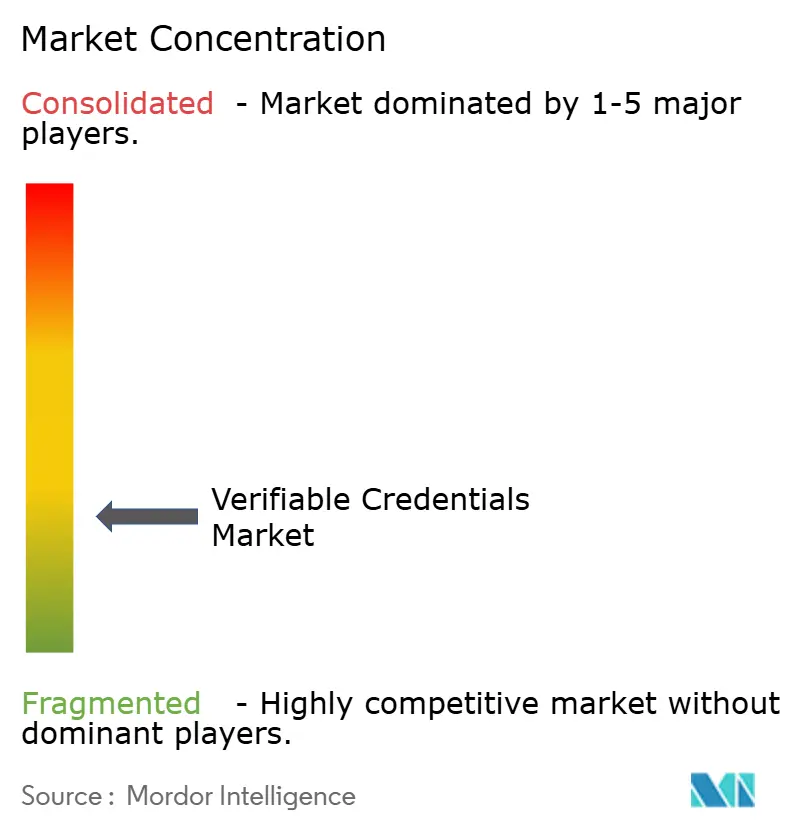
Providers are competing for issuer relationships, verifier acceptance, wallet integration, and trust network participation. Interoperability is a core requirement because customers cannot depend on a single credential format or wallet. Companies that align with W3C standards and open exchange protocols can reduce integration concerns. The competitive environment is active but not yet consolidated around a small set of dominant providers.
Verifiable Credentials Industry Leaders
-
Microsoft Corporation
-
IBM Corporation
-
Okta, Inc.
-
Thales S.A.
-
MATTR Limited
- *Disclaimer: Major Players sorted in no particular order
Recent Industry Developments
- June 2026: authID and Trinsic launched Digital ID support for 70+ digital IDs across 50+ countries through a single integration, combining Trinsic's global acceptance infrastructure, covering mobile driver's licences, European eIDs, BankIDs, and OEM wallets, with authID's Proof biometric product. The partnership establishes a cryptographic biometric root of trust at onboarding for international enterprise deployments.
- November 2025: IDEMIA Public Security was selected as a launch partner for Microsoft Entra Verified ID following a successful pilot, integrating IDEMIA's biometric identity and verification technology into Entra Verified ID for organization-wide credential issuance and account recovery use cases across Microsoft's partner ecosystem.
- October 2025: MATTR and FrankieOne announced a partnership integrating MATTR's verifiable credential services into FrankieOne's identity orchestration platform, connecting to more than 350 vendors, for KYC, KYB, AML, onboarding, and payments use cases, with ISO 18013-5 and 18013-7 mobile driver's licence support hosted locally in Australia with global scalability pathways.
- August 2025: R&S Northeast partnered with Spherity to deploy Authorized Trading Partner credentials using OCI specifications, DIDs, W3C Verifiable Credentials, and GS1 standards for real-time pharmaceutical trading partner verification under DSCSA, advancing supply chain security ahead of the FDA's November 2026 enforcement deadline.
Global Verifiable Credentials Market Report Scope
Verifiable credentials are cryptographically secured digital assets that serve as the tamper-proof equivalents of physical documents, such as passports, driver’s licenses, or academic degrees. Issued and digitally signed by an authorized entity, these credentials are held securely within a user's digital wallet, ensuring authenticity and preventing unauthorized duplication or modification during presentation.
The Verifiable Credentials Market Report is Segmented by Component (Software and Services), Deployment Mode (Cloud, On-premise, and Hybrid), Organization Size (Large Enterprises and Small and Medium Enterprises), Credential Type (Identity Credentials, Academic Credentials, Professional Credentials, Health Credentials, and Other Credentials), Application (Identity Verification, Access Management, Healthcare Identity and Consent, Payments and Financial Transactions, and Other Applications), End User (Government Agencies, Educational Institutions, Healthcare Providers, BFSI, IT and Telecommunications, Retail and Consumer Services, and Other End Users), and Geography (North America, South America, Europe, Asia-Pacific, Middle East, and Africa). The Market Forecasts are Provided in Terms of Value (USD).
| Software |
| Services |
| Cloud |
| On-Premises |
| Hybrid |
| Large Enterprises |
| Small and Medium Enterprises |
| Identity Credentials |
| Academic Credentials |
| Professional Credentials |
| Health Credentials |
| Other Credentials |
| Identity Verification |
| Access Management |
| Healthcare Identity and Consent |
| Payments and Financial Transactions |
| Other Applications |
| Government Agencies |
| Educational Institutions |
| Healthcare Providers |
| BFSI |
| IT and Telecommunications |
| Retail and Consumer Services |
| Other End Users |
| North America | United States |
| Canada | |
| Mexico | |
| South America | Brazil |
| Argentina | |
| Rest of South America | |
| Europe | Germany |
| United Kingdom | |
| France | |
| Italy | |
| Spain | |
| Rest of Europe | |
| Asia-Pacific | China |
| India | |
| Japan | |
| South Korea | |
| Australia | |
| Rest of Asia-Pacific | |
| Middle East | Saudi Arabia |
| United Arab Emirates | |
| Turkey | |
| Rest of Middle East | |
| Africa | South Africa |
| Nigeria | |
| Egypt | |
| Rest of Africa |
| By Component | Software | |
| Services | ||
| By Deployment Mode | Cloud | |
| On-Premises | ||
| Hybrid | ||
| By Organization Size | Large Enterprises | |
| Small and Medium Enterprises | ||
| By Credential Type | Identity Credentials | |
| Academic Credentials | ||
| Professional Credentials | ||
| Health Credentials | ||
| Other Credentials | ||
| By Application | Identity Verification | |
| Access Management | ||
| Healthcare Identity and Consent | ||
| Payments and Financial Transactions | ||
| Other Applications | ||
| By End User | Government Agencies | |
| Educational Institutions | ||
| Healthcare Providers | ||
| BFSI | ||
| IT and Telecommunications | ||
| Retail and Consumer Services | ||
| Other End Users | ||
| By Geography | North America | United States |
| Canada | ||
| Mexico | ||
| South America | Brazil | |
| Argentina | ||
| Rest of South America | ||
| Europe | Germany | |
| United Kingdom | ||
| France | ||
| Italy | ||
| Spain | ||
| Rest of Europe | ||
| Asia-Pacific | China | |
| India | ||
| Japan | ||
| South Korea | ||
| Australia | ||
| Rest of Asia-Pacific | ||
| Middle East | Saudi Arabia | |
| United Arab Emirates | ||
| Turkey | ||
| Rest of Middle East | ||
| Africa | South Africa | |
| Nigeria | ||
| Egypt | ||
| Rest of Africa | ||
Key Questions Answered in the Report
What is the size of the Verifiable Credentials Market?
The Verifiable Credentials Market is valued at USD 1.14 billion in 2026 and is projected to reach USD 4.78 billion by 2032 at a 27.30% CAGR.
What is driving adoption of verifiable credentials?
European wallet rules, demand for reusable identity proofing, fraud prevention needs, and digital education and workforce records support adoption.
Which component leads verifiable credential spending?
Software leads with 67.31% revenue share in 2026 because issuance, verification, wallet, and credential-status functions rely on platform capabilities.
Which use case is expected to expand fastest?
Payments and financial transactions are projected to expand at a 30.19% CAGR through 2032 as firms seek stronger identity assurance for fast and cross-border payments.
Which region leads verifiable credential adoption?
North America leads with 36.23% revenue share in 2026, supported by enterprise identity platforms and pharmaceutical supply-chain programs.
Which end user is expected to expand fastest?
Healthcare providers are projected to expand at a 30.27% CAGR through 2032 because of requirements for identity, consent, licensing, and supply-chain verification.