
Age Verification Market Size and Share
Market Overview
| Study Period | 2020 - 2031 |
|---|---|
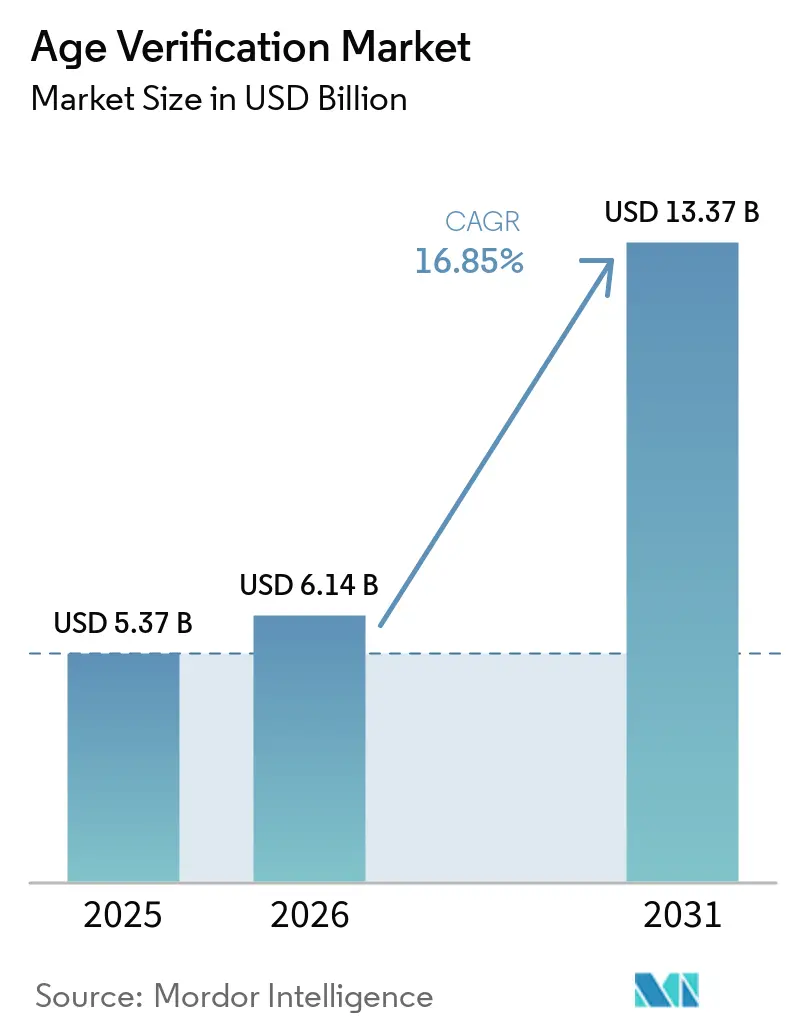
| Market Size (2026) | USD 6.14 Billion |
| Market Size (2031) | USD 13.37 Billion |
| Growth Rate (2026 - 2031) | 16.85 % |
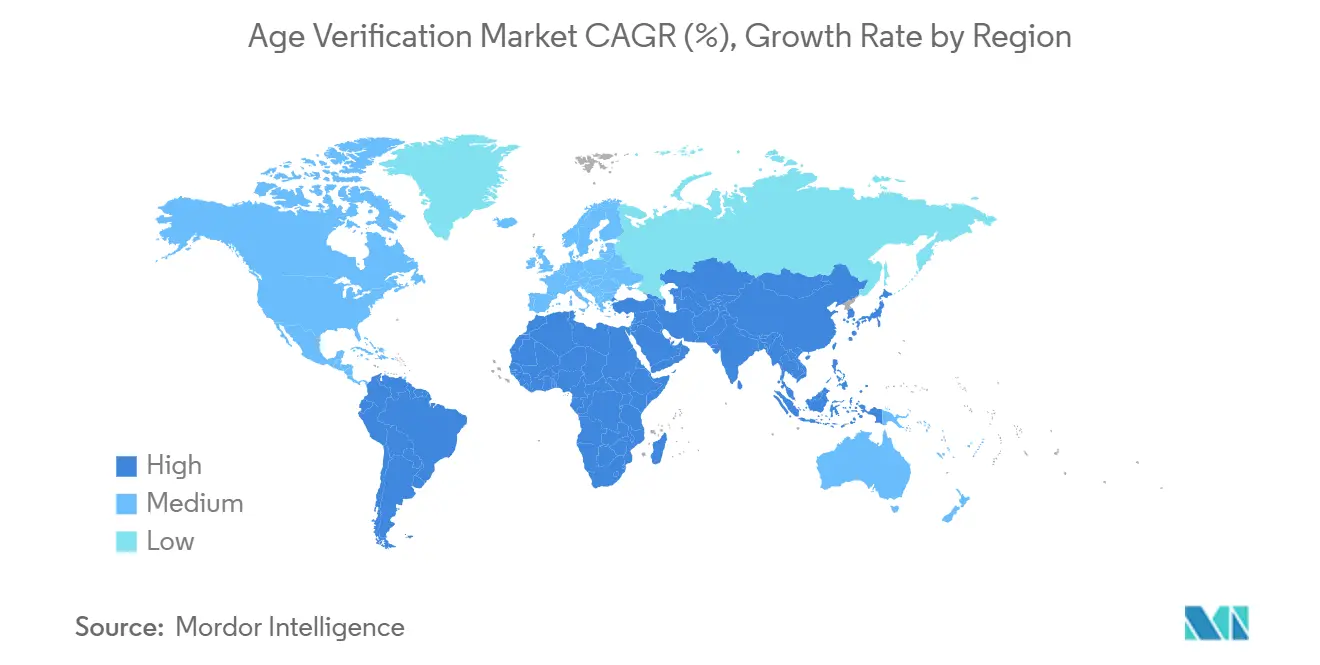
| Fastest Growing Market | Asia-Pacific |
| Largest Market | North America |
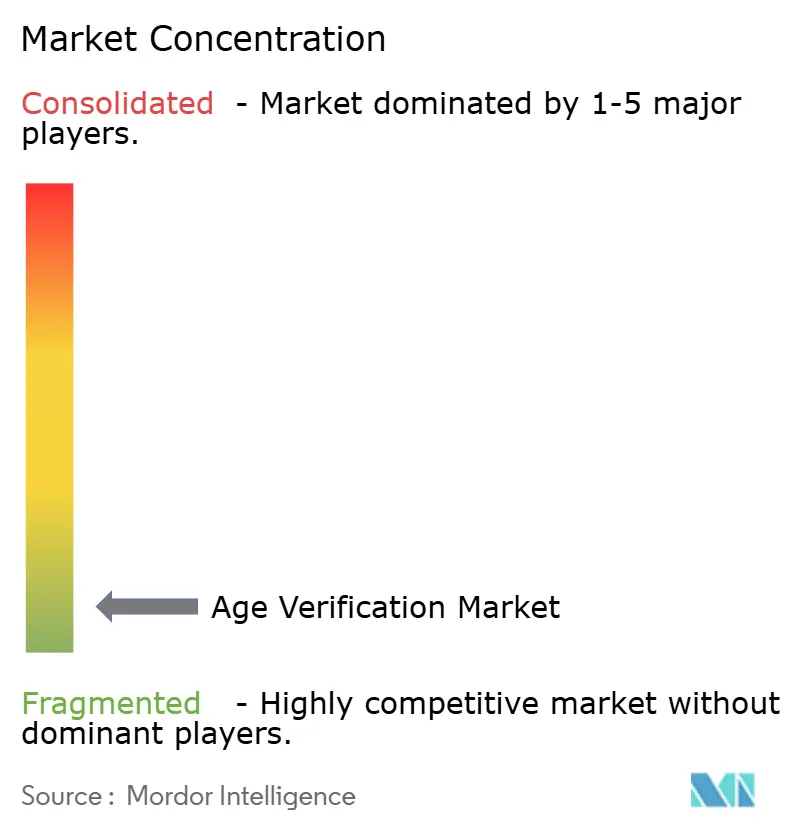
| Market Concentration | Low |
Major Players *Disclaimer: Major Players sorted in no particular order Image © Mordor Intelligence. Reuse requires attribution under CC BY 4.0. | |
Age Verification Market Analysis by Mordor Intelligence
The age verification market size is projected to expand from USD 5.37 billion in 2025 to USD 6.27 billion in 2026, and to USD 13.37 billion by 2031, registering a CAGR of 16.85% between 2026 and 2031. The age-verification market is moving from optional checks to required compliance systems as child-safety and adult-content rules take effect across several jurisdictions. The UK Online Safety Act entered its enforcement phase in July 2025, Australia introduced a national social media minimum age in December 2025, and the European Commission stated in April 2026 that its age-verification app was technically ready. These developments are changing buying decisions because platforms must now meet formal requirements rather than choose verification tools only for internal risk management. Vendors are responding by combining document checks, biometric tools, data verification, and digital credentials within a single service. The strongest opportunities in the age verification market are tied to recurring compliance work, cross-border implementation, and privacy-preserving methods for confirming eligibility.
Key Report Takeaways
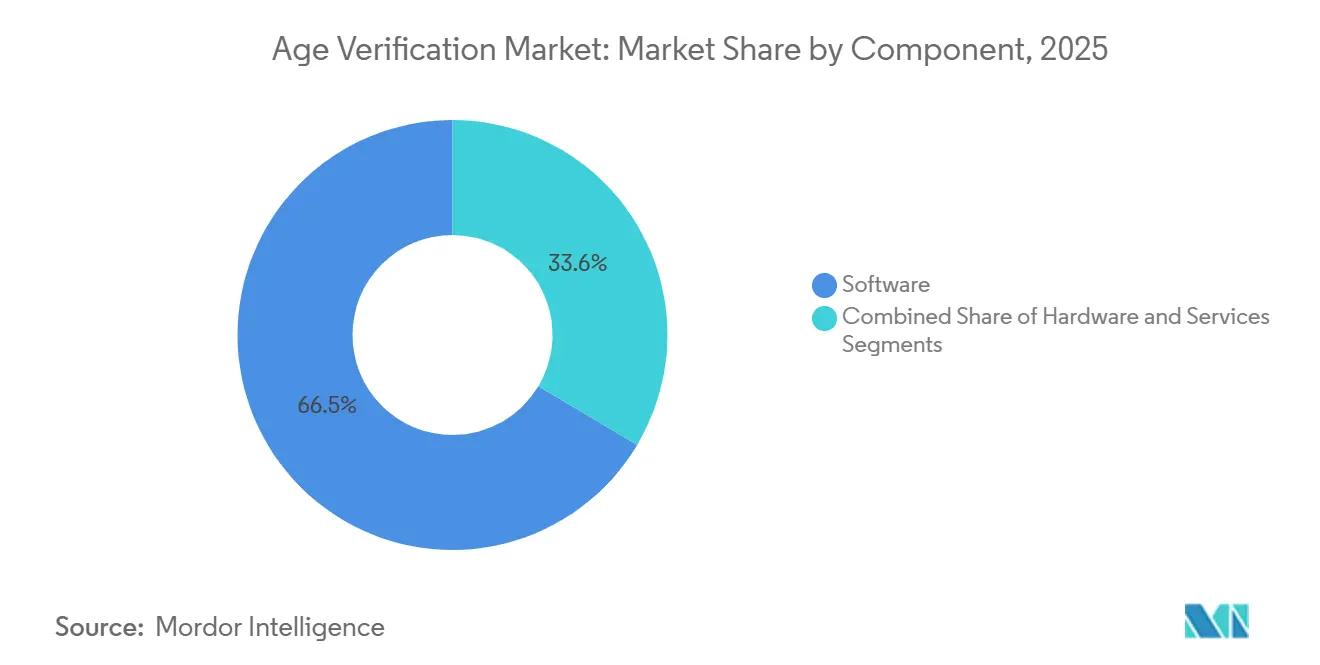
- By component, software held 66.45% of the Age Verification Market revenue share in 2025, while services are projected to expand at an 18.32% CAGR through 2031.
- By verification method, Document and Electronic-ID Verification accounted for 28.56% of the market revenue share in 2025, while Digital Age Credentials and Wallet-Based Proofs are expected to grow at a 17.67% CAGR through 2031.
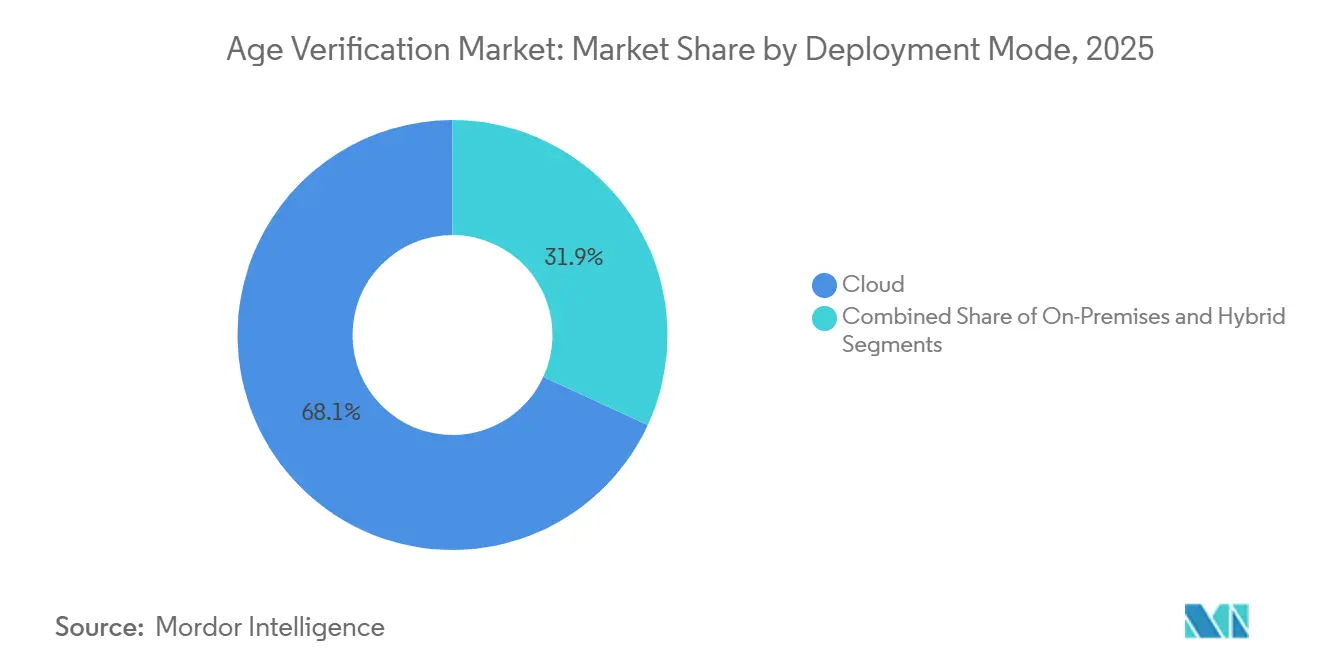
- By deployment mode, cloud accounted for 68.13% of the Age Verification Market revenue in 2025, while hybrid deployment is projected to grow at an 18.66% CAGR through 2031.
- By customer type, commercial enterprises accounted for 67.29% of the Age Verification Market in 2025, while government and public-sector organizations are expected to record an 18.96% CAGR through 2031.
- By geography, North America accounted for 33.12% of the Age Verification Market revenue in 2025, while Asia-Pacific is projected to advance at a 17.98% CAGR through 2031.
Note: Market size and forecast figures in this report are generated using Mordor Intelligence’s proprietary estimation framework, updated with the latest available data and insights as of January 2026.
Global Age Verification Market Trends and Insights
Drivers Impact Analysis*
| Driver | (~) % Impact on CAGR Forecast | Geographic Relevance | Impact Timeline |
|---|---|---|---|
| Expansion of Online Age-Restricted Commerce | +4.2% | Global | Short term (≤ 2 years) |
| Mandatory Child-Safety and Platform-Compliance Measures | +3.8% | North America, UK, EU, Australia | Short term (≤ 2 years) |
| Growth of Online Gambling and Gaming Regulation | +3.0% | UK, EU, North America | Medium term (2-4 years) |
| Rising Adoption of Privacy-Preserving Age Assurance | +2.4% | EU, UK, Global | Medium term (2-4 years) |
| Reusable Digital Age Credentials Across Multiple Platforms | +1.7% | EU, Asia-Pacific | Long term (≥ 4 years) |
| Age-Assurance Evidence as a Trust and Insurance Requirement | +1.1% | North America and EU | Long term (≥ 4 years) |
| Source: Mordor Intelligence | |||
Expansion of Online Age-Restricted Commerce
Digital channels for alcohol, tobacco, cannabis, pharmaceuticals, and adult content increasingly require more than a self-declaration checkbox. U.S. rules are spreading across adult-content and social-media services, which broadens the group of operators that must assess age before allowing access. Tennessee treated certain age-verification failures as a Class C felony, thereby increasing the legal consequences of inadequate controls. Utah's S.B. 73 added a 2% tax on online adult-content revenue effective October 2026, along with verification requirements. Brazil's Digital ECA, Lei 15.211/2025, became enforceable on March 17, 2026, and allowed penalties of up to 10% of Brazilian revenue per violation. The age verification market, therefore, benefits when compliance costs become a standard operating expense for operators serving restricted online categories.
Mandatory Child-Safety and Platform-Compliance Measures
Rules for platforms are extending verification demand beyond adult-content sites to social media, gaming, and messaging services. The UK Online Safety Act required in-scope services to use highly effective age assurance from July 25, 2025. Ofcom reported in July 2026 that age checks were being deployed at an unprecedented scale, with 77 of the 100 largest dedicated pornography services complying and 7 more blocking access from the UK. Australia removed 4.7 million underage accounts within 5 weeks of its national minimum-age measure taking effect on December 10, 2025. Japan's Cabinet Office presented an outline in June 2026 that considered stronger age verification by social network operators, including possible integration with the MyNumber card. The age verification market gains recurring demand because platforms must maintain compliance as rules, enforcement approaches, and user risks change.
Growth of Online Gambling and Gaming Regulation
Online gambling and gaming have used age controls for years, but stricter requirements are reopening vendor selection and system upgrade cycles. The UK Gambling Commission removed the earlier 72-hour KYC grace period, requiring age and identity verification before making deposits or engaging in gambling activity. Denmark's regulatory approach requires iGaming services to connect to the national digital identity system, making government-linked verification a central control mechanism. China requires real-name checks for online game users and imposes time limits on minors, while major operators use facial recognition controls. Operators serving both U.S. states and UK users can face different requirements for verification methods and evidence. This variation supports demand in the age verification market for managed systems that can apply jurisdiction-specific rules rather than a single method for every user.
Rising Adoption of Privacy-Preserving Age Assurance
Privacy requirements are increasing the demand for systems that verify an age threshold without disclosing full identity. France required a double-anonymity option from January 11, 2025, under the SREN Law, meaning the content provider could receive no identity information under that method. The European Data Protection Board stated in February 2025 that age-assurance systems should follow data-minimization principles and avoid the use of biometric data when less intrusive options are available. Technical frameworks now combine verifiable credentials, Privacy Pass, WebAuthn, and Oblivious HTTP to provide a yes-or-no age-eligibility result. The EU Digital Identity Wallet supports selective disclosure, allowing a person to demonstrate an age threshold without sharing a date of birth. This direction gives the age-verification market a reason to compete on both privacy design and verification accuracy.
Restraints Impact Analysis*
| Restraint | (~) % Impact on CAGR Forecast | Geographic Relevance | Impact Timeline |
|---|---|---|---|
| Privacy, Data-Protection, and Biometric-Consent Obligations | -2.5% | EU, UK, Asia-Pacific | Short term (≤ 2 years) |
| False Rejections and Demographic Performance Gaps | -1.8% | Global | Medium term (2-4 years) |
| Fragmented Regulatory Definitions and Compliance Thresholds | -1.3% | Global | Medium term (2-4 years) |
| Limited Interoperability of Digital Age Credentials | -0.9% | EU, Asia-Pacific | Long term (≥ 4 years) |
| Source: Mordor Intelligence | |||
Privacy, Data-Protection, and Biometric-Consent Obligations
Consent and data protection obligations can delay deployment, even when a platform acknowledges the need for age checks. The European Data Protection Board cautioned in February 2025 against making government-issued identification the standard method, as such documents may contain biometric data and impose a disproportionate privacy burden.[1] Australia's rules restrict the use of government identity material as the sole verification method, while some U.S. rules require identification or database checks as a minimum. France also requires an option where the content platform does not receive identity information. eIDAS 2.0 and Australia's Privacy Act reinforce data-minimization duties, while gambling and financial-services regulators may require a clear audit record. These conflicting requirements can slow procurement in the age-verification market because enterprises need a system that meets safety, privacy, and audit obligations simultaneously.
False Rejections and Demographic Performance Gaps
False rejections pose operational and legal risks when verification systems perform differently across user groups. Research by the National Institute of Standards and Technology found that age-estimation performance can vary by sex, the demographic representation in the training data, image quality, and the composition of region-of-birth data. Entrust recorded a 58% rise in deepfake selfies and a 40% increase in injection attacks during 2025, raising the security standard expected of production systems. Vendors must detect fraudulent submissions without excluding legitimate users whose images are low quality or who fall outside well-represented training groups. These conditions can lead to accessibility concerns and potential scrutiny under equal-treatment rules. The age verification market must therefore balance stronger fraud controls with fair and usable verification experiences.
*Our forecasts treat driver/restraint impacts as directional, not additive. The impact forecasts reflect baseline growth, mix effects, and variable interactions.
Segment Analysis
By Component: Services Growth Supports Established Software Demand
Software held 66.45% of the age verification market share in 2025, supported by API-based orchestration, document scanning, and biometric matching used by large enterprises and platforms. Earlier integration with KYC, identity management, and fraud prevention systems slowed replacement decisions, even when buyers sought better performance or privacy controls. Hardware served in-person checks at restricted venues, pharmacies, and point-of-sale locations. Its role remained limited as more customer journeys moved online. The component mix favored tools that can process remote users at scale.
Services are projected to expand at an 18.32% CAGR from 2026 to 2031, the highest rate among components. The category covers implementation support, managed operations, recurring audits, and compliance advice. Ofcom expects regulated services to conduct regular vendor due diligence, making ongoing support relevant after installation. Evidence requirements can extend vendor relationships beyond an initial integration. Demand in the age-verification market is driven by customers who lack internal biometric processing and regulatory compliance teams.

By Verification Method: Digital Credentials Challenge Document-Led Workflows
Document and Electronic ID Verification accounted for 28.56% of the age verification market share in 2025 because it met established requirements across the UK, the United States, and Europe. It also produced an auditable record valued by gambling and financial services regulators. Authoritative Database Verification used credit bureau, telecommunications, and government record data to validate age without a document. Facial Age Estimation offered a non-document route that evaluated a selfie without requesting identity details. Other options included third-party signals, parental verification, and waterfall checks that apply stronger controls when risk warrants them.
Digital Age Credentials and Wallet-Based Proofs are expected to record a 17.67% CAGR from 2026 to 2031. In the age-verification market, this method enables governments and other authoritative bodies to issue credentials for age verification. Jumio integrated Trinsic's digital ID gateway in June 2026 to support mobile driver's licenses, eIDs, EU Digital Identity Wallet credentials, and reusable credentials in more than 60 countries.[2] The FIDO Alliance stated that WebAuthn can support device-bound proof of possession without server-side biometric storage. Ofcom found device, behavioral, and contextual inference unsuitable as an independent method for under-18 gating because it needs post-signup information.
By Deployment Mode: Hybrid Designs Address Local Data Rules
Cloud deployment held 68.13% of the age verification market in 2025. API-first services and vendor-managed infrastructure suited operators with limited internal identity-processing capacity. In the age-verification market, cloud delivery can shorten implementation time after a new rule takes effect. It can also avoid the upfront cost of dedicated biometric-processing servers. On-premises systems remained important for organizations that limit the transmission of biometric captures to outside servers.
Hybrid deployment is projected to grow at an 18.66% CAGR from 2026 to 2031. Malaysia's government record-keeping requirements and Indonesia's parental consent rules can make a fully cloud-based approach difficult. Cross-border operators still need cloud orchestration for traffic, policy, and risk management across jurisdictions. A hybrid design can keep selected biometric processing in a controlled environment while using cloud tools for matching and decisioning. Demand is linked to customers' management of local sovereignty rules and global digital operations.
By Customer Type: Public Procurement Broadens the Buyer Base
Commercial enterprises represented 67.29% of customer-type demand in 2025. Media platforms, restricted-product retailers, online gambling operators, and social media companies faced broad requirements and near-term enforcement deadlines. These buyers may need age checks at registration, before payment, and when a risk signal appears. Nonprofit and educational organizations had lower transaction volumes and used verification for restricted learning content and youth-protection obligations. Within the age-verification market, commercial customers remained the primary source of near-term deployments.
Government and public-sector organizations are expected to grow at an 18.96% CAGR from 2026 to 2031. The EU Digital Identity Wallet framework requires every member state to offer at least 1 wallet to citizens, residents, and businesses by December 2026. This positions public bodies as purchasers of identity infrastructure, not only as rulemakers. Japan's Digital Agency formed an advisory panel in 2025 to examine verifiable credentials for digital government documents. Singapore requires designated app stores to use compliant age-assurance processes from April 1, 2026.
Geography Analysis
North America accounted for 33.12% of market revenue in 2025. The U.S. Supreme Court's June 2025 ruling in Free Speech Coalition v. Paxton removed a major constitutional uncertainty around Texas adult-content verification requirements. State adoption then expanded, while further bills continued to be considered in 2026. The lack of a federal standard means platforms can face different requirements across states. This makes cross-market orchestration important for providers that support multiple jurisdictions.
The age-verification market in Europe is shaped by the Digital Services Act's child-safety duties and the EU Digital Identity Wallet requirement. The wallet framework requires member states to provide at least 1 wallet by December 2026.[3] France began enforcement under the SREN Law in January 2025 and pursued pornography services without suitable verification systems. Germany's KJM approved SEON's identity verification solution in August 2026. Middle Eastern demand is linked to national digital identity programs, while use in Africa remains at an earlier stage.
Asia-Pacific is projected to expand at a 17.98% CAGR through 2031, the highest regional rate in the age verification market. Australia removed 4.7 million underage accounts within 5 weeks after its minimum-age measure took effect in December 2025. Singapore and Malaysia introduced new age-assurance requirements in 2026. Indonesia established 5 developmental age bands and required parental consent for users under 17. South America also adds demand, with Brazil's Digital ECA starting in March 2026.
Competitive Landscape
The age verification market remained moderately fragmented, with no single provider holding more than a low- to mid-single-digit global share. Vendors face differing rules by location and method, which makes a universally applicable product difficult to deliver. Competition includes specialists, KYC and anti-money-laundering platforms, identity-orchestration vendors, and fraud-prevention companies. Buyers increasingly prefer systems that combine methods rather than relying on a single verification route. Cross-jurisdictional orchestration can help global customers meet differing local requirements.
Veriff acquired Vespia in February 2026 to broaden its trust platform across individual and business verification. GBG expanded its partnership with Equifax in May 2026, integrating identity and fraud tools into GBG Go.[4] Jumio integrated Trinsic in June 2026 to accept digital IDs in more than 60 countries through a single platform. These integrations can reduce the number of credential-specific connections that customers manage. They also help providers remain relevant as government-issued credentials become more common.
Age verification market competition now differentiates on privacy, interoperability, fraud resilience, and policy management, not only verification accuracy. GBG launched Reach in September 2026 for policy-driven address verification within agent workflows. SEON received eIDAS 2.0 certification and KJM approval in August 2026. The OpenID Foundation completed conformance tests for OpenID4VP and OpenID4VCI in 2026, supporting consistent credential-exchange implementation.
Age Verification Industry Leaders
-
Veriff OÜ
-
Jumio Corporation
-
iProov Limited
-
Persona Identities, Inc.
-
GBG Plc
- *Disclaimer: Major Players sorted in no particular order
Recent Industry Developments
- September 2026: GBG partnered with Intellias to expand the delivery of its identity data signals across gaming and financial services. It also launched Reach, a tool for real-time, policy-driven address verification within agentic AI workflows.
- August 2026: SEON announced that its identity verification solution has received eIDAS 2.0 certification and KJM approval for age verification in Germany. The dual approval allows existing SEON fraud-prevention customers to add compliant identity proofing and age verification without onboarding a separate vendor.
- July 2026: iDenfy received EUR 138,000 (USD 152,000) in EU co-funding for its Age Identification project, a non-document biometric age-estimation capability that assesses age from a selfie without storing personal data.
- June 2026: Jumio integrated Trinsic's digital ID gateway, enabling customers to accept digital IDs in more than 60 countries through a single platform alongside biometric and document checks.
Global Age Verification Market Report Scope
The Age Verification Market comprises software, hardware, and services that enable organizations to determine, validate, estimate, or verify an individual's age before granting access to age-restricted products, services, content, transactions, or digital experiences. Age verification solutions leverage a variety of methods, including identity document verification, electronic identity verification, authoritative database checks, facial age estimation, digital identity credentials, behavioral analysis, parental verification mechanisms, and multi-method age assurance technologies to support regulatory compliance, online safety, fraud prevention, and user protection initiatives.
The Age Verification Market Report is Segmented by Component (Software, Hardware, and Services), Verification Method (Document and Electronic-ID Verification, Authoritative Database Verification, Digital Age Credentials and Wallet-Based Proofs, Facial Age Estimation, Verified Account and Third-Party Age Signals, Device, Behavioral, and Contextual Age Inference, Parental or Guardian Verification, and Hybrid and Multi-Method Age Assurance), Deployment Mode (Cloud, On-Premises, and Hybrid), Customer Type (Commercial Enterprises, Government and Public-Sector Organizations, and Nonprofit and Educational Organizations), and Geography (North America, South America, Europe, Asia-Pacific, Middle East, and Africa). The Market Forecasts are Provided in Terms of Value (USD).
| Software |
| Hardware |
| Services |
| Document and Electronic-ID Verification |
| Authoritative Database Verification |
| Digital Age Credentials and Wallet-Based Proofs |
| Facial Age Estimation |
| Verified Account and Third-Party Age Signals |
| Device, Behavioral, and Contextual Age Inference |
| Parental or Guardian Verification |
| Hybrid and Multi-Method Age Assurance |
| Cloud |
| On-Premises |
| Hybrid |
| Commercial Enterprises |
| Government and Public-Sector Organizations |
| Nonprofit and Educational Organizations |
| North America | United States |
| Canada | |
| South America | Brazil |
| Mexico | |
| Rest of South America | |
| Europe | United Kingdom |
| Germany | |
| France | |
| Italy | |
| Rest of Europe | |
| Asia-Pacific | China |
| Japan | |
| South Korea | |
| India | |
| Rest of Asia-Pacific | |
| Middle East | Saudi Arabia |
| United Arab Emirates | |
| Rest of Middle East | |
| Africa | South Africa |
| Rest of Africa |
| By Component | Software | |
| Hardware | ||
| Services | ||
| By Verification Method | Document and Electronic-ID Verification | |
| Authoritative Database Verification | ||
| Digital Age Credentials and Wallet-Based Proofs | ||
| Facial Age Estimation | ||
| Verified Account and Third-Party Age Signals | ||
| Device, Behavioral, and Contextual Age Inference | ||
| Parental or Guardian Verification | ||
| Hybrid and Multi-Method Age Assurance | ||
| By Deployment Mode | Cloud | |
| On-Premises | ||
| Hybrid | ||
| By Customer Type | Commercial Enterprises | |
| Government and Public-Sector Organizations | ||
| Nonprofit and Educational Organizations | ||
| By Geography | North America | United States |
| Canada | ||
| South America | Brazil | |
| Mexico | ||
| Rest of South America | ||
| Europe | United Kingdom | |
| Germany | ||
| France | ||
| Italy | ||
| Rest of Europe | ||
| Asia-Pacific | China | |
| Japan | ||
| South Korea | ||
| India | ||
| Rest of Asia-Pacific | ||
| Middle East | Saudi Arabia | |
| United Arab Emirates | ||
| Rest of Middle East | ||
| Africa | South Africa | |
| Rest of Africa | ||
Key Questions Answered in the Report
What is the current size of the age verification sector?
The sector is projected to grow from USD 6.14 billion in 2026 to USD 13.37 billion by 2031 at a CAGR of 16.85%.
What is driving demand for age verification solutions?
Child-safety rules, adult-content controls, gambling requirements, and privacy-preserving age assurance are expanding adoption.
Which component leads age verification spending?
Software led with 66.45% of revenue in 2025, while services are projected to grow fastest at an 18.32% CAGR through 2031.
Which verification approach is growing fastest?
Digital Age Credentials and Wallet-Based Proofs are expected to grow at a 17.67% CAGR through 2031.
Which region is growing fastest for age assurance?
Asia-Pacific is projected to record the highest regional CAGR at 17.98% through 2031.
Why are hybrid age verification systems gaining use?
Hybrid systems are projected to expand at an 18.66% CAGR because they combine local data handling with cloud-based orchestration.