
Digital Work Instructions Software Market Size and Share
Market Overview
| Study Period | 2020 - 2031 |
|---|---|
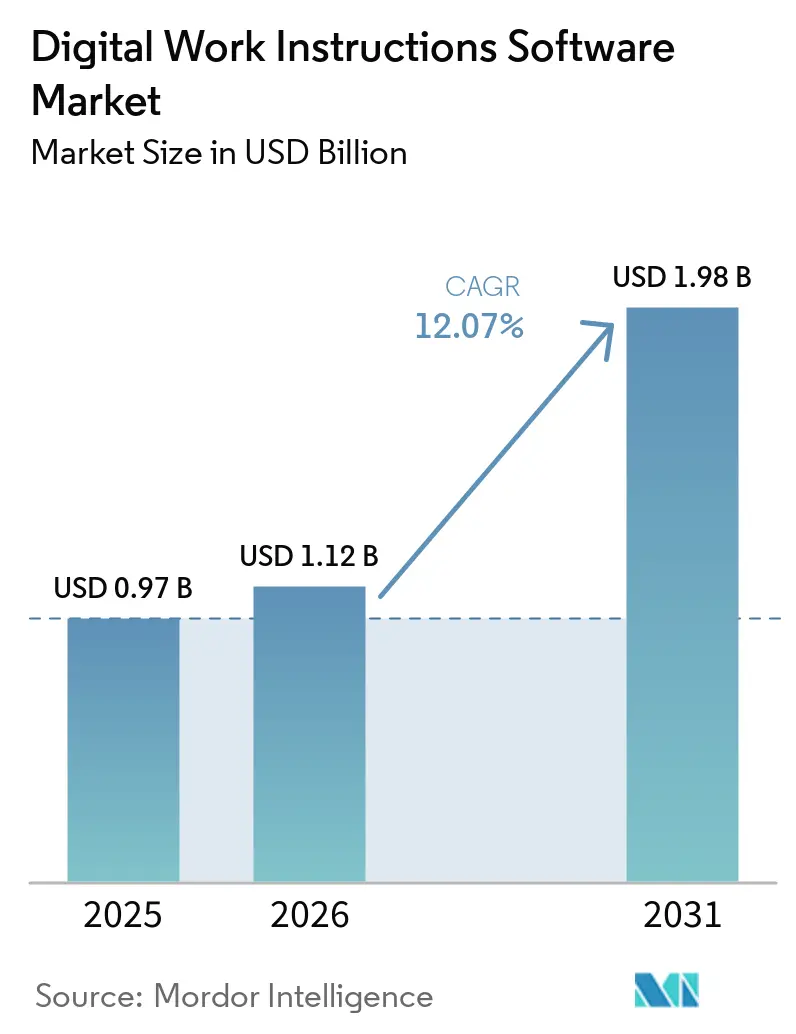
| Market Size (2026) | USD 1.12 Billion |
| Market Size (2031) | USD 1.98 Billion |
| Growth Rate (2026 - 2031) | 12.07 % |
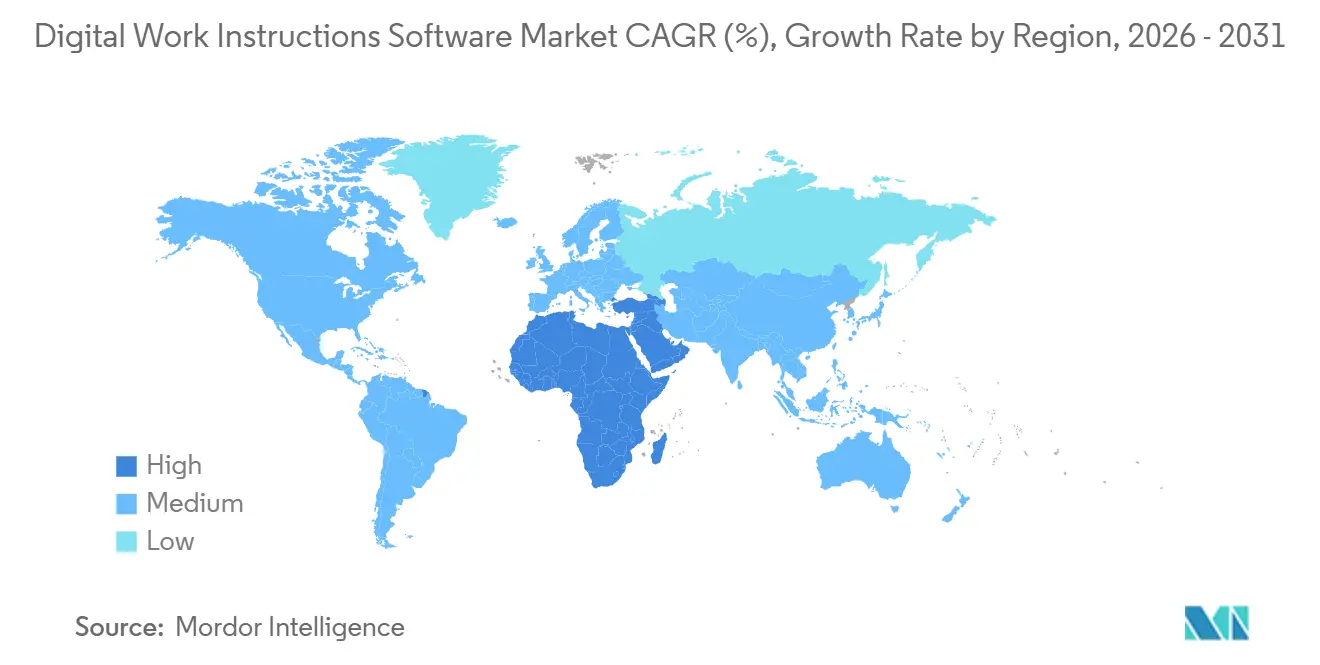
| Fastest Growing Market | Middle East |
| Largest Market | North America |
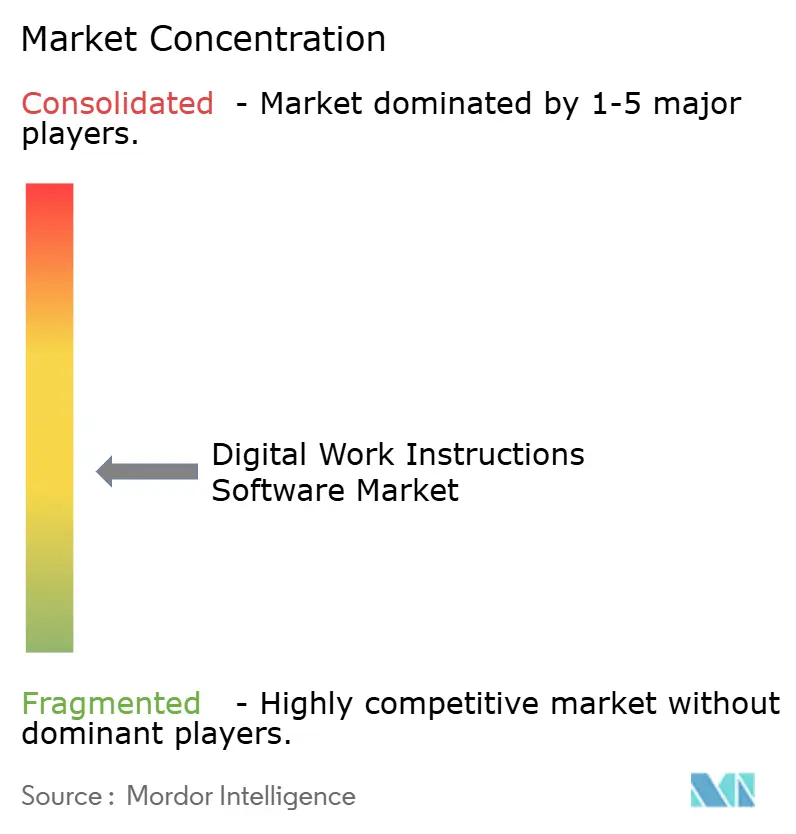
| Market Concentration | Medium |
Major Players *Disclaimer: Major Players sorted in no particular order Image © Mordor Intelligence. Reuse requires attribution under CC BY 4.0. | |
Digital Work Instructions Software Market Analysis by Mordor Intelligence
The digital work instructions software market size is projected to expand from USD 0.97 billion in 2025 and USD 1.12 billion in 2026 to USD 1.98 billion by 2031, registering a CAGR of 12.07% between 2026 to 2031. Industrial digitalization is moving manufacturers away from paper procedures and static PDF files toward guided workflows that connect operators with production systems. Tighter quality audits, faster product changeovers, and shortages of skilled workers are making verified task execution more important across factories. Generative AI can shorten implementation work by converting legacy procedures, video demonstrations, and 3D CAD files into usable instruction sequences. This gives vendors an opening beyond early technology adopters, especially where manufacturers already operate cloud, IoT, or manufacturing execution systems. In the digital work instructions software market, suppliers are competing on platform integration, easier content creation, and the ability to govern procedures across several sites.
Key Report Takeaways
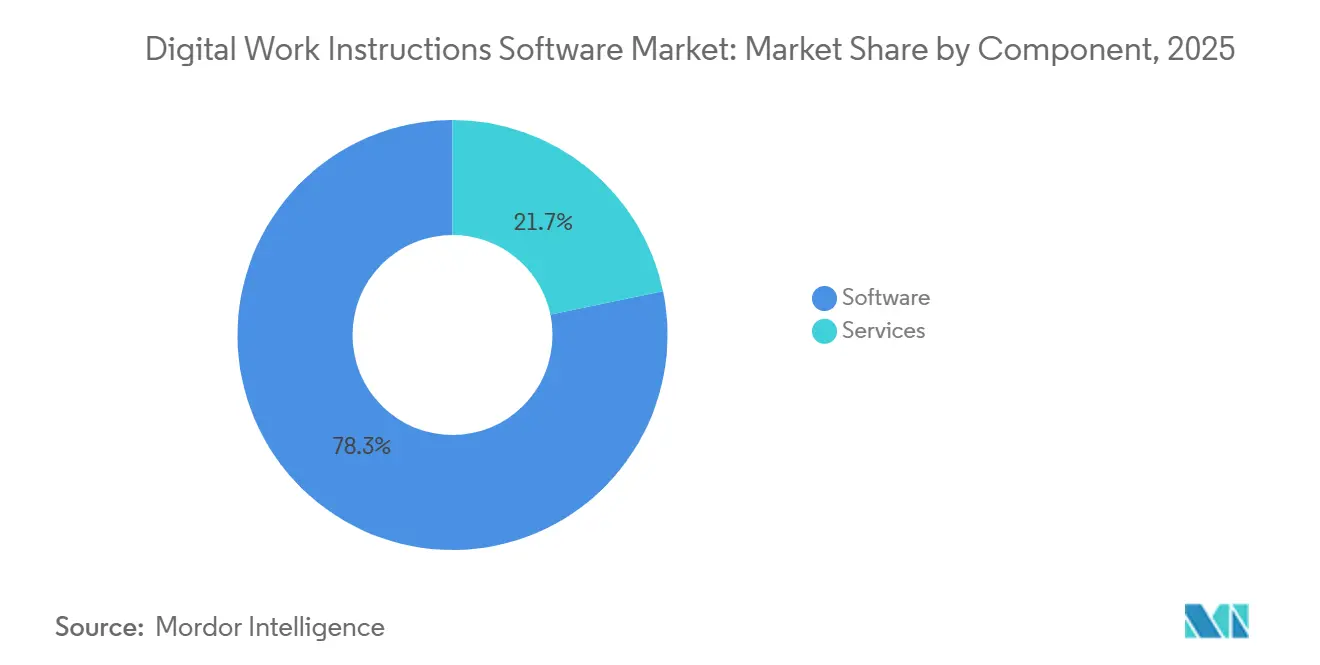
- By component, software held 78.27% of 2025 revenue in the digital work instructions software market and is projected to expand at a 12.64% CAGR through 2031.
- By deployment, cloud-based platforms held 65.79% of 2025 revenue and are projected to expand at a 13.02% CAGR through 2031.
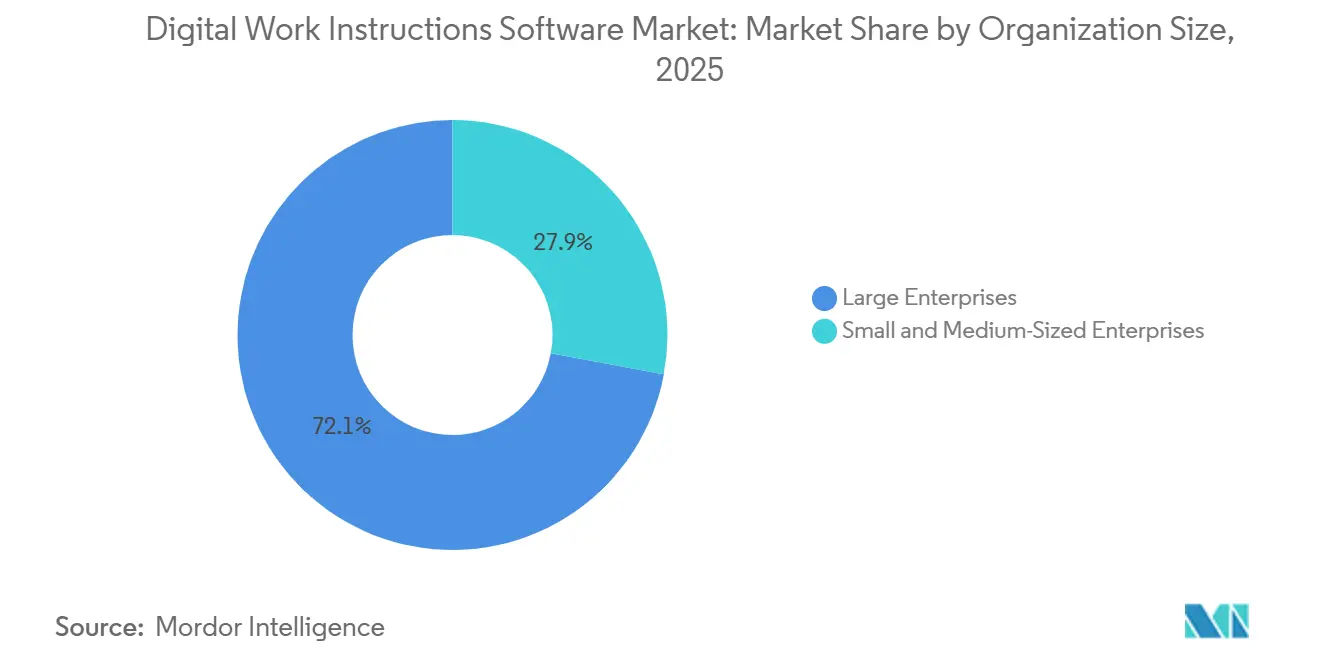
- By organization size, large enterprises held 72.07% of 2025 revenue, while SMEs are projected to record the highest CAGR of 14.23% through 2031 in the digital work instructions software market.
- By application, assembly, production, and line operations held 22.34% of 2025 revenue, while safety, lockout/tagout, and compliance are projected to grow at a 15.27% CAGR through 2031.
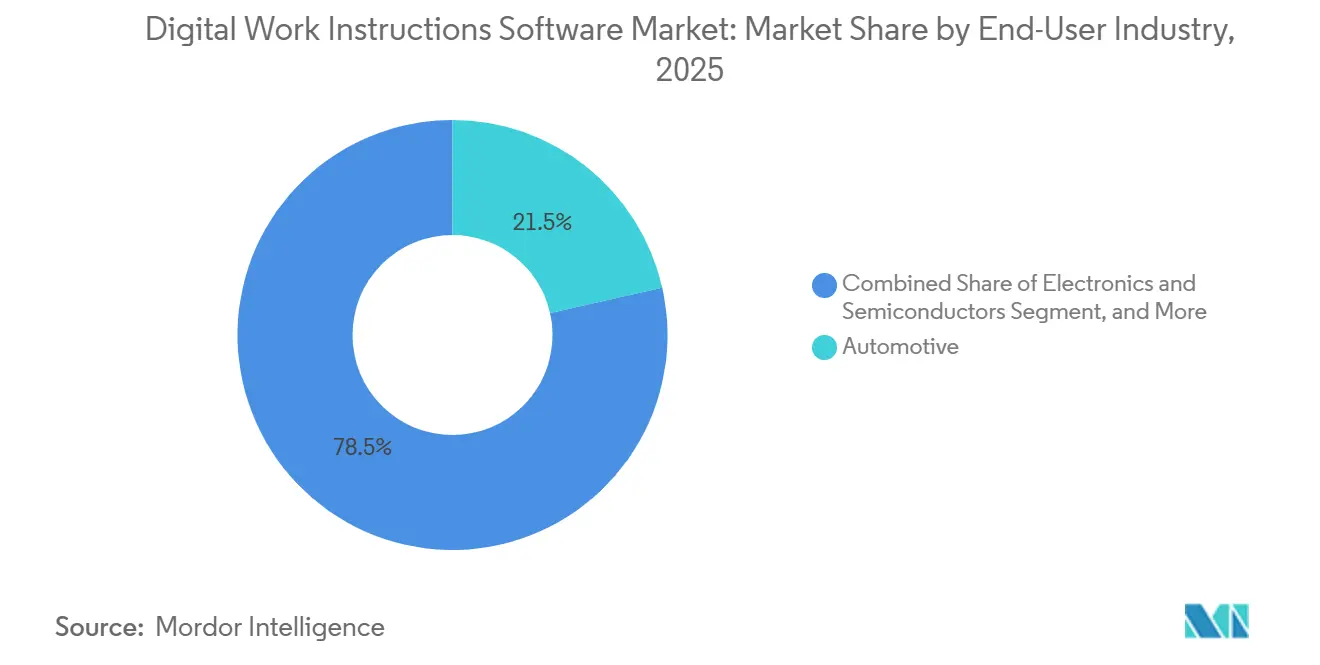
- By end-user industry, automotive held 21.47% of 2025 revenue in the digital work instructions software market, while electronics and semiconductors are projected to expand at a 14.56% CAGR through 2031.
- By delivery device, tablets and industrial panel PCs held 46.12% of 2025 revenue, while wearables and smart glasses are projected to grow at a 16.12% CAGR through 2031.
- By geography, North America held 34.12% of 2025 revenue, while the Middle East is projected to grow at a 14.68% CAGR through 2031 in the digital work instructions software market.
Note: Market size and forecast figures in this report are generated using Mordor Intelligence’s proprietary estimation framework, updated with the latest available data and insights as of January 2026.
Market Trends and Insights
Drivers Impact Analysis of Digital Work Instructions Software Market*
| DRIVER | (~) % IMPACT ON CAGR FORECAST | GEOGRAPHIC RELEVANCE | IMPACT TIMELINE |
|---|---|---|---|
| Industrial Digitalization and Smart Manufacturing Adoption | +2.8% | Global | Short term (≤ 2 years) |
| Replacement of Paper-Based and Static PDF Procedures | +2.2% | Global, with deep traction in North America and Europe | Medium term (2-4 years) |
| Skilled Labor Shortages and Faster Frontline Onboarding | +1.8% | North America, Europe, Asia-Pacific | Medium term (2-4 years) |
| Increasing Requirements for Traceability, Quality, and Safety Compliance | +1.5% | Global, with intensity in North America and APAC core | Long term (≥ 4 years) |
| AI-Assisted Conversion of Legacy Documents Into Executable Workflows | +1.3% | Global | Medium term (2-4 years) |
| Machine-Linked Task Enforcement and Proof-of-Completion Records | +1.0% | North America and Europe, with spillover to APAC | Long term (≥ 4 years) |
| Source: Mordor Intelligence | |||
Industrial Digitalization and Smart Manufacturing Adoption
Industrial digitalization is driving demand for digital work instruction software as factories connect operational data to day-to-day work. Rockwell Automation reported in 2024 that 95% of manufacturers were using or evaluating smart manufacturing technologies, up from 84% in 2023. The same research found that 83% expected to implement generative AI in their operations.[1]Rockwell Automation, “Ninety-Five Percent of Manufacturers Are Investing in AI to Navigate Uncertainty and Accelerate Smart Manufacturing,” Rockwell Automation, rockwellautomation.com These investments establish the cloud connectivity, IoT data streams, and workflow systems that instruction platforms need. A manufacturer with sensor networks and cloud manufacturing systems can add operator guidance without installing another hardware layer. The digital work instructions software market can therefore benefit when smart-factory programs shift from isolated projects to standardized operating practices.
Replacement of Paper-Based and Static PDF Procedures
Paper instructions and static PDFs do not provide the operator identity, timestamps, or deviation records needed during modern quality reviews. That limitation becomes more significant when customers require documented process capability from suppliers. A current digital procedure can record each completed step and retain a version history after a process revision. It can also reduce confusion when experienced employees leave or when several shifts use the same work cell. This creates a commercial reason to replace paper systems that extends beyond general interest in factory digitalization. The digital work instructions software market is supported by manufacturers that treat traceable procedures as part of supplier qualification and business continuity.
Skilled Labor Shortages and Faster Frontline Onboarding
Labor shortages are pushing manufacturers to place operating knowledge into processes rather than relying on individual experience. The National Association of Manufacturers stated in 2025 that the United States could face a shortage of 1.9 million manufacturing workers by 2033, with nearly half of the 3.8 million projected openings left unfilled.[2]National Association of Manufacturers, “The State of the Manufacturing Workforce in 2025,” National Association of Manufacturers, nam.org The World Economic Forum reported in 2025 that 74% of companies faced a shortage of skilled workers. It also found that 94% expected to hire or repurpose workers through greater smart-manufacturing adoption. Guided, multimedia procedures can help new operators perform complex and variable tasks with less reliance on informal coaching. The digital work instructions software market gains relevance where retaining production knowledge reduces the disruption caused by turnover.
Increasing Requirements for Traceability, Quality, and Safety Compliance
Traceability requirements are shifting from periodic documents toward continuous records created during production. ANSI/ISA 95.00.01-2025 reinforces structured links between enterprise and control systems, which supports the need for reliable data exchange between ERP, MES, and the shop floor. In regulated manufacturing, electronic records and signatures are important for meeting FDA 21 CFR Part 11 expectations. ISO 9001:2015 and IATF 16949 also require current work instructions to be accessible at the point of use. Digital procedures can provide worker-attributed records for every step, which paper processes cannot deliver consistently across many facilities. This raises the value of the digital work instructions software market for aerospace, automotive, pharmaceutical, and other manufacturers managing frequent audits.
Restraints Impact Analysis of Digital Work Instructions Software Market*
| RESTRAINT | (~) % IMPACT ON CAGR FORECAST | GEOGRAPHIC RELEVANCE | IMPACT TIMELINE |
|---|---|---|---|
| Integration Complexity Across Legacy ERP, MES, SCADA, and PLC Environments | -2.1% | Global, most acute in legacy-heavy North America and Europe | Long term (≥ 4 years) |
| High Initial Implementation and Validation Costs | -1.7% | Global, particularly SMEs in Asia-Pacific and South America | Medium term (2-4 years) |
| Worker Acceptance, Privacy, and Labor-Relations Concerns | -0.8% | North America and Europe | Medium term (2-4 years) |
| Connectivity, Device Durability, and Offline-Execution Constraints in Harsh Facilities | -0.6% | APAC core, with spillover to the Middle East and Africa | Long term (≥ 4 years) |
| Source: Mordor Intelligence | |||
Integration Complexity Across Legacy ERP, MES, SCADA, and PLC Environments
Integration remains the most persistent barrier because many plants use technology stacks that were not designed to exchange data easily. Work orders, bill-of-materials records, and machine-state signals often sit in separate proprietary systems. Connecting them can require custom middleware and months of work before operators see value on the production floor. ANSI/ISA 95.00.01-2025 provides a common framework for enterprise-to-control-system integration, but many facilities still depend on custom connectors. These connectors may need revision after software updates, which increases operating complexity. The digital work instructions software market faces a narrower immediate opportunity among mid-sized manufacturers without dedicated operational technology integration teams.
High Initial Implementation and Validation Costs
Implementation costs extend beyond software licenses because firms must migrate content, provide devices, validate processes, and train supervisors. FDA-regulated manufacturers may need 6 to 12 months of documented testing to validate a platform under 21 CFR Part 11. This lengthens the period before a buyer can realize operational value and concentrates financial exposure early in a project. Cloud subscriptions and per-operator pricing can reduce the initial software commitment for smaller organizations. They do not remove the work required to retire legacy documentation or establish new quality routines. The digital work instructions software market must therefore show a clear path from content migration to sustained frontline use, especially for cost-sensitive SMEs.
*Our forecasts treat driver/restraint impacts as directional, not additive. The impact forecasts reflect baseline growth, mix effects, and variable interactions.
Digital Work Instructions Software Market Segment Analysis
By Component:
Software Remains the Core Platform LayerSoftware accounted for 78.27% of 2025 revenue in the digital work instructions market, reflecting the importance of authoring, version control, analytics, and real-time delivery across operator-guidance platforms. Platform licenses can support larger user groups without costs rising in direct proportion to usage, unlike implementation and customization services, which require specialist effort and tend to grow with billable hours. Manufacturers use the software layer to create instructions, manage revisions, present approved content to operators, and administer procedures across several facilities from a common environment. Services remain important where legacy systems, regulated processes, and detailed validation requirements create additional technical work, but they do not replace the platform’s recurring operational role. The component structure, therefore, remains platform-led, with software delivering the primary value to buyers, replacing disconnected files, paper-based procedures, and informal operating knowledge.
Software is projected to grow at a 12.64% CAGR through 2031 as suppliers extend AI-enabled authoring and enterprise customers consolidate multi-site activity into common SaaS agreements. Siemens described intelligent, AI-powered work instructions in its Opcenter production environment during 2025, while Rockwell Automation presented AI-driven work instructions through its Plex business. These approaches place AI functionality within the product environment rather than treating it solely as a custom services engagement. Dozuki stated that its AI suite digitized 724% more documents year over year during 2025, alongside more than 250,000 new guides and 2.7 million tracked work orders. In the digital work instructions software industry, this enables customers to expand their usable content libraries while reducing manual authoring and maintaining more consistent control over updates.[3]Dozuki, “Dozuki Announces Record Breaking 2025,” Dozuki, dozuki.com


By Deployment:
Cloud Supports Centralized Procedure GovernanceCloud-based deployment held 65.79% of 2025 revenue and leads the digital work instructions software market because it allows a manufacturer to govern approved content from a central environment. When a process changes, the platform can distribute the revised instruction to several facilities and shifts at once, reducing the risk of local files remaining in use after a revision. Cloud environments also give teams a common basis for content approvals, access control, performance review, and the management of contract manufacturing relationships. Hybrid deployments remain relevant where unreliable connectivity or data-residency conditions prevent a fully cloud-based operating model. On-premises systems continue to serve defense, aerospace, and heavily regulated pharmaceutical sites where hosting rules or certification expectations limit external data storage.
Cloud deployment is projected to grow at a 13.02% CAGR through 2031, the fastest rate among deployment models, because centralized publication also supports no-code tools for process engineers. Dozuki opened primary or backup data centers in Frankfurt, Paris, Singapore, and Tokyo during 2025, showing that data residency can influence customer decisions even where cloud administration is preferred. Tulip reported 364% growth in customer adoption of generative AI capabilities and 519% growth in automation adoption over the prior 2 years, indicating that a cloud platform can accelerate use of newly available functionality. The digital work instructions software market benefits when approved features and content updates can reach users across an enterprise without separate local installations. Vendors must still address device connectivity, regulatory validation, and local hosting requirements for individual plants.
By Organization Size:
Large Enterprises Lead Spending While SMEs ExpandLarge enterprises accounted for 72.07% of 2025 revenue, giving them the leading position in the digital work instructions software market because they have larger technology budgets, wider multi-site footprints, and internal teams capable of managing complex integrations. They can connect instruction platforms with MES, ERP, and quality systems, then embed those platforms deeply within daily production operations. These connections can raise switching costs and support longer vendor relationships once procedural content becomes part of the operating model. Large organizations also manage more variation across products, plants, and shifts, which increases the value of centrally controlled content and repeatable task execution. Their spending remains important because a single enterprise program can bring together licenses, analytics, content governance, and integration work across several facilities.
SMEs are projected to record a 14.23% CAGR through 2031, the highest rate by organization size, as tiered subscriptions, per-operator pricing, rapid deployment packages, and pre-built templates lower entry barriers. These options can reduce the need for large upfront capital approvals, although migration, training, and process ownership still require internal commitment. The World Economic Forum found that 94% of surveyed companies expected smart-manufacturing adoption to help them hire or repurpose workers during 2025. This matters to smaller firms because the departure of an experienced operator can affect a greater proportion of total workforce knowledge than at a larger manufacturer. The digital work instructions software industry can expand among SME suppliers in Southeast Asia, North Africa, and Eastern Europe as they enter automotive and electronics value chains that require more controlled procedure governance.
By Application:
Assembly Leads While Safety and Compliance Grow FastestAssembly, production, and line operations held 22.34% of 2025 application revenue, the largest share in the digital work instructions software market, because these activities directly affect throughput, product quality, and the reliability of line changeovers. Operators need variant-specific sequences that respond to changing production schedules, along with quality checkpoints that remain visible during work. Step locking, media-rich instructions, and digital sign-off can provide this control during repetitive or high-volume tasks. Standard operating procedures and standard work, inspection and quality assurance, equipment setup and changeover, maintenance, and operator care rely on the same core ability to present an approved sequence at the moment of work. The range of use cases shows that the application extends beyond assembly to any task where consistency, guidance, and evidence of completion are operationally important.
Safety, lockout/tagout, and compliance are projected to grow at a 15.27% CAGR through 2031, the fastest application rate, as employers seek stronger evidence that hazardous-energy procedures were followed. OSHA lists control-of-hazardous-energy violations under 29 CFR 1910.147 as one of its frequently cited standards. Digital timestamping and worker attribution can provide a completion record that paper permit systems cannot consistently provide, while ISO 45001 and OSHA requirements reinforce the need for current procedures at the point of use. Dozuki partnered with Vector Solutions in 2025 to combine OSHA-, NFPA-, and ANSI-aligned training content with digital work instruction delivery. The digital work instructions software market has a clear compliance use case: organizations need more reliable evidence of safety procedures and documented task completion.
By End-User Industry:
Automotive Leads and Electronics Increases Precision DemandAutomotive retained 21.47% of 2025 end-user revenue, the largest position in the digital work instructions software market, because the sector relies on standardized station-level work and detailed quality discipline. Electric vehicle battery assembly adds sensitive tasks involving torque application, adhesive dispensing, and thermal management, where process variation can have serious production consequences. Automotive suppliers also face customer quality requirements that can require evidence that specified procedures were followed during production. Industrial machinery and equipment create other needs around setup and complex configuration, while pharmaceuticals, chemicals, food and beverage, energy, utilities, and logistics each add their own compliance or knowledge-transfer needs. The common factor is the need to place approved operating knowledge directly where workers perform tasks, despite different regulatory frameworks and production environments.
Electronics and semiconductors are projected to grow at a 14.56% CAGR through 2031, the fastest end-user rate, because advanced chip and packaging facilities allow very little tolerance for operator deviation. A departure from the prescribed procedure can affect an entire wafer lot, strengthening the case for controlled guidance and detailed execution records. Samsung Electronics announced in March 2026 that it planned to transition global manufacturing operations into AI-driven factories by 2030, with AI agents across quality control, production, and logistics.[4]Samsung Electronics, “Samsung Electronics Announces Strategy To Transition Global Manufacturing Into AI-Driven Factories by 2030,” Samsung Mobile Press, samsungmobilepress.com The announcement demonstrates the scale of operational transformation underway in a high-precision manufacturing setting. The digital work instructions software market is relevant to this vertical because complicated procedures, rapid process changes, and stringent defect expectations all increase the value of machine-linked guidance.

By Delivery Device:
Tablets Remain Established While Wearables Grow FasterTablets and industrial panel PCs accounted for 46.12% of 2025 delivery-device revenue, reflecting their extensive installed base in the digital work instructions software market and their alignment with existing industrial hardware purchasing practices. Ruggedized tablets can display rich media, capture input, and support quality confirmation at a workstation, while smartphones can serve mobile workers in logistics and warehousing settings. Bring-your-own-device policies can further support smartphone use where control and security practices allow it. Desktop and web interfaces remain appropriate for fixed workstations, including cleanroom semiconductor settings where wearables may create contamination or electrostatic discharge concerns. The existing device mix reflects the practical demands of different work areas rather than a single hardware choice for every production task.
Wearables and smart glasses are projected to expand at a 16.12% CAGR through 2031, the fastest rate among delivery devices, because they can provide hands-free guidance during high-mix and complex assembly work. A tablet can interrupt a task when an operator must put down tools or look away from the work area to use a screen. EON Reality launched Field IQ in June 2026 for Meta Ray-Ban Display smart glasses, providing step-by-step guidance, photo verification, and real-time audit trails. This reflects a move from experimental smart eyewear toward production-oriented guidance applications that combine task support with audit evidence. The digital work instructions software market can benefit when hands-free delivery improves compliance and task flow without disrupting operator work.
Geography Analysis
North America Digital Work Instructions Software Market
North America held 34.12% of 2025 revenue, making it the largest regional contributor to the digital work instructions software market. The United States supports demand through automotive, aerospace, contract electronics, and a strong focus on quality and safety procedures, while OSHA enforcement increases the importance of documented safety execution. Canada and Mexico also contribute to regional demand, with Mexico benefiting from near-shoring as automotive producers realign supply chains in response to tariff conditions. These conditions can add plants that need standardized procedures across regional operations and provide vendors with a large installed base of operational systems to connect. The region is mature, although older technology systems can make integration difficult for some buyers.
Europe Digital Work Instructions Software Market
Europe is the second-largest geography, with Germany carrying importance because of its automotive supplier base, and with regulated manufacturing supporting adoption in pharmaceutical production and food processing. Manufacturers must manage detailed quality documentation and make current instructions accessible to workers, while buyers can place greater emphasis on data control and hosting location. Dozuki’s 2025 expansion into Frankfurt and Paris shows that suppliers are responding to these requirements. In the digital work instructions software market, regional growth depends on combining compliance templates, local support, and integration with established production systems.
MEA, APAC and South America Digital Work Instructions Software Market
The Middle East is projected to grow at a 14.68% CAGR through 2031, the fastest regional rate. Rockwell Automation reported in 2025 that 98% of manufacturers in the UAE and Saudi Arabia were using or planning to implement generative AI, which points to digital-first operating architectures in new industrial facilities. Asia-Pacific remains diverse, with Japan’s automotive and electronics supply chains, China’s manufacturing scale, India’s expanding smartphone and semiconductor assembly capacity, and South Korea’s semiconductor plants. South America has early use cases in Brazil’s automotive sector and Argentina’s agri-industrial base, while Africa remains at an earlier adoption stage despite growing foreign manufacturing investment. Across these geographies, the digital work instructions software market can grow where new facilities adopt standardized digital procedures before paper-based practices become deeply established.

Competitive Landscape
The digital work instructions software market is moderately fragmented, with industrial automation and enterprise software providers competing alongside specialized connected-worker vendors. Siemens, Honeywell, and SAP can embed instruction functions within broader MES, ERP, and quality-management environments, using existing customer relationships and integration depth during renewals. Tulip Interfaces, Dozuki, and Augmentir compete by offering simpler interfaces, faster AI-assisted authoring, and flexible deployment options that appeal to operational teams. Buyers can choose an integrated suite or a specialist product based on their existing systems, internal skills, and urgency. The field, therefore, offers several routes to adoption rather than one uniform supplier model.
Integration capability is increasingly important because instruction platforms need to exchange information with ERP, MES, control, and quality systems, and ANSI/ISA 95.00.01-2025 addresses enterprise and control-system integration. CAI Software acquired Parsable in September 2024, bringing a connected-worker platform with more than 1,000 site-level deployments into its industrial technology portfolio. MasterControl acquired Qualer in March 2025, thereby extending its life-sciences platform to include laboratory asset management. These transactions show that suppliers are expanding the scope of their quality, execution, and asset-management capabilities.
Mid-market and SME customers remain an important opening because cost and integration complexity can still prevent deployment at firms with fewer than 500 employees. Southeast Asia, the Middle East, and North Africa are also relevant where industrial policy supports digital manufacturing but vendor penetration remains limited, while procedure-completion data can be used with quality prediction tools to identify deviations before defects appear. Tulip secured USD 120 million in Series D funding in January 2026, with Mitsubishi Electric as a strategic investor, and reported a USD 1.3 billion valuation.[5]Tulip Interfaces, “Tulip Secures USD 120 Million Series D to Give Frontline Workers AI,” Tulip Interfaces, tulip.co The company said the funding would support global manufacturing channel expansion, while ServiceNow launched Industrial Connected Workforce in April 2026 to extend its workflow platform into shop-floor execution. These actions increase competitive pressure from both manufacturing specialists and broad enterprise software providers.
Digital Work Instructions Software Industry Leaders
Siemens AG
PTC Inc.
Tulip Interfaces, Inc.
Dozuki, Inc.
Honeywell International Inc.
- *Disclaimer: Major Players sorted in no particular order
Digital Work Instructions Software Market Companies Covered in this Report
- Siemens AG
- PTC Inc.
- Tulip Interfaces, Inc.
- Dozuki, Inc.
- Honeywell International Inc.
- Augmentir, Inc.
- ABB Ltd.
- Rockwell Automation, Inc.
- Schneider Electric SE
- Dassault Systèmes SE
- SAP SE
- Microsoft Corporation
- Hexagon AB
- SwipeGuide B.V.
- Visual Knowledge Share Ltd.
- Zaptic Ltd.
- Operations1 GmbH
- iBASEt, Inc.
- MasterControl, Inc.
- EASE, Inc.
- VKS Solutions Inc.
- Parsable, Inc.
- L&T Technology Services Limited
- Yokogawa Electric Corporation
- Mitsubishi Electric Corporation

Recent Industry Developments in Digital Work Instructions Software Market
- June 2026: EON Reality, together with EON AI Ventures, launched Field IQ, an AI copilot for industrial field workers delivered via Meta Ray-Ban Display smart glasses. Field IQ provided hands-free step-by-step procedural guidance, AI-driven photo verification, and real-time audit trails. The platform entered limited pilot availability in June 2026 with an initial cohort of 10 anchor industrial enterprises, signaling commercial deployment of AI-augmented wearable guidance in oil and gas, manufacturing, aerospace, and construction applications.
- April 2026: ServiceNow launched Industrial Connected Workforce at Hannover Messe on April 20, 2026, an AI-powered platform that digitizes standard operating procedures into guided step-by-step tasks, assigns work by role and location, and delivers contextual knowledge at the point of need. Quality engineers also gained AI-powered root-cause analysis capabilities. The launch extended ServiceNow's workflow platform, which processes more than 85 billion workflows annually, into shop-floor operational execution, representing a major entry by a horizontal enterprise SaaS provider into the digital work instruction segment.
- April 2026: Tulip Interfaces showcased its human-first AI manufacturing platform at Hannover Messe 2026, demonstrating a fully simulated truck factory across 4 AI-native stations. Tulip's Operations AI agent, which ingests process documents and shop-floor layouts to iteratively design and refine production systems, was central to the demonstration, illustrating how agentic AI is transitioning from concept to deployable shop-floor architecture.
- March 2026: Tulip Interfaces announced Factory Playback at NVIDIA GTC 2026, powered by NVIDIA AI and the Cosmos Reason vision-language model. Factory Playback reconstructs and replays factory operations as they occurred by synchronizing machine telemetry, operator workflows, quality events, and video into a unified operational timeline. This enables manufacturers to trace production deviations to root cause with video-level precision and directly extends the audit-trail capability of digital work instruction platforms.


Global Digital Work Instructions Software Market Report Scope
The Digital Work Instructions Software Market encompasses software solutions that enable organizations to develop, manage, distribute, and update interactive work instructions and standardized operating procedures in digital formats. These solutions provide step-by-step guidance through text, images, videos, diagrams, and other multimedia content accessible across computers, tablets, mobile devices, and wearable technologies. Digital work instructions software enables organizations to enhance process consistency, expedite employee training, minimize operational errors, maintain regulatory compliance, and support continuous improvement initiatives across manufacturing, maintenance, warehousing, and assembly operations.
The Digital Work Instructions Software Market Report is Segmented by Component (Software, and Services), Deployment (Cloud-Based, Hybrid, and On-Premises), Organization Size (Large Enterprises, and Small and Medium-Sized Enterprises), Application (Standard Operating Procedures and Standard Work, Assembly, Production, and Line Operations, Inspection and Quality Assurance, Equipment Setup and Changeover, Maintenance and Operator Care, Safety, Lockout/Tagout, and Compliance, and Other Applications), End-User Industry (Automotive, Electronics and Semiconductors, Industrial Machinery and Equipment, Pharmaceuticals and Life Sciences, Chemicals, Food and Beverage, Energy and Utilities, Logistics, Warehousing, and Distribution, and Other End-User Industries [Mining and Metals, Construction and Field Operations, Aerospace and Defense]), Delivery Device (Tablets and Industrial Panel PCs, Smartphones, Desktop and Web Interfaces, Wearables and Smart Glasses, and Other Delivery Devices), and Geography (North America, South America, Europe, Asia-Pacific, Middle East, and Africa). The Market Forecasts are Provided in Terms of Value (USD).
| Software |
| Services |
| Cloud-Based |
| Hybrid |
| On-Premises |
| Large Enterprises |
| Small and Medium-Sized Enterprises |
| Standard Operating Procedures and Standard Work |
| Assembly, Production, and Line Operations |
| Inspection and Quality Assurance |
| Equipment Setup and Changeover |
| Maintenance and Operator Care |
| Safety, Lockout/Tagout, and Compliance |
| Other Applications |
| Automotive |
| Electronics and Semiconductors |
| Industrial Machinery and Equipment |
| Pharmaceuticals and Life Sciences |
| Chemicals |
| Food and Beverage |
| Energy and Utilities |
| Logistics, Warehousing, and Distribution |
| Other End-User Industries (Mining and Metals, Construction and Field Operations, Aerospace and Defense) |
| Tablets and Industrial Panel PCs |
| Smartphones |
| Desktop and Web Interfaces |
| Wearables and Smart Glasses |
| Other Delivery Devices |
| North America | United States |
| Canada | |
| Mexico | |
| South America | Brazil |
| Argentina | |
| Rest of South America | |
| Europe | Germany |
| United Kingdom | |
| France | |
| Italy | |
| Spain | |
| Russia | |
| Rest of Europe | |
| Asia-Pacific | China |
| Japan | |
| India | |
| South Korea | |
| Australia | |
| Southeast Asia | |
| Rest of Asia-Pacific | |
| Middle East | Saudi Arabia |
| United Arab Emirates | |
| Turkey | |
| Rest of Middle East | |
| Africa | South Africa |
| Egypt | |
| Rest of Africa |
| By Component | Software | |
| Services | ||
| By Deployment | Cloud-Based | |
| Hybrid | ||
| On-Premises | ||
| By Organization Size | Large Enterprises | |
| Small and Medium-Sized Enterprises | ||
| By Application | Standard Operating Procedures and Standard Work | |
| Assembly, Production, and Line Operations | ||
| Inspection and Quality Assurance | ||
| Equipment Setup and Changeover | ||
| Maintenance and Operator Care | ||
| Safety, Lockout/Tagout, and Compliance | ||
| Other Applications | ||
| By End-User Industry | Automotive | |
| Electronics and Semiconductors | ||
| Industrial Machinery and Equipment | ||
| Pharmaceuticals and Life Sciences | ||
| Chemicals | ||
| Food and Beverage | ||
| Energy and Utilities | ||
| Logistics, Warehousing, and Distribution | ||
| Other End-User Industries (Mining and Metals, Construction and Field Operations, Aerospace and Defense) | ||
| By Delivery Device | Tablets and Industrial Panel PCs | |
| Smartphones | ||
| Desktop and Web Interfaces | ||
| Wearables and Smart Glasses | ||
| Other Delivery Devices | ||
| By Geography | North America | United States |
| Canada | ||
| Mexico | ||
| South America | Brazil | |
| Argentina | ||
| Rest of South America | ||
| Europe | Germany | |
| United Kingdom | ||
| France | ||
| Italy | ||
| Spain | ||
| Russia | ||
| Rest of Europe | ||
| Asia-Pacific | China | |
| Japan | ||
| India | ||
| South Korea | ||
| Australia | ||
| Southeast Asia | ||
| Rest of Asia-Pacific | ||
| Middle East | Saudi Arabia | |
| United Arab Emirates | ||
| Turkey | ||
| Rest of Middle East | ||
| Africa | South Africa | |
| Egypt | ||
| Rest of Africa | ||


Key Questions Answered in the Report
What is the digital work instructions software market size?
The digital work instructions software market size is projected to expand from USD 0.97 billion in 2025 and USD 1.12 billion in 2026 to USD 1.98 billion by 2031, registering a CAGR of 12.07% between 2026 to 2031.
What is driving adoption of digital work instruction platforms?
Manufacturers are replacing paper procedures to improve traceability, speed onboarding, manage product changeovers, and support quality and safety requirements.
Which deployment model leads demand?
Cloud-based deployment held 65.79% of 2025 revenue and is projected to expand at a 13.02% CAGR through 2031 because it supports centralized content governance across sites.
Which end users are expanding the fastest?
Electronics and semiconductors are projected to grow at a 14.56% CAGR through 2031 as precision assembly and chip packaging require tightly controlled procedures.
Why are wearable devices becoming more relevant in factory operations?
Wearables and smart glasses are projected to grow at a 16.12% CAGR through 2031 because they can provide hands-free guidance for complex work.
What is the main challenge for new deployments?
Connecting platforms with legacy ERP, MES, SCADA, and PLC systems can require custom middleware, extended implementation work, and specialist technical resources.
Page last updated on:





