
Digital Storytelling Courses Market Size and Share
Market Overview
| Study Period | 2021 - 2031 |
|---|---|
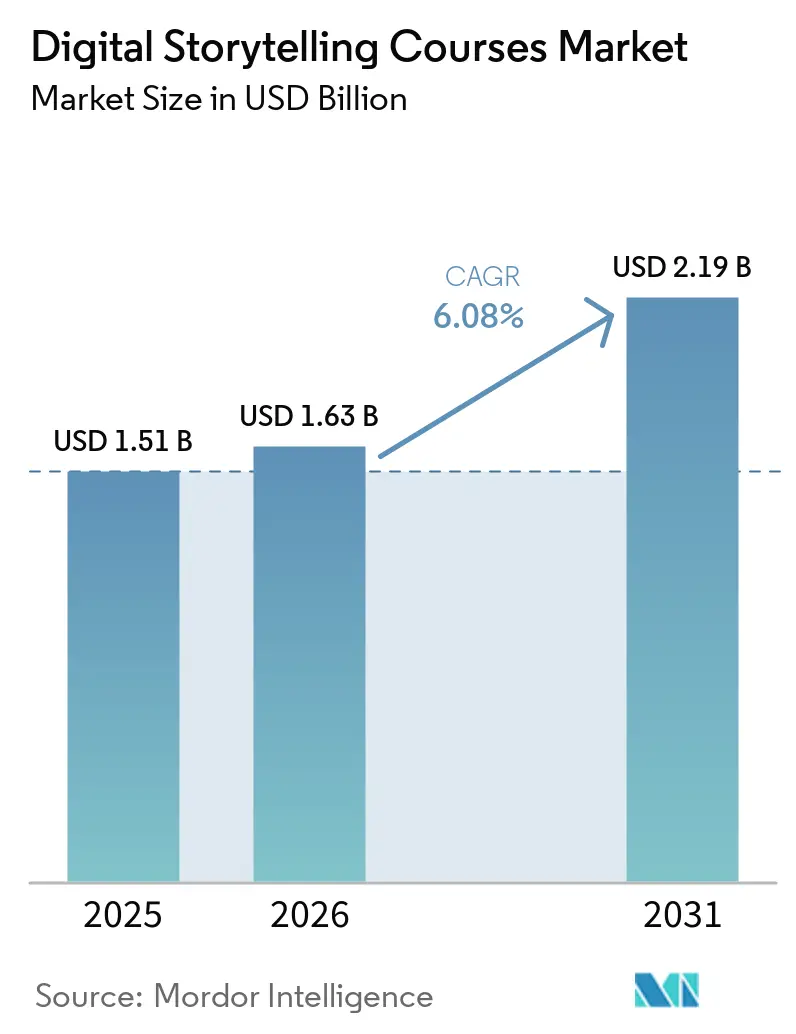
| Market Size (2026) | USD 1.63 Billion |
| Market Size (2031) | USD 2.19 Billion |
| Growth Rate (2026 - 2031) | 6.08 % |
| Fastest Growing Market | Asia-Pacific |
| Largest Market | North America |
| Market Concentration | Medium |
Major Players *Disclaimer: Major Players sorted in no particular order Image © Mordor Intelligence. Reuse requires attribution under CC BY 4.0. | |
Digital Storytelling Courses Market Analysis by Mordor Intelligence
The Digital Storytelling Courses Market was valued at USD 1.51 billion in 2025 and estimated to grow from USD 1.63 billion in 2026 to reach USD 2.19 billion by 2031, at a CAGR of 6.08% during the forecast period (2026-2031). Increasing demand for narrative skills in digital channels is driving growth, as maintaining communication quality becomes challenging in high-volume content environments. The rise of AI-generated content has further highlighted the need for human-led story development to ensure consistent emotion, tone, and audience relevance. Adoption is supported by short-form learning and modular instruction, with many organizations incorporating microlearning and blended skill delivery into workforce development programs[1]. Competitive strategies now focus on adaptive learning, enterprise pathways, and branded credentials to improve retention and pricing. The merger of Coursera and Udemy in May 2026 underscores the importance of scale, enterprise access, and catalog depth, as buyers increasingly prefer comprehensive learning ecosystems over standalone creative courses.
Key Report Takeaways
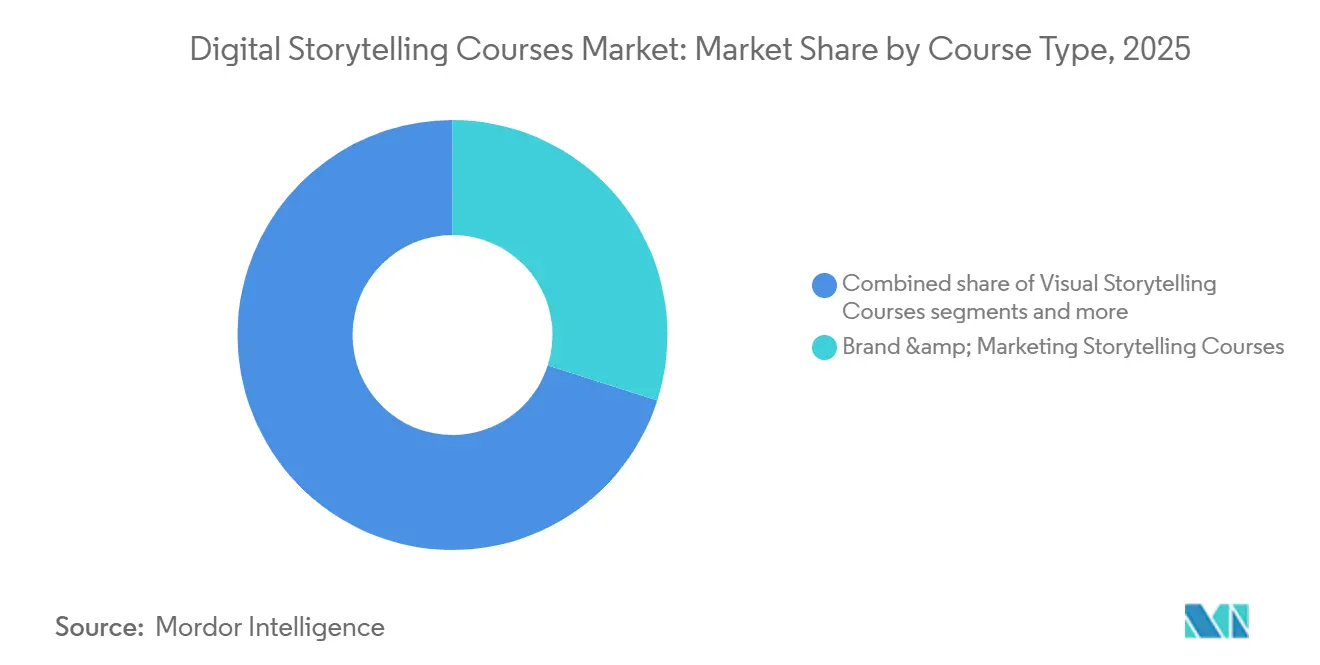
- By course type, Brand & Marketing Storytelling Courses led with a 29.92% revenue share of the Digital Storytelling Courses Market in 2025, while Video Storytelling Courses are projected to grow at the highest CAGR of 7.88% by 2031.
- By delivery mode, Self-Paced Courses held a 58.14% share of the Digital Storytelling Courses Market in 2025, while Blended Learning Courses are projected to grow at the highest CAGR of 6.44% by 2031.
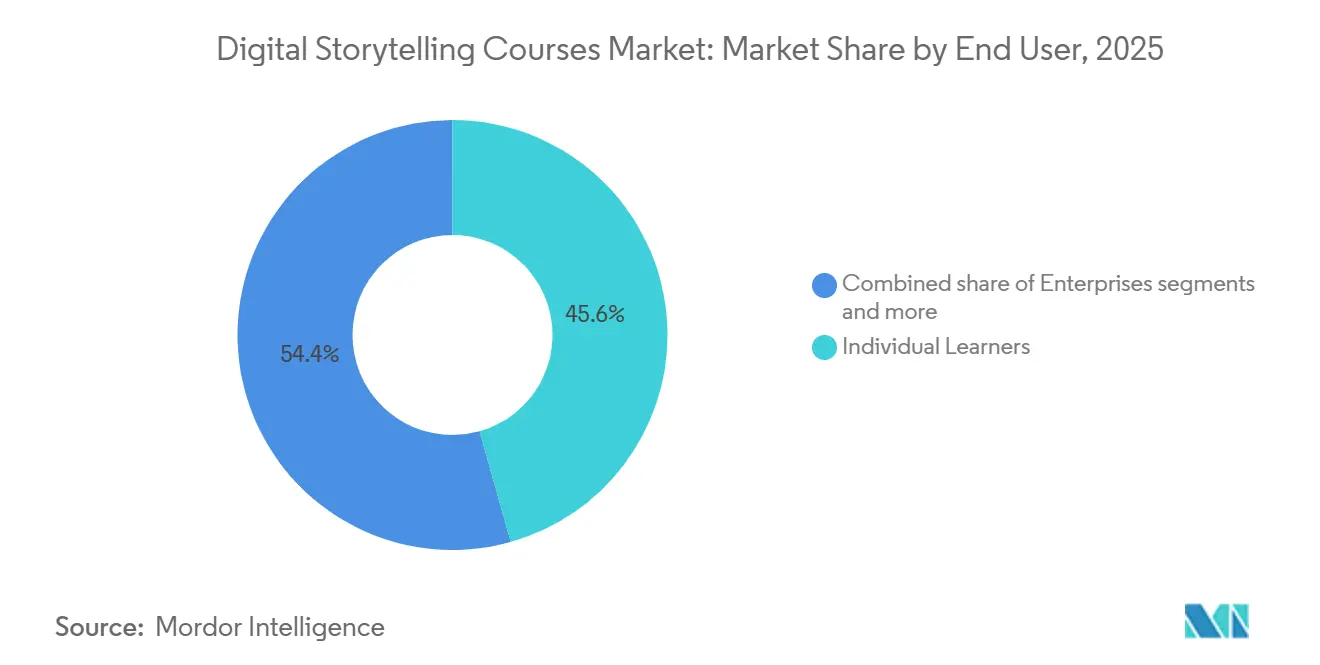
- By end user, Individual Learners accounted for a 45.63% share of the Digital Storytelling Courses Market in 2025, while Enterprises are projected to grow at the highest CAGR of 7.24% by 2031.
- By end-use industry, Marketing & Advertising Agencies held a 27.94% share of the Digital Storytelling Courses Market in 2025, while Independent Creators & Freelancers are projected to grow at the highest CAGR of 6.93% by 2031.
- By geography, North America held a 37.29% revenue share of the Digital Storytelling Courses Market in 2025, while Asia-Pacific is projected to grow at the highest CAGR of 7.05% by 2031.
Note: Market size and forecast figures in this report are generated using Mordor Intelligence’s proprietary estimation framework, updated with the latest available data and insights as of January 2026.
Global Digital Storytelling Courses Market Trends and Insights
Drivers Impact Analysis*
| Driver | (~) % Impact on CAGR Forecast | Geographic Relevance | Impact Timeline |
|---|---|---|---|
| Rising Demand for Creator-Led, Short-Form and Self-Paced Learning Formats | +1.3% | Global, concentrated in North America, Asia-Pacific, and Western Europe | Short term (≤ 2 years) |
| Increasing Demand for Communication, Branding, and Visual Storytelling Skills Across Industries | +1.2% | Global, led by North America and Europe | Medium term (2-4 years) |
| Expansion of Remote Learning and Hybrid Skill Development Ecosystems | +0.8% | Global, with early adoption in North America, Europe, and core Asia-Pacific markets | Medium term (2-4 years) |
| Employer Preference for Portfolio-Based and Practical Skill Validation | +0.7% | North America, Western Europe, and Australia | Medium term (2-4 years) |
| Integration of AI-Driven Personalization in Creative Learning Platforms | +1.4% | Global, with stronger penetration in North America and Europe | Short term (≤ 2 years) |
| Growth of Creator Economy and Independent Digital Content Production | +1.0% | Global, strongest in North America and Asia-Pacific, with rising relevance in South America and Africa | Medium term (2-4 years) |
| Source: Mordor Intelligence | |||
Rising Demand for Creator-Led, Short-Form and Self-Paced Learning Formats
Creator-led learning is becoming increasingly significant in the digital storytelling courses market as learners in creative fields often favor instructors who actively practice their craft over those with purely academic backgrounds. The market is also experiencing growth due to the adoption of microlearning, which integrates short-form learning formats into talent development programs. Self-paced delivery methods are particularly suited to creative training, as they accommodate project-based practice, revision cycles, and flexible work schedules, which are less compatible with rigid classroom structures. This trend is further driving the adoption of hybrid learning ecosystems, where organizations blend on-demand modules with guided feedback and cohort interactions to achieve structured learning outcomes. The rise of AI tools simplifying content creation is also influencing the market, shifting the focus toward concise, practical, creator-led instruction. This approach emphasizes helping learners refine skills such as voice, pacing, and narrative clarity, rather than concentrating solely on technical aspects[2].
Increasing Demand for Communication, Branding, and Visual Storytelling Skills Across Industries
The digital storytelling courses market is experiencing growth due to the increasing importance of communication and brand narrative skills across various industries, including software, finance, healthcare, media, and marketing. Communication has been identified as a critical skill for open roles, driving demand for training that helps teams articulate complex ideas effectively. Emotional influence plays a significant role in consumer decisions, emphasizing the relevance of visual and story-based communication in business contexts. Employers are increasingly prioritizing practical skill validation and portfolio-based evidence, reflecting a shift in preference toward demonstrable abilities over mere course completion. This trend is encouraging the adoption of project-based submissions, applied exercises, and certificate-backed outcomes, which are more easily recognized by employers for recruitment and professional development purposes.
Integration of AI-Driven Personalization in Creative Learning Platforms
AI-driven personalization is a key factor driving growth in the digital storytelling courses market, as it enhances how platforms support learner progression, recommendations, and retention. Research has shown that combining generative AI with adaptive learning systems creates more inclusive and learner-focused environments, encouraging the use of personalized learning paths in creative education. Studies also indicate that students favor AI-personalized educational videos over traditional, non-personalized content, which is particularly relevant for story-based visual instruction and modular course design. These advancements allow platforms to guide learners toward appropriate projects, improve instructional pacing, and identify gaps in narrative structure or audience targeting. Providers that invest in advanced AI learning architectures can also generate detailed skill data for enterprise applications, strengthening their competitive position compared to platforms that rely on static video libraries[3].
Growth of Creator Economy and Independent Digital Content Production
The digital storytelling courses market benefits from the steady growth of independent digital content production across various channels, including video, social media, audio, and brand-focused creator platforms. This demand extends beyond hobbyist learning, as creators increasingly prioritize storytelling skills to enhance monetization, grow audiences, and build personal brands. A recent survey highlighted that creators are setting structured business goals, reflecting a shift toward more commercially focused content creation. This trend supports the market, as learners seek practical training in areas such as crafting engaging hooks, maintaining story flow, engaging audiences, and ensuring narrative consistency across short-form platforms. Opportunities are strongest for courses that address creator needs while meeting professional standards, particularly when platforms combine storytelling instruction with project-based learning and clear demonstrations of skill development.
Restraints Impact Analysis*
| Restraint | (~) % Impact on CAGR Forecast | Geographic Relevance | Impact Timeline |
|---|---|---|---|
| Low Willingness to Pay for Non-Certified Creative Learning Courses | -0.9% | Global, most acute in South and Southeast Asia, Sub-Saharan Africa, and Latin America | Short term (≤ 2 years) |
| High Content Saturation and Platform-Level Competition | -0.8% | Global, particularly North America, Western Europe, and core Asia-Pacific markets | Medium term (2-4 years) |
| Lack of Standardized Learning Outcomes and Certification Consistency | -0.6% | Global, especially in enterprise procurement in North America and Europe | Medium term (2-4 years) |
| Limited Corporate Budget Allocation for Non-Core Creative Upskilling | -0.7% | North America and Europe, with spillover into enterprise Asia-Pacific markets | Medium term (2-4 years) |
| Source: Mordor Intelligence | |||
Low Willingness to Pay for Non-Certified Creative Learning Courses
Low willingness to pay remains a significant challenge in the digital storytelling courses market, particularly when courses lack recognized certifications, practical assessments, or clear career benefits. This issue is intensified by constrained learning budgets, as organizations tend to prioritize training that directly supports essential business functions such as revenue generation, compliance, or technical performance. Storytelling programs often face competition for funding with mandatory training in technology, leadership, and role-specific skills, further limiting their adoption. The absence of standardized learning outcomes and consistent certification also hinders market growth, as enterprise buyers increasingly seek structured credentials and clear quality benchmarks before approving expenditures. Providers that focus on demonstrating practical outcomes, implementing robust assessment frameworks, and aligning with employer-recognized standards are better positioned to address these challenges and gain traction in the market.
High Content Saturation and Platform-Level Competition
High content saturation poses a structural challenge in the digital storytelling courses market, as advancements in AI-assisted production have simplified the creation of lessons, templates, and creative modules on a large scale. Many marketers now rely on AI for tasks such as scripting, editing, and improving accessibility, leading to a continuous influx of story-based educational content. While extensive catalogs in open marketplaces can attract search traffic, they often reduce discovery quality when courses appear similar in topic, promise, and format. This increases the effort required for learners and enterprise buyers to evaluate options, potentially delaying decisions and shifting demand toward well-established brands with stronger ratings, clearer learning pathways, and broader recognition. As a result, the market tends to favor larger platforms that can better manage content quality, ensure accurate recommendations, and build trust, compared to smaller, specialized providers.
*Our forecasts treat driver/restraint impacts as directional, not additive. The impact forecasts reflect baseline growth, mix effects, and variable interactions.
Segment Analysis
By Course Type: Brand Narrative Leads, Video Storytelling Gaining Ground Fastest
Brand & Marketing Storytelling Courses held 29.92% of the digital storytelling courses market share in 2025, reflecting strong demand from marketing, communications, and brand teams. These teams require professionals to convert product features, campaign ideas, and audience insights into clear narratives. Official Report identified communication as the most sought-after skill across open roles, supporting this demand. Adobe’s 2026 creative trends report highlighted the value of emotional relevance in messaging, explaining the continued investment in brand storytelling training. This segment remains essential for improving campaign coherence, customer engagement, and platform-specific messaging.
Video Storytelling Courses are expected to grow at a 7.88% CAGR through 2031, making them the fastest-growing course type in the market. Official Data report showed in-house video and creative teams accounted for 54.3% of production activity, indicating a need for story structure and message development. Official Report emphasized the importance of focused, human-centered stories in driving video performance, sustaining demand for training as production tools become more accessible. Visual and Multimedia Storytelling Courses serve professional communicators and institutions expanding digital literacy[4]. Creative Writing & Narrative Design Courses, while specialized, remain relevant in areas like game design, UX writing, and interactive content, where narrative skills provide significant value.

By Delivery Mode: Self-Paced Formats Drive Retention in Creative Learning
Self-paced courses represented 58.14% of the digital storytelling courses market size in 2025, making them the leading delivery mode. Their effectiveness lies in supporting creative skill development, as learners benefit from time for repetition, experimentation, and revision rather than fixed schedules. This format is well-suited for creators, marketing professionals, and freelancers who balance learning with ongoing projects. Official Study reported that 66% of organizations use microlearning and short-form content, reflecting the growing acceptance of flexible delivery structures. Self-paced learning is expected to remain significant due to its convenience and alignment with the practical, project-based nature of storytelling skill development.
Blended learning courses are projected to grow at a 6.44% CAGR through 2031, surpassing instructor-led formats in growth. Official Study found that 54% of organizations already use blended models in training systems, showing a preference for combining asynchronous content with guided support. The launch of MasterClass Executive in February 2026 highlights this model with cohort-based learning, AI-driven support, and credential offerings. Instructor-led online courses remain relevant for organizations seeking direct accountability, synchronized pacing, and live team discussions. The digital storytelling courses market is shifting toward a layered format mix, where self-paced learning supports scalability, and blended delivery enhances professional outcomes.
By End User: Individual Learners Lead, Enterprise Segment Accelerating
Individual learners held 45.63% of the digital storytelling courses market in 2025, reflecting a strong consumer base. Many platforms were initially designed for self-directed creative learning, which continues to drive demand among individuals focused on content creation, portfolio development, and communication skills. This group values accessibility, flexibility, and practical learning paths that support freelance work, creator growth, or professional visibility. The appeal of digital storytelling courses lies in their versatility, covering video, social media, writing, visual content, and branded communication, ensuring a diverse learner base and reducing reliance on specific professional categories.
Enterprises are projected to grow at a 7.24% CAGR through 2031, making them the fastest-growing end-user group in the market. This growth highlights the shift in viewing communication and narrative skills as strategic business capabilities. Simplilearn’s Learning Hub+ secured over 25,000 enterprise licenses and issued more than 7,000 professional certifications within 12 months of its 2024 launch, indicating strong demand for structured digital learning among corporate buyers. Academic institutions remain a stable segment, integrating storytelling into journalism, communications, and media design programs. Media and creative agencies, though smaller in learner count, allocate higher spending per learner, maintaining their importance in the market.
By End-Use Industry: Marketing Agencies Anchor Spend, Independent Creators Grow Fastest
Marketing and Advertising Agencies represented 27.94% of the digital storytelling courses market size in 2025, making them the largest end-use industry. These agencies require story-driven capabilities for campaign planning, audience segmentation, video scripting, social media hooks, and consistent brand voice across channels. Research from LinkedIn on communication demand and Adobe on emotion-driven consumer decisions highlights the importance of narrative quality in this segment. Agencies face growing pressure to produce more content while maintaining differentiation, increasing the need for structured storytelling training, even as production tools become more automated. The market benefits from this demand, as narrative judgment remains harder to standardize than basic production workflows.
Independent Creators and Freelancers are expected to grow at a 6.93% CAGR through 2031, making them the fastest-growing end-use industry segment. This growth is driven by creators treating their work as a business, with a 2025 survey showing 98% had set business goals. Media and entertainment companies require scalable, story-led content across formats, while corporate enterprises use storytelling for internal communication, employer branding, and external messaging. Education and academic institutions are expanding their role, supported by Adobe's 2024 initiative to train 30 million learners globally in AI literacy, content creation, and digital marketing skills by 2030. This diverse demand base strengthens the digital storytelling courses market.
Geography Analysis
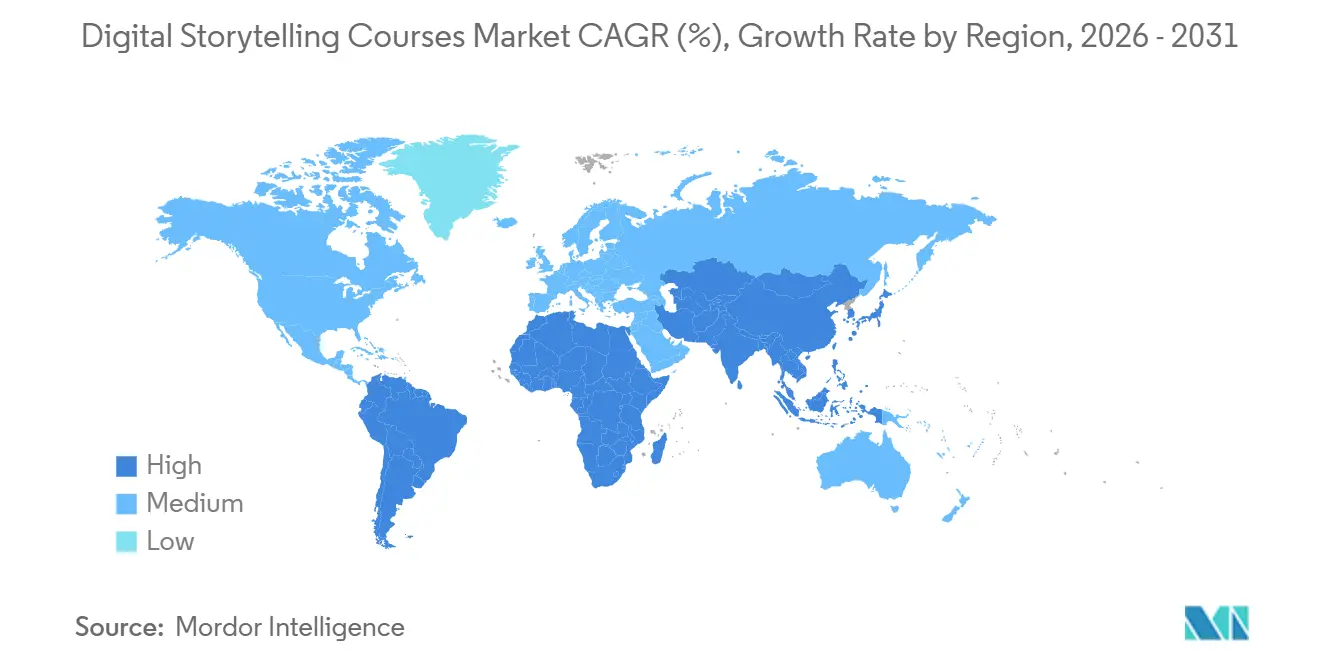
North America held 37.3% of the digital storytelling courses market share in 2025, driven by higher enterprise learning budgets, strong platform penetration, and a concentration of employers emphasizing communication skills. Average annual talent development spending in 2024 was USD 1,254 per employee, fostering a mature training environment. Demand spans industries such as media, marketing, and software, supported by both consumer learners and institutional buyers, offering multiple growth channels. The Asia-Pacific region is projected to grow at a 7.1% CAGR through 2031, supported by a younger digital population, wider mobile internet access, and increased online learning adoption. India’s vernacular digital ecosystem drives demand for multilingual storytelling training. Investments like Cognizant’s immersive learning center in Chennai, training 100,000 individuals annually, and LinkedIn Learning’s deployment for 33,000 FPT Corporation employees in Vietnam highlight the region’s growth.
Europe remains stable, with the United Kingdom, Germany, and France anchoring enterprise and academic demand. The region benefits from a strong institutional learning culture and acceptance of structured online education. South America shows potential, with Brazil and Chile gaining relevance as digital content creation and monetization become more formalized. The Middle East and Africa hold smaller market shares but are gaining relevance through government-led digital skills programs and improved broadband access. Africa’s growing creator base and the Gulf’s workforce development focus offer long-term opportunities for accessible and practical course designs.
Competitive Landscape
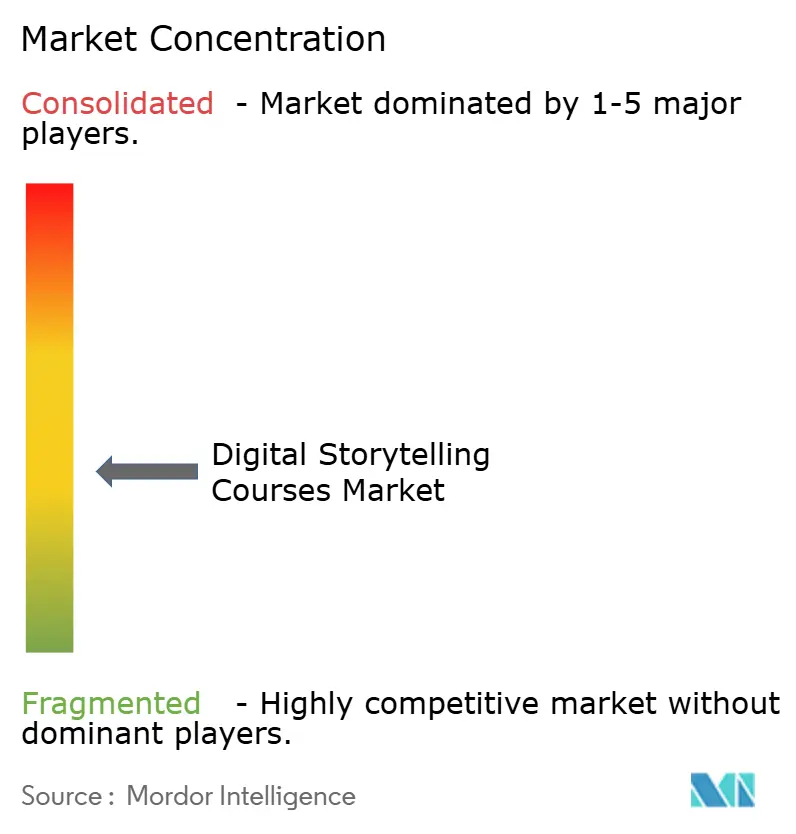
The digital storytelling courses market is moderately fragmented, with the top five players holding a significant combined share. The leading competitors include Coursera Inc., Udemy, Inc., Skillshare, Inc., MasterClass, Inc., and Domestika Inc. These platforms are recognized for their extensive course offerings, strong brand presence, and focus on storytelling, creator, writing, and visual content training. The merger of Coursera and Udemy is expected to impact the market significantly, enhancing their capabilities in pricing, distribution, and enterprise procurement.
Skillshare focuses on creator-led, project-based classes and self-paced learning. MasterClass offers curated, expert-led content and has expanded into professional development with new certificate programs. Domestika aligns with design, illustration, writing, and creative education, though it primarily targets consumers. Coursera and Udemy provide broad catalog offerings and institutional reach, while the other three players contribute specialized creative-learning relevance. This combination ensures a better market fit compared to platforms focused on software or video infrastructure.
Other participants include edX LLC, FutureLearn Limited, CreativeLive, Inc., School of Motion, Inc., Yellowbrick Learning Inc., CG Spectrum Pty Ltd., Stage 32, LLC, BBC Maestro Ltd., The New York Film Academy, The Writers Studio, and The Novelry Ltd. These companies enhance competitive depth in areas like university-led learning, filmmaking, writing, and motion design but lack the scale and cross-segment coverage of the top players.
Digital Storytelling Courses Industry Leaders
-
Coursera Inc.
-
Udemy, Inc.
-
Skillshare, Inc.
-
MasterClass, Inc.
-
MasterClass, Inc.
- *Disclaimer: Major Players sorted in no particular order
Recent Industry Developments
- May 2026: Coursera merged with Udemy, forming the largest online learning platform with 290 million learners, 18,000 enterprise customers, and projected 2025 revenue exceeding USD 1.5 billion. The merger, announced in December 2025 and approved on April 9, 2026, aims to achieve USD 115 million in annual cost synergies within 24 months. The combined entity focuses on developing an AI-driven skills platform for the global workforce.
- April 2026: MasterClass launched "Lead With AI: Adapt, Implement and Transform Your Organization," a certificate course created with Microsoft. The course helps professionals integrate AI and agent technologies into business workflows. It is part of a growing range of MasterClass Certificates developed with partners such as the Navy SEAL Foundation and X (The Moonshot Factory).
- February 2026: MasterClass launched MasterClass Executive, an AI-native business school experience developed with the University of Chicago Booth School of Business and OpenAI. This cohort-based program claims to achieve learning outcomes 60% faster than traditional methods and includes access to OpenAI Certifications. Enrollment for the first cohort was priced at USD 2,500.
- December 2025: Coursera and Udemy have announced a definitive merger agreement, valuing the combined company at USD 2.5 billion at the time of the announcement. The transaction underscores the strategic significance of their complementary strengths - Udemy's marketplace of over 155,000 courses and Coursera's partnerships with more than 250 universities - in meeting comprehensive workforce learning requirements.
Global Digital Storytelling Courses Market Report Scope
| Visual Storytelling Courses |
| Video Storytelling Courses |
| Multimedia Storytelling Courses |
| Brand & Marketing Storytelling Courses |
| Creative Writing & Narrative Design Courses |
| Self-Paced Courses |
| Instructor-Led Online Courses |
| Blended Learning Courses |
| Individual Learners |
| Academic Institutions |
| Enterprises |
| Media and Creative Agencies |
| Media & Entertainment Industry |
| Marketing & Advertising Agencies |
| Education & Academic Institutions |
| Corporate Enterprises |
| Independent Creators & Freelancers |
| North America | United States |
| Canada | |
| Mexico | |
| South America | Brazil |
| Peru | |
| Chile | |
| Argentina | |
| Rest of South America | |
| Europe | United Kingdom |
| Germany | |
| France | |
| Spain | |
| Italy | |
| BENELUX (Belgium, Netherlands, and Luxembourg) | |
| NORDICS (Denmark, Finland, Iceland, Norway, and Sweden) | |
| Rest of Europe | |
| Asia-Pacific | India |
| China | |
| Japan | |
| Australia | |
| South Korea | |
| South East Asia (Singapore, Malaysia, Thailand, Indonesia, Vietnam, and Philippines) | |
| Rest of Asia-Pacific | |
| Middle East and Africa | United Arab Emirates |
| Saudi Arabia | |
| South Africa | |
| Nigeria | |
| Rest of Middle East and Africa |
| By Course Type | Visual Storytelling Courses | |
| Video Storytelling Courses | ||
| Multimedia Storytelling Courses | ||
| Brand & Marketing Storytelling Courses | ||
| Creative Writing & Narrative Design Courses | ||
| By Delivery Mode | Self-Paced Courses | |
| Instructor-Led Online Courses | ||
| Blended Learning Courses | ||
| By End User | Individual Learners | |
| Academic Institutions | ||
| Enterprises | ||
| Media and Creative Agencies | ||
| By End-Use Industry | Media & Entertainment Industry | |
| Marketing & Advertising Agencies | ||
| Education & Academic Institutions | ||
| Corporate Enterprises | ||
| Independent Creators & Freelancers | ||
| By Geography | North America | United States |
| Canada | ||
| Mexico | ||
| South America | Brazil | |
| Peru | ||
| Chile | ||
| Argentina | ||
| Rest of South America | ||
| Europe | United Kingdom | |
| Germany | ||
| France | ||
| Spain | ||
| Italy | ||
| BENELUX (Belgium, Netherlands, and Luxembourg) | ||
| NORDICS (Denmark, Finland, Iceland, Norway, and Sweden) | ||
| Rest of Europe | ||
| Asia-Pacific | India | |
| China | ||
| Japan | ||
| Australia | ||
| South Korea | ||
| South East Asia (Singapore, Malaysia, Thailand, Indonesia, Vietnam, and Philippines) | ||
| Rest of Asia-Pacific | ||
| Middle East and Africa | United Arab Emirates | |
| Saudi Arabia | ||
| South Africa | ||
| Nigeria | ||
| Rest of Middle East and Africa | ||
Key Questions Answered in the Report
What is the expected size of digital storytelling courses by 2031?
The category is projected to reach USD 2.19 billion by 2031 from USD 1.63 billion in 2026, with a 6.08% CAGR over 2026-2031.
Which course type leads revenue and which one grows the fastest?
Brand & Marketing Storytelling Courses led with 29.92% share in 2025, while Video Storytelling Courses are projected to post the fastest CAGR at 7.88% through 2031.
Why are self-paced formats so important in this space?
Self-Paced Courses held 58.14% share in 2025 because creative learning often works better through flexible, repeatable project cycles than fixed classroom schedules.
Which buyer group is expanding the fastest?
Enterprises are the fastest-growing end-user segment with a projected 7.24% CAGR through 2031 as communication and narrative capabilities become more strategic in workforce development.
Which region offers the strongest growth opportunity?
Asia-Pacific is projected to grow the fastest at a 7.05% CAGR through 2031, supported by digital learning adoption, mobile access, and strong momentum in India and Southeast Asia.
How concentrated is competition among leading platforms?
The top 5 players are estimated to hold 45%-55% combined share, which indicates moderate concentration rather than winner-take-all control.