
Digital Public Infrastructure Platforms Market Size and Share
Market Overview
| Study Period | 2020 - 2031 |
|---|---|
| Market Size (2026) | USD 23.87 Billion |
| Market Size (2031) | USD 49.87 Billion |
| Growth Rate (2026 - 2031) | 15.88 % |
| Fastest Growing Market | Middle East and Africa |
| Largest Market | Asia-Pacific |
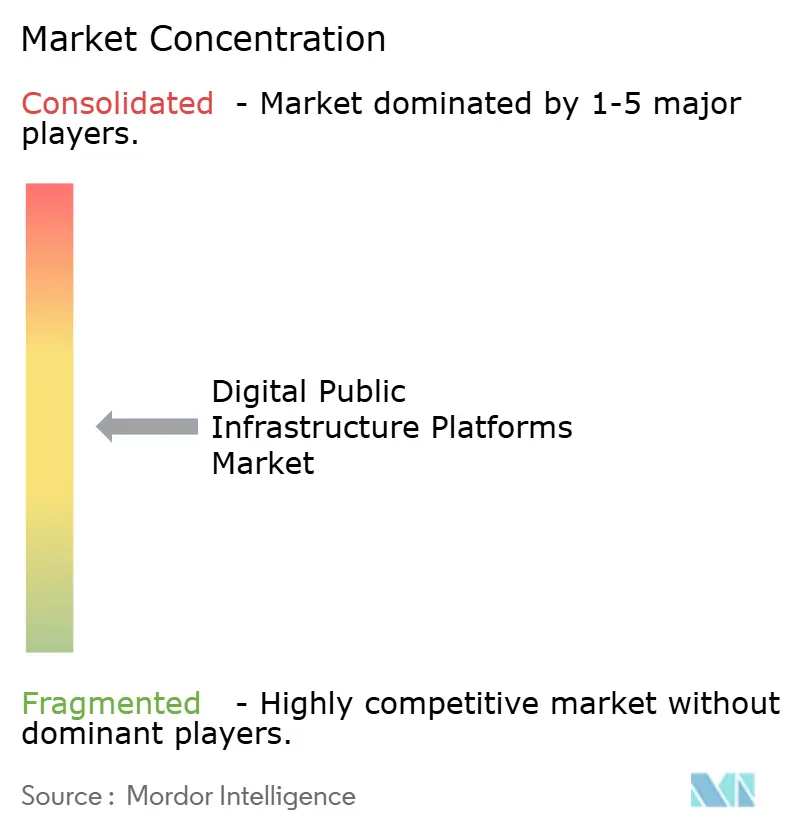
| Market Concentration | Medium |
Major Players *Disclaimer: Major Players sorted in no particular order Image © Mordor Intelligence. Reuse requires attribution under CC BY 4.0. | |
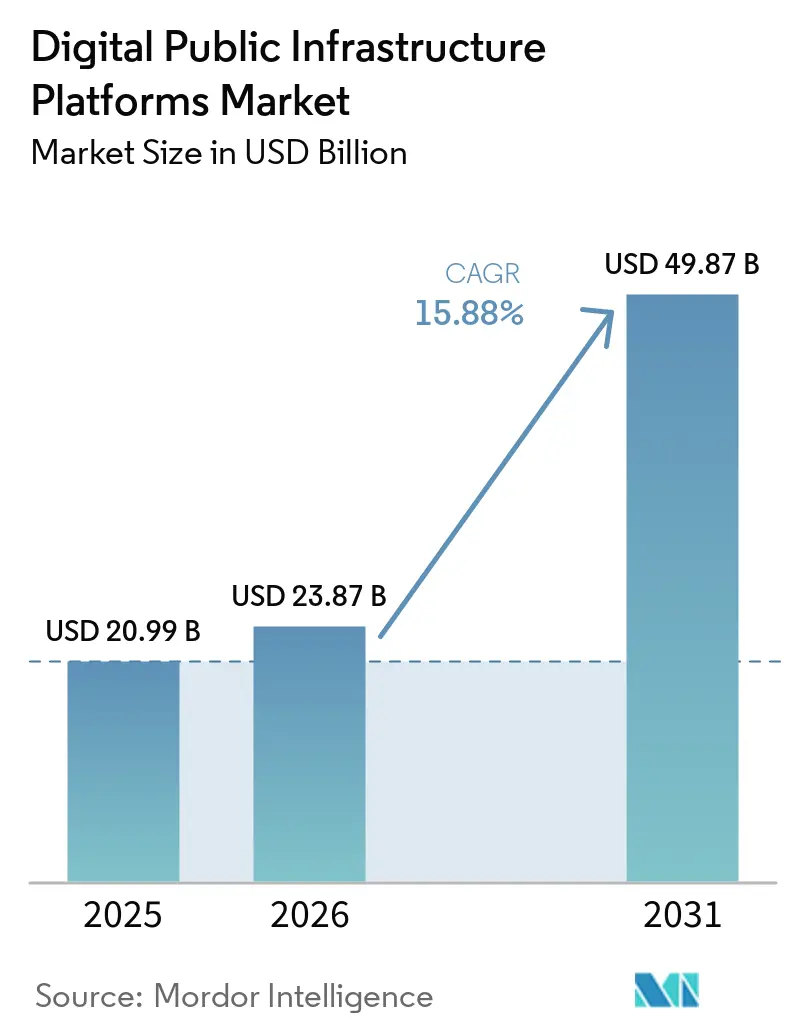
Digital Public Infrastructure Platforms Market Analysis by Mordor Intelligence
The Digital public infrastructure platforms market size is projected to expand from USD 21.0 billion in 2025 and USD 23.9 billion in 2026 to USD 49.9 billion by 2031, registering a CAGR of 15.88% between 2026 to 2031. National digital mandates, multilateral programs, and large public-service rollouts are increasing demand for interoperable identity, payment, and data systems. Governments are placing greater weight on systems that can serve large populations while meeting security and data-residency requirements. Open-source foundations are also changing procurement, because buyers can separate software selection from implementation and support. This creates opportunities for providers that combine expertise in standards with local delivery, sovereign hosting, and long-term operations. The digital public infrastructure platforms market is therefore moving toward a mix of national platforms, shared public infrastructure, and specialized service layers.
Key Report Takeaways
- By platform type, digital identity platforms held 36.78% of the digital public infrastructure platforms market share in 2025, while data exchange and consent platforms are projected to expand at a CAGR of 16.43% through 2031.
- By deployment mode, cloud-based platforms accounted for 44.65% of revenue in 2025, while hybrid deployment is expected to expand at a CAGR of 16.31% through 2031.
- By end user, the government and public sector held 50.87% of revenue in 2025, while financial institutions are projected to record the highest CAGR of 17.88% through 2031 in the digital public infrastructure platforms market.
- By geography, Asia-Pacific held 31.21% of revenue in 2025, while the Middle East and Africa is expected to expand at a CAGR of 17.32% through 2031.
Note: Market size and forecast figures in this report are generated using Mordor Intelligence’s proprietary estimation framework, updated with the latest available data and insights as of January 2026.
Market Trends and Insights
Drivers Impact Analysis of Digital Public Infrastructure Platforms Market*
| DRIVER | (~) % IMPACT ON CAGR FORECAST | GEOGRAPHIC RELEVANCE | IMPACT TIMELINE |
|---|---|---|---|
| National Digital Identity Expansion | +3.2% | Global, with early gains in Asia-Pacific, Europe, and East Africa | Medium term (2-4 years) |
| Real-Time Government Payment Rails and Benefit Delivery | +2.8% | Global, with strong near-term activity in India, the United States, Brazil, and East Africa | Short term (≤ 2 years) |
| Interoperable Data Exchange and Consent Frameworks | +2.4% | Europe, India, South America, and the Middle East and Africa | Medium term (2-4 years) |
| Open Standards and Modular Open-Source Adoption | +2.0% | Global, particularly in Africa, South Asia, and Southeast Asia | Long term (≥ 4 years) |
| AI-Ready Public Service Architecture | +1.5% | North America, Europe, and the Asia-Pacific | Long term (≥ 4 years) |
| Cross-Border Digital Service Portability | +1.2% | Europe, ASEAN, the Gulf Cooperation Council, Africa, and South America | Medium term (2-4 years) |
| Source: Mordor Intelligence | |||
National Digital Identity Expansion
Digital identity programs are replacing paper-based verification across a broader range of public services. In 2025, 88% of the 33 surveyed OECD countries had active interoperability frameworks, while 18 countries gave citizens access to at least 75% of public services through secure digital identity. The Nordic countries and the Netherlands reported identity adoption rates above 90% of their populations. Regulation (EU) 2024/1183 requires European Union member states to provide citizens and residents with at least 1 EU Digital Identity Wallet by the end of 2026. In the Philippines, PhilSys enrolled 80 million people, equal to 87% of the eligible population, and enrollment was associated with 8 million new bank accounts. These outcomes make the digital public infrastructure platforms market relevant to agencies responsible for benefits, financial access, and national service delivery.[1]
Real-Time Government Payment Rails and Benefit Delivery
Government-to-person payments are becoming a core use case for national digital infrastructure. India’s UPI handled 49% of global real-time payment transaction volume in 2024 and processed 743 million transactions a day, according to data cited by the Government of India. Brazil’s gov.br had reached 175 million registered users by March 2026, and Conecta gov.br completed more than 1.1 billion data-exchange transactions in 2025. In the United States, FedNow processed USD 853.4 billion in payment value during 2025 and USD 271.3 billion in the first quarter of 2026. More than 1,600 financial institutions participated in FedNow, and the Treasury made the service available to federal agencies through its Digital Payout Program. These developments bring the digital public infrastructure platforms market closer to fiscal administration, as payment, identity, and data functions become connected.[2]
Interoperable Data Exchange and Consent Frameworks
Consent-based data exchange is gaining importance alongside identity and payment systems. ISO/IEC TS 27560:2023 defines a technology-neutral structure for machine-readable consent records, audit trails, and portability across systems. The United Kingdom’s Data Use and Access Act 2025 introduced powers for Smart Data schemes, while India’s DPDP Rules, 2025, define consent managers as registered intermediaries with fiduciary duties. Data-sharing systems were present in 85% of surveyed OECD countries in 2025, compared with 73% for identity and 55% for payments. Vendors must integrate data exchange functions with legal controls, public-service workflows, and auditable, revisable records. This widens the digital public infrastructure platforms market beyond identity enrollment and payment processing.[3]
Open Standards and Modular Open-Source Adoption
Open-source platforms are changing the basis of public procurement. MOSIP reported 29 active country engagements and more than 185 million digital IDs generated through national deployments. Its Mozilla Public License 2.0 framework requires modifications to remain open source, supporting interoperability and limiting proprietary forks. MOSIP and WSO2 formed a partnership in February 2026 to modernize the eSignet single sign-on platform by moving its codebase from Java to Go. The Center for Digital Public Infrastructure also published its DPI-AI Framework in 2026 to enable interoperable and auditable AI components within DPI workflows. This shifts the digital public infrastructure platforms industry toward implementation, sovereign hosting, ecosystem development, and ongoing support.[4]
Restraints Impact Analysis of Digital Public Infrastructure Platforms Market*
| RESTRAINT | (~) % IMPACT ON CAGR FORECAST | GEOGRAPHIC RELEVANCE | IMPACT TIMELINE |
|---|---|---|---|
| Data Sovereignty and Privacy Liability | -1.5% | Global, with acute requirements in Europe, India, and Southeast Asia | Medium term (2-4 years) |
| Fragmented Governance and Institutional Ownership | -1.2% | Sub-Saharan Africa, South Asia, South America, and federal systems | Long term (≥ 4 years) |
| Legacy System Integration and Talent Scarcity | -0.9% | North America, Europe, and the Asia-Pacific government agencies | Medium term (2-4 years) |
| Sustainable Funding and Lifecycle Operations Pressure | -0.7% | Lower-middle-income countries in Africa, South Asia, and Small Island Developing States | Long term (≥ 4 years) |
| Source: Mordor Intelligence | |||
Data Sovereignty and Privacy Liability
Data localization rules can make cross-border platform design more difficult. Privacy frameworks in Europe and India require strong controls over personal data, including biometric information. Providers may need separate sovereign-cloud environments, certification processes, and operational teams for individual jurisdictions. A 2025 review of digital sovereignty identified data privacy, security exposure, and dependence on international technology as major barriers to trust in national digital infrastructure. As platforms authenticate welfare payments, health records, and financial services, a security failure can affect several services through the same foundational system. This can lengthen procurement, favor hybrid and multi-vendor architectures, and limit revenue concentration in the digital public infrastructure platforms market.
Fragmented Governance and Institutional Ownership
Public infrastructure programs often involve central ministries, regulators, state agencies, and sector authorities. Divided ownership can delay decisions on standards, budgets, interfaces, and operational responsibilities. The UNDP identified fragmented institutional coordination as a primary barrier to DPI scale in Africa, alongside low digital literacy and uneven connectivity. A Global Solutions Initiative paper noted that weak governance guardrails can expose public data to disproportionate private capture. These conditions can create scope changes, longer sales cycles, and continuing support requirements for vendors. The digital public infrastructure platforms market, therefore, favors providers with local partners, clear delivery models, and proven government integration capability.[5]
*Our forecasts treat driver/restraint impacts as directional, not additive. The impact forecasts reflect baseline growth, mix effects, and variable interactions.
Digital Public Infrastructure Platforms Market Segment Analysis
By Platform Type:
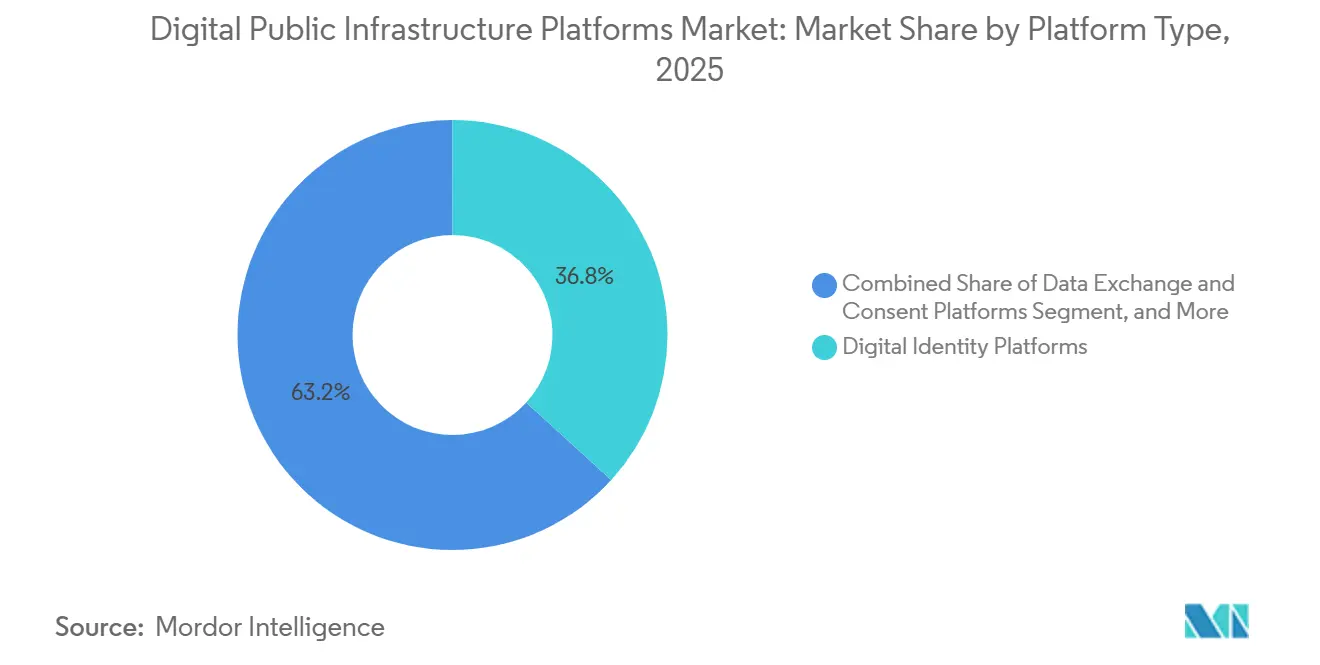
Identity Leads, While Data Exchange Supports GrowthDigital identity platforms are expected to hold 36.78% of the digital public infrastructure platforms market share in 2025. This position reflects the role of verified identity as the authentication layer for downstream public services. At least 64 countries are expected to operate DPI-like digital identity systems in 2025. The European Digital Identity Wallet requirement is also establishing a defined compliance timeline across the European Union. National identity programs are likely to remain important as late-adopting countries expand basic registration and credentialing. These factors are expected to support continued procurement of enrollment, authentication, wallet, and credential-management systems.
Data exchange and consent platforms are projected to register a CAGR of 16.43% through 2031. Their growth is linked to privacy regulations and the need for interoperable public data systems. ISO/IEC TS 27560:2023 is emerging as a relevant reference for machine-readable consent records. Payment platforms remain important because benefit delivery and real-time payment systems depend on trusted identity and data links. Notification and messaging tools can also support service continuity by keeping citizens informed about program status and regulatory updates. Other platform types include civil registry digitization, e-procurement, and environmental data systems, reflecting a broader interpretation of national public infrastructure.

By Deployment Mode:
Cloud Provides Scale, While Hybrid Protects Sensitive DataCloud-based platforms are expected to account for 44.65% of revenue in the digital public infrastructure platforms market in 2025. Governments use cloud infrastructure to manage variable enrollment volumes and reduce initial capital requirements. Cloud environments can also enable faster software updates as public agencies add new digital service functions. The OECD is expected to report a shift from siloed systems toward shared government-wide cloud platforms in 2026. These platforms may combine commercial and sovereign services rather than relying on a single infrastructure model. This approach supports broader adoption in the digital public infrastructure platforms market.
Hybrid deployment is projected to expand at a CAGR of 16.31% through 2031. It allows agencies to maintain direct control over identity and consent records while using cloud resources for document verification, fraud detection, and AI workloads. On-premises systems remain relevant for defense agencies, central banks, and other functions that handle highly sensitive data. Security classifications and data-residency policies influence which workloads can move into shared environments. Providers must offer consistent controls across public cloud, private cloud, and on-premises systems. This requirement favors firms that can support the same interfaces and governance model across multiple deployment settings.
By End User:
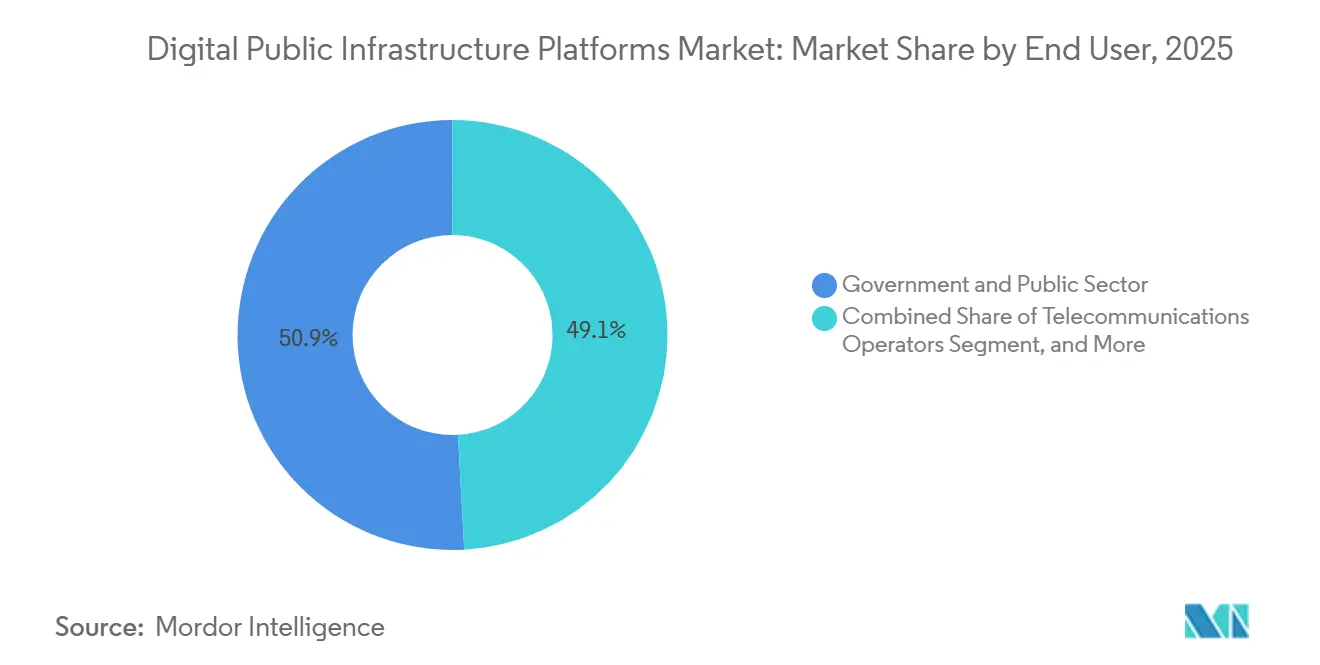
Government Demand Remains Foundational, While Financial Institutions ExpandThe government and public sector segment is expected to account for 50.87% of revenue in the digital public infrastructure platforms market in 2025. This reflects the state-led nature of foundational identity, data, and payment infrastructure. Public buyers are placing greater emphasis on lifecycle management agreements that cover operations and maintenance over 5 to 10 years. This can improve revenue continuity for established suppliers. It can also make vendor lock-in a more important consideration in contract design. Therefore, the digital public infrastructure platforms market depends on both initial implementation capacity and long-term service delivery.
Financial institutions are projected to record the highest CAGR of 17.88% through 2031. Their demand is tied to digital know-your-customer procedures, anti-money-laundering controls, and customer onboarding. Banks in India use Aadhaar-based e-KYC for digital account opening. MOSIP is expected to join the Mojaloop Global Partner Program in 2025, demonstrating how national identity systems can act as trusted identity proxies in payment ecosystems. Healthcare providers also need trusted identity and secure data exchange for electronic records, vaccination systems, and telemedicine. Telecommunications, transport, and utility providers can adopt related services once national identity and payment rails are established.
Geography Analysis
APAC Digital Public Infrastructure Platforms Market
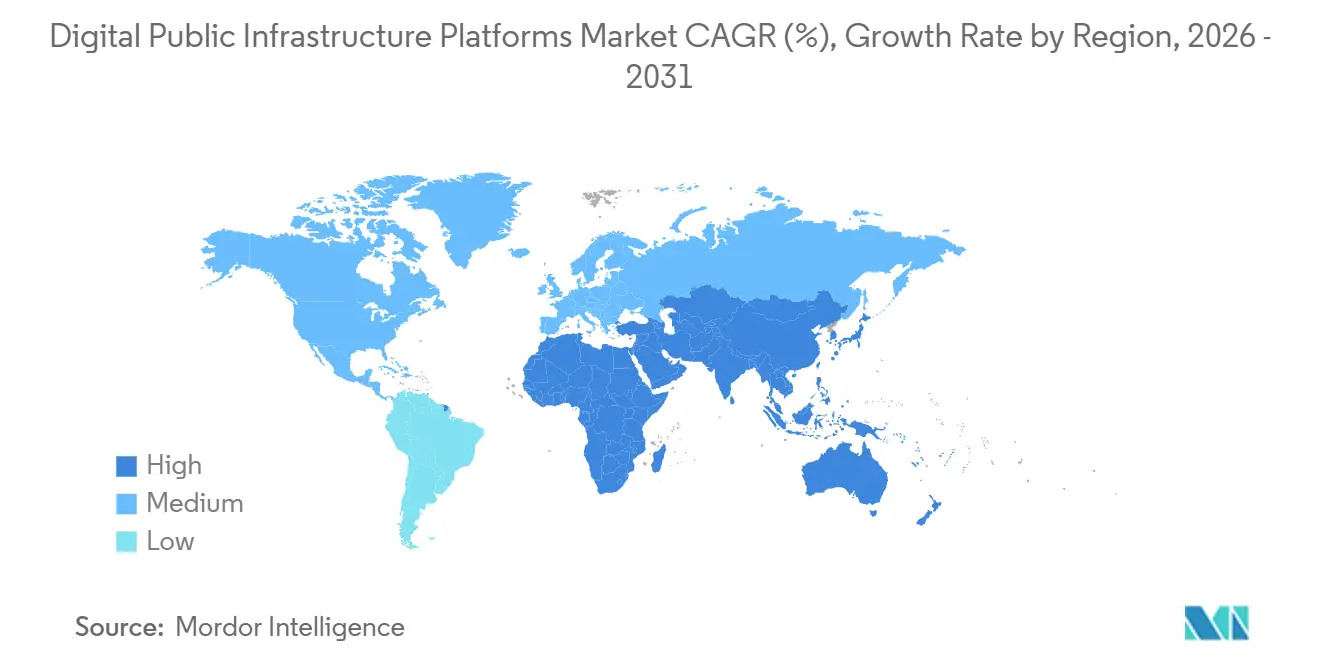
Asia-Pacific is expected to account for 31.21% of revenue in 2025, making it the largest digital public infrastructure platforms market by geography. India is expected to record 1.4 billion Aadhaar enrollments and 125 billion e-authentications by 2025. Government welfare programs are also expected to disburse USD 450 billion through direct benefit transfers. India is expected to sign DPI cooperation memoranda with 24 countries by February 2026. Malaysia’s MyDigital ID is expected to reach 12 million users and integrate with 114 online government services by June 2026. The Philippines’ identity program also shows the link between foundational registration and financial access.
The Americas and Europe Digital Public Infrastructure Platforms Market
Modernization needs across large existing public systems support growth in North America and Europe. FedNow is expected to process USD 271.3 billion during the first quarter of 2026 across more than 1,600 participating institutions. The US federal government is expected to spend more than USD 100 billion annually on information technology in 2025. The GAO stated that 80% of that spending goes toward maintaining existing systems. European wallet requirements continue to create a compliance-led pipeline for identity providers. Brazil adds significant activity in South America through gov.br and Conecta gov.br.
MEA Digital Public Infrastructure Platforms Market
The Middle East and Africa are projected to expand at a CAGR of 17.32% through 2031. The African Union is expected to adopt eight annexes to the AfCFTA Digital Trade Protocol in February 2025. The Cotonou Declaration committed West and Central African governments to interoperable payments across 15 countries and a 40% reduction in digital cross-border transfer costs. UNDP reported that instant payment systems are expected to operate in 31 of 55 African Union member states in 2026. It also reported that 36 countries had deployed digital identity, while more than 550 million Africans still lacked official identification. This coverage gap supports a long-term investment need across the region.
Competitive Landscape
The digital public infrastructure platforms market is moderately concentrated. Microsoft, Amazon Web Services, Oracle, Google, and SAP compete with identity and biometric providers such as Thales, IDEMIA, Entrust, Veridos, Okta, Ping Identity, and Signicat. Large cloud and enterprise software firms offer infrastructure capacity and AI capabilities. Identity specialists compete through credentials, biometric protection, and compliance with public-sector standards. Open-source consortia provide another option for governments seeking greater technical sovereignty. High security requirements, language localization, and sovereign cloud compliance remain significant barriers for new entrants.
Thales built a verifiable credentials issuance platform on AWS that supports more than 300 national identity programs. It also achieved ISO 18013-5 certification for a digital identity wallet. Ping Identity is expected to complete its acquisition of Keyless in January 2026. The acquisition adds zero-knowledge biometric authentication and re-verification capabilities that avoid exposing raw biometric information. MOSIP’s country-led model has also strengthened interest in vendor-neutral foundations.
The strongest opportunity areas include the secure provision of AI-enabled public services and deployments in lower-income countries. The DPI-AI Framework requires AI functions to operate as interoperable and auditable components within existing DPI systems. This approach favors providers with established identity and consent-management capabilities. Compliance requirements can also favor suppliers that already have government-grade security controls. Commercial providers may increasingly combine premium support, local integration, and sovereign hosting with open-source foundations. This business model can help them participate in the digital public infrastructure platforms market without relying solely on closed software licenses.
Digital Public Infrastructure Platforms Industry Leaders
-
Thales Group
-
Google LLC
-
Amazon Web Services, Inc.
-
Microsoft Corporation
-
SAP SE
- *Disclaimer: Major Players sorted in no particular order
Digital Public Infrastructure Platforms Market Companies Covered in this Report
- Microsoft Corporation
- International Business Machines Corporation
- Thales Group
- NEC Corporation
- Oracle Corporation
- Entrust Corporation
- Ping Identity Corporation
- IDEMIA Group
- Signicat AS
- Mitek Systems, Inc.
- Jumio Corporation
- Okta, Inc.
- SAP SE
- Amazon Web Services, Inc.
- Google LLC
- Veridos GmbH
Recent Industry Developments in Digital Public Infrastructure Platforms Market
- July 2026: Okta signed a definitive agreement to acquire Permiso Security for USD 200 million, adding cloud-native identity threat detection and response capabilities, behavioral analytics, and threat detection across human, non-human, and agentic identities in multi-cloud environments, extending Okta's platform to secure AI agents in government and financial DPI contexts.
- July 2026: The US Department of Defense awarded Oracle a 10-year Enterprise Software Agreement worth up to USD 7 billion, consolidating on-premises Oracle software, licenses, maintenance, and consulting across the Pentagon, intelligence community, and US Coast Guard, with the CIA designated as the first customer under the agreement and USD 441 million in projected taxpayer savings.
- February 2026: The Government of India confirmed DPI cooperation Memoranda of Understanding with 24 countries for India Stack, covering digital identity, digital payments, data exchange, and service delivery systems. UPI is live in 8 countries and was recognized by the IMF in June 2025 as the world's largest retail fast payment system by transaction volume.
- February 2026: Morocco's Ministry of Digital Transition and Administrative Reform signed 8 conventions with government departments and digital identity partners, including SHAREID, iDAKTO, and La Marocaine Électronique des E-Services, to deploy Idarati X.0, a national digital wallet and meta-application designed to unify citizen access to public services across ministries.
Global Digital Public Infrastructure Platforms Market Report Scope
The Digital Public Infrastructure Platforms Report is Segmented by Platform Type (Digital Identity, Payments, Data Exchange, Notifications, and Other Platform Type), Deployment Mode (Cloud-Based, On-Premise, and Hybrid), End User (Government and Public Sector, Financial Institutions, Healthcare Providers, Telecommunications Operators, Transport and Mobility Agencies, Utilities and Energy Operators, and Other End Users), and Geography (North America, South America, Europe, Asia-Pacific, and Middle East and Africa). The Market Forecasts are Provided in Terms of Value (USD).
Segmentation Overview
| Digital Identity Platforms |
| Digital Payments Platforms |
| Data Exchange and Consent Platforms |
| Digital Notifications and Messaging Platforms |
| Other Platform Type |
| Cloud-Based |
| On-Premise |
| Hybrid |
| Government and Public Sector |
| Financial Institutions |
| Healthcare Providers |
| Telecommunications Operators |
| Transport and Mobility Agencies |
| Utilities and Energy Operators |
| Other End Users |
| North America | United States | |
| Canada | ||
| Mexico | ||
| South America | Brazil | |
| Argentina | ||
| Rest of South America | ||
| Europe | United Kingdom | |
| Germany | ||
| France | ||
| Italy | ||
| Rest of Europe | ||
| Asia-Pacific | China | |
| Japan | ||
| India | ||
| South Korea | ||
| Rest of Asia | ||
| Middle East and Africa | Middle East | Saudi Arabia |
| United Arab Emirates | ||
| Rest of Middle East | ||
| Africa | South Africa | |
| Egypt | ||
| Rest of Africa | ||
| By Platform Type | Digital Identity Platforms | ||
| Digital Payments Platforms | |||
| Data Exchange and Consent Platforms | |||
| Digital Notifications and Messaging Platforms | |||
| Other Platform Type | |||
| By Deployment Mode | Cloud-Based | ||
| On-Premise | |||
| Hybrid | |||
| By End User | Government and Public Sector | ||
| Financial Institutions | |||
| Healthcare Providers | |||
| Telecommunications Operators | |||
| Transport and Mobility Agencies | |||
| Utilities and Energy Operators | |||
| Other End Users | |||
| By Geography | North America | United States | |
| Canada | |||
| Mexico | |||
| South America | Brazil | ||
| Argentina | |||
| Rest of South America | |||
| Europe | United Kingdom | ||
| Germany | |||
| France | |||
| Italy | |||
| Rest of Europe | |||
| Asia-Pacific | China | ||
| Japan | |||
| India | |||
| South Korea | |||
| Rest of Asia | |||
| Middle East and Africa | Middle East | Saudi Arabia | |
| United Arab Emirates | |||
| Rest of Middle East | |||
| Africa | South Africa | ||
| Egypt | |||
| Rest of Africa | |||
Key Questions Answered in the Report
What is the size of the digital public infrastructure platforms market?
The digital public infrastructure platforms market was valued at USD 23.9 billion in 2026 and is projected to reach USD 49.9 billion by 2031, growing at a CAGR of 15.88%. The expansion reflects increasing public investment in digital identity, payment, and data-sharing systems that serve national populations. These platforms integrate governance, secure credentials, and long-term operational capabilities into connected public infrastructure rather than standalone technology solutions.
Which platform type leads digital public infrastructure spending?
Digital identity platforms accounted for the largest share, 36.78% in 2025, because they provide authentication capabilities that enable other public digital services. The market also relies on data exchange, consent management, payment, and messaging functions that operate on trusted public-service infrastructure.
Which deployment model is expanding fastest for digital public infrastructure platforms?
Hybrid deployment is expected to grow at a CAGR of 16.31% through 2031. It enables agencies to retain sensitive data on-premises while leveraging cloud infrastructure for selected workloads, balancing scalability with data residency and sovereignty requirements.
Why are financial institutions adopting digital public infrastructure platforms?
Financial institutions are increasingly using these platforms for digital KYC, anti-money laundering (AML), and customer onboarding, contributing to a projected CAGR of 17.88% through 2031. Trusted national identity systems reduce repetitive verification and streamline customer onboarding processes.
Which region is expected to grow fastest in the digital public infrastructure platforms market?
The Middle East and Africa is projected to register the fastest growth, with a CAGR of 17.32% through 2031. Growth is driven by investments in digital identity, instant payment systems, cross-border interoperability, and foundational public digital services.
What are the key restraints on digital public infrastructure deployment?
Key challenges include data sovereignty requirements, privacy and compliance obligations, fragmented institutional ownership, legacy system integration, and long-term funding constraints. Successful deployment requires strong governance, security, interoperability, and sustainable operational models.
What is the market concentration score for the digital public infrastructure platforms market?
The market has a concentration score of 5, indicating a moderately fragmented competitive landscape. The market includes a broad mix of cloud providers, enterprise software companies, digital identity specialists, and open-source solution providers, with no evidence of a highly concentrated market based on the available data.