
Digital Onboarding Orchestration Market Size and Share
Market Overview
| Study Period | 2020 - 2031 |
|---|---|
| Market Size (2026) | USD 4.58 Billion |
| Market Size (2031) | USD 9.53 Billion |
| Growth Rate (2026 - 2031) | 15.81 % |
| Fastest Growing Market | Asia-Pacific |
| Largest Market | North America |
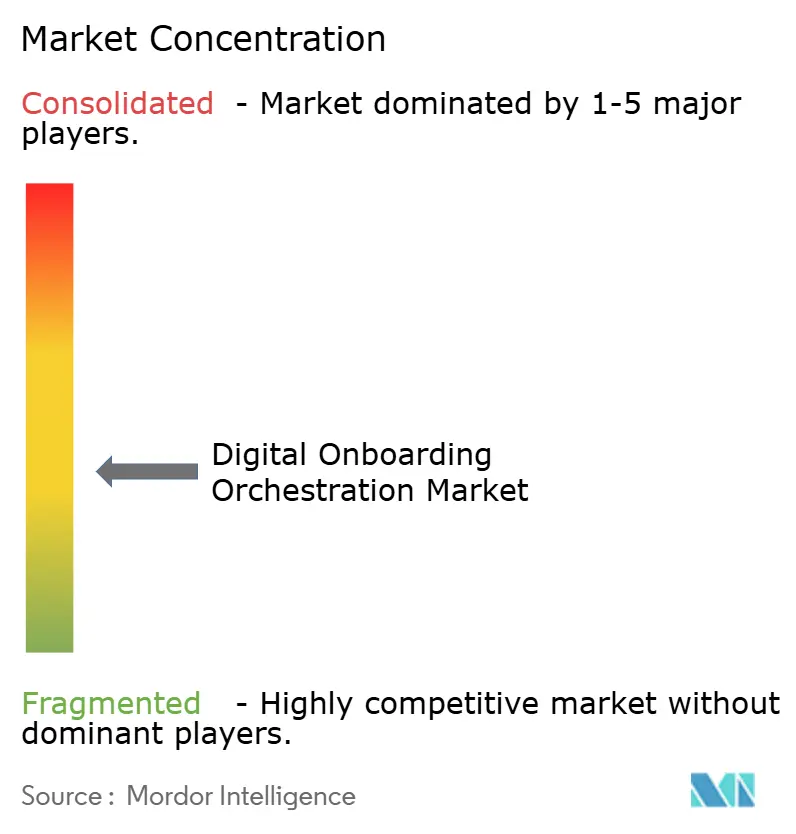
| Market Concentration | Medium |
Major Players *Disclaimer: Major Players sorted in no particular order Image © Mordor Intelligence. Reuse requires attribution under CC BY 4.0. | |
Digital Onboarding Orchestration Market Analysis by Mordor Intelligence
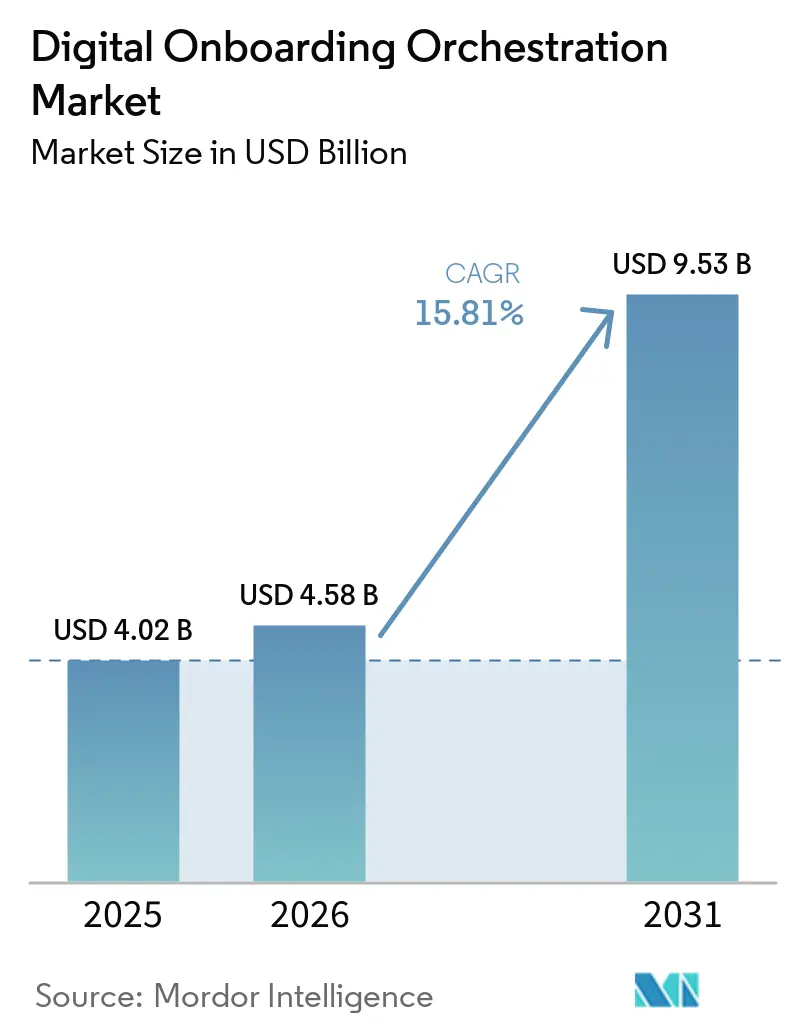
The Digital Onboarding Orchestration Market size is projected to expand from USD 4.02 billion in 2025 to USD 4.58 billion in 2026, and to USD 9.53 billion by 2031, registering a CAGR of 15.81% between 2026 and 2031. Regulation is changing onboarding procurement because institutions now need evidence that identity, screening, risk, and recordkeeping processes operate together, including when an application moves between automated checks, manual review, and a final customer decision. The EU digital identity rollout is pushing financial institutions to prepare systems that can work with wallet-based credentials, adopt more standardized customer due diligence requirements, and implement documented controls that can be reviewed across multiple operating markets. Fraud prevention is also becoming a broader workflow issue because document checks alone cannot address synthetic identities or injected media, and compliance teams must be able to connect suspicious activity with the records, signals, and actions used in a decision. Providers are responding by combining identity verification, business verification, screening, fraud signals, case management, and compliance reporting in a single operating layer, rather than asking operational teams to coordinate separate systems. The Digital Onboarding Orchestration Market, therefore, favors platforms that can adapt rules across jurisdictions while reducing the operational burden of multiple specialized vendors, as buyers increasingly need a consistent operating model that accommodates local documentation, consent, identity assurance, screening, and exception-handling requirements without having to rebuild each customer journey.
Key Report Takeaways
- By product type, end-to-end onboarding orchestration platforms held 38.19% of the Digital Onboarding Orchestration Market in 2025, while KYC, KYB, and AML workflow automation modules are projected to expand at a 16.92% CAGR through 2031.
- By deployment mode, cloud-based deployment held 68.44% of the Digital Onboarding Orchestration Market share in 2025, while hybrid deployment is projected to expand at a 17.38% CAGR through 2031.
- By organization size, large enterprises held 71.10% of the Digital Onboarding Orchestration Market share in 2025, while SMEs are projected to expand at a 17.75% CAGR through 2031.
- By end user, BFSI held 26.14% of the Digital Onboarding Orchestration Market share in 2025, while healthcare and life sciences are projected to expand at a 16.34% CAGR through 2031.
- By geography, North America held 37.42% of the Digital Onboarding Orchestration Market share in 2025, while Asia-Pacific is projected to expand at a 16.59% CAGR through 2031.
Note: Market size and forecast figures in this report are generated using Mordor Intelligence’s proprietary estimation framework, updated with the latest available data and insights as of January 2026.
Global Digital Onboarding Orchestration Market Trends and Insights
Drivers Impact Analysis*
| Driver | (~) % Impact on CAGR Forecast | Geographic Relevance | Impact Timeline |
|---|---|---|---|
| Tightening KYC, KYB, and AML Compliance Requirements | +3.8% | Global | Medium term (2-4 years) |
| Escalating Synthetic Identity and Deepfake Fraud | +3.2% | Global | Short term (≤ 2 years) |
| Mobile-First Remote Account Opening | +2.5% | Asia-Pacific core, spill-over to North America and Middle East and Africa | Medium term (2-4 years) |
| API-First Replacement of Fragmented Point Solutions | +2.1% | North America and EU | Medium term (2-4 years) |
| Reusable Digital Identity and Verifiable Credentials | +1.4% | EU, with early gains in Singapore and India | Long term (≥ 4 years) |
| Dynamic Trust Routing Across Identity Data Sources | +0.9% | Global, with North America and EU as core areas | Long term (≥ 4 years) |
| Source: Mordor Intelligence | |||
Tightening KYC, KYB, and AML Compliance Requirements
Regulatory mandates are a central procurement trigger for the Digital Onboarding Orchestration Market. The EU AML package creates a more consistent rulebook for customer due diligence, politically exposed person screening, enhanced checks, and electronic identification validation. eIDAS-compliant identification methods can be treated as equivalent to face-to-face verification within the framework, thereby supporting fully digital customer journeys. The United Kingdom's 2026 money-laundering regulations aligned cryptoasset business requirements with the Financial Action Task Force standards. The Reserve Bank of India issued revised KYC directions for all Indian Financial Institutions in November 2025, including expectations for deepfake-resistant V-CIP liveness controls. These different implementation schedules make configurable rule engines more valuable than fixed workflows in the Digital Onboarding Orchestration Market.
Escalating Synthetic Identity and Deepfake Fraud
Synthetic identity and deepfake attacks are expanding the set of risks that onboarding controls must address. LexisNexis Risk Solutions reported an eightfold year-over-year increase in synthetic identity fraud in 2025, representing 11% of detected fraud across 116 billion online transactions. The same reporting identified a 76% rise in attack rates on gaming platforms during 2025. Recorded Future documented that injection attacks can feed manipulated media directly into verification systems, bypassing a device's camera. This threat shifts attention from basic liveness checks toward device, network, behavioral, and biometric signals working together. The Digital Onboarding Orchestration Market benefits when buyers need a coordinated decision process rather than a standalone identity check.
Mobile-First Remote Account Opening
Mobile account opening is becoming the standard route for banking, healthcare, and public services in many regions. The World Bank reported that 79% of adults in surveyed economies held an account with a financial institution or mobile money provider in 2025. Growth has been strongest in regions where mobile access and national digital identity systems developed together. This operating model increases demand for onboarding journeys that can verify a person on a small screen, recover from failed attempts, and meet local consent rules. Reusable credentials can also reduce the need for repeated checks when a customer returns to a service. These conditions broaden the addressable use cases for the Digital Onboarding Orchestration Market beyond conventional bank account opening.
API-First Replacement of Fragmented Point Solutions
Organizations are reducing dependence on separate tools for identification, KYC, screening, and fraud review. The United Kingdom government's sectoral analysis found that customer onboarding was the most cited use case among dedicated digital identity providers, at 42%.[1] A common orchestration layer gives compliance teams a clearer owner for decisions, exceptions, and evidence. It can also reduce the coordination burden created when several vendors contribute to a single customer outcome. The EU Digital Operational Resilience Act increases the importance of documented management of critical information and communication technology providers. This supports platform strategies that simplify vendor oversight in the Digital Onboarding Orchestration Market, particularly when procurement teams must assess how connected providers share data, respond to incidents, maintain service availability, and support a defensible compliance record across several customer journeys and operating locations.
Restraints Impact Analysis*
| Restraint | (~) % Impact on CAGR Forecast | Geographic Relevance | Impact Timeline |
|---|---|---|---|
| Regulatory Fragmentation and Biometric Privacy Burden | -2.0% | Global, with EU and North America as core areas | Medium term (2-4 years) |
| Legacy-Core Integration and Implementation Costs | -1.6% | Global, with North America and Europe as core areas | Medium term (2-4 years) |
| Non-Deterministic AI Decisions in Exceptional Cases | -0.8% | Global | Long term (≥ 4 years) |
| Data Localization and Sovereign-Cloud Constraints | -0.7% | Asia-Pacific and Middle East and Africa core | Long term (≥ 4 years) |
| Source: Mordor Intelligence | |||
Regulatory Fragmentation and Biometric Privacy Burden
Privacy requirements can make cross-border implementation slower and more expensive. The General Data Protection Regulation treats biometric data used for unique identification as a special category, which requires an appropriate legal basis and controlled processing. The EU AML rules will harmonize elements of customer due diligence, but national requirements for remote identification techniques will remain relevant. The European Commission's digital identity framework requires member states to make European Digital Identity Wallets available by the end of 2026. Platform teams must therefore separate onboarding verification from other biometric monitoring uses that carry different controls. This fragmented environment raises the cost of entering new countries in the Digital Onboarding Orchestration Market.
Legacy-Core Integration and Implementation Costs
Legacy banking and insurance systems can delay the deployment of orchestration software. Older cores often use proprietary interfaces and batch processes that do not fit real-time identity and risk decisions, which can force a provider to build additional connections before a straightforward customer journey can be released. A bank must map existing data flows and third-party connections before it can safely place an onboarding layer over core systems. The operational risk is clear: an unstable core can disrupt account opening, even when the new interface works correctly. Institutions also need staff who understand older integration environments and newer cloud-based services. These requirements lengthen implementation cycles and can limit near-term spending in the Digital Onboarding Orchestration Market.
*Our forecasts treat driver/restraint impacts as directional, not additive. The impact forecasts reflect baseline growth, mix effects, and variable interactions.
Segment Analysis
By Product Type: Unified Platforms Lead Compliance Workflow Demand
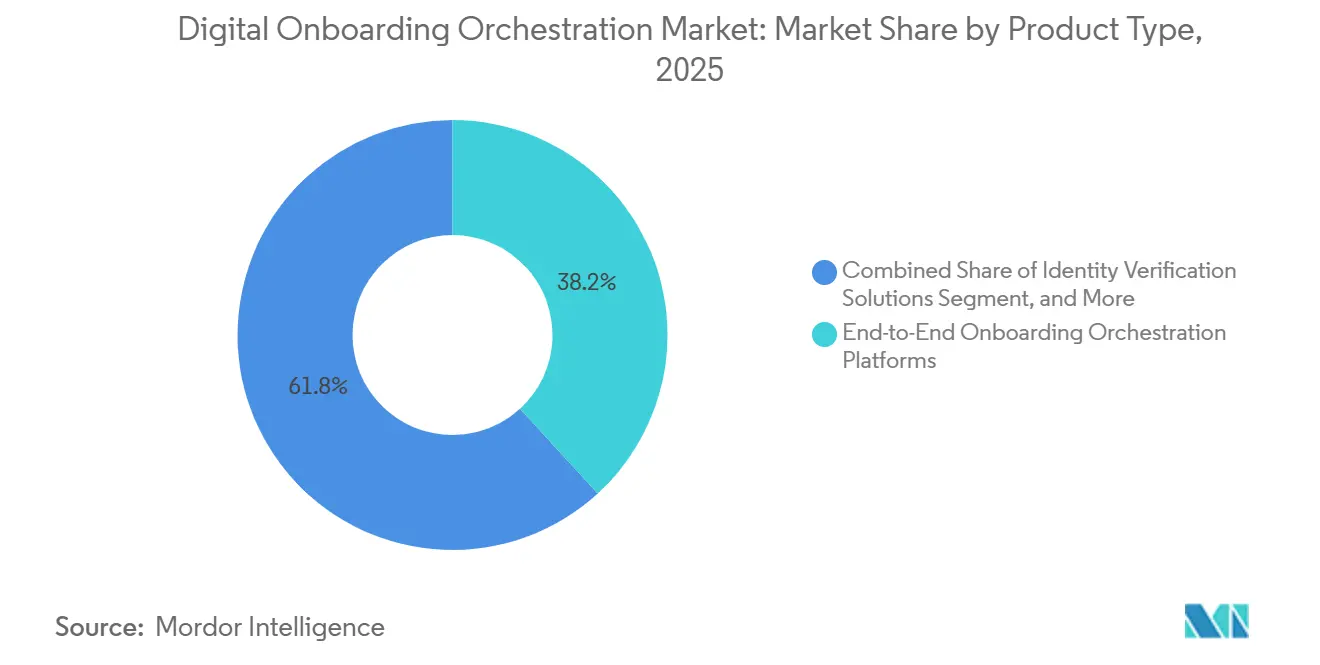
End-to-end onboarding orchestration platforms held 38.19% of the Digital Onboarding Orchestration Market share in 2025. Their position reflects the demand for a single workflow owner across identity proofing, sanctions screening, beneficial ownership review, risk scoring, and electronic signatures. Regulated banks, insurers, and investment firms need this coordination because a broken handoff can create both a poor customer experience and an incomplete audit record. The platforms are particularly useful when several review teams must act on the same case without duplicating information, repeating document requests, or transferring responsibility among separate technology providers. They also provide a single place to document exceptions, decision rules, and approvals, which makes the category relevant where accountability matters as much as speed, customer completion, operational consistency, and the ability to demonstrate why a particular decision was made.
KYC, KYB, and AML workflow automation modules are projected to grow at a 16.92% CAGR through 2031. Cross-border beneficial ownership requirements are increasing the value of tools that can structure checks around changing rules, incomplete company registries, and country-specific documentation practices that affect business onboarding decisions. Trulioo launched its UBO Discovery Agent in July 2026 to automate ownership resolution in registry-sparse markets, including Malaysia, Vietnam, and the United Kingdom.[2] Identity verification and document intelligence solutions remain important adjacent categories because fraudulent documents increasingly require more than optical character recognition, particularly for altered documents and synthetic submissions, which require additional forensic review. Fraud detection and risk decisioning platforms add context from signals that may not be present in a submitted identity document. Integration, analytics, and compliance audit tools have a smaller base, but their role grows as institutions need explainable, time-stamped evidence.

By Deployment Mode: Hybrid Architectures Balance Control and Scale
Cloud-based deployment held 68.44% of the Digital Onboarding Orchestration Market share in 2025. Cloud delivery supports scalable processing, frequent model updates, and access to watchlist data across multiple countries, helping providers serve customers that operate across several regulated jurisdictions from a common environment. It suits workloads that rise around product launches, regulatory deadlines, and geographic expansion. It can also help providers implement improvements without requiring each customer to run a separate upgrade cycle, and these benefits help explain why the cloud is the leading deployment choice for many commercial users. The approach remains subject to each institution's data handling and resilience requirements, while hybrid deployment is projected to grow at a 17.38% CAGR through 2031, making it the fastest-growing mode.
It allows an institution to retain sensitive identity records within a controlled infrastructure while using cloud-hosted workflow and fraud services, which can be useful when national rules or internal policies restrict where biometric information may be stored. Sumsub's eIDAS 2.0 recertification at the High Level of Confidence covered automated identification, video identification, e-ID verification, and KYB verification. On-premises systems remain important for government bodies and critical financial utilities with strict sovereignty restrictions. However, they can require more internal maintenance and slower feature updates. The Digital Onboarding Orchestration Market size for hybrid architectures is supported by buyers seeking both control over sensitive data and access to scalable services.
By Organization Size: SME Adoption Builds Through Accessible Compliance Tools
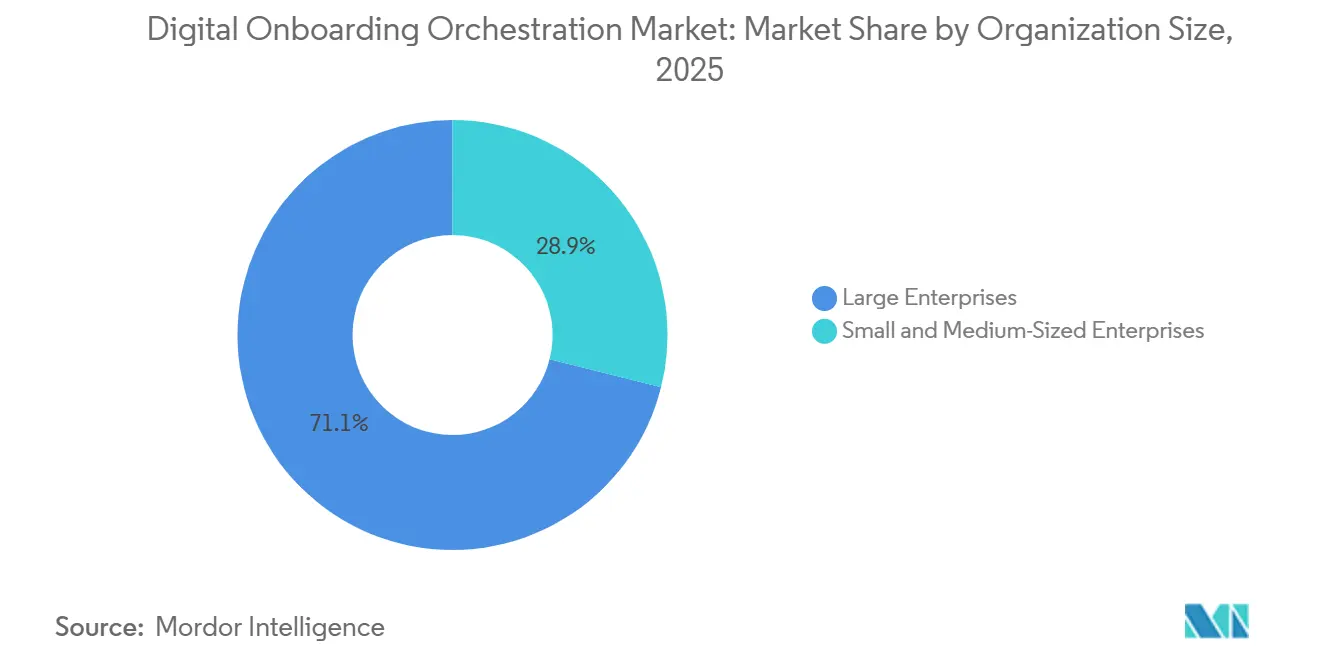
Large enterprises accounted for 71.10% of the Digital Onboarding Orchestration Market in 2025. They have large onboarding volumes, longstanding compliance obligations, and established contracts with identity and risk vendors. Tier 1 banks and global insurers can also support longer implementation projects than smaller organizations, including the testing, governance, data mapping, and formal assurance work that often accompanies a major onboarding change. Their demand centers on global coverage, reliable controls, and detailed audit evidence, and enterprise providers have historically shaped their sales models around these accounts. This has preserved the large-enterprise lead despite the wider availability of application programming interfaces and more accessible subscription-based technology options, while SMEs are projected to grow at a 17.75% CAGR through 2031.
The expansion of AML requirements into sectors such as accounting, real estate, and trust services brings more small firms into structured verification processes. Duna reported a financial services case in which onboarding time fell from 8 or more days to under 9 minutes through a business onboarding solution. No-code workflow tools and usage-based access can reduce the need for upfront technology investment, while allowing smaller teams to adapt customer journeys and compliance rules without maintaining a large internal development function. Larger customers may also expect smaller suppliers to demonstrate recognized security and privacy controls. These factors make simpler, volume-priced products an important route to SME growth in the Digital Onboarding Orchestration Market.
By End User: Healthcare Extends Digital Identity Use Cases
BFSI held a 26.14% share of the Digital Onboarding Orchestration Market in 2025. Financial institutions face direct requirements for KYC, AML, sanctions screening, and beneficial ownership review, often across multiple products, customer categories, and business entities, all of which require a consistent evidence trail. These obligations make the value of organized workflows especially clear during account opening and periodic customer review. Banks also need reliable evidence when an application is escalated or declined. The sector's compliance intensity has made it the leading buyer group, and it continues to set expectations for control design across other end-user categories, such as healthcare, government, retail, and gaming organizations, that adopt processes that require more reliable identity proofing, clearer decision records, and stronger controls over repeat access to digital services.
Healthcare and life sciences are projected to grow at a 16.34% CAGR through 2031. Patient identity fraud, telehealth credential verification, and enrollment in digital health services are creating new identity checks, making secure access and account recovery important parts of patient-facing digital service design. MRO embedded automated identity proofing in patient access workflows in March 2026. ID.me became available through Epic Toolbox for the MyChart identity verification category in April 2026. NHS England published version 3.1 of its digital identity verification and authentication standard in December 2025, with full conformance required by December 2026. IT and telecommunications, government and public administration, retail and e-commerce, gaming, and gambling also create substantial onboarding volumes.
Geography Analysis
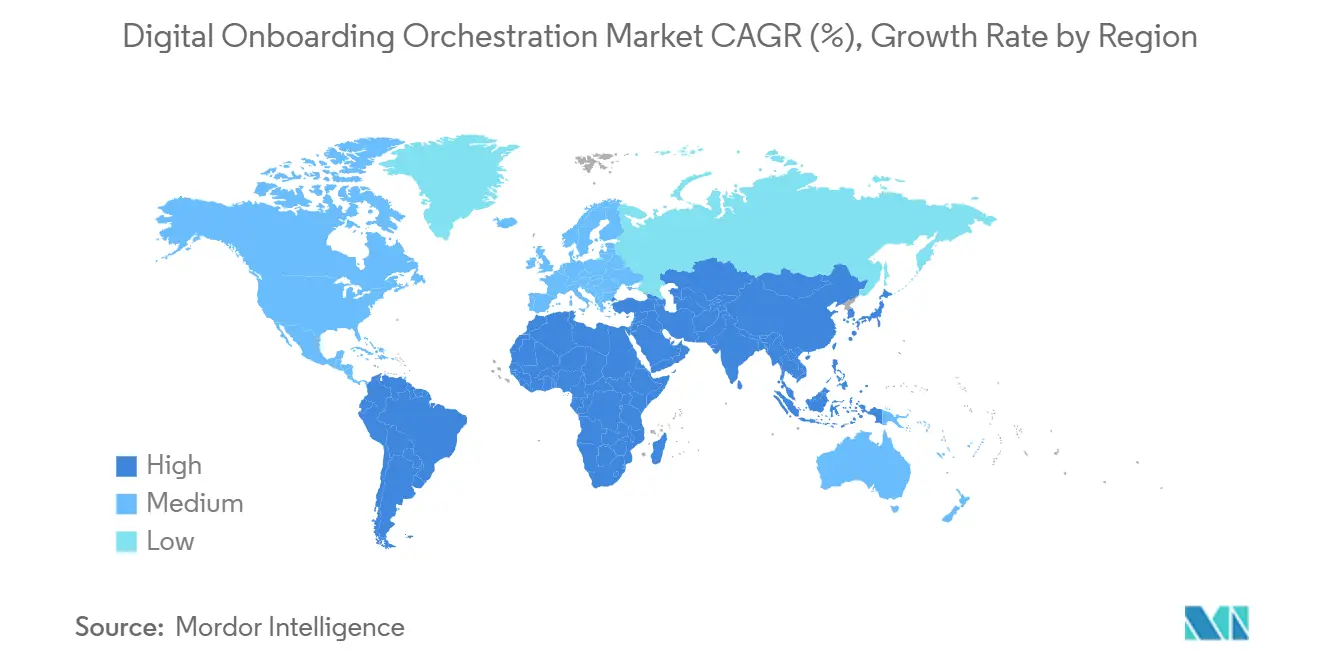
North America accounted for 37.42% of the Digital Onboarding Orchestration Market in 2025. The region combines a large financial services customer base with active public-sector identity programs, giving vendors opportunities to serve commercial institutions and agencies that must manage high volumes of identity proofing requests. Socure received a 5-year, USD 163 million contract in May 2026 for Login.gov identity proofing. This showed that public agencies can be a direct source of demand alongside financial institutions, and Socure also announced a strategic growth investment at a USD 5.2 billion valuation and acquired Fravity in August 2026. The acquisition added automation capabilities for compliance investigations.
Europe was the second-largest geography in 2025, led by demand from the United Kingdom, Germany, and France. Member states are required to make European Digital Identity Wallets available by the end of 2026 under the eIDAS framework.[3] This creates a concentrated technology upgrade cycle for onboarding providers because financial institutions must align customer journeys, assurance levels, credential acceptance, and supporting evidence with the new framework, while the EU AI Act clarification in August 2026 also keeps distinctions between biometric matching and prohibited remote identification uses relevant to product design. South America remains smaller, but Jumio launched selfie.DONE across the region in April 2026 after entering Brazil in October 2025, and the rollout indicates commercial interest in reusable identity services across the region.
Asia-Pacific is projected to grow at a 16.59% CAGR through 2031. India's Aadhaar system surpassed 150 billion cumulative authentications in April 2025 and processes 2.3 billion eKYC checks each month. The scale of this infrastructure provides service providers with a lower-cost identity foundation and institutions with a widely used route to support remote verification without building a separate identity network from the ground up, while Singapore's Singpass and Thailand's National Digital ID system also support mature national identity services. Australia's AML/CTF Amendment Act 2024 extends verification obligations to more service providers from 2026. The Middle East and Africa have the smallest share, but Saudi Arabia's Vision 2030 program, UAE digital onboarding requirements, and financial inclusion efforts support activity across the Digital Onboarding Orchestration Market.
Competitive Landscape
The Digital Onboarding Orchestration Market is moderately fragmented, and no provider leads across every product, deployment, and customer dimension. Competition includes identity verification specialists, workflow-focused compliance providers, data intelligence companies, and newer automation providers. Providers are broadening their platforms through business verification, fraud detection, AML capabilities, and case management. This strategy can reduce the number of vendors a customer must coordinate, while giving risk and compliance teams a more connected view of the evidence used for customer acceptance or escalation, and it also helps vendors address larger parts of a regulated customer journey. Acquisition is a visible route to broader platform coverage.
Veriff acquired KYB provider Vespia in February 2026 and made its business verification capabilities available across the platform by mid-2026. Socure acquired Fravity in August 2026 and integrated its capabilities into RiskOS Agents for compliance investigations.[4] These moves reflect the value of integrating identity, entity verification, and investigative work into a single environment. They also raise the investment threshold for smaller providers focused on a single onboarding function, while companies that cannot sustain broad product development or certification efforts may face greater pressure to specialize or partner. Technology and compliance credentials are also shaping vendor selection. Sumsub launched Model Context Protocol integration in June 2026 to let artificial intelligence agents configure compliance environments from policy documents.
It also announced an AI-powered trust infrastructure in July 2026 that brought verification, screening, fraud signals, case management, and reporting together, while certification under relevant European remote onboarding standards can help a provider compete where formal assurance is important, especially when a financial institution needs to show that its chosen approach meets a defined level of confidence and technical control. Opportunities remain in SME compliance services, cross-border credential portability, and explainable support for manual reviews, and these areas are attractive because buyers need simpler ways to deploy controls across new jurisdictions, manage credential reuse, and support staff who still need clear reasons for automated or assisted decisions.
Digital Onboarding Orchestration Industry Leaders
-
Jumio Corporation
-
Veriff OÜ
-
Socure, Inc.
-
Trulioo Information Services Inc.
-
Persona Identities, Inc.
- *Disclaimer: Major Players sorted in no particular order
Recent Industry Developments
- September 2026: Socure and NextgenID announced a strategic partnership at Identity Week America 2026, combining Socure's AI-powered IAL2 identity resolution with NextgenID's Kantara-certified IAL3 in-person proofing, closing the verification gap where synthetic identity fraud most commonly operates.
- August 2026: Socure raised USD 156 million in a Series E extension at a USD 5.2 billion valuation, led by Summit Partners with participation from Goldman Sachs Alternatives, Wells Fargo, and DocuSign. It simultaneously acquired agentic AI platform Fravity and integrated its capabilities into RiskOS as RiskOS Agents to automate compliance investigations.
- July 2026: Trulioo launched the UBO Discovery Agent, the first AI-powered agent to automate beneficial ownership resolution in KYB verification workflows, initially deployed across Malaysia, Vietnam, and the United Kingdom.
- July 2026: Sumsub announced its transformation into an AI-powered trust infrastructure, consolidating identity verification, AML screening, fraud signals, risk profiles, case management, and compliance reporting into a single platform.
Global Digital Onboarding Orchestration Market Report Scope
The Digital Onboarding Orchestration Market comprises software platforms and solutions that automate, coordinate, and manage digital customer onboarding processes across identity verification, KYC, KYB, AML compliance, fraud prevention, risk assessment, workflow management, analytics, and regulatory reporting functions. These platforms enable organizations to orchestrate multiple onboarding technologies, third-party data sources, verification providers, and compliance workflows through a unified framework, improving customer experience, operational efficiency, compliance effectiveness, and onboarding conversion rates.
The Digital Onboarding Orchestration Market Report is Segmented by Product Type (End-to-End Onboarding Orchestration Platforms, Identity Verification and Document Intelligence Solutions, KYC, KYB, and AML Workflow Automation Modules, Fraud Detection and Risk Decisioning Platforms, and Integration, Analytics, and Compliance Audit Tools), Deployment Mode (Cloud-Based, On-Premises, and Hybrid), Organization Size (Large Enterprises, and Small and Medium-Sized Enterprises), End User (Banking, Financial Services, and Insurance [BFSI], IT and Telecommunication, Healthcare and Life Sciences, Government and Public Administration, Retail and E-Commerce, and Other End Users), and Geography (North America, South America, Europe, Asia-Pacific, and Middle East and Africa). The Market Forecasts are Provided in Terms of Value (USD).
| End-to-End Onboarding Orchestration Platforms |
| Identity Verification and Document Intelligence Solutions |
| KYC, KYB, and AML Workflow Automation Modules |
| Fraud Detection and Risk Decisioning Platforms |
| Integration, Analytics, and Compliance Audit Tools |
| Cloud-Based |
| On-Premises |
| Hybrid |
| Large Enterprises |
| Small and Medium-Sized Enterprises |
| Banking, Financial Services, and Insurance (BFSI) |
| IT and Telecommunication |
| Healthcare and Life Sciences |
| Government and Public Administration |
| Retail and E-Commerce |
| Other End users |
| North America | United States | |
| Canada | ||
| South America | Brazil | |
| Mexico | ||
| Rest of South America | ||
| Europe | Germany | |
| United Kingdom | ||
| France | ||
| Italy | ||
| Rest of Europe | ||
| Asia-Pacific | China | |
| Japan | ||
| India | ||
| South Korea | ||
| Rest of Asia-Pacific | ||
| Middle East and Africa | Middle East | Saudi Arabia |
| United Arab Emirates | ||
| Rest of Middle East | ||
| Africa | South Africa | |
| Rest of Africa | ||
| By Product Type | End-to-End Onboarding Orchestration Platforms | ||
| Identity Verification and Document Intelligence Solutions | |||
| KYC, KYB, and AML Workflow Automation Modules | |||
| Fraud Detection and Risk Decisioning Platforms | |||
| Integration, Analytics, and Compliance Audit Tools | |||
| By Deployment Mode | Cloud-Based | ||
| On-Premises | |||
| Hybrid | |||
| By Organization Size | Large Enterprises | ||
| Small and Medium-Sized Enterprises | |||
| By End User | Banking, Financial Services, and Insurance (BFSI) | ||
| IT and Telecommunication | |||
| Healthcare and Life Sciences | |||
| Government and Public Administration | |||
| Retail and E-Commerce | |||
| Other End users | |||
| By Geography | North America | United States | |
| Canada | |||
| South America | Brazil | ||
| Mexico | |||
| Rest of South America | |||
| Europe | Germany | ||
| United Kingdom | |||
| France | |||
| Italy | |||
| Rest of Europe | |||
| Asia-Pacific | China | ||
| Japan | |||
| India | |||
| South Korea | |||
| Rest of Asia-Pacific | |||
| Middle East and Africa | Middle East | Saudi Arabia | |
| United Arab Emirates | |||
| Rest of Middle East | |||
| Africa | South Africa | ||
| Rest of Africa | |||
Key Questions Answered in the Report
What is the size of the Digital Onboarding Orchestration Market?
The Digital Onboarding Orchestration Market is projected to expand from USD 4.58 billion in 2026 to USD 9.53 billion by 2031 at a 15.81% CAGR.
What is driving demand for digital onboarding orchestration platforms?
Tighter KYC, KYB, and AML obligations, rising synthetic identity fraud, mobile account opening, and the need to replace fragmented vendor stacks are central demand factors, as institutions seek stronger control over the customer journey and supporting compliance records.
Which product type held the largest share in 2025?
End-to-end onboarding orchestration platforms held 38.19% share in 2025 because regulated organizations need coordinated workflows and audit records.
Which deployment mode is growing fastest?
Hybrid deployment is projected to grow at a 17.38% CAGR through 2031 as institutions balance data control with scalable cloud services.
Which customer group is growing fastest?
SMEs are projected to grow at a 17.75% CAGR through 2031 as accessible workflow tools lower implementation barriers.
Which region is expanding fastest?
Asia-Pacific is projected to grow at a 16.59% CAGR through 2031, supported by national identity systems, mobile adoption, and stronger verification requirements.