
Digital Credential Management Market Size and Share
Market Overview
| Study Period | 2021 - 2032 |
|---|---|
| Market Size (2027) | USD 2.05 Billion |
| Market Size (2032) | USD 4.37 Billion |
| Growth Rate (2027 - 2032) | 16.34 % |
| Fastest Growing Market | Asia-Pacific |
| Largest Market | North America |
| Market Concentration | Medium |
Major Players *Disclaimer: Major Players sorted in no particular order Image © Mordor Intelligence. Reuse requires attribution under CC BY 4.0. | |
Digital Credential Management Market Analysis by Mordor Intelligence
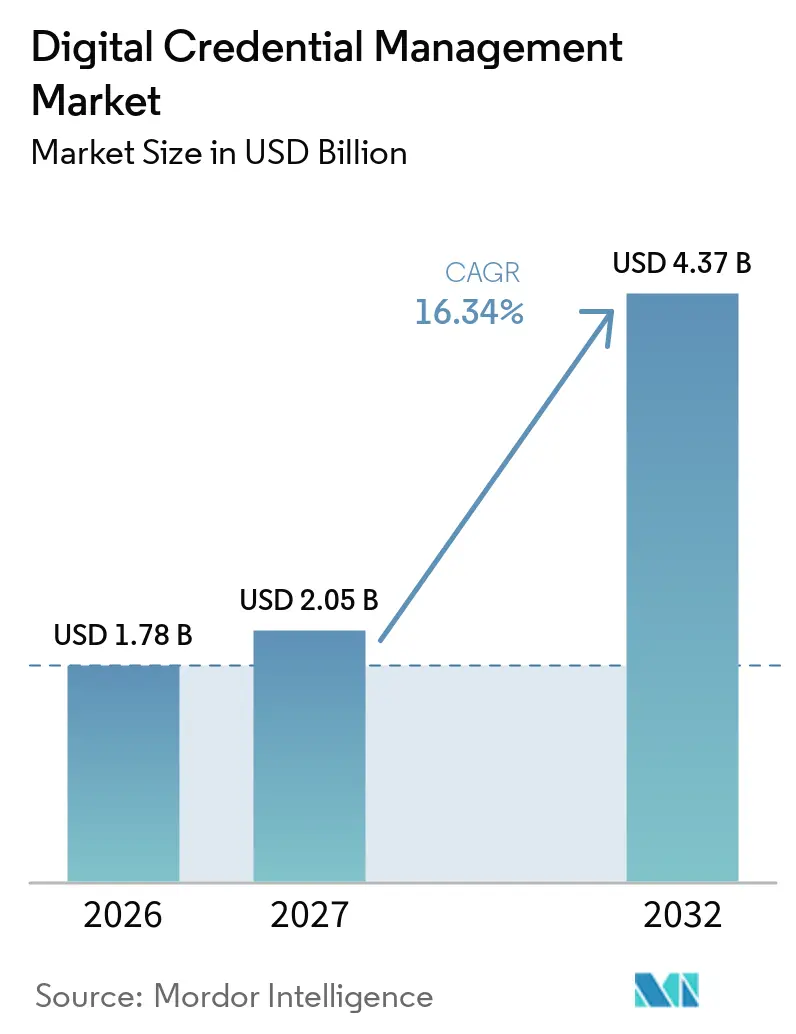
The digital credential management market size is projected to expand from USD 1.78 billion in 2026 and USD 2.05 billion in 2027 to USD 4.37 billion by 2032, registering a CAGR of 16.34% between 2027 and 2032. Regulatory deadlines are making digital credentials a compliance requirement for issuers, wallets, and relying parties across major economies. The European Digital Identity Wallet deadline is moving demand beyond stand-alone certificates toward interoperable identity infrastructure that can be used in public services and regulated private transactions. Rising deepfake fraud is also increasing interest in credentials that can be cryptographically verified and revoked when needed. Open standards are changing buyer expectations, since organizations increasingly need systems that work across wallets, identity platforms, and national trust frameworks. The digital credential management market, therefore, presents opportunities for providers that combine standards support, deployment capability, lifecycle governance, and practical integration services.
Key Report Takeaways
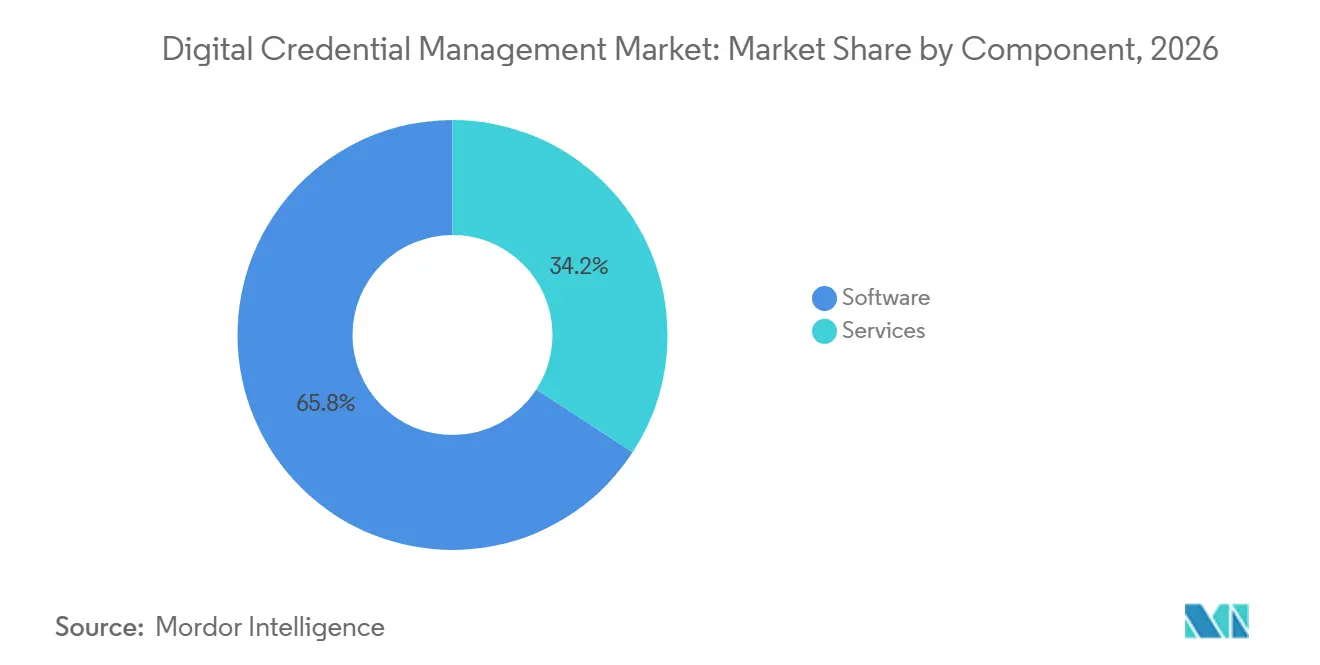
- By component, software held 65.81% of the digital credential management market share in 2026, while services are projected to expand at a 17.87% CAGR through 2032.
- By deployment mode, cloud-based deployment held 72.65% revenue share in 2026 and is projected to expand at a 17.22% CAGR through 2032.
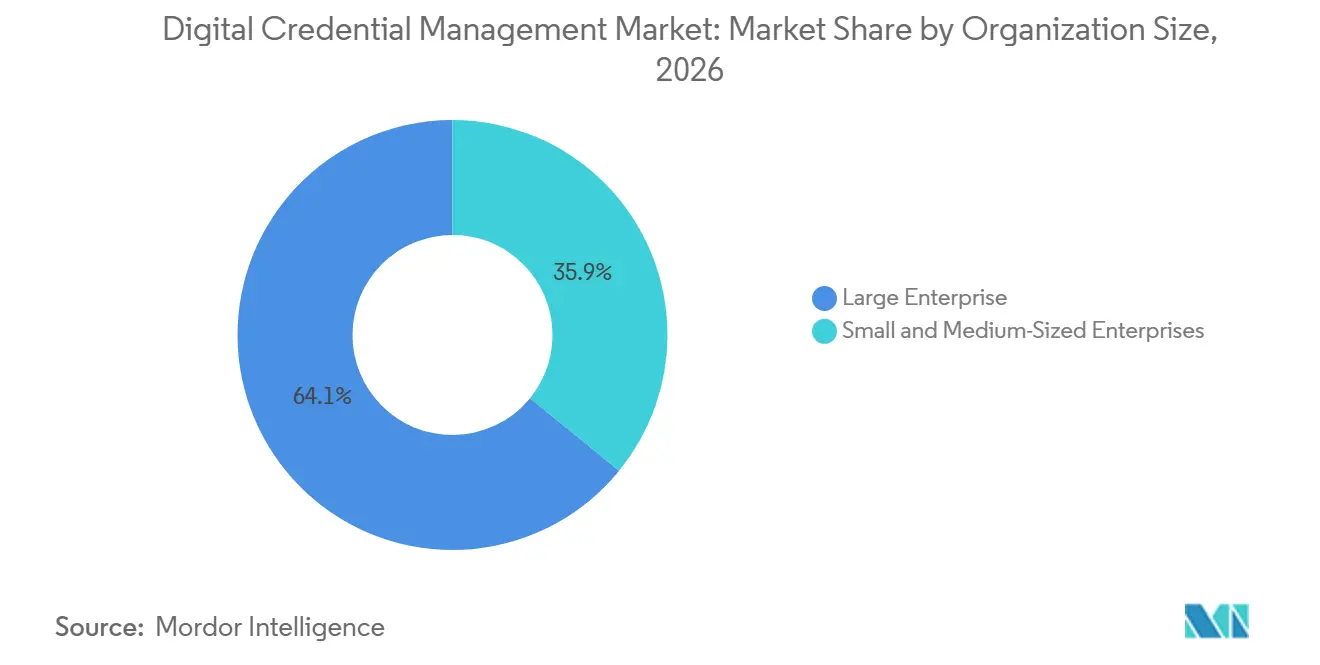
- By organization size, large enterprises held 64.12% revenue share in the digital credential management market in 2026, while small and medium-sized enterprises are projected to expand at an 18.20% CAGR through 2032.
- By credential type, verifiable identity credentials held 36.17% revenue share in 2026, while digital badges and microcredentials are projected to expand at a 17.79% CAGR through 2032.
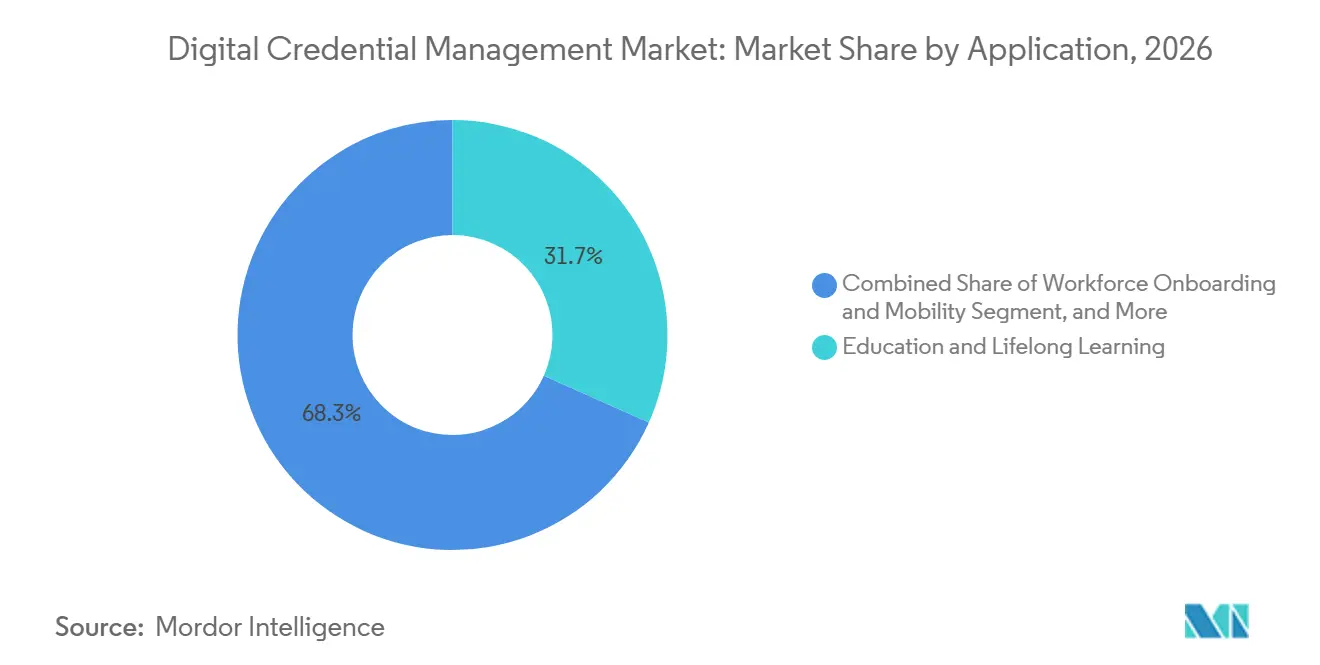
- By application, education and lifelong learning accounted for 31.67% of revenue in the digital credential management market in 2026, while workforce onboarding and mobility are projected to expand at an 18.31% CAGR through 2032.
- By end user, academic institutions held 27.83% revenue share in 2026, while enterprise users are projected to expand at an 18.29% CAGR through 2032.
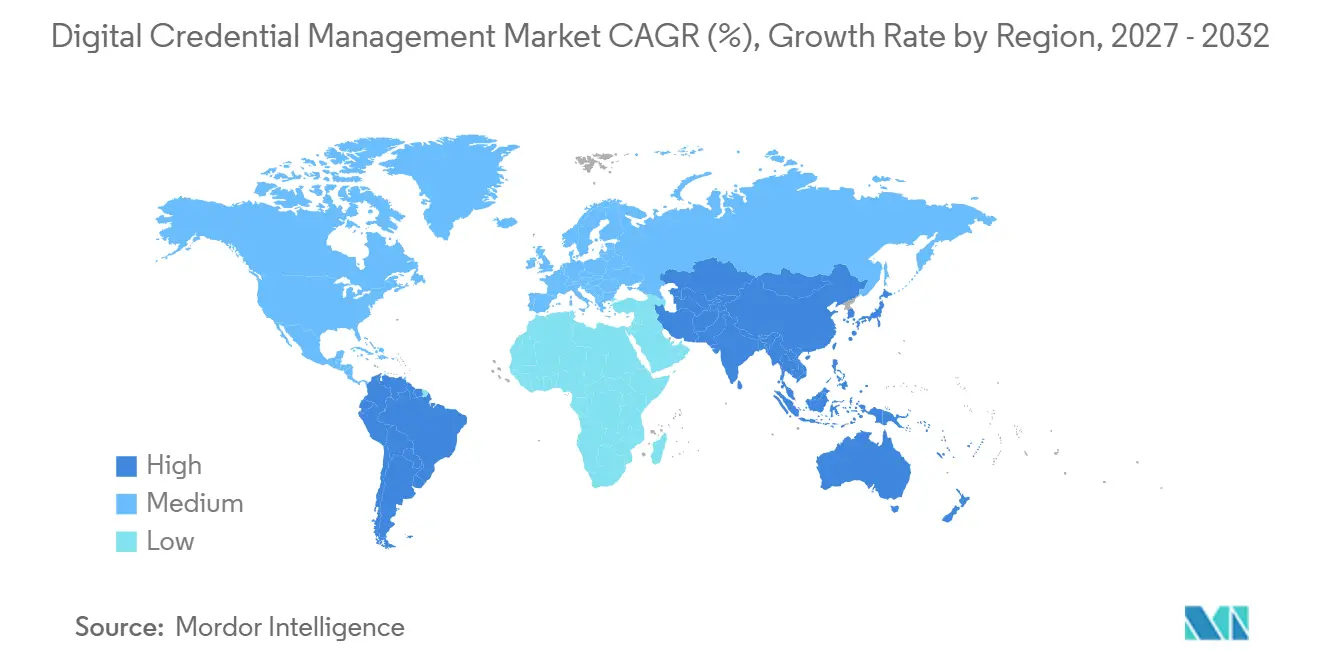
- By geography, North America held 36.34% revenue share in the digital credential management market in 2026, while Asia-Pacific is projected to expand at an 18.61% CAGR through 2032.
Note: Market numbers in this report are based on Mordor Intelligence's proprietary estimation framework, which combines nine months of actuals with Q4 projections for base year 2026.
Global Digital Credential Management Market Trends and Insights
Drivers Impact Analysis*
| Driver | (~) % Impact on CAGR Forecast | Geographic Relevance | Impact Timeline |
|---|---|---|---|
| Regulatory Wallet Mandates and Digital Public Infrastructure Spending | +2.8% | Global, with concentrated early impact in Europe, North America, and East Asia | Short term (≤ 2 years) |
| AI-Generated Identity Fraud and Deepfake Risk | +2.5% | Global, with highest urgency in North America, Western Europe, and financial-services-dense Asia-Pacific markets | Short term (≤ 2 years) |
| Skills-Based Hiring and Portable Workforce Credentials | +2.0% | North America and Europe, with spillover to Australia, India, and South Korea | Medium term (2-4 years) |
| Open Standards and Interoperable Digital Wallet Adoption | +1.8% | Global, with fastest maturity in European and Asia-Pacific national infrastructure programs | Medium term (2-4 years) |
| Credential Reuse Across Onboarding, KYC, and Access Workflows | +1.5% | North America and Europe, with growing adoption in Middle East financial centers | Medium term (2-4 years) |
| Verifiable Credentials for Machine and AI-Agent Authorization | +1.2% | Global enterprise deployments, concentrated in the North American technology sector | Long term (≥ 4 years) |
| Source: Mordor Intelligence | |||
Regulatory Wallet Mandates and Digital Public Infrastructure Spending
Regulatory implementation schedules are creating defined buying periods for the digital credential management market. Regulation (EU) 2024/1183 requires European Union member states to make at least 1 European Digital Identity Wallet available by December 6, 2026. Public-sector bodies are required to accept the wallet from that date, while regulated private sectors, including financial services, must accept it by December 2027. Germany published a draft Digital Identity Act in March 2026, showing how European rules can lead to national legislation and procurement activity. NIST finalized Special Publication 800-63-4 in August 2025, adding federal digital identity guidance that addresses synthetic media risks in identity proofing.[1] California also began its Career Passport pilot in June 2026, which brought 4 vendors into a state-supported learning and employment record initiative.
AI-Generated Identity Fraud and Deepfake Risk
Skills-based hiring is extending the use of digital credentials beyond academic records. The National Association of Colleges and Employers reported that 70% of employers used skills-based hiring in 2026, compared with 65% in 2025. It also found that 71% of adopting employers used these practices at least half of the time. The share of employers using GPA as a screening tool declined from 73% in 2019 to 42% in 2026. This shift requires employers and learning providers to map credentials to recognized job frameworks and make them easier to validate. The European Commission’s Skills Portability Act proposal would require digital attestations of qualifications to be interoperable, machine-readable, and secure across member states.
Skills-Based Hiring and Portable Workforce Credentials
Skills-based hiring is extending the use of digital credentials beyond academic records. The National Association of Colleges and Employers reported that 70% of employers used skills-based hiring in 2026, compared with 65% in 2025. It also found that 71% of adopting employers used these practices at least half of the time. The share of employers using GPA as a screening tool declined from 73% in 2019 to 42% in 2026. This shift requires employers and learning providers to map credentials to recognized job frameworks and make them easier to validate. The European Commission’s Skills Portability Act proposal would require digital attestations of qualifications to be interoperable, machine-readable, and secure across member states.
Open Standards and Interoperable Digital Wallet Adoption
Open standards are reducing the value of closed credential systems while expanding the digital credential management market to buyers that need cross-platform exchange. W3C published Verifiable Credentials Data Model v2.1 in 2026 and issued a Candidate Recommendation for DID Resolution v1.0 in August 2026. These specifications provide common data and cryptographic foundations for verifiable credential exchange. The FIDO Alliance launched its Digital Credentials Initiative with EMVCo, ISO, the OpenID Foundation, and W3C to address fragmentation across the identity ecosystem. National programs in Europe, India, Japan, Australia, and New Zealand are using standards that include OpenID for Verifiable Credential Issuance and ISO/IEC 18013-5. Accredible introduced Open Badge 3.0 and W3C Verifiable Credentials 2.0 support in January 2026 without requiring issuers to alter their workflows.
Restraints Impact Analysis*
| Restraint | (~) % Impact on CAGR Forecast | Geographic Relevance | Impact Timeline |
|---|---|---|---|
| Fragmented Trust Frameworks and Incomplete Cross-Wallet Interoperability | -1.5% | Global, with the greatest effect on cross-border deployments spanning Europe, Asia-Pacific, and North America | Medium term (2-4 years) |
| Privacy, Consent, and Data-Residency Compliance Complexity | -1.2% | Europe, China, and India, with spillover to South America and the Middle East | Medium term (2-4 years) |
| Issuer and Verifier Network-Effect Bottlenecks | -0.8% | Global, with sharp effects in emerging and mid-tier markets with limited issuer ecosystems | Long term (≥ 4 years) |
| Credential Recovery, Revocation, and Long-Term Wallet Usability | -0.6% | Global enterprise and government programs operating at population scale | Long term (≥ 4 years) |
| Source: Mordor Intelligence | |||
Fragmented Trust Frameworks and Incomplete Cross-Wallet Interoperability
Cross-wallet interoperability remains a material constraint on large, cross-border deployments in the digital credential management market. A World Bank note separates interoperability into credential portability, signature verifiability, and legal recognition. It notes that jurisdictions need alignment across all 3 areas before credentials can move consistently across borders.[2] A credential issued under United States guidance may still require separate recognition and assurance mapping before a relying party in Germany accepts it. This means technical standards alone do not settle governance and legal-recognition questions. Vendors, therefore, face longer sales cycles and expensive, tailored integration work for multinational programs.
Privacy, Consent, and Data-Residency Compliance Complexity
Privacy rules make credential architecture more costly and time-consuming for issuers and relying parties. The General Data Protection Regulation requires organizations to limit the personal data disclosed in each transaction. Selective disclosure methods can support this outcome, but each relying-party connection must be configured for the relevant attributes. Research on revocation mechanisms for the European Digital Identity Wallet also identifies challenges in managing revocation at national scale. China’s Personal Information Protection Law adds data localization requirements that can restrict cloud architecture choices. These requirements can extend procurement cycles and favor organizations with strong legal and technical resources.
*Our forecasts treat driver/restraint impacts as directional, not additive. The impact forecasts reflect baseline growth, mix effects, and variable interactions.
Segment Analysis
By Component: Services Gain Ground as Deployment Complexity Increases
Software held 65.81% of revenue in 2026, which reflects the established base of issuance platforms supporting the digital credential management market in education and enterprise settings. The digital credential management market has benefited from institutions replacing paper certificates and static PDFs with subscription-based platforms. Software providers manage issuance, storage, presentation, and verification functions through their systems. However, buyers increasingly need support for W3C Verifiable Credentials, eIDAS 2.0, ISO/IEC 18013-5, and other standards at the same time.
Services in the digital credential management market are projected to expand at a 17.87% CAGR through 2032 as deployments require integration and lifecycle support. IBM’s December 2025 standards-based issuance offering uses ISO/IEC 18013-5, IETF SD-JWT, OID4VCI, and OID4VP in a single implementation. Such configurations require specialist skills to connect identity systems, wallets, and relying-party applications. Organizations must also maintain revocation functions at scale and adjust their systems as technical specifications change. NIST SP 800-63-4 and European implementing regulations therefore support recurring demand for advisory, managed deployment, and update services.
By Deployment Mode: Cloud Leads While Hybrid Meets Regulated Needs
Cloud-based deployment held 72.65% of revenue in 2026 and is projected to expand at a 17.22% CAGR through 2032. The position reflects the widespread use of software as a service by education, human resources, and enterprise identity teams in the digital credential management market. Managed infrastructure can help issuers scale verification and issuance without building their own large operating environments. IBM documentation states that its OID4VCI implementation can issue credentials in under 2 seconds in cloud-native configurations. This performance helps explain continued cloud adoption for high-volume programs.
On-premises systems still matter in defense, national security, and financial services, where policies or laws restrict the handling of credential metadata in public clouds. Hybrid models allow issuers to use scalable cloud elements while protecting sensitive data in controlled environments. Germany’s EUDI Wallet implementation concept describes a phased approach that links cloud-native components with protected infrastructure for sensitive attributes. Oracle released Identity and Access Management 14c in March 2025 with configurations that support cloud and on-premises environments. The digital credential management industry is therefore likely to retain multiple delivery models rather than shift fully to a single cloud approach.
By Organization Size: Large Enterprises Provide Scale While SMEs Add Momentum
Large enterprises held 64.12% of revenue in 2026 because they have the resources to link credentials with established identity, human resources, and onboarding systems. These programs often require identity architecture, legal review, and support across multiple privacy regimes. Their procurement processes also tend to favor established platforms and integration partners. This customer group gives providers sizeable deployment opportunities across the digital credential management market.
Small and medium-sized enterprises are projected to expand at an 18.20% CAGR through 2032. Software as a service offerings reduce the cost and internal expertise needed to issue and verify credentials. The OECD notes that small employers need practical tools as they replace degree requirements with skills-based assessment. Platform offerings from Accredible, Sertifier, and CertifyMe are designed to support workforce certification, customer onboarding, and partner access without extensive custom development. The HR Open Standards Consortium released the Trusted Career Profile standard to help create interoperable learning and employment record ecosystems.

By Credential Type: Identity Credentials Lead and Microcredentials Build Demand
Verifiable identity credentials held 36.17% of revenue in 2026, making them the largest credential type in the digital credential management market. Government identity programs, financial services KYC processes, and enterprise workforce identity use support the segment. These applications require high assurance and are subject to detailed regulation. eIDAS 2.0, ISO/IEC 18013-5, and NIST SP 800-63-4 all reinforce the need for verifiable identity systems.
Digital badges and microcredentials are projected to expand at a 17.79% CAGR through 2032. They address the need to record specific and current skills rather than only historical degrees. Professional certifications and licenses require periodic verification and revocation reporting, which creates an ongoing service opportunity. Entitlement, membership, and authorization credentials can be reused across onboarding, KYC, and access workflows after an identity has been verified. The digital credential management market can therefore gain value from more frequent credential use, not only from initial issuance.
By Application: Education Anchors Adoption While Workforce Mobility Expands
Education and lifelong learning held 31.67% of revenue in 2026, supported by long-standing use of digital certificates and badges. Colleges, certification organizations, and workforce providers have deployed credential systems to issue achievements at scale. Open Badge standards have made it easier for these records to be presented and checked across platforms in the digital credential management market. Accredible stated in early 2025 that more than 24 million learners were covered through its platform.
Workforce onboarding and mobility are projected to expand at an 18.31% CAGR through 2032, the fastest rate among applications. Skills-based hiring and repeated identity verification both support this use case. Government services also create demand as EUDI Wallet requirements enter public-sector procurement across 27 European Union member states. Financial services providers are seeking high-assurance identity verification that can be reused, while healthcare organizations need credential systems that support license checks and professional recognition. IDEMIA and Indicio announced a March 2026 offering for banks, decentralized finance platforms, and cross-border payment providers.
By End User: Academic Institutions Lead While Enterprise Demand Broadens
Academic institutions held 27.83% of revenue in 2026, reflecting their established use of digital badges and certificate programs. This base includes colleges, universities, professional certification organizations, and other learning providers. Platforms such as Accredible, Parchment, and Canvas Credentials have built integrations that support institutional issuance processes in the digital credential management market. The segment remains important because education providers generate credential records that can later be used by employers and licensing bodies.
Enterprise users are projected to expand at an 18.29% CAGR through 2032. Demand comes from workforce portability, customer identity verification, and emerging machine authorization requirements. Microsoft Research published Vega in 2026, a system designed to let users prove facts from government-issued credentials without revealing the credential itself. The work indicates how credentials may become relevant to AI-agent authorization and other non-human identity scenarios. Banks, healthcare providers, and technology and identity service providers also require platforms that can fit into broader identity orchestration stacks.
Geography Analysis
North America held 36.34% of revenue in 2026, supported by mature enterprise identity systems and early credential platform adoption. The United States benefits from a large base of identity technology buyers and public initiatives that support skills-based hiring. California entered the demonstration phase of its Career Passport pilot in June 2026 with 4 selected technology vendors. The state linked the program to academic records, verified skills, and non-degree credentials. NIST SP 800-63-4 provides a federal assurance framework for digital identity deployments in the digital credential management market.
Europe has a major regulatory pipeline because 27 European Union member states must make at least 1 EUDI Wallet available by December 2026. The framework creates a common timetable for wallet issuers, relying parties, and related service providers. The European Commission updated technical specifications through Implementing Regulations (EU) 2026/798 and 2026/1731 in 2026. Germany’s draft Digital Identity Act demonstrates the national policy activity that follows European requirements. The digital credential management market share in Europe is supported by the need for compliance-ready credential issuance and verification systems.
Asia-Pacific is projected to expand at an 18.61% CAGR through 2032, the fastest regional rate. China established distributed digital identity standards through YD/T 6745-2026 and YD/T 6896-2026, creating a national technical reference for identity services.[3] India’s DigiLocker, Singapore’s National Digital Identity framework, and Taiwan’s wallet program add public infrastructure that can support enterprise use cases. Japan registered the Creclude platform as its first trusted service for verifiable credential-based remote signing in October 2026. The ASEAN Digital Identity Gateway launched its Singapore node in May 2026 to support digital identity connections in the region. South America, the Middle East, and Africa remain earlier-stage markets, but government identity programs in Brazil, the United Arab Emirates, Nigeria, and South Africa create a pipeline for future adoption in the digital credential management market.
Competitive Landscape
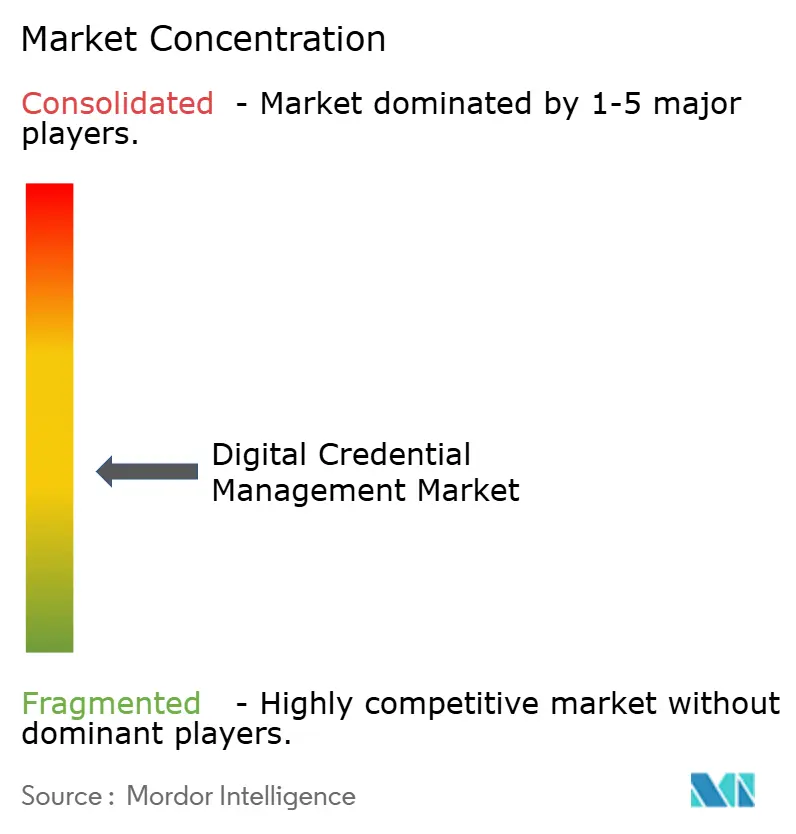
The digital credential management market has a moderately fragmented structure, with specialist credential platforms and broader identity providers serving different buyer needs. Accredible, Parchment, Sertifier, CertifyMe, Badgecraft, and Dock Labs focus on credential program management, badge design, learner engagement, and standards support. IBM, Microsoft, Thales, Oracle, and Ping Identity compete through enterprise integration, identity and access management capabilities, and capacity for large public-sector deployments. Competition centers on the ability to meet eIDAS 2.0 requirements while supporting W3C Verifiable Credentials. Thales achieved ISO/IEC 18013-5 certification for its digital identity wallet through UL Solutions’ certification program, which shows the level of standards readiness needed for national contracts.
Microsoft Research’s 2026 Vega publication shows a strategy to bring cryptographic credential assurance into Azure and Entra-related infrastructure. The system can prove facts from government-issued credentials without revealing the credential itself. IBM Verify added a pre-authorized code grant type for verifiable credential scenarios in its June 2026 update. This enables secure transfer from an issuer to a wallet without interrupting a user session. These product steps show that large identity providers are extending their platforms toward verifiable credential issuance and presentation in the digital credential management market.
Specialist providers retain opportunities where customers need practical deployment with less internal identity expertise. This is particularly relevant for organizations with 50 to 500 employees that face fraud and compliance requirements without large identity architecture teams. Accredible’s January 2026 support for Open Badge 3.0 and W3C Verifiable Credentials 2.0 reduced migration friction for issuers. IDEMIA announced partnerships with Proof and Indicio in March 2026 to combine biometric proofing, privacy-preserving signatures, and interoperable verification. The digital credential management market is likely to favor providers that can pair open standards with usable tools and repeatable deployment support.
Digital Credential Management Industry Leaders
-
Pearson plc
-
Accredible, Inc.
-
Thales S.A.
-
IBM Corporation
-
Oracle Corporation
- *Disclaimer: Major Players sorted in no particular order
Recent Industry Developments
- October 2026: Japan's JIPDEC registered "Creclude," a next-generation digital credential issuance and verification platform co-developed by Mitsubishi UFJ Trust Bank and TOPPAN Co., as Japan's first trusted service for verifiable credentials-based remote signing, representing the country's inaugural third-party evaluation of W3C VC-based attribute certification. The development establishes a regulatory trust anchor for enterprise VC adoption in Japan's financial sector, providing a compliance pathway that other issuers are expected to follow.
- August 2026: Accredible launched Skills Frameworks, enabling credential issuers to align issued badges to industry-recognized external occupational frameworks, including O*NET, ESCO, and NACE Career Readiness Competencies, or to upload proprietary skills taxonomies, directly embedding employer-recognized authority into verifiable credentials without changing existing issuance workflows.
- June 2026: California launched the Career Passport pilot demonstration phase, a state-backed Learning and Employment Record initiative combining academic transcripts with verified skills and non-degree credentials, engaging 4 selected technology vendors in real-user testing through August 2026. The pilot is part of Governor Newsom's Master Plan for Career Education and builds on more than 245,000 registered apprenticeships completed since 2019.
- March 2026: IDEMIA Public Security announced a strategic partnership with Proof to deliver a privacy-preserving verifiable digital credential combining IDEMIA's biometric identity proofing with Proof's PKI-based digital signature and authorization network. The joint solution targets payments fraud, KYC, and access management use cases for financial institutions seeking user-controlled, revocable credentials.
Global Digital Credential Management Market Report Scope
Digital credential management refers to the comprehensive framework of software platforms and protocols used by organizations to issue, manage, and verify secure, tamper-proof digital records of identity, skills, and qualifications.
The Digital Credential Management Market Report is Segmented by Components (Software and Services), Deployment Mode (Cloud-Based, On-Premises, and Hybrid), Organization Size (Large Enterprises and Small and Medium-Sized Enterprises), Credential Type (Verifiable Identity Credentials, Professional Certifications and Licenses, Entitlement, Membership, and Authorization Credentials, Digital Badges and Microcredentials, and Other Credential Types), Application (Education and Lifelong Learning, Workforce Onboarding and Mobility, Customer and Business Identity Verification, Healthcare Identity and Professional Licensure, Government Services and Digital Public Infrastructure, Financial Services and Payments, and Other Applications), End User (Academic Institutions, Enterprise, Banks and Financial Institutions, Healthcare Providers, Technology and Identity Service Providers, and Other End Users) and Geography (North America, South America, Europe, Asia-Pacific, Middle East, and Africa). The Market Forecasts are Provided in Terms of Value (USD).
| Software |
| Services |
| Cloud-Based |
| On-Premises |
| Hybrid |
| Large Enterprises |
| Small and Medium-Sized Enterprises |
| Verifiable Identity Credentials |
| Professional Certifications and Licenses |
| Entitlement, Membership, and Authorization Credentials |
| Digital Badges and Microcredentials |
| Other Credential Types |
| Education and Lifelong Learning |
| Workforce Onboarding and Mobility |
| Customer and Business Identity Verification |
| Healthcare Identity and Professional Licensure |
| Government Services and Digital Public Infrastructure |
| Financial Services and Payments |
| Other Applications |
| Academic Institutions |
| Enterprise |
| Banks and Financial Institutions |
| Healthcare Providers |
| Technology and Identity Service Providers |
| Other End Users |
| North America | United States |
| Canada | |
| Mexico | |
| South America | Brazil |
| Argentina | |
| Rest of South America | |
| Europe | Germany |
| United Kingdom | |
| France | |
| Italy | |
| Spain | |
| Rest of Europe | |
| Asia-Pacific | China |
| India | |
| Japan | |
| South Korea | |
| Australia | |
| Rest of Asia-Pacific | |
| Middle East | Saudi Arabia |
| United Arab Emirates | |
| Turkey | |
| Rest of Middle East | |
| Africa | South Africa |
| Nigeria | |
| Egypt | |
| Rest of Africa |
| By Component | Software | |
| Services | ||
| By Deployment Mode | Cloud-Based | |
| On-Premises | ||
| Hybrid | ||
| By Organization Size | Large Enterprises | |
| Small and Medium-Sized Enterprises | ||
| By Credential Type | Verifiable Identity Credentials | |
| Professional Certifications and Licenses | ||
| Entitlement, Membership, and Authorization Credentials | ||
| Digital Badges and Microcredentials | ||
| Other Credential Types | ||
| By Application | Education and Lifelong Learning | |
| Workforce Onboarding and Mobility | ||
| Customer and Business Identity Verification | ||
| Healthcare Identity and Professional Licensure | ||
| Government Services and Digital Public Infrastructure | ||
| Financial Services and Payments | ||
| Other Applications | ||
| By End User | Academic Institutions | |
| Enterprise | ||
| Banks and Financial Institutions | ||
| Healthcare Providers | ||
| Technology and Identity Service Providers | ||
| Other End Users | ||
| By Geography | North America | United States |
| Canada | ||
| Mexico | ||
| South America | Brazil | |
| Argentina | ||
| Rest of South America | ||
| Europe | Germany | |
| United Kingdom | ||
| France | ||
| Italy | ||
| Spain | ||
| Rest of Europe | ||
| Asia-Pacific | China | |
| India | ||
| Japan | ||
| South Korea | ||
| Australia | ||
| Rest of Asia-Pacific | ||
| Middle East | Saudi Arabia | |
| United Arab Emirates | ||
| Turkey | ||
| Rest of Middle East | ||
| Africa | South Africa | |
| Nigeria | ||
| Egypt | ||
| Rest of Africa | ||
Key Questions Answered in the Report
What is the size of the digital credential management market?
The digital credential management market is projected to reach USD 4.37 billion by 2032 from USD 2.05 billion in 2027, at a 16.34% CAGR.
What is driving adoption of digital credentials?
EUDI Wallet requirements, skills-based hiring, deepfake fraud risks, and adoption of interoperable standards are increasing demand in the digital credential management market.
Which component is expanding fastest?
Services are projected to expand at a 17.87% CAGR through 2032 as organizations need deployment, integration, and lifecycle support.
Which deployment model is most widely used?
Cloud-based deployment held 72.65% revenue share in 2026 and is projected to expand at a 17.22% CAGR through 2032.
Which application has the highest projected CAGR?
Workforce onboarding and mobility are projected to expand at an 18.31% CAGR through 2032.
Which region has the fastest projected expansion?
Asia-Pacific is projected to expand at an 18.61% CAGR through 2032, supported by public digital identity programs and regional standards activity.