
Digital Audio Platforms Market Size and Share
Market Overview
| Study Period | 2020 - 2031 |
|---|---|
| Market Size (2026) | USD 21.07 Billion |
| Market Size (2031) | USD 42.49 Billion |
| Growth Rate (2026 - 2031) | 15.06 % |
| Fastest Growing Market | Asia-Pacific |
| Largest Market | North America |
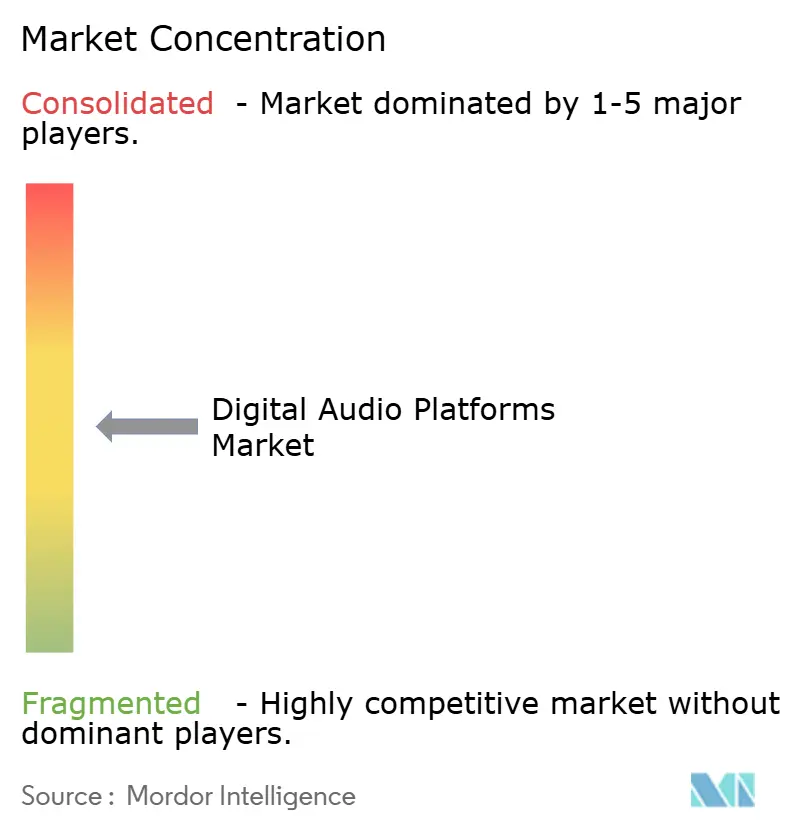
| Market Concentration | Medium |
Major Players
*Disclaimer: Major Players sorted in no particular order Image © Mordor Intelligence. Reuse requires attribution under CC BY 4.0. |
|
Digital Audio Platforms Market Analysis by Mordor Intelligence
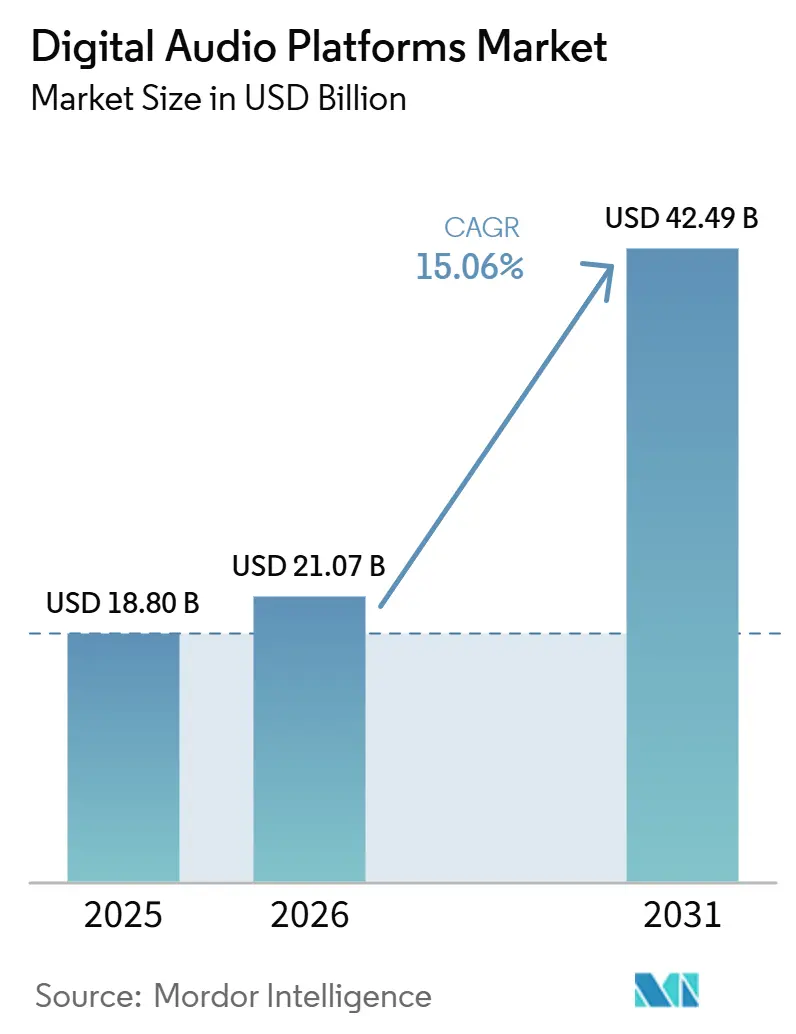
The digital audio platforms market size is expected to increase from USD 18.80 billion in 2025 to USD 21.07 billion in 2026 and reach USD 42.49 billion by 2031, growing at a CAGR of 15.06% over 2026-2031. Streaming has continued to displace physical formats and downloads as listeners move toward on-demand access. Smartphone use and wider mobile broadband availability support this transition, especially in emerging economies. Global recorded-music streaming revenue exceeded USD 22 billion in 2025, and paid subscriptions reached 837 million accounts. Platforms are broadening their offers across music, podcasts, audiobooks, and radio while regional services use local catalogs and carrier relationships to compete. Royalty costs, catalog licensing terms, and privacy requirements remain important limits on profitability and advertising models.
Key Report Takeaways
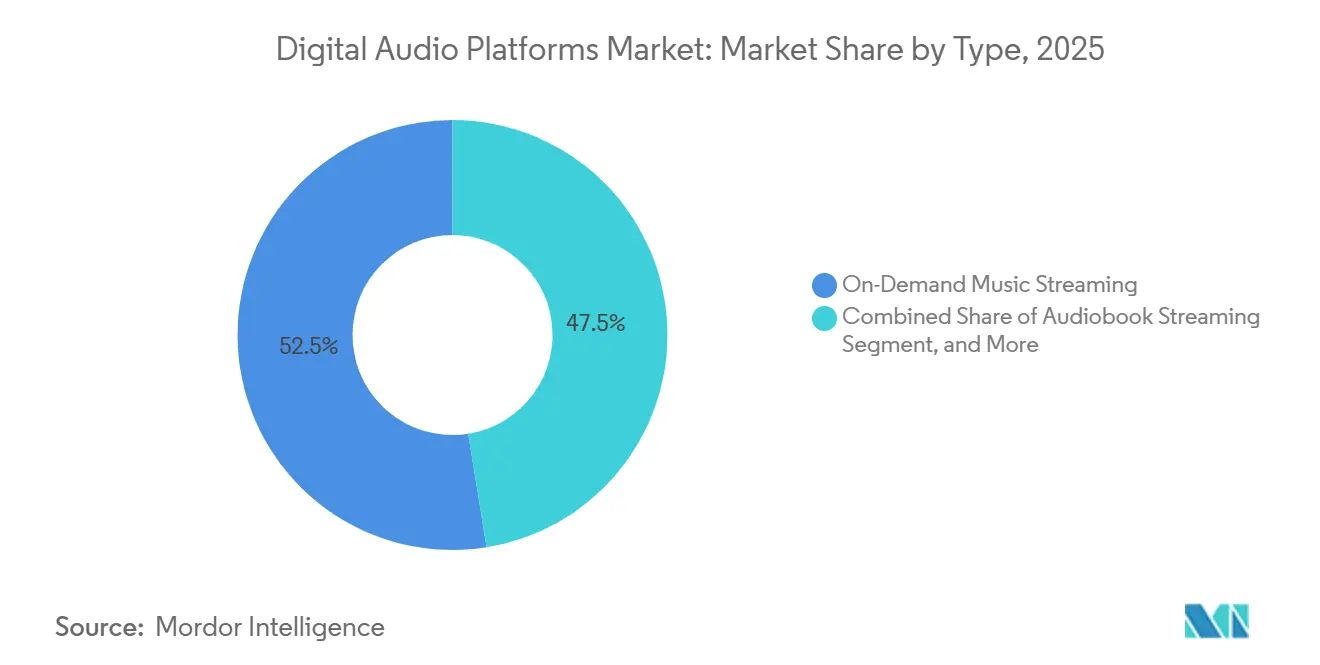
- By format type, on-demand music streaming held 52.53% of market value in 2025, while audiobook streaming is projected to expand at a 15.16% CAGR through 2031.
- By monetization model, subscription-based services held 58.59% of market value in 2025, while advertising-based services are projected to expand at a 15.36% CAGR through 2031.
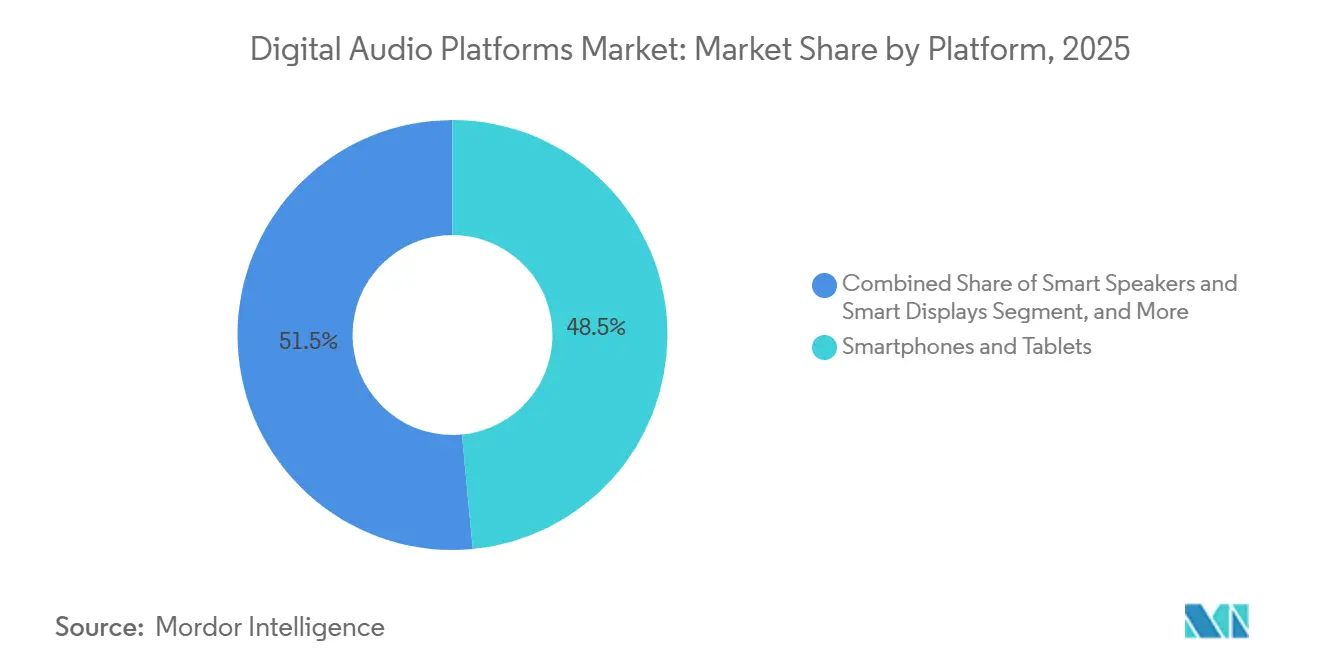
- By device, smartphones and tablets accounted for 48.49% of the digital audio platforms market size in 2025, while smart speakers and smart displays are projected to expand at a 15.84% CAGR through 2031.
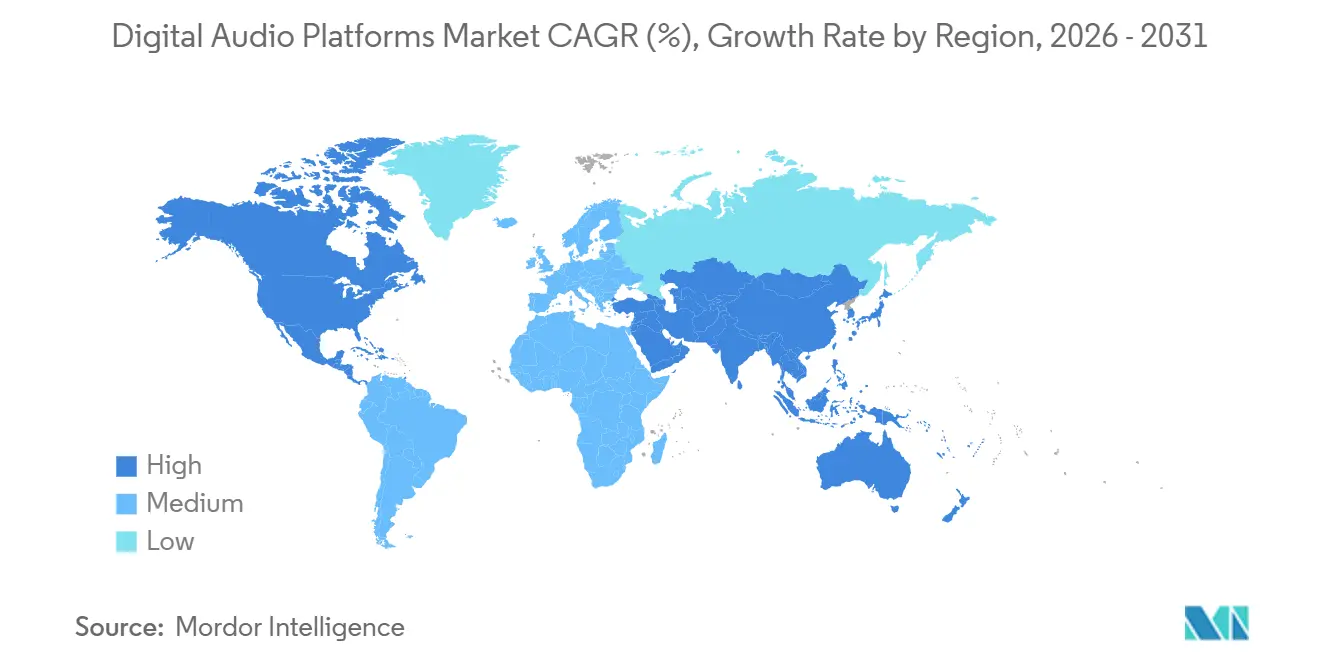
- By geography, North America held 38.40% of the digital audio platforms market share in 2025, while Asia-Pacific is projected to expand at a 16.11% CAGR through 2031.
Note: Market size and forecast figures in this report are generated using Mordor Intelligence’s proprietary estimation framework, updated with the latest available data and insights as of January 2026.
Global Digital Audio Platforms Market Trends and Insights
Drivers Impact Analysis*
| Driver | (~) % Impact on CAGR Forecast | Geographic Relevance | Impact Timeline |
|---|---|---|---|
| Subscription Price Rationalization in Emerging Economies | +3.5% | Asia-Pacific, Middle East and Africa, South America | Short term (≤ 2 years) |
| Telco OTT Bundling Pushes Paid Uptake | +3.0% | Asia-Pacific core, spill-over to Middle East and Africa | Short term (≤ 2 years) |
| Rapid Smart Speaker Install Base Expansion | +2.0% | North America and Europe, extending to Asia-Pacific | Medium term (2-4 years) |
| OEM-Level In-Car Streaming Integrations | +1.5% | North America, Europe, China | Medium term (2-4 years) |
| AI Voice DJ and Generative Playlists Extend Daily Listening Time | +1.5% | Global, early gains in North America and Europe | Medium term (2-4 years) |
| Blockchain-Based Royalty Settlement Attracts Independent Catalogs | +0.5% | Global | Long term (≥ 4 years) |
| Source: Mordor Intelligence | |||
Subscription Price Rationalization in Emerging Economies
India had 14.4 million paid music subscribers in 2025, compared with an internet user base of more than 700 million people. Paid music subscriptions in the country increased 37% during the year, while audio subscription revenue exceeded INR 10.3 billion (USD 118.2 million). Annual revenue per user in India ranged from USD 4 to USD 10, compared with USD 100 to USD 140 in the United States. Lower prices can therefore build listening habits among large groups before household incomes rise. This approach treats lower-priced tiers as a longer-term engagement investment rather than a short-lived discount. India’s paid subscriber base is forecast to more than double by 2028, with revenue forecast to reach INR 22 billion (USD 236 million).
Telco OTT Bundling Pushes Paid Uptake
Telecom operators have become important subscriber channels for the digital audio platforms market where card use limits direct digital payments. In May 2026, Reliance Jio launched an INR 200 (USD 2.40) OTT pass with 15 streaming platforms, 30 GB of data, and unlimited 5G access for 28 days. In June 2026, CelcomDigi introduced StreamMORE plans in Malaysia from MYR 19.90 (USD 4.50) per month.[1]CelcomDigi, “CelcomDigi Redefines Entertainment with All-New StreamMORE Bundles,” CelcomDigi, corporate.celcomdigi.com Vodafone Idea also became the first Indian carrier to include Spotify Premium in eligible postpaid plans during June 2026. This model follows earlier carrier relationships involving JioSaavn Pro and Apple Music. Subscribers acquired through a mobile plan can have lower churn because their billing is tied to the plan renewal cycle.
Rapid Smart Speaker Install Base Expansion
Amazon reported in February 2025 that it had shipped more than 600 million Alexa-enabled devices worldwide. This installed base lets the digital audio platforms market reach listeners without acquiring every user through a separate mobile application. Smart speaker listeners commonly favor passive, ambient listening over active playlist selection. That behavior raises the value of radio-style curation and responsive recommendations. Screen-free interaction also makes algorithmic discovery more important because listeners depend on a platform to make the next selection. North American and European markets are more mature, while Xiaomi and Baidu’s DuerOS ecosystem support additional device adoption in Asia-Pacific.
OEM-Level In-Car Streaming Integrations
Native vehicle integrations give the digital audio platforms market a potential multi-year audio relationship at the point of vehicle purchase. General Motors began offering Apple Music natively in 2025-plus Chevrolet and Cadillac vehicles through over-the-air updates in December 2025. The service is included through OnStar Basics for as long as 8 years after purchase on eligible vehicles. Volvo Cars is integrating Apple Music into more than 2 million vehicles, including spatial audio support in the EX60, EX90, and ES90.[2]Volvo Cars. "Apple Music Coming to More than Two Million Volvo Cars, with Up to Three Months Free Subscriptions." 2026. Hyundai’s Pleos Connect platform is intended for 20 million vehicles by 2030 and includes Spotify, YouTube, NAVER, and essential.
Restraints Impact Analysis*
| Restraint | (~) % Impact on CAGR Forecast | Geographic Relevance | Impact Timeline |
|---|---|---|---|
| Royalty-Rate Inflation Exceeding ARPU Growth | -2.5% | Global | Medium term (2-4 years) |
| Content-License Windowing by Major Labels | -1.5% | Global | Medium term (2-4 years) |
| Data-Privacy Regulations Limiting Ad-Targeting | -1.0% | Europe, North America | Medium term (2-4 years) |
| Algorithmic Discovery Bias Marginalizing Long-Tail Creators | -0.5% | Global | Long term (≥ 4 years) |
| Source: Mordor Intelligence | |||
Royalty-Rate Inflation Exceeding ARPU Growth
Content royalties consumed 65% to 68% of major platform revenue in 2025, limiting the room for higher gross margins. Spotify reported paying more than USD 11 billion in royalties during 2025, which was more than 10% higher than the prior year. Spotify’s fourth-quarter 2025 gross margin was 32.2%, meaning content and platform costs represented a large share of revenue. The U.S. Phonorecords IV framework continues to increase songwriting royalty costs through its 2027 peak. Major labels are also using consumer segmentation and higher revenue per user as priorities in licensing discussions. Pressure is greatest in lower-priced parts of the digital audio platforms market because revenue per listener grows more slowly than total listening and royalty obligations.
Content-License Windowing by Major Labels
Major labels can hold back prominent releases from specific services or tiers for a defined period. This practice can support content tiering or improve labels’ negotiating position on royalty terms. Universal Music Group has described a strategy that encourages consumer segmentation and limits the depth of some free offerings. A service without direct, pre-negotiated terms may lose listeners when another service receives earlier access to a high-profile release. Universal Music Group, Sony Music Entertainment, and Warner Music Group licensed catalogs to the AI streaming startup Klay in November 2025. The arrangement showed that catalog access can shape competition as well as generate current royalty income.
*Our forecasts treat driver/restraint impacts as directional, not additive. The impact forecasts reflect baseline growth, mix effects, and variable interactions.
Segment Analysis
By Format Type: On-Demand Streaming Leads While Audiobooks Gain Momentum
On-demand music streaming held 52.53% of market value in 2025. The digital audio platforms market has benefited as listeners shift from radio and downloads to personalized, on-demand services. Paid music streaming accounts reached 837 million worldwide by the end of 2025.[3]IFPI. "IFPI Global Music Report 2026: Global Recorded Music Revenues Grow 6.4% as Record Companies Drive Innovation." March 18, 2026. Subscription streaming revenue increased 8.8% during 2025, which supported continuing monetization even as subscriber growth slowed in North America and Europe. Live internet radio has declined in volume across several Western markets but still serves smartphone users in emerging economies.
Audiobook streaming is projected to record a 15.16% CAGR between 2026 and 2031. U.S. audiobook sales increased 9% to USD 2.43 billion in 2025, and more than 750,000 active titles were available. Spotify stated in May 2026 that audiobook listening hours had increased 60% year over year. Audiobooks+ reached 1 million subscribers and was tracking toward USD 100 million in annualized recurring revenue. Existing smartphone and smart speaker infrastructure lowers the added cost of reaching audio listeners who already use a music platform.



By Monetization Model: Subscription Services Lead as Advertising Scales
Subscription-based services commanded 58.59% of market value in 2025. The segment reflects established premium subscriber bases in North America and Europe. Major-label licensing strategies support paid tiers by emphasizing higher revenue per user and clearer consumer segmentation. Transaction-based purchases, including downloads and pay-per-track purchases, have continued to lose relevance in mature markets. Within the digital audio platforms market, hybrid and freemium models remain the main acquisition route for services seeking to convert free listeners over time.
Advertising-based services are projected to expand at a 15.36% CAGR through 2031. Programmatic audio advertising is growing in emerging economies, while podcasts and audiobooks add advertising inventory. The European Data Protection Board’s Guidelines 3/2025 limit behavioral profiling under the Digital Services Act and the GDPR. European platforms are therefore moving toward contextual and cohort-based approaches using content, genre, and time-of-day signals. Spotify opened podcast advertising inventory to buyers using Amazon DSP in 2025 after launching its Ad Exchange with The Trade Desk and Google Display and Video 360.
By Device: Smartphones Dominate as Speakers and Cars Extend Listening
Smartphones and tablets accounted for 48.49% of the digital audio platforms market size in 2025. Their lead gives the digital audio platforms market broad access through widespread ownership, mobile broadband, and app-based listening. More than 700 million internet users in India accessed digital content primarily through smartphones in 2025. Laptops and desktops still support listening during work and home-office periods. Smart TVs offer an additional outlet for video podcasts and audiobook formats with visual material.
Smart speakers and smart displays are projected to post a 15.84% CAGR through 2031. Amazon’s shipment of more than 600 million Alexa-enabled devices gives services a large embedded access point. Connected cars may provide the greatest value per device because integrations can last for years. General Motors’ 8-year streaming commitment and Hyundai’s planned 20 million-vehicle Pleos Connect rollout make the car a stronger listening endpoint. LG introduced its webOS Automotive Content Platform on Kia’s EV3 in Europe during July 2025, with plans for EV4, EV5, and New Sportage models. Toyota’s 2026 multimedia system also includes Spotify streaming and first-generation AT&T 5G connectivity.
Geography Analysis
North America held 38.40% of global market value in 2025. The region has high revenue per user and mature paid subscriber bases in the United States and Canada. Mexico’s recorded-music market grew 13.3% in 2025. Spotify, Apple Music, Amazon Music, and YouTube Music use exclusive podcasts, hardware integration, and personalized features to compete in the United States. General Motors’ multiyear Apple Music offer, Toyota’s native Spotify access, and Volvo’s Apple Music rollout link platform access to vehicle ownership. South America remains smaller, but Brazil grew 14.1% in 2025. Claro Música uses carrier bundling and regional catalogs across Brazil, Argentina, and nearby markets.
Asia-Pacific is projected to be the fastest-growing region in the digital audio platforms market, with a 16.11% CAGR through 2031. India’s paid music subscriber base grew 37% to 14.4 million in 2025 as lower prices and carrier bundles supported conversion. China grew 20.1% in 2025 and became the fourth-largest recorded-music market globally. Tencent Music Entertainment completed its USD 2.4 billion acquisition of Ximalaya in June 2026, extending its position in podcasts and audiobooks. Japan grew 8.9% in 2025, with demand for high-resolution audio supporting premium positioning. South Korea is also expanding the connected-car listening channel through Hyundai’s platform. Europe grew 5.6% in 2025, while privacy rules are changing the design of advertising-supported offers.
The Middle East and Africa region grew, with Saudi Arabia and the UAE supporting consumption growth. Smartphone penetration above 90% across Gulf Cooperation Council markets supports direct app-based use. Regional carriers increasingly include audio services in premium postpaid packages. Anghami has used this carrier model to develop a regional subscriber base alongside global services. Boomplay has built a regional position through African catalogs, data-efficient streaming, and mobile money payments. Low revenue per user remains a constraint, but younger mobile-first users support longer-term volume growth for the digital audio platforms market.

Competitive Landscape
The digital audio platforms market is semi-consolidated globally. Spotify, Apple Music, Amazon Music, and YouTube Music account for most international paid subscriptions, while regional and specialist services compete for local audiences. Spotify’s scale gives it a substantial behavioral database and the resources to invest in personalization. The company also combines music, podcasts, and audiobooks in a single service. Its Audiobooks+ offer had reached 1 million subscribers by May 2026 and was tracking toward USD 100 million in annualized recurring revenue. YouTube Music benefits from Alphabet’s search and video ecosystem, which provides a broad discovery channel for music.
Amazon combines Amazon Music with Prime and Audible, offering more than one entry point for subscriptions. Audible held 63% of the U.S. audiobook platform share in 2024, according to the provided research. Regional providers occupy a distinct place in the digital audio platforms market and compete differently from global services. Boomplay, KKBOX, Anghami, JioSaavn, Gaana, and Claro Música use local-language content, localized billing, and carrier distribution. TIDAL and Qobuz focus on high-fidelity audio for listeners and music professionals who place more value on sound quality. These positions can be defensible where a broad global catalog alone does not meet local payment, language, or audio-quality needs.
Competition also extends to creator payments and AI licensing. Services using blockchain-based settlement seek to attract independent catalogs with real-time, transparent micropayments. Wider use of ISRC and ISWC standards could make such systems easier to scale. Universal Music Group, Sony Music Entertainment, and Warner Music Group each licensed catalogs to Klay in November 2025, reflecting greater use of structured licensing for AI music services. Spotify also expanded its product features with Prompted Playlist in January 2026 and a conversational AI assistant in July 2026. The combined market share of the leading global players was not provided, so a market concentration score cannot be assigned under the stated share-based method.
Digital Audio Platforms Industry Leaders
-
Spotify Technology S.A.
-
Apple Inc.
-
Amazon.com, Inc.
-
Alphabet Inc.
-
Tencent Music Entertainment Group
- *Disclaimer: Major Players sorted in no particular order

Recent Industry Developments
- July 2026: Spotify launched a conversational AI assistant for Premium mobile users, enabling natural-language voice and text-based audio discovery that queries the platform’s full catalog and the user’s listening history in real time, extending an AI feature suite that already includes AI DJ and Prompted Playlist, and repositioning Spotify as an AI-first audio interface rather than a catalog browser.
- July 2026: Spotify and Netflix jointly announced a multiyear partnership with podcaster Jay Shetty to bring “On Purpose” exclusively to both platforms in a deal valued at USD 100 million, according to Bloomberg. The arrangement marks the first joint podcast exclusive between 2 distinct streaming services and demonstrates the consolidation of podcast inventory into platform-exclusive agreements.
- June 2026: Tencent Music Entertainment completed its USD 2.4 billion acquisition of Ximalaya, one of China’s largest podcast and audiobook platforms, making Ximalaya a wholly owned TME subsidiary and positioning the company as China’s most comprehensive multi-format digital audio operator.
- June 2026: Vodafone Idea became the first Indian carrier to partner with Spotify, bundling 3 months of Spotify Premium at no additional cost with eligible postpaid plans and extending telco-bundled distribution.


Global Digital Audio Platforms Market Report Scope
The Global Digital Audio Platforms Market comprises software-based platforms and services that enable the creation, distribution, streaming, monetization, and consumption of digital audio content over internet-connected devices.
The Digital Audio Platforms Market Report is Segmented by Format Type (On-Demand Music Streaming, Live Internet Radio, Podcast Hosting, Audiobook Streaming, and Other Format Types), Monetization Model (Subscription-Based, Advertising-Based, Transaction-Based, Hybrid Model, and Freemium Model), Device (Smartphones and Tablets, Laptops and Desktops, Smart TVs, Smart Speakers and Smart Displays, Connected Cars, and Other Devices (Wearable devices, IoT, etc.)), and Geography (North America, South America, Europe, Asia-Pacific, Middle East, and Africa). The Market Forecasts are Provided in Terms of Value (USD).
| On-Demand Music Streaming |
| Live Internet Radio |
| Podcast Hosting |
| Audiobook Streaming |
| Other Format Types |
| Subscription-Based |
| Advertising-Based |
| Transaction-Based |
| Hybrid Model |
| Freemium Model |
| Smartphones and Tablets |
| Laptops and Desktops |
| Smart TVs |
| Smart Speakers and Smart Displays |
| Connected Cars |
| Other Devices (Wearable devices, IoT, etc.) |
| North America | United States |
| Canada | |
| Mexico | |
| South America | Brazil |
| Argentina | |
| Rest of South America | |
| Europe | Germany |
| United Kingdom | |
| France | |
| Italy | |
| Spain | |
| Russia | |
| Rest of Europe | |
| Asia-Pacific | China |
| India | |
| Japan | |
| South Korea | |
| Australia and New Zealand | |
| Rest of Asia-Pacific | |
| Middle East | Saudi Arabia |
| United Arab Emirates | |
| Turkey | |
| Rest of Middle East | |
| Africa | South Africa |
| Nigeria | |
| Rest of Africa |
| By Format Type | On-Demand Music Streaming | |
| Live Internet Radio | ||
| Podcast Hosting | ||
| Audiobook Streaming | ||
| Other Format Types | ||
| By Monetization Model | Subscription-Based | |
| Advertising-Based | ||
| Transaction-Based | ||
| Hybrid Model | ||
| Freemium Model | ||
| By Device | Smartphones and Tablets | |
| Laptops and Desktops | ||
| Smart TVs | ||
| Smart Speakers and Smart Displays | ||
| Connected Cars | ||
| Other Devices (Wearable devices, IoT, etc.) | ||
| By Geography | North America | United States |
| Canada | ||
| Mexico | ||
| South America | Brazil | |
| Argentina | ||
| Rest of South America | ||
| Europe | Germany | |
| United Kingdom | ||
| France | ||
| Italy | ||
| Spain | ||
| Russia | ||
| Rest of Europe | ||
| Asia-Pacific | China | |
| India | ||
| Japan | ||
| South Korea | ||
| Australia and New Zealand | ||
| Rest of Asia-Pacific | ||
| Middle East | Saudi Arabia | |
| United Arab Emirates | ||
| Turkey | ||
| Rest of Middle East | ||
| Africa | South Africa | |
| Nigeria | ||
| Rest of Africa | ||


Key Questions Answered in the Report
What is the projected size of the digital audio platforms market?
The digital audio platforms market is projected to reach USD 42.49 billion by 2031, from USD 21.07 billion in 2026, at a 15.06% CAGR.
Which content format leads digital audio platforms?
On-demand music streaming led with 52.53% of market value in 2025. Audiobook streaming is the fastest-growing format with a projected 15.16% CAGR.
Which revenue model is growing fastest for digital audio platforms?
Advertising-based services are projected to grow at a 15.36% CAGR through 2031, supported by programmatic audio, podcast, and audiobook inventory.
Why are telecom bundles important for audio services?
Carrier bundles simplify billing in markets with low card usage and can reduce churn by linking subscriptions to a mobile plan renewal cycle.
Which device category will grow fastest for digital audio listening?
Smart speakers and smart displays are projected to grow at a 15.84% CAGR through 2031, supported by voice-driven and ambient listening.
Which region has the fastest projected growth in digital audio platforms?
Asia-Pacific is projected to grow at a 16.11% CAGR through 2031, supported by localized pricing, carrier distribution, and regional-language catalogs.
Page last updated on:





