
Dicalcium Phosphate Market Size and Share
Market Overview
| Study Period | 2022 - 2032 |
|---|---|
| Market Size (2027) | USD 717.88 Million |
| Market Size (2032) | USD 926.29 Million |
| Growth Rate (2027 - 2032) | 5.23 % |
| Fastest Growing Market | Asia-Pacific |
| Largest Market | Asia-Pacific |
| Market Concentration | Medium |
Major Players *Disclaimer: Major Players sorted in no particular order Image © Mordor Intelligence. Reuse requires attribution under CC BY 4.0. | |
Dicalcium Phosphate Market Analysis by Mordor Intelligence
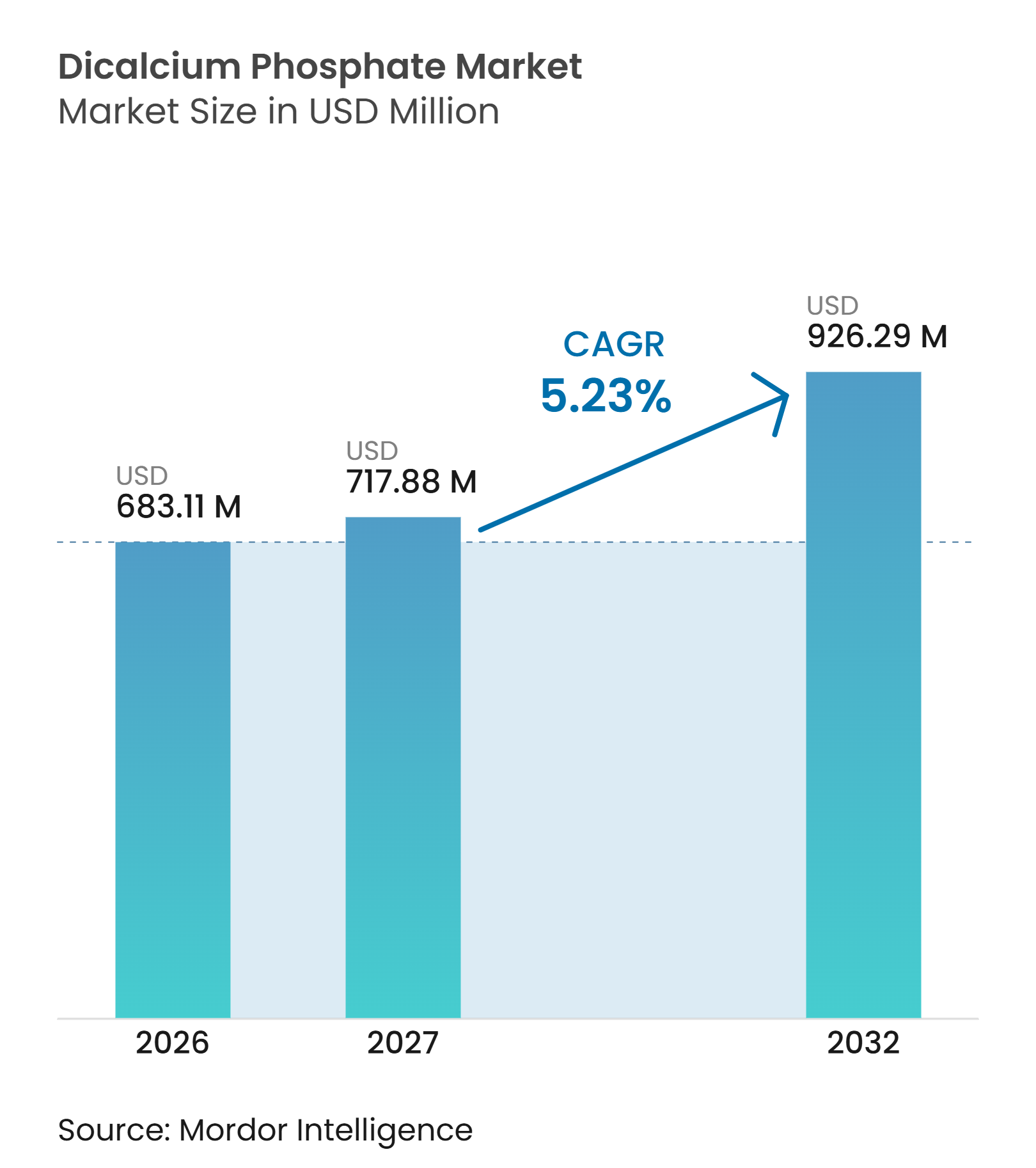
The Dicalcium Phosphate Market size was valued at USD 683.11 million in 2026 and is estimated to grow from USD 717.88 million in 2027 to reach USD 926.29 million by 2032, at a CAGR of 5.23% during the forecast period (2027-2032). The dicalcium phosphate market is supported by demand from feed producers, food manufacturers, and tablet formulators, which gives suppliers several outlets for their output and leaves the dicalcium phosphate market less dependent on a single customer group. Feed applications continue to provide the largest demand base, while pharmaceutical and nutraceutical grades support higher unit values. The dicalcium phosphate market is also changing as sulfur costs raise the operating risk of phosphoric-acid production. This situation improves the case for hydrochloric-acid processing where producers can secure suitable acid supply. Certification requirements in major consuming areas raise sourcing standards and favor established suppliers with documented quality systems.
Key Report Takeaways
- By production method, the phosphoric acid process held 62.34% of the dicalcium phosphate market share in 2026, while the hydrochloric acid process is projected to advance at a 5.98% CAGR through 2032.
- By product form, powder held 58.11% of the dicalcium phosphate market share in 2026, while granules are projected to advance at a 6.07% CAGR through 2032.
- By end-use, animal feed held 45.07% of the dicalcium phosphate market share in 2026, while pharmaceuticals are projected to advance at a 6.33% CAGR through 2032.
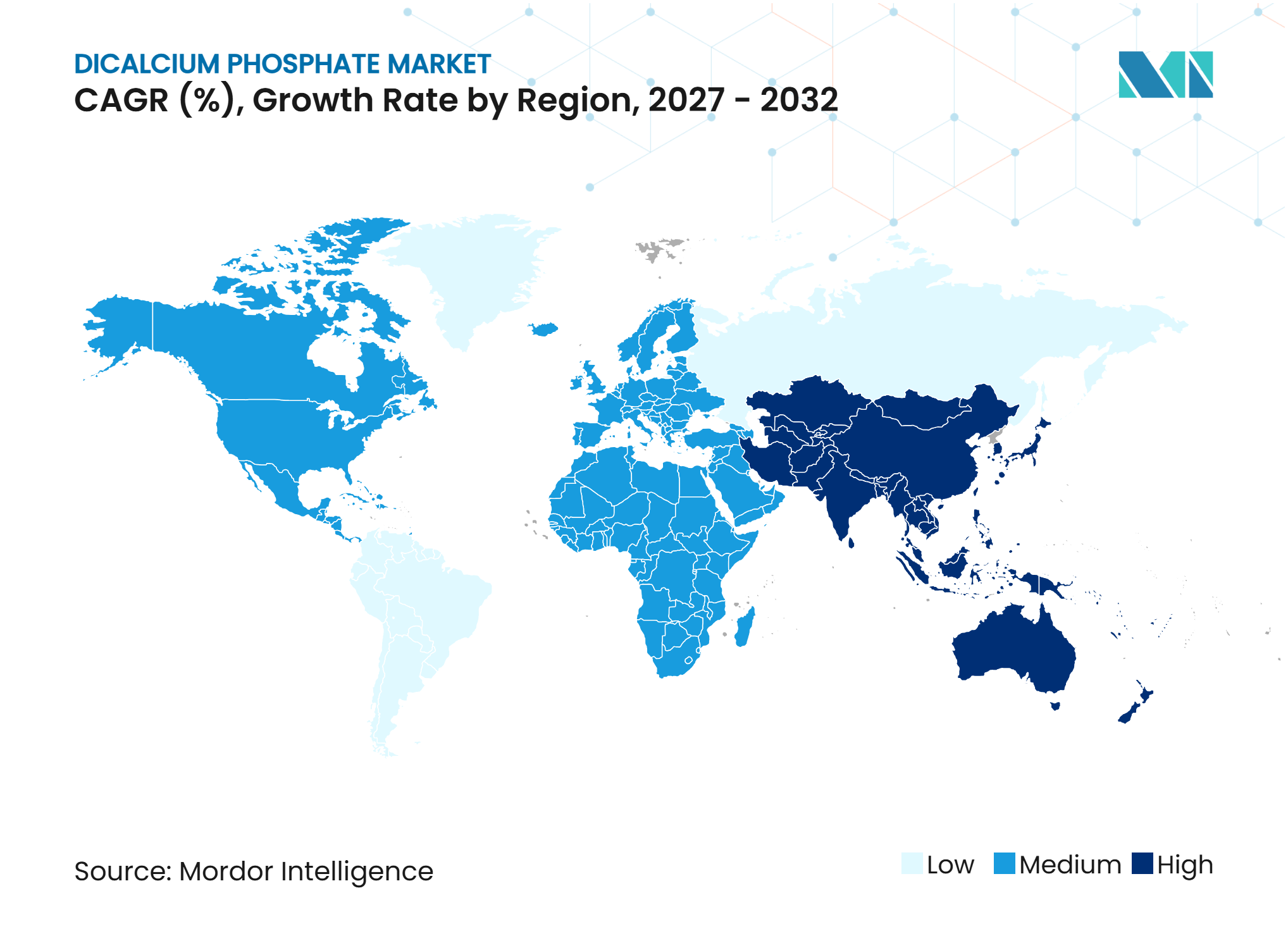
- By geography, Asia-Pacific held 40.45% of the dicalcium phosphate market share in 2026 and is projected to advance at a 6.15% CAGR through 2032.
Note: Market numbers in this report are based on Mordor Intelligence's proprietary estimation framework, which combines nine months of actuals with Q4 projections for base year 2026.
Market Trends and Insights
Drivers Impact Analysis of Dicalcium Phosphate Market*
| Driver | (~) % Impact on CAGR Forecast | Geographic Relevance | Impact Timeline |
|---|---|---|---|
| Expansion of Livestock, Poultry, Swine, Aquaculture, and Pet Nutrition | +2.1% | APAC core (China, India, ASEAN), spillover to MEA and South America | Long term (≥ 4 years) |
| Asia-Pacific Feed-Mill and Phosphate-Processing Capacity Expansion | +1.3% | China, India, Vietnam, Indonesia | Medium term (2-4 years) |
| Pharmaceutical and Nutraceutical Grade Demand | +0.9% | North America, Europe, East Asia | Medium term (2-4 years) |
| Growth in Food Fortification and Preventive Nutrition | +0.6% | Global, with early gains in India, Southeast Asia, Sub-Saharan Africa | Medium term (2-4 years) |
| HCl Route Economics Under Sulfur Price Volatility | +0.4% | China, Middle East, emerging producers in South Asia | Short term (≤ 2 years) |
| Source: Mordor Intelligence | |||
Expansion of Livestock, Poultry, Swine, Aquaculture, and Pet Nutrition
The dicalcium phosphate market benefits when compound feed production expands because dicalcium phosphate is a widely used source of phosphorus and calcium in mineral premixes. Intensive poultry, swine, and aquaculture systems need consistent nutrient inputs, which support recurring procurement rather than irregular purchases. Aquaculture diets require dependable phosphorus availability, particularly in high-density fish and shrimp operations, and this raises the importance of controlled feed-grade material. Pet nutrition is also moving toward more tightly specified formulations, especially in premium product lines. This shift can increase demand for suppliers that can document purity and particle characteristics. Feed capacity additions in major consuming regions show continuing investment in the downstream systems that consume feed phosphates, while larger operators increasingly seek stable mineral supply arrangements, predictable delivery schedules, and quality records that can be reviewed across more than one production location.
Growth in Food Fortification and Preventive Nutrition
Food manufacturers use calcium phosphate ingredients for nutritional and functional roles, creating an additional outlet beyond animal nutrition. Public-health fortification policies keep attention on nutrient gaps, although calcium phosphate use depends on each product formulation and national rules. The World Health Organization issued updated guidance on vitamin A and D fortification of edible oils and fats in 2025, reinforcing the wider policy focus on food fortification. In the United States, the Food and Drug Administration permitted calcium phosphate as a color additive under specified conditions in 2025[1]. Innophos subsequently introduced VersaCal Bright for applications that need a titanium dioxide alternative. These uses extend the dicalcium phosphate market into food applications where ingredient function and regulatory status both influence buying decisions, including the practical need to avoid reformulation delays and to maintain consistent appearance in finished products, giving the dicalcium phosphate market another route to value creation beyond conventional mineral supplementation.
Pharmaceutical and Nutraceutical Grade Demand
Pharmaceutical-grade dicalcium phosphate remains important in direct-compression tablets because it can function as a diluent and support reproducible production. Nutraceutical products broaden demand because they often use solid dosage formats but require different product positioning and supply support. Suppliers serving this tier must manage United States Pharmacopeia and National Formulary requirements, together with European Pharmacopoeia requirements where relevant. This is harder to achieve with a feed-grade line alone because the controls, documentation, and batch consistency requirements differ. Innophos highlighted its excipient portfolio at CPHI 2025, showing ongoing supplier focus on pharmaceutical and nutraceutical customers that need technically supported materials, specification continuity, and documentation that can be incorporated into formal product-development and quality processes. This part of the dicalcium phosphate market is shaped by qualification periods that can be longer than in commodity feed channels.
Asia-Pacific Feed-Mill and Phosphate-Processing Capacity Expansion
New feed-mill and phosphate-processing capacity can shorten delivery times for regional customers and reduce dependence on imports. China’s production base is especially important because domestic consumption and export activity both affect regional availability. Feed-grade dicalcium phosphate producers face rising documentation and technical requirements, which increase the need for consistent production controls. Larger facilities are better positioned to absorb the cost of testing and certification, which may make customer qualification more selective. This can improve supply reliability for buyers but creates a higher barrier for smaller producers. In India, Vietnam, and Indonesia, investment in animal-protein value chains is also creating a closer link between feed capacity and local phosphate demand, because feed producers usually need dependable mineral inputs before they can increase throughput or add new formulas, so regional capacity can influence the dicalcium phosphate market through both production and consumption.
Restraints Impact Analysis of Dicalcium Phosphate Market*
| Restraint | (~) % Impact on CAGR Forecast | Geographic Relevance | Impact Timeline |
|---|---|---|---|
| Phosphate Rock, Sulfur, and Calcium Feedstock Price Volatility | -1.2% | Global, most acute in North America, Europe, and Middle East | Short term (≤ 2 years) |
| EHS (Environmental, Health, and Safety) Burden of Phosphate Processing | -0.5% | North America, Europe, China (environmental inspection zones) | Long term (≥ 4 years) |
| Regulatory Compliance Cost for Feed, Food, and Pharmaceutical Grades | -0.3% | EU, North America, India, China | Medium term (2-4 years) |
| Source: Mordor Intelligence | |||
Phosphate Rock, Sulfur, and Calcium Feedstock Price Volatility
The dicalcium phosphate market faces cost pressure when phosphate rock, sulfur, and calcium inputs move sharply, while the dicalcium phosphate market also must preserve product availability for recurring customer contracts. The phosphoric-acid route is particularly exposed because sulfuric acid is a core input in conventional wet-acid processing. Stable phosphate-rock pricing does not fully protect producers when acid costs rise faster than finished-product prices. Calcium sources also add a separate exposure because lime and limestone production depend on energy-intensive kiln operations. Buyers with annual supply agreements can resist rapid price pass-through, which compresses producer margins during input shocks. Mosaic described the scale of its phosphate operations in its 2025 annual filing, showing why input conditions have broad consequences for integrated producers, their downstream customers, and the reliability of supply contracts that are negotiated before cost conditions change.
EHS (Environmental, Health, and Safety) Burden of Phosphate Processing
Phosphate processing can generate phosphogypsum and fluoride-bearing wastewater streams that require long-term management. These responsibilities add capital and operating costs beyond the immediate chemical conversion process. The U.S. Environmental Protection Agency modified its consent decree with J.R. Simplot Company in June 2025, setting measures related to liquid effluent routing and fluoride emissions at the Don Plant in Idaho[2]. Environmental inspections can also disrupt mine access, transport, and plant utilization when operators must address permit or monitoring issues. Smaller facilities may find it difficult to fund the required controls, which can reduce the number of qualified producers. The dicalcium phosphate market must therefore balance lower unit costs against compliance systems that protect operating continuity, preserve permits, reduce operational disruption, and give customers confidence that deliveries can continue through tighter enforcement cycles.
*Our forecasts treat driver/restraint impacts as directional, not additive. The impact forecasts reflect baseline growth, mix effects, and variable interactions.
Dicalcium Phosphate Market Segment Analysis
By Production Method:
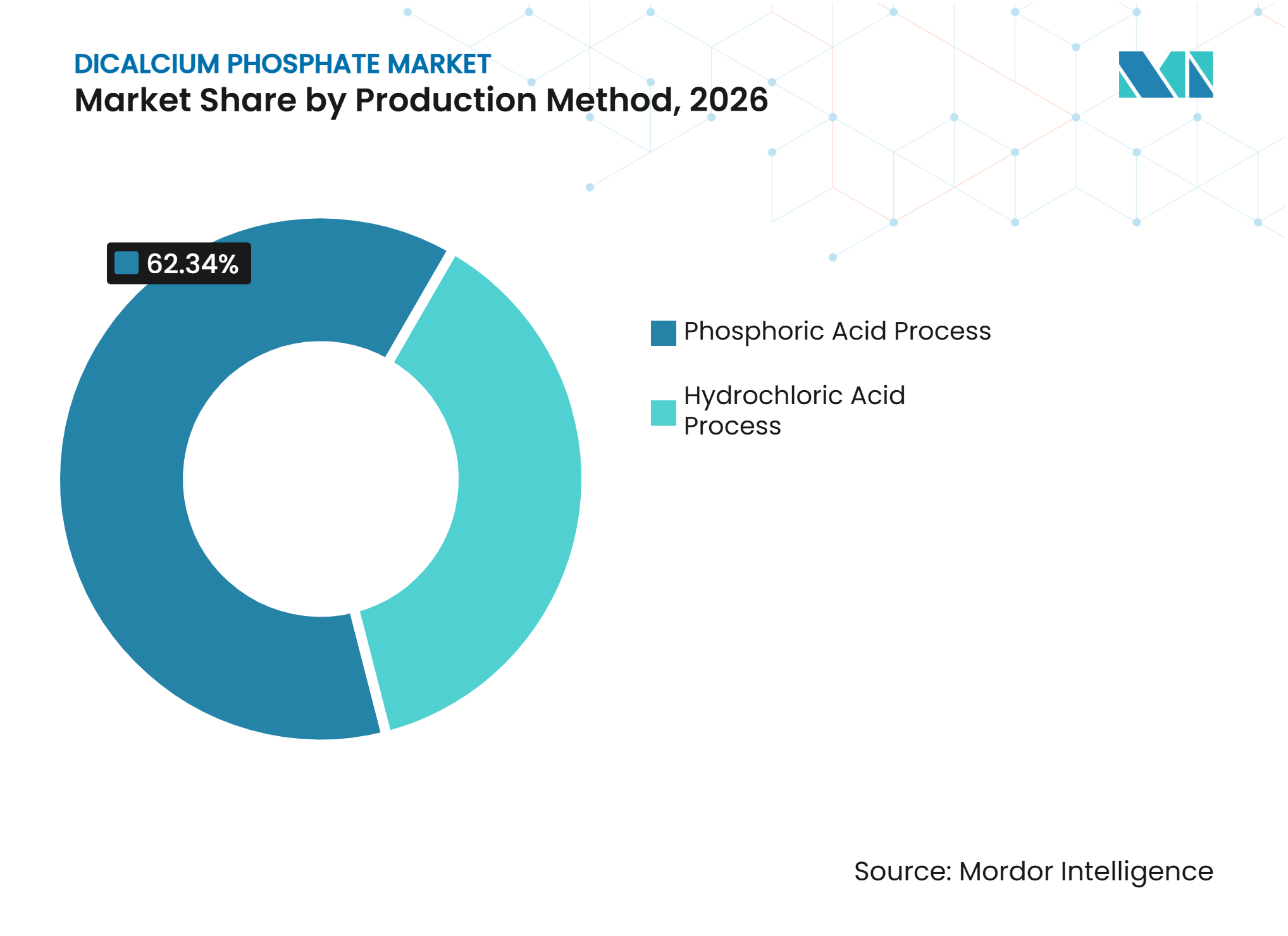
Phosphoric Acid Process Leads, While Hydrochloric Acid Processing Gains RelevanceThe phosphoric acid process held 62.34% of the market share in 2026. Its position reflects long-standing investment in wet-acid lines designed for high-volume feed-grade production. Large phosphate reserves and established sulfuric-acid infrastructure support this route in China, Morocco, and North America. The process fits supply chains that connect rock mining, acid production, and commodity feed phosphate. It remains familiar to plant operators and supports dependable large-volume output for customers whose procurement systems prioritize established chemistry, recurring availability, and predictable physical properties.
The hydrochloric acid process is projected to advance at a 5.98% CAGR through 2032. It offers a different production model because it can avoid direct sulfuric acid dependence and may recover calcium chloride in suitable markets. Its economic case is strongest where hydrochloric acid is available near chlor-alkali operations and where lower-grade ore can be processed effectively. Producers still need to manage chloride streams, water use, and local disposal rules. Dual-route capability gives producers a useful response when acid input prices diverge, making it a relevant sourcing consideration for customers that evaluate supply security alongside material quality, lead times, and the cost of qualifying an alternative producer.


By Product Form:
Powder Retains Broad Use, While Granules Fit Automated HandlingPowder held 58.11% of the market share in 2026. Its broad use is linked to its cost position and compatibility with established feed-mixing systems. Feed mills in developing regions often use equipment designed for powdered mineral ingredients. This reduces the need for immediate equipment upgrades and supports continued demand. Powder is also suitable for large-volume purchases where cost per metric ton has greater weight than handling convenience, particularly where feed mills already have storage, mixing, and dust-control arrangements designed for powder inputs.
Granules are projected to advance at a 6.07% CAGR through 2032. Their flowability and lower dust potential suit automated dosing systems used by larger feed compounding operations. Granular material can reduce bridging in conveying equipment and support more consistent metering. Prayon serves animal nutrition applications with phosphate products, while Innophos offers dicalcium phosphate excipients for direct-compression applications. The product choice will continue to depend on each customer’s equipment, labor practices, required grade, and the extent to which the operation values lower dust, dependable flow, and reduced manual intervention in the handling process. In this way, equipment modernization can affect the dicalcium phosphate market without changing the underlying need for mineral supplementation.
By End-Use:
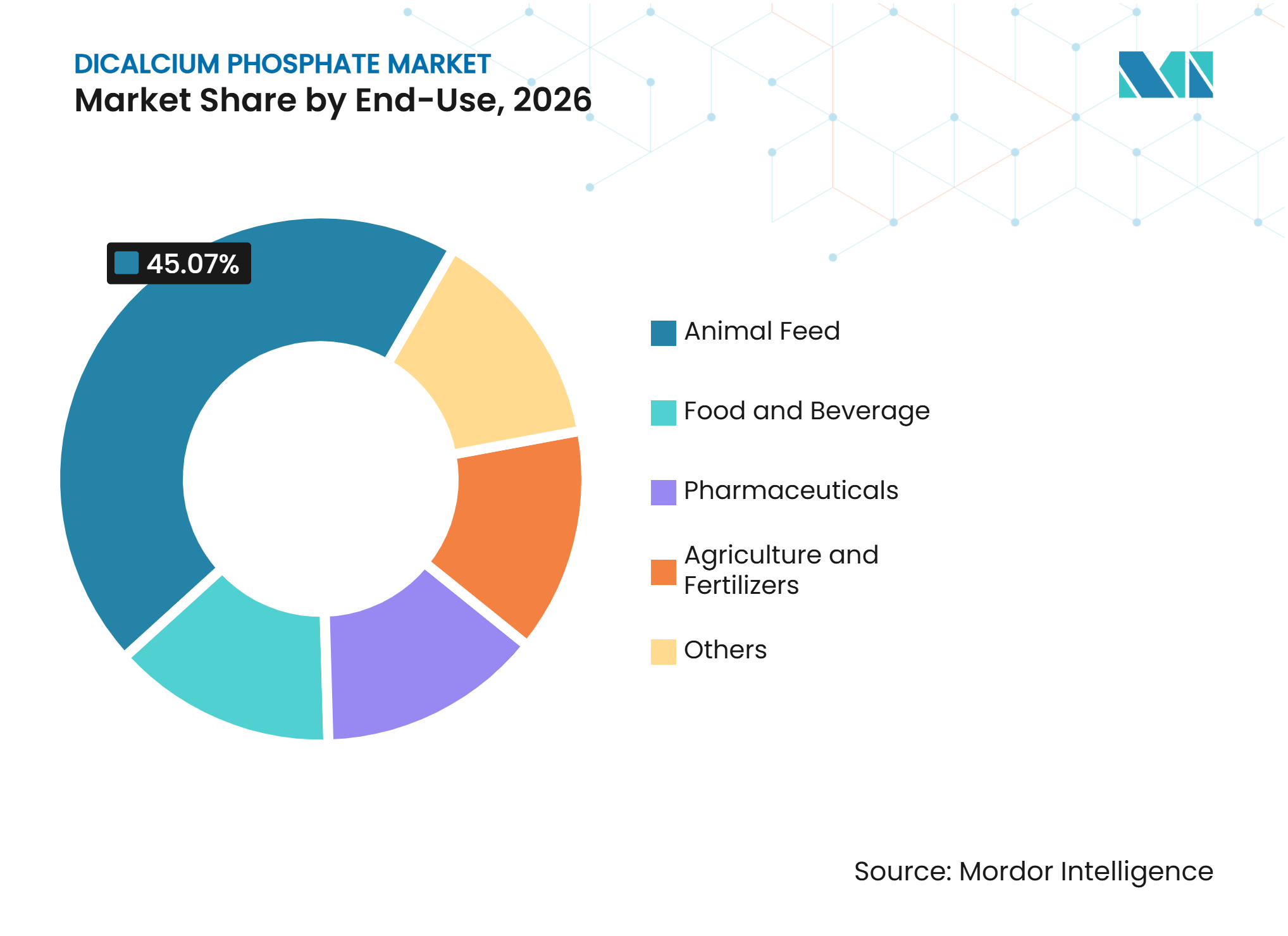
Animal Feed Provides Revenue, While Pharmaceuticals Support Higher ValueAnimal feed held 45.07% of the market share in 2026. Livestock, poultry, swine, and aquaculture operators use it to provide available phosphorus and calcium in formulated rations. Feed demand is closely tied to commercial animal production and the shift toward consistent compound-feed use. Producers serving this segment need reliable logistics, consistent mineral specifications, customer-approved quality records, and enough regional inventory to avoid interrupting feed formulations that are planned around established mineral inclusion rates.
Pharmaceuticals are projected to advance at a 6.33% CAGR through 2032. This application uses higher-purity material in direct-compression tablets and related dosage forms. Research on co-processed dicalcium phosphate and lipid excipients published in 2025 reported improved solubility, dissolution, and bioavailability in tablet formulations. Food and beverage, agriculture and fertilizers, and other industrial uses provide further demand outlets with their own purchasing and regulatory criteria, allowing suppliers with the right production controls to spread commercial exposure across customers with different ordering cycles and quality needs.


Geography Analysis
Asia-Pacific
Asia-Pacific held 40.45% of the market share in 2026 and is projected to advance at a 6.15% CAGR through 2032. China has a large production base, strong compound-feed demand, and an important role in regional phosphate trade. India, Vietnam, and Indonesia add demand through investment in livestock, aquaculture, and feed systems. Southeast Asian aquaculture and livestock value chains need mineral inputs that support consistent feed formulation. The Food and Agriculture Organization (FAO) identifies aquaculture as a central element of food production and nutrition systems worldwide, and its continued role in regional diets supports the need for reliable mineral inputs in fish and shrimp feed manufacturing.
North America
North America has integrated phosphate producers that supply feed, fertilizer, industrial, and specialty applications. Mosaic, Nutrien, and Simplot Company have operations and supply relationships that connect phosphate resources with downstream markets. Mosaic disclosed significant United States and Brazilian P2O5 capacity in its 2025 annual filing. Environmental compliance affects both existing plants and project planning, as demonstrated by the U.S. Environmental Protection Agency’s 2025 Simplot action. Pharmaceutical and specialty food demand gives the region outlets beyond bulk feed phosphate, which can help producers apply established phosphate-processing capabilities to customer groups that need tighter specifications, shorter approval cycles, and clearer documentation.
Europe, South America, and Middle East and Africa
Europe focuses more strongly on differentiated phosphate products because energy, labor, and compliance costs are high. South America has demand from animal protein production but can be exposed when local acid or phosphate output is interrupted. The Middle East and Africa combine phosphate-resource strength with downstream investment opportunities. Jordan Phosphate Mines Company and Indonesia agreed in 2025 to establish a phosphoric-acid plant in Surabaya, strengthening links between resource suppliers and Southeast Asian consumers. Compliance, shipping access, and acid supply will influence which locations capture further production investment, while producers will also assess local energy conditions, access to phosphate rock or intermediates, and proximity to customers that require feed, food, or specialty grades.
Competitive Landscape
Market Concentration
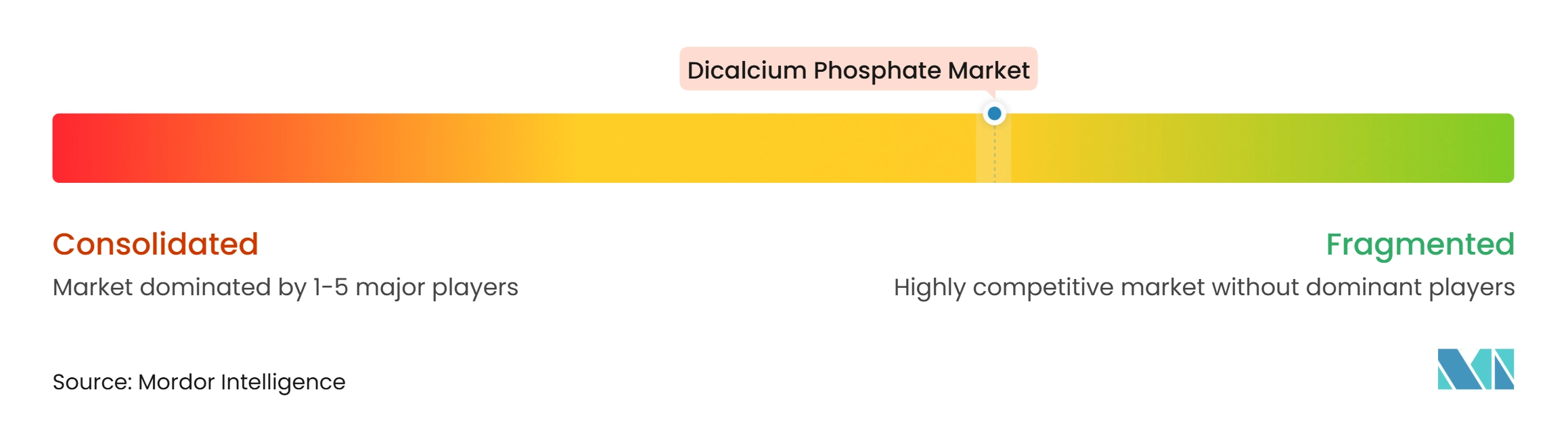
The dicalcium phosphate market is moderately concentrated, with top players including Nutrien, OCP Group, Innophos, ICL, and Prayon. These organizations have advantages in phosphate rock access, acid production, logistics, and customer qualification. Specialty suppliers such as Innophos and Prayon focus on food, pharmaceutical, and high-purity grades where documentation and process consistency carry more weight. Gujarat Narmada Valley Fertilizers & Chemicals Ltd. also participates in the broader Indian fertilizer and chemicals sector. Grade range, regulatory records, and regional delivery capability are central to customer selection, particularly where a buyer seeks one supplier that can meet feed-grade requirements while also supporting higher-purity product needs through separate controls.
Companies are responding through specialty expansion, capacity investment, and operational adjustment. Innophos introduced VersaCal Bright after the U.S. Food and Drug Administration action on calcium phosphate, expanding its addressable food application base. Prayon announced in 2025 that it would build an electronic-grade phosphoric-acid unit in Bex, Switzerland, designed to double production capacity. Simplot Company reorganized its structure in September 2025 to bring food, agriculture, and feed operating groups under centralized oversight, a move that aligns these activities more closely as the company manages related customer and supply-chain requirements.
The dicalcium phosphate market rewards producers that can manage multiple grades without disrupting quality control. Feed-grade supply relies on scale and competitive logistics, while food and pharmaceutical grades require controlled particle characteristics and formal compliance systems. FAMI-QS, the Feed Additives and Premixtures Quality System, supports feed supply-chain qualification in Europe. The U.S. Food and Drug Administration action and the European food-additives framework also affect product opportunities in food applications. Companies with separate lines or robust segregation practices can more credibly serve diverse customers, because they can limit cross-grade risk, manage different release standards, and offer more dependable quality records when customers conduct supplier reviews.
Dicalcium Phosphate Industry Leaders
-
Nutrien
-
OCP Group
-
Innophos
-
ICL
-
Prayon
- *Disclaimer: Major Players sorted in no particular order
Dicalcium Phosphate Market Companies Covered in this Report
- Anglo American plc
- EcoPhos Group
- EuroChem Group AG
- Gujarat Narmada Valley Fertilizers & Chemicals Ltd.
- ICL
- Innophos
- KEMAPCO
- Mosaic
- Nutrien
- OCP Group
- Prayon
- Simplot Company
- TIMAB Magnesium
- Vale S.A.
- Yara International ASA
Recent Industry Developments in Dicalcium Phosphate Market
- October 2026: Shivam Chemicals Limited commenced Phase I production of feed-grade dicalcium phosphate at its subsidiary’s manufacturing facility in Dahej, Gujarat, adding in-house production to its existing feed-phosphate distribution business. The development expanded domestic manufacturing capacity and strengthened the company's participation in India's animal nutrition and feed phosphate supply chain.
- October 2026: India's Department of Animal Husbandry and Dairying notified the Animal Feeds and Feed Ingredients (Quality Control) Order, 2026, bringing animal feed-grade dicalcium phosphate under compulsory Bureau of Indian Standards (BIS) certification in accordance with IS 5470. The requirement is scheduled to take effect for general enterprises from April 1, 2027, increasing quality-compliance requirements for domestic manufacturers and importers supplying the Indian dicalcium phosphate market.
Global Dicalcium Phosphate Market Report Scope
Dicalcium phosphate (DCP) is an inorganic calcium phosphate compound produced through the reaction of calcium-containing materials with phosphoric acid or other processing agents. It serves as a source of calcium and phosphorus and is valued for its nutritional and functional properties. It is widely used in animal feed, food formulations, pharmaceutical products, and agricultural applications.
The Dicalcium Phosphate Market is segmented by production method, product form, end-use, and geography. By production method, the market is segmented into phosphoric acid process and hydrochloric acid process. By product form, the market is segmented into powder and granules. By end-use, the market is segmented into animal feed, food and beverage, pharmaceuticals, agriculture and fertilizers, and others. The report also covers the market size and forecasts for dicalcium phosphate in 15 countries across major regions. For each segment, the market sizing and forecasts have been done on the basis of value (USD).
Segmentation Overview
| Phosphoric Acid Process |
| Hydrochloric Acid Process |
| Powder |
| Granules |
| Animal Feed |
| Food and Beverage |
| Pharmaceuticals |
| Agriculture and Fertilizers |
| Others |
| Asia-Pacific | China |
| India | |
| Japan | |
| South Korea | |
| ASEAN Countries | |
| Rest of Asia-Pacific | |
| North America | United States |
| Canada | |
| Mexico | |
| Europe | Germany |
| United Kingdom | |
| France | |
| Italy | |
| NORDIC Countries | |
| Rest of Europe | |
| South America | Brazil |
| Argentina | |
| Rest of South America | |
| Middle East and Africa | Saudi Arabia |
| South Africa | |
| Rest of Middle East and Africa |
| By Production Method | Phosphoric Acid Process | |
| Hydrochloric Acid Process | ||
| By Product Form | Powder | |
| Granules | ||
| By End-Use | Animal Feed | |
| Food and Beverage | ||
| Pharmaceuticals | ||
| Agriculture and Fertilizers | ||
| Others | ||
| By Geography | Asia-Pacific | China |
| India | ||
| Japan | ||
| South Korea | ||
| ASEAN Countries | ||
| Rest of Asia-Pacific | ||
| North America | United States | |
| Canada | ||
| Mexico | ||
| Europe | Germany | |
| United Kingdom | ||
| France | ||
| Italy | ||
| NORDIC Countries | ||
| Rest of Europe | ||
| South America | Brazil | |
| Argentina | ||
| Rest of South America | ||
| Middle East and Africa | Saudi Arabia | |
| South Africa | ||
| Rest of Middle East and Africa | ||
Key Questions Answered in the Report
What is the size of the dicalcium phosphate market?
The dicalcium phosphate market size was valued at USD 683.11 million in 2026 and is estimated to grow from USD 717.88 million in 2027 to reach USD 926.29 million by 2032, at a CAGR of 5.23% during the forecast period (2027-2032).
What is driving demand for dicalcium phosphate?
Demand is supported by compound animal feed, food applications, pharmaceutical tablets, and nutraceutical formulations.
Which production method held the largest share in 2026?
The phosphoric acid process held a 62.34% share in 2026.
Which form is projected to advance fastest through 2032?
Granules are projected to advance at a 6.07% CAGR through 2032 as automated feed operations value improved flow and reduced dust.