
DHA From Algae Market Size and Share
Market Overview
| Study Period | 2021 - 2032 |
|---|---|
| Market Size (2027) | USD 2.38 Billion |
| Market Size (2032) | USD 3.45 Billion |
| Growth Rate (2027 - 2032) | 7.75 % |
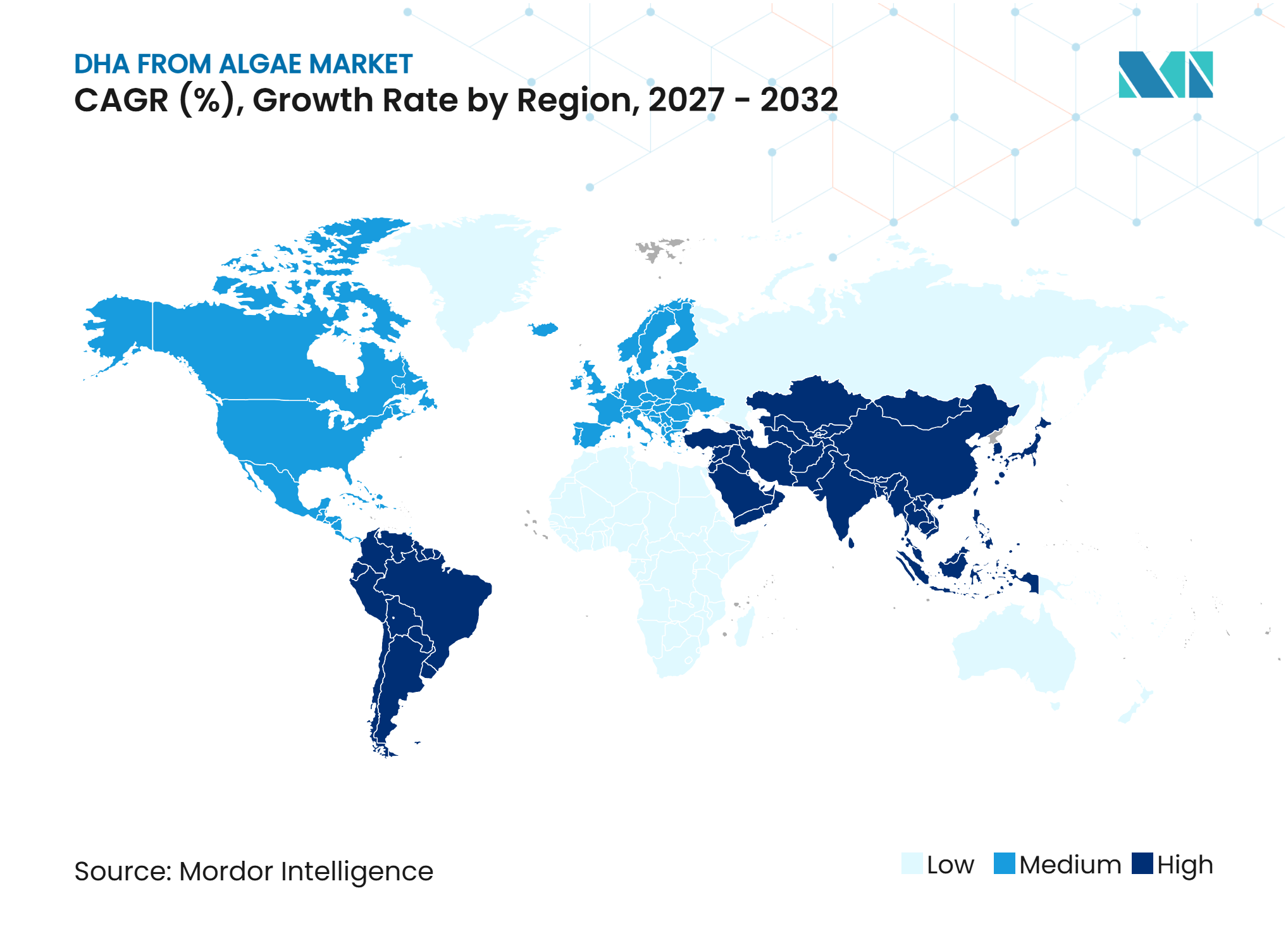
| Fastest Growing Market | Asia-Pacific |
| Largest Market | North America |
| Market Concentration | Medium |
Major Players *Disclaimer: Major Players sorted in no particular order Image © Mordor Intelligence. Reuse requires attribution under CC BY 4.0. | |
DHA From Algae Market Analysis by Mordor Intelligence
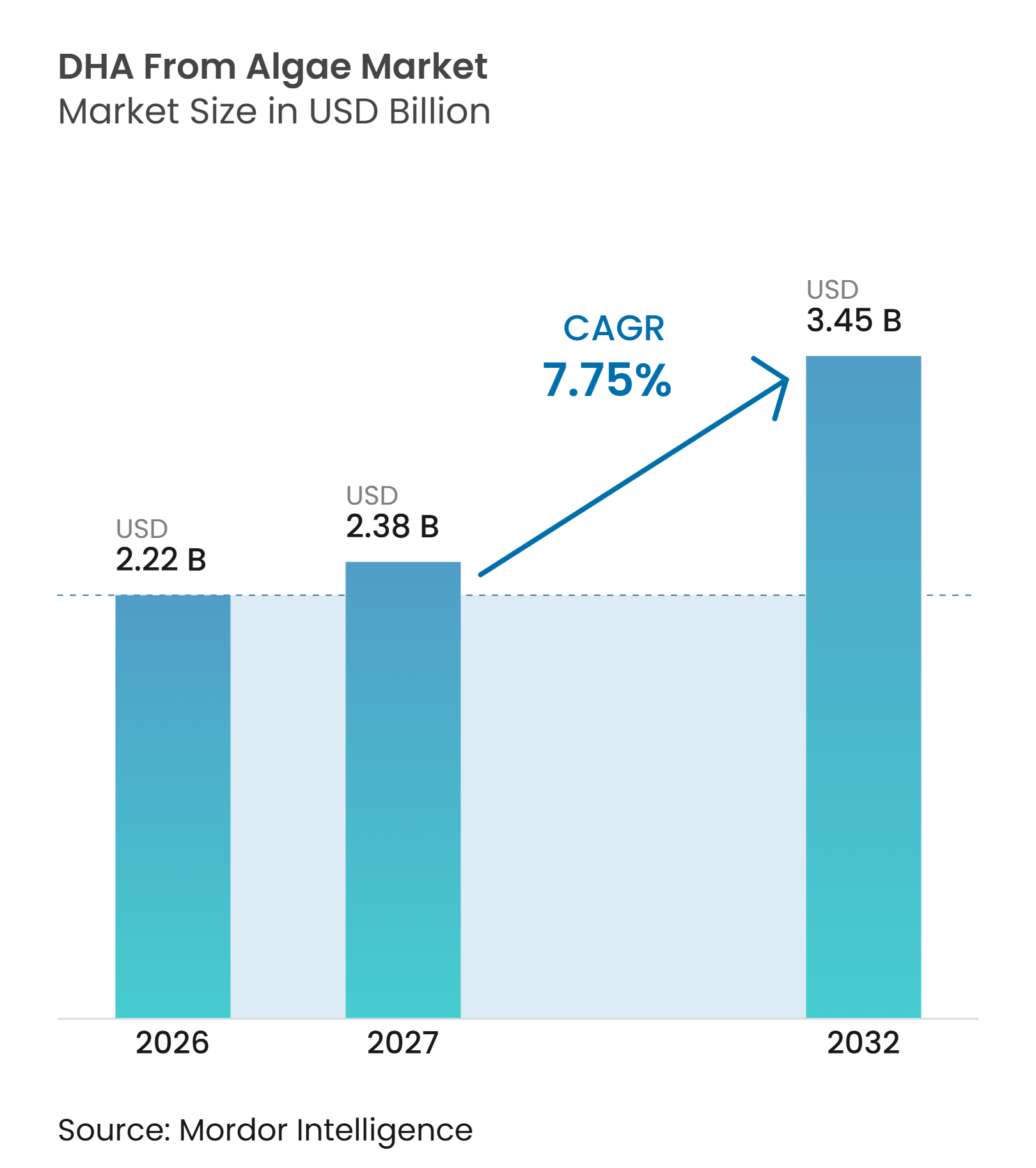
The DHA From Algae Market size is projected to expand from USD 2.22 billion in 2026 and USD 2.38 billion in 2027 to USD 3.45 billion by 2032, registering a CAGR of 7.75% between 2027 and 2032.
The category is moving beyond a simple substitute for fish oil because controlled fermentation offers nutrition brands a more predictable source of DHA. Supply concerns around marine oils have made traceability, stable production schedules, and non-fish positioning more important in customer qualification decisions. Algal fermentation also supports vegan and clean-label product positioning, which can matter in supplements, prenatal nutrition, and fortified foods. Technical progress in encapsulation and emulsions is widening the range of products that can include DHA without a strong marine taste. The DHA from algae market therefore depends on suppliers that can combine dependable fermentation, regulatory documentation, and application support.
Key Report Takeaways
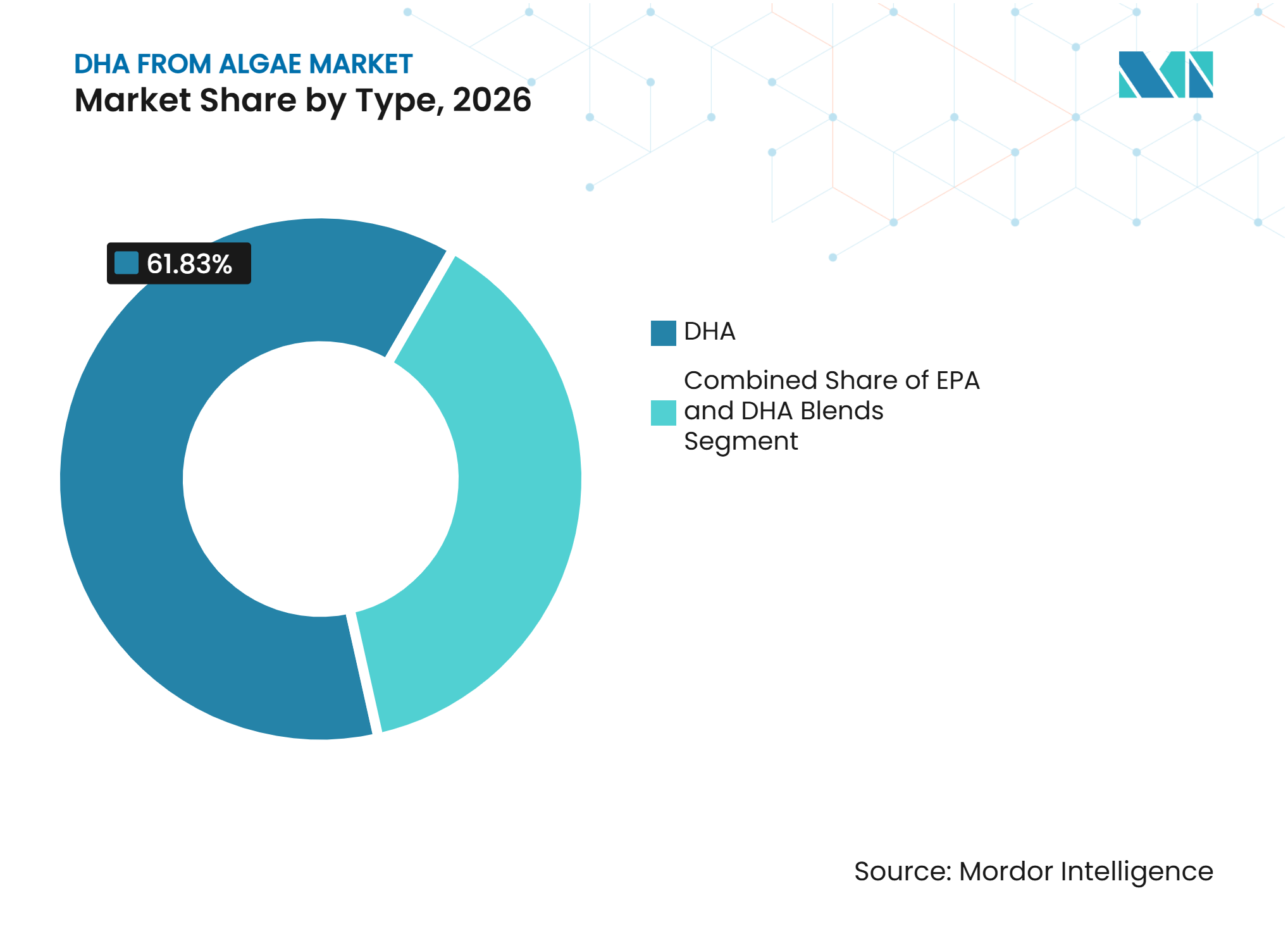
- By type, DHA held 61.83% of the DHA from algae market share in 2026, while EPA and DHA blends are projected to grow at an 8.37% CAGR through 2032.
- By form, oil accounted for 65.38% of the DHA from algae market size in 2026, while powder is forecast to expand at an 8.91% CAGR through 2032.
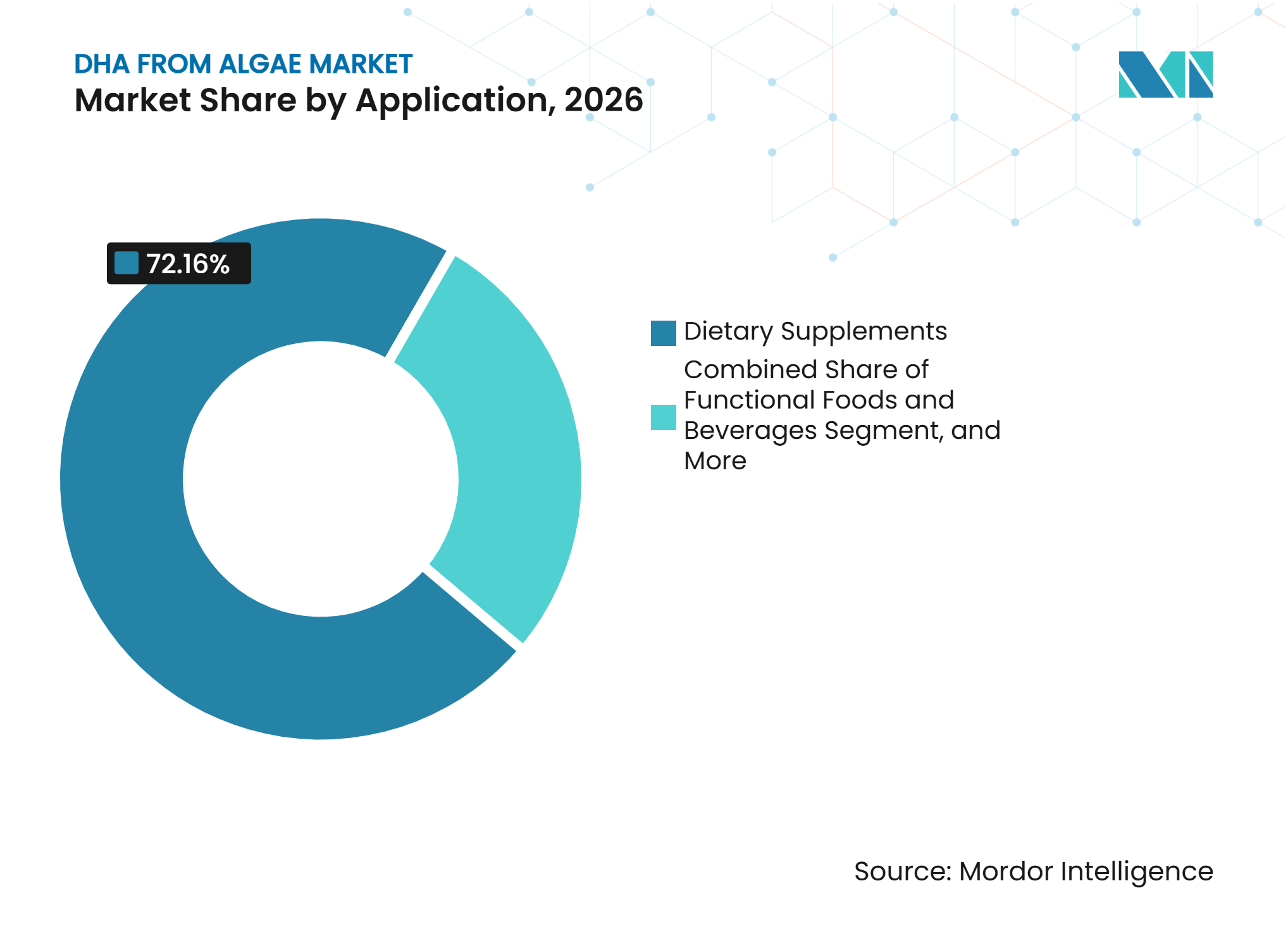
- By application, dietary supplements led with 72.16% revenue share in 2026, while functional foods and beverages are forecast to grow at a 9.02% CAGR through 2032.
- By end user, nutraceutical and supplement manufacturers held a 55.63% share in 2026, while food and beverage manufacturers are expected to record an 8.67% CAGR through 2032.
- By geography, North America held a 38.92% share in 2026, while Asia-Pacific is projected to grow at an 8.11% CAGR through 2032.
Note: Market size and forecast figures in this report are generated using Mordor Intelligence’s proprietary estimation framework, updated with the latest available data and insights as of January 2026.
Market Trends and Insights
Drivers Impact Analysis of DHA From Algae Market*
| Driver | (~) % Impact on CAGR Forecast | Geographic Relevance | Impact Timeline |
|---|---|---|---|
| Plant-Based and Fish-Independent Omega-3 Preference | +2.1% | Global, strongest in North America and Europe | Short term (≤ 2 years) |
| Infant-Formula DHA Standardization | +1.8% | Global, strongest regulatory influence in the EU, China, and India | Medium term (2-4 years) |
| Premiumization of Prenatal and Early-Life Nutrition | +1.4% | North America, Western Europe, and Australia | Medium term (2-4 years) |
| Algal DHA in Functional Foods and Beverages | +1.3% | Asia-Pacific, with spillover to North America and Europe | Medium term (2-4 years) |
| Circular Feedstocks and Fermentation Economics | +0.9% | Global, with early gains in Latin America and Southeast Asia | Long term (≥ 4 years) |
| Strain and Process Intensification for Higher DHA Potency | +0.8% | Global, with R&D concentration in Europe, the United States, and China | Long term (≥ 4 years) |
| Source: Mordor Intelligence | |||
Plant-Based and Fish-Independent Omega-3 Preference
Demand for vegan, traceable, and contaminant-conscious omega-3 products is changing how brands select DHA ingredients. Algal oil avoids the fish-based supply chain because fish obtain DHA and EPA through algae in the marine food web. This gives formulators a land-based ingredient that can support vegan certification and clean-label product design. Rohto F Okinawa launched a 100% algae-derived DHA and EPA supplement in Japan in September 2025, emphasizing the absence of fishy odor and its fish-free origin. The launch shows that sensory attributes and source transparency can influence consumer choices alongside nutrition claims. The DHA from algae market benefits when brands position algae-derived oil as a distinct ingredient rather than a direct copy of fish oil.
Infant-Formula DHA Standardization
DHA requirements in infant and follow-on formula provide a stable source of demand because procurement is linked to product compliance. The U.S. Food and Drug Administration requested information in 2025 on infant-formula nutrient requirements, including whether DHA should be considered under 21 CFR 107.100.[1] The European Food Safety Authority concluded in 2025 that oil from Schizochytrium limacinum strain ATCC-20889 was safe for use in infant and follow-on formula under the assessed conditions. Such reviews require clear strain identification, manufacturing controls, and safety evidence. These requirements make approval records valuable commercial assets for suppliers serving formula customers. They also lengthen entry timelines for newer producers in the DHA from algae market.
Premiumization of Prenatal and Early-Life Nutrition
Prenatal and early-life nutrition products place a high value on ingredient purity, dose consistency, and evidence packages. These attributes support the use of algae-derived DHA in premium formulations even where conventional oils remain less expensive. Formula and maternal-nutrition buyers also tend to require extensive documentation before changing an ingredient supplier. The resulting qualification process can favor established producers with validated manufacturing systems. Suppliers can use controlled fermentation to support traceability discussions with prenatal brands and their contract manufacturers. In the DHA from algae market, this channel can protect revenue quality because purchasing decisions are driven by compliance and performance, not only input cost.
Mainstreaming of Algal DHA in Functional Foods and Beverages
Functional foods and beverages are projected to be the fastest-growing application, with a 9.0% CAGR through 2032. Their growth depends on formulation systems that control oxidation and reduce unwanted flavor in water-based products. Research published in 2026 reported high encapsulation efficiency in a chitosan nanoemulsion system for microalgal DHA.[2] These systems can support use in plant-based drinks, gummies, fortified dairy products, and ready-to-drink nutrition formats. DSM-Firmenich introduced a microencapsulated omega-3 powder that delivers up to 500 mg of omega-3s in a two-piece gummy format. Better sensory performance gives food brands more practical reasons to consider the DHA from algae market.
Restraints Impact Analysis of DHA From Algae Market*
| Restraint | (~) % Impact on CAGR Forecast | Geographic Relevance | Impact Timeline |
|---|---|---|---|
| Fermentation Cost Premium Versus Fish Oil | -0.6% | Global, most acute for price-sensitive Asia-Pacific and Middle East and Africa buyers | Medium term (2-4 years) |
| Feedstock and Utility Cost Volatility | -0.5% | Global, strongest where producers depend on glucose or industrial sugars | Long term (≥ 4 years) |
| Proprietary Strain and Process IP Concentration | -0.4% | Global, restricting entry and expansion in Europe and North America | Long term (≥ 4 years) |
| Oxidation, Sensory and Shelf-Life Management | -0.3% | Global, particularly in emerging food and beverage applications | Short term (≤ 2 years) |
| Source: Mordor Intelligence | |||
Fermentation Cost Premium Versus Fish Oil
Fermentation costs remain a constraint where algae-derived DHA competes with lower-priced marine oils. Glucose can represent more than 60% of fermentation-media cost, creating pressure when commodity sugar prices or energy costs rise. A 2025 scientific review identified circular feedstocks, including agricultural and industrial co-products, as a route to lower carbon-source costs in microbial DHA production. These inputs still require producers to demonstrate reliable yields and consistent quality. Regulated food uses can require additional documentation when processes or inputs change. Cost improvement will be particularly important if the DHA from algae market expands into high-volume, price-sensitive applications.
Oxidation, Sensory and Shelf-Life Management
DHA is highly susceptible to oxidation because its molecular structure contains 6 double bonds. A 2025 study found that oxidation behavior differs between DHA-rich algal oil and its oil-in-water emulsion, which is relevant to beverage applications.[3] Product developers must therefore manage emulsifiers, encapsulation materials, processing temperatures, and antioxidant systems. Infant-formula and clinical-nutrition customers also use strict quality specifications and long validation cycles. Batch inconsistency can delay qualification or risk loss of a supply contract. These technical demands favor firms with strong application laboratories and experience serving the DHA from algae market.
*Our forecasts treat driver/restraint impacts as directional, not additive. The impact forecasts reflect baseline growth, mix effects, and variable interactions.
DHA From Algae Market Segment Analysis
By Type:
Pure DHA Anchors Demand While Blends ExpandPure DHA held 61.83% of the DHA from algae market share in 2026. Its position reflects long-standing use in infant formula and nutrition products where DHA is the central omega-3 ingredient. Regulatory and clinical familiarity gives pure DHA a strong base in high-volume formula applications. EPA remains relevant in products that emphasize cardiovascular nutrition, inflammation support, or a broader fatty-acid profile. Product teams often select the ingredient type according to the intended health proposition and delivery format. This makes pure DHA particularly important where clear specifications and low formulation complexity are required.
EPA and DHA blends are forecast to grow at an 8.37% CAGR through 2032. Fermentalg launched Omega ΩRIGINS in May 2026 with 4 EPA-to-DHA ratios, including a 2:1 blend, for sports nutrition and longevity applications. DSM-Firmenich also markets life’s Omega O3020 with a 1.5:1 EPA-to-DHA ratio and positions it as a high-potency alternative to standard fish oil. Defined-ratio products give brands a way to differentiate offerings for active aging, cognitive health, and sports nutrition. The DHA from algae industry is therefore seeing demand for blends where product positioning requires more than a single fatty acid.



By Form:
Oil Retains Scale While Powder Opens New FormatsOil commanded 65.38% of the DHA from algae market size in 2026. It is the starting material for several downstream formats and is used directly in liquid nutrition products and infant formula. Oil also supports a broad range of concentration and blending choices for ingredient suppliers. Softgels and capsules remain familiar delivery forms for adult dietary supplements. Emulsions and microencapsulated ingredients serve more specialized uses where dispersion, taste, or dosage precision is important. Oil retains a practical advantage because it fits established processing and supply-chain systems.
Powder is projected to grow at an 8.91% CAGR through 2032. Microencapsulation enables DHA use in dry mixes, gummies, powdered beverages, and food products that cannot accommodate liquid oil. The approach can also protect the ingredient during processing and storage when the wall system is selected carefully. DSM-Firmenich’s powder development for gummy applications illustrates how suppliers are using encapsulation to extend omega-3 delivery beyond softgels. Powder suppliers still need to prove oxidation stability, dispersibility, and acceptable taste in the final product. These requirements make technical service a meaningful differentiator in the DHA from algae market.
By Application:
Supplements Lead While Foods and Beverages AccelerateDietary supplements accounted for 72.16% of the DHA from algae market share in 2026. This application benefits from established consumer understanding of omega-3 products and familiar softgel formats. Algae-derived ingredients give supplement brands a vegan option for consumers who avoid fish or seek a fish-free source. The segment also gives brands room to use purity, traceability, and sustainability messages in product communication. Infant formula forms another important application because its DHA demand is more closely linked to compliance than discretionary spending. Pharmaceutical and clinical-nutrition uses are smaller but require detailed specifications and quality documentation.
Functional foods and beverages are expected to expand at a 9.02% CAGR through 2032. The segment includes fortified plant-based milks, protein drinks, gummies, dairy products, and other nutrition-focused foods. Nanoemulsion and Pickering emulsion approaches can improve the stability of DHA in aqueous systems. Better stability gives food companies a route to add DHA while limiting the flavor issues associated with marine oils. The DHA from algae market can gain from this shift because land-based fermentation aligns with plant-forward product positioning. Suppliers must still demonstrate that the ingredient performs consistently in each food matrix.

By End User:
Supplement Producers Provide the Base While Food Makers GrowNutraceutical and supplement manufacturers held 55.63% of the DHA from algae market share in 2026. These firms were early users of algae-derived omega-3s because they can sell premium, vegan products through established supplement channels. Their products often use clear source claims and convenient dosage forms to support retail differentiation. Maternal and infant-nutrition manufacturers form another important end-user group. Their buying decisions focus on approval status, safety data, and reliable supply rather than on short-term price movements. Pharmaceutical and clinical-nutrition companies require similarly detailed quality records for lower-volume, high-specification uses.
Food and beverage manufacturers are forecast to grow at an 8.67% CAGR through 2032. They are adopting algal DHA as formulation systems make it more feasible to use omega-3s in mainstream food formats. Corbion reported organic sales growth in food and pet nutrition during the first half of 2026 and identified adoption of AlgaPrime products among the relevant applications. These customers often need assistance with flavor, stability, and processing conditions before launch. The DHA from algae market will benefit when ingredient producers can move from bulk oil supply into collaborative application development. This end-user shift can expand demand beyond conventional supplement buyers.
Geography Analysis
North America
North America held 38.92% of the DHA from algae market share in 2026. The region benefits from mature supplement retail channels, active nutrition-product development, and a strong base of ingredient and contract manufacturers. The United States is the largest contributor because it has a broad supplement ecosystem and an established regulatory pathway for nutrition ingredients. The Food and Drug Administration’s 2025 request for information on infant-formula nutrient requirements shows that DHA remains part of an active policy discussion. This regulatory attention can increase the value of suppliers that maintain strong safety and documentation packages. Regional brands are also using vegan, clean-label, and fish-free claims to distinguish premium omega-3 products. The DHA from algae market size in North America is supported by the region’s ability to move new nutrition concepts from ingredient trials into consumer products.
Asia-Pacific
Asia-Pacific is projected to record an 8.11% CAGR through 2032. The region combines great infant-nutrition demand with strong interest in fortified foods and growing domestic fermentation capability. China is central to this activity because it is both a production base and a large market for human and animal nutrition ingredients. Corbion secured Chinese regulatory approvals for AlgaPrime DHA and AlgaVia DHA in July 2025. Sumitomo Corporation also signed an exclusive Japanese distribution agreement with Huvepharma for algae-derived DHA in January 2025. These moves show that local approvals and distribution partnerships are important routes to market. The DHA from algae market share is likely to shift toward suppliers that can pair competitive production with in-country commercial access.
Europe, Middle East and Africa, and South America
Europe remains an important consumption region because novel-food review and food-safety requirements can create a clear compliance framework for qualified suppliers. The European Food Safety Authority’s 2025 safety opinion on Schizochytrium limacinum oil supports use in infant and follow-on formula under specified conditions. European customers often place considerable weight on traceability, lifecycle documentation, and product claims. Corbion published an updated lifecycle assessment in 2026 for its algae-derived omega-3 DHA portfolio, reporting lower climate-change impact and water use than its 2021 benchmark. Middle East and Africa and South America are smaller demand areas, but they offer room for supplement adoption as distribution and nutrition awareness improve. Brazil has strategic relevance as the location of Corbion’s sugarcane-integrated algae fermentation facility. The DHA from algae market can grow in these mixed regions when suppliers align cost, import access, and compliance factors with local product needs.
Competitive Landscape
Market Concentration

The DHA from algae market is moderately consolidated in premium human nutrition. DSM-Firmenich, Corbion, and Fermentalg have visible positions based on approvals, fermentation capability, and customer access. Their advantage rests on the integration of strain knowledge, controlled production, and application support. Corbion announced a U.S. patent in April 2026 for a lysed algal cell suspension in oil with a DHA-rich omega-3 profile. DSM-Firmenich also reported its successful 2025 patent-infringement case against Mara Renewables in the United Kingdom. These actions show that proprietary production and extraction methods are important competitive assets.
Technology is a major route to additional share. Suppliers are developing microencapsulated powders, emulsions, and oils tailored to food, infant nutrition, supplements, pet food, and aquaculture uses. DSM-Firmenich launched Veramaris O3 Max Pure in April 2026 as a microalgal oil with a 3:2 EPA-to-DHA ratio for pet nutrition applications. Fermentalg launched Omega ΩRIGINS in May 2026 using patented Schizochytrium limacinum fermentation and 4 EPA-to-DHA ratios. These products address different formulation needs without relying on a single generic oil. The DHA from algae industry rewards companies that can show both technical performance and a clear use case.
Cost and capacity are becoming more significant competitive factors. Larger fermentation facilities can lower unit costs, although only validated quality systems can serve tightly regulated nutrition uses. Circular feedstocks may improve economics while also helping suppliers address customer expectations on sourcing and environmental reporting. Corbion’s 2026 lifecycle update linked its algae-derived portfolio to measured improvements in climate and water indicators. New entrants may find opportunities in animal nutrition and food applications where customer qualification can differ from infant formula. The DHA from algae market remains difficult for smaller firms when they lack protected processes, sufficient validation data, or customer-support resources. Competition is therefore likely to remain divided between differentiated premium suppliers and producers competing on volume and cost.
DHA From Algae Industry Leaders
-
BASF SE
-
Cargill, Incorporated
-
Lonza Group Ltd.
-
dsm-firmenich
-
Qualitas Health
- *Disclaimer: Major Players sorted in no particular order
DHA From Algae Market Companies Covered in this Report
- Algarithm Ingredients
- Algatechnologies Ltd.
- AlgaeCytes Ltd.
- Archer Daniels Midland Company
- BASF
- Cargill
- Corbion N.V.
- Cellana, Inc.
- Cabio Bioengineering (Wuhan) Co., Ltd.
- dsm-firmenich
- Far East Microalgae Industries
- Fermentalg SA
- Huison Biotech
- JC Biotech Pvt. Ltd.
- KD Pharma Group
- Kingdomway Group
- Lonza Group Ltd.
- Mara Renewables Corporation
- Nordic Naturals
- Polaris Nutritional Lipids
- Qualitas Health
- Shaanxi Sciphar Biotechnology
- Sophie’s Bionutrients
- Veramaris V.O.F.
Recent Industry Developments in DHA From Algae Market
- May 2026: Fermentalg launched Omega ΩRIGINS, a high-potency algal omega-3 oil from a patented Schizochytrium limacinum fermentation, available in 4 EPA: DHA ratios, including a 2:1 flagship blend targeting sports nutrition and longevity applications in multiple delivery formats.
- April 2026: Corbion announced a US patent covering the liquid suspension design of lysed algal cells in oil with a DHA-rich omega-3 profile used in its AlgaPrime DHA LS product for aquaculture, animal nutrition, and pet food.
- April 2026: dsm-firmenich unveiled Veramaris O3 Max Pure at Petfood Forum 2026, a microalgal oil delivering a 3:2 EPA: DHA ratio, produced through closed-system fermentation as a vegan, non-GMO fish oil replacement for pet nutrition formulators.
- November 2025: Corbion launched its BRIGHT 2030 strategy, identifying further algal fermentation activity in pet food and human nutrition as a strategic priority.
Global DHA From Algae Market Report Scope
The DHA from Algae Market refers to the global industry involved in the production, distribution, and commercialization of docosahexaenoic acid (DHA) derived from algal sources, primarily microalgae. DHA is a long-chain omega-3 fatty acid that plays a critical role in brain development, cognitive function, eye health, cardiovascular health, and overall wellness. Algae-based DHA serves as a sustainable, vegetarian, and vegan alternative to fish-derived omega-3 oils, offering a direct source of DHA without reliance on marine fisheries.
The DHA From Algae Market is segmented by type into DHA, EPA, and EPA & DHA blends. Based on form, the market is categorized into oil, powder, softgel and capsule, and emulsion and microencapsulated powder. By application, the market is segmented into infant formula, dietary supplements, functional foods and beverages, pharmaceuticals and clinical nutrition, animal feed and aquaculture, and cosmetics and personal care.
Based on end user, the market is segmented into infant and maternal nutrition manufacturers, nutraceutical and supplement manufacturers, food and beverage manufacturers, pharmaceutical and clinical-nutrition companies, and other end users. Geographically, the market is analyzed across North America (United States, Canada, Mexico), Europe (Germany, United Kingdom, France, Italy, Spain, and Rest of Europe), Asia-Pacific (China, Japan, India, Australia, South Korea, and Rest of Asia-Pacific), Middle East & Africa (GCC, South Africa, and Rest of Middle East & Africa), and South America (Brazil, Argentina, and Rest of South America).
Segmentation Overview
| DHA |
| EPA |
| EPA and DHA Blends |
| Oil |
| Powder |
| Softgel and Capsule |
| Emulsion and Microencapsulated Powder |
| Infant Formula |
| Dietary Supplements |
| Functional Foods and Beverages |
| Pharmaceuticals and Clinical Nutrition |
| Animal Feed and Aquaculture |
| Cosmetics and Personal Care |
| Infant and Maternal Nutrition Manufacturers |
| Nutraceutical and Supplement Manufacturers |
| Food and Beverage Manufacturers |
| Pharmaceutical and Clinical-Nutrition Companies |
| Other End Users |
| North America | United States |
| Canada | |
| Mexico | |
| Europe | Germany |
| United Kingdom | |
| France | |
| Italy | |
| Spain | |
| Rest of Europe | |
| Asia-Pacific | China |
| Japan | |
| India | |
| Australia | |
| South Korea | |
| Rest of Asia-Pacific | |
| Middle East & Africa | GCC |
| South Africa | |
| Rest of Middle East & Africa | |
| South America | Brazil |
| Argentina | |
| Rest of South America |
| By Type | DHA | |
| EPA | ||
| EPA and DHA Blends | ||
| By Form | Oil | |
| Powder | ||
| Softgel and Capsule | ||
| Emulsion and Microencapsulated Powder | ||
| By Application | Infant Formula | |
| Dietary Supplements | ||
| Functional Foods and Beverages | ||
| Pharmaceuticals and Clinical Nutrition | ||
| Animal Feed and Aquaculture | ||
| Cosmetics and Personal Care | ||
| By End User | Infant and Maternal Nutrition Manufacturers | |
| Nutraceutical and Supplement Manufacturers | ||
| Food and Beverage Manufacturers | ||
| Pharmaceutical and Clinical-Nutrition Companies | ||
| Other End Users | ||
| By Geography | North America | United States |
| Canada | ||
| Mexico | ||
| Europe | Germany | |
| United Kingdom | ||
| France | ||
| Italy | ||
| Spain | ||
| Rest of Europe | ||
| Asia-Pacific | China | |
| Japan | ||
| India | ||
| Australia | ||
| South Korea | ||
| Rest of Asia-Pacific | ||
| Middle East & Africa | GCC | |
| South Africa | ||
| Rest of Middle East & Africa | ||
| South America | Brazil | |
| Argentina | ||
| Rest of South America | ||
Key Questions Answered in the Report
What is driving demand for DHA from algae?
Demand is supported by fish-free positioning, controlled fermentation, infant-formula requirements, and use in food and beverage products. Controlled production can provide brands with a more predictable ingredient source than marine supply chains. Vegan certification, source traceability, and the absence of fishy odor can help a finished product stand apart in premium supplement channels. Product developers also see more opportunity as encapsulation and emulsion systems improve. These technical advances make it more practical to use DHA in gummies, powdered products, drinks, and fortified foods.
How large is the DHA from algae sector?
It is projected to grow from USD 2.22 billion in 2026 to USD 3.45 billion by 2032, at a 7.75% CAGR from 2027 to 2032. The forecast reflects demand from established supplement uses and regulated infant nutrition, together with newer food and beverage applications.
Which DHA from algae product type leads sales?
Pure DHA leads with a 61.83% share in 2026, while EPA and DHA blends are forecast to grow at an 8.37% CAGR through 2032. Pure DHA benefits from established use in formula and other nutrition products that need a focused DHA specification. Blends give brands a way to formulate broader omega-3 products for active aging, sports nutrition, and cognitive-health positioning. Producers are responding with products that provide defined EPA-to-DHA ratios rather than a single standard composition.
Why is DHA powder gaining attention?
Powder is forecast to expand at an 8.91% CAGR as encapsulation supports gummies, dry mixes, and fortified food applications. This form gives manufacturers more ways to use DHA where a liquid oil would be difficult to process or would affect texture. The encapsulation system must protect the ingredient during manufacturing and storage. Suppliers also need to demonstrate dispersibility, stability, and acceptable sensory performance in the final product. Those requirements explain why formulation expertise can matter as much as basic ingredient supply.
Which region is expanding fastest for algae-derived DHA?
Asia-Pacific is projected to grow at an 8.11% CAGR through 2032, supported by product approvals, distribution partnerships, and food and nutrition demand. China remains important as both a manufacturing center and a major destination for human and animal nutrition ingredients. Japan is also relevant because distribution partnerships are improving access to algae-derived DHA for supplement and infant-nutrition customers. Companies seeking growth in the region need local approvals, established commercial partners, and products suited to regional nutrition applications.