
Defect Detection Software Market Size and Share
Market Overview
| Study Period | 2020 - 2031 |
|---|---|
| Market Size (2026) | USD 1.17 Billion |
| Market Size (2031) | USD 2.05 Billion |
| Growth Rate (2026 - 2031) | 11.87 % |
| Fastest Growing Market | Asia-Pacific |
| Largest Market | Asia-Pacific |
| Market Concentration | Medium |
Major Players *Disclaimer: Major Players sorted in no particular order Image © Mordor Intelligence. Reuse requires attribution under CC BY 4.0. | |
Defect Detection Software Market Analysis by Mordor Intelligence
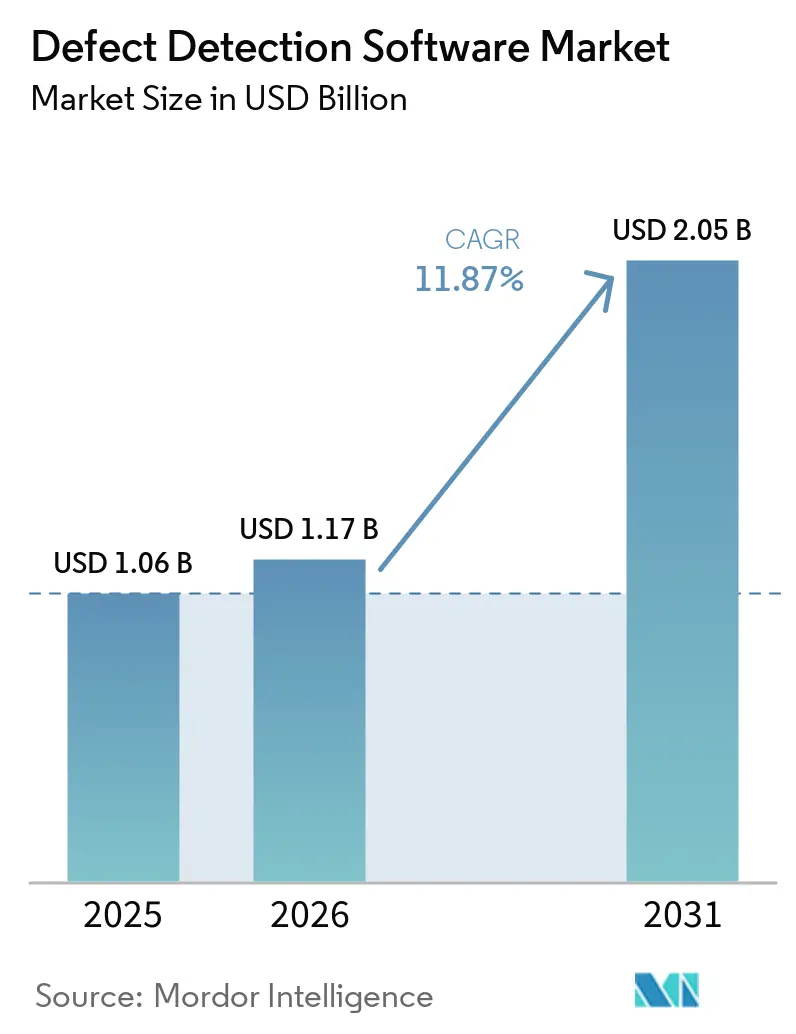
The defect detection software market size is projected to be USD 1.06 billion in 2025, USD 1.17 billion in 2026, and reach USD 2.05 billion by 2031, growing at a CAGR of 11.87% from 2026 to 2031. The defect detection software market is expanding as manufacturers place more inspection steps directly within production lines, where the quality decision can affect output, rework, and customer acceptance. Automotive, electronics, and pharmaceutical producers need consistent records of quality decisions and faster responses when defects are found. Automated vision systems are becoming part of production control rather than a separate quality activity, because plants need each result to inform line decisions, quality records, and later reviews. This places software selection closer to operational planning and makes reliable integration, clear user workflows, and support for change management important buyer considerations. The defect detection software market also benefits when plants need to preserve inspection knowledge as experienced personnel leave the workforce. Competition in the defect detection software market is moving toward platforms that combine local processing, central model control, and repeatable deployment across several sites.
Key Report Takeaways
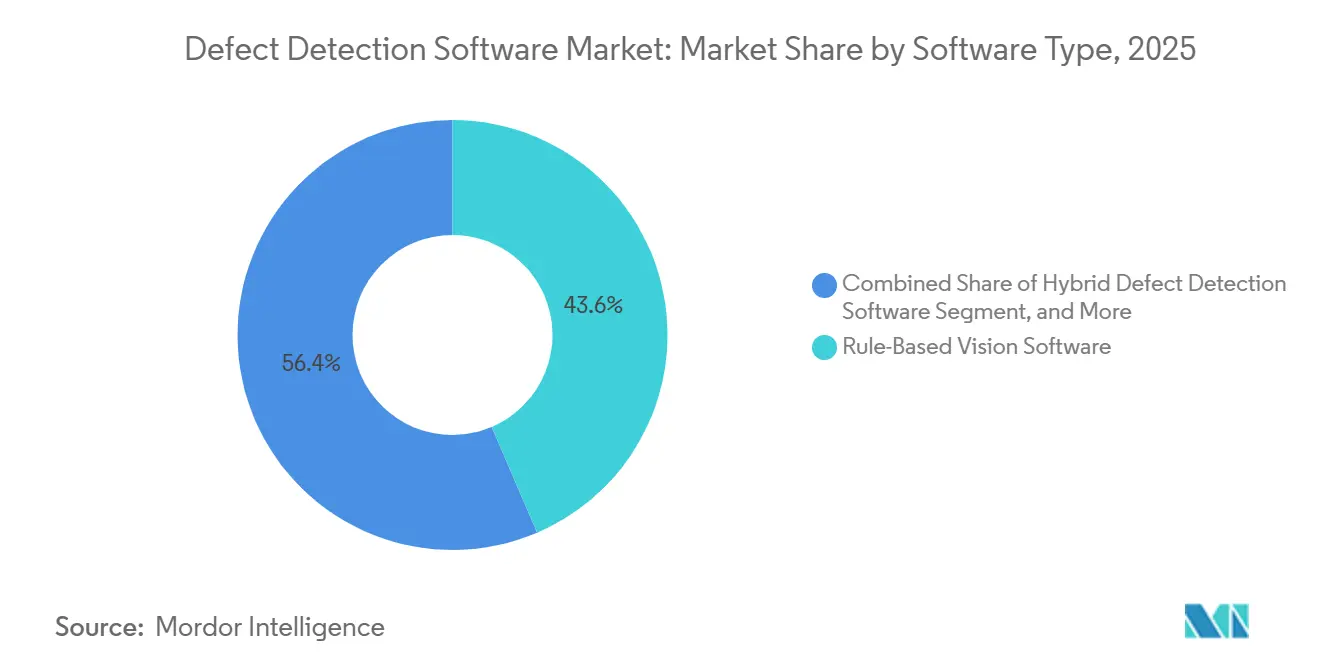
- By software type, Rule-Based Vision Software held 43.56% of the defect detection software market share in 2025, while AI/Machine Learning-Based Defect Detection Software is projected to expand at a 12.58% CAGR through 2031.
- By defect type, Surface Defects accounted for 34.78% of the segment in 2025, while Assembly and Component Defects are expected to expand at a 12.43% CAGR through 2031.
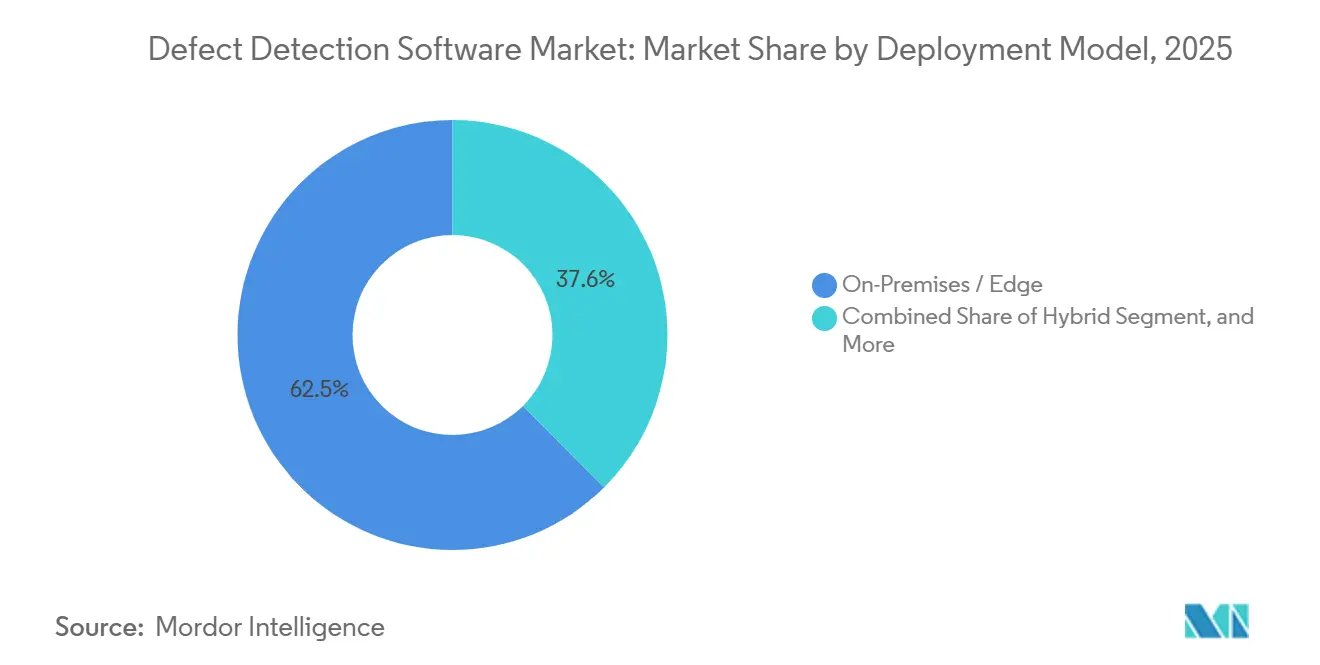
- By deployment model, On-Premises and Edge held 62.45% of the defect detection software market share in 2025, while Cloud-Based deployment is projected to grow at a 12.37% CAGR through 2031.
- By industry vertical, Automotive and Transportation held 24.78% of the segment in 2025, while Electronics and Semiconductors are expected to expand at a 12.64% CAGR through 2031.
- By geography, Asia-Pacific held 35.87% of global revenue in 2025 and is projected to grow at a 12.46% CAGR through 2031.
Note: Market size and forecast figures in this report are generated using Mordor Intelligence’s proprietary estimation framework, updated with the latest available data and insights as of January 2026.
Global Defect Detection Software Market Trends and Insights
Drivers Impact Analysis*
| Driver | (~) % Impact on CAGR Forecast | Geographic Relevance | Impact Timeline |
|---|---|---|---|
| Increasing Zero-Defect Manufacturing Requirements | +3.5% | Global | Short term (≤ 2 years) |
| AI Inspection in Electronics, Semiconductor, and Battery Plants | +2.5% | Asia-Pacific core, spillover to North America and Europe | Short term (≤ 2 years) |
| Quality-Inspection Labor Shortages | +2.0% | North America and Europe, with spillover to Asia-Pacific | Short term (≤ 2 years) |
| Shift to Deep Learning and Anomaly Detection | +1.5% | Global | Medium term (2-4 years) |
| Multi-Plant Traceability and Digital Quality Governance | +1.0% | North America and Europe | Medium term (2-4 years) |
| Few-Shot and Open-Set Detection | +0.8% | Global | Long term (≥ 4 years) |
| Source: Mordor Intelligence | |||
Increasing Zero-Defect Manufacturing Requirements
Zero-defect expectations are becoming contractual requirements in automotive and aerospace supply chains. This change raises the importance of inspection records that can support customer reviews and corrective actions. Manufacturers are also extending quality requirements from large suppliers to smaller component producers. The defect detection software market gains from this shift because automated inspection can create a more consistent record than manual checks and can make review practices easier to apply across suppliers. Systems that identify defects at the point of production can limit the movement of faulty parts to later stages. This need supports wider use of visual inspection software across suppliers that previously relied on manual review, especially where customer agreements require evidence that each quality check was completed.
AI Inspection Across Electronics, Semiconductor, and Battery Plants
Advanced semiconductor and battery production requires inspection systems that can detect small, infrequent defects. A 2026 study of VCSEL semiconductor production reduced inspection time from 17.7 seconds to 1.5 seconds while reporting 98.7% overall accuracy in a hybrid deep-learning approach. This evidence supports the operating case for faster automated inspection in complex production environments, where a missed defect can affect yield and downstream assembly work. Roboflow and NVIDIA demonstrated a synthetic-data workflow in June 2026 that achieved a mean average precision of 0.95 using 8 real defect images and physics-consistent synthetic examples. The approach can reduce the amount of real defect data required before a model is useful. Larger manufacturers are better placed to provide the computing resources, production data, and validation processes needed to use these systems at scale, while suppliers may adopt the tools later through customer-led programs.
Persistent Quality-Inspection Labor Shortages
Inspection roles rely on experience that is not always captured in work instructions. Personnel often recognize borderline surface variation, fit issues, and product-specific defect patterns through repeated observation. The defect detection software market provides a way to record and apply some of this knowledge through image libraries and anomaly models, which can give newer staff a more consistent starting point. Automated visual inspection can also keep a quality step operating when staffing levels change. A 2025 review of collaborative robots found that visual inspection is a key area for efficiency improvement, while final quality assurance remains less developed. This gap leaves a role for dedicated software that supports final inspection decisions and routes exceptions to qualified staff, allowing experienced inspectors to focus on cases that require judgment. It can also help plants maintain a stable review process as work shifts between teams and production schedules change.
Shift From Rule-Based Inspection to Deep Learning and Anomaly Detection
Rule-based tools remain useful when a product is stable and defect definitions are clear. Their limits become more visible on complex parts, changing geometry, reflective surfaces, and high-mix production. Cognex introduced Few Sample Classification with its In-Sight 6900 controller in April 2026, requiring 10 to 20 images per class for training. These capabilities can shorten changeover work for manufacturers that produce many part variants. They also increase pressure on suppliers whose offerings depend on lengthy rule configuration for each new product, particularly when buyers need rapid changes across several production lines.
Restraints Impact Analysis*
| Restraint | (~) % Impact on CAGR Forecast | Geographic Relevance | Impact Timeline |
|---|---|---|---|
| Legacy MES, ERP, SCADA, and PLC Integration Complexity | -0.7% | Global, particularly North America and Europe | Short term (≤ 2 years) |
| Validation, Auditability, and Requalification Burden | -0.5% | North America and Europe, pharmaceutical and medical device hubs | Medium term (2-4 years) |
| Sensor, Lighting, and Calibration Sensitivity | -0.3% | Global | Short term (≤ 2 years) |
| Novel-Defect and Class-Imbalance Risk | -0.2% | Global, particularly Asia-Pacific | Medium term (2-4 years) |
| Source: Mordor Intelligence | |||
Legacy MES, ERP, SCADA, and PLC Integration Complexity
Connecting inspection software to older production systems remains a major deployment issue. Many factories still operate with long-established SCADA historians, proprietary PLC protocols, and enterprise systems that were not designed for real-time image data. Each connection can require separate engineering work and testing. The defect detection software market is affected because large manufacturers can usually fund this work more easily than mid-sized plants, even when both groups see a need for automated quality checks. OPC UA and REST API support can help at the SCADA-MES and MES-ERP boundaries, but they do not eliminate all compatibility issues. Integration work can therefore consume a large share of the budget for installations in brownfield facilities, delaying a purchase even when the inspection use case is clear.
Validation, Auditability, and Requalification Burden in Regulated Production
Pharmaceutical and medical device manufacturers need documented control of software changes. AI inspection models must support records that show how classification logic changed and who approved the change. These needs make audit trails and reproducible documentation important product requirements. The U.S. Food and Drug Administration provides guidance on AI considerations to support regulatory decision-making for drug and biological products.[1]U.S. Food and Drug Administration, “Considerations for the Use of Artificial Intelligence to Support Regulatory Decision-Making for Drug and Biological Products,” FDA Guidance Documents, fda.gov. The compliance burden can favor established providers with documented validation processes. Smaller AI-focused providers may need more time and investment to meet the requirements of regulated production settings, even where their models perform well in technical tests.
*Our forecasts treat driver/restraint impacts as directional, not additive. The impact forecasts reflect baseline growth, mix effects, and variable interactions.
Segment Analysis
By Software Type: Rule-Based Vision Supports Stable Lines While AI Software Drives Growth
Rule-Based Vision Software held 43.56% of the defect detection software market share in 2025. It remains well-suited to high-speed, low-mix production where defect categories are stable, and product changes are limited. Stamping, casting, and continuous printing lines can benefit from a consistent pass-or-fail decision that does not require frequent retraining. Their position aligns with production lines where predictable outputs and established procedures are more important than broad adaptability.
Hybrid Defect Detection Software provides a practical bridge for manufacturers seeking to move beyond purely rule-based inspection. It can retain predefined checks while adding anomaly detection for surface conditions that are not captured by fixed rules. This structure can help quality managers maintain audit documentation during a technology transition. AI/Machine Learning-Based Defect Detection Software is projected to grow at a 12.58% CAGR through 2031. A systematic review found that transformer models can improve assessment of complex geometries through wider contextual analysis, while real-time YOLO models can support high-velocity production. OMRON updated its FH Vision System in October 2025 with AI features that automatically select suitable training images to reduce over-detection.



By Defect Type: Surface Defects Lead Current Use While Assembly Defects Expand
Surface Defects accounted for 34.78% of the defect detection software market in 2025. These defects occur across automotive panels, metal stampings, glass sheets, pharmaceutical packaging, and consumer products. Optical systems can evaluate many of them at production speed. Dimensional and Geometric Defects are important in precision engineering where tolerances are tight, and contact measurement is not practical for every part. Robot-integrated inspection supports these uses in aerospace and medical device machining. Material and Internal Defects, along with Contamination and Foreign-Object Defects, create opportunities for software that works with X-ray and CT inspection systems.
Assembly and Component Defects are projected to grow at a 12.43% CAGR through 2031. EV battery module manufacturing and printed circuit board assembly require verification of alignment, component presence, and assembly order. These checks are necessary before a product can move to the next stage, and the defect detection software market can support earlier identification of assembly errors. OMRON released the VHV5-SRV Barcode Verification System in June 2026 for calibrated inline verification in life sciences, pharmaceutical, food, and automotive applications.[2]OMRON Automation, “OMRON Introduces VHV5-SRV Barcode Verification System for 100% Inline Inspection,” OMRON Automation Press Release, automation.omron.com. Labeling and Packaging Defects are another adjacent area in pharmaceutical distribution and consumer goods.
By Deployment Model: Edge Systems Lead Current Demand While Cloud Management Expands
On-Premises and Edge deployments accounted for 62.45% of the defect detection software market share in 2025. Production lines often need pass-or-fail decisions in less than 50 milliseconds. Network-dependent processing can be difficult to use when factory connectivity adds delay or does not provide consistent performance. Local inference keeps the inspection decision close to the camera and controller, which helps maintain production when external connectivity changes.
Cloud-Based deployment is projected to grow at a 12.37% CAGR through 2031. The main value is centralized model development, version control, validation, and rollout across several plants. Cognex stated that OneVision became generally available in May 2026 after a beta program with more than 100 customers. The company described a cloud-to-edge approach in which models are managed centrally while runtime inference is completed locally. Hybrid systems can therefore combine central governance with the response time required on the production line.
By Industry Vertical: Automotive Leads Current Revenue While Electronics and Semiconductors Grow Fastest
Automotive and Transportation held 24.78% of the industry vertical segment in 2025. OEM quality requirements, EV battery inspection, and the use of machine vision in body and powertrain operations support this position. These production lines require checks for surface conditions, alignment, and assembly completeness. In Food and Beverage, AI anomaly detection can add value where unexpected contamination patterns are difficult to define through fixed rules. Pharmaceuticals and Medical Devices follow a compliance-led buying process where the quality of software records and audit documentation shapes supplier selection.
Electronics and Semiconductors are projected to grow at a 12.64% CAGR through 2031. Advanced packaging and smaller device features increase the need for automated optical inspection. The defect detection software market is relevant because defect types change as device designs and manufacturing methods change. OMRON announced the integration of NVIDIA Omniverse libraries into automated optical inspection and 3D-CT X-ray platforms for semiconductor inspection. Metal, machinery, glass, and ceramics remain established applications for surface inspection. AI-based anomaly detection can extend their use beyond known defect categories where historical good-part images are available.
Geography Analysis
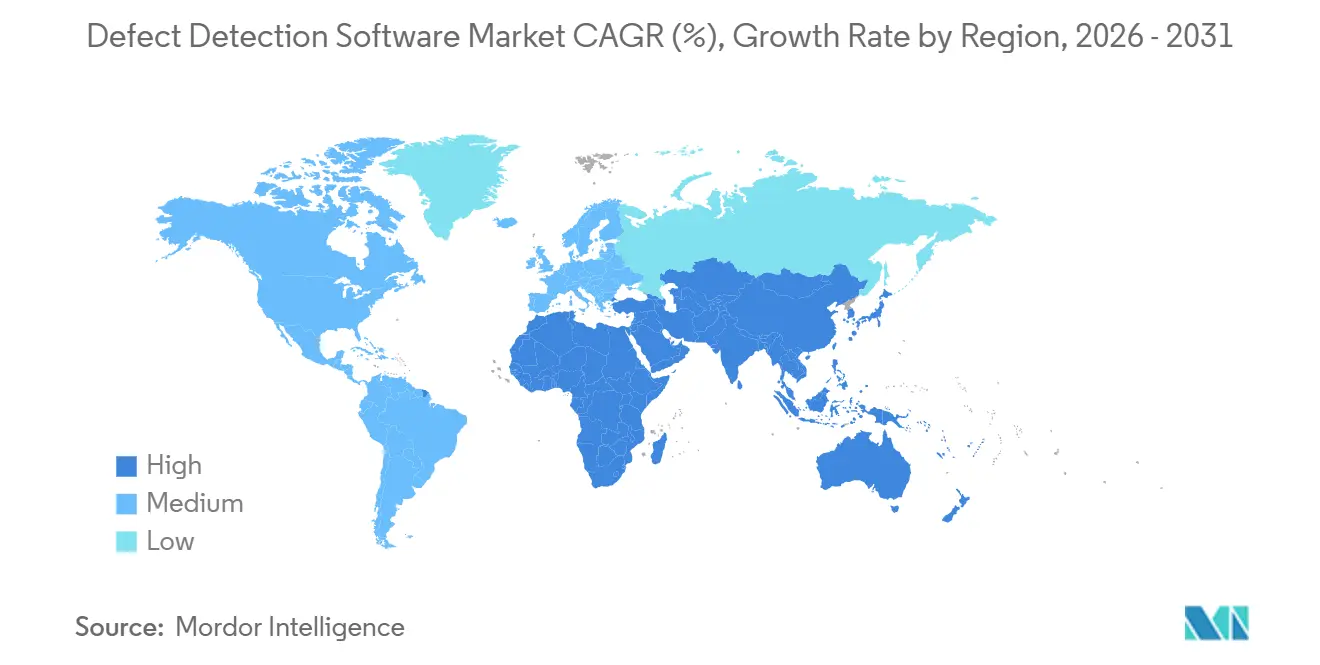
Asia-Pacific accounted for 35.87% of the global defect detection software market in 2025 and is projected to grow at a 12.46% CAGR through 2031. China’s electronics and semiconductor manufacturing base provides a large deployment setting for automated inspection. In January 2026, 8 Chinese government ministries issued the AI + Manufacturing Special Action Plan, which covers manufacturing quality, production monitoring, and process optimization. The Beijing Information Industry Association issued standard T/BIIA 081-2026 in July 2026, which provides technical specifications for deep learning-based industrial defect detection across several manufacturing sectors.[3]Beijing Information Industry Association, “T/BIIA 081-2026: Technical Specification for Industrial Defect Detection Systems Based on Deep Learning,” National Digital Standards Library, ndls.cnis.ac.cn. Japan is adding demand from precision electronics and automotive production, and Panasonic Connect launched the Bead Eye M edition in June 2026 with 3D sensing and AI-supported learning for welding inspection.
North America is the second-largest geography for the defect detection software market, supported by investment in domestic industrial capacity and automation. Semiconductor capacity expansion, adoption of robotics in automotive assembly, and reshoring programs are strengthening quality documentation needs across the region. Canada supports demand in aerospace and resource processing, while Mexico’s automotive manufacturing base needs production-grade inspection software at Tier-1 supplier facilities. Europe combines demand from automotive and precision engineering with compliance-focused investment in pharmaceutical manufacturing. SICK launched its Nova machine vision platform in August 2026 with AI-powered 3D inspection and anomaly heatmap capabilities.
South America is at an earlier stage of adoption, with demand centered on Brazil’s automotive assembly activity, Argentina’s food and beverage processing, and Chile’s mining operations. Price sensitivity and brownfield infrastructure support lower-cost on-premises installations, although multinational requirements can extend inspection obligations to regional Tier-2 suppliers. The Middle East is supported by manufacturing diversification plans in Saudi Arabia and the UAE, especially where petrochemical processing requires checks for contamination and material defects. Africa remains at an earlier adoption stage, with South Africa’s automotive cluster representing a near-term concentration of demand and cloud deployments gaining relevance where local support networks are developing.

Competitive Landscape
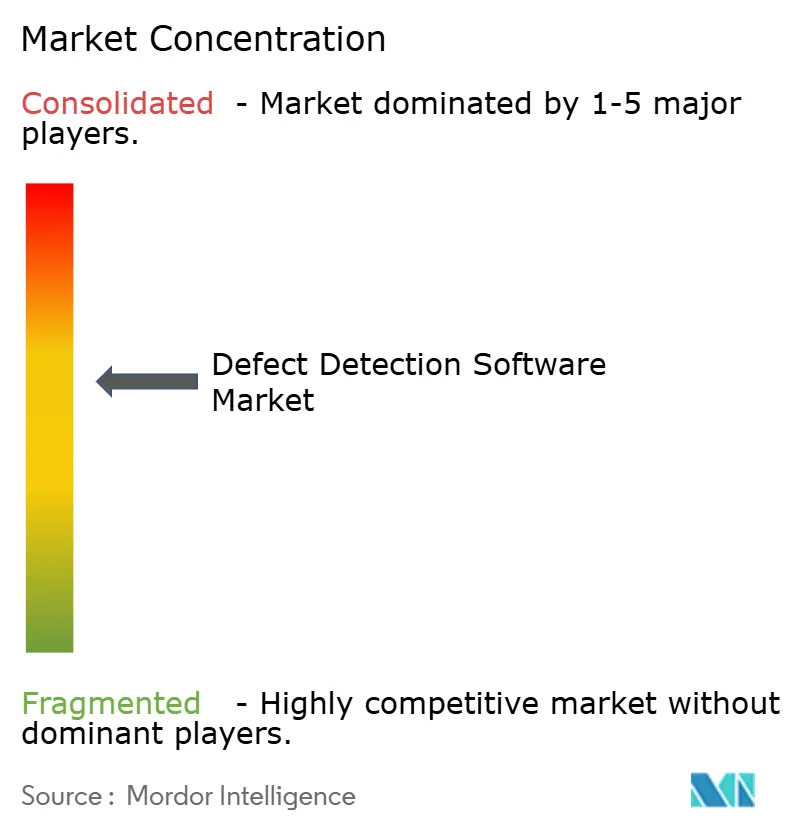
The defect detection software market is moderately consolidated among established machine vision providers. Cognex, KEYENCE, and OMRON have installed hardware bases, field service coverage, and experience connecting systems to industrial controls. These strengths remain important when buyers need dependable installation and ongoing support, although software-defined inspection and centralized model management are reducing the value of hardware integration alone. Cognex released the In-Sight 6900 Vision Controller in April 2026, featuring up to 157 TOPS of AI processing via an NVIDIA Jetson. It also released the In-Sight 3900 Vision System in May 2026 with up to 25-megapixel capability and Qualcomm Dragonwing processing.
The defect detection software market is also attracting AI-focused providers that offer low-code model training and more flexible deployment options, giving plant engineers more options as product designs change. Landing AI, Roboflow, and Instrumental compete by separating inspection logic from traditional machine vision hardware. ABB Robotics made a strategic investment in Landing AI in September 2025 to integrate LandingLens capabilities with robotic vision applications. This approach can route inspection deployments through robotics integrators rather than standalone software vendors. Roboflow introduced the AI1 all-in-one vision camera in May 2026 with an 8-megapixel 4K sensor, NVIDIA Jetson Orin NX computing, and built-in ring lighting.[4]Roboflow, “Introducing Roboflow AI1: The All-In-One Vision AI Camera,” Roboflow, blog.roboflow.com. The product targets inspection at welding stations, presses, and assembly points with a compact integrated configuration.
Few-shot and open-set inspection remain areas where suppliers in the defect detection software market can improve retraining workflows for high-mix production. Multi-plant quality governance and validated inspection platforms are further opportunities because manufacturers need connected defect information and regulated sectors need documented controls. SICK’s Nova platform supports color- and contrast-independent detection by combining deep learning with height data. These moves show how established suppliers are adding AI capability while retaining their industrial hardware presence.
Defect Detection Software Industry Leaders
Cognex Corporation
Keyence Corporation
OMRON Corporation
MVTec Software GmbH
Basler AG
- *Disclaimer: Major Players sorted in no particular order

Recent Industry Developments
- August 2026: SICK AG launched the Nova machine vision platform with AI-powered 3D quality inspection, incorporating deep learning with height-data analysis via its Nova foundation software. The solution enables color-and-contrast-independent surface and assembly defect detection with an anomaly heatmap interface, targeting applications in food and beverage, consumer goods, and industrial manufacturing that were previously inaccessible to rule-based 3D inspection.
- July 2026: KEYENCE unveiled the VS-G Series AI-Powered High-Performance Vision System, designed as a fully customizable controller-type platform establishing a new benchmark for automated inline appearance inspection. The system integrates AI-based parameter tuning and delivers 100% visual traceability, transitioning AI vision inspection from pilot-scale tools to production-hardened, high-speed assets on factory floors.
- June 2026: Panasonic Connect launched “Bead Eye M edition,” a welding inspection solution combining 3D sensing and AI technology that reduces inspection setup effort by approximately 90% through AI-assisted parameter configuration and automated non-defective product learning, enabling manufacturers to achieve automated inline weld bead defect detection without specialist machine vision expertise.
- May 2026: Cognex Corporation launched the In-Sight 3900 Vision System, built on NVIDIA Qualcomm Dragonwing platforms, delivering dedicated AI edge processing with resolutions up to 25 megapixels and inspection speeds 4 times faster than the previous generation, enabling demanding inline defect detection applications without external PC infrastructure.


Global Defect Detection Software Market Report Scope
The defect detection software market comprises solutions that use technologies such as artificial intelligence, machine learning, computer vision, and data analytics to identify, classify, and report defects in products, components, and processes. These solutions help manufacturers and other end users improve quality control, reduce operational errors, minimize waste, and enhance production efficiency.
The Defect Detection Software Market Report is Segmented by Software Type (Rule-Based Vision Software, AI/Machine Learning-Based Defect Detection Software, and Hybrid Defect Detection Software), Defect Type (Surface Defects, Dimensional/Geometric Defects, Assembly and Component Defects, Material/Internal Defects, Contamination and Foreign-Object Defects, and Labeling and Packaging Defects), Deployment Model (On-Premises/Edge, Cloud-Based, and Hybrid), Industry Vertical (Automotive and Transportation, Electronics and Semiconductors, Food and Beverage, Pharmaceuticals and Medical Devices, Metal and Machinery, Glass and Ceramics, and Other Industry Verticals), and Geography (North America, South America, Europe, Asia-Pacific, Middle East, and Africa). The Market Forecasts are Provided in Terms of Value (USD).
| Rule-Based Vision Software |
| AI / Machine Learning-Based Defect Detection Software |
| Hybrid Defect Detection Software |
| Surface Defects |
| Dimensional / Geometric Defects |
| Assembly and Component Defects |
| Material / Internal Defects |
| Contamination and Foreign-Object Defects |
| Labeling and Packaging Defects |
| On-Premises / Edge |
| Cloud-Based |
| Hybrid |
| Automotive and Transportation |
| Electronics and Semiconductors |
| Food and Beverage |
| Pharmaceuticals and Medical Devices |
| Metal and Machinery |
| Glass and Ceramics |
| Other Industry Verticals |
| North America | United States |
| Canada | |
| Mexico | |
| South America | Brazil |
| Argentina | |
| Chile | |
| Rest of South America | |
| Europe | Germany |
| United Kingdom | |
| France | |
| Italy | |
| Spain | |
| Rest of Europe | |
| Asia-Pacific | China |
| Japan | |
| India | |
| South Korea | |
| Australia | |
| Rest of Asia-Pacific | |
| Middle East | United Arab Emirates |
| Saudi Arabia | |
| Qatar | |
| Rest of Middle East | |
| Africa | South Africa |
| Egypt | |
| Nigeria | |
| Rest of Africa |
| By Software Type | Rule-Based Vision Software | |
| AI / Machine Learning-Based Defect Detection Software | ||
| Hybrid Defect Detection Software | ||
| By Defect Type | Surface Defects | |
| Dimensional / Geometric Defects | ||
| Assembly and Component Defects | ||
| Material / Internal Defects | ||
| Contamination and Foreign-Object Defects | ||
| Labeling and Packaging Defects | ||
| By Deployment Model | On-Premises / Edge | |
| Cloud-Based | ||
| Hybrid | ||
| By Industry Vertical | Automotive and Transportation | |
| Electronics and Semiconductors | ||
| Food and Beverage | ||
| Pharmaceuticals and Medical Devices | ||
| Metal and Machinery | ||
| Glass and Ceramics | ||
| Other Industry Verticals | ||
| By Geography | North America | United States |
| Canada | ||
| Mexico | ||
| South America | Brazil | |
| Argentina | ||
| Chile | ||
| Rest of South America | ||
| Europe | Germany | |
| United Kingdom | ||
| France | ||
| Italy | ||
| Spain | ||
| Rest of Europe | ||
| Asia-Pacific | China | |
| Japan | ||
| India | ||
| South Korea | ||
| Australia | ||
| Rest of Asia-Pacific | ||
| Middle East | United Arab Emirates | |
| Saudi Arabia | ||
| Qatar | ||
| Rest of Middle East | ||
| Africa | South Africa | |
| Egypt | ||
| Nigeria | ||
| Rest of Africa | ||


Key Questions Answered in the Report
What is the 2026 size of the defect detection software market?
The defect detection software market size is USD 1.17 billion in 2026 and is forecast to reach USD 2.05 billion by 2031 at an 11.87% CAGR.
Which software type held the largest share in 2025?
Rule-Based Vision Software led with a 43.56% share in 2025 because it fits stable, high-speed production lines with established defect definitions.
Which deployment model is growing fastest through 2031?
Cloud-Based deployment is projected to grow at a 12.37% CAGR because it supports centralized model management across several plants.
Which end-use sector is expected to grow fastest?
Electronics and Semiconductors is projected to grow at a 12.64% CAGR through 2031, supported by advanced packaging and automated optical inspection needs.
Why do manufacturers use edge-based defect detection systems?
Edge systems can support pass or fail decisions in less than 50 milliseconds, helping production lines avoid network-related delays.
Which region is expected to grow fastest through 2031?
Asia-Pacific is projected to grow at a 12.46% CAGR through 2031, supported by electronics, semiconductor, automotive, and precision manufacturing activity.
Page last updated on:


 Your data is secure and never sold or shared.


