
Deep Cycle Batteries Market Size and Share
Market Overview
| Study Period | 2022 - 2032 |
|---|---|
| Market Size (2027) | USD 4.11 Billion |
| Market Size (2032) | USD 5.29 Billion |
| Growth Rate (2027 - 2032) | 5.18 % |
| Fastest Growing Market | Asia-Pacific |
| Largest Market | Asia-Pacific |
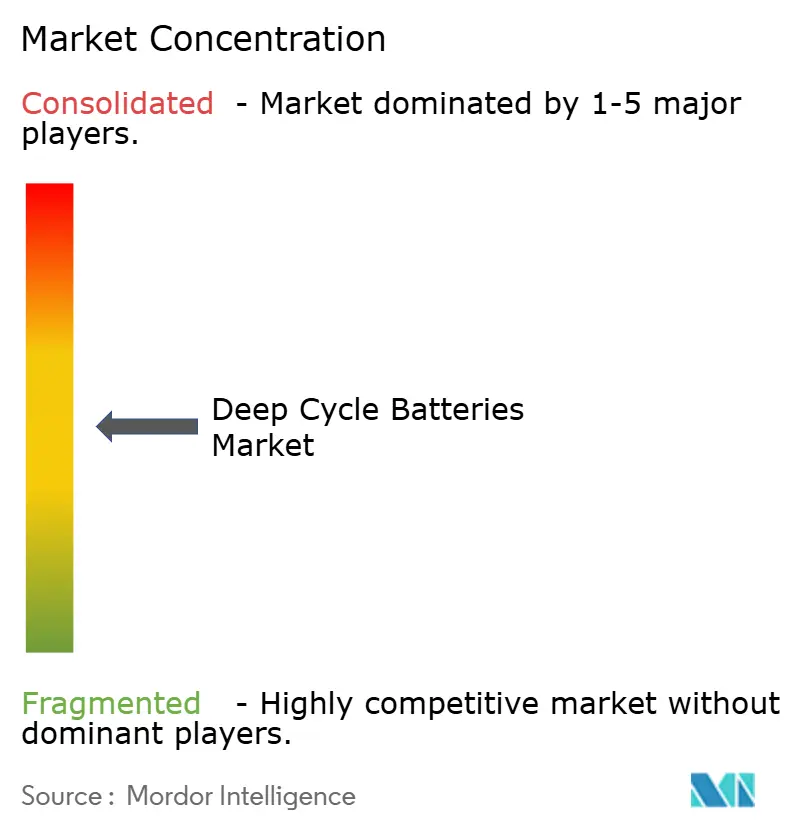
| Market Concentration | Medium |
Major Players *Disclaimer: Major Players sorted in no particular order Image © Mordor Intelligence. Reuse requires attribution under CC BY 4.0. | |
Deep Cycle Batteries Market Analysis by Mordor Intelligence
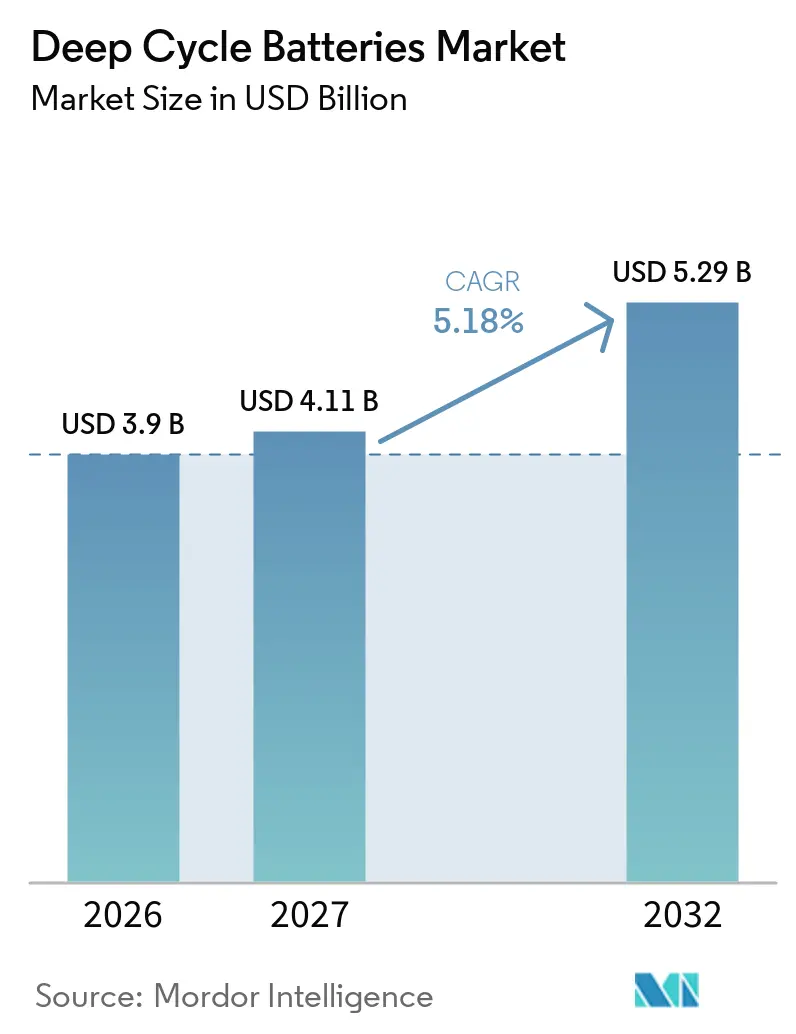
The Deep Cycle Batteries Market size is projected to be USD 3.9 billion in 2026, USD 4.11 billion in 2027, and reach USD 5.29 billion by 2032, growing at a CAGR of 5.18% from 2027 to 2032. The global deep cycle batteries market is supported by demand for repeat-discharge storage in solar systems, material handling equipment, telecom networks, and critical power applications. Lead-acid batteries retain a large installed base because they remain accessible in applications that require simple charging and lower initial spending. Lithium-ion systems are gaining ground where high daily use, longer service life, and reduced downtime justify their higher purchase cost. The global deep cycle batteries market also faces pressure from raw material availability, charging requirements, and tighter recycling obligations. Producers are responding by expanding certified products, improving battery monitoring, and offering both lead-acid and lithium-based formats.
Key Report Takeaways
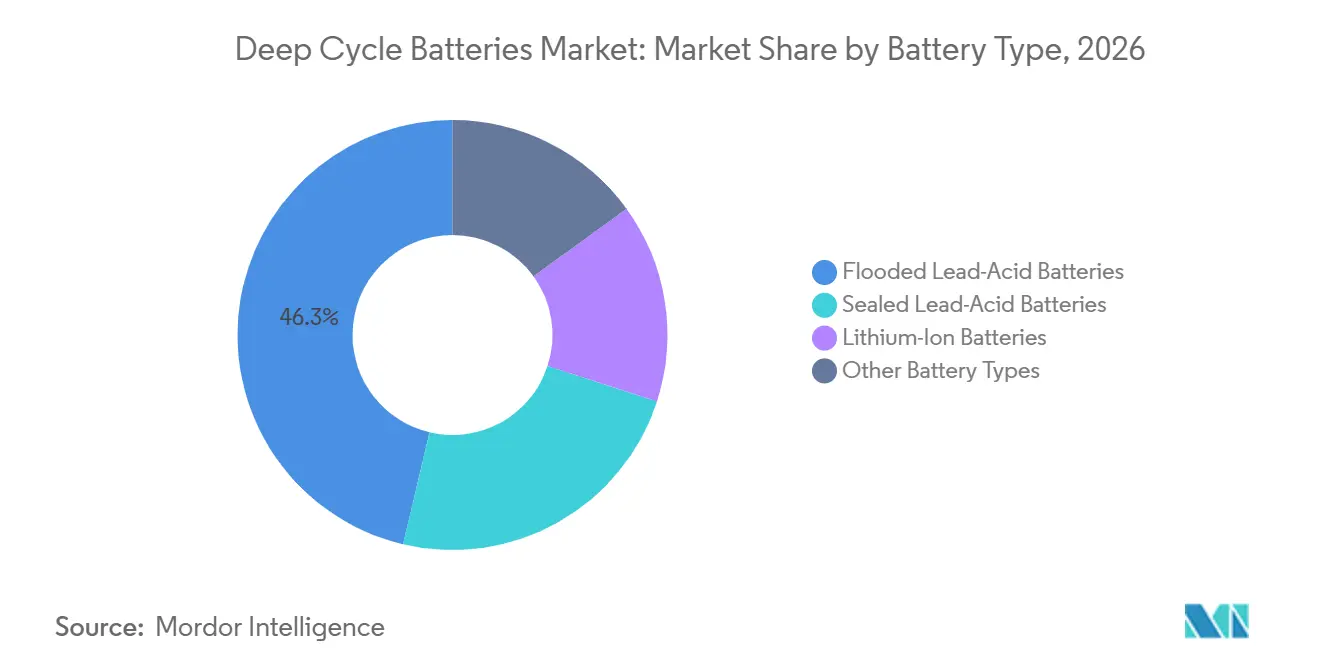
- By battery type, flooded lead-acid batteries held 46.3% of the global deep cycle batteries market share in 2026, while lithium-ion batteries are projected to grow at an 18.4% CAGR through 2032.
- By end user, industrial users accounted for 30.6% of the global deep cycle batteries market share in 2026, while utilities and renewable energy operators are forecast to grow at an 8.3% CAGR through 2032.
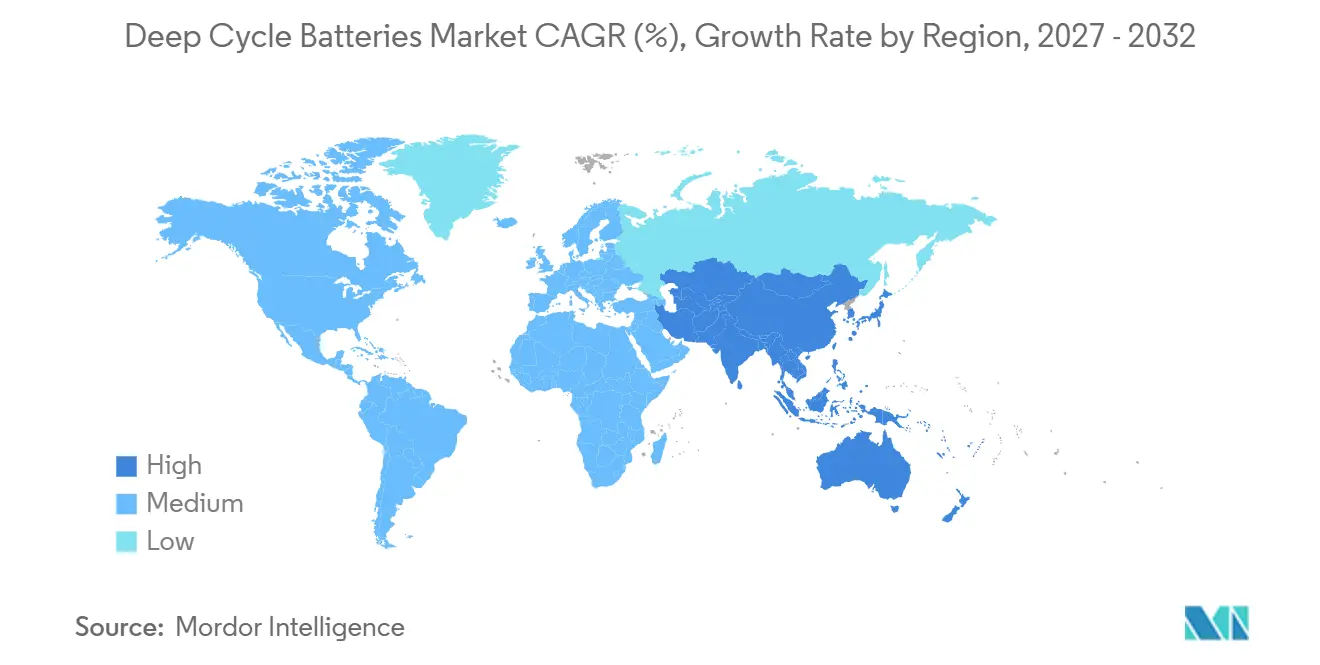
- By geography, Asia-Pacific accounted for 39.8% of the global deep cycle batteries market share in 2026 and is expected to grow at a 6.9% CAGR through 2032.
Note: Market numbers in this report are based on Mordor Intelligence's proprietary estimation framework, which combines nine months of actuals with Q4 projections for base year 2026.
Market Trends and Insights
Drivers Impact Analysis of Deep Cycle Batteries Market*
| Driver | (~) % Impact on CAGR Forecast | Geographic Relevance | Impact Timeline |
|---|---|---|---|
| Renewable Energy Storage and Solar-Plus-Storage Deployment | +1.4% | Global, strongest in Asia-Pacific, Europe, and the Middle East and North Africa | Medium term (2-4 years) |
| Electrification of Marine, RV, Golf Cart, and Material-Handling Applications | +0.8% | North America, Europe, and Asia-Pacific | Medium term (2-4 years) |
| Telecom, Data Center, and Distributed Backup Power Expansion | +1.0% | Global, concentrated in Asia-Pacific and North America | Short term (≤ 2 years) |
| Lithium-Ion Lifecycle and Usable-Energy Advantage | +0.9% | Global | Long term (≥ 4 years) |
| Application-Specific Battery Monitoring and Predictive Maintenance | +0.5% | North America, Europe, and Asia-Pacific industrial clusters | Medium term (2-4 years) |
| Replacement Demand from the Installed Lead-Acid Battery Base | +0.7% | Global | Medium term (2-4 years) |
| Source: Mordor Intelligence | |||
Renewable Energy Storage and Solar-Plus-Storage Deployment
Renewable energy storage supports the global deep cycle batteries market because batteries allow solar generation to serve loads after daylight hours. Rural electrification programs in South and Southeast Asia often use off-grid photovoltaic systems, which create recurring replacement demand for battery banks. China added 42.6 GWh of new energy storage in the first half of 2025, up 27.5% from the prior year, according to data reported by Shoto Group from the Ministry of Industry and Information Technology.[1] This deployment broadens demand beyond household backup into grid-connected and commercial systems. IEC 61427-2:2025 provides a testing framework for on-grid renewable energy storage batteries and includes a frequency-regulation test profile. The standard makes documented performance more important in tenders and strengthens the position of suppliers with tested storage products.
Electrification of Marine, Recreational Vehicle (RV), Golf Cart, and Material-Handling Applications
Electrification of low-speed vehicles and work equipment gives the global deep cycle batteries market a demand stream that differs from passenger electric vehicles. Golf carts, aerial work platforms, floor-cleaning equipment, and recreational vehicles need batteries that tolerate repeated partial discharge. Lead-acid products remain relevant where operators value familiar charging practices and lower purchase costs. East Penn introduced Deka Ready Power lithium and gel products for maintenance-free material handling applications in March 2025.[2] Trojan Battery launched its 48 V 171 Ah OnePack XR lithium-ion pack for golf carts and low-speed vehicles in March 2025, with a stated range of up to 75 miles per charge.[3] These launches show that suppliers are keeping lead-acid offerings while extending lithium options for demanding duty cycles.
Telecom, Data Center, and Distributed Backup Power Expansion
Telecom networks, distributed backup installations, and data centers require batteries that can deliver power when the grid fails. The global deep cycle batteries market benefits as high-density computing raises the importance of high-rate discharge performance. Shoto reported that its artificial intelligence data center storage business reached CNY 1,028 million, equivalent to USD 143 million, in the first half of 2025 and became its largest revenue source.[4] East Penn launched Armor Alloy Technology for its Deka HRC line in October 2025 for hyperscale data center backup applications. The company stated that it was the first U.S.-based manufacturer to achieve UL 1973 certification for the product line. These applications favor suppliers that can demonstrate consistent output, safety, and compliance.
Lithium-Ion Lifecycle and Usable-Energy Advantage
Lithium-ion systems support the global deep cycle batteries market by offering a larger usable share of installed capacity. Lithium-ion batteries can provide 80% to 100% usable depth of discharge, compared with 50% for standard flooded lead-acid products. This difference can reduce the capacity required for high-use applications and change total ownership costs. Narada stated that large-format lithium iron phosphate systems can achieve 8,000 to 15,000 cycles, compared with 400 to 1,500 cycles for flooded lead-acid products under similar conditions. EnerSys reported continued focus on maintenance-free and higher-margin product lines in its fiscal 2025 reporting. The benefit is strongest in industrial settings where equipment is used frequently and battery replacement interrupts operations.
Restraints Impact Analysis of Deep Cycle Batteries Market*
| Restraint | (~) % Impact on CAGR Forecast | Geographic Relevance | Impact Timeline |
|---|---|---|---|
| Lithium-Ion Substitution in High-Utilization Applications | -1.2% | Global, most acute in North America and Europe | Long term (≥ 4 years) |
| High Upfront Cost of Lithium-Based Deep-Cycle Systems | -0.8% | Southeast Asia, Sub-Saharan Africa, and South America | Medium term (2-4 years) |
| Charging, Thermal-Management, and Safety Complexity | -0.5% | Global | Medium term (2-4 years) |
| Inconsistent Recycling and Collection Infrastructure Outside Mature Markets | -0.4% | Southeast Asia, the Middle East and Africa, and South America | Long term (≥ 4 years) |
| Source: Mordor Intelligence | |||
Lithium-Ion Substitution in High-Utilization Applications
Lithium-ion substitution constrains demand for conventional deep cycle products in applications with frequent cycling. Forklift fleets that operate multiple shifts can cycle batteries 1,000 to 1,200 times per year, making service life and charging time central purchasing considerations. Lithium systems with longer cycle life can reduce battery-change downtime and the number of replacement units required. This effect is especially relevant for industrial and utility users, which together made up nearly 39% of 2026 revenue in the supplied data. International Electrotechnical Commission (IEC) 62619 sets safety requirements for industrial secondary lithium cells and batteries. Clearer safety requirements reduce a certification obstacle that previously slowed adoption in industrial installations. Suppliers without lithium products risk losing high-use accounts even when demand for the broader global deep cycle batteries market remains positive.
High Upfront Cost of Lithium-Based Deep-Cycle Systems
High initial cost remains a material barrier for lithium systems in price-sensitive markets. A lithium-deep cycle system can cost two to four times as much as an equivalent lead-acid bank at the point of purchase. This affects rural solar installations in South and Southeast Asia, Sub-Saharan Africa, and South America. Flooded lead-acid batteries therefore continue to serve applications where upfront affordability outweighs long-term operating savings. The result is a difference between volume demand in developing markets and value growth in mature markets. It also means the global deep cycle batteries market will retain multiple battery chemistries rather than moving to lithium-ion at a uniform pace.
*Our forecasts treat driver/restraint impacts as directional, not additive. The impact forecasts reflect baseline growth, mix effects, and variable interactions.
Deep Cycle Batteries Market Segment Analysis
By Battery Type:
Established Lead-Acid Demand Coexists with Faster Lithium-Ion AdoptionFlooded lead-acid batteries held 46.3% of global deep cycle batteries market share in 2026, while lithium-ion batteries are forecast to advance at an 18.4% CAGR through 2032. Flooded products remain widely used in rural solar backup, marine leisure, and golf cart applications. Their installed position reflects predictable replacement demand and sensitivity to initial cost. These batteries can tolerate imperfect charging practices and partial-state-of-charge use. They also do not require the battery management systems needed for lithium-ion products. Sealed lead-acid formats, including absorbed glass mat and gel batteries, represent the next large group of products. Telecom backup and uninterruptible power systems favor these formats because they are spill-proof and require less maintenance. HOPPECKE stated that its trak|bloc absorbed glass mat battery can deliver up to 1,000 cycles at 80% depth of discharge.
The global deep cycle batteries market size for lithium-ion products is supported by specialized product designs rather than a single replacement pattern. Trojan’s 48 V golf cart pack, East Penn’s Deka Ready Power lithium line, and EnerSys motive-power systems show how suppliers are addressing different use cases. East Penn states that its lithium products use active cooling and are designed for full-capacity operation at 40°C. Narada reported 8,000 to 15,000 cycles for large-format lithium iron phosphate storage formats. Other batteries, including sodium-ion and nickel-cadmium products, remain in smaller categories. Shoto began mass production of a telecom sodium-ion battery in April 2025 that it says operates from -40°C to 60°C and exceeds 4,000 cycles. Such products address temperature conditions that are difficult for many standard battery formats. Chemistry selection will therefore remain tied to site conditions, daily use, and maintenance capability.

By End User:
Industrial Fleets Anchor Demand While Utilities Expand Storage ProcurementIndustrial users accounted for 30.6% of global deep cycle batteries market share in 2026. Material handling equipment, forklifts, mining vehicles, and automated guided vehicles create recurring fleet-scale replacement demand. Operators in these settings increasingly compare total operating cost instead of simply comparing battery purchase prices. Battery cycle life, charging equipment, and downtime have direct effects on fleet availability. HOPPECKE reported that a 10-forklift fleet using its trak|uplift traction batteries could need 25% fewer batteries and 50% fewer chargers over the operating life. This type of analysis favors products that provide documented cycle performance. Industrial procurement is also pushing producers to offer monitoring tools and service support. These needs make product reliability and charging compatibility important competitive factors.
Utilities and renewable energy operators are expected to grow at an 8.3% CAGR through 2032. This part of the global deep cycle batteries market is closely connected to grid investment, solar deployment, and demand for stored power. China’s reported storage additions in the first half of 2025 show the scale of demand that can result from national storage programs. Narada reported a 2.8 GWh semi-solid-state battery order for independent storage projects in Shenzhen and Shantou. Residential users remain important for solar-plus-storage systems, especially where grid service is limited. Commercial users are adding backup and demand-response capacity. Automotive and transportation demand is centered on low-speed electric vehicles rather than mainstream passenger electric vehicles. The end-user mix gives suppliers opportunities across both recurring replacement sales and larger storage projects.
Geography Analysis
Asia-Pacific accounted for 39.8% of global deep cycle batteries market share in 2026 and is projected to grow at a 6.9% CAGR through 2032. China’s storage deployment, India’s rural electrification programs, and Southeast Asia’s telecom and data center construction support demand across multiple battery formats. Shoto reported CNY 2,246.3 million in first-half 2025 revenue, equivalent to USD 313 million, up 26.2% from the prior year. The company also reported that data center storage became its largest revenue category during the period. Regional suppliers including Narada, Shoto, Leoch, and Vision Group combine domestic demand with exports. Their scale supports cost competitiveness, while new products are extending their presence in data centers and storage systems. Shoto’s sodium-ion telecom battery is one example of products designed for difficult climates. IEC 61427-2 testing requirements influence tender specifications for renewable energy storage systems. The global deep cycle batteries market size in the region is therefore linked to both domestic deployment and export-oriented manufacturing.
North America and Europe are mature markets with a growing shift toward sealed lead-acid and lithium-ion systems for industrial and backup applications. In North America, East Penn’s material handling and data center launches show that certified performance is becoming a product differentiator. Stryten Energy completed its acquisition of C&D Technologies and Trojan Battery in October 2026, bringing major deep cycle and backup brands under one platform. In Europe, the Battery Regulation requires a 75% recycling efficiency target for lead-acid batteries by the end of 2025. The regulation also introduces battery passport requirements for industrial and electric vehicle batteries from February 2027. European Norm (EN) 18060:2025 is a harmonizedstandard supporting the regulatory framework. These compliance factors increase documentation requirements for suppliers. They may also favor companies that already have established certification and recycling processes.
South America, the Middle East, and Africa are supported by solar adoption, growing demand for backup power, and limited grid reliability in selected locations. Brazil, Chile, Saudi Arabia, and South Africa provide a mix of commercial solar, industrial, and remote power opportunities. Flooded lead-acid batteries remain common because many buyers prioritize lower initial cost and straightforward maintenance. The high upfront cost of lithium systems slows wider adoption in rural and off-grid projects. This makes replacement sales important to the global deep cycle batteries market in these regions. Collection and recycling systems are less consistent than in mature markets, which adds environmental and supply-chain risk. The U.S. Environmental Protection Agency’s 2026 review highlights the need for reliable battery collection practices across battery types. Producers that combine local distribution with recycling partnerships can improve customer confidence. Solar-plus-storage projects remain a route for lithium and lead-acid suppliers to serve different budget levels.
Competitive Landscape
The global deep cycle batteries market is moderately consolidated and includes established lead-acid producers, lithium-focused suppliers, and companies with portfolios across both technologies. EnerSys, East Penn Manufacturing, GS Yuasa, Amara Raja Energy & Mobility, and Stryten Energy are among the larger established suppliers. Chinese manufacturers including Narada, Shoto, Leoch, and Vision Group have broad production bases and export activity. The competitive pattern is fragmented across application niches even though several suppliers have large regional positions. EnerSys reported fiscal 2025 revenue of USD 3.6 billion and continued to focus on maintenance-free products and defense applications. Suppliers are seeking differentiation through high-rate performance, embedded monitoring, and thermal management. They are also expanding certifications for regulated data center, industrial, and storage applications. These strategies reduce reliance on commodity lead-acid pricing.
Stryten Energy’s October 2026 acquisition of C&D Technologies and Trojan Battery is a major structural move in North American battery manufacturing. The company retained both acquired brands and added an integrated platform with 18 facilities across the United States, Mexico, and China. East Penn’s October 2025 Armor Alloy launch focused on hyperscale data center backup and UL 1973 certification. Leoch displayed lead-carbon and lithium energy storage products at ees Europe in May 2025. CSB expanded its UL 1973:2022 certification coverage for smaller stationary Valve Regulated Lead-Acid (VRLA)-Absorbed Glass Mat (AGM) products in July 2025. These actions demonstrate that certification and product specialization are central to competition. Smaller regional manufacturers face higher costs when they must meet several technical standards.
The global deep cycle batteries market continues to offer room for suppliers that can serve off-grid and remote industrial sites with products suited to local maintenance capabilities. Lithium battery management requirements can be difficult to support in locations where service networks are limited. Lead-acid batteries retain an advantage where simple installation and field repair matter most. At the same time, lithium products are better suited to high-use systems where cycle life and charging speed reduce operating interruptions. Amara Raja began commercial production at its tubular battery facility in June 2025 and described lead recycling capacity of 50,000 metric tons, with planned expansion to 150,000 metric tons. This mix of recycling, local production, and new battery formats illustrates the portfolio approach needed across the sector.
Deep Cycle Batteries Industry Leaders
-
Trojan Battery Company, LLC
-
EnerSys
-
East Penn Manufacturing Co.
-
Exide Technologies
-
GS Yuasa Corporation
- *Disclaimer: Major Players sorted in no particular order
Deep Cycle Batteries Market Companies Covered in this Report
- Amara Raja Energy & Mobility Limited
- C&D Technologies, Inc.
- Crown Battery Manufacturing Company
- CSB Battery Co., Ltd.
- East Penn Manufacturing Co.
- EnerSys
- Exide Industries Limited
- Exide Technologies, LLC
- Fullriver Battery Manufacturing Co., Ltd.
- GS Yuasa Corporation
- HBL Engineering Limited
- HOPPECKE Batterien GmbH & Co. KG
- Leoch International Technology Limited
- Microtex Energy Private Limited
- Narada Power Source Co., Ltd.
- NPP Power (Shenzhen Center Power Tech Co., Ltd.)
- Shoto (Shuangdeng Group Co., Ltd.)
- Surrette Battery Company Limited
- Trojan Battery Company, LLC
- U.S. Battery Manufacturing Company
Recent Industry Developments in Deep Cycle Batteries Market
- October 2026: Stryten Energy completed the acquisition of C&D Technologies, Inc. and Trojan Battery Company, LLC, creating one of North America's most comprehensive battery manufacturing platforms with 18 facilities across the US, Mexico, and China and approximately 4,800 employees. Both C&D Technologies and Trojan Battery product brands are retained under Stryten Energy.
- October 2025: East Penn Manufacturing launched its proprietary Armor Alloy Technology for the Deka HRC line at the 7×24 International Exchange Conference in San Antonio. The technology targets hyperscale data center backup applications and is certified to Underwriters Laboratories (UL) 1973.
- October 2025: Shoto Group debuted its AI Data Center (AIDC) data center immersion lithium system at Data Centre World Asia in Singapore and signed a strategic partnership with Thailand's Planet Systems for ASEAN data center projects.
- September 2025: Exide Technologies launched a restructured commercial vehicle battery portfolio with the GEL PRO, EFB PRO, SHD PRO, and HD PRO ranges. The GEL PRO deep cycle variant allows a safe depth of discharge of 90%.
Global Deep Cycle Batteries Market Report Scope
A deep cycle battery is a rechargeable battery designed to deliver a steady amount of electrical power over an extended period. It can be regularly discharged to 50%–80% of its total capacity, or up to 100% for lithium types, without sustaining damage.
The deep cycle batteries market is segmented into battery type, end user, and geography. By battery type, the market is segmented into flooded lead-acid batteries, sealed lead-acid batteries, lithium-ion batteries, and other battery types. By end user, the market is divided into residential, commercial, industrial, utilities, renewable energy operators, and automotive and transportation. The report also covers the market size and forecasts for the global deep cycle batteries market across 26 countries in key regions. For each segment, the market sizing and forecasts have been provided on the basis of value (USD).
Segmentation Overview
| Flooded Lead-Acid Batteries |
| Sealed Lead-Acid Batteries |
| Lithium-Ion Batteries |
| Other Battery Types |
| Residential |
| Commercial |
| Industrial |
| Utilities and Renewable Energy Operators |
| Automotive and Transportation |
| North America | United States |
| Canada | |
| Mexico | |
| Europe | Germany |
| France | |
| Italy | |
| Spain | |
| United Kingdom | |
| Poland | |
| Russia | |
| Rest of Europe | |
| Asia-Pacific | China |
| India | |
| Japan | |
| South Korea | |
| Australia | |
| Indonesia | |
| Vietnam | |
| Thailand | |
| Rest of Asia-Pacific | |
| South America | Brazil |
| Argentina | |
| Chile | |
| Rest of South America | |
| Middle East and Africa | Saudi Arabia |
| United Arab Emirates | |
| Egypt | |
| South Africa | |
| Morocco | |
| Rest of Middle East and Africa |
| By Battery Type | Flooded Lead-Acid Batteries | |
| Sealed Lead-Acid Batteries | ||
| Lithium-Ion Batteries | ||
| Other Battery Types | ||
| By End User | Residential | |
| Commercial | ||
| Industrial | ||
| Utilities and Renewable Energy Operators | ||
| Automotive and Transportation | ||
| By Geography | North America | United States |
| Canada | ||
| Mexico | ||
| Europe | Germany | |
| France | ||
| Italy | ||
| Spain | ||
| United Kingdom | ||
| Poland | ||
| Russia | ||
| Rest of Europe | ||
| Asia-Pacific | China | |
| India | ||
| Japan | ||
| South Korea | ||
| Australia | ||
| Indonesia | ||
| Vietnam | ||
| Thailand | ||
| Rest of Asia-Pacific | ||
| South America | Brazil | |
| Argentina | ||
| Chile | ||
| Rest of South America | ||
| Middle East and Africa | Saudi Arabia | |
| United Arab Emirates | ||
| Egypt | ||
| South Africa | ||
| Morocco | ||
| Rest of Middle East and Africa | ||
Key Questions Answered in the Report
What is driving demand for deep cycle batteries?
Solar-plus-storage projects, industrial equipment, telecom networks, and data centers are increasing demand for repeat-discharge batteries.
How large is the deep cycle batteries market?
The market is projected to increase from USD 4.11 billion in 2027 to USD 5.29 billion by 2032 at a 5.18% CAGR.
Which battery type is growing fastest?
Lithium-ion batteries are forecast to grow at an 18.4% CAGR through 2032, supported by longer cycle life and greater usable capacity.
Why do flooded lead-acid batteries remain widely used?
They held 46.3% share in 2026 because they offer lower upfront costs, simple charging, and broad use in solar backup, marine, and golf cart applications.
Which end user has the largest demand?
Industrial users held 30.6% share in 2026 because forklifts, mining vehicles, and automated guided vehicles create recurring fleet demand.
Which region is expected to expand fastest?
Asia-Pacific is projected to grow at a 6.9% CAGR through 2032, supported by storage deployment, rural electrification, and expanding telecom and data center capacity.