
Debris Loaders Market Size and Share
Market Overview
| Study Period | 2020 - 2032 |
|---|---|
| Market Size (2027) | USD 220.17 Million |
| Market Size (2032) | USD 275.82 Million |
| Growth Rate (2027 - 2032) | 4.61 % |
| Fastest Growing Market | Asia-Pacific |
| Largest Market | North America |
| Market Concentration | Medium |
Major Players *Disclaimer: Major Players sorted in no particular order Image © Mordor Intelligence. Reuse requires attribution under CC BY 4.0. | |
Debris Loaders Market Analysis by Mordor Intelligence
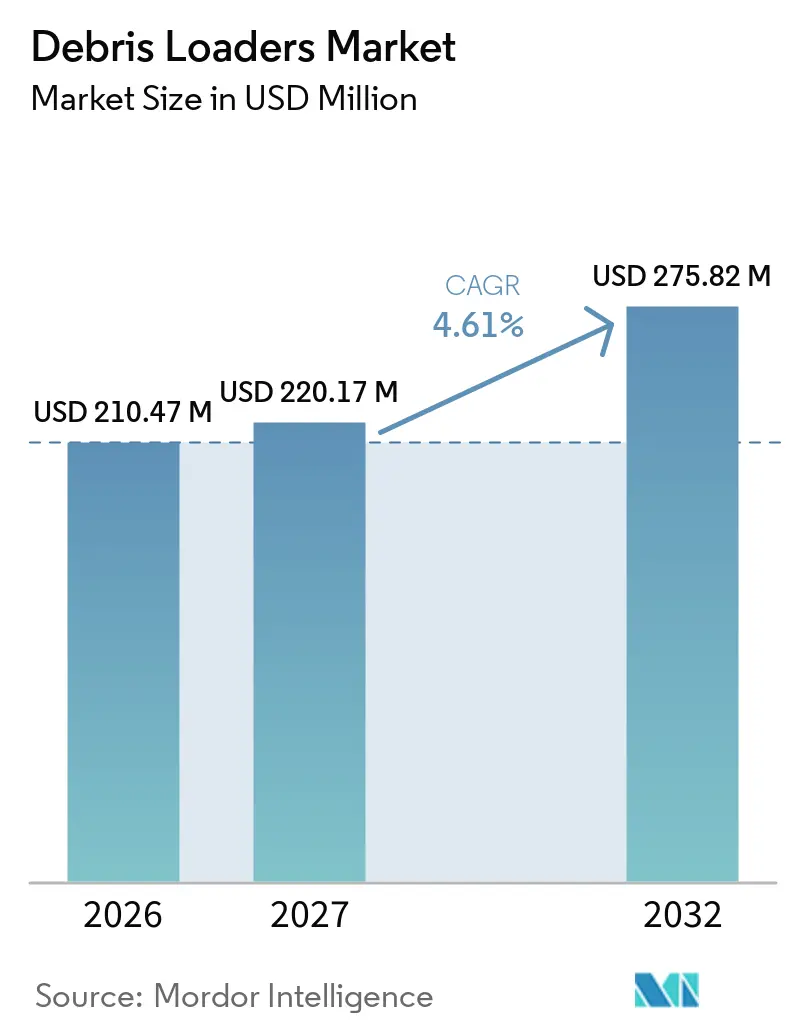
The debris loaders market size was valued at USD 210.47 million in 2026 and is expected to grow from USD 220.17 million in 2027 to USD 275.82 million by 2032, at a CAGR of 4.61% during 2027-2032. Demand is tied to municipal leaf collection, public-works staffing gaps, and the need to complete seasonal routes with fewer operators. Bureau of Labor Statistics data cited in November 2025 showed about 570,000 job openings against 156,000 hires in state and local government excluding education, a 3.7-to-1 ratio[1]. This ratio is more than twice that of the private sector, indicating persistent difficulties in staffing essential services. This makes single-operator collection systems more valuable to public-works managers and supports equipment replacement decisions. The debris loaders market also benefits from storm-response work, organic-waste diversion programs, and the need for adaptable equipment for seasonal tasks.
Key Report Takeaways
- By product type, truck-mounted loaders held a 41.27% share in 2026, while skid/hitch-mounted loaders are projected to grow at a 5.47% CAGR through 2032.
- By collection mechanism, vacuum/suction loaders held a 72.36% share in 2026, while knuckleboom/grapple loaders are projected to grow at a 5.63% CAGR through 2032.
- By power source, engine-driven units held a 68.42% share in 2026, while electric and battery units are projected to grow at an 11.36% CAGR through 2032.
- By engine power, loaders above 35 HP held a 48.00% share in 2026, while below-20 HP loaders are projected to grow at a 5.29% CAGR through 2032.
- By end user, municipalities and public works departments held a 52.37% share in 2026, while storm and disaster clean-up contractors are projected to grow at a 6.17% CAGR through 2032.
- By geography, North America held a 46.28% share in 2026, while Asia-Pacific is projected to grow at a 6.04% CAGR through 2032.
Note: Market numbers in this report are based on Mordor Intelligence's proprietary estimation framework, which combines nine months of actuals with Q4 projections for base year 2026.
Market Trends and Insights
Drivers Impact Analysis of Debris Loaders Market*
| Driver | (~) % Impact on CAGR Forecast | Geographic Relevance | Impact Timeline |
|---|---|---|---|
| Municipal Leaf-Collection Mechanization and Labor Shortages | +1.8% | North America, Europe | Short term (≤ 2 years) |
| Storm and Disaster Debris Response Requirements | +1.2% | North America, Asia-Pacific, Middle East and Africa | Medium term (2–4 years) |
| Organic-Waste Diversion and Leaf-Mulching Programs | +0.8% | North America, Europe | Medium term (2–4 years) |
| Expansion of Commercial Landscaping and Grounds Maintenance | +0.6% | Global | Long term (≥ 4 years) |
| Peak-Season Fleet Flexibility Through Multi-Mount Configurations | +0.4% | North America, Europe | Medium term (2–4 years) |
| Service-Level Expectations for Faster Curbside Leaf Collection | +0.3% | North America, Europe | Short term (≤ 2 years) |
| Source: Mordor Intelligence | |||
Municipal Leaf-Collection Mechanization and Labor Shortages
Labor availability has become a lasting reason for municipalities to mechanize leaf collection. The debris loaders market is supported by equipment that enables a single operator to manage collection work that once required larger crews. Municipal employment fell by more than 300,000 workers between March 2020 and March 2022, which narrowed the available labor pool for public services[2]. Truck-mounted vacuum systems help public works teams collect leaves with fewer workers and reduce reliance on drivers with specialized licenses. This changes replacement planning because labor savings can carry more weight than the initial cost of a loader.
Storm and Disaster Debris Response Requirements
Storm-response contractors increasingly maintain specialized collection equipment as part of their regular fleets. FEMA classifies debris removal as Category A work and supports the removal of vegetative and mixed disaster debris through its Public Assistance program[3]. This framework encourages contractors to maintain purpose-built equipment that can be deployed when a response begins. Knuckleboom and grapple equipment can handle large woody material and mixed debris without placing a ground worker close to the load. The debris loaders market therefore has demand beyond leaf season in areas exposed to tropical storms and other severe events. Contractors also value machines that can move quickly between municipal routes, staging sites, and constrained rights-of-way.
Organic-Waste Diversion and Leaf-Mulching Programs
Organic-waste rules are increasing the importance of separate yard-waste collection and processing. California requires jurisdictions to provide organic-waste collection service to residents and businesses under its statewide program. The debris loaders market gains from this requirement when municipal programs need dependable ways to collect leaves and other plant material before processing. Leaf-mulching operations favor impeller systems that reduce material volume before hauling. Fewer hauling trips can help a municipality manage seasonal workload and improve the use of composting facilities. Similar diversion approaches in other states are extending the operating case for equipment that serves yard-waste routes.
Expansion of Commercial Landscaping and Grounds Maintenance
Commercial grounds-maintenance work supports recurring demand for equipment that speeds up seasonal clean-up. Landscaping fleets often need to cover several sites during the same leaf-fall period. Trailer-mounted and skid/hitch-mounted machines allow contractors to assign a loader to available tow vehicles instead of buying a dedicated chassis for each unit. This flexibility supports the debris loaders market because it improves equipment use across routes of different sizes. Multi-mount configurations also help contractors shift equipment between crews when demand changes during the day. The resulting buying decision is shaped by labor productivity, transport flexibility, and the ability to keep equipment in use outside the heaviest collection weeks.
Restraints Impact Analysis of Debris Loaders Market*
| Restraint | (~) % Impact on CAGR Forecast | Geographic Relevance | Impact Timeline |
|---|---|---|---|
| High Acquisition and Lifecycle Maintenance Costs | -1.2% | Global | Long term (≥ 4 years) |
| Emissions, Noise, and Local Operating Restrictions | -0.8% | North America, Europe | Medium term (2–4 years) |
| Short Seasonal Utilization and Fleet Storage Constraints | -0.5% | North America, Europe (temperate zones) | Long term (≥ 4 years) |
| Wet, Contaminated Debris and Clogging-Related Downtime | -0.3% | Global | Short term (≤ 2 years) |
| Source: Mordor Intelligence | |||
High Acquisition and Lifecycle Maintenance Costs
High purchase prices can delay fleet replacement for small municipalities and local contractors. A debris loader often requires investment in the collection body, chassis integration, and supporting maintenance capacity. Wear parts such as impeller blades, housing liners, and intake hoses add recurring costs over the working life of the equipment. The debris loaders market is therefore more exposed to local budget timing than equipment categories purchased in smaller units. Seasonal use can make the capital case harder when a municipality lacks a multi-purpose chassis strategy. The cost of emissions-compliant diesel equipment also raises the entry hurdle for buyers that must operate under stricter engine rules.
Emissions, Noise, and Local Operating Restrictions
Emissions and noise requirements can slow purchases when buyers must reconsider the power system they use. California’s small off-road engine rules require most new small off-road engines to be zero-emission from model year 2024, with portable generators following from model year 2028[4]. These requirements affect smaller gasoline-powered equipment and make electric alternatives more relevant in regulated applications. The debris loaders market must also account for local restrictions on early-morning work and equipment noise. European non-road machinery requirements create a similar need for compliant engine choices in procurement planning. Smaller operators can face a difficult transition when electric systems do not yet match their preferred duty cycle or when compliant diesel equipment costs more.
*Our forecasts treat driver/restraint impacts as directional, not additive. The impact forecasts reflect baseline growth, mix effects, and variable interactions.
Debris Loaders Market Segment Analysis
By Product Type:
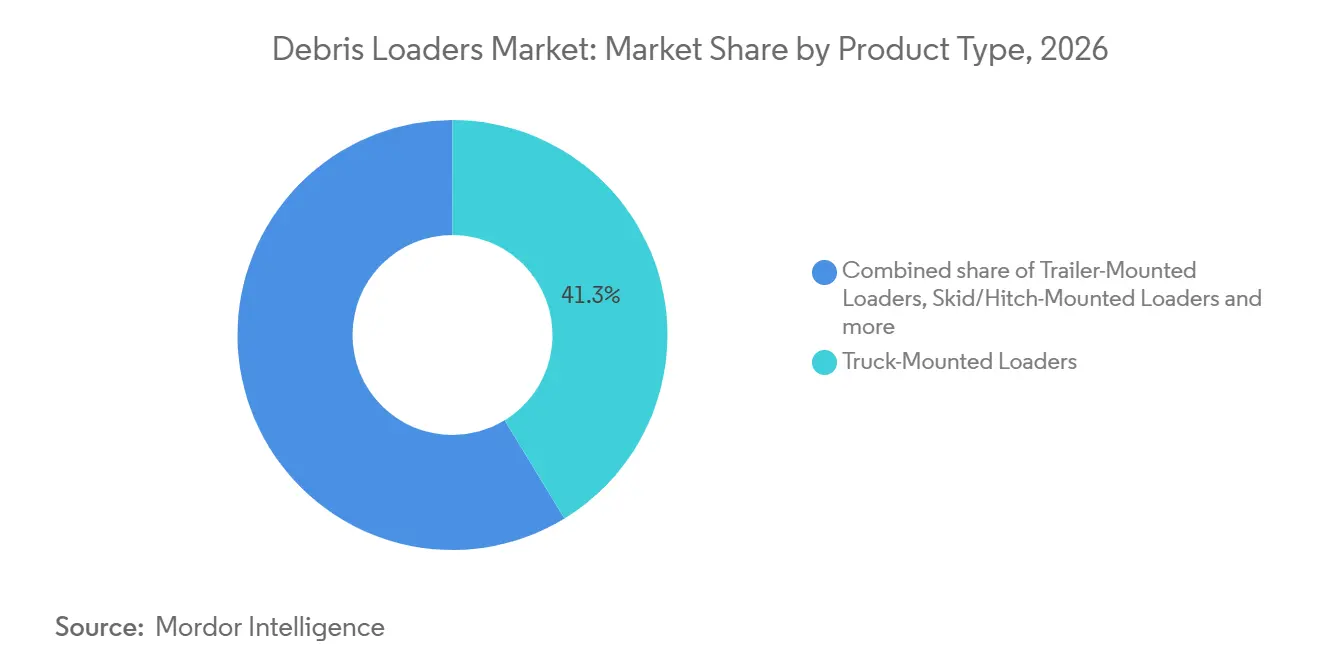
Truck-Mounted Platforms Dominant, Hitch Configurations AcceleratingTruck-mounted loaders held a 41.27% share of the debris loaders market in 2026. Their position reflects municipal demand for high-capacity collection systems with in-cab boom control and efficient route coverage. These platforms suit public-works fleets that need a dedicated machine for planned curbside programs. They can also support a single operator, which is important where seasonal crews are difficult to hire. Trailer-mounted equipment serves buyers seeking an alternative to a dedicated chassis. Walk-behind and self-propelled units remain relevant where access limits prevent larger vehicles from entering a site.
Skid/hitch-mounted loaders are projected to grow at a 5.47% CAGR through 2032. Contractors can move these units between trucks, which helps use a single loader across several jobs. The arrangement can reduce the need to pair each collection system with one permanent vehicle. This makes the configuration useful for commercial landscaping fleets facing short but intense collection seasons. Product development in the debris loaders market is also emphasizing equipment that can be demounted when a truck is needed for another role. Hooklift systems support this approach by allowing a municipal chassis to serve different tasks through the year.

By Collection Mechanism:
Vacuum Segment Entrenched, Grapple Loader RisingVacuum/suction loaders held a 72.36% share of the debris loaders market in 2026. Their broad use follows established municipal preference for high-airflow collection on leaf routes. Impeller-based systems can collect loose material and reduce its volume before it is transported to a disposal or processing site. This supports a more efficient route when high volumes of leaves gather along curbs. Vacuum equipment also fits routine grounds-maintenance use where material is relatively light and uniform. Sweepers and other specialized collector arrangements continue to serve sites where surface precision matters more than volume.
Knuckleboom/grapple loaders are projected to grow at a 5.63% CAGR through 2032. Their appeal is strongest in storm-response work where debris is larger, heavier, and more varied than routine leaf material. A grapple can handle woody debris and construction remnants that would be unsuitable for a suction-based system. The debris loaders market benefits from this capability because weather recovery work requires equipment that can operate without additional ground handling. Municipal emergency plans and contractor fleets can use grapple systems for material at rights-of-way and temporary staging areas. The equipment is also useful when tree debris must be loaded quickly after an event.
By Power Source:
Engine-Driven Segment Dominant, Electric Platform Fastest GrowingEngine-driven units held a 68.42% share of the debris loaders market in 2026. Gasoline and diesel systems remain established because they support long workdays and are familiar to fleet maintenance teams. They are particularly suited to peak autumn periods when equipment may operate for extended shifts. PTO and hydraulic systems also remain relevant in municipal grounds fleets that already use tractors as base vehicles. This equipment format can fit European operating practices that favor tractor-based maintenance equipment. Existing supply chains and familiarity with services continue to support engine-driven equipment in the debris loaders market.
Electric and battery units are projected to grow at an 11.36% CAGR through 2032. Their adoption is linked to emissions rules, the need for quieter operation, and municipalities' interest in zero-emission fleet options. California’s zero-emission standards for covered small off-road engines make the transition to electric power more important for affected applications. Electric platforms can be particularly useful on urban routes where equipment noise is a procurement concern. Buyers still assess runtime, charging arrangements, and seasonal utilization before changing their fleet mix. Manufacturers are responding by offering battery systems designed to support a full work shift in selected compact-equipment applications.
By Engine Power:
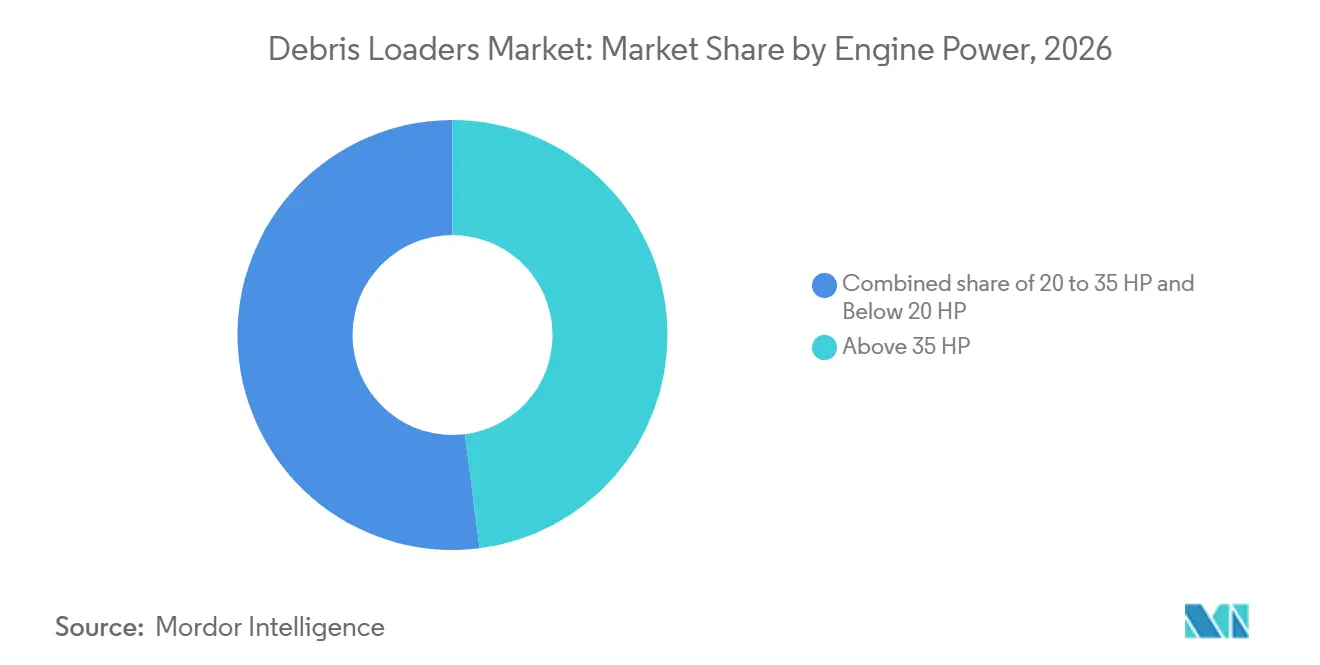
Above 35 HP Bracket Leading, Below-20 HP GrowingLoaders above 35 HP held a 48.00% share of the debris loaders market in 2026. This range covers the truck-mounted and high-capacity trailer-mounted systems that municipalities use on curbside leaf routes, where airflow and throughput determine how quickly a route can be completed. Public-works fleets favor these units for large seasonal volumes and storm-related debris. The 20 to 35 HP category held a 36.00% share, serving many trailer-mounted and skid-mounted machines used by contractor fleets. It provides sufficient output for common collection routes without requiring the larger chassis used in heavy municipal systems. Its position reflects the balance between throughput, mobility, and operating cost.
Below-20 HP loaders are projected to grow at a 5.29% CAGR through 2032. This range is relevant to smaller sites, residential service contractors, golf facilities, and institutional campuses. Compact electric equipment is becoming more visible in these applications because noise and local emissions can matter more than maximum airflow. The debris loaders market can gain from buyers that need a machine suited to restricted access or shorter collection routes. These operators may prioritize equipment that is easy to transport and simple to store. The growth outlook also reflects regulatory attention on smaller spark-ignition equipment.
By End User:
Municipal Demand Anchors, Storm-Response Contractors Fastest GrowingMunicipalities and public works departments held a 52.37% share of the debris loaders market in 2026. Their demand is tied to recurring leaf collection, street maintenance, public-site upkeep, and scheduled replacement programs. These buyers often require equipment that combines collection capacity with consistent route performance. Budget cycles can smooth fleet replacement, though they can also delay purchases when local funds are constrained. Municipal teams value systems that reduce manual raking and limit the crew size required for a route. This end-user group gives the debris loaders industry a stable base of demand, despite the seasonal nature of collection work.
Storm and disaster clean-up contractors are projected to grow at a 6.17% CAGR through 2032. Their work is driven by the need to clear vegetative and mixed debris after severe weather. Contractors need machines that can handle changing site conditions and move between response zones. This favors grapple equipment, durable truck-mounted platforms, and machines that can be deployed quickly. The debris loaders market may see stronger demand in locations with frequent storm recovery activity.
Geography Analysis
North America held a 46.28% share of the debris loaders market in 2026. Mature municipal curbside leaf-collection programs in the northeastern and midwestern United States support the region’s leading position. Public-works departments in these areas maintain seasonal collection schedules that require specialized equipment, predictable route planning, and dependable maintenance support. Storm-response contractors across the Gulf Coast and southeastern states create a separate demand base for larger debris-handling equipment. Canada and Mexico add demand through urban municipalities with public-cleanliness programs and seasonal vegetation collection needs.
Europe has a moderate growth outlook because operators are replacing equipment and seeking machines capable of performing multiple grounds-maintenance tasks. The European debris loaders market is shaped by non-road engine requirements that influence equipment selection and place greater emphasis on compliant power systems, practical service support, and quieter operation. Germany, France, and the United Kingdom have established municipal fleets, while Benelux and Nordic operators commonly use tractor-based equipment. PTO-driven vacuum collectors fit this model because they can work with machinery already used for public grounds maintenance. The region’s buyers also seek longer annual use from a chassis or collector body before committing capital to specialized equipment.
Asia-Pacific is projected to grow at a 6.04% CAGR through 2032. The Asia-Pacific debris loaders market benefits from municipal sanitation modernization in China and Japan, commercial landscaping activity in South Korea and Southeast Asia, and post-disaster work in coastal India and the Philippines. Regional manufacturers are developing electric leaf-vacuum platforms that differ from truck-focused designs common in North America. Japan and Australia have more mature municipal programs, while South America, the Middle East, and Africa face budget limits, intermittent procurement, and narrower service networks for specialized machinery. Differences in municipal funding and dealer coverage will continue to shape equipment adoption across these markets.

Competitive Landscape
The debris loaders market is moderately concentrated. The Toro Company, Briggs & Stratton through Billy Goat, Schiller Grounds Care through Little Wonder, Old Dominion Brush Company, and Tarco are among the leading suppliers. Their combined position does not give a small group of manufacturers control over pricing or regulatory direction. Regional and international producers continue to address local mounting preferences, power choices, dealer relationships, and specialized use cases. This structure gives buyers several options when they need a particular chassis arrangement or collection method.
Suppliers are following two main product paths. Some are improving emissions compliance and electric capability for access to regulated markets. Others are developing configurable systems that help operators use equipment across several seasons and reduce idle time outside leaf collection. Billy Goat introduced the Leaf Dragon-X in October 2026 as a trailer-mounted option for commercial contractor fleets, while Old Dominion Brush has developed a single-engine collector truck system and ECO-MODE technology for municipal and contractor applications. These moves show how suppliers are balancing fuel use, route productivity, quiet operation, and flexibility without relying on one product format.
European suppliers such as TRILO, Votex B.V., Peruzzo Srl, and RABAUD compete through PTO-driven and multi-functional systems designed for tractor-equipped fleets. North American manufacturers have greater visibility in truck-mounted systems, while European suppliers are well placed in flexible collector configurations. Battery-electric equipment remains an open area for suppliers that can meet municipal duty-cycle requirements. Low-noise equipment is another opportunity where local rules limit early-morning collection work. Compact grapple attachments could also suit narrow urban streets during storm recovery, giving the debris loaders market another defined product opportunity.
Debris Loaders Industry Leaders
-
The Toro Company
-
Briggs & Stratton, LLC
-
Schiller Grounds Care, Inc.
-
Old Dominion Brush Company, Inc.
-
Tarco, Inc.
- *Disclaimer: Major Players sorted in no particular order

Debris Loaders Market Companies Covered in this Report
- The Toro Company
- Briggs & Stratton, LLC
- Schiller Grounds Care, Inc.
- Old Dominion Brush Company, Inc.
- Harper Industries, Inc.
- Metalcraft of Mayville, Inc.
- Midwest Equipment Mfg.
- Alamo Group Inc.
- Venture Products, Inc.
- Buffalo Turbine LLC
- Curbtender, Inc.
- New PECO, Inc.
- PwrQuip LLC
- TRILO Smart Industries
- Yangzhou Weibang Garden Machine Co., Ltd.
- RABAUD
- Peruzzo Srl
- Votex B.V.
- Tarco, Inc.
Recent Industry Developments in Debris Loaders Market
- October 2026: Billy Goat Industries launched the Leaf Dragon-X (DL3702VE), a 37 HP trailer-mounted debris loader with 5,050 CFM of suction for large contractor fleets.
- January 2026: Alamo Group completed its acquisition of Petersen Industries, a manufacturer of truck-mounted grapple loaders for municipal and industrial customers.
- December 2025: Alamo Group agreed to acquire Petersen Industries to expand its grapple loader offering for municipal and industrial customers.
Global Debris Loaders Market Report Scope
The Debris Loaders Market is segmented by Product Type, Collection Mechanism, Power Source, Engine Power, End User, and Geography. By Product Type, the market is segmented into Truck-Mounted Loaders, Trailer-Mounted Loaders, Skid/Hitch-Mounted Loaders, and Walk-Behind and Self-Propelled Loaders. By Collection Mechanism, the market is segmented into Vacuum/Suction Loaders, Knuckleboom/Grapple Loaders, and Other Collection Mechanisms. By Power Source, the market is segmented into Engine-Driven (Gasoline, Diesel), PTO/Hydraulic-Driven, and Electric and Battery. By Engine Power, the market is segmented into Below 20 HP, 20 to 35 HP, and Above 35 HP. By End User, the market is segmented into Municipalities and Public Works, Landscaping and Grounds-Maintenance Contractors, Golf Courses and Sports Turf, Storm and Disaster Clean-Up Contractors, and Other End Users (Institutional Campuses, Residential). By Geography, the market is segmented into North America (United States, Canada, and Mexico), Europe (Germany, France, United Kingdom, Italy, Spain, Russia, Nordic Countries, Benelux, and Rest of Europe), Asia-Pacific (China, Japan, South Korea, India, Australia, Southeast Asia, and Rest of Asia-Pacific), South America (Brazil, Argentina, Chile, Colombia, and Rest of South America), and Middle East and Africa (Turkey, Saudi Arabia, United Arab Emirates, Israel, Iran, Egypt, South Africa, and Rest of Middle East and Africa). Market forecasts are provided in terms of Value (USD) and Volume (Units).
Segmentation Overview
| Truck-Mounted Loaders |
| Trailer-Mounted Loaders |
| Skid/Hitch-Mounted Loaders |
| Walk-Behind and Self-Propelled Loaders |
| Vacuum/Suction Loaders |
| Knuckleboom/Grapple Loaders |
| Other Collection Mechanisms |
| Engine-Driven (Gasoline, Diesel) |
| PTO/Hydraulic-Driven |
| Electric and Battery |
| Below 20 HP |
| 20 to 35 HP |
| Above 35 HP |
| Municipalities and Public Works |
| Landscaping and Grounds-Maintenance Contractors |
| Golf Courses and Sports Turf |
| Storm and Disaster Clean-Up Contractors |
| Other End Users (Institutional Campuses, Residential) |
| North America | United States |
| Canada | |
| Mexico | |
| Europe | Germany |
| France | |
| United Kingdom | |
| Italy | |
| Spain | |
| Russia | |
| Nordic Countries | |
| Benelux | |
| Rest of Europe | |
| Asia-Pacific | China |
| Japan | |
| South Korea | |
| India | |
| Australia | |
| Southeast Asia | |
| Rest of Asia-Pacific | |
| South America | Brazil |
| Argentina | |
| Chile | |
| Colombia | |
| Rest of South America | |
| Middle East and Africa | Turkey |
| Saudi Arabia | |
| United Arab Emirates | |
| Israel | |
| Iran | |
| Egypt | |
| South Africa | |
| Rest of Middle East and Africa |
| By Product Type | Truck-Mounted Loaders | |
| Trailer-Mounted Loaders | ||
| Skid/Hitch-Mounted Loaders | ||
| Walk-Behind and Self-Propelled Loaders | ||
| By Collection Mechanism | Vacuum/Suction Loaders | |
| Knuckleboom/Grapple Loaders | ||
| Other Collection Mechanisms | ||
| By Power Source | Engine-Driven (Gasoline, Diesel) | |
| PTO/Hydraulic-Driven | ||
| Electric and Battery | ||
| By Engine Power | Below 20 HP | |
| 20 to 35 HP | ||
| Above 35 HP | ||
| By End User | Municipalities and Public Works | |
| Landscaping and Grounds-Maintenance Contractors | ||
| Golf Courses and Sports Turf | ||
| Storm and Disaster Clean-Up Contractors | ||
| Other End Users (Institutional Campuses, Residential) | ||
| By Geography | North America | United States |
| Canada | ||
| Mexico | ||
| Europe | Germany | |
| France | ||
| United Kingdom | ||
| Italy | ||
| Spain | ||
| Russia | ||
| Nordic Countries | ||
| Benelux | ||
| Rest of Europe | ||
| Asia-Pacific | China | |
| Japan | ||
| South Korea | ||
| India | ||
| Australia | ||
| Southeast Asia | ||
| Rest of Asia-Pacific | ||
| South America | Brazil | |
| Argentina | ||
| Chile | ||
| Colombia | ||
| Rest of South America | ||
| Middle East and Africa | Turkey | |
| Saudi Arabia | ||
| United Arab Emirates | ||
| Israel | ||
| Iran | ||
| Egypt | ||
| South Africa | ||
| Rest of Middle East and Africa | ||
Key Questions Answered in the Report
What is the projected value of the debris loaders market by 2032?
The debris loaders market is projected to reach USD 275.82 million by 2032, from USD 220.17 million in 2027. The forecast reflects replacement demand, municipal collection programs, and equipment needs following severe weather.
What is driving demand for debris loaders?
Municipal labor shortages, mechanized leaf collection, storm recovery work, and organic-waste collection programs support demand. Buyers also value equipment that lowers manual work and can serve several seasonal assignments.
Which debris loader product type has the largest share?
Truck-mounted loaders lead product types with a 41.27% share in 2026. Their scale and operator control suit municipal curbside routes that require high-volume collection and predictable performance.
Which power source is growing fastest for debris loaders?
Electric and battery units are projected to grow at an 11.36% CAGR through 2032. Their outlook is linked to emissions requirements, quieter operation, and fleet interest in zero-emission equipment.