
DDR6 and CXL Memory Expansion Technology Market Size and Share
Market Overview
| Study Period | 2020 - 2031 |
|---|---|
| Market Size (2026) | USD 0.59 Billion |
| Market Size (2031) | USD 6.78 Billion |
| Growth Rate (2026 - 2031) | 62.96 % |
| Fastest Growing Market | Asia-Pacific |
| Largest Market | North America |
| Market Concentration | Medium |
Major Players *Disclaimer: Major Players sorted in no particular order Image © Mordor Intelligence. Reuse requires attribution under CC BY 4.0. | |
DDR6 and CXL Memory Expansion Technology Market Analysis by Mordor Intelligence
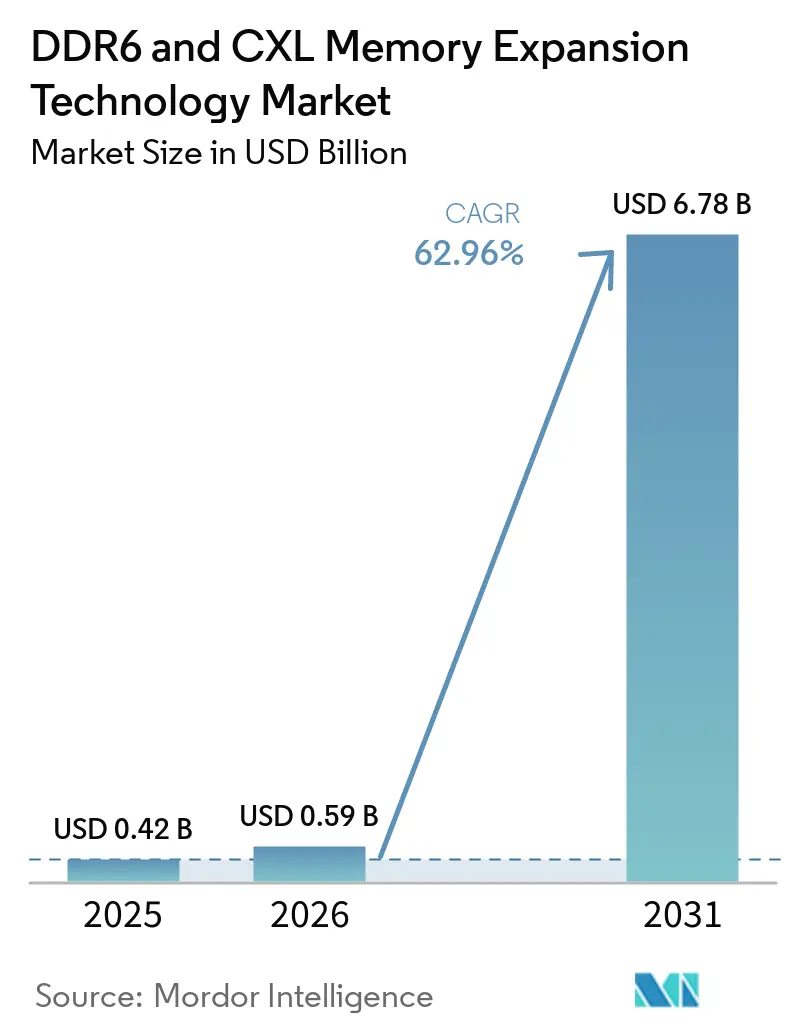
The DDR6 And CXL Memory Expansion Technology Market size is projected to expand from USD 0.42 billion in 2025 and USD 0.59 billion in 2026 to USD 6.78 billion by 2031, registering a CAGR of 62.96% between 2026 to 2031. The DDR6 and CXL memory expansion technology market is moving into commercial use as hyperscale operators deploy CXL 2.0 memory expansion modules in production servers and prepare for broader pooling architectures. Demand is rising because AI inference workloads need far more active memory, especially for long context models and large recommendation systems. The DDR6 and CXL memory expansion technology market is also benefiting from a clear cost case, since disaggregated memory can reduce stranded DRAM and improve server use across large fleets. Competition is taking shape across memory modules, switches, controllers, and software, which means value is no longer limited to DRAM supply alone. The next phase of growth depends on CPU platform readiness, software maturity, and the ability of vendors to turn early validation programs into repeat deployments.
Key Report Takeaways
- By technology, CXL Memory Expansion led with 43.1% share of the DDR6 and CXL memory expansion technology market in 2025, while CXL Memory Pooling and Sharing is projected to grow at a 64.3% CAGR through 2031.
- By component, hardware held 76.6% share of the DDR6 and CXL memory expansion technology market in 2025, while software is projected to expand at a 64.8% CAGR through 2031.
- By application, cloud and hyperscale computing accounted for 35.8% share in 2025, while AI and machine learning are projected to grow at a 65.0% CAGR through 2031.
- By end user, hyperscale cloud services held a 51.2% share of the DDR6 and CXL memory expansion technology market in 2025, and this segment is projected to record the highest CAGR of 65.2% through 2031.
- By geography, North America held 53.9% share in 2025, while the Asia Pacific is projected to expand at a 63.9% CAGR through 2031.
Note: Market size and forecast figures in this report are generated using Mordor Intelligence’s proprietary estimation framework, updated with the latest available data and insights as of January 2026.
Global DDR6 and CXL Memory Expansion Technology Market Trends and Insights
Drivers Impact Analysis*
| Driver | (~) % Impact on CAGR Forecast | Geographic Relevance | Impact Timeline |
|---|---|---|---|
| Rising AI, GenAI, And Machine Learning Inference Demand | +8.5% | Global, with concentration in North America and Asia Pacific hyperscale clusters | Short term (≤ 2 years) |
| Memory Overprovisioning Reduction Via CXL Disaggregation | +6.2% | Global, with early gains in U.S.-based hyperscale and colocation operators | Short term (≤ 2 years) |
| Native CXL Enablement In New Server CPU Platforms | +5.8% | North America and Europe for Intel and AMD adoption, Asia Pacific for server OEM adoption | Medium term (2-4 years) |
| DDR6 Transition And High-Bandwidth DRAM Demand | +4.7% | Global, with first-mover advantage in South Korean and U.S. server ecosystems | Medium term (2-4 years) |
| Software-Defined Memory Solutions And Orchestration Tooling | +3.1% | North America and Europe, extending into Asia Pacific enterprise environments | Medium term (2-4 years) |
| Disaggregated Memory Architecture Adoption In Composable Infrastructure | +2.8% | North America and Asia Pacific core regions, with early spillover into Europe hyperscale | Long term (≥ 4 years) |
| Source: Mordor Intelligence | |||
Rising AI, GenAI, and Machine Learning Inference Demand
The DDR6 and CXL memory expansion technology market is being driven by a memory bottleneck that arises when AI inference runs at scale. Long-running context-transformer workloads need the full KV-cache to remain active, which pushes memory demand beyond what HBM and local DDR can handle on their own. A peer-reviewed IEEE study found that CXL-pooled memory achieved much higher throughput than HBM-only, recompute, and distributed DDR setups once the context length exceeded the HBM-fit range of 100,000 tokens.[1] SK hynix reported in 2026 that its IMTE architecture, which places CXL hybrid memory between DDR and SSD, improved AI inference efficiency by 35.7%. As AI agents, recommendation models, and long context systems expand, CXL memory is shifting from a cost tool into a functional requirement for deployment.
Memory Overprovisioning Reduction Via CXL Disaggregation
The DDR6 and CXL memory expansion technology market is also gaining support from the need to reduce wasted DRAM across server fleets. Traditional server design fixes memory to each host, so spare capacity often sits idle even when other systems are constrained. Meta demonstrated this at ISCA 2026, where its Vistara deployment used a custom CXL ASIC to connect decommissioned DDR4 memory to new AMD EPYC Turin servers and reduced the need for AI inference servers. The same deployment lowered out-of-memory failures and distributed cache latency across millions of production servers. This makes CXL useful not only for efficiency and capital control but also for extending memory life during server refresh cycles.
Native CXL Enablement in New Server CPU Platforms
The DDR6 and CXL memory expansion technology market depends on server CPUs that treat CXL as a true memory tier rather than a limited add-on feature. Micron published test results showing that CXL E3.S devices used alongside DDR5 on Intel Xeon platforms improved bandwidth across read-only and mixed read-and-write workloads. The same study reported performance gains across tested HPC and AI workloads. As server shipments move toward platforms built for newer PCIe standards and richer CXL support, the installed base for commercial memory expansion and pooling should widen. Compliance work within the CXL Consortium is also lowering integration risk by improving device interoperability and validation visibility.
DDR6 Transition and High-Bandwidth DRAM Demand
The DDR6 and CXL memory expansion technology market is also tied to the next step in server DRAM performance. DDR6 is being positioned as the next major memory transition, with higher transfer speeds and architecture changes that support denser server designs. Industry reports indicate that DDR6 is expected to deliver significantly higher base speeds than DDR5. The same reports note that DDR6 could support much higher peak speeds and module bandwidth, which explains why vendors are preparing early for qualification and platform pairing. Rather than competing with CXL, faster local DDR should make CXL more attractive as a capacity tier, since the performance role and the capacity role become clearer inside the same server architecture.
Restraints Impact Analysis*
| Restraint | (~) % Impact on CAGR Forecast | Geographic Relevance | Impact Timeline |
|---|---|---|---|
| High Integration And Validation Costs For CXL Platforms | -6.4% | Global, more acute in enterprise and mid-tier data centers than hyperscale | Medium term (2-4 years) |
| Legacy Server Compatibility Constraints | -4.9% | Asia Pacific enterprise and Europe mid-market, less acute for greenfield U.S. hyperscale | Medium term (2-4 years) |
| Software Ecosystem Immaturity For CXL Memory Tiering | -4.2% | Global, most pronounced in non-hyperscale enterprise environments | Medium term (2-4 years) |
| Latency Sensitivity Requirements In Mission-Critical Workloads | -3.1% | Global, with concentration in financial services and real-time enterprise workloads | Long term (≥ 4 years) |
| Source: Mordor Intelligence | |||
High Integration and Validation Costs for CXL Platforms
The DDR6 and CXL memory expansion technology market still faces heavy validation demands before large enterprise rollouts can become routine. CXL deployments require testing across protocol compliance, PCIe link integrity, NUMA behavior, firmware combinations, and operating system page placement. A 2026 IEEE Transactions on Computers study found that CPU and DRAM internals, rather than the CXL protocol itself, dominated latency and variability, but it also stressed the need for structured qualification around link errors, interference, and failure behavior.[2] Samsung disclosed that it had supplied CXL 2.0 samples to more than 40 companies, including major cloud and server vendors, underscoring the breadth of the validation workload remaining before scaled deployment. This favors hyperscalers with dedicated hardware teams and slows adoption in enterprise data centers that rely on packaged and prequalified infrastructure.
Legacy Server Compatibility Constraints
The DDR6 and CXL memory expansion technology market is also limited by the installed base of older servers. CXL memory expansion needs host CPUs with native protocol support over PCIe 5.0 or PCIe 6.0, so many older DDR4-era systems cannot use CXL devices at all. Samsung stated in its 2025 CXL material that current constraints should ease as CXL 3.0-based platforms from Intel and AMD enter the market. That means the realistic addressable fleet in 2026 is much smaller than the total server base, even if interest from operators is strong. Longer refresh cycles in enterprise data centers, especially outside the fastest hyperscale clusters, will keep this restraint in place for several years.
*Our forecasts treat driver/restraint impacts as directional, not additive. The impact forecasts reflect baseline growth, mix effects, and variable interactions.
Segment Analysis
By Technology: CXL Memory Expansion Anchors Share While Pooling Scales Fastest
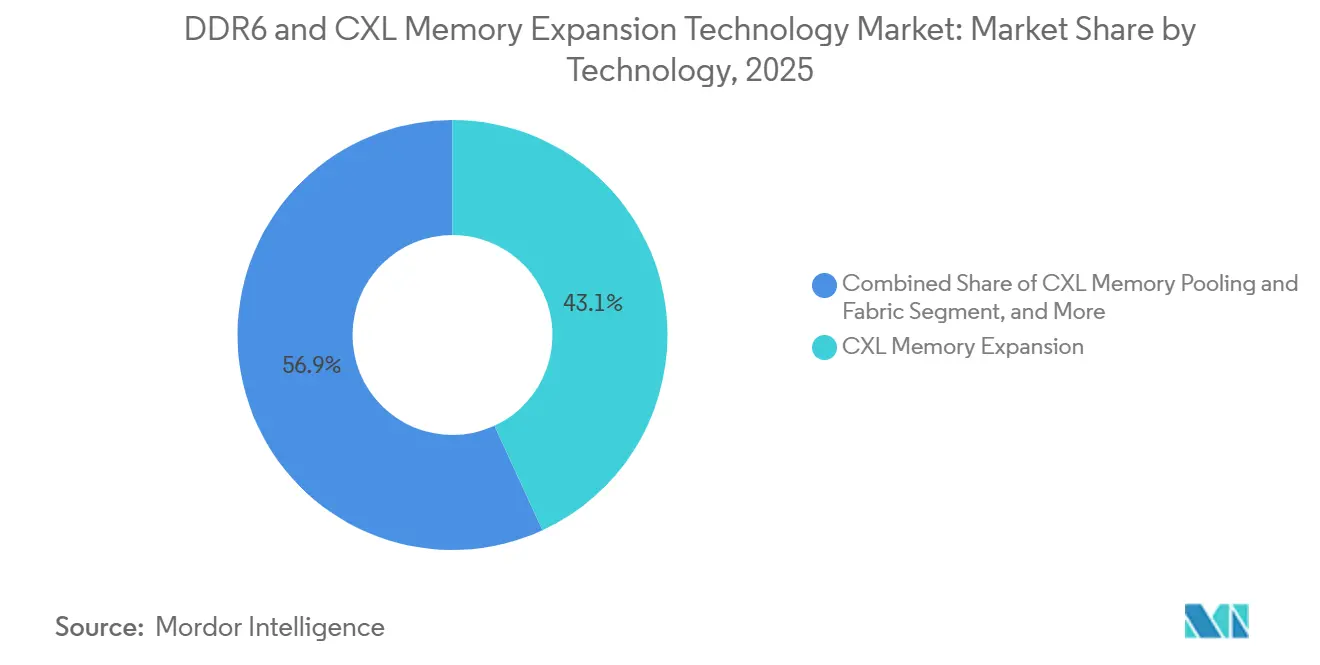
CXL Memory Expansion held 43.1% of the DDR6 and CXL memory expansion technology market share in 2025, making it the largest technology segment at the start of commercialization. Hyperscale customers adopted this layer first because single-host expansion solves immediate capacity gaps without needing the full complexity of shared fabrics. Micron’s CZ122 module, described as the first CXL 2.0-compliant product, was integrated by AIC into the SB201-SU storage server platform with Intel in May 2025. That rollout showed how the early DDR6 and CXL memory expansion technology industry formed around server vendors, CPU suppliers, and module developers working in tandem.
CXL Memory Pooling and Sharing is forecast to grow at a 64.3% CAGR through 2031, making it the fastest-growing technology segment in the DDR6 and CXL memory expansion technology market. This shift points to a move away from isolated server upgrades and toward rack-level memory allocation across multiple hosts. XConn Technologies and MemVerge demonstrated a 100 TiB commercial CXL memory pool at the OCP Global Summit 2025, providing the market with a visible example of a larger shared-fabric deployment. The infrastructure layer for that transition is also expanding, with Marvell launching the Structera S 30260 in 2026 as a 260-lane CXL 3.0 switch designed for up to 48 TB of shared memory across 16 to 32 hosts.[3]

By Component: Hardware Dominates but Software Economics Drive Platform Value
Hardware held 76.6% of the DDR6 and CXL memory expansion technology market size in 2025, reflecting the capital-heavy nature of module design, switch silicon, controllers, and retimers in an early-stage buildout. The lead is large because initial deployments require specialized devices that still carry premium pricing relative to standard DRAM. Services remained the smallest component segment, largely tied to deployment support, platform qualification, and enterprise integration. Software, however, is forecast to grow at a 64.8% CAGR through 2031, which makes it the fastest-growing component area in the DDR6 and CXL memory expansion technology market.
This pattern matters because the hardware value proposition depends on how well memory tiering, page placement, and orchestration are handled in production environments. Micron’s Xeon 6 testing showed that CXL expansion can add meaningful bandwidth and application gains, but those gains still need system-level control to remain stable under real workloads. Astera Labs positioned its Leo CXL Smart Memory Controllers for Microsoft Azure M-series virtual machines in 2025, targeting in-memory databases, AI inference, and KV-cache workloads. That is why the DDR6 and CXL memory expansion technology industry is starting to reward vendors that combine silicon with software-aware deployment models instead of selling hardware in isolation.
By Application: AI and Machine Learning Sets the Growth Ceiling
AI and machine learning is projected to expand at a 65.0% CAGR through 2031, making it the fastest-growing application in the DDR6 and CXL memory expansion technology market. Demand here comes from LLM inference, recommendation model embeddings, and multi-agent systems that need far more active memory than standard server layouts can provide. An IEEE DATE 2026 study found that CXL-based pooled memory for embedding operations delivered 2.84x throughput improvement over conventional memory management in large-scale AI recommendation inference. DOI.ORG That helps explain why AI workloads are setting the pace for commercial CXL adoption across hyperscale environments.
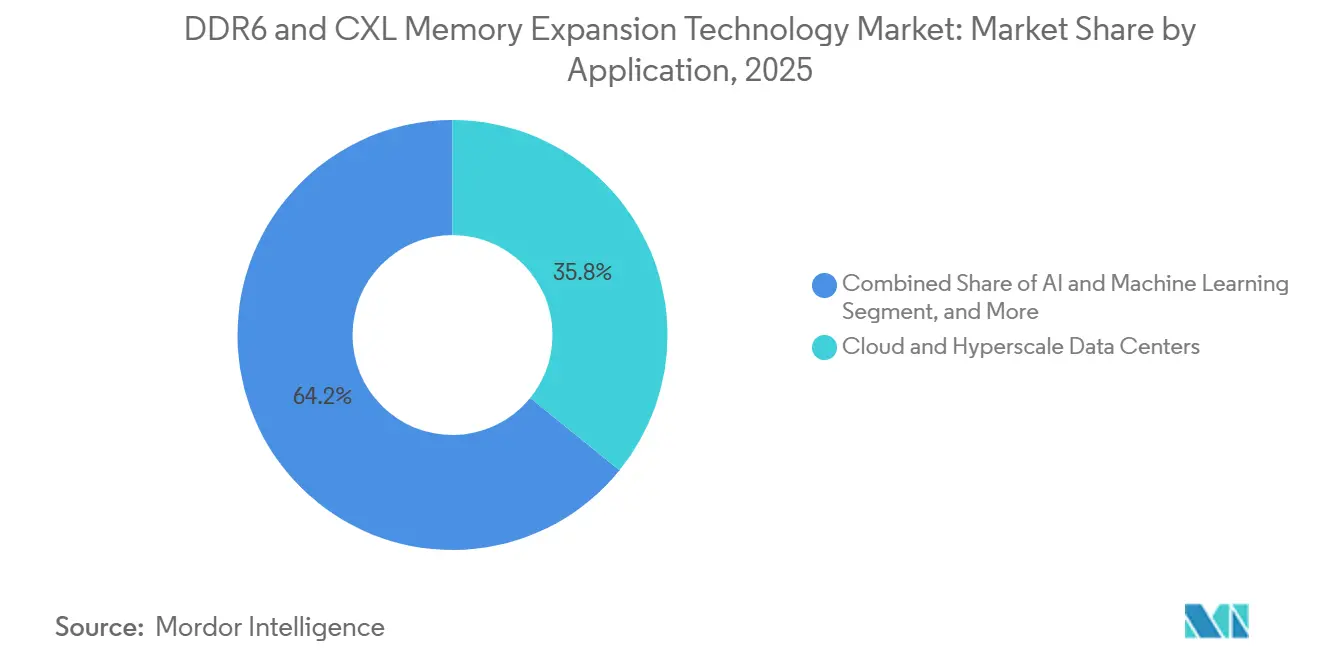
Cloud and hyperscale computing still accounted for 35.8% of the 2025 DDR6 and CXL memory expansion technology market, indicating that adoption extends beyond AI alone. This category includes distributed caches, build systems, relational databases, and other memory-hungry workloads that benefit from capacity expansion even when AI is not the primary driver. Micron’s published Xeon 6 results showed a 24% geometric mean speedup across HPC and AI workloads, supporting the broader case for mixed-workload adoption. Astera Labs also tied early cloud deployment to database and inference use cases, which indicates that application breadth will remain important even as AI captures more of the growth in the DDR6 and CXL memory expansion technology market.
By End User: Hyperscale Cloud Services Drive Both Scale and Speed
Hyperscale cloud services held 51.2% share of the end-user base in 2026 and also recorded the highest projected CAGR of 65.2% through 2031 in the DDR6 and CXL memory expansion technology market. This is unusual because the largest end-user segment is also the fastest-growing one. It reflects the fact that hyperscalers have the validation teams, procurement scale, and software depth needed to move forward with early CXL adoption. Astera Labs announced in 2025 that its Leo controllers were deployed on Microsoft Azure M-series virtual machines, which marked the first announced cloud deployment of CXL-attached memory.
The next adoption layer includes enterprise data centers, colocation, and managed services, where buying behavior is shaped more by qualification and support than by first-mover speed. Server OEMs and integrators, therefore, act as commercial gatekeepers, since non-hyperscale buyers often prefer certified server designs over direct component integration. Meta’s Vistara work shows what is possible at a very large scale, but it also highlights the internal engineering effort required to unlock the full value of disaggregated memory. Research institutions, government users, and telecom operators remain smaller in current revenue terms, yet their testing and architecture work still matter because they broaden the pipeline of use cases for the DDR6 and CXL memory expansion technology industry.
Geography Analysis
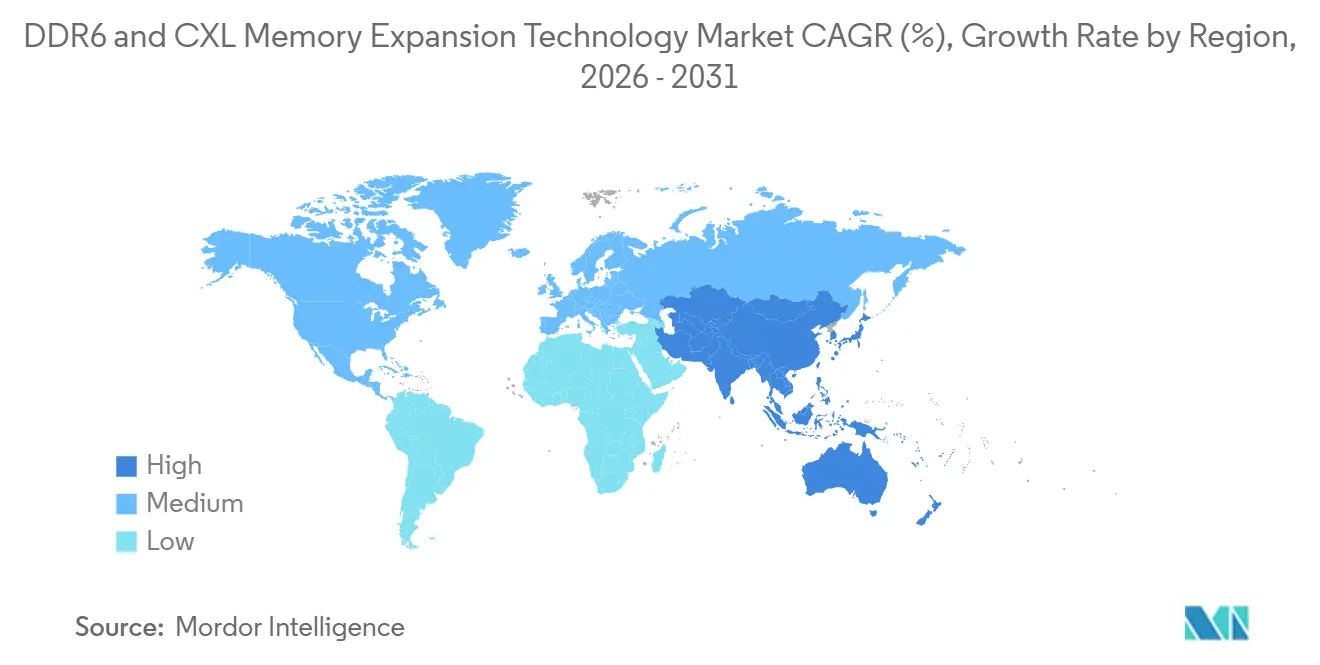
North America held 53.9% of the DDR6 and CXL memory expansion technology market share in 2025, which made it the clear leading region. The region benefits from the largest concentration of hyperscale data center capacity and a deep vendor base across controllers, software, and systems integration. The DDR6 and CXL memory expansion technology market in North America is also supported by close links between platform developers and cloud buyers, which shortens pilot cycles. Astera Labs’ 2025 Azure deployment provided a strong commercial signal that CXL-attached memory had moved beyond lab testing and into cloud infrastructure. The presence of companies such as Astera Labs, MemVerge, GigaIO, and Liqid also strengthens the regional ecosystem around software and fabric-level architecture.
Asia Pacific is projected to grow at a 63.9% CAGR through 2031, making it the fastest-growing region in the DDR6 and CXL memory expansion technology market. Growth is being supported by the region’s strength in DRAM manufacturing, packaging, substrate supply, and domestic AI infrastructure programs. Samsung and SK hynix intensified competition in 2026 around CXL 3.2-based memory modules, with both companies focusing on higher-bandwidth next-generation products. Montage Technology also launched its CXL 3.1 MXC chip in 2025 and confirmed bulk supply that year, which points to a rising domestic controller ecosystem in China. Taiwan remains important through substrate manufacturers, while Japan is advancing integration work that connects CXL with broader distributed infrastructure models.
Europe and the Rest of the World hold smaller shares, but both remain strategically relevant to the DDR6 and CXL memory expansion technology market. In Europe, early evaluation is centered on database expansion and memory-intensive enterprise workloads, especially where high memory per core matters. Rest of the World in 2026 remained more dependent on hyperscale cloud access than on direct ownership of advanced CXL infrastructure. Over time, sovereign AI buildouts and new data center investment could create a wider buyer base once platform compatibility and software maturity improve.
Competitive Landscape
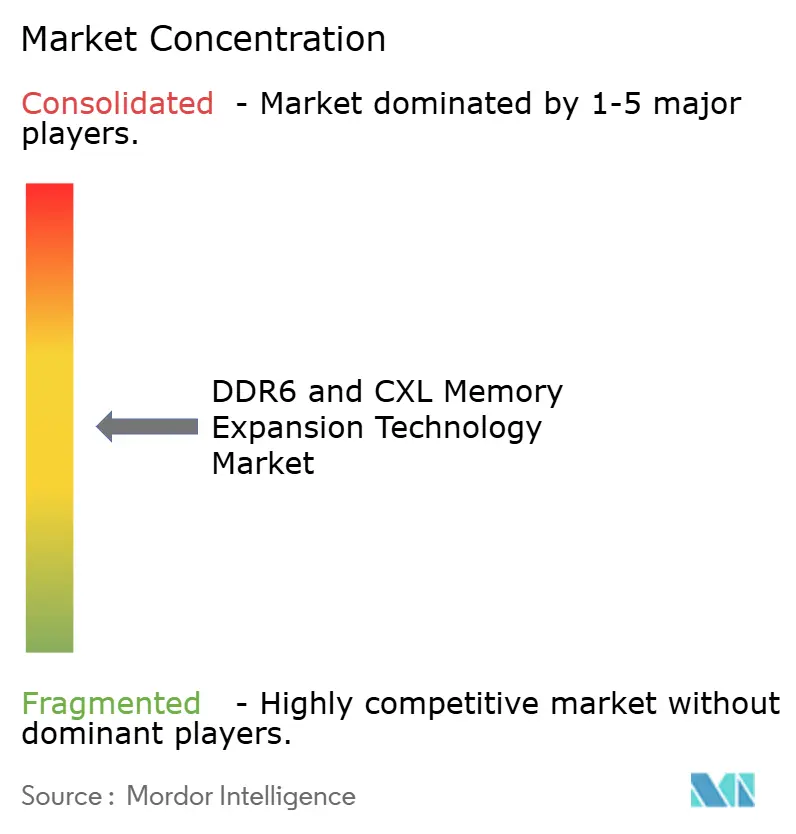
The DDR6 and CXL memory expansion technology market is fragmented across the full value chain, even though some layers are highly concentrated. Samsung Electronics, SK hynix, and Micron held dominant positions in global DRAM supply in 2025, giving them a strong starting point for memory module development. Even so, open standards limit how much long-term differentiation can be maintained in basic Type-3 expansion devices. That is why the DDR6 and CXL memory expansion technology market is becoming more competitive in controllers, switches, retimers, and orchestration software.
Marvell strengthened its position in 2026 by launching the Structera S 30260 following its acquisition of XConn Technologies, underscoring how quickly the fabric infrastructure is consolidating. The product supports up to 4 TB/s aggregate bandwidth and targets rack-scale shared memory, which places Marvell near the center of next-generation pooling deployments. Astera Labs took a different route by tying its Leo controllers to a cloud deployment on Microsoft Azure, which gave it a strong proof point in commercial infrastructure. Montage Technology also expanded its position with the launch and bulk supply of its CXL 3.1 MXC chip, indicating that China’s domestic ecosystem is building a parallel supply path in controllers.
Software and systems integration remain the most open competitive areas in the DDR6 and CXL memory expansion technology market. MemVerge, Liqid, and GigaIO are all trying to make CXL practical at the workload level, where memory placement and pooling must work without heavy application rewrites. Meta’s Vistara deployment showed that system-level software can be the difference between a technical feature and a large production gain. This means competitive advantage is shifting toward vendors that can combine interoperable hardware with stable operational tooling, rather than relying only on component performance.
DDR6 and CXL Memory Expansion Technology Industry Leaders
-
Samsung Electronics Co., Ltd.
-
SK hynix Inc.
-
Micron Technology, Inc.
-
Intel Corporation
-
Advanced Micro Devices, Inc.
- *Disclaimer: Major Players sorted in no particular order
Recent Industry Developments
- July 2026: Samsung Electronics and SK hynix intensified competition to mass-produce CXL 3.2-based memory modules within the year. Samsung is targeting end-of-2026 mass production of its CMM-D 3.0 featuring the CXL Hot Page Monitoring Unit function, while SK hynix began sales of its second-generation CMM-DDR5 sample at HPED 2026, both companies reportedly doubling bandwidth versus their prior-generation CXL 2.0 products.
- June 2026: Meta presented its Vistara CXL 2.0 ASIC at ISCA 2026, disclosing hyperscale deployment across millions of production servers. The chip bridges decommissioned DDR4 memory to new AMD EPYC Turin servers, delivering a 25% reduction in AI inference server count, 33% fewer out-of-memory failures, and 29% lower distributed cache latency.
- March 2026: Marvell Technology launched the Structera S 30260, a 260-lane CXL 3.0 switch supporting up to 48 TB of shared memory across 16-32 hosts at 4 TB/s aggregate bandwidth, expected to begin sampling to customers in Q3 2026 and positioned as the first purpose-built CXL switching solution for rack-scale AI memory pooling.
- November 2025: The CXL Consortium released the CXL 4.0 specification, doubling interconnect bandwidth from 64 GT/s to 128 GT/s with zero added latency via PCIe 7.0 integration, adding bundled port support and enhanced memory RAS features for production AI infrastructure.
Global DDR6 and CXL Memory Expansion Technology Market Report Scope
The DDR6 and CXL Memory Expansion Technology market comprises next-generation memory technologies, hardware, software, and infrastructure solutions that enhance server memory capacity, bandwidth, scalability, and utilization through DDR6 memory and Compute Express Link (CXL)-based memory expansion architectures. The market includes DDR6 memory devices, CXL memory expansion modules, CXL memory pooling and fabric solutions, CXL controllers, switches, retimers, supporting software platforms, and integration services.
The DDR6 and CXL Memory Expansion Technology Market Report is Segmented by Technology (DDR6 Memory, CXL Memory Expansion, CXL Memory Pooling and Fabric, and CXL Controllers, Switches, and Retimers), Component (Hardware, Software, and Services), Application (AI and Machine Learning, High-Performance Computing, Cloud and Hyperscale Data Centers, In-Memory Databases and Analytics, Enterprise IT and Virtualization, and Edge and Telecom Infrastructure), End User (Hyperscale Cloud Service Providers, Enterprise Data Centers, Colocation and Managed Service Providers, Server OEMs and System Integrators, Research and Academic Institutions, Government and Defense, and Telecom Operators), and Geography (North America, Europe, Asia-Pacific, and Rest of the World). The Market Forecasts are Provided in Terms of Value (USD).
| DDR6 Memory |
| CXL Memory Expansion |
| CXL Memory Pooling and Fabric |
| CXL Controllers, Switches, and Retimers |
| Hardware |
| Software |
| Services |
| AI and Machine Learning |
| High-Performance Computing |
| Cloud and Hyperscale Data Centers |
| In-Memory Databases and Analytics |
| Enterprise IT and Virtualization |
| Edge and Telecom Infrastructure |
| Hyperscale Cloud Service Providers |
| Enterprise Data Centers |
| Colocation and Managed Service Providers |
| Server OEMs and System Integrators |
| Research and Academic Institutions |
| Government and Defense |
| Telecom Operators |
| North America | |
| Europe | |
| Asia Pacific | China |
| Japan | |
| South Korea | |
| Taiwan | |
| Rest of Asia Pacific | |
| Rest of the World |
| By Technology | DDR6 Memory | |
| CXL Memory Expansion | ||
| CXL Memory Pooling and Fabric | ||
| CXL Controllers, Switches, and Retimers | ||
| By Component | Hardware | |
| Software | ||
| Services | ||
| By Application | AI and Machine Learning | |
| High-Performance Computing | ||
| Cloud and Hyperscale Data Centers | ||
| In-Memory Databases and Analytics | ||
| Enterprise IT and Virtualization | ||
| Edge and Telecom Infrastructure | ||
| By End User | Hyperscale Cloud Service Providers | |
| Enterprise Data Centers | ||
| Colocation and Managed Service Providers | ||
| Server OEMs and System Integrators | ||
| Research and Academic Institutions | ||
| Government and Defense | ||
| Telecom Operators | ||
| By Geography | North America | |
| Europe | ||
| Asia Pacific | China | |
| Japan | ||
| South Korea | ||
| Taiwan | ||
| Rest of Asia Pacific | ||
| Rest of the World | ||
Key Questions Answered in the Report
What is driving adoption of DDR6 and CXL memory expansion technology in data centers?
The main driver is AI inference, where long context models and embedding workloads need much more active memory. The DDR6 and CXL memory expansion technology market is projected to grow from USD 0.6 billion in 2026 to USD 6.8 billion by 2031 at a 63% CAGR.
Which application is growing the fastest in this space?
AI and machine learning is the fastest-growing application, with a projected 65.0% CAGR through 2031, supported by KV-cache, recommendation models, and multi-agent workloads.
Which region leads current demand for DDR6 and CXL memory expansion technology?
North America led in 2025 with a 53.9% share because hyperscale cloud deployment and ecosystem depth are strongest there.
Which region is expanding the fastest?
Asia Pacific is the fastest-growing region, with a projected 63.9% CAGR through 2031, supported by DRAM manufacturing strength and rising local CXL ecosystem activity.
Why is software becoming important in CXL deployment?
Software is the fastest-growing component segment at a 64.8% CAGR because memory tiering, orchestration, and page placement determine whether hardware gains can be sustained in production.
Who are the key competitors across the value chain?
Samsung, SK hynix, and Micron are strong in memory supply, while Marvell, Astera Labs, Montage Technology, MemVerge, Liqid, and GigaIO are important in switches, controllers, and system-level orchestration for the DDR6 and CXL memory expansion technology market.