
DDR5 Workstation Memory Module Market Size and Share
Market Overview
| Study Period | 2020 - 2031 |
|---|---|
| Market Size (2025) | USD 1.95 Billion |
| Market Size (2031) | USD 3.34 Billion |
| Growth Rate (2026 - 2031) | 11.36 % |
| Fastest Growing Market | Asia-Pacific |
| Largest Market | North America |
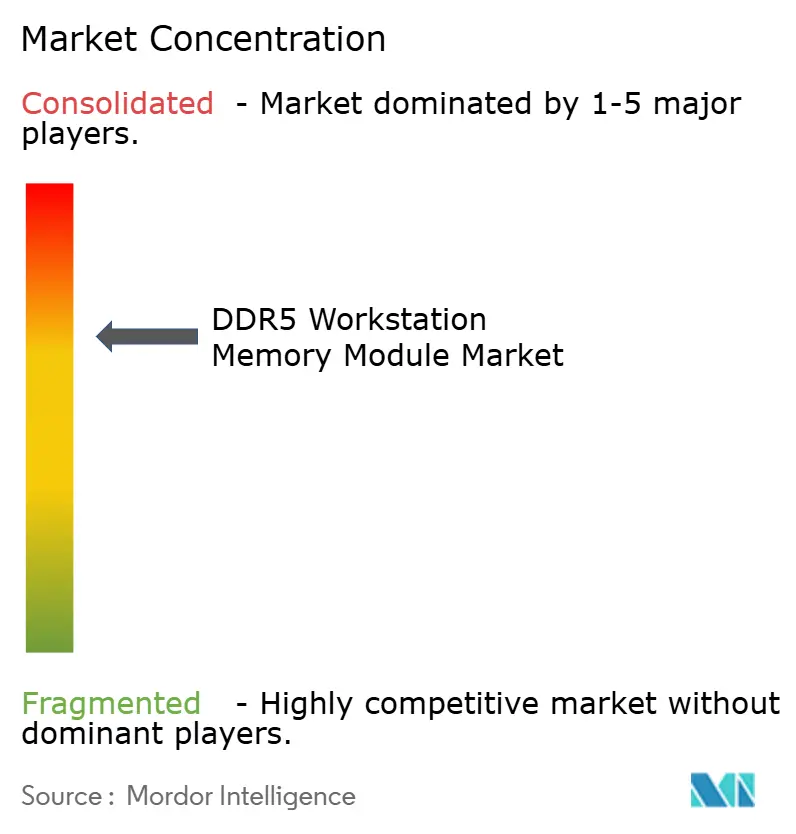
| Market Concentration | Medium |
Major Players *Disclaimer: Major Players sorted in no particular order Image © Mordor Intelligence. Reuse requires attribution under CC BY 4.0. | |
DDR5 Workstation Memory Module Market Analysis by Mordor Intelligence
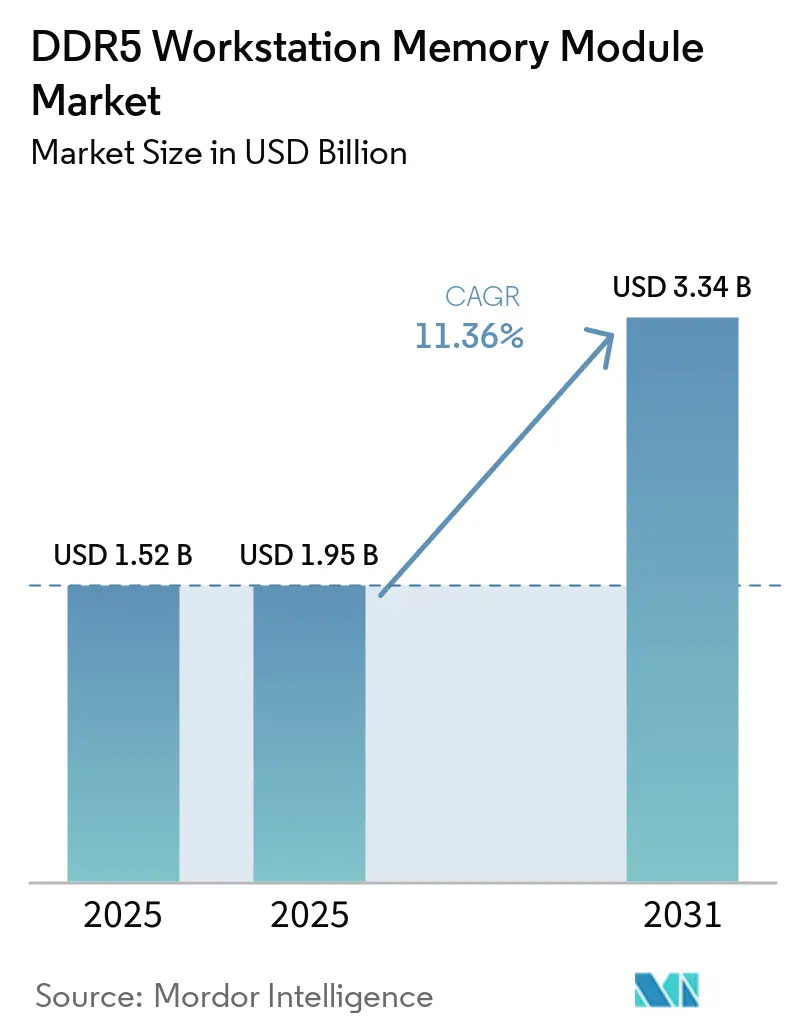
The DDR5 workstation memory module market size is projected to be USD 1.52 billion in 2025, USD 1.95 billion in 2026, and reach USD 3.34 billion by 2031, growing at a CAGR of 11.36% from 2026 to 2031. New Intel Xeon and AMD Threadripper PRO platforms are shifting professional buyers away from DDR4 systems, as DDR5 is now the required memory architecture for many new workstation designs. Local AI, simulation, and content workflows are making memory capacity a more immediate purchasing concern, as several applications run simultaneously. This favors suppliers that can provide qualified ECC, high-density, and high-speed modules for professional platforms. Supply allocation to HBM has also raised the importance of secure DRAM sourcing and long-term OEM relationships. The DDR5 workstation memory module market is therefore shaped by platform qualification, capacity requirements, and the ability to serve enterprise refresh programs.
Key Report Takeaways
- By memory type, ECC DDR5 held 62.48% of the DDR5 workstation memory module market share in 2025 and is forecast to grow at an 11.52% CAGR through 2031.
- By form factor, RDIMM and 3DS RDIMM accounted for 48.21% of demand in 2025, while CAMM and CAMM2 are forecast to grow at a 12.42% CAGR through 2031 in the DDR5 workstation memory module market.
- By capacity, the 32 GB to 64 GB tier held 40.67% in 2025, while the above-128 GB tier is forecast to grow at a 12.39% CAGR through 2031 in the DDR5 workstation memory module market.
- By speed, the up to 4800 MT/s tier held 36.44% in 2025, while the above 6400 MT/s tier is forecast to grow at a 12.36% CAGR through 2031 in the DDR5 workstation memory module market.
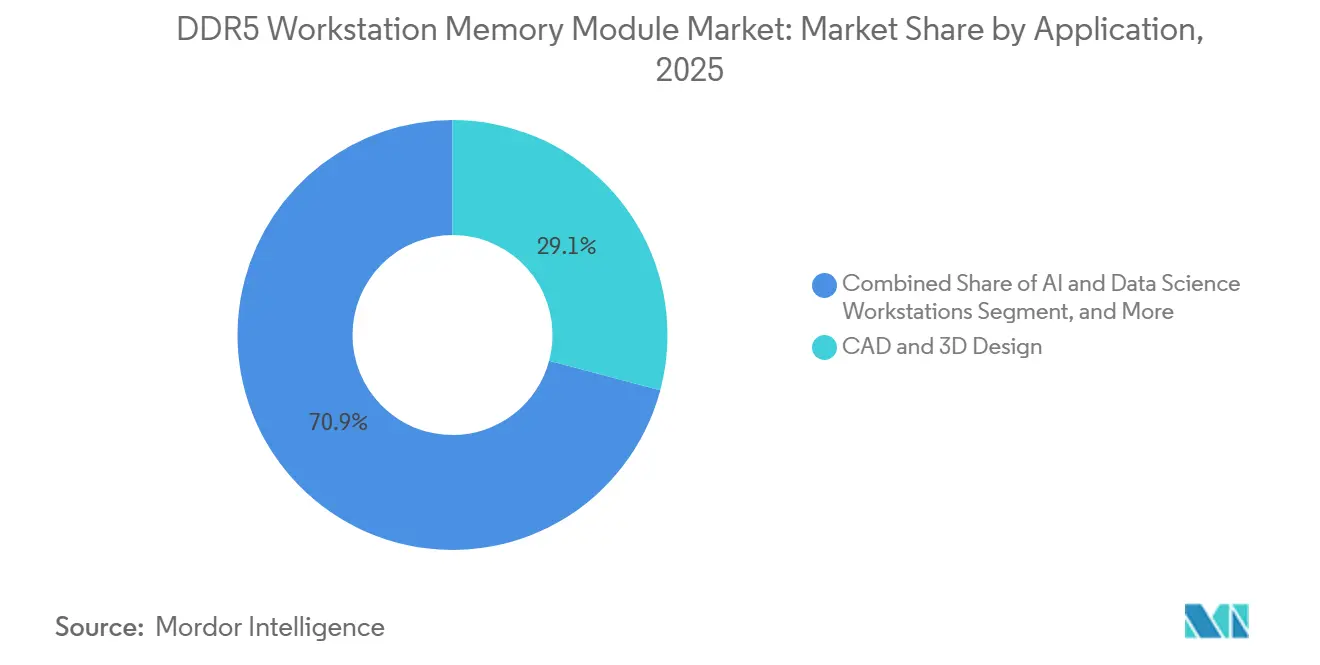
- By application, CAD and 3D Design held 29.14% in 2025, while AI and Data Science Workstations are forecast to grow at a 12.47% CAGR through 2031 in the DDR5 workstation memory module market.
- By distribution channel, OEMs and System Integrators held 69.32% in 2025, while Enterprise VARs and IT Resellers are forecast to grow at a 12.18% CAGR through 2031 in the DDR5 workstation memory module market.
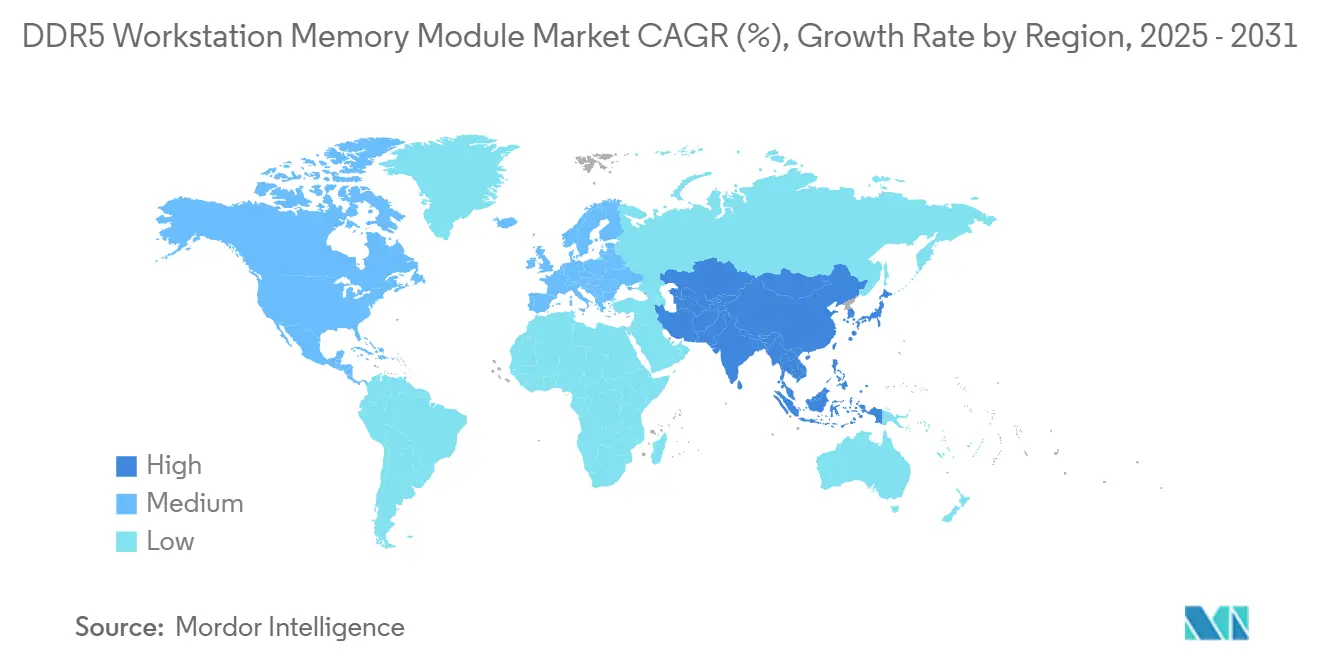
- By geography, North America held 38.56% in 2025, while the Asia Pacific is forecast to grow at a 12.31% CAGR through 2031 in the DDR5 workstation memory module market.
Note: Market size and forecast figures in this report are generated using Mordor Intelligence’s proprietary estimation framework, updated with the latest available data and insights as of January 2026.
Global DDR5 Workstation Memory Module Market Trends and Insights
Drivers Impact Analysis*
| Driver | (~) % Impact on CAGR Forecast | Geographic Relevance | Impact Timeline |
|---|---|---|---|
| Migration of Professional Workstations to DDR5 Platforms | +2.8% | Global | Short term (≤ 2 years) |
| Rising Memory Demand From AI-Assisted Design, Simulation, and Content Creation | +2.3% | North America and Asia Pacific | Short term (≤ 2 years) |
| Higher Capacity Requirements in CAD, 3D Rendering, and Engineering Workflows | +2.0% | North America and Europe | Medium term (2-4 years) |
| Broader Adoption of ECC for Data Integrity in Mission-Critical Workstations | +1.8% | North America and Europe | Medium term (2-4 years) |
| Rapid Refresh Cycles in OEM Workstation Platforms and Chipset Ecosystems | +1.4% | Global | Short term (≤ 2 years) |
| Module Specialization for High-Density, Low-Profile, and Thermally Constrained Systems | +0.8% | Asia Pacific core, spillover to North America | Long term (≥ 4 years) |
| Source: Mordor Intelligence | |||
Migration of Professional Workstations to DDR5 Platforms
Professional workstation migration is a major source of demand for the DDR5 workstation memory module market. Intel Xeon 6 and AMD Threadripper PRO 9000WX platforms use DDR5 architectures, making DDR4 a legacy option for new compatible workstation builds. JEDEC published the JESD305B.01 DDR5 RDIMM Common Standard in April 2026, establishing electrical and mechanical requirements for 288-position DDR5 registered DIMMs used in server, workstation, and database environments. A common standard helps module makers and OEMs assess compatibility against a shared technical reference. It also reduces the qualification burden when workstation designs introduce new processors, boards, and firmware revisions. The DDR5 workstation memory module market benefits as professional buyers replace systems rather than extending DDR4 configurations.
Rising Memory Demand From AI-Assisted Design, Simulation, and Content Creation
AI-assisted workflows are raising the memory baseline for professional systems in the DDR5 workstation memory module market. Micron reported in May 2026 that, in a demonstration, a 128 GB Dell Pro Max configuration completed a concurrent agentic AI workflow 30% faster than a 64 GB configuration.[1] The comparison covered simultaneous speech-to-text, image generation, and language-model reasoning workloads. CPU, GPU, and operating system processes can compete for the same system memory pool in these workstation environments. Higher-capacity configurations can therefore reduce memory contention and limit offloads during local multi-model work. This need supports demand for qualified high-density RDIMMs in engineering, financial modeling, generative media, and simulation workstations.
Higher Capacity Requirements in CAD, 3D Rendering, and Engineering Workflows
Large CAD models, physically based rendering, and engineering simulations require more active memory as project files and datasets become more complex. The above 128 GB capacity tier is forecast to grow at a 12.4% CAGR through 2031, while the above 32 GB to 64 GB tier remained the established volume range in 2025. Micron stated in May 2026 that 128 GB is becoming a practical baseline for agentic AI workflows where several models and processes operate together. SK hynix completed Intel Data Center Certification for a 256 GB DDR5 RDIMM based on its 32Gb 1b die in December 2025. The company reported up to 16% higher inference performance and 18% lower power consumption than its prior 128 GB module design. Higher-density products give workstation suppliers a path to expand capacity without using more slots.
Broader Adoption of ECC for Data Integrity in Mission-Critical Workstations
ECC memory is becoming more relevant in situations where incorrect outputs, simulation interruptions, or data corruption pose professional or financial risk. ECC DDR5 held 62.5% of demand in 2025 and is forecast to grow at an 11.5% CAGR through 2031. JEDEC’s JESD79-5D standard describes DDR5 SDRAM requirements and includes reliability and security features relevant to AI and machine learning applications. On-die ECC provides component-level correction in DDR5 devices, while sideband ECC in registered DIMMs adds system-level protection. This distinction matters for regulated and high-consequence workloads such as financial computing, pharmaceutical research, structural engineering, and AI development. Kingston expanded its FURY Renegade Pro DDR5 RDIMM range in 2026 to support Intel XMP and AMD EXPO profiles for professional workloads.[2]
Restraints Impact Analysis*
| Restraint | (~) % Impact on CAGR Forecast | Geographic Relevance | Impact Timeline |
|---|---|---|---|
| Premium Pricing Versus DDR4 and Mainstream Non-ECC Alternatives | -1.6% | Global | Short term (≤ 2 years) |
| Platform Compatibility Constraints Across CPUs, Chipsets, and Motherboards | -1.2% | Global, with acute pressure in Asia Pacific | Medium term (2-4 years) |
| Tight Supply for High-Capacity DDR5 ICs and Module Grades | -0.9% | Global | Short term (≤ 2 years) |
| Fragmented Demand Between ECC Workstations and Non-ECC High-Performance Desktops | -0.6% | North America and Europe | Medium term (2-4 years) |
| Source: Mordor Intelligence | |||
Premium Pricing Versus DDR4 and Mainstream Non-ECC Alternatives
DDR5 workstation modules cost more than DDR4 and mainstream non-ECC alternatives, delaying replacement decisions for organizations with fixed technology budgets. Buyers may continue using DDR4 ECC systems as long as existing platforms remain under warranty and workloads do not require greater bandwidth or density. High-capacity configurations require more complex DRAM components and qualification work than standard desktop modules. This can widen the price difference for 64 GB, 96 GB, and 128 GB registered modules. Smaller module vendors also have less ability to absorb changes in supply or component costs when they lack long-term allocation arrangements. These conditions can slow conversion to the DDR5 workstation memory module market even when the performance case is clear.
Platform Compatibility Constraints Across CPUs, Chipsets, and Motherboards
DDR5 workstation memory compatibility depends on the processor, chipset, motherboard, registered clock driver, BIOS revision, and module configuration. Intel W790, W880, and W890 platforms and AMD TRX50 and WRX90 platforms require separate validation paths. A module that has passed validation on one workstation board may not have the same status on another board. Kingston revised the PCB design for its KSM56R46BS8PMI-16HAI ECC RDIMM in July 2026 to improve signal integrity, manufacturability, and mechanical robustness. JEDEC published JESD323B in February 2026 to define common requirements for DDR5 CUDIMM and CQDIMM configurations. Separate form-factor standards add validation work for vendors serving both registered and unbuffered professional systems.
*Our forecasts treat driver/restraint impacts as directional, not additive. The impact forecasts reflect baseline growth, mix effects, and variable interactions.
Segment Analysis
By Memory Type: ECC Leads Professional Demand as Reliability Needs Expand
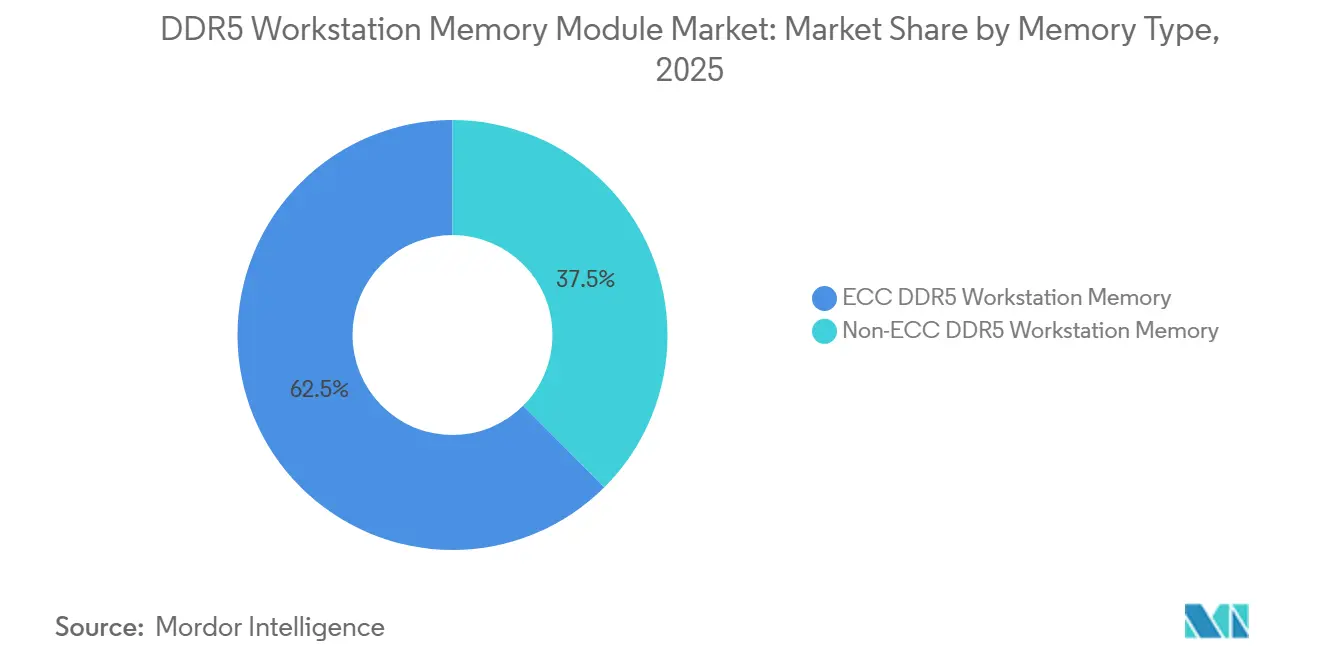
ECC DDR5 held 62.48% of the DDR5 workstation memory module market share in 2025 and is the fastest-growing memory type at an 11.52% CAGR through 2031. This combination reflects a shift from treating error correction as a specialist server feature to treating it as a standard workstation requirement. Engineering, financial analysis, simulation, and AI workloads can consume long processing runs, making system stability a central procurement consideration. ECC modules are especially relevant when undetected errors can affect reports, simulation results, or trained model outputs. JEDEC’s DDR5 standard provides on-die ECC at the device level, which improves baseline component reliability. Sideband ECC and the registered buffer in RDIMMs provide the additional system-level capability sought in many professional installations. Kingston, Corsair, and G.SKILL have developed ECC-oriented workstation memory offerings, indicating that branded suppliers are adding more depth to qualified professional configurations. The DDR5 workstation memory module market, therefore, gives ECC suppliers a wider commercial base than previous workstation memory generations.
Non-ECC DDR5 accounted for the remaining 37.5% of 2025 demand and remains relevant for creative, animation, and content production workloads. These users can prioritize bandwidth, speed tuning, and lower platform cost over system-level error correction. CUDIMM and CQDIMM formats provide a route to improved signal integrity in high-speed unbuffered designs. JEDEC’s JESD323B establishes common electrical and mechanical requirements for these module types, which supports broader cross-vendor qualification JEDEC. Apacer offers an industrial DDR5 CQDIMM with a 4-rank design, capacity up to 128 GB, and speeds up to 7200 MT/s for AI, HPC, and edge computing applications. The performance gap between ECC and non-ECC products can narrow in specific workloads, but their risk profiles remain different. As AI systems are deployed in more business-critical settings, buyers may favor ECC when reliability requirements outweigh a lower initial module cost. This leaves non-ECC products focused on applications where performance tuning and platform flexibility remain the primary buying criteria. Their purchasing decisions also depend on motherboard support, desired capacity, and the software workloads running on each workstation. The DDR5 workstation memory module market retains this category because many professional users still value configurable high-speed memory.
By Form Factor: RDIMM Maintains the Installed Base While CAMM2 Builds Momentum
RDIMM and 3DS RDIMM held 48.21% of the DDR5 workstation memory module market in 2025. Their position reflects the installed base of Intel Xeon and AMD Threadripper PRO systems, where registered memory is a platform requirement. Registered clock drivers support higher-capacity and multi-channel configurations in professional systems. 3DS RDIMMs can support high-density modules for deployments requiring more than 128 GB per slot. This is increasingly important for AI, modeling, and simulation systems that need large memory pools within a single workstation. Kingston Server Premier products and other qualified RDIMM ranges give OEMs and system builders a broad selection of validated designs. The form factor’s installed base also supports repeat purchasing when existing professional fleets need memory upgrades. The DDR5 workstation memory module industry continues to rely on RDIMMs for systems that require capacity, reliability, and platform certification.
CAMM and CAMM2 are the fastest-growing form-factor category at a 12.42% CAGR through 2031. Their appeal is strongest in mobile workstations and compact systems where vertical clearance and signal path design matter. JEDEC has documented the CAMM2 development path and its potential to create a common modular memory approach across device categories. The format can reduce the space taken by conventional SODIMM layouts near the processor area. Its adoption remains lower than RDIMM and SODIMM because connector standardization and cross-vendor interchangeability are still developing. CAMM2 has a more immediate route in mobile workstations, where compact mechanical design is a pressing constraint. Desktop towers retain entrenched DIMM-slot infrastructure and established procurement processes. The DDR5 workstation memory module market will likely see CAMM2 adoption advance first, where compact professional chassis justify a change in module architecture. Module suppliers must also develop compatible mechanical designs, validation processes, and production support before the format can scale. This makes the transition more gradual than a simple replacement of existing DIMM slots.
By Capacity: The 32 GB to 64 GB Range Remains the Volume Core
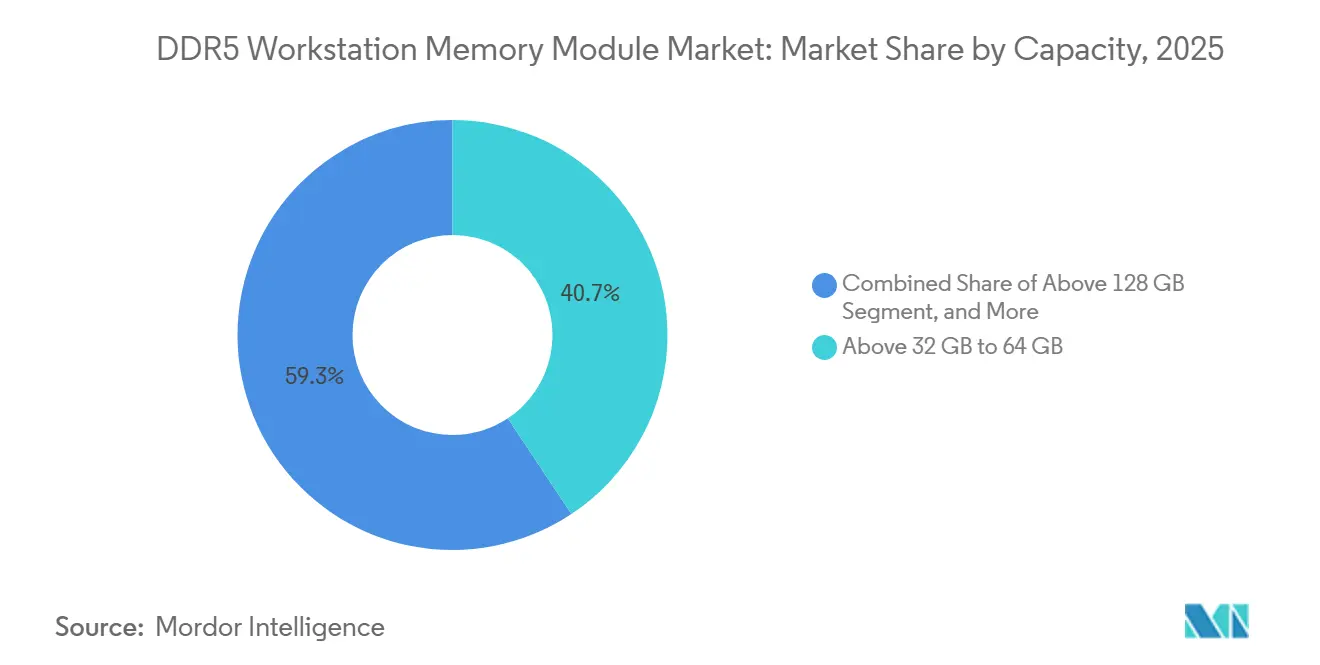
The above 32 GB to 64 GB tier held 40.67% of the DDR5 workstation memory module market in 2025 and is forecast to grow at an 11.14% CAGR through 2031. This range remains suitable for mixed CAD, engineering simulation, and general professional workloads. It gives buyers more working capacity than entry configurations without the higher sourcing burden of dense modules. Broad availability across vendors and chipsets also supports standardized OEM builds and enterprise fleet procurement. Corsair offers 64 GB DDR5 ECC RDIMM kits at 6400 MT/s for compatible Intel workstation platforms, illustrating the concentration of product options in this range. TEAMGROUP also offers high-capacity workstation-oriented DDR5 configurations that can scale from 256 GB to 512 GB using 64 GB modules. The 32 GB to 64 GB range, therefore, remains a practical configuration point for organizations updating large workstation fleets. It also acts as a step between older DDR4 systems and high-density AI configurations.
The above 128 GB tier is the fastest-growing capacity group at a 12.4% CAGR through 2031. Micron’s 2026 assessment of agentic AI workflows identifies 128 GB as a useful baseline when several models and services operate together. Larger capacity can reduce paging and cloud offloads during active local processing. Micron sampled a 256 GB DDR5 RDIMM architecture in 2026, pointing to a higher per-slot capacity path for professional systems. SK hynix also completed certification for a 256 GB DDR5 RDIMM on an Intel Xeon 6 platform in 2025.[3] High-density modules can help buyers reach large memory pools without filling every available slot. They also create more complex sourcing requirements because fewer vendors support premium capacities across all workstation platforms. The DDR5 workstation memory module industry is consequently moving toward configurations where capacity planning has equal weight with processor and GPU selection. Capacity upgrades can extend the usable life of a qualified workstation when a full platform replacement is not required. The DDR5 workstation memory module market,, therefor,e, has a greater addressable need for certified high-density products.

By Speed: 4800 MT/s Retains the Largest Installed Base
The up to 4800 MT/s tier held 36.44% of demand in 2025 and is forecast to grow at a 10.9% CAGR through 2031. Its scale reflects the installed base of systems built around Intel Xeon Sapphire Rapids and earlier AMD Threadripper PRO processors. These platforms use 4800 MT/s as their native JEDEC operating point, eliminating the need for manual memory-profile tuning. Engineering, financial, and scientific environments can keep such systems in service for several years because replacement budgets are often planned in cycles. Module suppliers in this category compete on capacity availability, price per GB, and verified compatibility. The 5200 MT/s to 6400 MT/s ranges serve newer workstation platforms with native support for higher DDR5 speeds. These speed bands provide an upgrade path without immediately moving to premium overclocked configurations. The DDR5 workstation memory module market still depends on 4800 MT/s products because installed systems continue to require compatible replacement and expansion modules.
The above 6400 MT/s tier is the fastest-growing speed group at a 12.39% CAGR through 2031. Demand is linked to platform certification activity rather than only to enthusiast-style overclocking. JEDEC advanced its DDR5 MRDIMM roadmap in April 2026, with Gen2 targeting 12,800 MT/s and Gen3 work progressing toward 17,600 MT/s. This roadmap sets longer-term performance expectations for registered memory used in servers and professional systems. Faster memory can support workloads that process large active datasets, including AI inference and complex simulation. However, high-speed configurations require careful validation across the motherboard, processor, BIOS, and cooling conditions. They are therefore more likely to be adopted through qualified OEM or systems-integration channels. The premium speed tier allows vendors to differentiate through platform testing and component engineering rather than frequency alone.
By Application: CAD and 3D Design Remain the Largest Use Case
CAD and 3D Design held 29.14% of application demand in 2025 and is forecast to expand at a 10.9% CAGR through 2031. Large assemblies, building information models, and aerospace component stacks can load large datasets into active memory during a work session. DDR5 bandwidth and capacity support these projects, while ECC configurations help meet professional reliability requirements. Engineering and simulation are closely related because finite element analysis and computational fluid dynamics use many of the same high-capacity workstation specifications. Media, animation, and content creation also benefit from DDR5 during rendering and asset processing. Financial and scientific computing place particular value on ECC because their calculations and research models can be sensitive to memory integrity. These established workloads provide a durable demand base for the DDR5 workstation memory module market. They also support recurring upgrades as software files, datasets, and render requirements become more demanding.
AI and Data Science Workstations are the fastest-growing application at a 12.47% CAGR through 2031. Local inference and training workflows require memory for model weights, active context, application services, and operating system processes. Micron’s 2026 test found that its 128 GB configuration completed concurrent agentic AI work 30% faster than its 64 GB comparison system MICRON. This result shows why capacity can affect workstation throughput when several AI tasks run at the same time. AI deployments are directing buyers toward the above 64 GB to 128 GB and above 128 GB capacity ranges. This creates demand for high-density modules that have been certified for specific professional platforms. The application is also increasing the value of integrated workstation design, since CPU, GPU, storage, and memory choices must be evaluated together. The DDR5 workstation memory module market benefits as AI tools extend from early adopters into engineering, analytics, and creative teams.
By Distribution Channel: OEMs and System Integrators Control Most Revenue
OEMs and System Integrators held 69.32% of the DDR5 workstation memory module market in 2025 and are forecast to grow at an 11.3% CAGR through 2031. Their role reflects the difficulty of validating workstation memory across multiple processors, boards, firmware versions, and thermal designs. OEMs can test RDIMMs against specific systems before the equipment reaches the buyer. This moves memory selection earlier in the procurement process, often before the final workstation is purchased. Factory-qualified memory configurations also reduce deployment risk for enterprises that operate large, standardized fleets. OEM supply-chain relationships can be important when high-capacity module availability is constrained. This channel position gives qualified suppliers an advantage by allowing them to be included in workstation design and validation programs. It also means many users obtain DDR5 memory as part of a complete system rather than as a separate aftermarket purchase.
Enterprise VARs and IT Resellers are the fastest-growing channel at a 12.18% CAGR through 2031. They serve organizations that need to expand memory in installed DDR5 workstation fleets after the original system purchase. A common use case is moving from 64 GB to 128 GB when newly adopted AI tools exceed the system’s initial configuration. Resellers can provide compatibility checking, component sourcing, and installation support for buyerswhot do not want to replace an entire workstation. Retail, e-commerce, and the aftermarket remain relevant for independent builders, research institutions, and smaller creative studios. These buyers often purchase components separately from the chassis and processor. The aftermarket can be more exposed to component supply pressure because it has less purchasing scale than contracted OEM volumes. This gives resellers a growth opportunity when organizations require a verified upgrade path for qualified professional equipment.
Geography Analysis
North America held 38.56% of regional demand in 2025, supported by AI infrastructure investment, major workstation OEM operations, and enterprise demand from financial services, aerospace and defense, and life sciences. These sectors use workstations for tasks where capacity, reliability, and validated configurations matter, while AI labs and cloud providers create demand for adjacent developer and data-science systems. High-capacity RDIMMs and faster speed tiers are more common in these early-adopter professional environments. Micron began 1-alpha DRAM production at its Manassas, Virginia, facility in May 2026 as part of its domestic manufacturing program.[4] The program supports the longer-term regional memory supply position, although it does not remove immediate module allocation constraints, and the DDR5 workstation memory module market retains North America as its leading demand center.
Europe is a stable demand center for professional workstations used in automotive engineering, industrial design, finance, and pharmaceutical research. Germany’s automotive and industrial sectors support CAD and simulation workloads that require qualified ECC memory, while the United Kingdom has financial services and pharmaceutical research activities that require reliable professional computing systems. Nordic data-center investment supports adjacent demand for development and infrastructure workstations. European buyers often favor ECC DDR5 RDIMM configurations where regulatory, engineering, and research requirements place a high value on data integrity. Platform longevity can favor compatible memory upgrades over frequent full-system replacement, making product certification and module availability important in the region.
Asia Pacific is forecast to grow at a 12.31% CAGR through 2031, the fastest pace among the regions. South Korea and Taiwan are important locations for DRAM production and module assembly, while China’s expanding AI infrastructure is increasing demand for high-capacity memory in server and related workstation deployments. Taiwan’s module ecosystem includes ADATA, Transcend, Silicon Power, and V-Color, while South Korean DRAM producers are investing in fabrication capacity expected to strengthen supply through the forecast period. Japan remains relevant to investment in advanced DRAM manufacturing, and the Rest of the World is expanding through sovereign AI programs, digitalization projects, and enterprise technology refreshes that support the DDR5 workstation memory module market.
Competitive Landscape
The DDR5 workstation memory module market has a concentrated upstream DRAM IC supply layer and a more fragmented module-brand layer. Samsung Electronics, SK hynix, and Micron Technology influence the availability, pricing, and specification grades of the DRAM components used by module vendors. Kingston Technology, Corsair, G.SKILL, TEAMGROUP, ADATA, and regional suppliers compete downstream through qualified product ranges, thermal design, and platform support. Access to allocated DRAM supply and established OEM relationships can be as important as module design. SK hynix completed Intel Data Center Certification for a 256 GB DDR5 RDIMM in 2025, and Micron has emphasized the role of higher capacity in concurrent agentic AI workstation workflows.
Module suppliers compete on platform certification depth and advertised speed. Kingston’s July 2026 PCB revision for an ECC RDIMM addressed signal integrity, manufacturability, and mechanical robustness as platform components and firmware evolve. Kingston also added a 16 GB DDR5-5600 ECC RDIMM production SKU in June 2026 for validated workstation and enterprise refreshes. G.SKILL introduced high-capacity DDR5-6000 and DDR5-6400 kits in 2025 for AI workloads, content creation, and professional workstations. CAMM2 suppliers are preparing for a potential shift in mobile workstation architectures, and the DDR5 workstation memory module market rewards suppliers that validate products across several form factors and workstation platforms.
The limited opportunity combines high capacity, high speed, and platform-specific certification. Products in the 256 GB class and speeds above 7200 MT/s require demanding component selection and system testing, allowing early validated products to retain premium positioning. The supplied material does not provide combined market shares for the top module brands or top DRAM suppliers, so a numerical market concentration score cannot be assigned under the stated scoring method. The competitive structure remains concentrated upstream and fragmented downstream, making long-term allocation agreements important for vendors seeking to support large workstation programs.
DDR5 Workstation Memory Module Industry Leaders
-
Kingston Technology Company, Inc.
-
CORSAIR
-
G.SKILL International Enterprise Co., Ltd.
-
Patriot Memory, Inc.
-
TEAMGROUP Inc.
- *Disclaimer: Major Players sorted in no particular order
Recent Industry Developments
- July 2026: Kingston revised the PCB design of its KSM56R46BS8PMI-16HAI DDR5-5600 ECC RDIMM from JEDEC R/C D0 to R/C D1, enhancing signal integrity, manufacturability, and mechanical robustness. The old BOM phase-out is scheduled for September 2026.
- July 2026: Kingston Technology added a new production SKU, the 16 GB DDR5-5600 ECC RDIMM KSM56R46BS8-16MH, a 1Rx8 CL46 server-grade module targeted at workstation and enterprise platform refreshes requiring validated DDR5-5600 ECC RDIMM components.
- April 2026: JEDEC published the JESD82-552 DDR5 Multiplexed Rank Data Buffer standard and advanced the DDR5 MRDIMM Gen2 roadmap targeting 12,800 MT/s, with Gen3 work beginning toward a 17,600 MT/s objective. This standards progression extends DDR5’s performance roadmap beyond standard RDIMM bandwidth, defining the technology path for next-generation high-bandwidth workstation memory.
- December 2025: SK hynix became the first in the industry to complete Intel Data Center Certification for its 32 GB 1a die-based 256 GB DDR5 RDIMM on the Intel Xeon 6 platform, delivering up to 16% higher inference performance and 18% lower power consumption relative to prior 128 GB modules based on 16Gb 1a DRAM.
Global DDR5 Workstation Memory Module Market Report Scope
The DDR5 Workstation Memory Module Market Report is Segmented by Memory Type (ECC DDR5 Workstation Memory, and Non-ECC DDR5 Workstation Memory), Form Factor (RDIMM / 3DS RDIMM, UDIMM / CUDIMM, SODIMM / CSODIMM, and CAMM / CAMM2), Capacity (Up to 4800 MT/s, 5200 MT/s to 5600 MT/s, 6000 MT/s to 6400 MT/s, and Above 6400 MT/s), Speed (Up to 5200 MT/s, 5600 MT/s, and 6000 MT/s and Above), Application (CAD and 3D Design, AI and Data Science Workstations, Engineering and Simulation, Media, Animation, and Content Creation, and Financial and Scientific Computing), Distribution Channel (OEM and System Integrators, Enterprise VARs and IT Resellers, and Retail, E-Commerce, and Aftermarket Upgrade Channel), and Geography (North America, Europe, Asia Pacific, Rest of World). The Market Forecasts are Provided in Terms of Value (USD).
| ECC DDR5 Workstation Memory |
| Non-ECC DDR5 Workstation Memory |
| RDIMM / 3DS RDIMM |
| UDIMM / CUDIMM |
| SODIMM / CSODIMM |
| CAMM / CAMM2 |
| Up to 4800 MT/s |
| 5200 MT/s to 5600 MT/s |
| 6000 MT/s to 6400 MT/s |
| Above 6400 MT/s |
| Up to 5200 MT/s |
| 5600 MT/s |
| 6000 MT/s and Above |
| CAD and 3D Design |
| AI and Data Science Workstations |
| Engineering and Simulation |
| Media, Animation, and Content Creation |
| Financial and Scientific Computing |
| OEM and System Integrators |
| Enterprise VARs and IT Resellers |
| Retail, E-Commerce, and Aftermarket Upgrade Channel |
| North America | |
| Europe | |
| Asia-Pacific | China |
| Japan | |
| South Korea | |
| Taiwan | |
| Rest of Asia-Pacific | |
| Rest of the World |
| By Memory Type | ECC DDR5 Workstation Memory | |
| Non-ECC DDR5 Workstation Memory | ||
| By Form Factor | RDIMM / 3DS RDIMM | |
| UDIMM / CUDIMM | ||
| SODIMM / CSODIMM | ||
| CAMM / CAMM2 | ||
| By Capacity | Up to 4800 MT/s | |
| 5200 MT/s to 5600 MT/s | ||
| 6000 MT/s to 6400 MT/s | ||
| Above 6400 MT/s | ||
| By Speed | Up to 5200 MT/s | |
| 5600 MT/s | ||
| 6000 MT/s and Above | ||
| By Application | CAD and 3D Design | |
| AI and Data Science Workstations | ||
| Engineering and Simulation | ||
| Media, Animation, and Content Creation | ||
| Financial and Scientific Computing | ||
| By Distribution Channel | OEM and System Integrators | |
| Enterprise VARs and IT Resellers | ||
| Retail, E-Commerce, and Aftermarket Upgrade Channel | ||
| By Geography | North America | |
| Europe | ||
| Asia-Pacific | China | |
| Japan | ||
| South Korea | ||
| Taiwan | ||
| Rest of Asia-Pacific | ||
| Rest of the World | ||
Key Questions Answered in the Report
How large is the DDR5 workstation memory module market in 2026?
The DDR5 workstation memory module market size is projected to be USD 1.52 billion in 2025, USD 1.95 billion in 2026, and reach USD 3.34 billion by 2031, growing at a CAGR of 11.36% from 2026 to 2031.
What is driving demand for DDR5 workstation memory modules?
New DDR5 workstation platforms, local AI workflows, simulation, and larger CAD workloads are increasing demand for qualified high-capacity memory. The purchase decision increasingly considers the required capacity, processor and motherboard compatibility, ECC requirements, and the availability of validated module configurations.
Why is ECC DDR5 important for professional workstations?
ECC DDR5 led with 62.48% of 2025 demand because engineering, financial, research, and AI workloads place greater value on data integrity. It can be particularly relevant when a lost calculation, corrupted output, or system interruption would delay a professional project.
Which DDR5 capacity tier is growing fastest for workstations?
The above 128 GB capacity tier is forecast to expand at a 12.39% CAGR through 2031, supported by local AI and multi-model workloads. Higher capacity can keep model weights, active context, and concurrent applications in memory during demanding professional work.
Which region is expanding fastest for DDR5 workstation modules?
Asia Pacific is forecast to grow at a 12.31% CAGR through 2031, supported by DRAM manufacturing, module assembly, and expanding AI infrastructure. The region also combines important supply-chain capabilities in South Korea and Taiwan with growing deployment demand in China.
Which sales channel leads professional DDR5 memory purchases?
OEM and System Integrators held 69.32% in 2025 because platform qualification and factory-configured systems guide most professional purchases. This channel helps buyers obtain memory that has been tested with the chosen processor, motherboard, firmware, and thermal design.