
DDR5 Server Memory RCD IC Market Size and Share
Market Overview
| Study Period | 2020 - 2031 |
|---|---|
| Market Size (2026) | USD 0.92 Billion |
| Market Size (2031) | USD 1.58 Billion |
| Growth Rate (2026 - 2031) | 11.42 % |
| Fastest Growing Market | North America |
| Largest Market | Asia-Pacific |
| Market Concentration | High |
Major Players *Disclaimer: Major Players sorted in no particular order Image © Mordor Intelligence. Reuse requires attribution under CC BY 4.0. | |
DDR5 Server Memory RCD IC Market Analysis by Mordor Intelligence
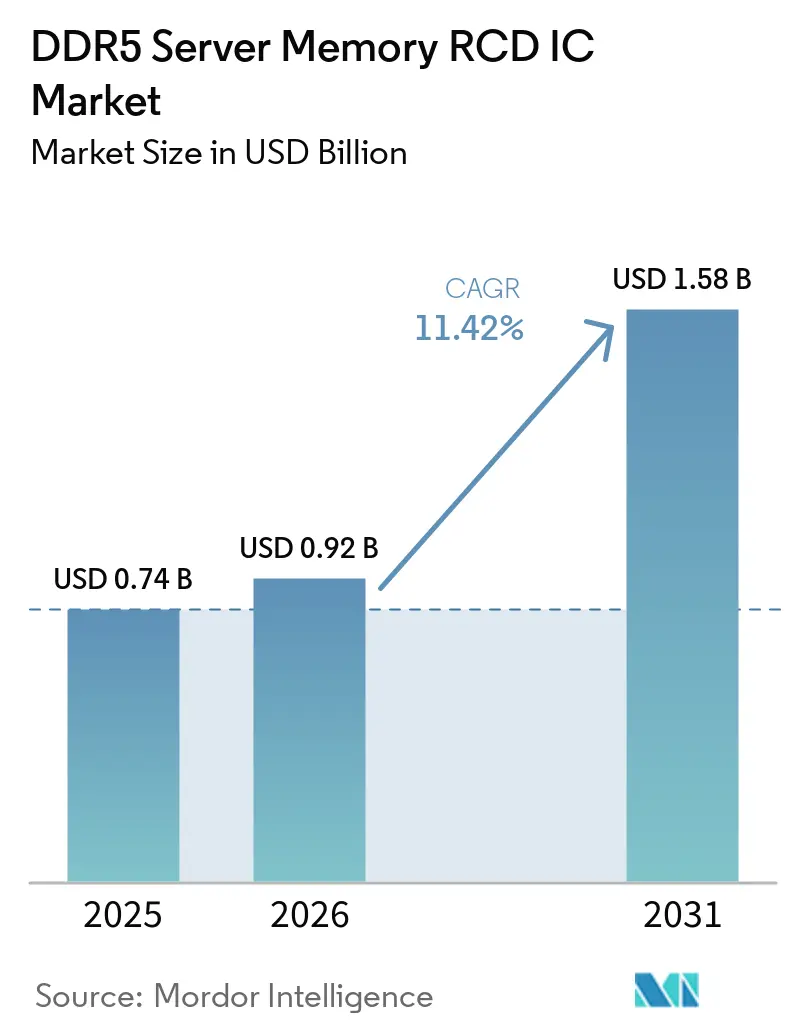
The DDR5 server memory RCD IC market size was valued at USD 0.74 billion in 2025 and is estimated to grow from USD 0.92 billion in 2026 to reach USD 1.58 billion by 2031, at a CAGR of 11.42% during the forecast period (2026-2031). The DDR5 transition has increased demand for server memory modules, as major DRAM manufacturers ended or accelerated DDR4 production cutoffs by late 2025 and early 2026. RCD ICs manage address, command, and clock signals in DDR5 server modules, so their performance affects memory throughput as platform data rates rise. AI and high-performance computing workloads are increasing memory bandwidth needs and supporting demand for faster module configurations. Suppliers are competing on qualification timing, data-rate capability, and integrated chipsets that include supporting module components. The DDR5 server memory RCD IC market also faces regulatory scrutiny and a concentrated customer base, which may affect pricing and supply relationships.
Key Report Takeaways
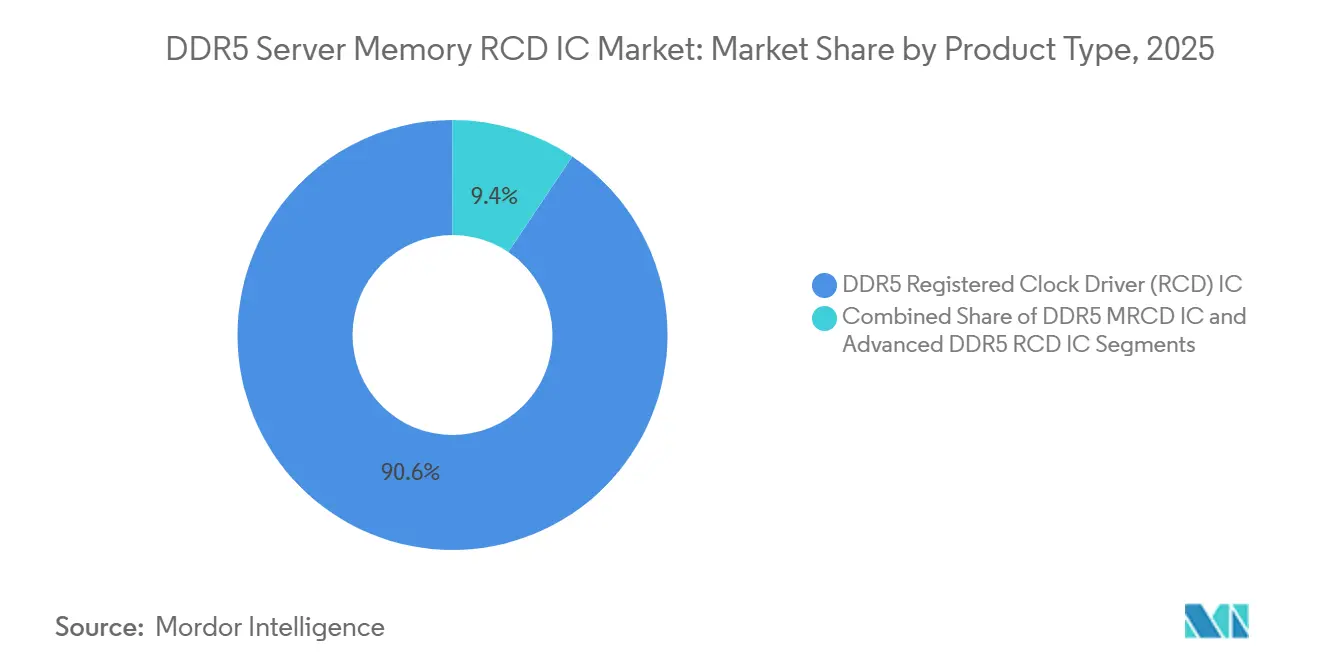
- By product type, DDR5 RCD IC held 90.60% of the DDR5 server memory RCD IC market share in 2025, while DDR5 MRCD IC is forecast to grow at an 11.78% CAGR through 2031 in the DDR5 Server Memory RCD IC market.
- By module type, RDIMM held 90.20% of the DDR5 server memory RCD IC market share in 2025, while MRDIMM/MCRDIMM is forecast to grow at an 11.58% CAGR through 2031 in the DDR5 Server Memory RCD IC market.
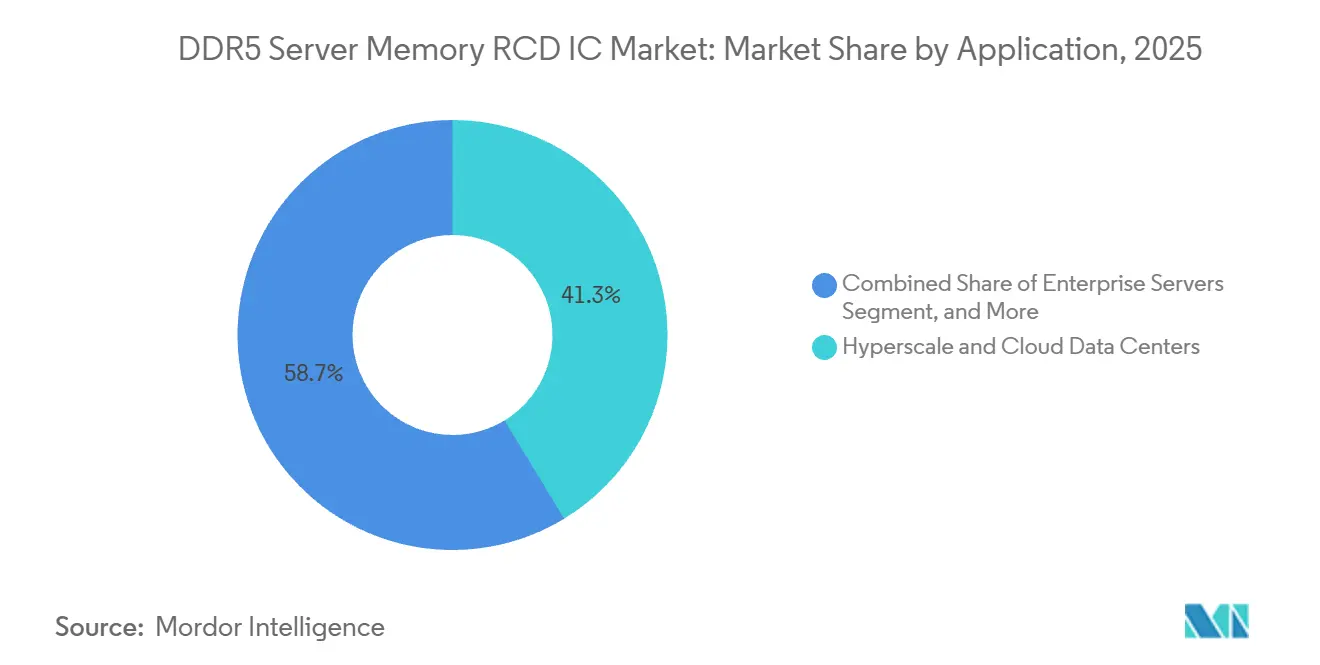
- By application, hyperscale and cloud data centers held 41.30% share in 2025, while AI and HPC servers are forecast to grow at a 12.18% CAGR through 2031 in the DDR5 Server Memory RCD IC market.
- By end user, memory module manufacturers held 40.80% share in 2025, while cloud service providers and hyperscalers are forecast to grow at an 11.72% CAGR through 2031 in the DDR5 Server Memory RCD IC market.
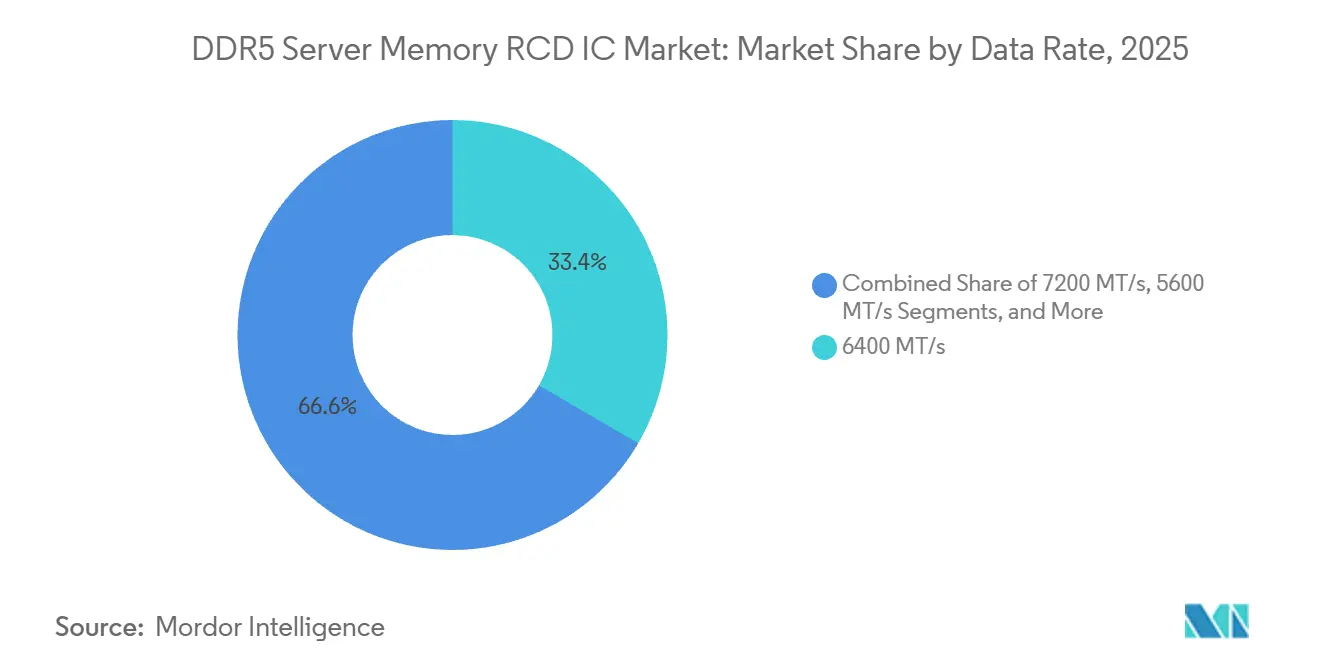
- By data rate, 6,400 MT/s held 33.40% share in 2025, while 9,600 MT/s and above is forecast to grow at a 12.34% CAGR through 2031 in the DDR5 Server Memory RCD IC market.
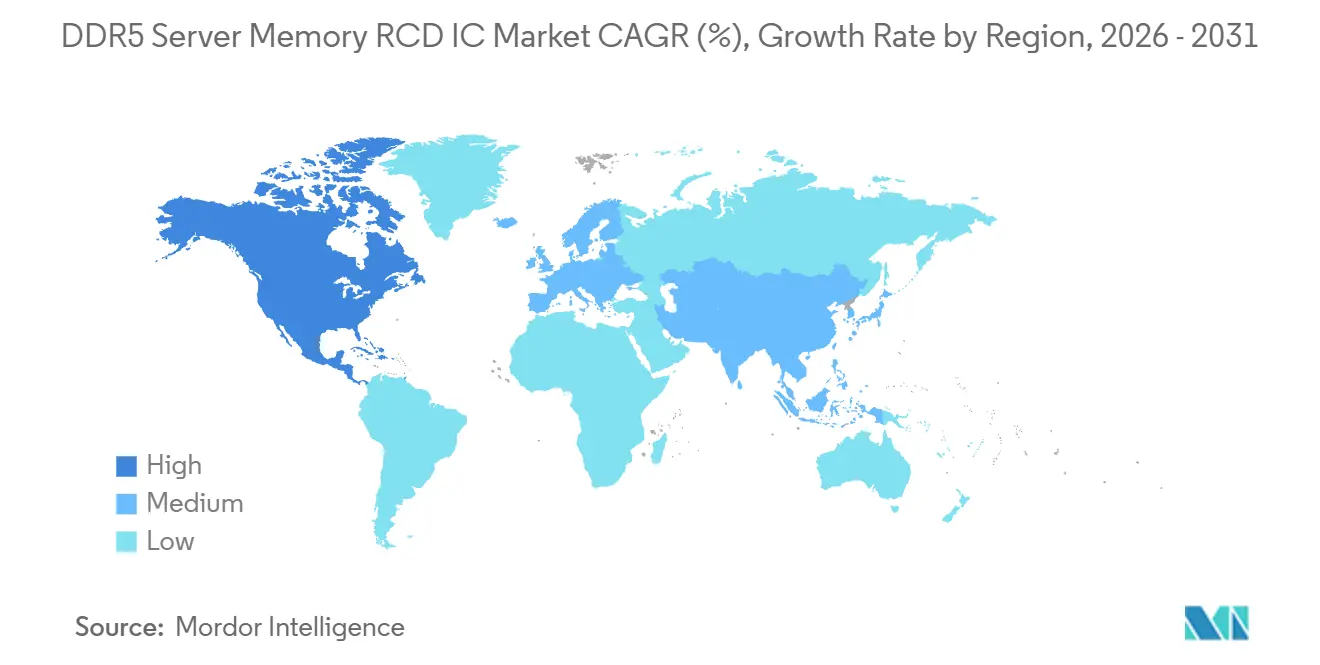
- By geography, Asia Pacific held 61.70% share in 2025, while North America is forecast to grow at an 11.63% CAGR through 2031 in the DDR5 Server Memory RCD IC market.
Note: Market size and forecast figures in this report are generated using Mordor Intelligence’s proprietary estimation framework, updated with the latest available data and insights as of January 2026.
Global DDR5 Server Memory RCD IC Market Trends and Insights
Drivers Impact Analysis*
| Driver | (~) % Impact on CAGR Forecast | Geographic Relevance | Impact Timeline |
|---|---|---|---|
| DDR5 Transition In Server Memory Modules | +3.2% | Global | Medium term (2-4 years) |
| AI And HPC Memory Bandwidth Expansion | +2.5% | North America and Asia Pacific core, spillover to Europe | Long term (≥ 4 years) |
| Migration From RDIMM To MRDIMM Architectures | +1.8% | Global | Medium term (2-4 years) |
| Higher Data Rate Qualification Cycles Favor Advanced RCD Generations | +1.0% | North America and Asia Pacific core | Medium term (2-4 years) |
| Tight Controller And DIMM-Level Signal Integrity Margins In 5 nm And Beyond Server Platforms | +0.9% | Global, with design activity in the United States, Japan, and South Korea | Long term (≥ 4 years) |
| Foundry Allocation Discipline For Niche Memory Interface ICs | +0.6% | Asia Pacific, especially Taiwan and South Korea, with global supply-side effects | Short term (≤ 2 years) |
| Source: Mordor Intelligence | |||
DDR5 Transition In Server Memory Modules
Every DDR5 RDIMM uses 1 RCD IC, which links server refresh activity and new server construction to RCD IC demand. Major DRAM manufacturers accelerated DDR4 production cutoffs by the end of 2025 or early 2026, which increased DDR5 module procurement. Each generation from 4,800 MT/s to 9,600 MT/s requires a higher-performance RCD IC and can support a higher unit selling price. Montage Technology reported a 65.6% gross margin for its interconnect chip line in 2025, showing the value effect of the platform shift. The 12-18 month sub-generation cycle keeps suppliers focused on new data-rate generations during the forecast period. This creates recurring demand for qualified RCD IC designs in the DDR5 server memory RCD IC market.
AI And HPC Memory Bandwidth Expansion
AI training and inference workloads require more memory bandwidth and capacity from server platforms. Higher system-on-chip core counts also increase the need for memory bandwidth per socket. Renesas stated in 2025 that generative AI was increasing SoC core counts and demand for memory bandwidth and capacity in data centers.[1] Faster RDIMM configurations and expanded memory channels support the use of higher-specification RCD ICs. AI inference clusters can require more memory channels per node than training configurations, increasing RCD IC content per server. This requirement supports value growth in the DDR5 server memory RCD IC market even when server unit growth is not the only demand measure.
Migration From RDIMM To MRDIMM Architectures
MRDIMM uses an MRCD IC to multiplex 2 memory ranks into a single module slot. This design raises bytes transferred per cycle at each physical DIMM position. A 2026 performance evaluation reported a 24% improvement for MRDIMM-8800 over RDIMM-6400 in HPCG testing and at least 10% improvement in generative AI workloads. Micron reported up to 39% higher bandwidth on Intel Xeon 6 platforms, with improved power efficiency. Montage Technology and Renesas Electronics are confirmed mass producers of first-generation MRCD and MDB chipsets, which concentrate the initial supply base. JEDEC’s MRDIMM Gen3 roadmap for 17,600 MT/s supports continuing value steps for MRCD ICs in the DDR5 server memory RCD IC market.[2]
Higher Data Rate Qualification Cycles Favor Advanced RCD Generations
Each higher DDR5 data-rate tier requires qualification by DRAM manufacturers, module OEMs, CPU platform providers, and customers. This process supports demand for new RCD silicon before older generations leave the installed base. Renesas launched its Gen6 RRG5006x at 9,600 MT/s in November 2025. Rambus introduced its RCD06 chipset at 9,600 MT/s in July 2026, while Montage Technology completed sampling of its RCD06 at 9,200 MT/s in June 2026. The supplier that completes validation earliest can secure design wins for a 12-18 month product-generation cycle. Qualification timing is therefore as important as silicon capability in the DDR5 server memory RCD IC market.
Restraints Impact Analysis*
| Restraint | (~) % Impact on CAGR Forecast | Geographic Relevance | Impact Timeline |
|---|---|---|---|
| Rapid Design Win Concentration Among Few Memory Module OEMs | -1.2% | Global, with primary effects in South Korea and Taiwan | Medium term (2-4 years) |
| Cyclical Server And DRAM Capex Sensitivity | -0.8% | Global | Short term (≤ 2 years) |
| Long Qualification And Platform Validation Timelines | -0.6% | North America and Asia Pacific core | Medium term (2-4 years) |
| Limited Multi-Sourcing And Customer Qualification Lock-In | -0.5% | Global | Long term (≥ 4 years) |
| Source: Mordor Intelligence | |||
Rapid Design Win Concentration Among Few Memory Module OEMs
RCD IC suppliers depend on a narrow group of DRAM manufacturers and memory module buyers. Samsung Electronics, SK hynix, and Micron make design-in choices that can influence revenue for an entire RCD generation. A single design win or loss can therefore have a large effect on a supplier’s shipment profile. South Korean prosecutors investigated alleged price coordination involving the 3 major RCD IC suppliers in July 2026. The investigation shows the tension between concentrated suppliers and concentrated buyers during repeated pricing and qualification discussions. Required pricing changes could reduce RCD IC unit selling prices relative to DDR5 server memory shipment growth in the RCD IC market.
Cyclical Server And DRAM Capex Sensitivity
DDR5 RCD IC revenue depends on server DRAM investment and module production cycles. A slowdown in hyperscaler or enterprise capital spending can reduce module output and RCD IC orders. The 2022-2023 DRAM inventory correction pushed DRAM prices to multiyear lows and temporarily affected memory interface IC suppliers. RCD ICs also use advanced CMOS nodes alongside higher-volume logic products, which can create foundry allocation limits during capacity-constrained periods. Capacity additions could weaken the pricing conditions that supported RCD IC unit selling prices during 2025 and 2026. These factors make the DDR5 server memory RCD IC market exposed to changes in server demand, memory supply, and foundry capacity.
*Our forecasts treat driver/restraint impacts as directional, not additive. The impact forecasts reflect baseline growth, mix effects, and variable interactions.
Segment Analysis
By Product Type: DDR5 RCD IC Holds The Installed Base While MRCD IC Gains Momentum
DDR5 RCD IC held 90.60% share in 2025 as RDIMM server deployments increased with DDR5 adoption. The largest product group benefited from the broad adoption of RDIMMs across server fleet refreshes and new data center deployments. Advanced RCD designs include decision feedback equalization and signal telemetry for higher data-rate operation. Renesas’ Gen6 RRG5006x included 8-tap DFE and Decision Engine Signal Telemetry and Margining. Montage Technology completed mass production of its 7,200 MT/s Gen4 RCD in October 2025. Its interconnect chip line recorded a 65.6% gross margin in 2025. New RCD generations enter qualification at a price premium before supplier offerings reach parity over the following 12-18 months.
DDR5 MRCD IC is forecast to grow at an 11.78% CAGR from 2026 to 2031, the fastest product-type rate. The segment is moving from scaled pilots toward broader MRDIMM deployment. Montage Technology launched its second-generation MRCD at 12,800 MT/s in January 2025 and reported a shipment scale-up starting in the fourth quarter of 2025. Renesas announced its Gen3 MRDIMM chipset, the MRCD RRG5013x, with a 16,000 MT/s target in July 2026. Montage Technology plans to finish third-generation MRCD engineering development by the end of 2026. JEDEC’s Gen3 MRDIMM roadmap at 17,600 MT/s indicates continued performance gains through 2031. This supports the DDR5 server memory RCD IC industry’s shift toward higher-value-per-module designs.

By Module Type: RDIMM Remains Broadly Compatible While MRDIMM And MCRDIMM Raise Bandwidth
RDIMM held 90.20% share in 2025, supported by broad compatibility across Intel Xeon, AMD EPYC, and ARM-based server designs. Its established qualification ecosystem and scalable density support ongoing use in enterprise and cloud systems. LRDIMM and high-capacity buffered DIMM configurations serve storage-dense systems where load-reduction buffering enables larger DRAM populations. Their role is narrowing where MRDIMM can provide capacity benefits with higher bandwidth. Financial services, health care, and government refresh programs follow multiyear procurement cycles that sustain RDIMM volumes. These deployments retain RDIMM as the volume anchor for the DDR5 server memory RCD IC market. The format also avoids the disruptive redesign that some users associate with a move to emerging module architectures.
MRDIMM/MCRDIMM is forecast to expand at an 11.86% CAGR from 2026 to 2031, the fastest module-type rate. A production-equivalent evaluation found that MRDIMM-8800 delivered 24% higher HPCG performance than RDIMM-6400. The same evaluation found at least 10% improvement across generative AI workloads. Micron reported up to 39% higher bandwidth and better power efficiency with Intel Xeon 6 platforms. MICRON.COM JEDEC published the JESD82-552 MDB02 standard in April 2026 and reported near completion of JESD82-542 MRCD02. Its Gen2 raw-card designs target 12,800 MT/s, providing a common technical base for wider adoption. These standards reduce interoperability barriers for this part of the DDR5 server memory RCD IC industry.
By Application: Hyperscale And Cloud Data Centers Provide Volume While AI And HPC Servers Grow Faster
Hyperscale and cloud data centers held 41.30% share in 2025, making them the largest application area. Large cloud deployments provide a broad base of volume for RCD IC suppliers. Their server programs rely on repeated qualification of memory platforms and module procurement. North American cloud service providers began planning 2026 server buildouts with a higher DDR5 deployment share from the second half of 2025. This planning activity increased hyperscale RDIMM procurement relative to earlier server cycles. The DDR5 server memory RCD IC market, therefore, depends strongly on cloud capacity programs and their chosen memory configurations. The application also connects demand from platform owners to the Asia Pacific module assembly base.
AI and HPC servers are forecast to grow at a 12.18% CAGR from 2026 to 2031, the highest application rate. Higher memory-channel requirements per CPU socket increase RCD IC content beyond the growth in aggregate server units. These servers need specific data-rate qualification and thermal validation as configurations become more demanding. The performance benefits of MRDIMM architectures are particularly relevant to HPC and generative AI workloads. Enterprise servers remain the second-largest application because financial services, health care, and government customers maintain independent refresh cycles. Networking and telecom infrastructure and high-performance workstations represent smaller applications with their own certification and form-factor requirements. This mix keeps the DDR5 server memory RCD IC market exposed to both large cloud deployments and specialized server platforms.
By End User: Module Manufacturers Lead While Cloud Providers Gain Procurement Influence
Memory module manufacturers held 40.80% share in 2025 and remained the main design-in channel for RCD ICs. RCD ICs are embedded in modules before the modules reach server OEMs or infrastructure operators. Samsung Electronics, SK hynix, and Micron combine DRAM and module operations, creating a dual role as buyers and producers. They source RCD ICs for module assembly while setting the requirements needed to secure design wins. Server OEMs, ODMs, and white-box server manufacturers are separate procurement groups that influence platform requirements. Their decisions align module qualification with CPU roadmaps and system validation. This channel structure remains central to the DDR5 server memory RCD IC market.
Cloud service providers and hyperscalers are forecast to grow at an 11.72% CAGR from 2026 to 2031, the fastest end-user rate. Direct engagement with memory supply chains is becoming more important for these customers. Amazon raised its 2026 capital guidance to USD 220 billion, with a portion linked to higher memory component costs. This reflects the increased importance of memory interface costs in cloud infrastructure budgets. System integrators and enterprise infrastructure providers are more price-sensitive end users. They generally procure standardized RDIMM configurations at scale and show less demand for leading-edge module types. The DDR5 server memory RCD IC market serves both direct hyperscaler engagement and established module-led procurement.
By Data Rate: 6,400 MT/s Supports Current Volume While 9,600 MT/s And Above Gains Design Activity
The 6,400 MT/s tier held 33.4% share in 2025 and represented the main point of platform readiness. It aligned with operating yields, signal integrity margins, and ecosystem support across Intel Xeon 6 and leading ARM-based server designs. JEDEC published DDR5RCD04, JESD82-514.01, for 6,400 MT/s and 7,200 MT/s operation in June 2024. JEDEC then published DDR5RCD05 (JESD82-515.01) with higher data-rate parameters in March 2026.[3] JEDEC.ORG The 4,800 MT/s and 5,600 MT/s tiers lost mix during 2025 as Gen3 and Gen4 RCDs entered production. Montage Technology’s 7,200 MT/s Gen4 RCD reached mass production in October 2025. The 8,000-8,800 MT/s range aligns with MRDIMM Gen1, where MRDIMM-8800 showed HPC performance gains over RDIMM-6400.
The 9,600 MT/s-and-above tier is forecast to grow at a 12.3% CAGR from 2026 to 2031. It is the fastest-growing data-rate category as suppliers move products through sampling and commercial launch. Renesas launched its Gen6 RRG5006x at 9,600 MT/s in November 2025, with production expected in the first half of 2027. Rambus launched RCD06 at 9,600 MT/s in July 2026, and Montage Technology sampled its RCD06 at 9,200 MT/s in June 2026. The 12-18 month product cycle means design-in work begins well before broad volume adoption. This tier will absorb qualification activity during 2026 and 2027 before a later volume increase. The DDR5 server memory RCD IC market depends on these advanced tiers to sustain unit-value growth.
Geography Analysis
Asia Pacific accounted for 61.70% of the market in 2025 and was the largest geographic region in the DDR5 server memory RCD IC market. South Korea concentrates major DRAM manufacturing through Samsung Electronics and SK Hynix. Taiwan has substantial third-party server module assembly for OEM and cloud customers. China is home to Montage Technology, which reported CNY 5.139 billion in interconnect chip revenue in 2025, equivalent to USD 715 million using the stated 2025 annual exchange rate. Montage Technology also reported a 65.6% gross margin on interconnect chips for 2025. The region brings RCD IC design, DRAM manufacturing, and module assembly into the same supply corridor.
Japan contributes through Renesas Electronics’ RCD IC development and through regional system integrators and platform validators. Renesas continues to advance higher-speed RCD and MRDIMM chipsets for server applications.[4] South Korean prosecutors raided the Korean offices of the 3 major RCD IC suppliers in July 2026 as part of an investigation into alleged price-fixing. This regulatory action places a further focus on the commercial relationships between RCD IC suppliers and major DRAM manufacturers. Higher DDR5 deployment plans by North American cloud operators also pull demand through Asia Pacific assembly operations. The region remains important to both production capacity and technical qualification in the DDR5 server memory RCD IC market.
North America is forecast to grow at an 11.63% CAGR from 2026 to 2031, the fastest geographic rate. Growth is linked to hyperscaler investment cycles concentrated in the United States. Intel’s server platform qualification activity has shaped which DDR5 data rates enter mainstream server deployment. Renesas, Rambus, and other participants support North American platform development with higher-speed RCD products. Europe relies more on enterprise and telecom server refresh cycles. The Middle East and Africa and South America are at an earlier stage of DDR5 server deployment through sovereign data center projects and hyperscaler regional expansion.
Competitive Landscape
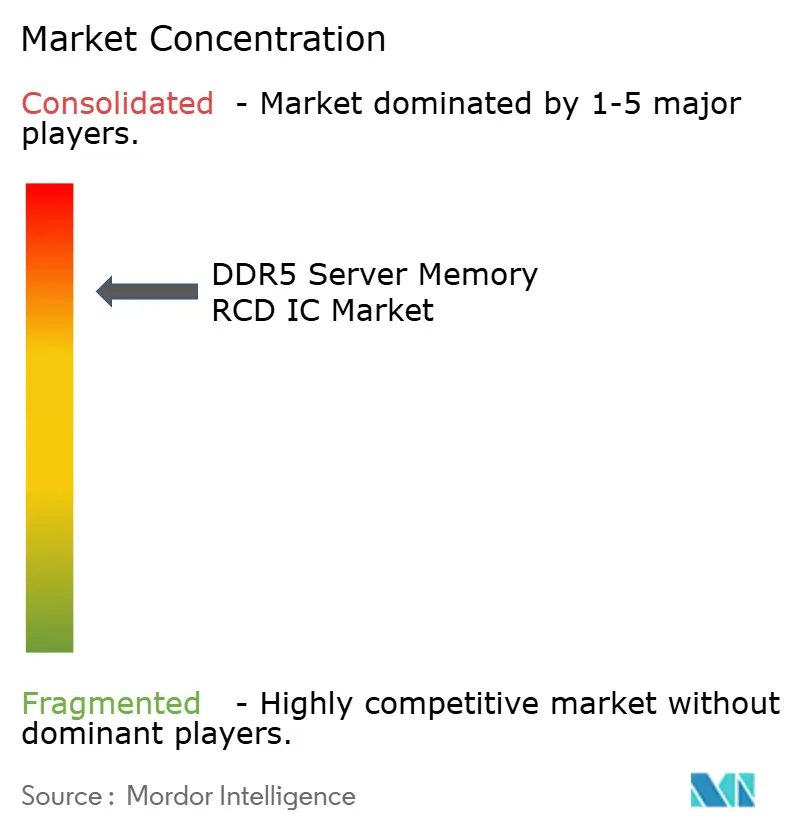
Renesas Electronics, Montage Technology, and Rambus collectively supplied more than 93% of global DDR5 RCD IC units in 2025. This structure gives the DDR5 server memory RCD IC market a high level of concentration. Suppliers compete to reach production first at each new data-rate tier because early qualification can determine a module maker’s design choice. They also offer supporting PMIC, SPD Hub, and temperature sensor ICs as integrated chipsets. Montage Technology completed mass production of its Gen4 RCD in October 2025. Rambus launched its DDR5 9600 RDIMM chipset in July 2026 for agentic AI and next-generation HPC data center infrastructure. These moves show that performance leadership and broader module chipsets are key competitive tools.
Participation in JEDEC standards and patent portfolios strengthens established supplier positions. Montage Technology acts as a lead standard drafter for several RCD and MRCD specifications within JEDEC committees. Renesas announced its Gen3 MRDIMM chipset in July 2026, targeting 16,000 MT/s with production expected in the second half of 2027. The company’s move extends competition from standard RCD ICs into higher-bandwidth MRDIMM systems. New entrants need access to advanced CMOS manufacturing, long qualification periods with DRAM manufacturers, and participation in standards. These requirements make entry into the DDR5 server memory RCD IC market difficult. The July 2026 investigation may also affect how suppliers and customers manage pricing and contractual terms.
A South Korean startup, Wonseemicron, completed DDR5 Gen2 RCD development and entered CPU manufacturer qualification in 2024. This activity shows that the supply structure is concentrated but not closed to new participants. Its progress remains subject to the same extended platform and customer validation requirements facing any challenger. Leading suppliers continue to use roadmap execution to defend their positions. Montage Technology’s RCD06 sampling at 9,200 MT/s in June 2026 is one example of this approach. JEDEC’s expanded MRDIMM roadmap also creates a shared technical path for suppliers preparing future products. The DDR5 server memory RCD IC market remains concentrated because the main suppliers hold established qualifications, product roadmaps, and customer relationships.
DDR5 Server Memory RCD IC Industry Leaders
-
Renesas Electronics
-
Montage Technology
-
Rambus
-
ONE Semiconductor
-
Integrated Silicon Solution, Inc. (ISSI)
- *Disclaimer: Major Players sorted in no particular order
Recent Industry Developments
- July 2026: Rambus launched the DDR5 9600 Server RDIMM Chipset, featuring its sixth-generation RCD, RCD06, supporting up to 9,600 MT/s, a 20% increase over the prior generation, alongside PMIC5030, SPD Hub, and Temperature Sensor ICs, targeting agentic AI and next-generation HPC data center infrastructure.
- July 2026: Renesas Electronics announced its third-generation DDR5 MRDIMM chipset solutions, MRCD RRG5013x and MDB RRG5103x, delivering up to 16,000 MT/s, 25% higher bandwidth than its second-generation solutions, while retaining backward compatibility with existing DDR5 infrastructure. Sampling commenced to all major DRAM suppliers, with production expected in the second half of 2027.
- June 2026: Montage Technology completed customer sampling of its sixth-generation DDR5 RCD, RCD06, supporting up to 9,200 MT/s, 15% higher than its predecessor, with dual-channel independent architecture, continuous-time linear equalization, and a low-jitter phase-locked loop for signal integrity optimization.
- April 2026: JEDEC published the JESD82-552 DDR5MDB02 Multiplexed Rank Data Buffer standard, announced near-completion of JESD82-542 DDR5MRCD02, and confirmed MRDIMM Gen2 raw-card designs targeting 12,800 MT/s, with MRDIMM Gen3 at 17,600 MT/s in early development.
- March 2026: JEDEC published the DDR5RCD05, JESD82-515.01, Registered Clock Driver standard, codifying DC interface parameters, switching parameters, DFE/CTLE training modes, and signal integrity requirements for DDR5 RDIMM RCDs at leading-edge data rates.
Global DDR5 Server Memory RCD IC Market Report Scope
The DDR5 Server Memory RCD IC Market is Segmented by Product Type (DDR5 Registered Clock Driver (RCD) IC, DDR5 Multiplexed Registering Clock Driver (MRCD) IC, and Advanced DDR5 RCD IC with Signal Integrity / DFE Features), Module Type (RDIMM, MRDIMM / MCRDIMM, and LRDIMM / High-Capacity Buffered DIMM), Application (Hyperscale and Cloud Data Centers, Enterprise Servers, Artificial Intelligence and High-Performance Computing Servers, Networking and Telecom Infrastructure, and High-Performance Workstations and Other Compute Systems), End User (Memory Module Manufacturers, DRAM Manufacturers / Integrated Memory Vendors, Server OEMs, ODMs / White-Box Server Manufacturers, Cloud Service Providers / Hyperscalers, and System Integrators and Enterprise Infrastructure Providers), Data Rate (4800 MT/s, 5600 MT/s, 6400 MT/s, 7200 MT/s, 8000–8800 MT/s, and 9600 MT/s and Above), and Geography (North America, Europe, Asia Pacific, Rest of World). The Market Forecasts are Provided in Terms of Value (USD).
| DDR5 Registered Clock Driver (RCD) IC |
| DDR5 Multiplexed Registering Clock Driver (MRCD) IC |
| Advanced DDR5 RCD IC with Signal Integrity / DFE Features |
| RDIMM |
| MRDIMM / MCRDIMM |
| LRDIMM / High-Capacity Buffered DIMM |
| Hyperscale and Cloud Data Centers |
| Enterprise Servers |
| Artificial Intelligence and High-Performance Computing Servers |
| Networking and Telecom Infrastructure |
| High-Performance Workstations and Other Compute Systems |
| Memory Module Manufacturers |
| DRAM Manufacturers / Integrated Memory Vendors |
| Server OEMs |
| ODMs / White-Box Server Manufacturers |
| Cloud Service Providers / Hyperscalers |
| System Integrators and Enterprise Infrastructure Providers |
| 4800 MT/s |
| 5600 MT/s |
| 6400 MT/s |
| 7200 MT/s |
| 8000–8800 MT/s |
| 9600 MT/s and Above |
| North America | |
| Europe | |
| Asia-Pacific | China |
| Japan | |
| South Korea | |
| Taiwan | |
| Rest of Asia-Pacific | |
| Rest of the World |
| By Product Type | DDR5 Registered Clock Driver (RCD) IC | |
| DDR5 Multiplexed Registering Clock Driver (MRCD) IC | ||
| Advanced DDR5 RCD IC with Signal Integrity / DFE Features | ||
| By Module Type | RDIMM | |
| MRDIMM / MCRDIMM | ||
| LRDIMM / High-Capacity Buffered DIMM | ||
| By Application | Hyperscale and Cloud Data Centers | |
| Enterprise Servers | ||
| Artificial Intelligence and High-Performance Computing Servers | ||
| Networking and Telecom Infrastructure | ||
| High-Performance Workstations and Other Compute Systems | ||
| By End User | Memory Module Manufacturers | |
| DRAM Manufacturers / Integrated Memory Vendors | ||
| Server OEMs | ||
| ODMs / White-Box Server Manufacturers | ||
| Cloud Service Providers / Hyperscalers | ||
| System Integrators and Enterprise Infrastructure Providers | ||
| By Data Rate | 4800 MT/s | |
| 5600 MT/s | ||
| 6400 MT/s | ||
| 7200 MT/s | ||
| 8000–8800 MT/s | ||
| 9600 MT/s and Above | ||
| By Geography | North America | |
| Europe | ||
| Asia-Pacific | China | |
| Japan | ||
| South Korea | ||
| Taiwan | ||
| Rest of Asia-Pacific | ||
| Rest of the World | ||
Key Questions Answered in the Report
What was the DDR5 server memory RCD IC market size in 2026?
The market size was estimated at USD 0.92 billion in 2026 and is forecast to reach USD 1.58 billion by 2031. The forecast represents an 11.42% CAGR during 2026-2031.
What is driving demand for DDR5 server memory RCD ICs?
DDR5 module adoption, AI and HPC bandwidth requirements, and recurring qualification of higher data-rate generations support demand. RCD ICs also become more important as module speeds rise and server platforms use more memory channels.
Which DDR5 module format is growing fastest?
MRDIMM/MCRDIMM is forecast to grow at an 11.86% CAGR from 2026 to 2031. The format supports higher bandwidth and depends on MRCD and MDB chipsets for its operating architecture.
Which application has the fastest growth outlook?
AI and HPC servers are forecast to grow at a 12.18% CAGR through 2031, the highest stated application rate. These servers need greater memory bandwidth and can use more memory channels per CPU socket.
Which region leads DDR5 server memory RCD IC demand?
Asia Pacific held 61.70% share in 2025, supported by its DRAM manufacturing and module assembly base. South Korea, Taiwan, China, and Japan each support different parts of the regional supply chain.