
DDR5 Gaming Memory Module Market Size and Share
Market Overview
| Study Period | 2020 - 2031 |
|---|---|
| Market Size (2026) | USD 2.41 Billion |
| Market Size (2031) | USD 3.53 Billion |
| Growth Rate (2026 - 2031) | 7.93 % |
| Fastest Growing Market | North America |
| Largest Market | Asia-Pacific |
| Market Concentration | Medium |
Major Players *Disclaimer: Major Players sorted in no particular order Image © Mordor Intelligence. Reuse requires attribution under CC BY 4.0. | |
DDR5 Gaming Memory Module Market Analysis by Mordor Intelligence
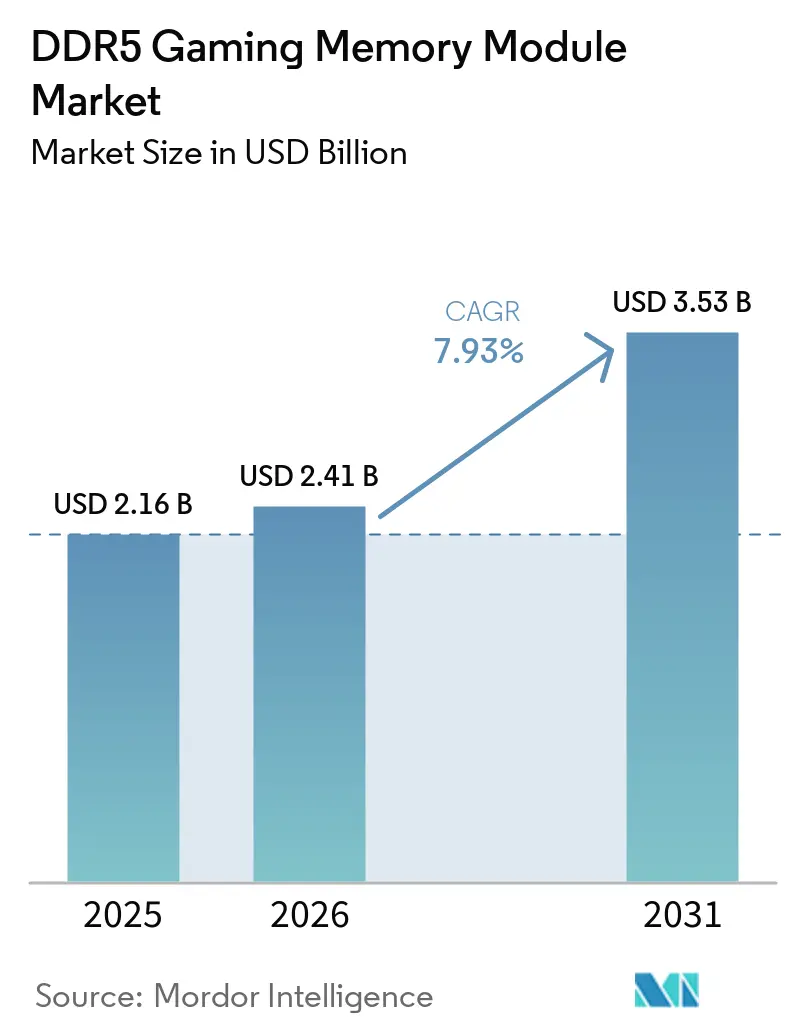
The DDR5 gaming memory module market size is projected to expand from USD 2.16 billion in 2025 to USD 2.41 billion in 2026, and to USD 3.53 billion by 2031, registering a CAGR of 7.93% between 2026 and 2031. New desktop gaming platforms now require DDR5, making the memory transition part of a complete platform purchase rather than an optional upgrade. AMD AM5 and Intel LGA1851 systems have removed DDR4 as a practical choice for most new gaming builds. Supply allocated to high-bandwidth memory has also raised consumer DDR5 prices, lifting average selling prices while reducing affordability for some builders. The DDR5 gaming memory module market, therefore, combines steady platform-led demand with a near-term pricing risk that can favor pre-built systems over aftermarket upgrades. Module suppliers are responding through higher-capacity kits, broader XMP and EXPO support, and differentiated designs that can command premium pricing.
Key Report Takeaways
- By capacity, 32GB kits accounted for 45.87% of revenue in 2025, while 96GB and higher capacity kits are forecast to grow at an 8.88% CAGR through 2031 in the DDR5 gaming memory module market.
- By speed, 6000-6400 MT/s kits held 49.34% of revenue in 2025, while above 7200 MT/s kits are forecast to grow at 8.72% CAGR through 2031 in the DDR5 gaming memory module market.
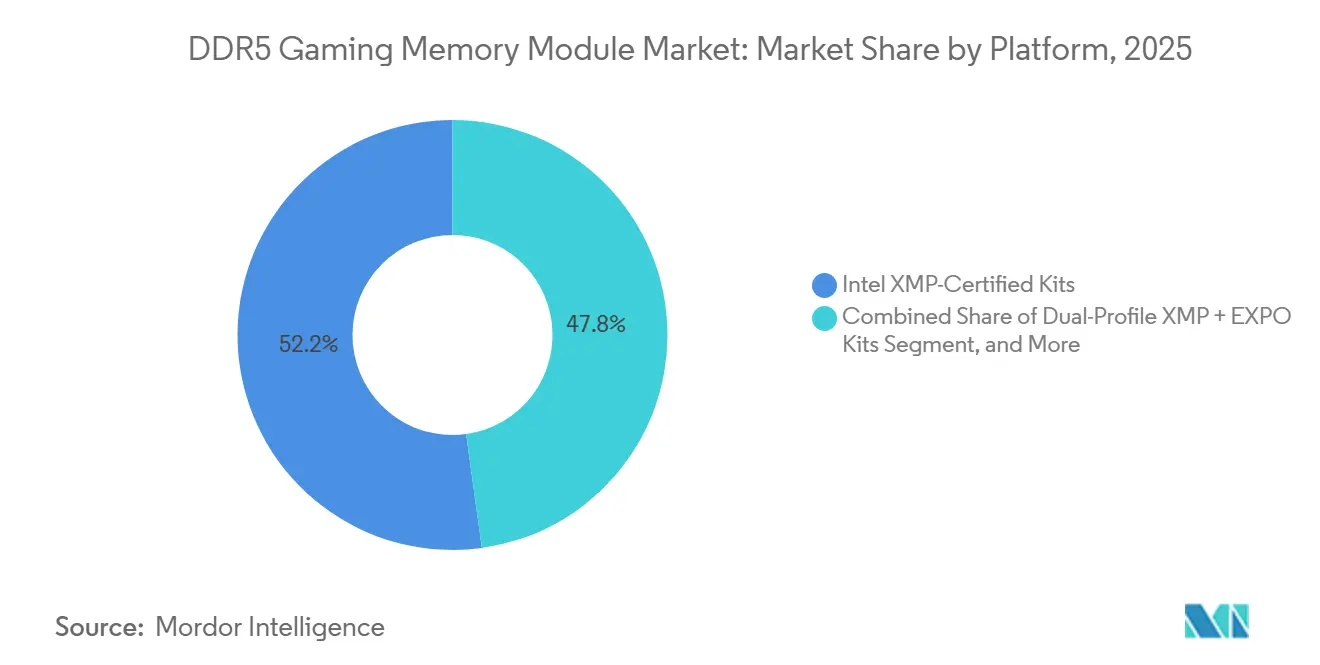
- By platform, Intel XMP-certified kits accounted for 52.18% of revenue in 2025, while dual-profile XMP and EXPO kits are forecast to grow at an 8.56% CAGR through 2031 in the DDR5 gaming memory module market.
- By application, mainstream gaming desktops accounted for 55.46% of revenue in 2025, while gaming-creator hybrid workstations are forecast to grow at an 8.63% CAGR through 2031 in the DDR5 gaming memory module market.
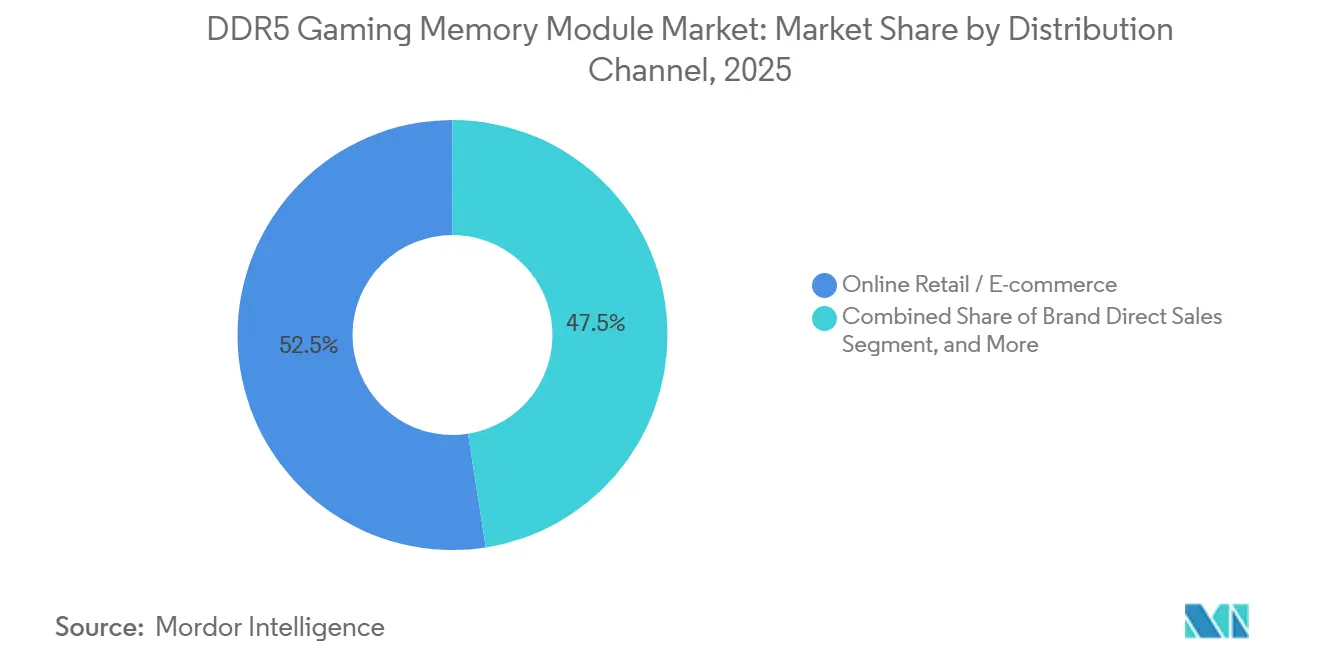
- By distribution channel, online retail and e-commerce accounted for 63.21% of revenue in 2025, while system integrators and boutique PC builders are forecast to grow at an 8.41% CAGR through 2031 in the DDR5 gaming memory module market.
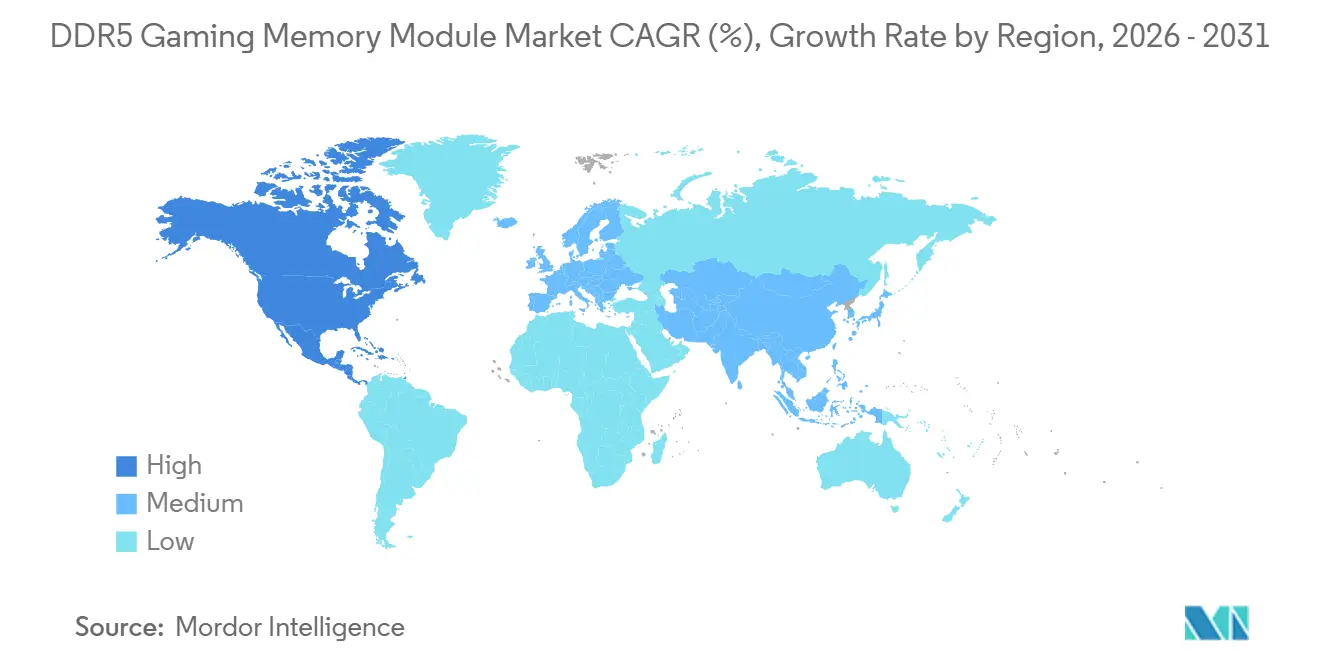
- By geography, Asia-Pacific accounted for 42.76% of revenue in 2025, while North America is forecast to record the fastest growth in the DDR5 gaming memory module market through 2031.
Note: Market size and forecast figures in this report are generated using Mordor Intelligence’s proprietary estimation framework, updated with the latest available data and insights as of January 2026.
Global DDR5 Gaming Memory Module Market Trends and Insights
Drivers Impact Analysis*
| Driver | (~) % Impact on CAGR Forecast | Geographic Relevance | Impact Timeline |
|---|---|---|---|
| DDR5 Adoption in New Gaming PC Platforms | +2.8% | Global | Short term (≤ 2 years) |
| XMP and EXPO Standardization Simplifying Overclocking | +1.5% | Global, with greater intensity in North America and Asia-Pacific | Short term (≤ 2 years) |
| Demand Shift Toward 32GB and 48GB Gaming Kits | +1.1% | Global, led by North America and China | Medium term (2-4 years) |
| Premiumization Through RGB and Enthusiast Aesthetics | +0.7% | North America and Europe | Medium term (2-4 years) |
| E-Commerce and DIY PC Channel Expansion | +0.5% | Asia-Pacific, with spillover to North America | Short term (≤ 2 years) |
| Vendor Margin Mix Shift Toward High-Bin Consumer Modules | +0.3% | Global | Long term (≥ 4 years) |
| Source: Mordor Intelligence | |||
DDR5 Adoption in New Gaming PC Platforms
The DDR5 gaming memory module market benefits from the broad shift to DDR5 in current desktop gaming platforms. AMD AM5 and Intel LGA1851 platforms require DDR5, so builders selecting those sockets cannot retain DDR4 memory from earlier systems. This requirement links memory demand directly to new processor and motherboard purchases. It also makes a 16GB DDR4 replacement cycle an opportunity to upgrade capacity at the same time. MSI stated that 32GB is the target for systems that run games with video capture, streaming tools, and chat applications.[1] The DDR5 gaming memory module market gains from this combined change in platform generation and memory capacity.
XMP and EXPO Standardization Simplifying Overclocking
Intel XMP 3.0 and AMD EXPO have made it easier to use rated memory speeds in consumer systems. Intel describes XMP 3.0 as a DDR5 profile system that includes user-defined profiles and on-module voltage control. AMD presents EXPO as an open memory-overclocking technology for Ryzen processors on Socket AM5. These profiles reduce the need for manual timing adjustments in the BIOS. Dual-profile kits further reduce uncertainty because a single module can support both major desktop platforms. G.SKILL demonstrated Trident Z5 NeoX RGB modules with AMD EXPO Ultra Low Latency profiles in June 2026, showing continued coordination between memory and processor platforms.
Demand Shift Toward 32GB and 48GB Gaming Kits
The DDR5 gaming memory module market is seeing demand move toward 32GB and 48GB kits as gaming systems handle more concurrent workloads. Streaming applications, communication tools, game modifications, and local AI workloads raise the value of memory headroom. MSI identified 32GB as a target configuration for demanding gaming systems in 2025. A 48GB dual-channel kit offers additional headroom without the full cost of a 64GB configuration. G.SKILL began selling overclocked kits with 64GB modules in July 2025, including configurations up to 256GB. This availability supports both creator-oriented gaming systems and conventional desktop upgrades.
Premiumization Through RGB and Enthusiast Aesthetics
RGB lighting and distinctive heat spreaders have become part of the purchase decision for enthusiast gaming systems. Buyers often seek modules that work with motherboard lighting ecosystems such as ASUS Aura Sync and MSI Mystic Light. Corsair introduced SHUGO DDR5 in May 2026, featuring light-emitting micro-drilling technology that illuminates the heat spreader surface. XPG launched NOVAKEY RGB DDR5 in May 2026 with an Infinity Mirror design, XMP 3.0 and EXPO support, and capacities of up to 32GB per module. These launches show that visual design and platform compatibility are being developed together. The DDR5 gaming memory module market can use this differentiation to support premium products even when standard memory specifications become more common.
Restraints Impact Analysis*
| Restraint | (~) % Impact on CAGR Forecast | Geographic Relevance | Impact Timeline |
|---|---|---|---|
| Price Premium Versus DDR4 and Memory Price Volatility | -1.8% | Global | Short term (≤ 2 years) |
| HBM and Server DDR5 Allocation Tightening Consumer Supply | -1.5% | Global, especially North America and Europe | Short term (≤ 2 years) |
| Motherboard Compatibility and BIOS Tuning Complexity | -0.5% | Global | Medium term (2-4 years) |
| Limited Real-World FPS Gains at Extreme Speed Tiers | -0.2% | Global, weighted toward North America and Asia-Pacific | Long term (≥ 4 years) |
| Source: Mordor Intelligence | |||
Price Premium Versus DDR4 and Memory Price Volatility
Memory pricing is the clearest near-term restraint for the DDR5 gaming memory module market. Higher DDR5 kit prices can delay upgrades and shift entry-level customers toward pre-built systems. The input research noted that a 32GB DDR5-6000 CL30 kit rose from below USD 90 in early 2025 to more than USD 529 by late 2025 and continued to rise into 2026. Large price increases narrow the group of buyers able to choose premium speed or capacity tiers. They also make the total system cost more important than individual component performance. The DDR5 gaming memory module market may still grow through platform adoption, but volatile pricing can limit aftermarket purchases while supply remains tight.
HBM and Server DDR5 Allocation Tightening Consumer Supply
The use of advanced DRAM capacity for AI infrastructure can restrict the supply available to consumer DDR5 products. HBM and server memory demand require suppliers to prioritize products with higher technical requirements and stronger contract demand. The result can be longer lead times for selected gaming memory kits and fewer choices at premium speed grades. This condition is particularly difficult for smaller-module brands with a smaller purchasing scale. It can also delay launches because module suppliers need stable die availability before committing to retail programs. The DDR5 gaming memory module market remains exposed to this supply allocation issue until additional capacity and broader die sourcing reduce the pressure.
*Our forecasts treat driver/restraint impacts as directional, not additive. The impact forecasts reflect baseline growth, mix effects, and variable interactions.
Segment Analysis
By Capacity: 32GB Anchors Mainstream Demand While High-Density Kits Advance
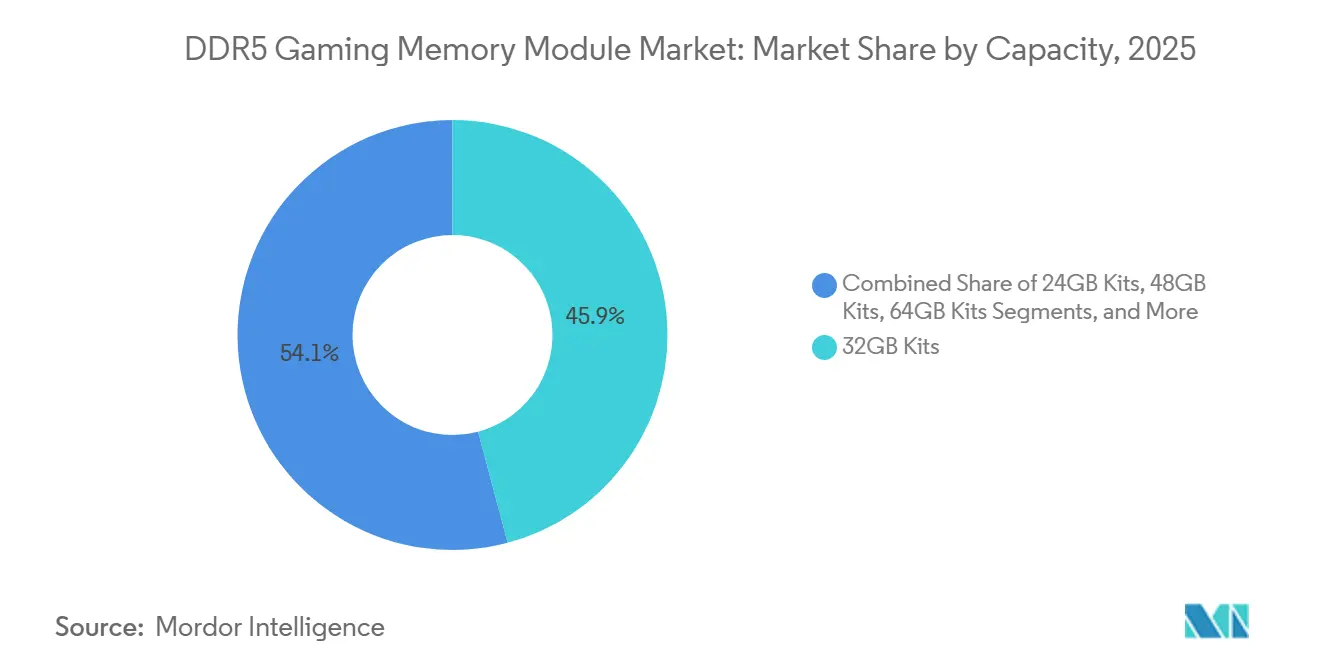
The 32GB kit category held 45.87% of the DDR5 gaming memory module market share within the capacity segment in 2025. It remains a practical configuration for AAA gaming systems that also run capture software, streaming applications, and communication tools. MSI’s 2025 guidance identified 32GB as a target for demanding gaming use cases. The category benefits from broad motherboard support and familiar dual-channel configurations. It also provides a clear step up from the 16GB level used in many DDR4-era systems. The DDR5 gaming memory module market, therefore, treats 32GB as the mainstream point where performance needs and budget considerations meet. Builders can use this capacity without moving into workstation-level system costs. That balance supports continuing volume demand across new gaming builds and replacement purchases.
The 96GB and above category is forecast to grow at 8.88% CAGR from 2026 to 2031, the fastest rate across capacity tiers. It serves gaming creator systems that combine 4K video processing, local AI inference, rendering, and game streaming. JEDEC’s JESD79-5D standard, published in November 2025, extended DDR5 support through 32Gb die configurations. The update supports larger module capacities. G.SKILL’s 2025 release included kits built with 64GB modules, with total capacities up to 256GB.[2] The 24GB and 48GB configurations occupy intermediate positions for users needing more headroom than 16GB or 32 GB offers. The 64GB tier serves workstation-adjacent gaming systems thatrune multiple applicationssimultaneouslye. Higher-density kits remain smaller in volume, but their pricing and use cases strengthen their contribution to the DDR5 gaming memory module market. The capacity structure consequently reflects different levels of system use rather than a single uniform upgrade path. A casual gaming desktop can remain in the mainstream 32GB category. A creator who edits video or runs local tools alongside games can require 48GB or 64GB. A hybrid workstation can justify still larger kits when memory demand rises across several applications. This range allows suppliers to offer several capacity levels without treating every buyer as an extreme user. It also supports a broad price ladder in retail channels. It gives retailers a straightforward way to guide customers from an entry configuration to a higher-capacity option when the intended workload justifies the additional spend, rather than presenting every large kit as necessary for ordinary gaming. This distinction matters because capacity demand rises with the number of programs operating simultaneously, not simply with the game itself.

By Speed: 6000-6400 MT/s Leads While Above 7200 MT/s Grows Fastest
The 6000-6400 MT/s tier accounted for 49.34% of speed-based revenue in 2025. This band is widely suited to current AM5 and LGA1851 gaming platforms. It provides manufacturers with a volume range for XMP and EXPO products, ensuring broad compatibility. Production scale also helps lower the cost of IC binning compared with the highest speed kits. The band supports buyers who want meaningful performance without the stability demands of extreme overclocking. It is therefore the core retail category for dual-profile memory products. The DDR5 gaming memory module market uses this tier as the main link between standard DDR5 operation and enthusiast-level specifications. It is likely to remain important as platform makers increase default memory speed settings.
The above 7200 MT/s segment is projected to grow at 8.72% CAGR through 2031. JEDEC published JESD323B Version 2 in February 2026 to define CUDIMM and CQDIMM standards for clocked unbuffered client modules up to 9600 MT/s. The standard creates a clearer basis for higher-speed client products. G.SKILL’s Trident Z5 CK DDR5-9600 products show how module suppliers are addressing this performance category. The 6600-7200 MT/s range offers an intermediate option for users seeking premium speeds without moving to the most demanding configurations. The up to 5600 MT/s range faces pressure as new boards increasingly favor faster operating profiles. Extreme-speed products remain concentrated among enthusiasts because their gains can vary by game, graphics setting, and platform configuration. Even so, they provide an important premium tier for the DDR5 gaming memory module market.
The speed structure also separates a stable retail core from a smaller premium performance category. Mainstream buyers are usually looking for reliable operation and broad board support. Enthusiasts may accept higher prices and more careful validation for higher-rated speeds. CUDIMM products clarify the technical direction, but their adoption still depends on compatible platforms and retail availability. The segment, therefore, grows through both advances in specifications and the practical ability to use those advances in a completed system. This distinction is important when comparing volume demand with high-end product value. The range also lets brands distinguish dependable everyday products from small-volume premium kits without altering the core customer message about compatibility. A buyer can start with a stable speed range and move upward only when the platform, cooling, and intended use support that choice. This reduces the chance that extreme specifications become the default recommendation for systems that do not need them.
By Platform: Intel XMP Leads While Dual-Profile Products Expand
Intel XMP-certified kits accounted for 52.18% of the platform segment revenue in 2025. XMP 3.0 provides vendor-defined profiles and user-writable options that support differentiated product tuning. This flexibility is especially relevant to premium kits for Intel gaming systems. Module vendors can use profile settings, timings, and speed grades to distinguish products within the same capacity class. The category also benefits from Intel’s established enthusiast desktop user base. XMP certification provides buyers with a clear signal that a kit was designed for a specific platform environment. It can reduce the perceived risk of selecting higher-speed memory. The DDR5 gaming memory module market continues to rely on this form of qualification as a quality marker in retail listings.
Dual-profile XMP and EXPO kits are forecast to grow at 8.56% CAGR from 2026 to 2031. They address retailers and builders who prefer a universal product for either AMD or Intel desktop platforms. AMD describes EXPO as a memory overclocking technology for Socket AM5 processors. Combining XMP and EXPO can simplify inventory management while giving users more future platform flexibility. AMD EXPO-certified products remain relevant for Ryzen systems that use platform-specific timings. JEDEC-standard and non-overclocked kits continue to serve OEMs and system integrators who need predictable settings and warranty support. JEDEC’s April 2026 roadmap communication included work on next-generation MRDIMM technology and a target of 12,800 MT/s. The DDR5 gaming memory module industry will need continuing validation work as these standards broaden the range of supported module types. Platform segmentation is shaped by the buyer’s existing processor choice and by the retailer’s need to keep products easy to identify. A kit that has only one supported profile can still meet the needs of a committed AMD or Intel user. A dual-profile kit can be more appealing where customers have not finalized their platform choice. This gives dual-profile products a clear role in e-commerce catalogs and in system-builder inventories. It also gives brands a way to reach more buyers without changing the module’s basic capacity. Certification and tested compatibility,, therefor,e, remain central commercial features, not merely technical labels. They provide a practical reference point for customers comparing similar-looking kits that support different profiles and animations. For retailers, clear certification information can simplify product discovery and reduce confusion when users search by processor platform. For brands, the same information supports a product range that can address both mainstream platform users and buyers who expect more advanced tuning options.
By Application: Mainstream Gaming Desktops Lead While Hybrid Workstations Accelerate
Mainstream gaming desktops held 55.46% of application revenue in 2025. These systems commonly use 32GB kits in the 6000-6400 MT/s range across AMD AM5 and Intel LGA1851 builds. Their large installed base makes them central to the DDR5 gaming memory module market. Buyers in this category focus on stable performance, compatibility, and a manageable total build cost. They also purchase through standard retail channels, where specifications can be compared easily. Enthusiasts and overclocking gaming PCs represent a smaller application group but absorb more premium RGB and high-bin products. That mix helps suppliers support higher average selling prices. Mainstream systems nevertheless provide the largest demand base because they are the standard route into current desktop gaming platforms.
Gaming-creator hybrid workstations are forecast to grow at 8.56% CAGR through 2031. These systems combine game play with local AI tasks, 4K video encoding, 3D rendering, and other memory-intensive workloads. Twelf Tech’s Nova AI workstation used 64GB DDR5 as a standard configuration for users running local models, image-generation pipelines, and high-refresh gaming. Such configurations illustrate why hybrid users place greater value on capacity than conventional gaming buyers do. Content creation and streaming setups also benefit from DDR5 bandwidth in consumer systems. G.SKILL’s 256GB kit release addressed users who need both overclocked performance and larger memory pools. This application broadens the DDR5 gaming memory module market beyond systems bought only for gaming. It also supports demand for 48GB, 64GB, and higher-capacity kits. The application mix shows why suppliers cannot rely only on traditional gaming specifications. Mainstream desktops require accessible and dependable kits, while hybrid workstations require greater capacity and more sustained performance. The same product portfolio can serve both groups when suppliers offer clear capacity and speed steps. Creator workloads also make memory purchases less dependent on a single game title or graphics setting. This gives high-capacity products a broader rationale within gaming-focused retail channels. The application category is likely to remain divided between high-volume mainstream systems and smaller, higher-value hybrid systems. This split encourages suppliers to keep mainstream capacity options readily available while using larger kits to serve users who clearly need more headroom. It also means that application demand cannot be assessed solely by gaming performance. The amount of memory required depends on the combination of play, media work, local software tools, and background applications that a particular system is expected to support.
By Distribution Channel: E-Commerce Holds Volume While Integrators Add Value
Online retail and e-commerce held 63.21% of distribution channel revenue in 2025. The channel provides buyers with detailed information on capacity, latency, speed, IC vendor, XMP or EXPO support, and RGB compatibility. This level of comparison is important because memory selection depends on platform-specific requirements. It also helps customers compare many brands and kit specifications without visiting a physical store. The DDR5 gaming memory module market benefits from this channel because products can reach gaming communities across Asia-Pacific, North America, and Europe. Dual-profile modules are particularly useful in e-commerce because retailers can list a single kit on multiple platforms. Product reviews and technical filters also make it easier for users to find compatible modules. These conditions preserve online retail’s leading role in the DDR5 gaming memory module market.
System integrators and boutique PC builders are forecast to grow at 8.41% CAGR through 2031. These providers package memory with tested components, reducing the troubleshooting burden for buyers who do not want to assemble a system. They can also sell coordinated systems that match memory design, motherboard lighting, cooling, and processor requirements. Offline component stores retain relevance for customers who want direct compatibility advice before purchase. They remain important in cities where upgrade culture is tied to local PC retail. Brand direct sales are a smaller channel, but they can support community engagement and direct product launches. Supply shortages can favor larger OEMs and integrators because they have greater access to volume procurement. The DDR5 gaming memory module market therefore includes both a large self-build channel and a growing service-led channel for buyers seeking validated configurations. Distribution patterns also reflect the difference between component buyers and customers seeking a complete system. Online buyers can assess detailed product specifications before ordering. Customers using integrators may place greater value on compatibility checks and a single point of support. Physical stores can still help users who need advice on a local upgrade. Direct channels give brands a way to present new designs to established communities. These parallel routes make it possible for manufacturers to serve both price-sensitive and service-oriented buyers. The channel mix also affects the information buyers receive before selecting a kit. Detailed digital specifications suit customers who compare products independently, while system builders can translate the same technical requirements into a completed configuration. This division helps explain why e-commerce retains the largest revenue position while integrators continue to grow as an option for buyers seeking compatibility assurance.
Geography Analysis
Asia-Pacific held 42.76% of the DDR5 gaming memory module market share in 2025. South Korea, China, Taiwan, and Japan combine major demand centers with important roles in memory manufacturing and electronics supply chains. South Korea remains central because Samsung Electronics and SK Hynix operate advanced DRAM manufacturing lines. China is a large gaming PC demand center and an emerging DDR5 die producer. Taiwan contributes module assembly, printed circuit board capability, and a dense electronics ecosystem. Japan supports advanced packaging materials and other semiconductor supply inputs. These combined roles make the Asia-Pacific region important on both the supply and consumption sides of the DDR5 gaming memory module market.
North America is forecasted to record the fastest regional growth of 8.35% from 2026 to 2031. The region has a sizable population of enthusiast builders and overclocking users, along with an established e-commerce infrastructure. Module brands often place their highest-priced RGB and premium-speed products in North American retail channels. Buyers in the region are demanding systems that combine gaming, streaming, and creator tasks. Pre-built systems can also gain attention as memory prices rise because the system maker absorbs the complexity of component procurement. Europe remains a mature gaming region with an active DIY PC culture. RoHS and WEEE obligations shape product listing and product design requirements across European channels. The DDR5 gaming memory module market must account for these compliance needs when suppliers plan regional launches.
China has a distinct position as both a major consumer and a growing participant in DRAM production. This combination can create closer links between local memory supply, AI hardware demand, and gaming PC purchases. The input research stated that CXMT is developing DDR5 capability for speeds up to 8000 MT/s and is supplying dies to consumer module brands. South Korea, India, and Southeast Asian countries remain relevant demand centers for mid-range 32GB DDR5-6000 kits. Their gaming populations are expanding alongside access to current desktop platforms. The Middle East, Africa, and South America represent smaller opportunities that can expand as gaming PC access and broadband availability improve. The platform shift to DDR5 gives these regions the same technical transition seen in more established gaming markets.
Competitive Landscape
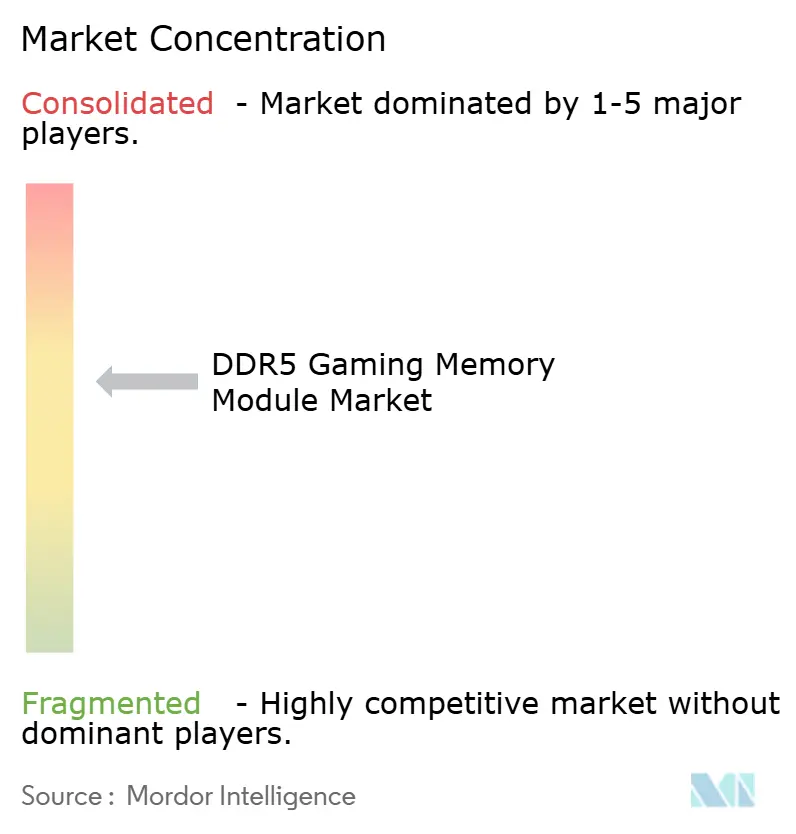
The DDR5 gaming memory module market is moderately fragmented among module brands but concentrated in the upstream DRAM die supply layer. Kingston Technology, Corsair, and G.SKILL are prominent brands in global e-commerce sales. Their product strategies depend on access to DRAM dies produced by Samsung, SK Hynix, and Micron. This dependence constrains margin flexibility when the memory supply is tight. Brands, therefore, compete through capacity options, speed grades, profile validation, RGB design, and retail visibility. Corsair’s SHUGO DDR5 series, introduced in May 2026, used light-emitting micro-drilling technology and a limited-edition positioning strategy.[3] The move illustrates a strategy built around design differentiation rather than standard specifications alone. The DDR5 gaming memory module market also rewards companies that can keep widely available products in popular capacity-and-speed combinations.
Platform certification is another important basis for competition. Intel XMP and AMD EXPO allow brands to show that a kit is configured for current desktop platforms. G.SKILL’s June 2026 NeoX RGB demonstration, featuring EXPO Ultra Low Latency profiles, showed how vendors use platform-specific tuning for differentiation.[4] XPG’s NOVAKEY RGB launch combined an Infinity Mirror design with support for both XMP 3.0 and EXPO. Dual-profile products are also attractive because retailers can support AMD and Intel customers with fewer stock-keeping units. Lighting ecosystem compatibility with products from ASUS and MSI remains relevant for premium system builds. Active cooling and local AI-oriented memory configurations remain areas where suppliers can develop specialized products. These approaches show that module suppliers need both broad retail products and differentiated enthusiast offerings.
JEDEC standards set the technical framework that shapes longer-term product development. JESD323B Version 2 established a common standard for CUDIMM and CQDIMM products with speeds up to 9600 MT/s. JEDEC also reported progress on a next-generation MRDIMM roadmap with a 12,800 MT/s target in April 2026. Suppliers need signal-integrity, printed circuit board, and validation capability to address these higher speed categories. New DRAM die suppliers could affect mid-range kit pricing if they scale successfully. That would place greater emphasis on brand recognition, design, ecosystem software, and retail execution. The DDR5 gaming memory module market is therefore likely to remain competitive at the brand level even while die supply stays concentrated. Companies that balance supply access with credible platform validation will be better positioned across mainstream and premium product ranges, because they can maintain widely requested configurations while preparing products for changing standards. This balance is especially important when buyers expect reliable profile operation but also want options that reflect new speed, capacity, and design developments. It requires close coordination between procurement, product engineering, retail planning, and platform testing, rather than relying on a single premium feature to sustain demand.
DDR5 Gaming Memory Module Industry Leaders
-
SK hynix Inc.
-
Samsung Electronics Co., Ltd.
-
Micron Technology, Inc.
-
G.SKILL International Enterprise Co., Ltd.
-
Corsair Memory, Inc.
-
Kingston Technology Company, Inc.
- *Disclaimer: Major Players sorted in no particular order
Recent Industry Developments
- June 2026: G.SKILL demonstrated the Trident Z5 NeoX RGB DDR5 at Computex 2026 as the first consumer memory series to support AMD EXPO Ultra Low Latency profiles, with specifications ranging from DDR5-6000 CL36 to CL26 in 32GB (2x16GB) configurations, validated across multiple motherboard platforms. The launch was executed as an AMD launch-partner program and deepens co-engineering relationships between G.SKILL and AMD for Ryzen desktop platforms.
- May 2026: Corsair announced SHUGO DDR5, a limited-edition enthusiast memory series built with patent-pending light-emitting micro-drilling technology that channels RGB illumination through the heat spreader’s metal surface itself. Launching at DDR5-6000 CL28 in 32GB (2x16GB) configurations with hand-selected DDR5 ICs and DHX cooling technology, SHUGO adopts a controlled-release, collector-grade distribution model positioning gaming memory as a lifestyle product with scarcity-driven pricing.
- May 2026: XPG, ADATA’s gaming sub-brand, launched NOVAKEY RGB DDR5, featuring the world’s first patented Infinity Mirror design, with speeds up to 6400 MT/s and capacities up to 32GB per module, supporting both Intel XMP 3.0 and AMD EXPO. The series received a 2026 CES Innovation Best of Innovation Award and integrates 50% recycled aluminum into its heat sink construction, along with a 10-layer printed circuit board and on-die ECC.
- April 2026: JEDEC published JESD82-552, the DDR5MDB02 Multiplexed Rank Data Buffer standard, and announced active progress toward MRDIMM Gen2 raw card designs targeting 12,800 MT/s bandwidth, establishing the technical design envelope for next-generation premium DDR5 module families through 2031. An expected forthcoming publication of JESD82-542, DDR5MRCD02, will further advance signal integrity and timing control for MRDIMM applications.
Global DDR5 Gaming Memory Module Market Report Scope
The DDR5 Gaming Memory Module Market Report is Segmented by Capacity (16GB Kits, 24GB Kits, 32GB Kits, 48GB Kits, 64GB Kits, and 96GB and Above Kits), Speed (Up to 5600 MT/s, 6000 MT/s to 6400 MT/s, 6600 MT/s to 7200 MT/s, and Above 7200 MT/s), Platform (Intel XMP-Certified Kits, AMD EXPO-Certified Kits, Dual-Profile XMP + EXPO Kits, and JEDEC Standard / Non-OC Kits), Application (Mainstream Gaming Desktops, Enthusiast / Overclocking Gaming PCs, Content Creation and Streaming Setups, Gaming-Creator Hybrid Workstations), Distribution Channel (Online Retail / E-commerce, Offline Retail / PC Component Stores, Brand Direct Sales, and System Integrators and Boutique PC Builders), and Geography (North America, Europe, Asia Pacific, and Rest of the World). The Market Forecasts are Provided in Terms of Value (USD).
| 16GB Kits |
| 24GB Kits |
| 32GB Kits |
| 48GB Kits |
| 64GB Kits |
| 96GB and Above Kits |
| Up to 5600 MT/s |
| 6000 MT/s to 6400 MT/s |
| 6600 MT/s to 7200 MT/s |
| Above 7200 MT/s |
| Intel XMP-Certified Kits |
| AMD EXPO-Certified Kits |
| Dual-Profile XMP + EXPO Kits |
| JEDEC Standard / Non-OC Kits |
| Mainstream Gaming Desktops |
| Enthusiast / Overclocking Gaming PCs |
| Content Creation and Streaming Setups |
| Gaming-Creator Hybrid Workstations |
| Online Retail / E-commerce |
| Offline Retail / PC Component Stores |
| Brand Direct Sales |
| System Integrators and Boutique PC Builders |
| North America | |
| Europe | |
| Asia-Pacific | China |
| Japan | |
| South Korea | |
| Taiwan | |
| Rest of Asia-Pacific | |
| Rest of the World |
| By Capacity | 16GB Kits | |
| 24GB Kits | ||
| 32GB Kits | ||
| 48GB Kits | ||
| 64GB Kits | ||
| 96GB and Above Kits | ||
| By Speed | Up to 5600 MT/s | |
| 6000 MT/s to 6400 MT/s | ||
| 6600 MT/s to 7200 MT/s | ||
| Above 7200 MT/s | ||
| By Platform | Intel XMP-Certified Kits | |
| AMD EXPO-Certified Kits | ||
| Dual-Profile XMP + EXPO Kits | ||
| JEDEC Standard / Non-OC Kits | ||
| By Application | Mainstream Gaming Desktops | |
| Enthusiast / Overclocking Gaming PCs | ||
| Content Creation and Streaming Setups | ||
| Gaming-Creator Hybrid Workstations | ||
| By Distribution Channel | Online Retail / E-commerce | |
| Offline Retail / PC Component Stores | ||
| Brand Direct Sales | ||
| System Integrators and Boutique PC Builders | ||
| By Geography | North America | |
| Europe | ||
| Asia-Pacific | China | |
| Japan | ||
| South Korea | ||
| Taiwan | ||
| Rest of Asia-Pacific | ||
| Rest of the World | ||
Key Questions Answered in the Report
What is driving demand for DDR5 gaming memory modules, and what will be the market size in 2031?
AMD AM5 and Intel LGA1851 systems require DDR5, which ties memory purchases to new gaming PC platform builds. This requirement supports demand even when discretionary upgrade spending becomes more cautious. It also simplifies purchasing decisions for new builders. The DDR5 gaming memory module market size is projected to expand from USD 2.16 billion in 2025 and USD 2.41 billion in 2026 to USD 3.53 billion by 2031, registering a CAGR of 7.93% between 2026 and 2031.
Which DDR5 capacity is most common for gaming PCs?
32GB kits held 45.9% of capacity-segment revenue in 2025 and remain the mainstream configuration for demanding gaming systems.
Which DDR5 speed tier leads gaming memory sales?
The 6000-6400 MT/s tier held 49.34% of speed-segment revenue in 2025, supported by broad platform compatibility.
Why are dual-profile XMP and EXPO kits gaining attention?
They support AMD and Intel systems, which can simplify retail stock selection and give buyers more platform flexibility.
Which application is growing fastest for DDR5 gaming memory?
Gaming-creator hybrid workstations are forecast to grow at 8.63% CAGR through 2031 because they combine gaming with local AI, rendering, and video workloads.
Why can DDR5 kit prices be volatile?
AI infrastructure demand can redirect advanced DRAM capacity toward HBM and server products, tightening consumer DDR5 supply. That can raise the cost of popular gaming kits and encourage some buyers to defer upgrades or select complete systems instead.