
Database and Identity Network Verification Market Size and Share
Market Overview
| Study Period | 2021 - 2032 |
|---|---|
| Market Size (2027) | USD 3.68 Billion |
| Market Size (2032) | USD 6.17 Billion |
| Growth Rate (2027 - 2032) | 10.85 % |
| Fastest Growing Market | Asia-Pacific |
| Largest Market | North America |
| Market Concentration | Medium |
Major Players *Disclaimer: Major Players sorted in no particular order Image © Mordor Intelligence. Reuse requires attribution under CC BY 4.0. | |
Database and Identity Network Verification Market Analysis by Mordor Intelligence
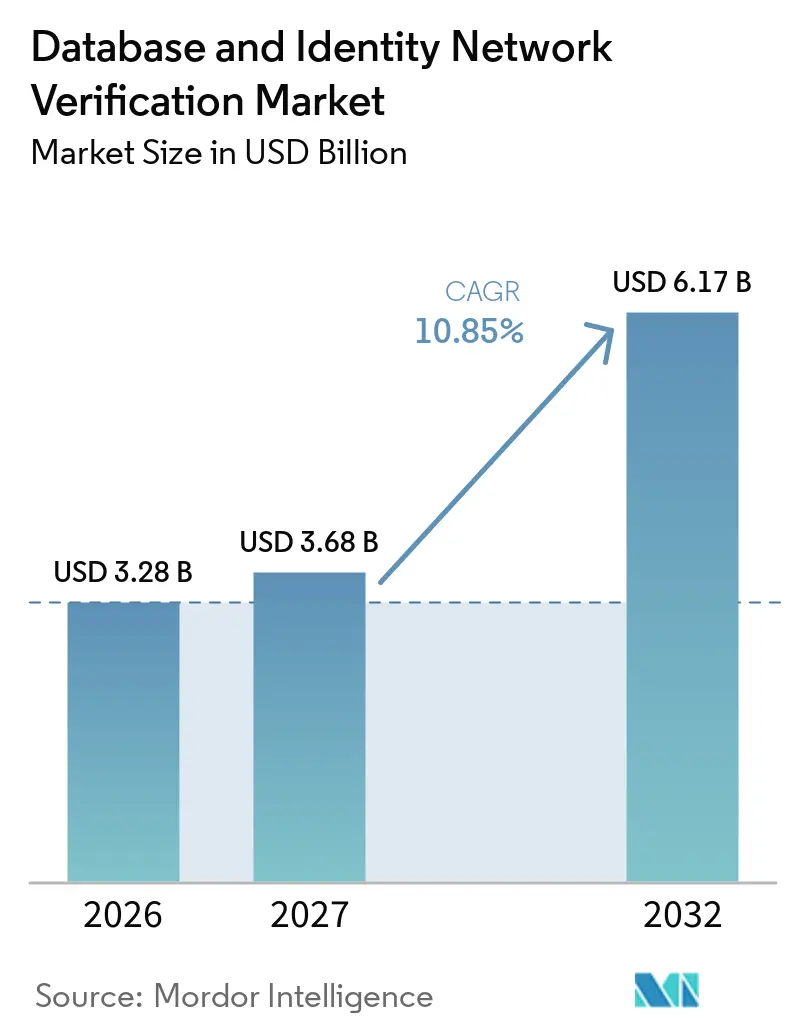
The database and identity network verification market size is projected to expand from USD 3.28 billion in 2026 and USD 3.68 billion in 2027 to USD 6.17 billion by 2032, registering a CAGR of 10.85% between 2027 to 2032. The database and identity network verification market is being shaped by more sophisticated fraud, tighter know-your-customer and anti-money-laundering obligations, and the move toward digital identity interactions in banking, government, and commerce. The EU Digital Identity Wallet rollout and the U.S. acceptance of verifiable digital credentials are making identity controls a compliance priority for regulated organizations. Buyers are increasingly looking for platforms that combine database matching, document checks, biometric signals, risk decisions, and ongoing monitoring into a single workflow. This preference favors providers with broad data coverage, clear compliance credentials, and deployment options that work across local data rules.
Key Report Takeaways
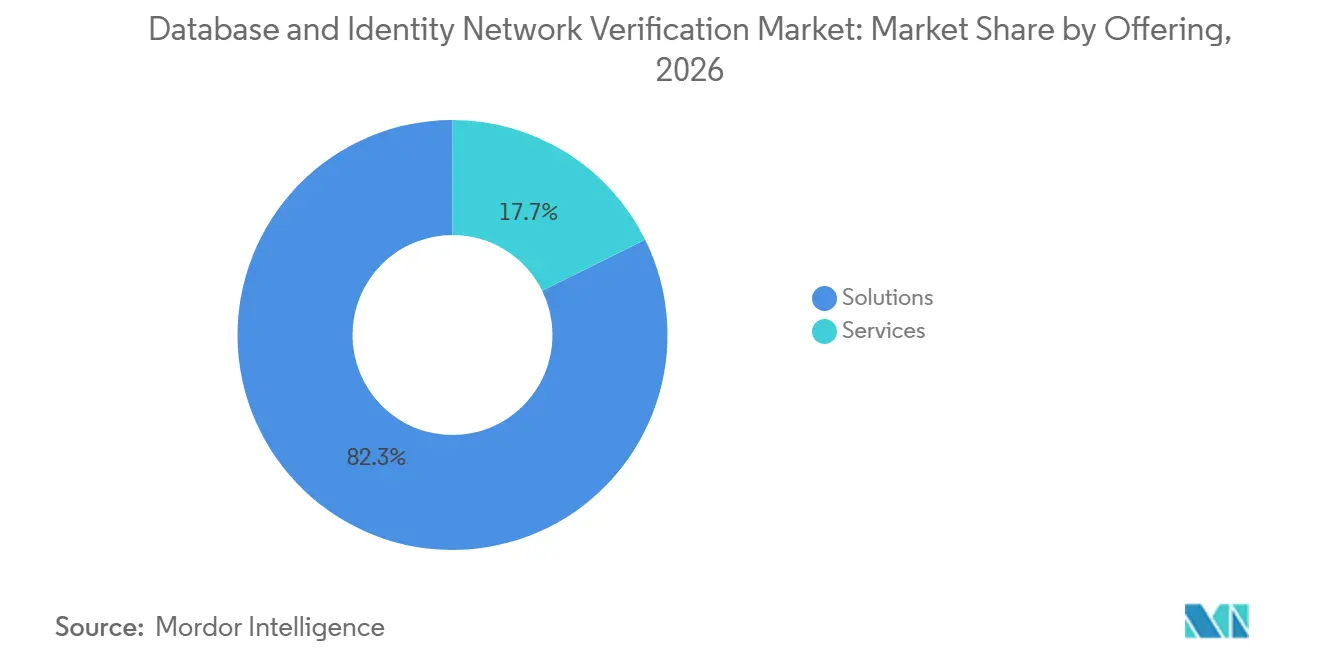
- By offering solutions, the market is projected to expand at an 11.25% CAGR through 2032 and generate an 82.31% share in 2026 in the database and identity network verification market.
- By verification method, database and data verification held the largest share in 2026 at 38.43%, while digital identity and verifiable credential verification are projected to expand at an 11.84% CAGR through 2032.
- By deployment, cloud held 69.29% of the database and identity network verification market share in 2026, and the segment is expected to expand at a CAGR of 11.43% through 2032.
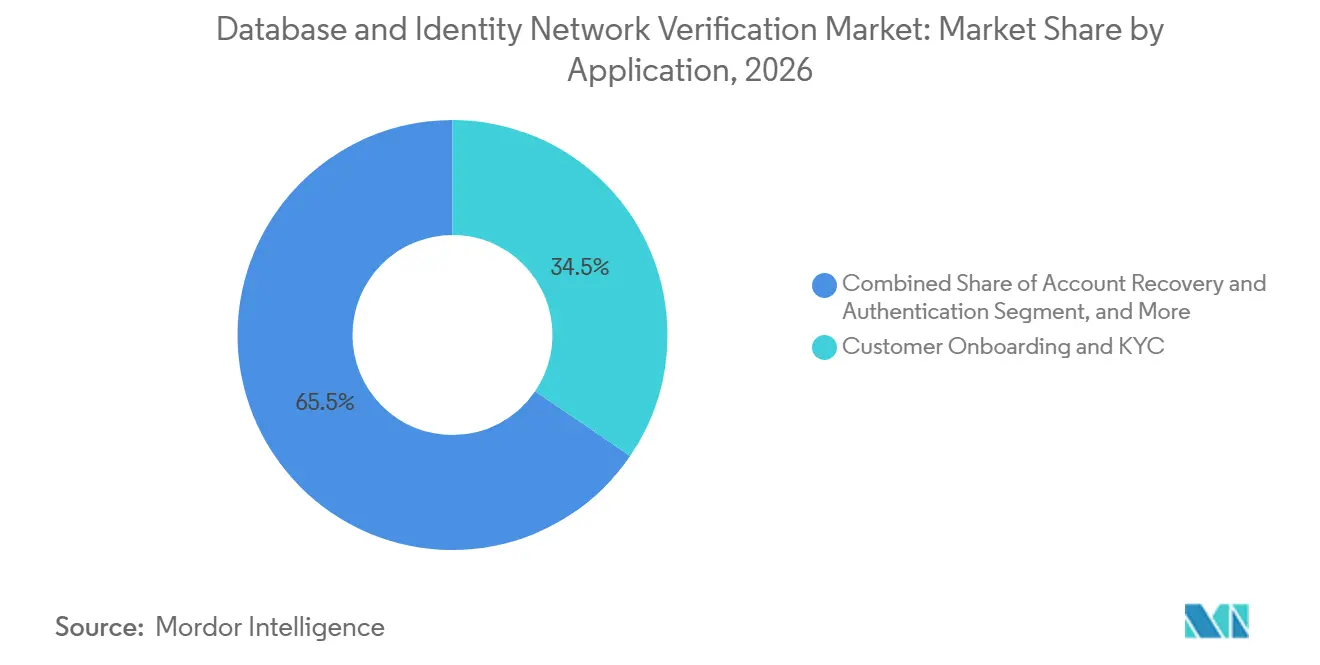
- By application, customer onboarding and KYC held 34.52% of the database and identity network verification market size in 2026, while Know Your Business and beneficial ownership are projected to expand at a 12.05% CAGR through 2032.
- By end user, BFSI held 38.22% of the database and identity network verification market share in 2026, while the government and public sector are projected to expand at an 11.98% CAGR through 2032.
- By geography, North America held the largest position in 2026, while Asia-Pacific is projected to expand at an 11.81% CAGR through 2032.
Note: Market numbers in this report are based on Mordor Intelligence's proprietary estimation framework, which combines nine months of actuals with Q4 projections for base year 2026.
Market Trends and Insights
Drivers Impact Analysis of Database and Identity Network Verification Market*
| Driver | (~) % Impact on CAGR Forecast | Geographic Relevance | Impact Timeline |
|---|---|---|---|
| Strengthening KYC, AML, and Digital Identity Requirements | +2.8% | Global, with mandates concentrated in North America and Europe | Short term (≤ 2 years) |
| Increasing Synthetic Identity, Deepfake, and Account-Takeover Fraud Risks | +2.2% | Global, with highest severity in North America and Asia-Pacific core markets | Short term (≤ 2 years) |
| Growing Adoption of Remote Onboarding and Digital Payment Solutions | +1.7% | Asia-Pacific core markets, with spillover to South America and Africa | Medium term (2-4 years) |
| Rising Demand for Cross-Border Identity Coverage and Localized Data Matching | +1.3% | Asia-Pacific, Europe, and Middle East trade corridors | Medium term (2-4 years) |
| Advancements in AI-Driven Risk Decisioning and Continuous Monitoring | +1.1% | Global | Medium term (2-4 years) |
| Expanding Use of Reusable Digital Identities and Verifiable Credentials | +0.8% | North America and Europe, with Asia-Pacific spillover | Long term (≥ 4 years) |
| Source: Mordor Intelligence | |||
Strengthening KYC, AML, and Digital Identity Regulatory Requirements
The database and identity network verification market is benefiting from regulations that require more reliable digital onboarding. The EU Anti-Money Laundering Regulation creates a single rulebook for obliged entities and requires acceptance of the EU Digital Identity Wallet for customer due diligence by 2027. The eIDAS 2.0 regulation requires each member state to make at least 1 wallet available by the end of 2026. In the United States, federal banking agencies clarified on September 8, 2026, that state-issued mobile driver's licenses and government-issued verifiable digital credentials can satisfy Customer Identification Program requirements when used appropriately.[1] These requirements make accredited digital identity connections more important when selecting vendors. They also move procurement influence toward compliance and risk teams, which can shorten decisions for vendors that already meet required standards.
Increasing Synthetic Identity, Deepfake, and Account-Takeover Fraud Risks
Rising fraud losses are pushing the database and identity network verification market toward layered controls instead of isolated document checks. U.S. consumers reported substantial digital fraud losses, while account takeover fraud increased year over year and accounted for a notable share of suspected digital fraud globally. Entrust reported that deepfakes appeared in 1 in every 5 biometric fraud attempts, injection attacks increased 40%, and deepfaked selfie attempts increased 58% in 1 year. The same TransUnion update estimated potential US lender losses from synthetic identities at USD 2.6 billion at the end of 2025. These attacks can blend authentic registry details with false elements, which makes database and network signals valuable before a document is accepted. Account takeover also shows why many buyers are extending verification into authentication and post-onboarding monitoring.
Growing Adoption of Remote Onboarding and Digital Payment Solutions
Remote account opening and instant payments are creating sustained demand across the database and identity network verification market. India’s DigiLocker has supported more than 620 million users and issued more than 9.5 billion digital documents, creating a large base for government-linked verification flows. The Reserve Bank of India reported that Unified Payments Interface processed 185.8 billion transactions in fiscal year 2025-26, illustrating the operating scale that identity checks must support. Singapore’s government has described Singpass as a national digital identity system used across public and private services. These settings reward fast matching against trusted records and reduce the practicality of manual review. Veriff’s May 2025 launch of U.S. Database Verification also showed how providers are taking registry matching into financial services, gaming, e-commerce, and healthcare.
Rising Demand for Cross-Border Identity Coverage and Localized Data Matching
Cross-border activity is raising demand for verification providers that can work across different business registries and ownership rules. The Financial Action Task Force has identified transparency of beneficial ownership as a core element of efforts against illicit finance. The database and identity network verification market therefore has a clear need for current business records, entity matching, and ownership mapping that can be applied consistently across jurisdictions. Trulioo reported in October 2025 that its US KYB transaction volume had increased 1,996% since 2023 and 102% year over year. That increase shows how quickly business verification is becoming central to commercial onboarding. Local matching remains necessary because legal entity names, ownership records, and available registry fields vary by country. Providers that can connect broad coverage with traceable data sources are better placed to serve international customers.
Restraints Impact Analysis of Database and Identity Network Verification Market*
| Restraint | (~) % Impact on CAGR Forecast | Geographic Relevance | Impact Timeline |
|---|---|---|---|
| Fragmented Data-Access Permissions and Inconsistent Registry Quality | -2.0% | Africa, South America, and parts of Asia-Pacific with underdeveloped civil registries | Medium term (2-4 years) |
| Complexity in Privacy Compliance, Data Localization, and Consent Management | -1.8% | Global, with strict requirements in the EU, China, India, and Gulf states | Long term (≥ 4 years) |
| Higher False Decline Rates Due to Incomplete or Nonstandard Identity Records | -1.3% | Sub-Saharan Africa, rural Asia-Pacific, and South America | Medium term (2-4 years) |
| High Costs of Integration, Identity Assurance, and Ongoing Data Curation | -1.0% | Global, with a disproportionate effect on mid-market and small business buyers | Long term (≥ 4 years) |
| Source: Mordor Intelligence | |||
Fragmented Data-Access Permissions and Inconsistent Registry Quality
Uneven registry coverage limits how consistently the database and identity network verification market can serve emerging economies. Civil records may be held by separate agencies, updated on different schedules, or made available without standardized application programming interfaces. These conditions make it harder to confirm a person's or a business's record in real time. The problem is especially important for cross-border KYB programs, where legal names, beneficial ownership data, and supporting evidence are not presented uniformly. The added work raises the cost of entering each new country and weakens the economics of a standard per-verification price. It can also lead to false declines when legitimate users cannot be matched to incomplete or outdated records.
Complexity in Privacy Compliance, Data Localization, and Consent Management
Privacy and data localization rules can require the database and identity network verification market to operate separate infrastructure in individual countries. India’s Digital Personal Data Protection Rules, 2025, set out implementation provisions for the Digital Personal Data Protection Act.[2] The Reserve Bank of India requires that payment system data be stored only in systems located in India. China’s Personal Information Protection Law includes requirements for certain cross-border transfers of personal information. Kenya’s data protection authority has issued guidance on cross-border data transfers. Each rule can add legal review, consent management, local processing, and operational controls. This reduces the cost advantage that a single global data network would otherwise provide.
*Our forecasts treat driver/restraint impacts as directional, not additive. The impact forecasts reflect baseline growth, mix effects, and variable interactions.
Database and Identity Network Verification Market Segment Analysis
By Offering:
Integrated Solutions Support Platform AdoptionSolutions are projected to expand at an 11.25% CAGR from 2027 to 2032 in the database and identity network verification market. Buyers are selecting integrated platforms that bring orchestration, risk decisions, anti-money-laundering screening, and compliance reporting into a single contract. This reduces the number of systems that an onboarding team must connect and manage. It also gives compliance staff a more consistent view of decision records and escalations. In October 2025, Trulioo introduced enhanced biometric authentication, dynamic KYB intelligence, and real-time company monitoring as elements of its unified platform.
Services remain important for implementation, legacy system integration, and regulatory advisory work. Financial institutions with older onboarding systems often need this support as they adapt to new digital identity standards. The distinction between the 2 offerings is narrowing because software platforms now include more automated updates, liveness detection, and workflow configuration. Platform licensing is also becoming more common than isolated transaction pricing. This model links vendor revenue to customer onboarding activity and can increase switching costs after a platform is embedded. In the database and identity network verification industry, point providers can face pricing pressure when broad platforms bundle individual check types into a single offer.
By Verification Method:
Digital Credentials Raise the Importance of StandardsDatabase and data verification held the largest position in the database and identity network verification market in 2026. It acts as a real-time matching layer against government and commercial records, either as a first step or alongside document and biometric checks. Document verification remains important where authoritative data sources are limited or an original document must be examined. Biometric verification adds liveness and face matching controls that can help detect impersonation. Non-biometric signals, including phone intelligence and knowledge-based checks, are more often used to support continuous monitoring than to establish identity on their own.
Digital identity and verifiable credential verification are projected to expand at an 11.84% CAGR through 2032. The W3C published Verifiable Credentials 2.0 as a formal web standard on May 15, 2025. The specification supports credentials that can be expressed, exchanged, and verified in a machine-readable format. OpenID Foundation conformance testing for OpenID4VP and OpenID4VCI is available for self-certification. The standards give national wallet programs and private-sector providers a clearer route toward interoperability. Providers that establish compliant credential flows before large-wallet deployments may be better prepared as enterprise demand expands.
By Deployment:
Cloud Retains the Largest Role While Hybrid Supports Local RulesCloud deployment accounted for 69.29% of the database and identity network verification market size in 2026. API-first delivery appeals to fintech and platform buyers that need rapid integration, centralized updates, and scalable audit records. Cloud platforms can also update rules and risk models without requiring customer teams to install new versions locally. These features are useful when a provider serves multiple customer channels or expands into new regions. Managed cloud deployment can therefore reduce the operational burden of maintaining a verification program.
On-premises deployment remains relevant where government agencies or financial centers require local handling of sensitive identity data. Hybrid deployment is becoming more useful for multinational organizations that need local processing while using shared fraud models and global workflow tools. This configuration can support data residency obligations without requiring every function to be rebuilt on a country-by-country basis. Sumsub stated in 2026 that its trust infrastructure served more than 4,000 global customers, highlighting the need for flexible operating models across jurisdictions. Deployment flexibility is now assessed during procurement rather than treated only as a technical setting after purchase. In the database and identity network verification industry, providers tied to a single delivery model may be excluded from opportunities that require local controls.
By Application:
Ownership Transparency Drives Business Verification DemandCustomer onboarding and KYC accounted for 34.52% of the database and identity network verification market size in 2026. Account opening remains the primary point at which regulated businesses must verify a customer’s identity. The application brings together database checks, document review, biometric matching, sanctions screening, and case management. Its importance is sustained by legal duties under anti-money laundering and customer due diligence rules. Organizations also use these controls to reduce friction by approving legitimate customers faster when trusted data is available.
Know Your Business and beneficial ownership are projected to expand at a 12.05% CAGR through 2032. FinCEN issued an interim final rule on Beneficial Ownership Information reporting that became effective on March 26, 2025. Trulioo launched its UBO Discovery Agent in July 2026 to automate beneficial ownership structure mapping across multiple jurisdictions. Anti-money laundering and sanctions screening is also becoming more immediate as payments move faster. Account recovery and authentication are gaining attention because account takeover can occur after an originally valid onboarding decision. Fraud prevention and transaction monitoring are increasingly integrated into the same identity stack, as ongoing signals replace periodic reviews.

By End User:
BFSI Keeps the Largest Spending BaseBFSI accounted for 38.22% of the database and identity network verification market size in 2026. Banks, insurers, payment providers, and other financial businesses face overlapping KYC, anti-money laundering, and customer due diligence duties. Their exposure to account takeover, payment fraud, and synthetic identity fraud supports spending both on onboarding and after an account has been opened. Entrust found that account takeover represented 55% of digital banking incidents and that 82% of payment-related fraud was concentrated during authentication. This makes continuous verification more valuable to financial services buyers.
The government and public sector are projected to expand at an 11.98% CAGR through 2032. Public services need reliable identity proofing for benefit payments, citizen access, and secure use of digital government systems. The US General Services Administration has continued to operate Login.gov as a shared sign-in service for government agencies. Retail and e-commerce users are adopting identity checks for age-restricted purchases, return fraud, and marketplace controls. Telecommunications providers can supply device, mobile number, and SIM-related signals as secondary controls. Healthcare, insurance, gaming, and sharing-economy platforms also need scalable identity assurance as digital interactions expand.
Geography Analysis
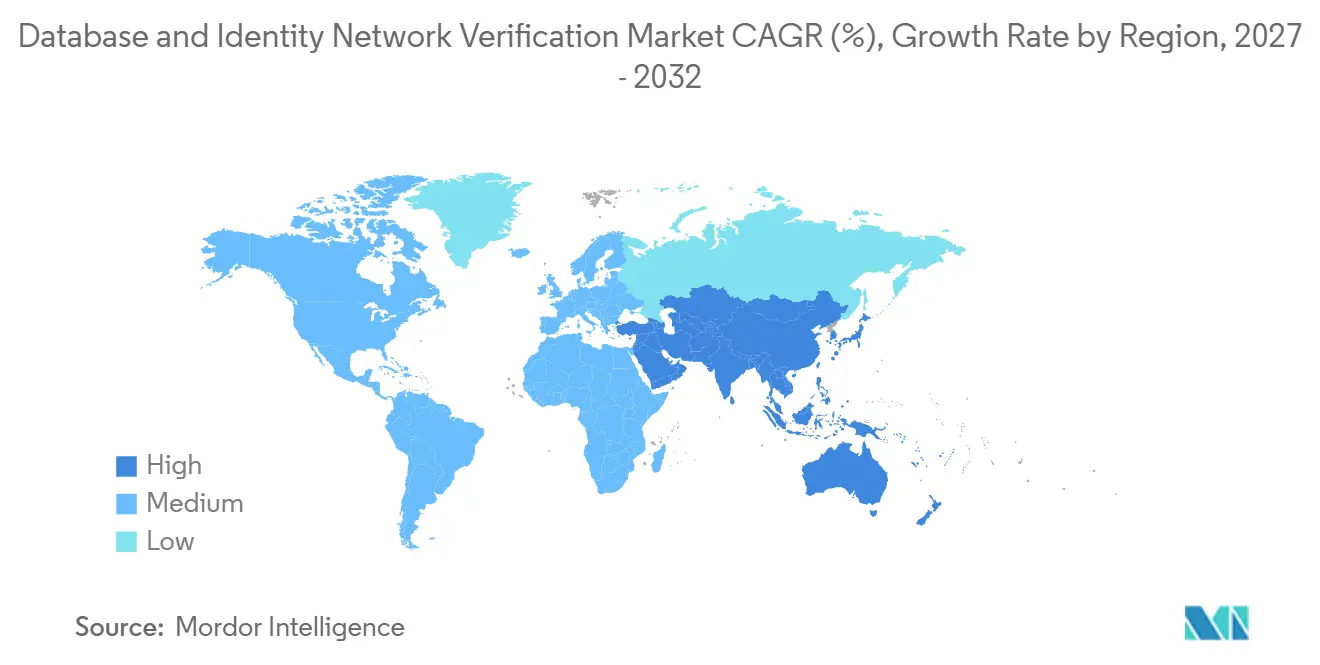
North America held the largest position in the database and identity network verification market in 2026. The region has a high concentration of financial institutions, identity-focused technology companies, and digital platform businesses. U.S. federal guidance issued on September 8, 2026, clarified the potential use of mobile driver's licenses and verifiable digital credentials in Customer Identification Programs. This gives regulated buyers a clearer path for digital credential onboarding. Trulioo stated that it processed more than 20 million verification transactions for US customers in 2025.
Europe has a strong regulatory reason to upgrade its identity infrastructure. The eIDAS 2.0 regulation provides the basis for European Digital Identity Wallets, while the Anti-Money Laundering Regulation harmonizes requirements for obliged entities. Veriff received certification under the UK Digital Identity and Attributes Trust Framework in February 2026. Germany, the United Kingdom, and France remain important revenue centers because they combine large financial sectors with active digital identity programs. Italy, Spain, and Nordic markets are likely to gain importance as wallet programs enter wider use. The database and identity network verification market in Europe, therefore, rewards providers that can demonstrate compliance with standards and regional coverage.
Asia-Pacific is projected to expand at an 11.81% CAGR through 2032. Government e-ID programs, mobile-first finance, and fast payment systems are creating a large-volume environment for database matching. India’s DigiLocker and payment infrastructure show the scale of digital identity interactions in the region. Jumio launched selfie.DONE in Asia-Pacific in September 2026 and reported a 20% increase in verification completion rates, with up to 60% of users able to authenticate without document rescanning. The Middle East is supported by digitalization and fintech licensing, although local data rules shape deployment choices. Africa has potential through mobile money, but registry quality can limit accuracy. South America is led by Brazil’s digital finance activity, and Veriff opened a São Paulo headquarters in May 2025 after reporting 2.5x growth in business volume in the region during 2024.
Competitive Landscape
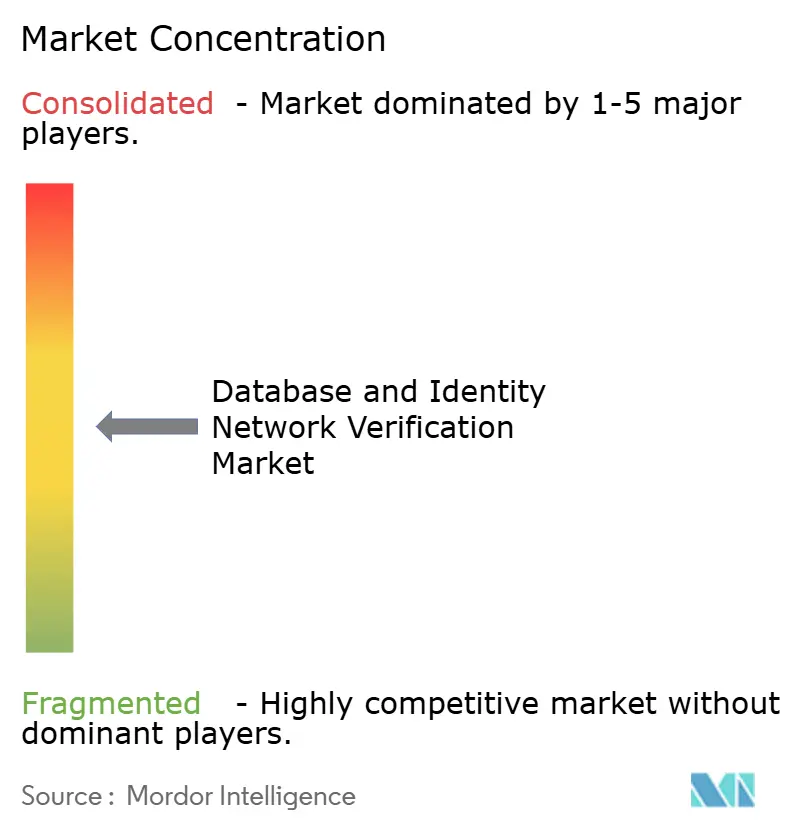
The database and identity network verification market is moderately fragmented. Trulioo, Jumio, Socure, and Veriff compete as broad global platforms, while iDenfy, PXL Vision, Innovatrics, and AuthenticID are among the more specialized providers. Buyers are placing more weight on the reach of a provider’s data network, orchestration capability, and ability to manage the full customer identity lifecycle. Jumio announced in June 2026 that it could support digital ID acceptance across more than 60 countries and territories through a single Trinsic integration. That move illustrates the value of reducing country-by-country integration work for multinational customers.
Platform providers are extending beyond an initial document or database check into fraud prevention, authentication, monitoring, and business verification. Socure acquired Fravity in August 2026 and raised USD 156 million in growth funding, expanding its focus on fraud investigation following the acquisition. Veriff received FIDO Alliance certification for Full Auto IDV in April 2026, strengthening its interoperability position for regulated enterprise buyers. Trulioo also introduced advanced identity capabilities in October 2025 that combined biometric authentication, KYB intelligence, and company monitoring. These moves show why individual check performance alone is no longer sufficient for large procurement programs.
Database-layer fraud specialists such as SentiLink and Prove Identity remain relevant because registry and credit signals can identify synthetic identity patterns that biometric controls alone may not detect. Reusable identity and cross-border beneficial ownership verification remain areas where providers are seeking more complete, interoperable offerings. Sumsub repositioned its offering in 2026 as an AI-powered trust infrastructure that connects verification, fraud prevention, transaction monitoring, and compliance workflows.[3] Competition is likely to remain active because regional registry access, standards certifications, and data localization capabilities vary significantly among providers. The database and identity network verification market favors firms that can combine global reach with local data controls. It also leaves room for specialists who solve high-value problems in a particular fraud type, verification method, or geography.
Database and Identity Network Verification Industry Leaders
-
Trulioo Information Services Inc.
-
Veriff OÜ
-
Sumsub Inc.
-
Socure, Inc.
-
Jumio Corporation
- *Disclaimer: Major Players sorted in no particular order
Database and Identity Network Verification Market Companies Covered in this Report
- Trulioo Information Services Inc.
- Veriff OÜ
- Sumsub Inc.
- Persona Identities, Inc.
- Socure, Inc.
- Jumio Corporation
- AU10TIX Ltd.
- Mitek Systems, Inc.
- IDnow GmbH
- Signicat AS
- ID.me, Inc.
- Incode Technologies, Inc.
- Regula Forensics Inc.
- Innovatrics, s.r.o.
- iDenfy UAB
- PXL Vision AG
- Shufti Pro Ltd.
- HyperVerge, Inc.
- AuthenticID, Inc.
- Facephi Biometria, S.A.
- Yoti Ltd.
- SentiLink, Inc.
- PROVE IDENTITY, INC.
- Intellicheck, Inc.
Recent Industry Developments in Database and Identity Network Verification Market
- October 2026: Trulioo partnered with Fiserv to deliver identity and business verification for merchant onboarding and underwriting across international markets through a single integration point, enabling consistent multi-jurisdiction verification without requiring market-by-market process rebuilding. The partnership extends Trulioo's verification coverage into Fiserv's global merchant processing network and underscores the trend toward enterprise consolidation of identity and payment infrastructure under fewer vendor relationships.
- September 2026: Jumio completed the worldwide rollout of selfie.DONE to EMEA on September 28, 2026, achieving full global deployment coverage following sequential launches in South America, North America, and Asia-Pacific. The reusable identity solution enables users previously verified through Jumio's global identity graph to authenticate in subsequent interactions using only a selfie, reducing document re-scan requirements and verification friction at scale.
- August 2026: Socure raised USD 156 million in strategic growth funding and acquired Fravity, an agentic AI platform for fraud investigation, on August 27, 2026. The transaction expanded Socure’s move into AI-driven post-onboarding risk management and established a USD 5.2 billion valuation.
- June 2026: Jumio became the first identity intelligence provider to enable digital ID acceptance across more than 60 countries and territories through a single integration with credential gateway Trinsic. The arrangement supports eIDAS-compliant digital IDs across nearly 20 EU countries without requiring separate vendor relationships or country-by-country accreditation for customers.
Global Database and Identity Network Verification Market Report Scope
The Database and Identity Network Verification Market refers to the market for software solutions and services that validate database records, verify personal and business identities, authenticate identity documents and biometric attributes, and establish the accuracy, legitimacy, and trustworthiness of digital identities across interconnected systems and networks.
The Database and Identity Network Verification Report is Segmented by Offering (Solutions, and Services), Verification Method (Database and Data Verification, Document Verification, Biometric Verification, Non-Biometric Verification, and Digital Identity and Verifiable Credential Verification), Deployment (Cloud, On-Premises, and Hybrid), Application (Customer Onboarding and KYC, Know Your Business and Beneficial Ownership, Anti-Money Laundering and Sanctions Screening, Account Recovery and Authentication, Fraud Prevention and Transaction Monitoring, and Workforce and Citizen Identity Verification), End User (BFSI, Government and Public Sector, Retail and E-Commerce, Telecommunications, Healthcare and Insurance, and Other End Users), and Geography (North America, South America, Europe, Asia-Pacific, Middle East, and Africa). The Market Forecasts are Provided in Terms of Value (USD).
Segmentation Overview
| Solutions |
| Services |
| Database and Data Verification |
| Document Verification |
| Biometric Verification |
| Non-Biometric Verification |
| Digital Identity and Verifiable Credential Verification |
| Cloud |
| On-Premises |
| Hybrid |
| Customer Onboarding and KYC |
| Know Your Business and Beneficial Ownership |
| Anti-Money Laundering and Sanctions Screening |
| Account Recovery and Authentication |
| Fraud Prevention and Transaction Monitoring |
| Workforce and Citizen Identity Verification |
| BFSI |
| Government and Public Sector |
| Retail and E-Commerce |
| Telecommunications |
| Healthcare and Insurance |
| Other End Users |
| North America | United States |
| Canada | |
| Mexico | |
| South America | Brazil |
| Argentina | |
| Colombia | |
| Rest of South America | |
| Europe | United Kingdom |
| Germany | |
| France | |
| Italy | |
| Spain | |
| Rest of Europe | |
| Asia-Pacific | China |
| India | |
| Japan | |
| Singapore | |
| Australia | |
| Rest of Asia-Pacific | |
| Middle East | United Arab Emirates |
| Saudi Arabia | |
| Turkey | |
| Rest of Middle East | |
| Africa | South Africa |
| Nigeria | |
| Kenya | |
| Egypt | |
| Rest of Africa |
| By Offering | Solutions | |
| Services | ||
| By Verification Method | Database and Data Verification | |
| Document Verification | ||
| Biometric Verification | ||
| Non-Biometric Verification | ||
| Digital Identity and Verifiable Credential Verification | ||
| By Deployment | Cloud | |
| On-Premises | ||
| Hybrid | ||
| By Application | Customer Onboarding and KYC | |
| Know Your Business and Beneficial Ownership | ||
| Anti-Money Laundering and Sanctions Screening | ||
| Account Recovery and Authentication | ||
| Fraud Prevention and Transaction Monitoring | ||
| Workforce and Citizen Identity Verification | ||
| By End User | BFSI | |
| Government and Public Sector | ||
| Retail and E-Commerce | ||
| Telecommunications | ||
| Healthcare and Insurance | ||
| Other End Users | ||
| By Geography | North America | United States |
| Canada | ||
| Mexico | ||
| South America | Brazil | |
| Argentina | ||
| Colombia | ||
| Rest of South America | ||
| Europe | United Kingdom | |
| Germany | ||
| France | ||
| Italy | ||
| Spain | ||
| Rest of Europe | ||
| Asia-Pacific | China | |
| India | ||
| Japan | ||
| Singapore | ||
| Australia | ||
| Rest of Asia-Pacific | ||
| Middle East | United Arab Emirates | |
| Saudi Arabia | ||
| Turkey | ||
| Rest of Middle East | ||
| Africa | South Africa | |
| Nigeria | ||
| Kenya | ||
| Egypt | ||
| Rest of Africa | ||
Key Questions Answered in the Report
What is the database and identity network verification market size?
The database and identity network verification market is projected to increase from USD 3.28 billion in 2026 to USD 6.17 billion by 2032, at a 10.85% CAGR from 2027 to 2032.
What is driving demand for database and identity network verification?
Fraud risk, digital onboarding, payment growth, and KYC and anti-money laundering obligations are supporting adoption.
Which deployment model has the leading position?
Cloud deployment held 69.29% in 2026 because API-based delivery supports fast integration and centralized compliance updates.
Which application is expanding fastest?
Know Your Business and beneficial ownership is projected to expand at a 12.05% CAGR through 2032.
Which end user has the largest spending position?
BFSI held 38.22% in 2026 due to its KYC, anti-money laundering, and customer due diligence requirements.
Which region is projected to expand fastest?
Asia-Pacific is projected to expand at an 11.81% CAGR through 2032, supported by e-ID systems, mobile finance, and digital payments.