
Data Residency and Sovereignty Compliance Tools Market Size and Share
Market Overview
| Study Period | 2019 - 2030 |
|---|---|
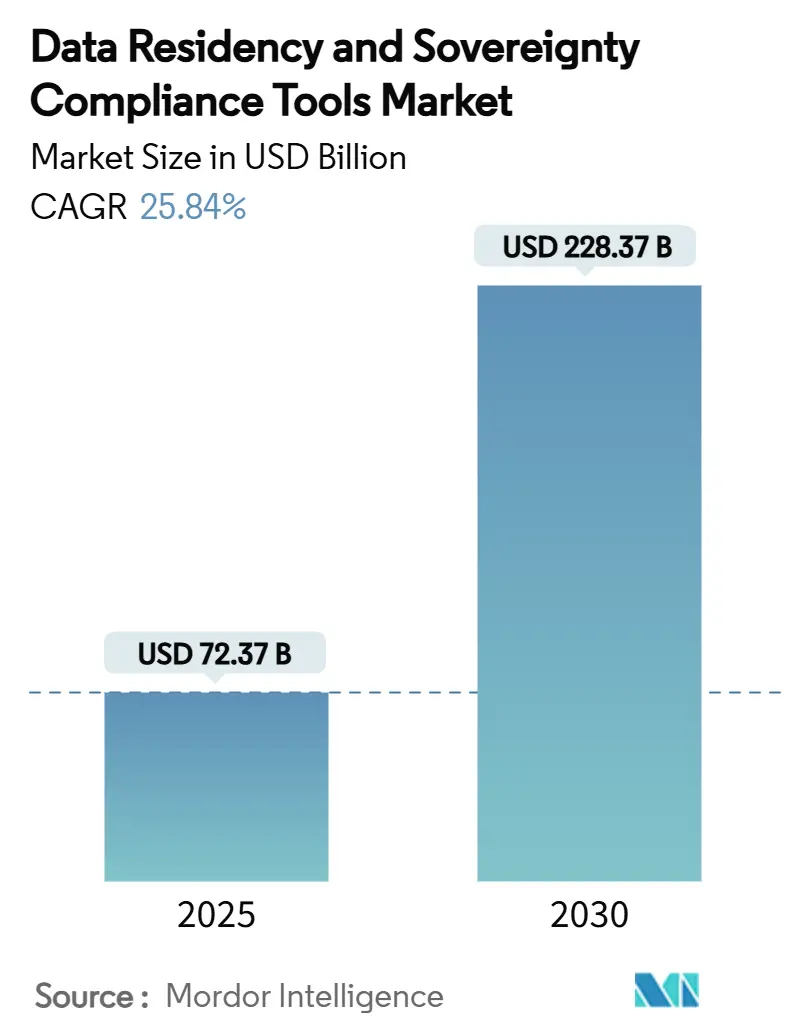
| Market Size (2025) | USD 72.37 Billion |
| Market Size (2030) | USD 228.37 Billion |
| Growth Rate (2025 - 2030) | 25.84 % |
| Fastest Growing Market | Asia Pacific |
| Largest Market | North America |
| Market Concentration | Medium |
Major Players *Disclaimer: Major Players sorted in no particular order Image © Mordor Intelligence. Reuse requires attribution under CC BY 4.0. | |
Data Residency and Sovereignty Compliance Tools Market Analysis by Mordor Intelligence
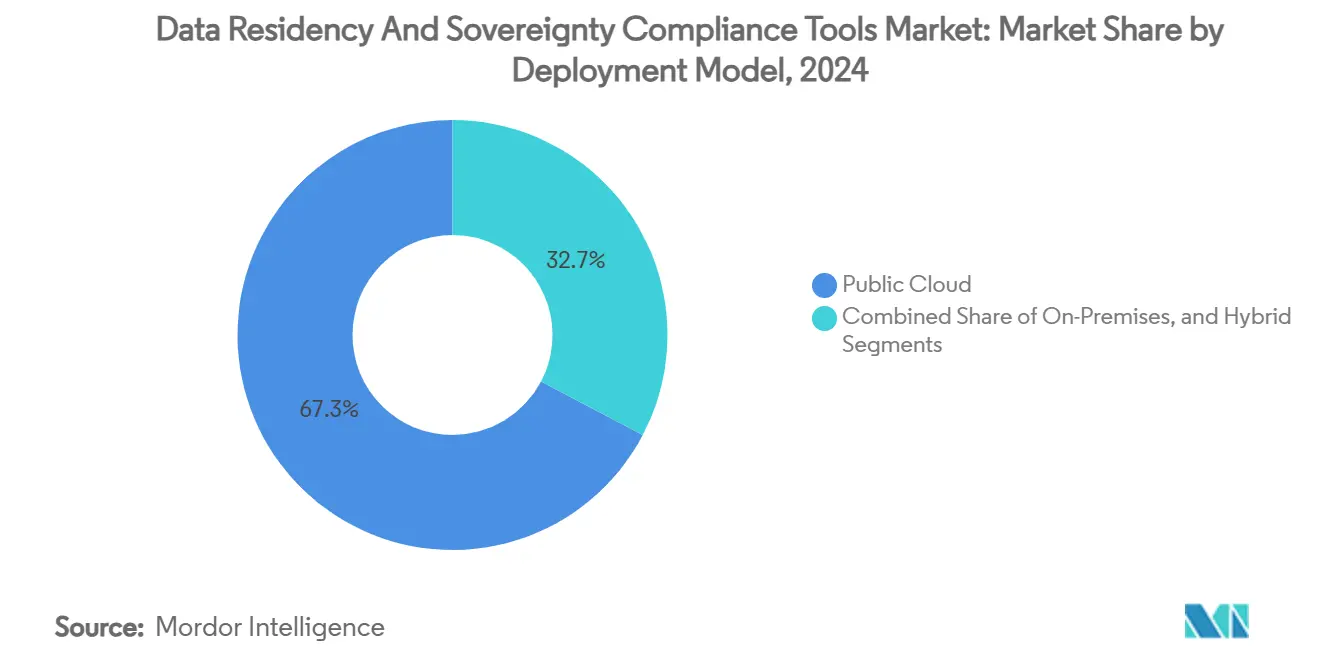
Data residency and Sovereignty Compliance Tools market size reached USD 72.37 billion in 2025 and is forecast to rise to USD 228.37 billion by 2030, implying a compounding CAGR of 25.84%. Momentum is being driven by synchronized data-localization statutes, hyperscaler sovereign-cloud rollouts, and the rising financial exposure that follows non-compliance. Public cloud deployments led with 67.3% market share in 2024, yet hybrid architectures are advancing the fastest at a 30.2% CAGR as enterprises redistribute sensitive workloads to jurisdictionally aligned environments. The banking and financial services segment retained adoption leadership, while government workloads are catching up quickly as digital sovereignty becomes a national security priority. Investor appetite stays robust, illustrated by funding rounds for providers such as BigID and Skyflow. Overall, the data residency solutions market is moving from niche compliance tooling toward an integrated governance layer that underpins AI-enabled transformation programs.
Key Report Takeaways
- By deployment model, public cloud captured 67.3% revenue share in 2024; hybrid architectures are projected to expand at a 30.2% CAGR to 2030.
- By tool type, data-privacy management suites commanded 35.2% of the data residency solutions market size in 2024, while residency-as-a-service recorded the highest projected CAGR at 32.2% through 2030.
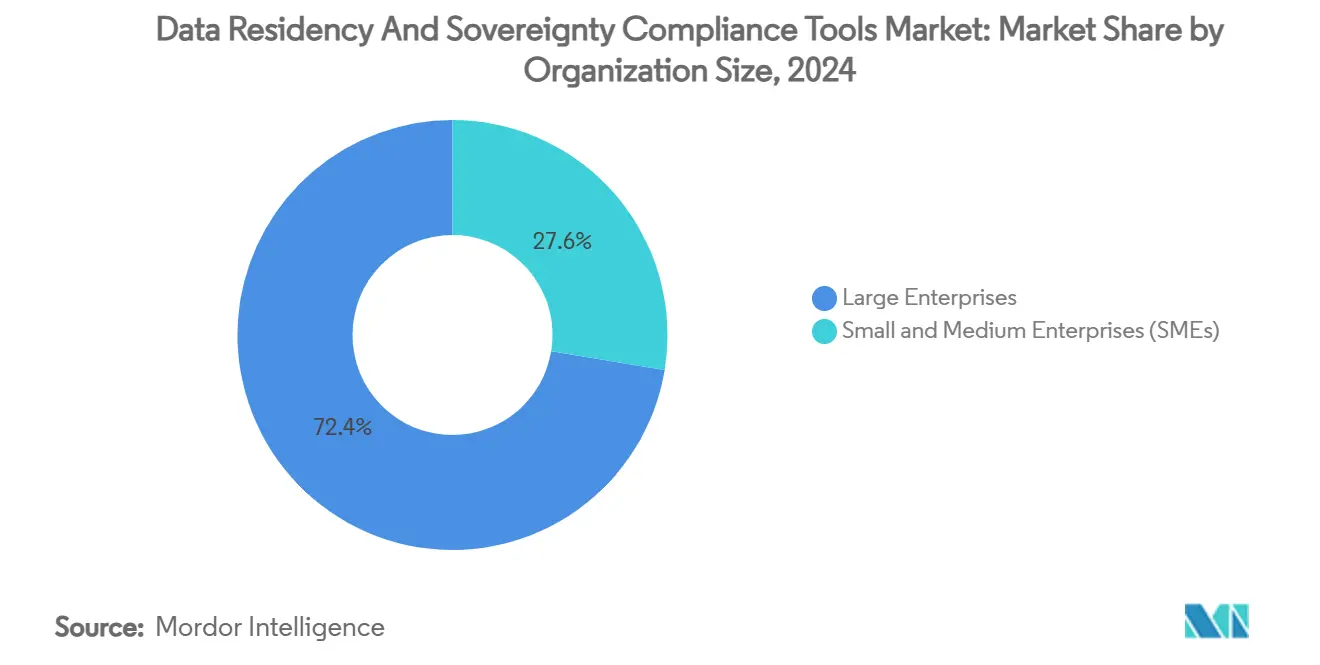
- By organisation size, large enterprises held 72.4% of the data residency solutions market share in 2024, and small and medium enterprises are advancing at a 31.2% CAGR through 2030.
- By end-use industry, BFSI accounted for a 29.1% share of the data residency solutions market size in 2024, and the government segment is advancing at a 29.1% CAGR through 2030.
- By geography, North America led with 38.2% revenue share in 2024; Asia-Pacific is forecast to register the quickest growth at a 28.1% CAGR to 2030.
Note: Market size and forecast figures in this report are generated using Mordor Intelligence’s proprietary estimation framework, updated with the latest available data and insights as of January 2026.
Market Trends and Insights
Drivers Impact Analysis of Data Residency and Sovereignty Compliance Tools Market*
| Driver | (~) % Impact on CAGR Forecast | Geographic Relevance | Impact Timeline |
|---|---|---|---|
| Strict data-localization laws and penalties | +6.2% | Global, Asia-Pacific, and EU | Medium term (2-4 years) |
| Hyperscaler sovereign-cloud rollouts | +5.8% | North America and the EU, Asia-Pacific expansion | Short term (≤2 years) |
| Rising cost of non-compliance and litigation | +4.9% | Global, regulated industries | Short term (≤2 years) |
| Residency-as-a-service expansion to 70+ nations | +3.7% | Global, emerging markets | Medium term (2-4 years) |
| AI-model localisation requirements | +3.1% | North America, EU, China | Long term (≥4 years) |
| Digital-trade pacts embedding sovereignty clauses | +2.7% | Asia-Pacific, EU-US | Long term (≥4 years) |
| Source: Mordor Intelligence | |||
Proliferation of Strict Data-Localization Laws and Penalties
GDPR enforcement peaked during 2024 with EUR 1.2 billion in fines, while daily breach notifications averaged 363 incidents. China’s Network Data Security Management regulations, which took effect in January 2025, layer tiered obligations on firms processing large personal data volumes.[1] India’s Digital Personal Data Protection Act introduces extraterritorial reach and penalties up to INR 250 crore (USD 30 million). Similar moves in Indonesia and Malaysia signal Asia-Pacific harmonisation. Collectively, these statutes boost the compliance premium and position the data residency solutions market as a foundational requirement for cross-border operations.
Hyperscaler Sovereign-Cloud Roll-outs
AWS earmarked EUR 7.8 billion (USD 8.8 billion) for European sovereign-cloud infrastructure to be fully operational by end-2025, including EU-resident personnel. Microsoft’s Cloud for Sovereignty enables encrypted policy-controlled workloads and continues to add regional key-management options.[2] Oracle and other hyperscalers mirror the blueprint across Asia-Pacific, encouraging enterprises to mix cloud services with jurisdictional controls. These investments enlarge the data residency solutions market by creating plug-in points for independence-certified tooling and advisory overlays.
Rising Cost of Non-Compliance and Cyber-Breach Litigation
Guidehouse documented federal-agency savings of USD 20 million per year when proactive governance replaced piecemeal remediation. Liability is personalising: investigations by European regulators increasingly cite individual board members, accelerating executive-level urgency. Financial institutions carry disproportionate exposure because payment data must remain in-country across many jurisdictions. As 86% of CIOs plan selective workload repatriation, risk managers now treat data residency investment as a hedge against spiralling breach settlements.[3]
AI-Model Localization Demands Compliant Data Pipes
The EU AI Act, effective August 2025, mandates risk-mitigation disclosure for general-purpose models that train on personal data.[4] National compute strategies in Canada and Singapore prioritise sovereign datasets to avoid model bias and leakage. China’s Personal Information Protection Law requires local storage for training data. Demand therefore rises for residency platforms capable of handling large-scale vector stores, model checkpoints, and synthetic-data pipelines without breaching jurisdictional boundaries.
Restraints Impact Analysis of Data Residency and Sovereignty Compliance Tools Market*
| Restraint | (~) % Impact on CAGR Forecast | Geographic Relevance | Impact Timeline |
|---|---|---|---|
| High implementation and orchestration costs | -3.8% | Global, SMEs | Short term (≤2 years) |
| Regulatory patchwork and volatility | -2.9% | Global, cross-border firms | Medium term (2-4 years) |
| Sustainability-driven data-centre repatriation | -1.7% | EU and North America | Long term (≥4 years) |
| Trade-barrier headwinds for cross-border SaaS | -1.4% | US-China, EU-US | Medium term (2-4 years) |
| Source: Mordor Intelligence | |||
High Implementation and Orchestration Costs
Deployment often combines infrastructure change, legal consultancy, and ongoing audit management, sending total ownership beyond initial budgets. SMEs feel the pinch most acutely, even though cloud-native residency-as-a-service models help to flatten capital outlays. Vendors that bundle advisory support with automated monitoring find traction, yet macro-economic caution keeps some organisations in pilot phases rather than full roll-outs.
Regulatory Patchwork and Volatility Across Jurisdictions
Enterprises must map obligations spanning EU adequacy decisions, US CLOUD Act reach, and overlapping national AI rules. Policy shifts can invalidate a previously compliant architecture, forcing continuous redesign. Providers that embed regulatory intelligence and configuration agility into platforms reduce this burden, though the residual uncertainty still subtracts points from the data residency solutions market CAGR.
*Our forecasts treat driver/restraint impacts as directional, not additive. The impact forecasts reflect baseline growth, mix effects, and variable interactions.
Data Residency and Sovereignty Compliance Tools Market Segment Analysis
By Deployment Model:
Hybrid Architectures Bridge Sovereignty GapsHybrid environments deliver the flexibility to hold sensitive data within sovereign space while leveraging public-cloud cost benefits for non-sensitive workloads. The segment’s 30.2% CAGR underscores its role as the agility lever for multinational firms. Public cloud maintains a commanding share due to hyperscaler investment in sovereign zones, whereas on-premises systems remain essential for ultra-regulated workloads such as defense. CIO plans to repatriate selected workloads to further energise demand for configurable placement engines. Vendors able to orchestrate data rules across object stores, private clouds, and colocation footprints are carving a competitive advantage.
The data residency solutions market size attributed to public-cloud deployments is expected to keep expanding as AWS, Microsoft, and Oracle certify additional sovereign regions. At the same time, hybrid solutions increasingly include carbon-aware placement features that shift low-risk data toward facilities powered by renewable energy, fulfilling both compliance and sustainability mandates. As geopolitical tensions rise, many boards consider hybrid policy engines not merely technical tooling but strategic insurance against forced decoupling scenarios.

By Tool Type:
Residency-as-a-Service Platforms Democratize ComplianceData-privacy management suites integrate discovery, classification, and policy enforcement in one console and therefore lead to 2024 revenue. Demand now tilts toward residency-as-a-service offerings that wrap predefined controls, in-country vaults, and automated transfer impact assessments behind subscription pricing. Skyflow’s privacy vault supports 150+ jurisdictions, illustrating market appetite for turnkey coverage. Tokenisation and vaulting tools gain particular velocity as zero-trust frameworks become standard for AI workloads.
Spending on governance, risk, and compliance platforms that incorporate residency modules remains steady among highly regulated enterprises that want single-pane consolidation. Meanwhile, sovereign-cloud enablement toolkits optimise Kubernetes clusters to run inside hyperscaler sovereign regions, lowering integration friction. Funding into BigID and similar vendors signals that investors view AI-aligned data hygiene as the next catalyst for the data residency solutions market.
By Organization Size:
SME Adoption Accelerates Through Cloud-Native SolutionsLarge enterprises retained a 72.4% share in 2024 because cross-border operations multiply compliance triggers. That said, SMEs are forecast to post a 31.2% CAGR as laws add extraterritorial teeth and as plug-and-play residency services reduce complexity. Canada’s cloud-first policy exemplifies how public procurement frameworks can boost SME adoption by standardising baseline controls.
Consumption-based pricing replaces hefty upfront licences, letting smaller firms pilot country-specific vaults before expanding. Managed service providers bundle legal updates and audit reporting into monthly subscriptions, side-stepping the need for in-house specialists. As regulatory agencies signal they will not exempt smaller entities from fines, the data residency solutions market continues to enlarge its addressable SME universe.
By End-Use Industry:
Government Sector Drives Sovereign Cloud AdoptionBFSI institutions stored the largest share of regulated data and therefore commanded a 29.1% slice of 2024 revenue. Transaction monitoring, payment-card information, and anti-money laundering analytics all sit under localisation mandates in many territories. Government agencies are projected to outpace other verticals at a matching 29.1% CAGR because national AI strategies hinge on domestically processed datasets.
Healthcare providers prioritise patient data protection under HIPAA and GDPR, and pharmaceutical trial data must stay within sponsor geographies. Retail and eCommerce platforms respond to consumer-privacy expectations and new cross-border tax regulations, while manufacturers confront emerging industrial-data sovereignty clauses. Each vertical fuels niche feature demand—such as template policies for electronic health records—that specialist vendors are quick to monetise within the broader data residency solutions market.
Geography Analysis
North America Data Residency and Sovereignty Compliance Tools Market
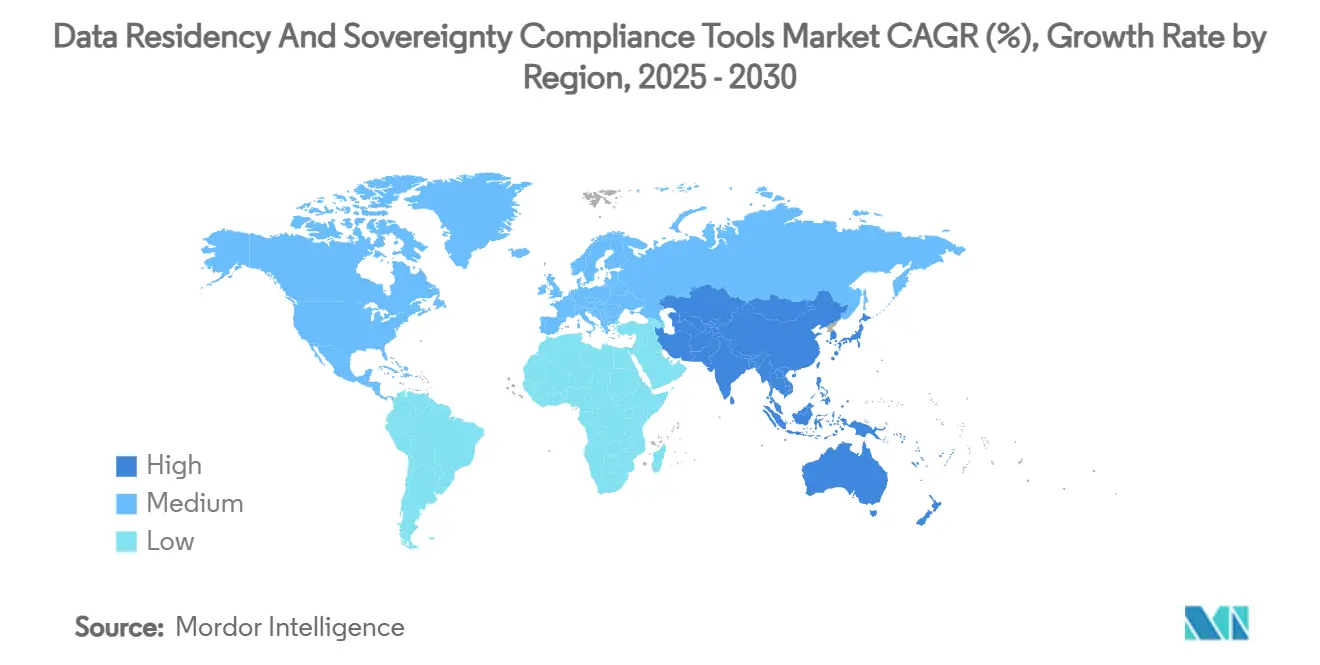
North America held a 38.2% share in 2024, anchored by the US CLOUD Act, Canada’s PIPEDA, and expansive hyperscaler footprints. The region serves as a compliance testbed; multinationals refine architectures that reconcile federal, state, and sectoral statutes before rolling them out globally. Recent US policy papers on AI export controls add another jurisdictional layer that platform vendors must encode. Canada’s adoption of public cloud up to Protected B classification shows how policy clarity can accelerate rollout while maintaining sovereignty controls.
APAC Data Residency and Sovereignty Compliance Tools Market
Asia-Pacific is forecast to register a 28.1% CAGR, the fastest among all regions. India’s Digital Personal Data Protection Act, China’s Network Data Security Management regulations, and Indonesia’s Personal Data Protection Law together form a harmonising backbone that simplifies regional scaling for solution providers. Massive data-centre expansion, driven by AI workloads, provides the physical substrate for residency vaults and sovereign clouds. Multinationals now treat Asia-Pacific localisation budgets as core project lines rather than contingency items, cementing the region’s importance within the data residency solutions market.
EMEA Data Residency and Sovereignty Compliance Tools Market
Europe capitalises on GDPR maturity and hyperscaler sovereign-cloud capital expenditure. AWS’s EUR 7.8 billion (USD 8.8 billion) programme includes dedicated EU-resident staff and air-gapped networks. Rising enforcement, evidenced by 2024’s fine tally, keeps compliance budgets resilient. The EU AI Act extends governance to algorithmic outputs, intensifying the need for fine-grained audit trails that residency tooling can supply. In the Middle East and Africa, governments are drafting comprehensive privacy frameworks and subsidising cloud campuses to attract foreign investment, opening a greenfield for residency specialists.
Competitive Landscape
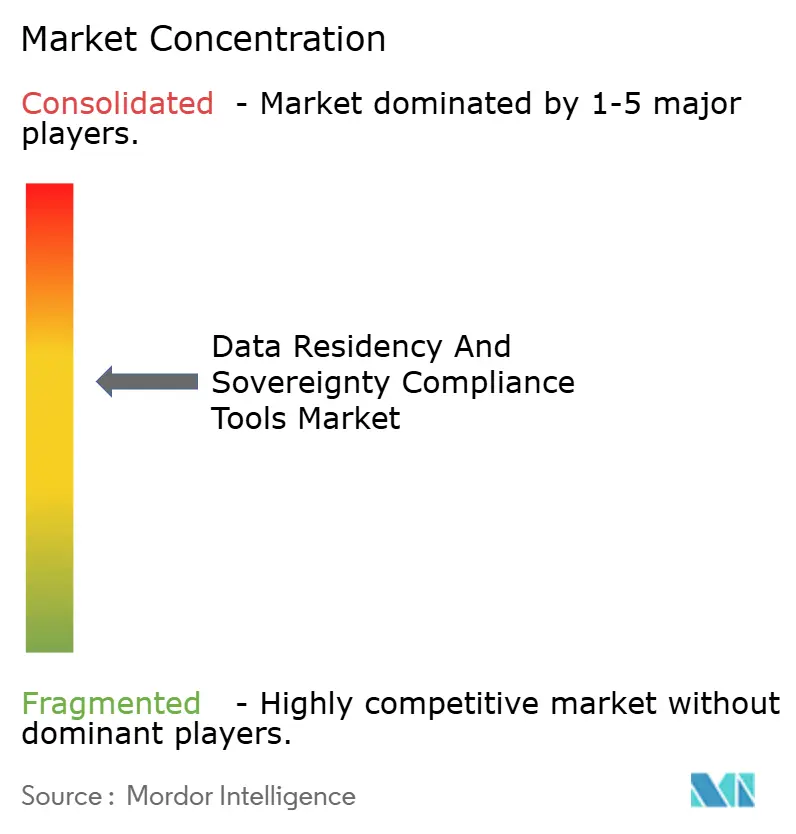
The data residency solutions market shows moderate fragmentation. The top five together account for a moderate share of total revenue. Platform vendors such as Salesforce strengthened portfolios through the USD 1.9 billion Own Company acquisition, signalling a shift toward embedded residency controls inside mainstream SaaS suites. BigID’s USD 60 million February 2025 raise funds AI-driven data discovery that underpins residency for generative models, while Skyflow’s vault expansion highlights growing appetite for geography-specific token stores.
Partnerships act as force multipliers; Temenos teams with InCountry to localise banking data without breaking SaaS economics. Hyperscalers remain frenemies—providing sovereign foundations yet competing through native compliance features. Start-ups differentiate via AI-assisted mapping of regulatory changes into machine-readable policies, helping customers dodge the “policy fatigue” that accompanies rule volatility. On the customer side, 86% of CIOs intend to shuffle workloads among clouds or back on-premises, creating a consistent pipeline of transformation projects that vendors can target.
Barriers to entry are rising because certification audits, legal expertise, and global coverage require capital. However, niche innovators can still carve foothold by focusing on single-country nuances or vertical templates. Overall, competition balances between consolidation plays and specialised disruptors, keeping pricing power evenly distributed.
Data Residency and Sovereignty Compliance Tools Industry Leaders
-
OneTrust, LLC
-
TrustArc Inc.
-
BigID, Inc.
-
InCountry, Inc.
-
Skyflow, Inc.
- *Disclaimer: Major Players sorted in no particular order
Data Residency and Sovereignty Compliance Tools Market Companies Covered in this Report
- OneTrust, LLC
- TrustArc Inc.
- BigID, Inc.
- InCountry, Inc.
- Skyflow, Inc.
- Riscosity, Inc.
- Odaseva SAS
- Protegrity USA, Inc.
- Privacera, Inc.
- SecuPi Ltd.
- Immuta, Inc.
- Securiti, Inc.
- DataGrail, Inc.
- DataGuard GmbH
- Ketch, Inc.
- Delphix Corporation
- Anonos Inc.
- Data Sentinel Inc.
- Egnyte, Inc.
- Atakama Inc.
- Virtru, Inc.
- Enveil, Inc.
- Evervault Ltd.
- CryptoMove, Inc.
- StrongSalt, Inc.
Recent Industry Developments in Data Residency and Sovereignty Compliance Tools Market
- June 2025: AWS completed its European sovereign-cloud infrastructure build, deploying EU-resident operations teams to satisfy regional requirements.
- May 2025: India released draft rules under the Digital Personal Data Protection Act, detailing cross-border transfer allowlists.
- April 2025: Microsoft enhanced Cloud for Sovereignty with stricter encryption policies and region-locked keys.
- February 2025: BigID raised USD 60 million in a Riverwood-led round to enhance AI-aligned data governance capabilities.
Global Data Residency and Sovereignty Compliance Tools Market Report Scope
| On-Premises |
| Public Cloud |
| Hybrid |
| Data Residency-as-a-Service Platforms |
| Data-Privacy Management Suites |
| GRC Platforms with Residency Modules |
| Sovereign-Cloud Enablement Tools |
| Tokenisation and Data-Vault Solutions |
| Large Enterprises |
| Small and Medium Enterprises (SMEs) |
| BFSI |
| Healthcare and Life Sciences |
| Government and Public Sector |
| IT and Telecom |
| Retail and eCommerce |
| Manufacturing and Industrial |
| North America | United States | |
| Canada | ||
| Mexico | ||
| South America | Brazil | |
| Argentina | ||
| Rest of South America | ||
| Europe | Germany | |
| United Kingdom | ||
| France | ||
| Italy | ||
| Spain | ||
| Russia | ||
| Rest of Europe | ||
| Asia-Pacific | China | |
| Japan | ||
| India | ||
| South Korea | ||
| Rest of Asia-Pacific | ||
| Middle East and Africa | Middle East | Saudi Arabia |
| United Arab Emirates | ||
| Turkey | ||
| Rest of Middle East | ||
| Africa | South Africa | |
| Nigeria | ||
| Rest of Africa | ||
| By Deployment Model | On-Premises | ||
| Public Cloud | |||
| Hybrid | |||
| By Tool Type | Data Residency-as-a-Service Platforms | ||
| Data-Privacy Management Suites | |||
| GRC Platforms with Residency Modules | |||
| Sovereign-Cloud Enablement Tools | |||
| Tokenisation and Data-Vault Solutions | |||
| By Organisation Size | Large Enterprises | ||
| Small and Medium Enterprises (SMEs) | |||
| By End-Use Industry | BFSI | ||
| Healthcare and Life Sciences | |||
| Government and Public Sector | |||
| IT and Telecom | |||
| Retail and eCommerce | |||
| Manufacturing and Industrial | |||
| By Geography | North America | United States | |
| Canada | |||
| Mexico | |||
| South America | Brazil | ||
| Argentina | |||
| Rest of South America | |||
| Europe | Germany | ||
| United Kingdom | |||
| France | |||
| Italy | |||
| Spain | |||
| Russia | |||
| Rest of Europe | |||
| Asia-Pacific | China | ||
| Japan | |||
| India | |||
| South Korea | |||
| Rest of Asia-Pacific | |||
| Middle East and Africa | Middle East | Saudi Arabia | |
| United Arab Emirates | |||
| Turkey | |||
| Rest of Middle East | |||
| Africa | South Africa | ||
| Nigeria | |||
| Rest of Africa | |||
Key Questions Answered in the Report
What is the forecast value of the data residency solutions market by 2030?
The market is expected to reach USD 228.37 billion by 2030, expanding at a 25.84% CAGR.
Which deployment model is growing fastest in data residency projects?
Hybrid architectures are advancing at a 30.2% CAGR as firms balance sovereignty with flexibility.
Why are government agencies accelerating the adoption of residency platforms?
Digital sovereignty mandates and national AI strategies require workloads and datasets to remain within domestic jurisdictions.
How are hyperscalers influencing data residency purchasing decisions?
Investments such as AWS’s EUR 7.8 billion European sovereign cloud create compliant infrastructures that third-party tools can leverage.
What cost benefits arise from proactive residency compliance?
Case studies show federal agencies can save up to USD 20 million per year by replacing ad-hoc remediation with modernised data-governance architectures.
Which regions will contribute most to future market growth?
Asia-Pacific leads with a projected 28.1% CAGR due to regulatory harmonisation and large-scale data-centre build-outs.