
Data Center Risk Engineering and Management Market Size and Share
Market Overview
| Study Period | 2021 - 2032 |
|---|---|
| Market Size (2027) | USD 2.71 Billion |
| Market Size (2032) | USD 5.29 Billion |
| Growth Rate (2027 - 2032) | 14.31 % |
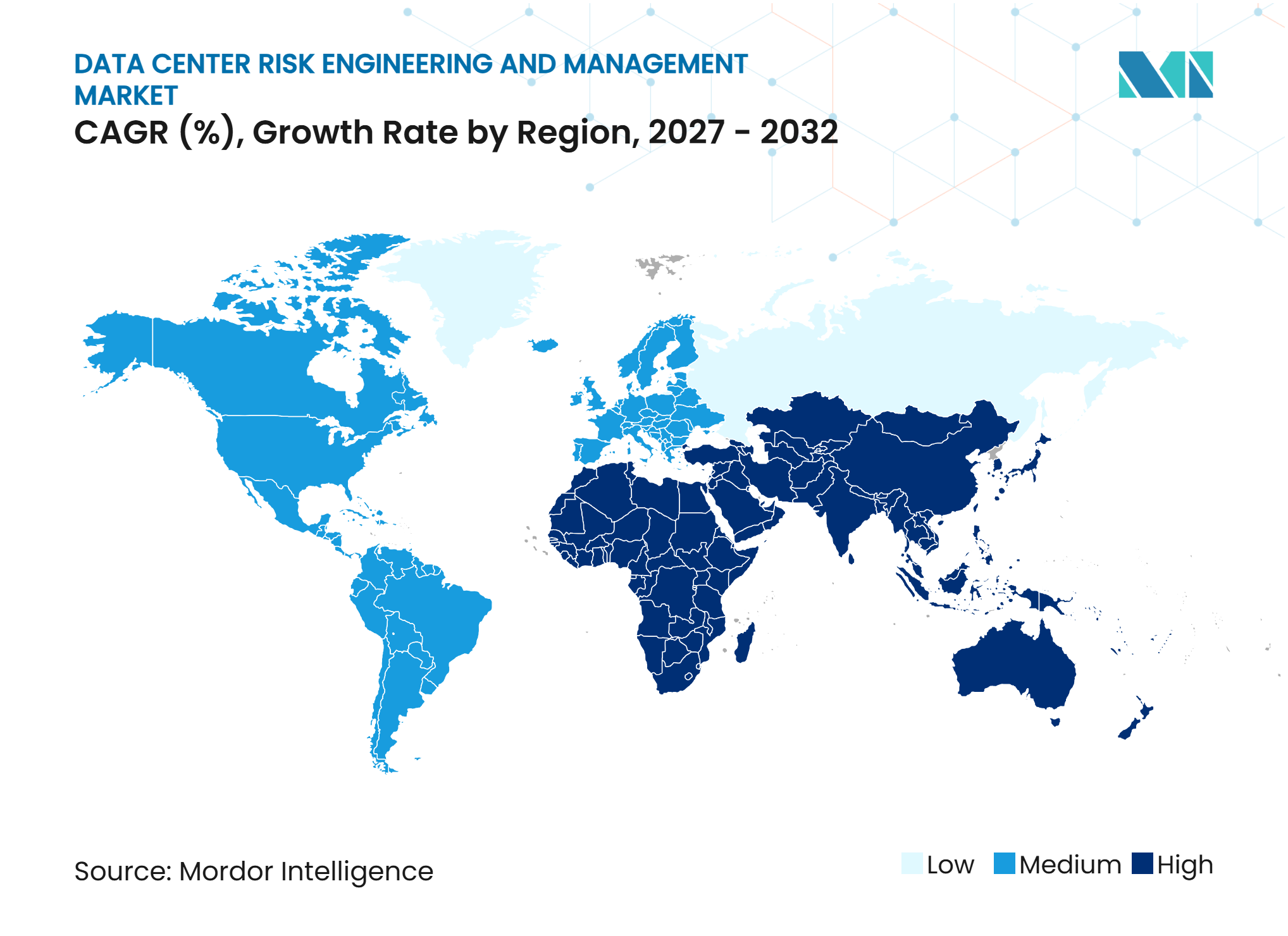
| Fastest Growing Market | Asia-Pacific |
| Largest Market | North America |
| Market Concentration | Medium |
Major Players *Disclaimer: Major Players sorted in no particular order Image © Mordor Intelligence. Reuse requires attribution under CC BY 4.0. | |
Data Center Risk Engineering and Management Market Analysis by Mordor Intelligence
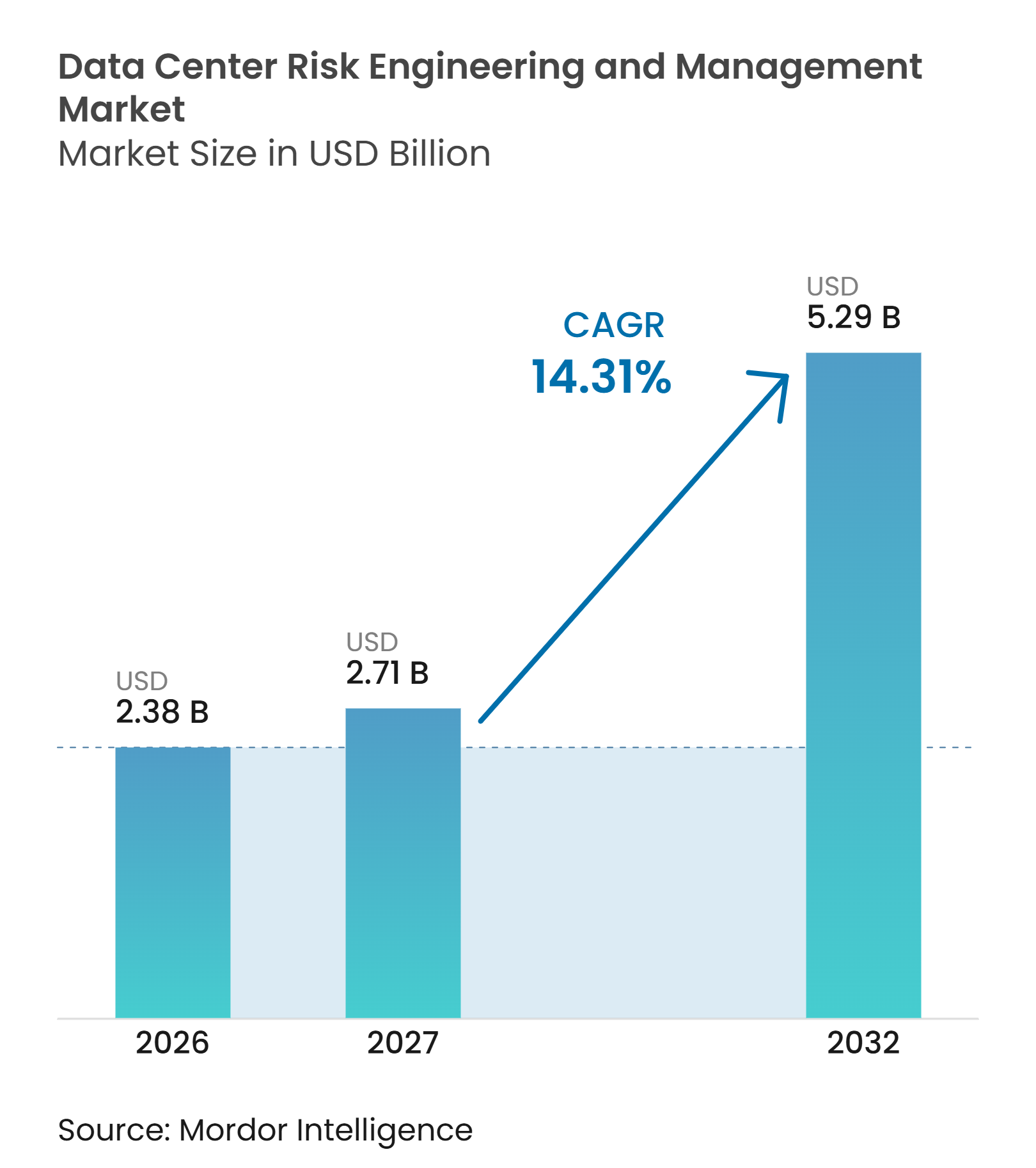
The Data Center Risk Engineering and Management Market size is projected to expand from USD 2.38 billion in 2026 to USD 2.71 billion in 2027, and to USD 5.29 billion by 2032, registering a CAGR of 14.31% from 2027 to 2032. The data center risk engineering and management market is growing as AI workloads increase the electrical and thermal demands placed on new and operating facilities. Larger campuses also concentrate more equipment, capital, and potential service interruption at single locations, which increases the need for documented technical assurance. Insurance, lending, and customer due diligence are making evidence of resilience more important during design, construction, and operations. Providers are responding by combining engineering reviews, commissioning, monitoring, and risk documentation across the facility lifecycle. The data center risk engineering and management market also faces a shortage of specialized engineers and limited loss history for AI-specific equipment, which can slow the development of consistent risk models.
Key Report Takeaways
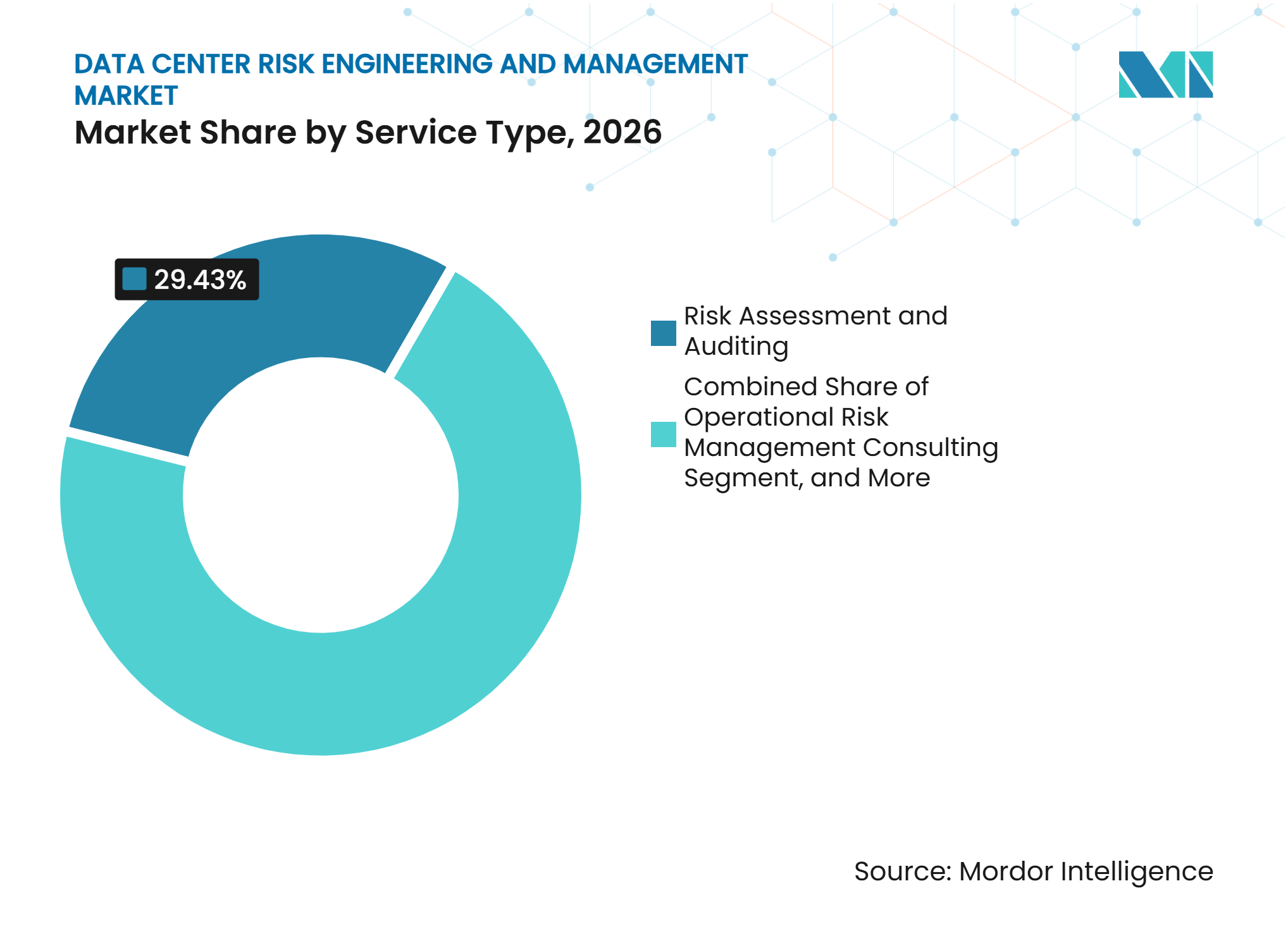
- By service type, Risk Assessment and Auditing accounted for 29.43% of revenue in 2026, while Reliability and Availability Engineering is projected to expand at a 15.63% CAGR through 2032.
- By risk category, Electrical and Power Infrastructure Risk held 27.84% revenue share in 2026, while Cooling and Thermal Management Risk is expected to grow at a 15.27% CAGR through 2032.
- By assessment method, Qualitative Risk Assessment accounted for 31.27% of revenue in 2026, while Continuous Risk Assessment and Monitoring is projected to expand at a 15.84% CAGR through 2032.
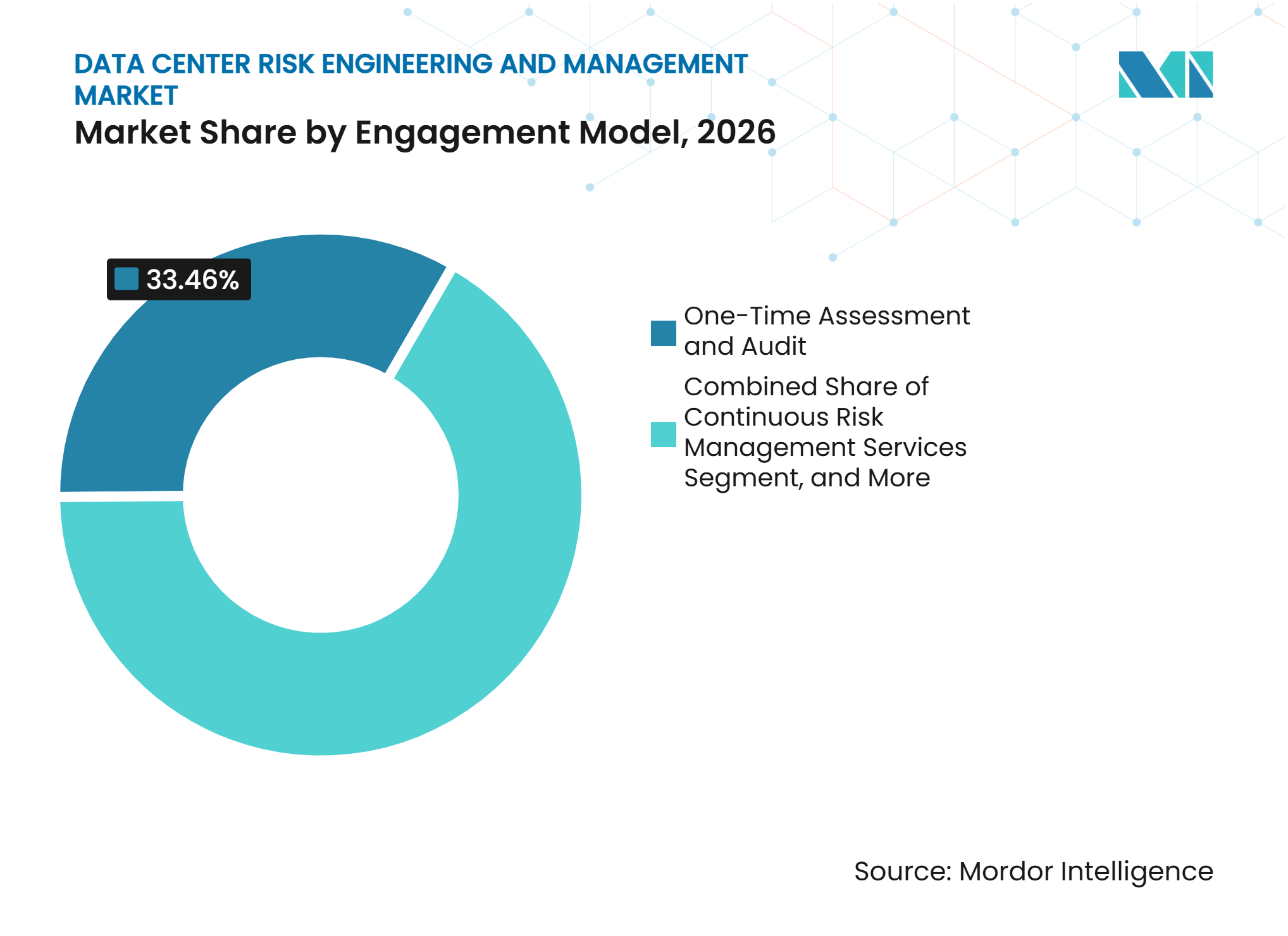
- By engagement model, One-Time Assessment and Audit accounted for 33.46% of revenue in 2026, while Continuous Risk Management Services is expected to expand at a 15.72% CAGR through 2032.
- By project lifecycle stage, Operational Risk Management held 34.69% revenue share in 2026, while Expansion, Retrofit, and Modernization is projected to grow at a 15.39% CAGR through 2032.
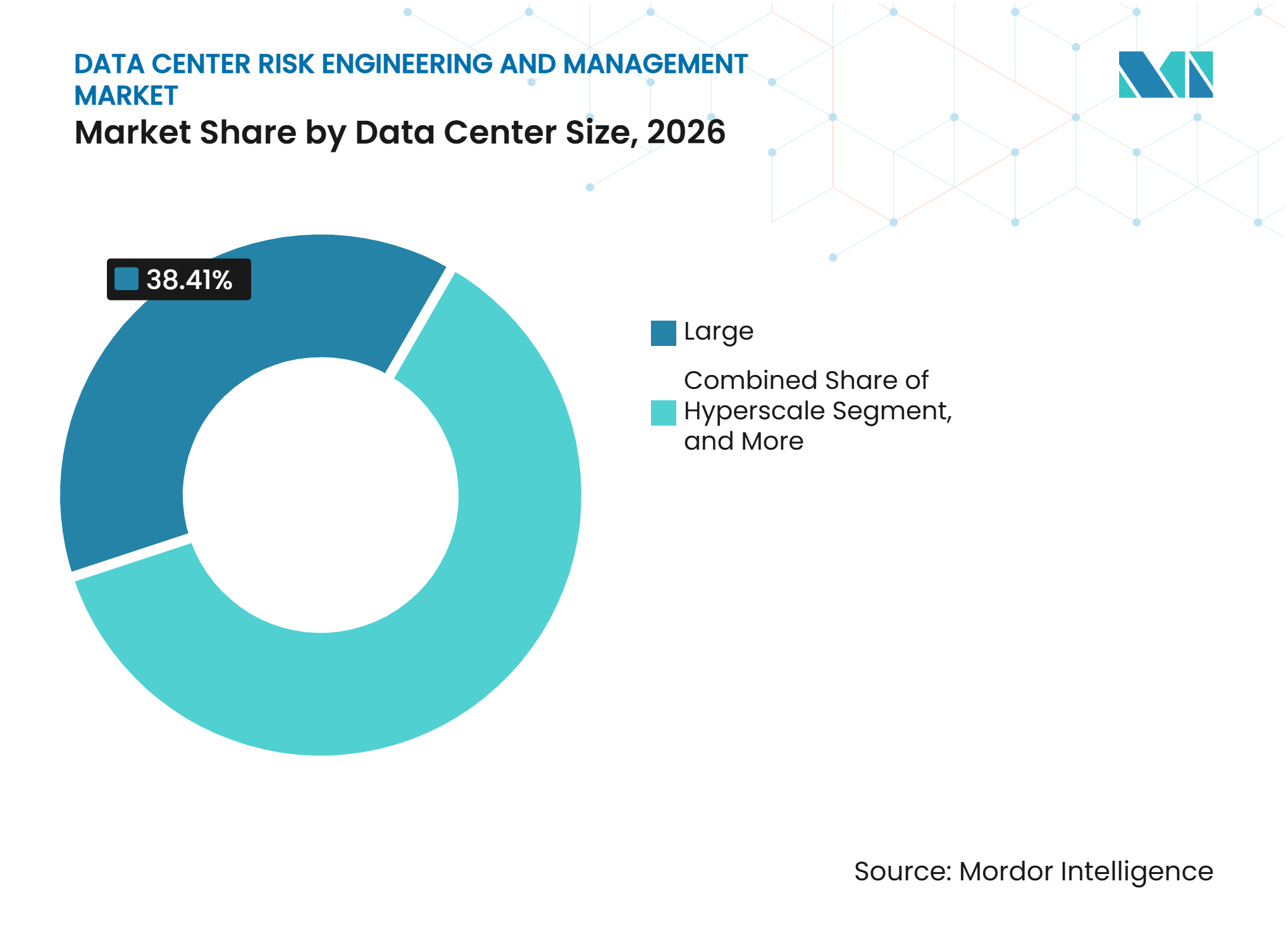
- By data center size, Large data centers held 38.41% revenue share in 2026, while Hyperscale is expected to advance at a 15.61% CAGR through 2032.
- By data center type, Colocation facilities accounted for 41.83% of the data center risk engineering and management market in 2026, while Cloud Service Providers are projected to grow at a 15.86% CAGR through 2032.
- By geography, North America held 41.28% revenue share in 2026, while Asia-Pacific is expected to expand at a 15.36% CAGR through 2032.
Note: Market numbers in this report are based on Mordor Intelligence's proprietary estimation framework, which combines nine months of actuals with Q4 projections for base year 2026.
Market Trends and Insights
Drivers Impact Analysis of Data Center Risk Engineering and Management Market*
| Driver | (~) % Impact on CAGR Forecast | Geographic Relevance | Impact Timeline |
|---|---|---|---|
| AI-Driven Power Density and High-Density Computing | +2.8% | Global, acute in North America and Asia-Pacific | Short term (≤ 2 years) |
| Expansion of Hyperscale and Colocation Data Center Campuses | +2.5% | Global, spillover to Middle East and Africa | Short term (≤ 2 years) |
| Documented Resilience Demand From Insurers, Lenders, Investors, and Customers | +2.0% | North America and Europe core, Asia-Pacific and Middle East emerging | Medium term (2-4 years) |
| Greater Reliance on Independent Commissioning and Technical Assurance | +1.8% | Global, early gains in Singapore, Malaysia, Germany, and the United Kingdom | Medium term (2-4 years) |
| Lifecycle Risk Expertise for Live-Facility Upgrades and Concurrent Construction | +1.5% | North America and Europe, where legacy stock is concentrated | Medium term (2-4 years) |
| Systemic Risk Modeling for Correlated Campus Exposure | +1.2% | Global, acute in Northern Virginia and Johor mega-clusters | Long term (≥ 4 years) |
| Source: Mordor Intelligence | |||
AI-Driven Power Density and High-Density Computing
AI workloads are changing the physical risk profile of facilities and expanding the data center risk engineering and management market. Racks that previously required 10 kW can require 120 kW for AI workloads, while future rack demand could reach 1 MW, requiring a reassessment of electrical, thermal, fire, and operating conditions across a facility. Schneider Electric reported that arc-flash outcomes in 800 VDC architectures depend on capacitor placement and fault-clearing behavior, factors that conventional AC review methods do not address. Battery units placed near server racks can lead to thermal-runaway scenarios that develop over extended periods, making periodic reviews less complete for this type of exposure. Early specialists can turn these new requirements into repeatable engineering methods as operators and insurers establish acceptance criteria for AI facilities.
Expansion of Hyperscale and Colocation Data Center Campuses
The scale of new construction is expanding the scope of work required in the data center risk engineering and management market. Swiss Re reported that capital expenditure by the 5 leading cloud platforms is forecast to exceed USD 600 billion in 2026, with 75% linked directly to physical AI infrastructure. Allianz Commercial identified the data center construction boom as a source of broader insurance and engineering exposure. Higher project values mean that an assessment must address interfaces among construction work, live operations, power delivery, cooling systems, and insurance requirements, rather than considering each discipline separately. This construction cycle favors firms that can support projects from site selection through operational handover.
Documented Resilience Demand from Insurers, Lenders, Investors, and Customers
Resilience documentation is becoming a practical requirement for projects seeking insurance capacity, financing, and regulated customers. FM revised its Property Loss Prevention Data Sheets 5-32 in January 2026, increasing wall fire-resistance requirements from 1 hour to 2 hours and adding a liquid-cooling section. Aon launched its Data Center Lifecycle Insurance Program in July 2025, offering up to USD 1.5 billion in combined coverage and embedding engineering and cyber impact modeling into the facility design framework. The DORA and NIS2 frameworks are also increasing formal documentation obligations for facilities serving regulated European clients. Uptime Institute Tier certifications, commissioning records, and engineering reports can therefore become part of financing and customer diligence, not only a technical record. This shift supports longer engagements in the data center risk engineering and management market because evidence must remain up to date as the facility evolves.
Greater Reliance on Independent Commissioning and Technical Assurance
Independent commissioning is gaining importance because a facility can fail at the interfaces among many contractors, systems, and controls. Modern campuses can involve more than 50 engineering disciplines, which makes integrated systems testing important before live operations begin. UL Solutions, the Open Compute Project, ABB, and Eaton reviewed more than 60 power distribution standards in January 2026 to identify gaps affecting AI data center applications. Bureau Veritas reported support for more than 2,000 data center projects across 35 countries, showing the scale of capacity needed for multinational programs.[1] The data center risk engineering and management market benefits where local commissioning capacity has not kept pace with construction in newer hubs.
Restraints Impact Analysis of Data Center Risk Engineering and Management Market*
| Restraint | (~) % Impact on CAGR Forecast | Geographic Relevance | Impact Timeline |
|---|---|---|---|
| High Cost of Specialist Risk Engineering and Assurance Services | -2.5% | Global, most acute in emerging markets where operator fee elasticity is low | Short term (≤ 2 years) |
| Limited Availability of Data Center-Specific Engineering Talent | -2.0% | Global, acute shortfalls in North America, Asia-Pacific core, and the Middle East | Medium term (2-4 years) |
| Limited Loss Experience for Next-Generation AI Data Centers | -1.5% | Global, most consequential for actuarial-driven insurance-linked programs | Medium term (2-4 years) |
| Fragmented Risk Data and Inconsistent Risk Scoring Methods | -1.0% | Global | Long term (≥ 4 years) |
| Source: Mordor Intelligence | |||
High Cost of Specialist Risk Engineering and Assurance Services
Specialist assurance fees can limit adoption among operators of sub-50 MW facilities, even when the case for stronger prevention is clear. Allianz Commercial reported that fire and water damage accounted for most of the EUR 700 million (USD 770 million) in data center insurance claims examined in its analysis in the source material. AI-specific electrical, cooling, and commissioning expertise commands higher fees than general engineering, while time-and-materials pricing increases with system complexity. Smaller enterprise and edge operators can consequently opt for periodic reviews rather than full-lifecycle programs. Managed models that spread assurance costs among clients can lower this barrier, although their use remains concentrated in hyperscale and large colocation accounts. This price sensitivity can restrain the data center risk engineering and management market in locations where project economics are less favorable.
Limited Availability of Data Center-Specific Engineering Talent
The limited availability of specialized engineers constrains delivery capacity in the data center risk engineering and management market. IEEE Spectrum reported that AI data centers need specialists in high-voltage power, liquid cooling, and related systems, roles that require substantial technical preparation. Uptime Institute's outage evidence also shows why rushed commissioning can produce lasting operational consequences. Firms need durable training and retention programs because spot hiring cannot replace accumulated familiarity with facility design, testing, and incident patterns. Staffing pressure can otherwise lead to shorter reviews, delayed work, and uneven service quality across regions.
*Our forecasts treat driver/restraint impacts as directional, not additive. The impact forecasts reflect baseline growth, mix effects, and variable interactions.
Data Center Risk Engineering and Management Market Segment Analysis
By Service Type:
Audits Anchor Revenue as Reliability Engineering Leads GrowthRisk Assessment and Auditing held 29.43% of the data center risk engineering and management market share in 2026. It remains a common entry point because insurance renewals, financing reviews, and Tier certification support often require a documented assessment. These engagements identify gaps in electrical systems, cooling arrangements, fire protection, physical security, and operating controls. They also provide operators with a defined baseline before committing to broader remediation or monitoring work. Reliability and Availability Engineering is expected to grow at a 15.63% CAGR through 2032 as AI clients request availability commitments supported by fault-tolerance analysis.
Failure Mode and Effects Analysis, fault-tree analysis, and root-cause analysis are becoming more relevant where 800 VDC distribution and direct-to-chip cooling introduce unfamiliar failure pathways. Hazard Identification and Risk Evaluation work is also entering the site selection phase, where environmental and community concerns can affect project progress. Risk Mitigation Planning, operational consulting, and certification support complete the portfolio for the data center risk engineering industry. European compliance needs under NIS2 and DORA can increase the use of certification support for operators serving regulated customers. The combination of audit-led entry work and engineering-led remediation creates a pathway from a discrete review to an ongoing technical relationship.



By Risk Category:
Electrical Risk Leads Spend as Cooling Risk Leads GrowthElectrical and Power Infrastructure Risk accounted for 27.84% of revenue in 2026, reflecting the central role of power delivery in data center reliability. Power systems include utility connections, switchgear, transformers, backup generation, batteries, power distribution units, and controls. Electrical reviews, therefore, extend beyond component inspection to maintenance practices, protection settings, redundancy design, and fault response. Cooling and Thermal Management Risk is projected to grow at a 15.27% CAGR through 2032.
Liquid cooling broadens the scope of the data center risk engineering and management market, as cooling systems now carry additional water- and fluid-management exposure. Swiss Re reported that liquid-related losses accounted for nearly 24% of total data center loss costs in its study, including loss categories tied to fire-suppression leakage and liquid escaping from new cooling networks. Oak Ridge National Laboratory placed risk assessment in the reliability and resilience workstream for next-generation AI thermal management. Fire and life safety, structural, environmental, climate, and physical security work remains necessary because facilities can face multiple hazards simultaneously.
By Assessment Method:
Qualitative Methods Dominate as Continuous Monitoring AcceleratesQualitative Risk Assessment accounted for 31.27% of revenue in 2026 because it supports insurance submissions, certification records, and compliance reviews. This approach uses structured expert judgment to identify hazards, evaluate controls, and prioritize actions. It is widely understood by facility teams and can be completed without the detailed loss datasets required for numerical modeling. It also provides a practical starting point where a site needs a documented review before a financing, insurance, or operational decision. Continuous Risk Assessment and Monitoring is projected to grow at a 15.84% CAGR through 2032.
Dynamic AI workloads create operating conditions that a static review can miss, strengthening the case for continuous monitoring in the data center risk engineering and management market. Vertiv reported GPU cluster current slew rates of 10 to 100 amps per nanosecond at the die level, illustrating the speed of changes that can affect electrical conditions. Simulation and digital modeling are useful before a facility goes live because they can test system behavior under defined fault conditions. Quantitative and reliability-centered methods can support insurers seeking probability-based information, while scenario-based analysis allows a team to test outages, cooling losses, and campus-wide incidents. These methods are complementary, and operators can use them together as the quality of operating data improves.
By Engagement Model:
One-Time Audits Retain Share as Continuous Services Drive GrowthOne-Time Assessment and Audit held a 33.46% revenue share in 2026 because many buyers need a specific deliverable for a renewal, acquisition, financing event, or certification milestone. This engagement gives an operator a focused opinion on current controls and priority gaps. It is more affordable than a retained program and remains relevant for mid-market facilities with limited assurance budgets. It also offers a clear starting point for buyers that have not previously used formal risk engineering services. Continuous Risk Management Services is expected to grow at a 15.72% CAGR through 2032.
Continuous services align with the growing view that data centers are changing systems rather than fixed assets. WTW's 2026 framework treated data centers as dynamic, mission-critical infrastructure requiring construction, power, cybersecurity, and compliance expertise across the asset lifecycle.[2] Managed Risk Engineering and integrated engineering and advisory services can provide large operators with a single technical authority across multiple sites. Periodic Risk Review remains an accessible option for buyers who need annual compliance support without retaining a team year-round. The data center risk engineering and management market is therefore moving toward a mix of transaction-based and lifecycle-based engagement models.

By Project Lifecycle Stage:
Operations Lead Spend as Retrofit Work ExpandsOperational Risk Management held a 34.69% revenue share in 2026 because existing facilities require recurring reviews of procedures, maintenance, emergency response, and control changes. The installed base of colocation and cloud facilities creates demand that extends beyond new construction. Operations teams need to maintain service levels while accommodating tenant changes, equipment upgrades, and evolving compliance requirements. This makes operational risk a standing responsibility rather than a final handover activity. Expansion, Retrofit, and Modernization is projected to grow at a 15.39% CAGR through 2032.
Uptime Institute reported that more than 27% of operators manage facilities older than 15 years, creating a large group of sites that may need upgrades for higher-density AI equipment. Allianz Commercial identified testing and commissioning as a high-risk phase in construction and expansion because latent defects and coordination gaps can emerge before full operation. Retrofit work is particularly demanding because systems must be changed around live workloads and service commitments. Design, construction, commissioning, and site-selection services remain important at earlier stages. Each new density requirement can enlarge the portion of the installed base that needs engineering support, reinforcing demand across the data center risk engineering and management market.
By Data Center Size:
Large Facilities Drive Revenue as Hyperscale Redefines ScopeLarge data centers accounted for 38.41% of revenue in 2026, supported by their established base of insurance assessments, certification renewals, and compliance programs. These facilities have enough equipment and revenue exposure to justify formal recurring assurance. Their operators also manage complex utility, tenant, and vendor relationships that need clear technical controls. This creates predictable demand for risk reviews even where no large expansion is underway. Hyperscale is projected to grow at a 15.61% CAGR through 2032.
Hyperscale campuses raise the scale and concentration of risks addressed by the data center risk engineering and management market. Swiss Re noted that major facilities can cluster in hazard-prone regions and share infrastructure, networks, and specialist suppliers, allowing one disruption to affect several insured parties. Engineering reviews must consequently consider both individual facility resilience and campus-level exposure. Small and medium facilities have lower average spend per site, but ESG disclosure and supplier qualification requirements can broaden demand below the hyperscale tier. The contrast is not simply one of building size because the number of shared dependencies also changes the engineering task.
By Data Center Type:
Colocation Leads Revenue as CSPs Record Fastest GrowthColocation facilities accounted for 41.83% of the data center risk engineering and management market size in 2026. Their multi-tenant service level commitments, compliance obligations, and insurance arrangements create a recurring need for documented assurance. Operators must manage shared infrastructure while protecting separate customer environments, which makes control design and incident response especially important. The broad tenant mix can also add different audit and evidence requirements at the same site. Cloud Service Providers are projected to grow at a 15.86% CAGR through 2032.
Cloud Service Providers are expanding through hyperscale investments and national AI or sovereign compute programs. Their facilities need risk reviews that address rapid build schedules, high-density equipment, power availability, cooling design, and operational continuity. Enterprise and edge data centers represent a wider installed base but usually have lower risk-engineering spend per location because facilities are smaller. Formal disclosure expectations and cloud supplier requirements can still increase their use of documented engineering reviews. The data center risk engineering and management market therefore serves different facility types with distinct patterns of scale, customer exposure, and technical complexity.
Geography Analysis
North America
North America held 41.28% of the data center risk engineering and management market share in 2026. The region combines a concentrated hyperscale pipeline with mature insurance and lending practices that favor formal technical documentation. US facilities also face a wide range of weather exposures, including hail and tornado conditions, which make natural catastrophe assessment part of site-level engineering. FM's revised data sheets add a stronger loss-prevention reference point for fire protection and liquid cooling. These conditions favor providers that can combine facility reviews with construction assurance, climate exposure assessment, and operational monitoring.
Asia-Pacific
Asia-Pacific is projected to expand at a 15.36% CAGR through 2032 in the data center risk engineering and management market. Fast construction in Singapore, Malaysia, and other hubs is increasing the need for independent commissioning and local engineering capability. Singapore Standard SS 726:2026 established a national framework for liquid-cooling commissioning and risk management in tropical settings, providing operators with a clearer reference for compliance.[3] High heat and drought exposure in parts of the region make cooling resilience and water-related risk central design considerations. The region can benefit from digital commissioning records and integrated testing because rapid construction increases the chance of gaps among power, cooling, and control-system handovers.
Europe, the Middle East, South America, and Africa
Europe's activity is centered on Germany, the United Kingdom, and Ireland, while Spain, Finland, and Denmark are attracting investment under more favorable permitting and power conditions. NIS2 and DORA create regulatory influence through incident reporting, third-party risk review, and ICT resilience testing for operators serving regulated clients. In the Middle East, sovereign AI programs in Saudi Arabia and the United Arab Emirates are supporting large projects in markets with limited established risk-engineering capacity. Activity in South America is concentrated in Brazil and Argentina, while in Africa, investment in digital infrastructure is led by South Africa, Nigeria, and Egypt.
Competitive Landscape
Market Concentration
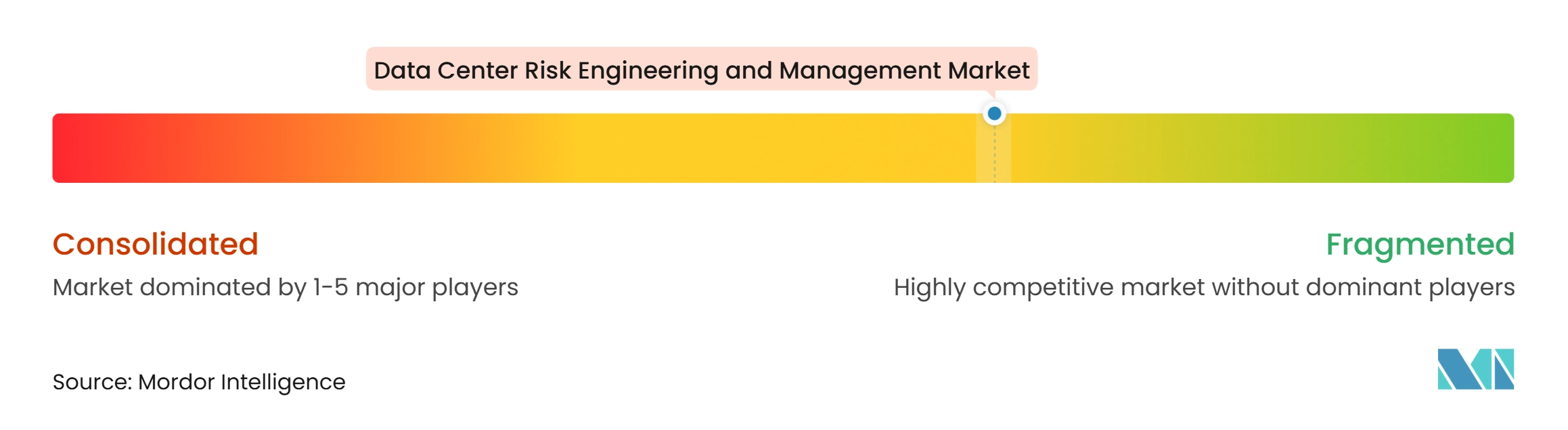
The data center risk engineering and management market is moderately fragmented across insurance-led engineers, independent inspection and certification bodies, and infrastructure technology vendors. Insurance-led participants include FM Insurance, Aon, and Marsh McLennan, which combine risk assessment with insurance capacity and program design. Independent bodies such as SGS, Bureau Veritas, TÜV SÜD, TÜV Rheinland, DNV, Intertek, RINA, and UL Solutions offer testing, inspection, certification, and technical assurance. Their work commonly aligns with the ISO/IEC 22237 and EN 50600 frameworks, which can provide operators with a shared basis for documenting facility quality. Infrastructure vendors, including Schneider Electric, Vertiv, Johnson Controls, and Siemens, can add commissioning and monitoring capabilities by leveraging data from their installed equipment.
Lifecycle integration is a leading competitive approach in the data center risk engineering and management market. Aon launched its Data Center Lifecycle Insurance Program, with risk engineering and cyber modeling integrated into a single facility-design framework. Marsh expanded its Nimbus facility for large-scale construction projects to limits of up to USD 2.7 billion in March 2026.[4] Schneider Electric acquired a controlling interest in Motivair in February 2025 and introduced an end-to-end liquid-cooling portfolio for high-density computing environments. These moves show that technical assurance, insurance design, cooling technology, and operational data are becoming more closely connected.
Digital commissioning and continuous telemetry are a clear opportunity because they can improve visibility during handover and operations. SGS stated that structured data capture and real-time verification can reduce handover risk where power, cooling, automation, and digital infrastructure operate as a tightly linked environment. UL Solutions' work with the Open Compute Project, ABB, and Eaton can also help early participants develop assessment practices for evolving AI power architectures. The data center risk engineering and management market rewards firms that can assess correlated campus exposures rather than inspect each building in isolation. Market concentration score is 3 because no combined share data for the top 5 companies is provided and the market includes many insurance, certification, and technology vendors without evidence that a small group controls a large share.
Data Center Risk Engineering and Management Industry Leaders
-
Aon plc
-
Zurich Insurance Group AG
-
Allianz SE
-
American International Group, Inc.
-
AXA SA
- *Disclaimer: Major Players sorted in no particular order
Data Center Risk Engineering and Management Market Companies Covered in this Report
- Aon plc
- American International Group, Inc.
- Zurich Insurance Group AG
- Allianz SE
- AXA SA
- Chubb Limited
- Marsh & McLennan Companies, Inc.
- SGS SA
- Bureau Veritas SA
- TÜV SÜD AG
- TÜV Rheinland AG
- Uptime Institute Professional Services
- Schneider Electric SE
- Vertiv Holdings Co
- Siemens AG
- Johnson Controls International plc
- DNV AS
- RINA S.p.A.
- Intertek Group plc
- UL Solutions Inc.
Recent Industry Developments in Data Center Risk Engineering and Management Market
- October 2026: Bureau Veritas launched its Mission Critical Data Centers Brochure, positioning assurance and advisory services across the data center lifecycle. The firm reports experience across more than 2,000 data center projects in over 35 countries, with over 1,000 data center-experienced engineers, reinforcing its positioning as a multi-discipline technical assurance partner for operators and investors building mission-critical infrastructure.
- April 2026: SGS expanded its data center services portfolio to include digital commissioning solutions and hyperscale-specific FAT and SAT testing, deploying its System Start-Up Matrix approach to reduce handover risk and accelerate operational readiness at complex hyperscale build environments globally.
- March 2026: Marsh McLennan expanded its Nimbus insurance facility for large-scale data center construction projects to limits of up to USD 2.7 billion inclusive of delay-in-start-up and business interruption coverage. Originally launched in June 2025, Nimbus is the first construction insurance facility of its kind and is deployed on active projects in the US, United Kingdom, and the Netherlands.
- February 2026: Johnson Controls launched the YORK YDAM air-cooled magnetic bearing centrifugal chiller, delivering 3.5 MW of cooling capacity with up to 20% increased capacity density for high-density multistory data centers and AI factories. Shipments are scheduled for late 2026, addressing structural risk from increasingly constrained rooflines in AI campus builds where higher-density white space requires more cooling per square meter.
Global Data Center Risk Engineering and Management Market Report Scope
The data center risk engineering and management market comprises solutions and services that help organizations identify, assess, mitigate, and manage operational, environmental, cybersecurity, and infrastructure risks across data center facilities.
The Data Center Risk Engineering and Management Market Report is Segmented by Service Type (Risk Assessment and Auditing, Reliability and Availability Engineering, Failure Mode and Effects Analysis (FMEA), Fault Tree and Root Cause Analysis, Hazard Identification and Risk Evaluation, Risk Mitigation Planning, Operational Risk Management Consulting, and Compliance and Engineering Certification Support), Risk Category (Electrical and Power Infrastructure Risk, Cooling and Thermal Management Risk, Fire and Life Safety Risk, Structural and Building Infrastructure Risk, Environmental and Climate Risk, Operational and Human Error Risk, Supply Chain and Equipment Availability Risk, and Physical Security and Access Risk), Assessment Method (Qualitative Risk Assessment, Quantitative Risk Assessment, Reliability-Centered Assessment, Scenario-Based Risk Analysis, Simulation and Digital Modeling, and Continuous Risk Assessment and Monitoring), Engagement Model (One-Time Assessment and Audit, Periodic Risk Review, Continuous Risk Management Services, Managed Risk Engineering, and Integrated Engineering and Advisory Services), Project Lifecycle Stage (Site Selection and Feasibility, Design and Engineering, Construction and Commissioning, Operational Risk Management, and Expansion, Retrofit, and Modernization), Data Center Size (Small, Medium, Large, and Hyperscale), Data Center Type (Colocation, Cloud Service Providers (CSPs), and Enterprise and Edge), and Geography (North America, South America, Europe, Asia-Pacific, Middle East, and Africa). The Market Forecasts are Provided in Terms of Value (USD).
Segmentation Overview
| Risk Assessment and Auditing |
| Reliability and Availability Engineering |
| Failure Mode and Effects Analysis (FMEA) |
| Fault Tree and Root Cause Analysis |
| Hazard Identification and Risk Evaluation |
| Risk Mitigation Planning |
| Operational Risk Management Consulting |
| Compliance and Engineering Certification Support |
| Electrical and Power Infrastructure Risk |
| Cooling and Thermal Management Risk |
| Fire and Life Safety Risk |
| Structural and Building Infrastructure Risk |
| Environmental and Climate Risk |
| Operational and Human Error Risk |
| Supply Chain and Equipment Availability Risk |
| Physical Security and Access Risk |
| Qualitative Risk Assessment |
| Quantitative Risk Assessment |
| Reliability-Centered Assessment |
| Scenario-Based Risk Analysis |
| Simulation and Digital Modeling |
| Continuous Risk Assessment and Monitoring |
| One-Time Assessment and Audit |
| Periodic Risk Review |
| Continuous Risk Management Services |
| Managed Risk Engineering |
| Integrated Engineering and Advisory Services |
| Site Selection and Feasibility |
| Design and Engineering |
| Construction and Commissioning |
| Operational Risk Management |
| Expansion, Retrofit, and Modernization |
| Small |
| Medium |
| Large |
| Hyperscale |
| Colocation |
| Cloud Service Providers (CSPs) |
| Enterprise and Edge |
| North America | United States |
| Canada | |
| Mexico | |
| South America | Brazil |
| Argentina | |
| Rest of South America | |
| Europe | Germany |
| United Kingdom | |
| France | |
| Italy | |
| Spain | |
| Russia | |
| Rest of Europe | |
| Asia-Pacific | China |
| India | |
| Japan | |
| South Korea | |
| Australia | |
| Rest of Asia-Pacific | |
| Middle East | Saudi Arabia |
| United Arab Emirates | |
| Turkey | |
| Rest of Middle East | |
| Africa | South Africa |
| Egypt | |
| Nigeria | |
| Rest of Africa |
| By Service Type | Risk Assessment and Auditing | |
| Reliability and Availability Engineering | ||
| Failure Mode and Effects Analysis (FMEA) | ||
| Fault Tree and Root Cause Analysis | ||
| Hazard Identification and Risk Evaluation | ||
| Risk Mitigation Planning | ||
| Operational Risk Management Consulting | ||
| Compliance and Engineering Certification Support | ||
| By Risk Category | Electrical and Power Infrastructure Risk | |
| Cooling and Thermal Management Risk | ||
| Fire and Life Safety Risk | ||
| Structural and Building Infrastructure Risk | ||
| Environmental and Climate Risk | ||
| Operational and Human Error Risk | ||
| Supply Chain and Equipment Availability Risk | ||
| Physical Security and Access Risk | ||
| By Assessment Method | Qualitative Risk Assessment | |
| Quantitative Risk Assessment | ||
| Reliability-Centered Assessment | ||
| Scenario-Based Risk Analysis | ||
| Simulation and Digital Modeling | ||
| Continuous Risk Assessment and Monitoring | ||
| By Engagement Model | One-Time Assessment and Audit | |
| Periodic Risk Review | ||
| Continuous Risk Management Services | ||
| Managed Risk Engineering | ||
| Integrated Engineering and Advisory Services | ||
| By Project Lifecycle Stage | Site Selection and Feasibility | |
| Design and Engineering | ||
| Construction and Commissioning | ||
| Operational Risk Management | ||
| Expansion, Retrofit, and Modernization | ||
| By Data Center Size | Small | |
| Medium | ||
| Large | ||
| Hyperscale | ||
| By Data Center Type | Colocation | |
| Cloud Service Providers (CSPs) | ||
| Enterprise and Edge | ||
| By Geography | North America | United States |
| Canada | ||
| Mexico | ||
| South America | Brazil | |
| Argentina | ||
| Rest of South America | ||
| Europe | Germany | |
| United Kingdom | ||
| France | ||
| Italy | ||
| Spain | ||
| Russia | ||
| Rest of Europe | ||
| Asia-Pacific | China | |
| India | ||
| Japan | ||
| South Korea | ||
| Australia | ||
| Rest of Asia-Pacific | ||
| Middle East | Saudi Arabia | |
| United Arab Emirates | ||
| Turkey | ||
| Rest of Middle East | ||
| Africa | South Africa | |
| Egypt | ||
| Nigeria | ||
| Rest of Africa | ||
Key Questions Answered in the Report
What is the size of the data center risk engineering and management market?
The market is projected to grow from USD 2.38 billion in 2026 and USD 2.71 billion in 2027 to USD 5.29 billion by 2032, at a 14.31% CAGR.
What is driving demand for data center risk engineering services?
AI-related power density, hyperscale construction, insurer requirements, and the need for independent commissioning are increasing demand for formal technical assurance.
Which service type holds the largest revenue share?
Risk Assessment and Auditing leads with 29.43% revenue share in 2026, while Reliability and Availability Engineering is projected to grow fastest at a 15.63% CAGR.
Which data center type is expanding fastest?
Cloud Service Providers are projected to grow at a 15.86% CAGR through 2032, supported by hyperscale investment and sovereign-compute programs.
Which region leads and which region is growing fastest?
North America leads with 41.28% revenue share in 2026, while Asia-Pacific is expected to grow fastest at a 15.36% CAGR through 2032.
Why is liquid cooling important for risk management?
Higher-density AI equipment increases cooling needs and introduces liquid-related exposure, which requires stronger commissioning, testing, and operating controls.