
Data Center Real Estate Market Size and Share
Market Overview
| Study Period | 2020 - 2031 |
|---|---|
| Market Size (2026) | USD 82.5 Billion |
| Market Size (2031) | USD 142.40 Billion |
| Growth Rate (2026 - 2031) | 11.54 % |
| Fastest Growing Market | Asia-Pacific |
| Largest Market | North America |
| Market Concentration | Medium |
Major Players *Disclaimer: Major Players sorted in no particular order Image © Mordor Intelligence. Reuse requires attribution under CC BY 4.0. | |
Data Center Real Estate Market Analysis by Mordor Intelligence
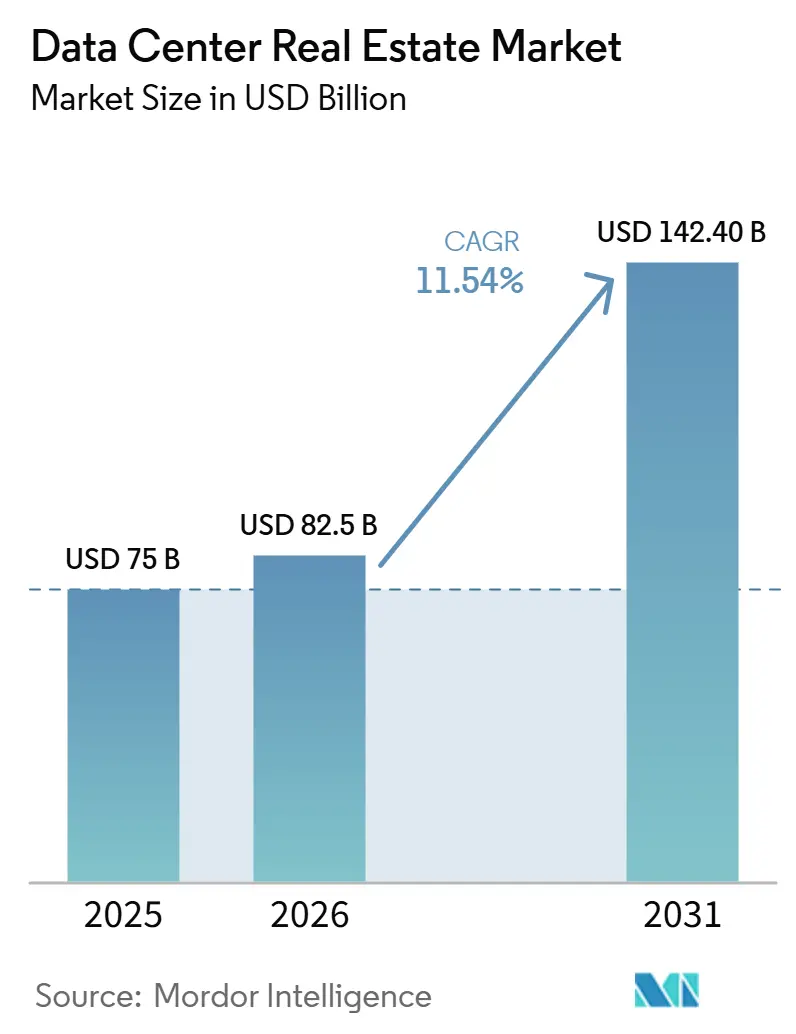
The Data Center Real Estate Market size is projected to expand from USD 75 billion in 2025 and USD 82.5 billion in 2026 to USD 142.40 billion by 2031, registering a CAGR of 11.54% between 2026 to 2031.
The data center real estate market is expanding as artificial intelligence (AI) workloads increase power density requirements, cloud platforms scale capacity, and enterprises continue shifting critical infrastructure into specialized facilities. The market is also expanding geographically as low-latency inference, sovereign data requirements, and the need for greater digital resilience push operators beyond a narrow set of legacy hubs. Leasing remains the preferred operating model because it enables tenants to accelerate deployment, reduce development risk, and secure capacity in locations where power availability and permitting have become increasingly constrained. The data center real estate market is also becoming more selective because sites with secured land, permits, and reliable power access hold a clear competitive advantage over greenfield developments with uncertain delivery timelines. Competition remains intense as institutional investors, real estate operators, and major technology companies compete for a limited supply of operational, AI-ready assets.
Key Report Takeaways
- By property type, colocation accounted for 46.80% of the data center real estate market share in 2025, while edge data center properties recorded the highest projected CAGR of 15.20% through 2031.
- By ownership, leased properties accounted for 78.40% of the market in 2025, and the same segment is forecast to post the fastest CAGR at 12.10% through 2031.
- By enterprise size, large enterprises held 69.10% of the data center real estate market size in 2025, while small and medium enterprises are projected to expand at the highest CAGR of 13.60% through 2031.
- By end-user, information technology and telecom accounted for 45.10% of the market in 2025, while healthcare is expected to grow fastest at a 14.30% CAGR through 2031.
- By geography, North America held 37.80% of the market in 2025, while Asia-Pacific is projected to record the highest CAGR at 13.80% through 2031.
Note: Market size and forecast figures in this report are generated using Mordor Intelligence’s proprietary estimation framework, updated with the latest available data and insights as of January 2026.
Market Trends and Insights
Drivers Impact Analysis of Data Center Real Estate Market*
| Drivers | (~) % Impact on CAGR Forecast | Geographic Relevance | Impact Timeline |
|---|---|---|---|
| AI Workloads Drive Demand for High-Power Data Center Facilities | +2.8% | Global, highest in North America and Asia-Pacific | Short term (≤ 2 years) |
| Cloud and Hyperscale Expansion Accelerates Capacity Growth | +2.3% | Global, concentrated in North America, Europe, and Asia-Pacific | Short term (≤ 2 years) |
| Data Localization Policies Increase In-Country Data Center Demand | +1.6% | Asia-Pacific, Middle East and Africa, South America, and Eastern Europe | Medium term (2-4 years) |
| Pre-Permitted Powered Sites Attract Data Center Investments | +1.3% | North America, Asia-Pacific, and emerging EMEA markets | Medium term (2-4 years) |
| Liquid-Cooling Adoption Supports Next-Generation Data Center Development | +0.9% | Global, with early gains in North America and Asia-Pacific AI hubs | Long term (≥ 4 years) |
| Behind-the-Meter Power Strategies Expand Energy-Integrated Campuses | +0.6% | North America core, with spillover to Australia and the Middle East | Medium term (2-4 years) |
| Source: Mordor Intelligence | |||
AI Workloads Drive Demand for High-Power Data Center Facilities
AI is changing the physical requirements of the data center real estate market because higher-density compute needs more power, more cooling, and larger contiguous capacity blocks. This shift is not limited to training clusters, as inference traffic is beginning to shape where future facilities should sit relative to users and enterprise applications. That change matters for real estate decisions because distributed inference supports growth in both major campuses and smaller nodes closer to demand centers. The pressure is also technological, since new server platforms are forcing operators to redesign thermal systems rather than expand legacy layouts. NVIDIA released its Rubin server platform in 2026 with a fully liquid-cooled design, which raises the bar for AI-ready infrastructure across new developments[1].
Cloud and Hyperscale Expansion Accelerates Capacity Growth
The data center real estate market continues to benefit from cloud expansion, as hyperscale tenants still need large blocks of capacity amid increasingly compressed delivery schedules. This has shifted value away from simple land banking and toward sites that can move into active development without long delays. It also favors operators who already understand large-campus execution, utility coordination, and long-duration lease structuring. Demand at this scale is changing the typical project profile, as 300 MW and larger requirements now influence how developers assemble land and power rather than market a building. As a result, the data center real estate market is seeing stronger overlap between hyperscale and colocation strategies at the upper end of capacity delivery.
Data Localization Policies Increase In-Country Data Center Demand
Data localization rules are turning regulation into direct infrastructure demand across multiple parts of the data center real estate market. Vietnam's Decree No. 165/2025/ND-CP took effect on July 1, 2025, and requires core and important data to be stored within Vietnamese borders[2]. Kenya's Cloud Policy, enacted in May 2025, also applies localization requirements based on data sensitivity. These policies push cloud providers, digital platforms, and regulated enterprises to build or lease local capacity from regional hubs. The result is a broader footprint for the data center real estate market, especially in countries where digital demand is rising but local supply is still limited.
Pre-Permitted Powered Sites Attract Data Center Investments
The strongest advantage in the data center real estate market now comes from land that already has permits, utility readiness, and a clear path to interconnection. This changes underwriting because investors are placing greater weight on delivery certainty than on traditional location-scoring factors alone. It also shifts competition toward owners who can secure substations, right-of-way access, and approvals before tenant commitments. In practical terms, sites with power visibility can lease faster, price better, and attract more strategic tenants than similar land without that readiness. The data center real estate market is, therefore, rewarding pre-development discipline in a way that few other real estate categories currently do.
Restraints Impact Analysis of Data Center Real Estate Market*
| Restraint | (~) % Impact on CAGR Forecast | Geographic Relevance | Impact Timeline |
|---|---|---|---|
| Power Grid Connection Delays Slow New Data Center Developments | -2.1% | Global, most acute in North America and Europe | Short term (≤ 2 years) |
| High Construction and Equipment Costs Reduce Project Returns | -1.4% | Global, worst in North America, the UK, Germany, and Singapore | Medium term (2-4 years) |
| Community Opposition Delays Data Center Project Approvals | -0.7% | North America and the EU, with spillover to Asia-Pacific urban corridors | Short term (≤ 2 years) |
| Climate Risks and Rising Insurance Costs Increase Operating Uncertainty | -0.5% | Global, highest in coastal United States, Southeast Asia, and the GCC | Long term (≥ 4 years) |
| Source: Mordor Intelligence | |||
Power Grid Connection Delays Slow New Data Center Developments
Grid connection timing is the primary operating constraint in the data center real estate market, as demand is not the problem in most core locations. When power delivery trails tenant demand by several years, developers cannot convert land and capital into revenue on a predictable schedule. That delay weakens site economics and forces occupiers to prelease earlier than they otherwise would. It also increases the value gap between ready sites and speculative projects that still depend on uncertain utility timelines. The data center real estate market is therefore being shaped as much by energy infrastructure sequencing as by digital demand growth.
High Construction and Equipment Costs Reduce Project Returns
Construction costs remain a meaningful restraint on the data center real estate market because the asset now requires more specialized materials, electrical systems, and cooling equipment than most commercial formats. AI-ready fit-outs push costs even higher because they add density, redundancy, and thermal demands that standard shells cannot absorb cheaply. Procurement timing has also become more difficult because long-lead electrical equipment can affect delivery even after financing is secured. This creates a wider performance gap between scaled developers with purchasing power and smaller operators without that leverage. In the data center real estate market, higher cost inflation does not stop demand, but it does compress margins and raise execution risk.
*Our forecasts treat driver/restraint impacts as directional, not additive. The impact forecasts reflect baseline growth, mix effects, and variable interactions.
Data Center Real Estate Market Segment Analysis
By Property Type:
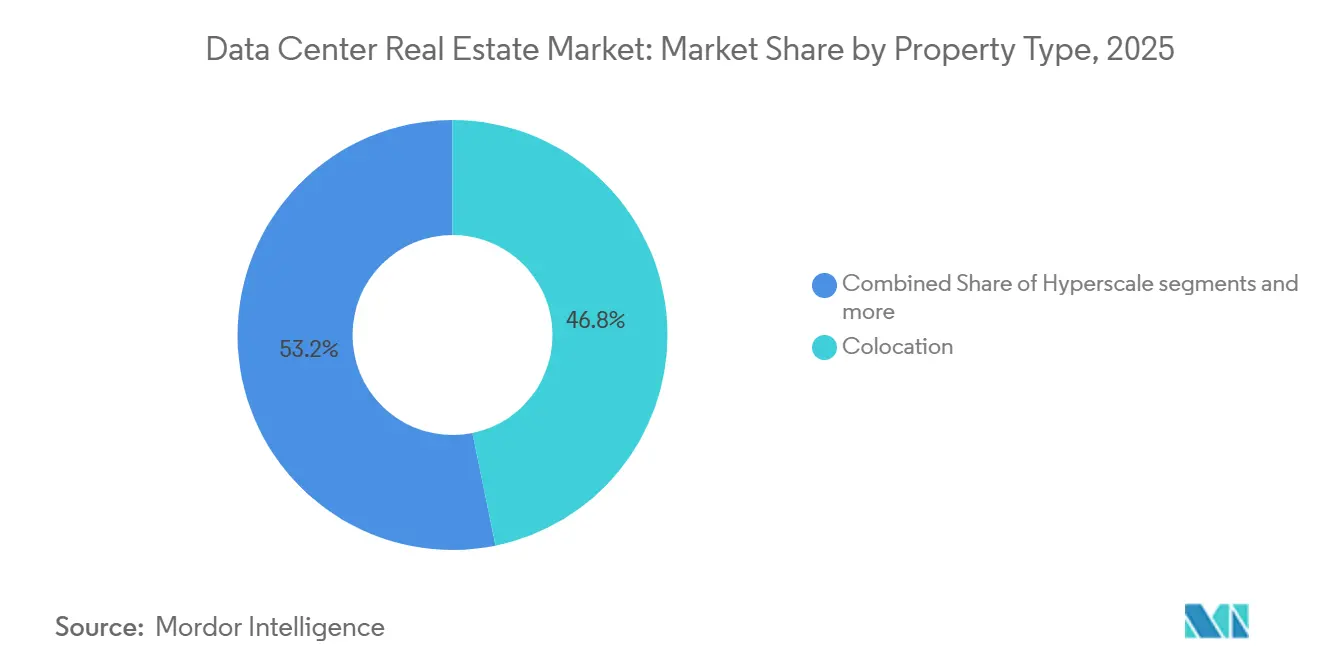
Colocation Dominates, Edge Data Center Properties Rewrites the Growth CurveColocation properties held 46.80% of the data center real estate market share in 2025, which kept this format in the leading position across the overall portfolio mix. The segment continues to benefit from tenants that want fast occupancy, shared infrastructure, and lower development exposure. This is especially important for cloud platforms, neocloud operators, and enterprises that need immediate capacity rather than a multiyear build cycle. Low vacancy in major colocation hubs also shows that supply remains tight in the most established demand corridors. In the data center real estate market, colocation still offers the broadest path to scale because it supports both enterprise demand and hyperscale overflow within a single operating model.
Hyperscale properties remain the second-largest segment because the largest tenants still require campus-style footprints and very large power commitments. At the same time, the edge data center properties segment is projected to expand at a 15.20% CAGR through 2031, making it the fastest-growing property format in the current mix. That growth reflects the spread of latency-sensitive inference, localized application delivery, and regional resilience planning. Modular properties are also gaining interest because they shorten deployment timelines in markets where traditional construction can take too long. The remaining formats continue to lose relative weight in the data center real estate industry as owner-managed legacy facilities give way to operator-led platforms with stronger power and cooling capabilities.

By Ownership:
Leased Model Dominates the MarketLeased properties accounted for 78.40% of the data center real estate market share in 2025 and also carry the fastest projected CAGR at 12.10% through 2031. This shows that the leading ownership model is not only large but also continues to strengthen as demand increases. Tenants favor leasing because it reduces balance sheet burden, shortens time to deployment, and transfers part of the development risk to specialist operators. That preference has become even more important as permitting, equipment procurement, and power delivery timelines have become less predictable. In the data center real estate market, the lease model is now tied as much to strategic speed as to real estate economics.
The strength of this segment is also visible in transaction activity for stabilized leased assets. In June 2026, Digital Realty agreed to acquire Blackstone's interests in three fully leased Northern Virginia data centers for USD 7.8 billion, highlighting how premium, long-term-leased assets are being valued in core markets[3]. Owner-occupied properties still serve specific needs in defense, intelligence, central banking, and enterprises with retained on-premises obligations. Build-to-suit structures further blur the line because they give tenants tailored facilities without requiring direct ownership. The data center real estate industry is therefore moving toward a model where control of mission-critical infrastructure matters more than owning the physical asset outright.
By Enterprise Size:
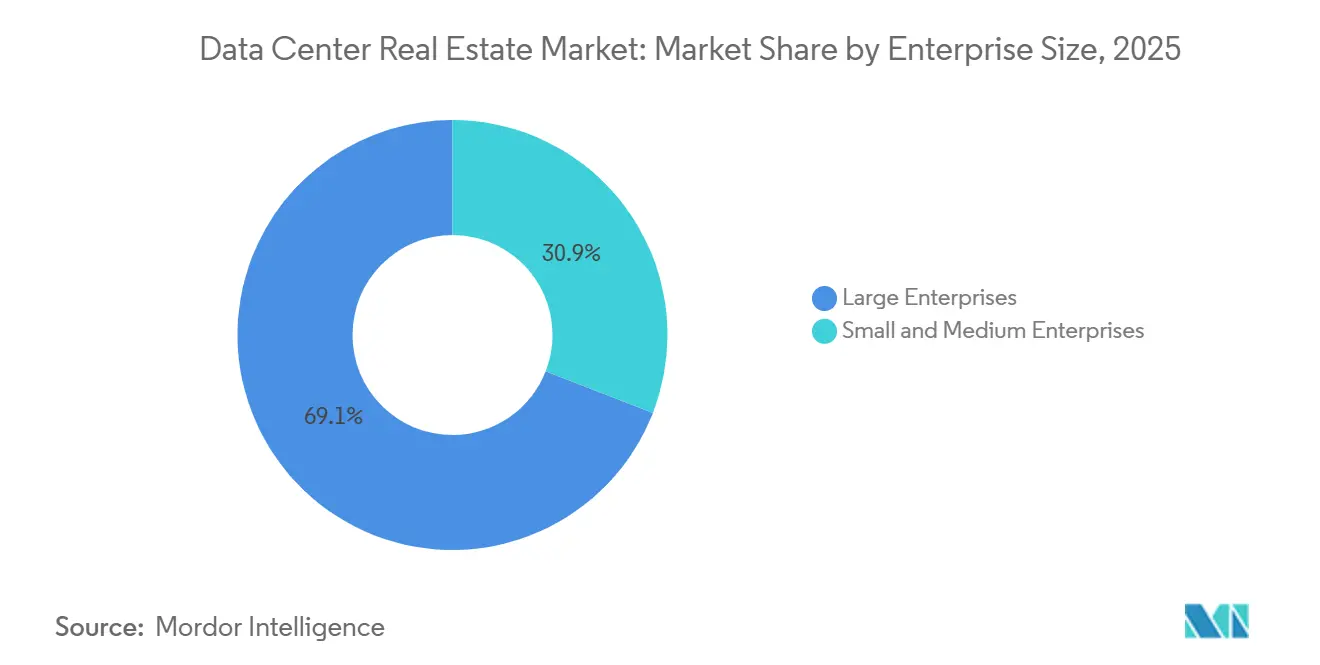
Large Enterprises Lead While Small and Medium Enterprises Drive Future GrowthLarge enterprises accounted for 69.10% of the market in 2025, reflecting the scale of demand from hyperscalers, telecom carriers, financial institutions, and large digital platforms. These buyers can commit to larger blocks, longer lease terms, and tighter delivery schedules than most smaller occupiers. Their presence is strongest in primary hubs where very large capacity commitments help define local market pricing and availability. This concentration also reinforces a two-tier pattern between assets that can serve large single tenants and assets that cannot. The data center real estate market remains anchored by these larger users because they continue to absorb the largest volumes of capital and power.
Small and medium enterprises are projected to grow at a 13.60% CAGR through 2031, which makes them the fastest-growing enterprise cohort in the current outlook. Their growth is tied to smaller contract sizes, broader colocation access, and more workable entry points through modular and edge formats. AI inference and cloud-adjacent deployments are also making specialized third-party space more useful for mid-sized firms with localized compute needs. This matters because it adds diversity to the demand base, even as large tenants continue to dominate absolute capacity. The segment is therefore helping the data center real estate market deepen beyond a narrow set of very large occupiers.
By End-Users:
Information Technology and Telecom Leads, Healthcare Becomes the Fastest DisruptorInformation technology and telecom end-users accounted for 45.10% of the data center real estate market in 2025, making them the largest demand segment across all verticals. Hyperscale cloud buildouts, telecom edge requirements, and ongoing digital platform expansion support their lead. This segment also tends to move first when capacity opens because core digital operators plan infrastructure well ahead of near-term utilization. Banking, financial services, and insurance remain the second-largest vertical because real-time transaction environments, digital risk systems, and regulatory resilience demands all require secure hosted infrastructure. In the data center real estate market, these two verticals still set the baseline for occupancy, lease tenure, and premium facility requirements.
Healthcare is projected to grow at a 14.30% CAGR through 2031, which makes it the fastest-expanding end-user segment in the current forecast. Its growth is being driven by electronic health records, medical imaging, patient monitoring, and AI-enabled diagnostics that require continuous uptime and low-latency access. Government and public sector demand is also rising as sovereign cloud programs and domestically located compute requirements become increasingly important across multiple regions. Other end users, including media, e-commerce, and energy, continue to expand their infrastructure footprints as their workloads become increasingly data-intensive. This widening set of occupiers gives the data center real estate market a broader and more resilient demand base than it had in earlier cycles.
Geography Analysis
North America Data Center Real Estate Market
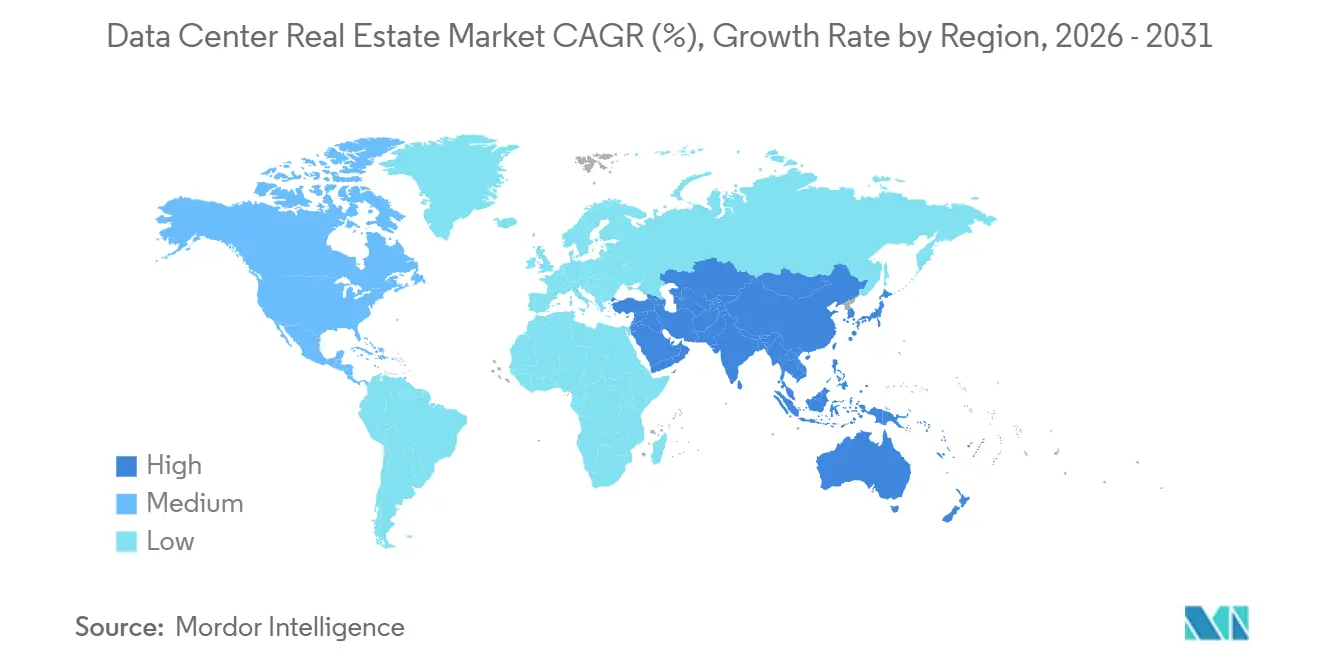
North America held 37.80% of the data center real estate market share in 2025, making it the largest regional contributor to global revenue. The United States remained the main anchor because it combines the deepest tenant pool with the largest concentration of operating platforms and capital. At the same time, the region is also where power delivery and approval timing are becoming the most immediate constraints on expansion. Canada is gaining relevance as an adjacent option for large-scale deployments, especially for operators seeking greater flexibility in campus development and energy sourcing. Mexico is also drawing interest from nearshore digital infrastructure strategies that aim to serve Latin American demand with lower latency and regional alignment.
Europe Data Center Real Estate Market
Europe accounted for a substantial share of the data center real estate market and continued to rely heavily on the FLAPD cluster for new supply additions in 2025. Frankfurt and London stayed at the center of regional activity because they combine deep connectivity, strong enterprise demand, and established operator ecosystems. Even so, tighter sustainability and reporting expectations are raising the compliance threshold for newer entrants. That dynamic supports larger, professionally managed assets that can absorb reporting, efficiency, and resilience requirements more effectively than small standalone facilities.
APAC, South America and MEA Data Center Real Estate Market
Asia-Pacific is projected to advance at a 13.80% CAGR through 2031, giving it the fastest regional growth rate in the data center real estate market. The region benefits from strong digital demand, hyperscale spillover, local cloud expansion, and a wider set of national policies that encourage in-country data hosting. India is emerging as one of the more structurally open markets because its live capacity base is growing while long-term demand remains broad. Malaysia and other secondary hubs are also gaining from Singapore overflow, which is redirecting some regional expansion into alternative supply locations. South America and the Middle East and Africa are smaller in absolute terms, but both regions are attracting attention where fiscal incentives, sovereign digital programs, and large AI-linked campus plans are creating new development corridors.
Competitive Landscape
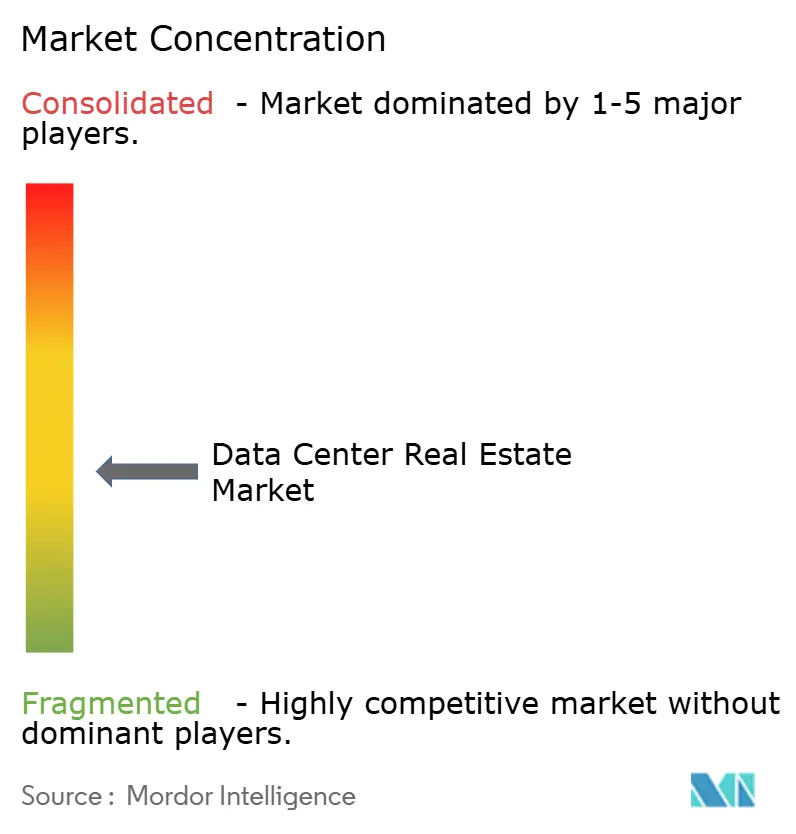
The data center real estate market remains moderately consolidated, with a small group of global operators controlling a significant share of premium capacity, tenant relationships, and development expertise. Companies such as Equinix, Digital Realty Trust, and NTT Global Data Centers continue to lead across colocation, wholesale, and hyperscale deployments through their extensive portfolios, strong capital access, operational experience, and ability to execute projects across multiple regions. At the same time, the broader competitive landscape remains diverse, as regional developers and specialized operators maintain strong positions in individual metropolitan markets and countries, particularly where local regulations, customer requirements, or power availability create barriers to entry.
Strategic investments and acquisitions in 2026 demonstrate how leading operators are strengthening their competitive positions. In June 2026, Digital Realty agreed to acquire Blackstone's interests in three Northern Virginia data centers for USD 7.8 billion, expanding its presence in one of the world's largest hyperscale markets. Such transactions enhance geographic reach, increase available capacity, and strengthen operators' ability to provide scalable, compliant infrastructure for hyperscale and enterprise customers. As a result, the data center real estate market increasingly favors providers that can combine portfolio scale, rapid execution, and reliable infrastructure delivery in capacity-constrained regions.
Private capital is also reshaping the competitive landscape as infrastructure funds, real estate investment trusts (REITs), institutional investors, and hyperscale tenants compete for stabilized assets and power-ready development sites. While this raises barriers for smaller operators with limited capital or development pipelines, attractive growth opportunities remain in secondary markets, emerging artificial intelligence (AI) inference hubs near major metropolitan areas, and regions where sovereign data localization requirements are expanding faster than available capacity. Developers capable of integrating energy infrastructure, advanced cooling solutions, and long-term tenant commitments are becoming increasingly competitive. Consequently, success in the data center real estate market is increasingly determined by access to power, development readiness, regulatory compliance, and the ability to deliver large-scale capacity efficiently.
Data Center Real Estate Industry Leaders
-
Equinix, Inc.
-
Digital Realty Trust, Inc.
-
NTT Global Data Centers
-
CyrusOne Inc.
-
QTS Realty Trust, LLC
- *Disclaimer: Major Players sorted in no particular order
Data Center Real Estate Market Companies Covered in this Report
- Equinix, Inc.
- Digital Realty Trust, Inc.
- NTT Global Data Centers
- CyrusOne Inc.
- QTS Realty Trust, LLC
- Iron Mountain Incorporated
- STACK Infrastructure
- Vantage Data Centers LLC
- EdgeConneX, Inc.
- GDS Holdings Limited
- Global Switch Limited
- ST Telemedia Global Data Centres
- DATA4 Group
- Colt Data Centre Services
- NorthC Group B.V.
- Keppel Data Centres Pte. Ltd.
- AirTrunk
- Yondr Group
- AtlasEdge
- Teraco Data Environments (Pty) Ltd.
Recent Industry Developments in Data Center Real Estate Market
- July 2026: Meta broke ground on its first data center in Canada, a 1 GW, AI-optimized campus in Sturgeon County, Alberta, representing more than CAD 13 billion (approximately USD 9.5 billion) in investment.
- July 2026: SK Telecom announced plans to build up to 15 GW of AI data center capacity in Korea, aiming to position the country as an AI infrastructure hub in Asia.
- June 2026: Digital Realty agreed to acquire Blackstone's 80% interest in two 96 MW data centers in Manassas, Virginia, and a 50% interest in a third 96 MW facility in Sterling, Virginia, for USD 7.8 billion at 100% share, including assumed debt.
- June 2026: Blackstone announced plans to invest USD 30 billion in AI data centers across Japan over 3 to 5 years, targeting more than 1 GW of combined capacity.
Global Data Center Real Estate Market Report Scope
The Data Center Real Estate Market Report is Segmented by Property Type (Colocation, Hyperscale, Edge Data Center Properties, and More), Ownership (Leased and Owner Occupied), Enterprise Size (Large Enterprises and Small and Medium Enterprises), End-Users Information Technology and Telecom, and More), and Geography (North America, Europe, Asia-Pacific, and More). The Market Forecasts are Provided in Terms of Value (USD).
Segmentation Overview
| Colocation |
| Hyperscale |
| Edge Data Center Properties |
| Modular Data Center Properties |
| Others (Wholesale, Retail and Enterprise) |
| Leased |
| Owner Occupied |
| Large Enterprises |
| Small and Medium Enterprises |
| Information Technology and Telecom |
| Banking, Financial Services, and Insurance |
| Government and Public Sector |
| Healthcare |
| Other End Users |
| North America | United States |
| Canada | |
| Mexico | |
| Europe | United Kingdom |
| Germany | |
| France | |
| Italy | |
| Spain | |
| Russia | |
| Rest of Europe | |
| Asia-Pacific | China |
| India | |
| Japan | |
| Australia | |
| South Korea | |
| SouthEast Asia (Singapore, Malaysia, Thailand, Indonesia, Vietnam, and Philippines) | |
| Rest of Asia-Pacific | |
| South America | Brazil |
| Argentina | |
| Rest of South America | |
| Middle East and Africa | Saudi Arabia |
| United Arab Emirates | |
| Turkey | |
| South Africa | |
| Nigeria | |
| Rest of Middle East and Africa |
| By Property Type | Colocation | |
| Hyperscale | ||
| Edge Data Center Properties | ||
| Modular Data Center Properties | ||
| Others (Wholesale, Retail and Enterprise) | ||
| By Ownership | Leased | |
| Owner Occupied | ||
| By Enterprise Size | Large Enterprises | |
| Small and Medium Enterprises | ||
| By End-Users | Information Technology and Telecom | |
| Banking, Financial Services, and Insurance | ||
| Government and Public Sector | ||
| Healthcare | ||
| Other End Users | ||
| By Geography | North America | United States |
| Canada | ||
| Mexico | ||
| Europe | United Kingdom | |
| Germany | ||
| France | ||
| Italy | ||
| Spain | ||
| Russia | ||
| Rest of Europe | ||
| Asia-Pacific | China | |
| India | ||
| Japan | ||
| Australia | ||
| South Korea | ||
| SouthEast Asia (Singapore, Malaysia, Thailand, Indonesia, Vietnam, and Philippines) | ||
| Rest of Asia-Pacific | ||
| South America | Brazil | |
| Argentina | ||
| Rest of South America | ||
| Middle East and Africa | Saudi Arabia | |
| United Arab Emirates | ||
| Turkey | ||
| South Africa | ||
| Nigeria | ||
| Rest of Middle East and Africa | ||
Key Questions Answered in the Report
What is driving growth in data center real estate through 2031?
Growth is being driven by AI workloads, cloud expansion, sovereign data requirements, and strong tenant preference for leased specialist facilities. The market is projected to reach USD 142.40 billion by 2031 at an 11.54% CAGR.
Which property type leads current demand?
Colocation leads with 46.80% share in 2025 because it offers faster deployment and lower development risk for enterprises and large cloud tenants.
Which property format is growing the fastest?
Edge data center properties are forecast to grow at a 15.20% CAGR through 2031 as low-latency inference and localized digital services expand.
Why is leasing so dominant in this space?
Leased properties held 78.40% share in 2025 because tenants want speed, flexibility, and reduced exposure to land, permit, and power delivery risk.
Which end-user segment is expanding the fastest?
Healthcare is projected to grow at a 14.30% CAGR through 2031 as digital health records, diagnostics, imaging, and patient monitoring create constant infrastructure demand.
Which region offers the strongest growth outlook?
Asia-Pacific has the fastest growth outlook with a 13.80% CAGR through 2031, supported by local cloud growth, data localization, and hyperscale expansion into new regional hubs.