
Data Center Climate Risk and Resilience Market Size and Share
Market Overview
| Study Period | 2021 - 2032 |
|---|---|
| Market Size (2027) | USD 2.81 Billion |
| Market Size (2032) | USD 5.16 Billion |
| Growth Rate (2027 - 2032) | 12.92 % |
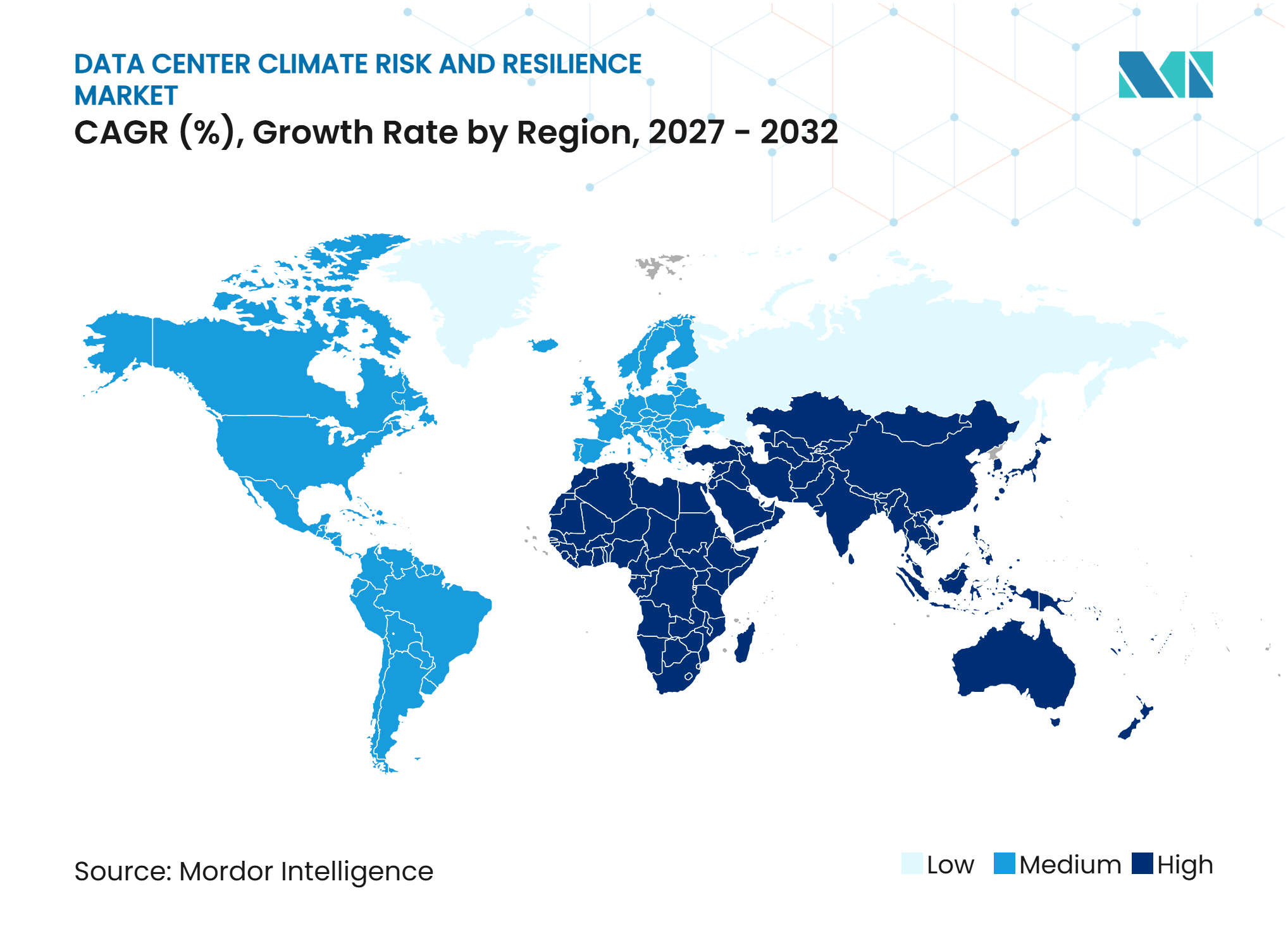
| Fastest Growing Market | Asia-Pacific |
| Largest Market | North America |
| Market Concentration | Medium |
Major Players *Disclaimer: Major Players sorted in no particular order Image © Mordor Intelligence. Reuse requires attribution under CC BY 4.0. | |
Data Center Climate Risk and Resilience Market Analysis by Mordor Intelligence
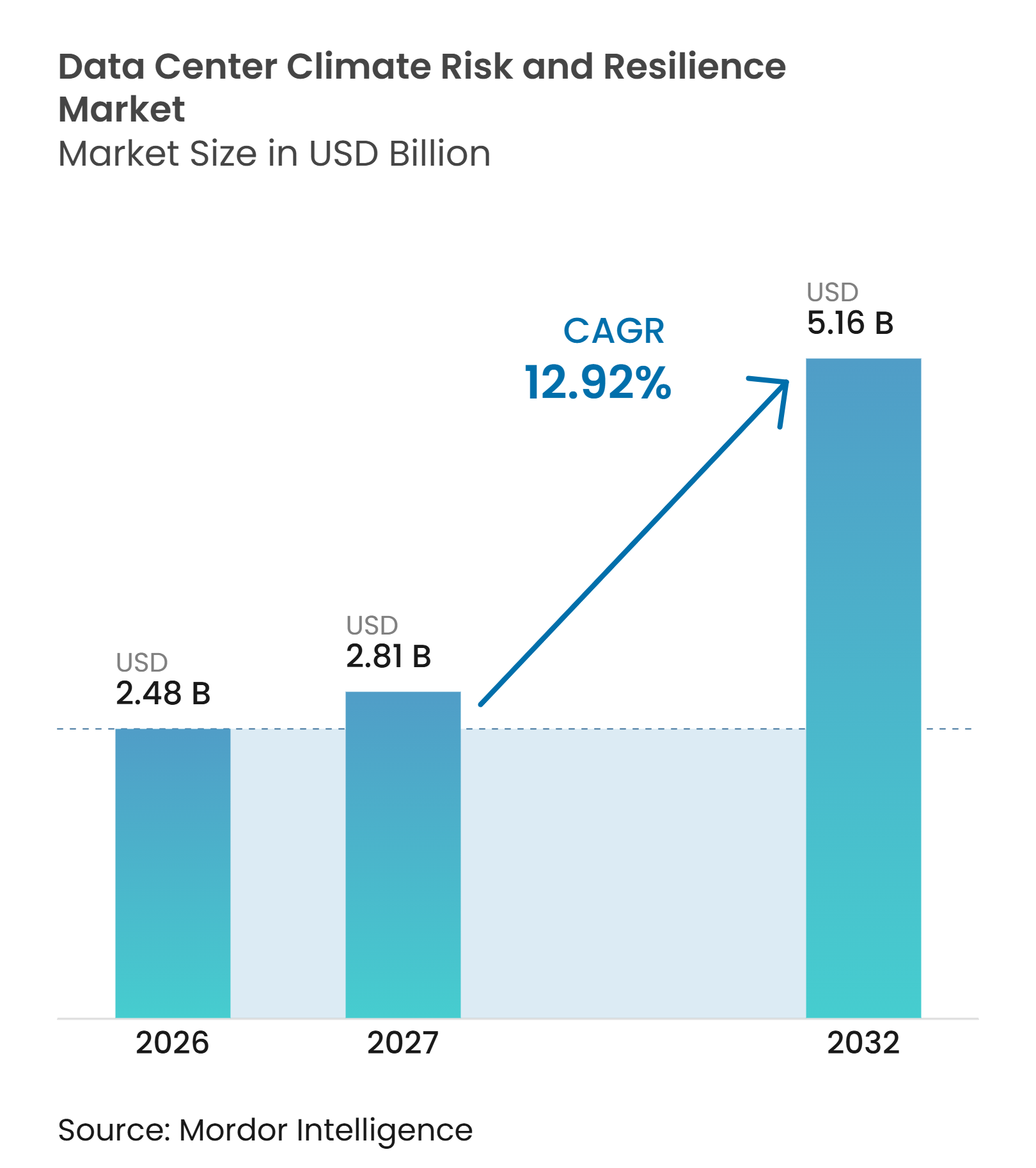
The Data Center Climate Risk and Resilience Market size was valued at USD 2.48 billion in 2026 and is estimated to grow from USD 2.81 billion in 2027 to reach USD 5.16 billion by 2032, at a CAGR of 12.92% during the forecast period (2027-2032). Rising AI computing density is making heat management, power continuity, and water planning central to facility design. Operators are moving climate review earlier in the site selection process because retrofits can disrupt critical operations and cost more than resilience measures incorporated during construction. Disclosure requirements in Europe and customer due diligence in North America are also expanding demand for documented resilience programs. The data center climate risk and resilience market is therefore shifting from a narrow technical service category toward a broader set of planning, monitoring, and engineering requirements.
Key Report Takeaways
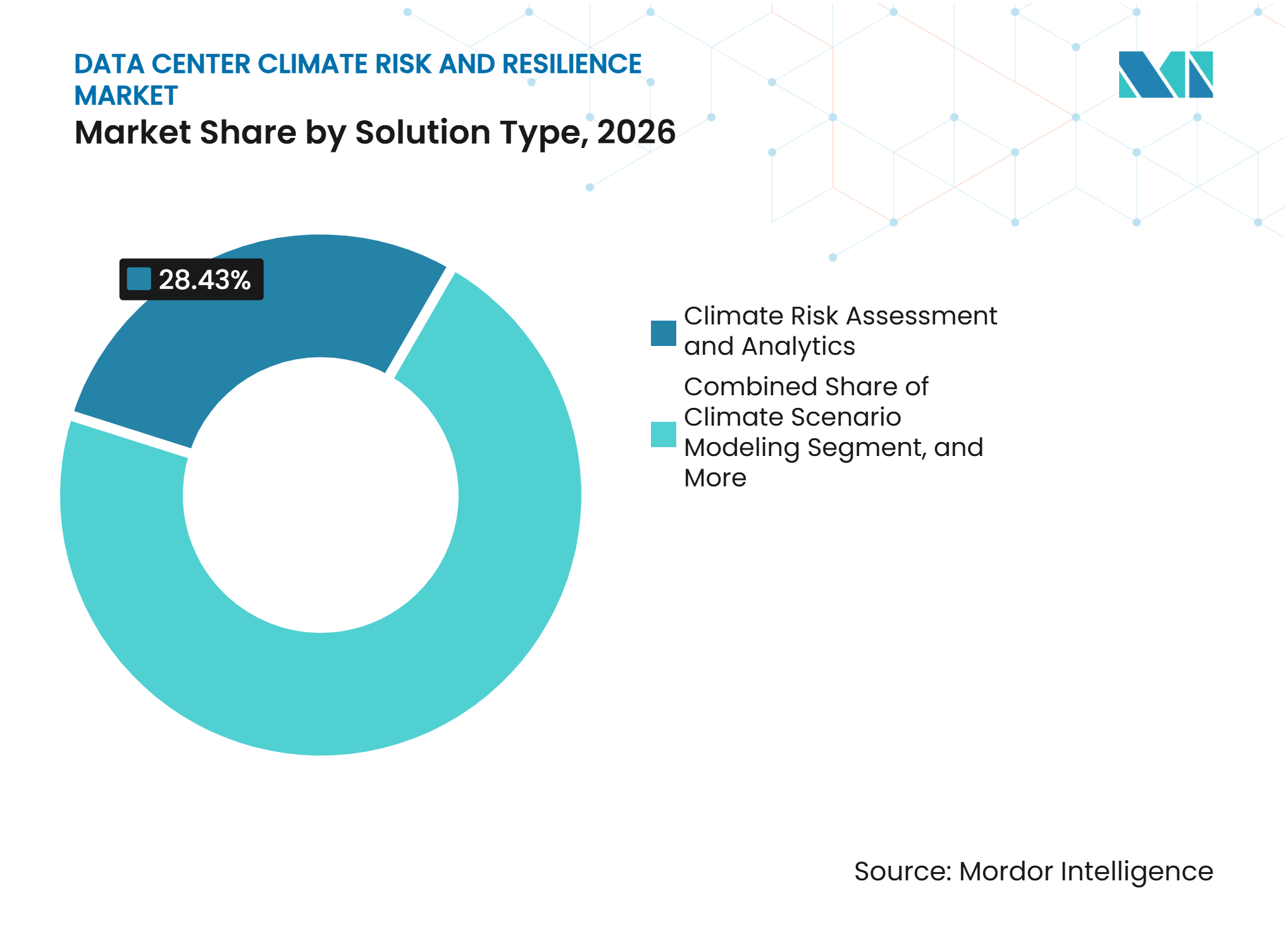
- By solution type, Climate Risk Assessment and Analytics held 28.43% of the data center climate risk and resilience market share in 2026, while Climate Risk Monitoring and Early Warning is projected to expand at a 13.62% CAGR through 2032.
- By climate hazard, Extreme Heat and Heatwaves accounted for 29.74% in 2026, while Compound and Multi-Hazard Events are projected to expand at a 13.76% CAGR through 2032.
- By assessment method, Physical Risk and Vulnerability Assessment held a 26.38% share in 2026, while Financial and Asset-Level Climate Risk Quantification is projected to expand at a 13.57% CAGR through 2032.
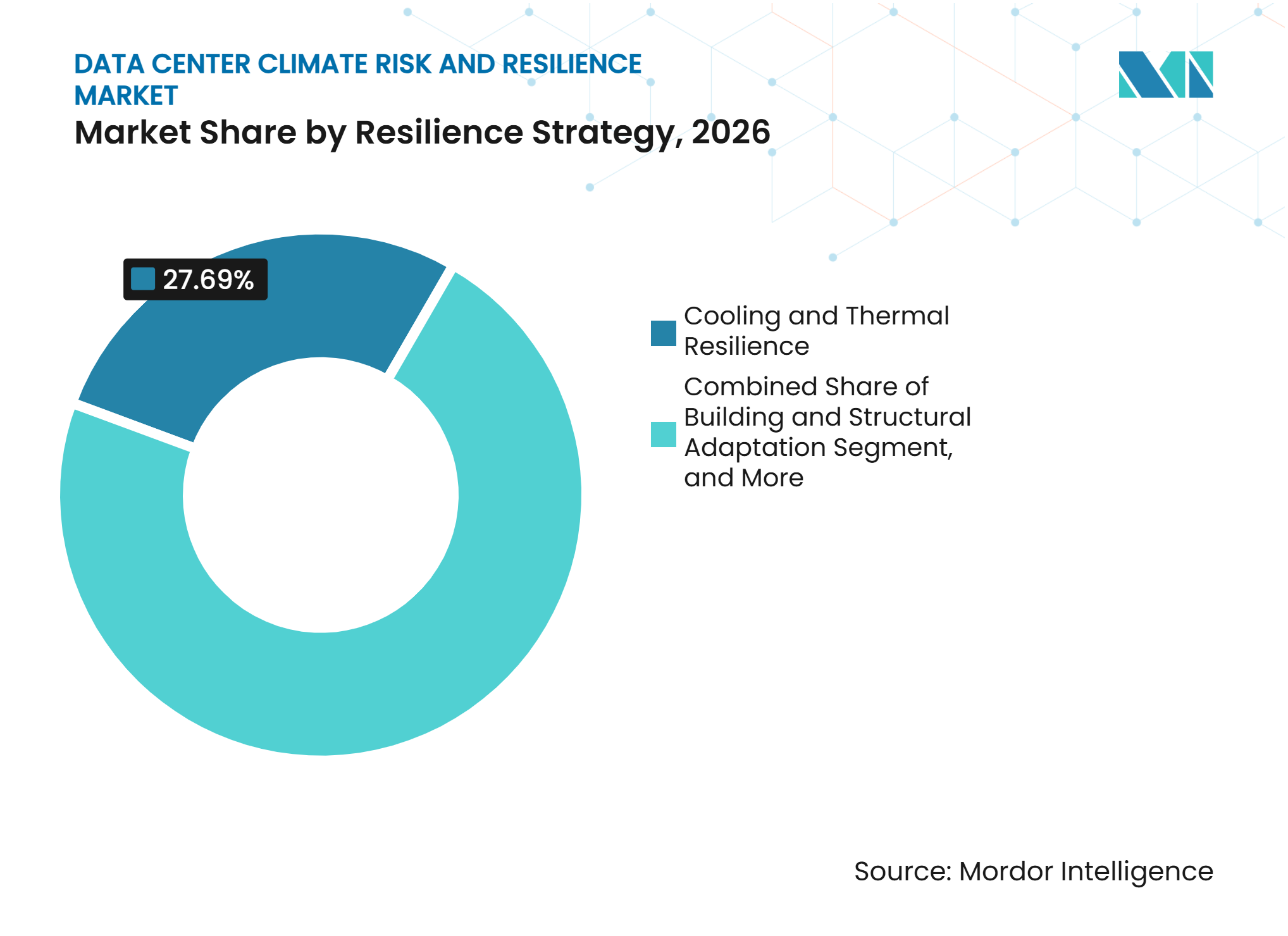
- By resilience strategy, Cooling and Thermal Resilience held a 27.69% share in 2026, while Water Availability and Conservation Measures is projected to expand at a 13.68% CAGR through 2032.
- By service type, Climate Risk Consulting held a 32.86% share in 2026, while Climate Engineering and Design is projected to expand at a 13.59% CAGR through 2032.
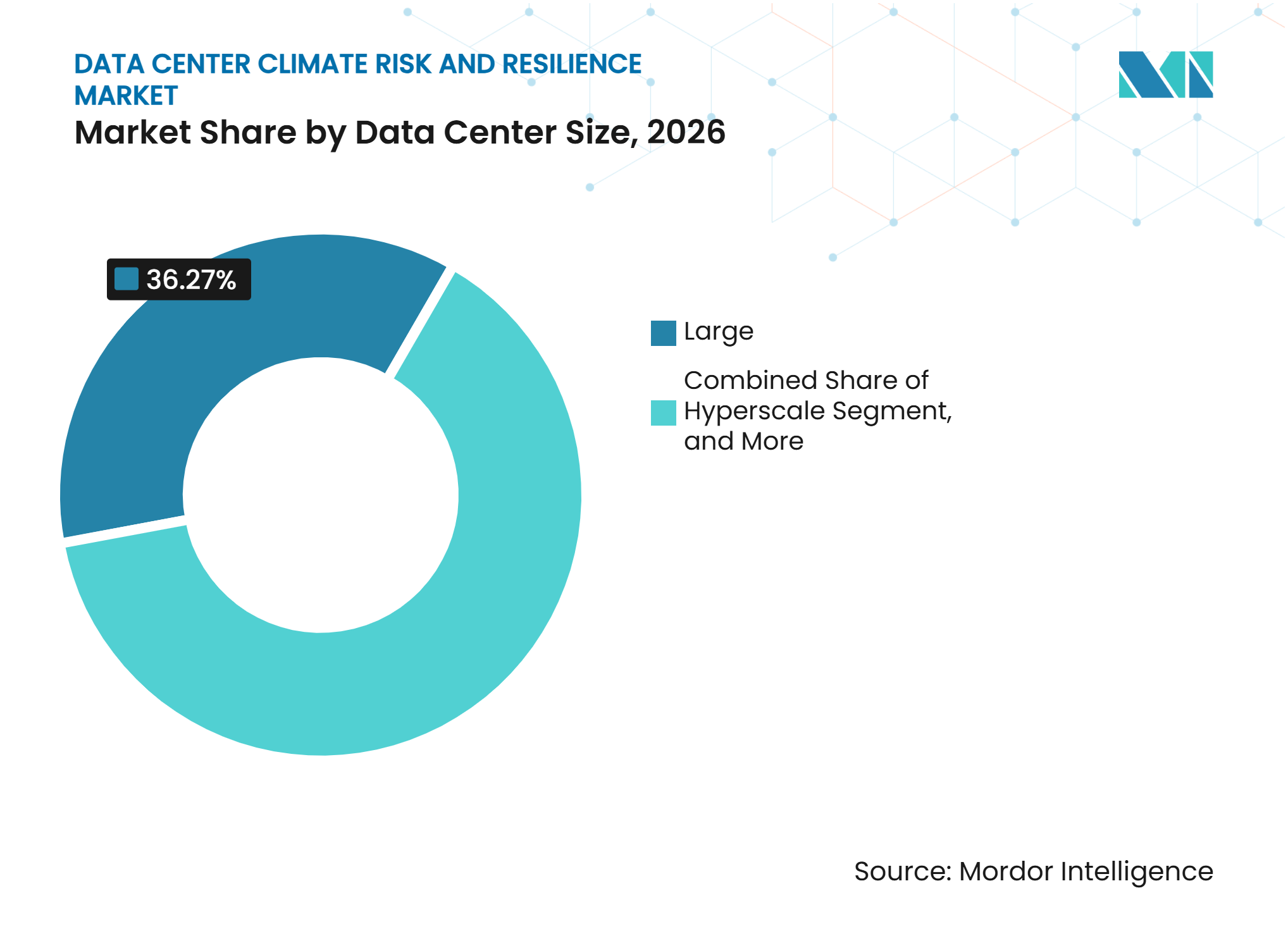
- By data center size, Large Data Centers held 36.27% share in 2026, while Hyperscale Data Centers is projected to expand at a 13.74% CAGR through 2032.
- By data center type, Colocation Data Centers held 41.92% share in 2026, while Cloud Service Providers are projected to expand at a 13.64% CAGR through 2032.
- By geography, North America held 38.58% share in 2026, while Asia-Pacific is projected to expand at a 13.72% CAGR through 2032.
Note: Market numbers in this report are based on Mordor Intelligence's proprietary estimation framework, which combines nine months of actuals with Q4 projections for base year 2026.
Market Trends and Insights
Drivers Impact Analysis of Data Center Climate Risk and Resilience Market*
| Driver | (~) % Impact on CAGR Forecast | Geographic Relevance | Impact Timeline |
|---|---|---|---|
| Expansion of AI and High-Performance Computing Infrastructure | +3.5% | Global, concentrated in North America, Asia-Pacific, and Western Europe | Short term (≤ 2 years) |
| Escalating Downtime and Climate-Related Business Interruption Costs | +2.8% | Global, highest severity in the Americas and Asia-Pacific | Short term (≤ 2 years) |
| Regulatory and Customer Demand for Verified Resilience | +2.4% | Europe and North America primarily, expanding to Asia-Pacific under EU EED and CSRD | Medium term (2-4 years) |
| Climate-Informed Siting as a Capital Allocation Requirement | +1.8% | North America and Europe, with early adoption in the Nordics and Canada | Medium term (2-4 years) |
| Water Stress Driving Closed-Loop Cooling and Reuse Investment | +1.2% | Asia-Pacific, with spillover to the Middle East and parts of North America | Medium term (2-4 years) |
| Insurer and Lender Pricing of Physical Climate Exposure | +0.9% | Global, led by North American and European financial markets | Long term (≥ 4 years) |
| Source: Mordor Intelligence | |||
Expansion of AI and High-Performance Computing Infrastructure
AI infrastructure is increasing the operational consequences of heat, water, and power disruption for data center operators. The International Energy Agency projects global data center electricity consumption to more than double, reaching around 945 TWh by 2030, with AI as a major driver of growth. Dense computing equipment raises cooling requirements and reduces the time available to respond when local weather conditions change. The ASEAN Guide for Sustainable Data Centre Development expects rack power densities in the region to reach 50 kW by 2027, which places additional pressure on thermal design and water planning. This operating profile supports demand for continuous monitoring, climate-informed design, and cooling systems that can operate reliably during extreme conditions. The data center climate risk and resilience market is benefiting from this shift because facility planning now needs to align computing demand with local infrastructure constraints.
Escalating Downtime and Climate-Related Business Interruption Costs
Data center operators are placing greater value on resilience because a weather-related outage can simultaneously affect customers, supply chains, and contractual service commitments. Uptime Institute reported that 54% of respondents said their most recent significant outage cost more than USD 100,000, and 20% reported costs above USD 1 million.[1] The financial exposure makes early warning, equipment redundancy, and response planning practical operating priorities rather than optional safeguards. High-density AI workloads may face greater disruption from cooling failure because component temperatures can rise quickly under sustained load. The data center climate risk and resilience market benefits when operators use risk assessments to identify weak points before an incident affects a service-level agreement. Demand is especially relevant for multi-tenant sites, where a single facility incident can create losses for several customers.
Regulatory and Customer Demand for Verified Resilience
Data center sustainability reporting is becoming more structured in Europe, which increases the need for reliable facility data and documented improvement plans. The European Commission requires data centers with installed IT power demand of at least 500 kW to report key performance information through the European database. The EU framework covers energy performance and includes reporting expectations that make water and environmental management more visible in procurement decisions. Operators serving large enterprise clients also face requests for evidence that facilities can maintain service under physical climate pressures. These requirements increase the role of risk audits, scenario analysis, and engineering plans within the data center climate risk and resilience market.
Climate-Informed Siting as a Capital Allocation Requirement
Site selection is becoming a more important resilience decision because new data centers operate for long periods and require large fixed investments. Incorporating adaptation measures during development can avoid the operational disruption associated with retrofits to live facilities. The U.S. Geological Survey has examined the co-location of AI data centers with energy infrastructure on federal public lands, reflecting the closer link between computing expansion, location, and energy planning. Operators now need to consider grid access, local water conditions, heat exposure, and the reliability of nearby infrastructure together. This approach widens the role of the data center climate risk and resilience market beyond building-level engineering. It also favors providers that can connect geographic screening with detailed facility design.
Restraints Impact Analysis of Data Center Climate Risk and Resilience Market*
| Restraint | (~) % Impact on CAGR Forecast | Geographic Relevance | Impact Timeline |
|---|---|---|---|
| High Retrofit Cost and Mission-Critical Downtime Risk | -1.6% | Global, most acute for legacy enterprise and colocation operators in dense markets | Short term (≤ 2 years) |
| Fragmented Climate Data and Inconsistent Modeling Methodologies | -1.2% | Global | Medium term (2-4 years) |
| Shared Utility-Node and Supply-Chain Correlation Risk | -0.8% | Asia-Pacific and North American dense clusters, including Johor and Northern Virginia | Medium term (2-4 years) |
| Long Lead Times for Transformers, Switchgear, and Resilience Equipment | -0.6% | Global, particularly North America and Europe | Short term (≤ 2 years) |
| Source: Mordor Intelligence | |||
High Retrofit Cost and Mission-Critical Downtime Risk
Retrofitting a live facility can be difficult because the cooling, electrical, and water systems must remain operational while work is underway. Operators with tight uptime commitments may delay upgrades when implementation requires equipment shutdowns or complex sequencing. The World Economic Forum identifies heat management and real-time monitoring as key resilience priorities, but these changes may require significant coordination in older sites. Legacy buildings may also have limited space for new cooling equipment, water treatment, or electrical protection systems. These constraints can slow adoption in the data center climate risk and resilience market even when risk assessments show a clear need for upgrades. Modular designs and phased engineering programs can reduce disruption, but they do not eliminate the cost challenge.
Fragmented Climate Data and Inconsistent Modeling Methodologies
Climate risk data can produce different results when providers use different hazard assumptions, time horizons, or facility boundaries. This makes it harder for investors and operators to compare sites and prioritize capital across a portfolio. A peer-reviewed spatial analysis found that climate-related operational risks across U.S. data centers are geographically structured, which supports more detailed, location-specific analysis. Single-hazard studies may not show the combined effect of heat, water scarcity, flooding, and grid stress on the same facility. The data center climate risk and resilience market therefore needs methods that can connect physical conditions with operational consequences. More consistent reporting standards could improve buyer confidence and support stronger comparisons among providers.
*Our forecasts treat driver/restraint impacts as directional, not additive. The impact forecasts reflect baseline growth, mix effects, and variable interactions.
Data Center Climate Risk and Resilience Market Segment Analysis
By Solution Type:
Analytics Leads as Continuous Monitoring ExpandsClimate Risk Assessment and Analytics held 28.43% of the market in 2026. It is commonly the first step because owners need a clear view of hazards before selecting technical investments. Assessment work can identify exposure to heat, flood, water scarcity, wildfire smoke, and severe wind at individual locations. Climate Scenario Modeling, Climate Risk Mapping, and Geospatial Analysis then help teams compare future conditions across existing and proposed sites. The European Commission’s data center reporting framework has made consistent facility information more important for operators subject to the EU rules.
Climate Risk Monitoring and Early Warning is projected to expand at a 13.62% CAGR through 2032. Monitoring complements periodic studies by giving operations teams information as weather, water availability, and local infrastructure conditions change. The World Economic Forum has highlighted real-time monitoring as a priority resilience investment because it helps operators act before conditions disrupt performance. AI facilities have strong reasons to use these systems because dense equipment leaves less flexibility when cooling performance declines. The data center climate risk and resilience market is likely to see more integrated offerings that link analytics, alerts, and operational responses.



By Climate Hazard:
Heat Leads While Multi-Hazard Planning GrowsExtreme Heat and Heatwaves accounted for 29.74% of the data center climate risk and resilience market in 2026. Heat directly affects cooling efficiency and can raise electricity demand when the grid is already under pressure. This creates a direct link between local temperature conditions and facility operating costs. The International Energy Agency identifies data centers as a growing source of electricity demand, making reliable cooling and power planning more important as AI capacity expands. Flooding, water scarcity, wildfire smoke, and severe wind also require attention because they can affect buildings, utility access, and equipment reliability.
Compound and Multi-Hazard Events are projected to expand at a 13.76% CAGR through 2032. Operators are moving away from planning for one climate condition at a time because hazards can occur together or affect the same service network. A facility may face high temperatures and water stress while also relying on a grid or transport network affected by severe weather. The peer-reviewed U.S. spatial analysis found meaningful connections among heat, water stress, and emissions risks across data center locations. Multi-hazard planning can help operators determine whether a single adaptation measure improves performance across multiple risks.
By Assessment Method:
Physical Vulnerability Provides the Starting PointPhysical Risk and Vulnerability Assessment commanded 26.38% of the market in 2026. This method examines how a site, building, cooling system, and power connection may respond to a specific physical hazard. Historical Hazard Analysis and Geographic and Geospatial Risk Mapping provide a baseline for this review. The next step often involves testing whether the facility can continue operating under more severe future conditions. These assessments support investment decisions across the data center climate risk and resilience market.
Financial and Asset-Level Climate Risk Quantification is projected to expand at a 13.57% CAGR through 2032. This approach translates facility exposure into possible operating, repair, and business interruption costs. It helps owners compare resilience spending with the financial consequences of inaction. Quantification can also support financing discussions when lenders ask how physical risks affect asset performance. Scientific research on the relationship between data centers and climate conditions shows why generic regional assumptions are not enough for asset-level decisions.
By Resilience Strategy:
Cooling Holds the Largest Position as Water Measures AccelerateCooling and Thermal Resilience accounted for 27.69% of the market in 2026. Cooling is a core operational requirement, and its importance increases as server density rises. The ASEAN guide projects rack densities of 50 kW by 2027, underscoring the need for cooling systems capable of handling high loads in warm climates.[2] This category includes equipment design, air management, liquid cooling, controls, and heat-rejection planning. In the data center climate risk and resilience market, cooling also depends on dependable electricity during heat events.
Water Availability and Conservation Measures is projected to expand at a 13.68% CAGR through 2032. Water planning is particularly relevant in regions where rapid data center growth overlaps with water supply constraints. Microsoft reports that it is testing zero-water evaporation cooling designs at new facilities as part of its water-positive objective for 2030. Operators may use closed-loop systems, direct-to-chip cooling, reclaimed water, or dry cooling according to local conditions. These choices can reduce dependence on potable water, although they may change power demand or capital requirements.

By Service Type:
Consulting Leads While Engineering Moves Into DeliveryClimate Risk Consulting held a 32.86% share in 2026. Consulting is often the entry point, as operators need to define their exposure, reporting requirements, and investment priorities before commissioning physical changes. Risk Auditing and Disclosure Support has become more relevant as reporting requirements increase in Europe. The EU framework requires reporting by facilities exceeding the 500 kW IT power threshold, giving operators a stronger incentive to organize their data and controls. This keeps consulting relevant across the data center climate risk and resilience market.
Climate Engineering and Design is projected to expand at a 13.59% CAGR through 2032. Engineering demand follows when risk reviews identify specific changes to cooling, water systems, buildings, power infrastructure, or controls. Johnson Controls introduced thermal management reference design guides for gigawatt-scale AI data centers in February 2026, including a zero-water heat-rejection approach. Standardized designs can shorten procurement and help customers compare options for high-density facilities. Engineering providers also need to show that designs can work under local weather and water conditions.
By Data Center Size:
Large Sites Lead and Hyperscale Sites Gain MomentumLarge Data Centers held a 36.27% share in 2026. These facilities have the scale, customer commitments, and capital budgets to support formal climate risk programs. Their operators often manage several critical systems at once, including power, cooling, water, physical security, and tenant service obligations. Large sites can therefore justify detailed assessments and engineered adaptation programs. The data center climate risk and resilience market also needs modular options for smaller facilities.
Hyperscale Data Centers are projected to expand at a 13.74% CAGR through 2032. Their growth is tied to cloud platforms and AI workloads that concentrate computing equipment in large campuses. Amazon Web Services reported a global power usage effectiveness of 1.14 in 2025 and described smart metering and direct chip-level liquid cooling as part of its water management approach. These sites require resilience planning at a scale that includes the wider power system and local water network. New facilities can embed design measures earlier than older sites, but their great demand may also increase local infrastructure pressures.
By Data Center Type:
Colocation Leads While Cloud Providers Expand FastColocation Data Centers held a 41.92% share in 2026. The multi-tenant model gives operators a strong incentive to manage climate exposure because one incident can affect multiple customer contracts. Customers may also ask for proof that facilities can maintain service during heat, flood, and power-disruption scenarios. Colocation operators need resilience programs that cover shared cooling, electrical distribution, building protection, and communications with tenants. This demand supports the data center climate risk and resilience market across metropolitan clusters.
Cloud Service Providers are projected to expand at a 13.64% CAGR through 2032. These providers operate large portfolios and have public sustainability commitments that make water and energy performance visible to customers. Microsoft states that it is pursuing water positivity by 2030 and is piloting zero-water evaporative designs at new U.S. data centers. Cloud providers can apply lessons from one campus across many locations, but each site still needs a local risk assessment. Their scale also increases the importance of consistent methods for site selection and resilience reporting.
Geography Analysis
North America
North America held 38.58% of the data center climate risk and resilience market share in 2026. The region has a large installed base of enterprise, colocation, and hyperscale infrastructure, which supports recurring demand for risk assessment and retrofit planning. The United States also has extensive AI investment and a growing need for dependable power and cooling infrastructure. The U.S. Geological Survey’s work on linking AI data centers with energy infrastructure shows the importance of location and grid planning for future capacity. California’s climate disclosure rules and customer due diligence add regulatory influence for operators with significant business activity in the state. Facilities in flood-, wildfire-, heat-, and water-stressed areas require different design and operational responses. The region is likely to see more use of real-time monitoring and site-specific scenario analysis as owners update older facilities. The data center climate risk and resilience market size is supported by the need to protect dense, high-value infrastructure while maintaining service commitments.
Asia-Pacific
Asia-Pacific is projected to expand at a 13.72% CAGR through 2032. Rapid cloud and AI investment is adding large facilities in markets where heat, humidity, water availability, and grid constraints can be material planning issues. The ASEAN Guide for Sustainable Data Centre Development provides regional guidance on energy efficiency, renewable energy, water management, and circular economy practices. The guide’s expectation of 50 kW rack density by 2027 reinforces the importance of thermal management in new projects. Operators in tropical markets are testing cooling approaches that reduce water use without compromising performance. Johnson Controls announced a planned SGD 60 million (USD 44 million) investment in its Singapore Innovation Center for advanced cooling research, which indicates continued attention to solutions for hot and power-constrained locations. Compliance factors vary by country, so facility owners need local water, energy, and construction requirements alongside regional sustainability guidance. The regional share is gaining as new capacity is built with these conditions in mind.
Europe, the Middle East and Africa, and South America
Europe has a strong policy-led case for resilience services because the Energy Efficiency Directive requires facility-level reporting for data centers with at least 500 kW of installed IT power demand. The European Commission’s proposed sustainability rating scheme for data centers also points to stronger comparability of energy and environmental performance across the region.[3] These requirements increase the value of audit support, climate data management, and engineering plans that can be explained to regulators and customers. In the Middle East and Africa, extreme heat and water availability make cooling choice and reuse planning central to new site development. AWS has reported efforts to reduce water use through direct chip-level liquid cooling and smart metering, which offers a relevant model for facilities in water-constrained areas. South America is also adding digital infrastructure and can incorporate climate screening earlier in project design than mature locations with large legacy estates. Across these mixed geographies, regulation, local utility capacity, water access, and building standards determine which resilience measures are practical. This creates a need for methods that are sufficiently consistent for portfolio management yet flexible enough for local compliance.
Competitive Landscape
Market Concentration
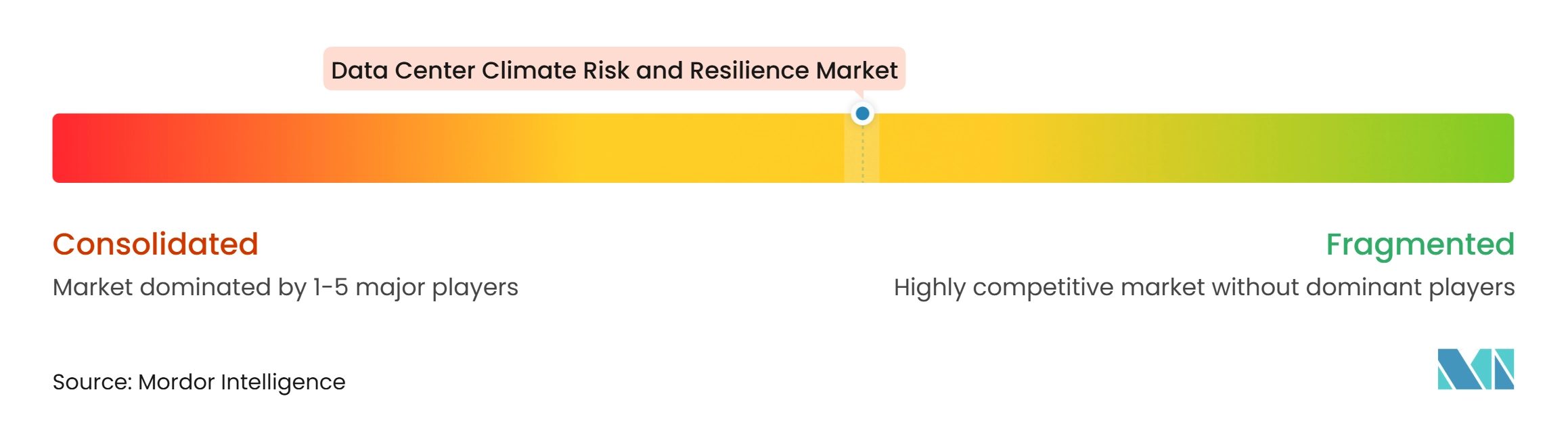
The data center climate risk and resilience market includes power and cooling infrastructure providers, building systems companies, water specialists, analytics firms, and specialized liquid-cooling suppliers. Competition is shaped by the ability to combine physical equipment with the assessment, monitoring, and engineering services that operators need. Established infrastructure providers have broad installed bases and relationships with large data center owners. Specialist providers can compete by addressing specific needs such as direct-to-chip cooling, water treatment, climate data, or controls. The market remains fragmented because no single participant covers every risk category and every stage of project delivery. Customers often use several providers when they combine site assessment, facility engineering, and equipment procurement.
Product development is a central competitive strategy as AI facilities demand higher cooling performance. Johnson Controls launched its Reference Design Guide Series for 1 GW AI data centers in February 2026, including a dry-cooler architecture designed for zero-water heat rejection. The company also expanded its liquid-cooling offering in September 2025 with a scalable coolant distribution unit platform. These moves show how suppliers are adapting established building-system capabilities to high-density computing environments. ABB also announced a research and development collaboration with NVIDIA in 2025 to develop power architectures for next-generation AI data centers.[4] Such initiatives place power delivery, cooling, and climate resilience within the same design discussion.
Water resilience and operational monitoring are becoming meaningful areas of differentiation. Amazon Web Services said it reduced cooling water use by 938 million liters in 2025 through measures including smart metering and direct chip-level liquid cooling. Microsoft reported continued work on zero-water evaporation designs and its water-positive goal for 2030. These programs raise customer expectations for evidence that cooling strategies can reduce water dependence. Providers that connect monitoring data with design changes can offer a clearer operational case than those supplying equipment alone. As EU reporting requirements become more detailed, vendors also need to support reliable facility data and documentation. The competitive position of each provider will depend on how well it can adapt offerings to local climate, water, and grid conditions.
Data Center Climate Risk and Resilience Industry Leaders
-
Schneider Electric SE
-
Vertiv Holdings Co.
-
Johnson Controls International plc
-
STULZ GmbH
-
Rittal GmbH & Co. KG
- *Disclaimer: Major Players sorted in no particular order
Data Center Climate Risk and Resilience Market Companies Covered in this Report
- Schneider Electric SE
- Vertiv Holdings Co.
- Johnson Controls International plc
- STULZ GmbH
- Rittal GmbH & Co. KG
- Eaton Corporation plc
- ABB Ltd
- Siemens AG
- Legrand SA
- Delta Electronics, Inc.
- Huawei Technologies Co., Ltd.
- Daikin Industries, Ltd.
- Mitsubishi Electric Corporation
- Trane Technologies plc
- Munters Group AB
- CoolIT Systems Inc.
- LiquidStack Inc.
- Submer Technologies S.L.
- Iceotope Technologies Limited
- Xylem Inc.
- Veolia Environnement S.A.
- Ecolab Inc.
Recent Industry Developments in Data Center Climate Risk and Resilience Market
- October 2026: Eaton announced the acquisition of Boyd Thermal from Goldman Sachs Asset Management for USD 9.5 billion, consolidating direct-to-chip and immersion cooling capability within its power management portfolio. Vertiv simultaneously announced the acquisition of PurgeRite for approximately USD 1 billion, and Daikin Applied acquired Chilldyne, a negative-pressure direct-to-chip cooling pioneer, marking a broad consolidation wave in advanced thermal management targeting AI-era infrastructure demands.
- September 2026: The European Commission published Commission Regulation C(2026)3472 on September 21, establishing a Union-wide sustainability rating scheme for data centers under the Energy Efficiency Directive. The regulation mandates facility-level public reporting of energy and water usage metrics, directly expanding the market for risk auditing and disclosure support services across EU member states.
- February 2026: Johnson Controls launched its Reference Design Guide Series for 1 GW AI data centers, introducing the industry’s first thermal architecture for gigawatt-scale AI factories featuring zero-water heat rejection via dry coolers. The design is co-aligned with NVIDIA’s DSX reference architecture and directly addresses water-stressed siting requirements for next-generation GPU facilities.
- January 2026: Accelsius closed a USD 65 million Series B funding round backed by Johnson Controls, intended to scale manufacturing and commercial deployment of its two-phase direct-to-chip liquid cooling systems for high-density AI and HPC data center applications.
Global Data Center Climate Risk and Resilience Market Report Scope
The Data Center Climate Risk and Resilience Market includes solutions and services that help data center operators assess, mitigate, and manage climate-related risks, including extreme weather events, rising temperatures, flooding, and power disruptions, to ensure operational continuity and infrastructure resilience.
The Data Center Climate Risk and Resilience Market Report is Segmented by Solution Type (Climate Risk Assessment and Analytics, Climate Scenario Modeling, Climate Risk Mapping and Geospatial Analysis, Climate Adaptation and Resilience Planning, Climate Risk Monitoring and Early Warning, and Climate Risk Advisory and Engineering Services), Climate Hazard (Extreme Heat and Heatwaves, Flooding and Sea-Level Rise, Hurricanes, Cyclones, and Severe Windstorms, Wildfires and Smoke Exposure, Drought and Water Scarcity, Extreme Cold, Ice, and Snow Events, and Compound and Multi-Hazard Events), Assessment Method (Historical Hazard Analysis, Forward-Looking Climate Scenario Analysis, Physical Risk and Vulnerability Assessment, Geographic and Geospatial Risk Mapping, Climate Stress Testing, and Financial and Asset-Level Climate Risk Quantification), Resilience Strategy (Site Selection and Climate-Informed Planning, Building and Structural Adaptation, Cooling and Thermal Resilience, Water Availability and Conservation Measures, Power Supply and Grid Resilience, Flood, Fire, and Severe Weather Protection, and Multi-Hazard Adaptation Planning), Service Type (Climate Risk Consulting, Climate Engineering and Design, Climate Adaptation Planning, Monitoring and Early Warning Services, and Risk Auditing and Disclosure Support), Data Center Size (Small, Medium, Large, and Hyperscale), Data Center Type (Colocation, Cloud Service Providers (CSPs), and Enterprise and Edge), and Geography (North America, South America, Europe, Asia-Pacific, Middle East, and Africa). The Market Forecasts are Provided in Terms of Value (USD).
Segmentation Overview
| Climate Risk Assessment and Analytics |
| Climate Scenario Modeling |
| Climate Risk Mapping and Geospatial Analysis |
| Climate Adaptation and Resilience Planning |
| Climate Risk Monitoring and Early Warning |
| Climate Risk Advisory and Engineering Services |
| Extreme Heat and Heatwaves |
| Flooding and Sea-Level Rise |
| Hurricanes, Cyclones, and Severe Windstorms |
| Wildfires and Smoke Exposure |
| Drought and Water Scarcity |
| Extreme Cold, Ice, and Snow Events |
| Compound and Multi-Hazard Events |
| Historical Hazard Analysis |
| Forward-Looking Climate Scenario Analysis |
| Physical Risk and Vulnerability Assessment |
| Geographic and Geospatial Risk Mapping |
| Climate Stress Testing |
| Financial and Asset-Level Climate Risk Quantification |
| Site Selection and Climate-Informed Planning |
| Building and Structural Adaptation |
| Cooling and Thermal Resilience |
| Water Availability and Conservation Measures |
| Power Supply and Grid Resilience |
| Flood, Fire, and Severe Weather Protection |
| Multi-Hazard Adaptation Planning |
| Climate Risk Consulting |
| Climate Engineering and Design |
| Climate Adaptation Planning |
| Monitoring and Early Warning Services |
| Risk Auditing and Disclosure Support |
| Small |
| Medium |
| Large |
| Hyperscale |
| Colocation |
| Cloud Service Providers (CSPs) |
| Enterprise and Edge |
| North America | United States |
| Canada | |
| Mexico | |
| South America | Brazil |
| Argentina | |
| Rest of South America | |
| Europe | Germany |
| United Kingdom | |
| France | |
| Italy | |
| Spain | |
| Russia | |
| Rest of Europe | |
| Asia-Pacific | China |
| India | |
| Japan | |
| South Korea | |
| Australia | |
| Rest of Asia-Pacific | |
| Middle East | Saudi Arabia |
| United Arab Emirates | |
| Turkey | |
| Rest of Middle East | |
| Africa | South Africa |
| Egypt | |
| Nigeria | |
| Rest of Africa |
| By Solution Type | Climate Risk Assessment and Analytics | |
| Climate Scenario Modeling | ||
| Climate Risk Mapping and Geospatial Analysis | ||
| Climate Adaptation and Resilience Planning | ||
| Climate Risk Monitoring and Early Warning | ||
| Climate Risk Advisory and Engineering Services | ||
| By Climate Hazard | Extreme Heat and Heatwaves | |
| Flooding and Sea-Level Rise | ||
| Hurricanes, Cyclones, and Severe Windstorms | ||
| Wildfires and Smoke Exposure | ||
| Drought and Water Scarcity | ||
| Extreme Cold, Ice, and Snow Events | ||
| Compound and Multi-Hazard Events | ||
| By Assessment Method | Historical Hazard Analysis | |
| Forward-Looking Climate Scenario Analysis | ||
| Physical Risk and Vulnerability Assessment | ||
| Geographic and Geospatial Risk Mapping | ||
| Climate Stress Testing | ||
| Financial and Asset-Level Climate Risk Quantification | ||
| By Resilience Strategy | Site Selection and Climate-Informed Planning | |
| Building and Structural Adaptation | ||
| Cooling and Thermal Resilience | ||
| Water Availability and Conservation Measures | ||
| Power Supply and Grid Resilience | ||
| Flood, Fire, and Severe Weather Protection | ||
| Multi-Hazard Adaptation Planning | ||
| By Service Type | Climate Risk Consulting | |
| Climate Engineering and Design | ||
| Climate Adaptation Planning | ||
| Monitoring and Early Warning Services | ||
| Risk Auditing and Disclosure Support | ||
| By Data Center Size | Small | |
| Medium | ||
| Large | ||
| Hyperscale | ||
| By Data Center Type | Colocation | |
| Cloud Service Providers (CSPs) | ||
| Enterprise and Edge | ||
| By Geography | North America | United States |
| Canada | ||
| Mexico | ||
| South America | Brazil | |
| Argentina | ||
| Rest of South America | ||
| Europe | Germany | |
| United Kingdom | ||
| France | ||
| Italy | ||
| Spain | ||
| Russia | ||
| Rest of Europe | ||
| Asia-Pacific | China | |
| India | ||
| Japan | ||
| South Korea | ||
| Australia | ||
| Rest of Asia-Pacific | ||
| Middle East | Saudi Arabia | |
| United Arab Emirates | ||
| Turkey | ||
| Rest of Middle East | ||
| Africa | South Africa | |
| Egypt | ||
| Nigeria | ||
| Rest of Africa | ||
Key Questions Answered in the Report
What is the data center climate risk and resilience market size?
The Data Center Climate Risk And Resilience Market size was valued at USD 2.48 billion in 2026 and is estimated to grow from USD 2.81 billion in 2027 to reach USD 5.16 billion by 2032, at a CAGR of 12.92% during the forecast period (2027-2032).
What is driving demand for data center climate resilience solutions?
AI computing growth, higher rack densities, water constraints, outage costs, and facility reporting requirements are raising demand for risk assessment, monitoring, and engineering.
Which solution type has the largest share?
Climate Risk Assessment and Analytics held the largest solution type share at 28.43% in 2026.
Which resilience strategy is growing the fastest?
Water Availability and Conservation Measures is projected to grow at a 13.68% CAGR through 2032.
Which data center type is the largest user of climate resilience services?
Colocation Data Centers held 41.92% share in 2026 because multi-tenant facilities need to manage shared climate and uptime risks.