
Data Center Perimeter Security Market Size and Share
Market Overview
| Study Period | 2021 - 2032 |
|---|---|
| Market Size (2027) | USD 2.68 Billion |
| Market Size (2032) | USD 4.48 Billion |
| Growth Rate (2027 - 2032) | 10.83 % |
| Fastest Growing Market | Asia-Pacific |
| Largest Market | North America |
| Market Concentration | Medium |
Major Players *Disclaimer: Major Players sorted in no particular order Image © Mordor Intelligence. Reuse requires attribution under CC BY 4.0. | |
Data Center Perimeter Security Market Analysis by Mordor Intelligence
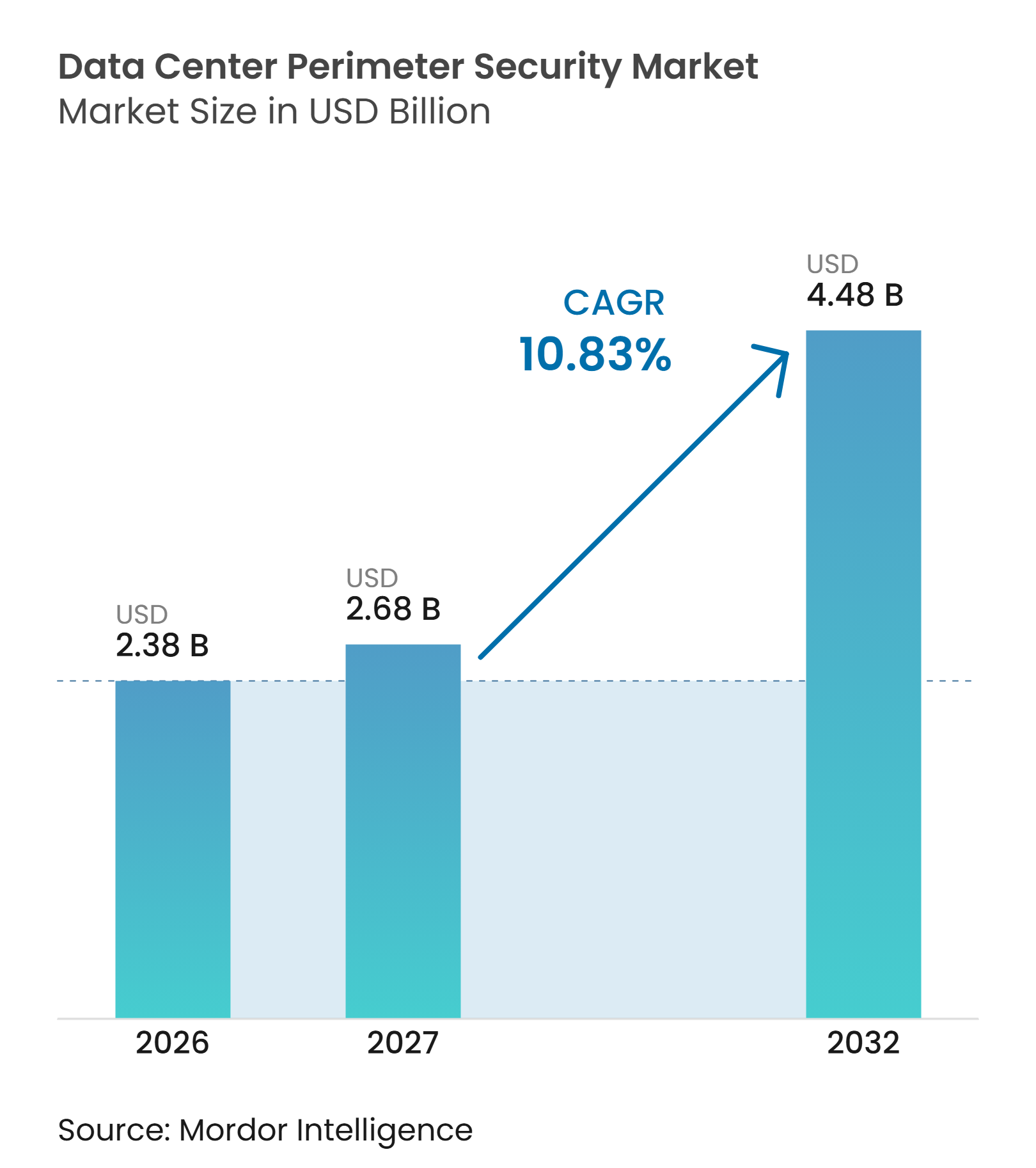
The Data Center Perimeter Security Market size was valued at USD 2.38 billion in 2026 and is estimated to grow from USD 2.68 billion in 2027 to reach USD 4.48 billion by 2032, at a CAGR of 10.83% during the forecast period (2027-2032).
New data center capacity is increasing the number of sites that need physical detection, access control, and verification at the boundary. AI campuses raise the value and density of computing equipment within each facility, which supports layered security designs. Colocation operators are also treating perimeter controls as part of customer audit expectations rather than a discretionary facility upgrade. Demand increasingly extends beyond equipment to integration, testing, maintenance, and documented change management. The Data Center Perimeter Security Market therefore benefits from both new campus construction and refresh programs at existing facilities.
Key Report Takeaways
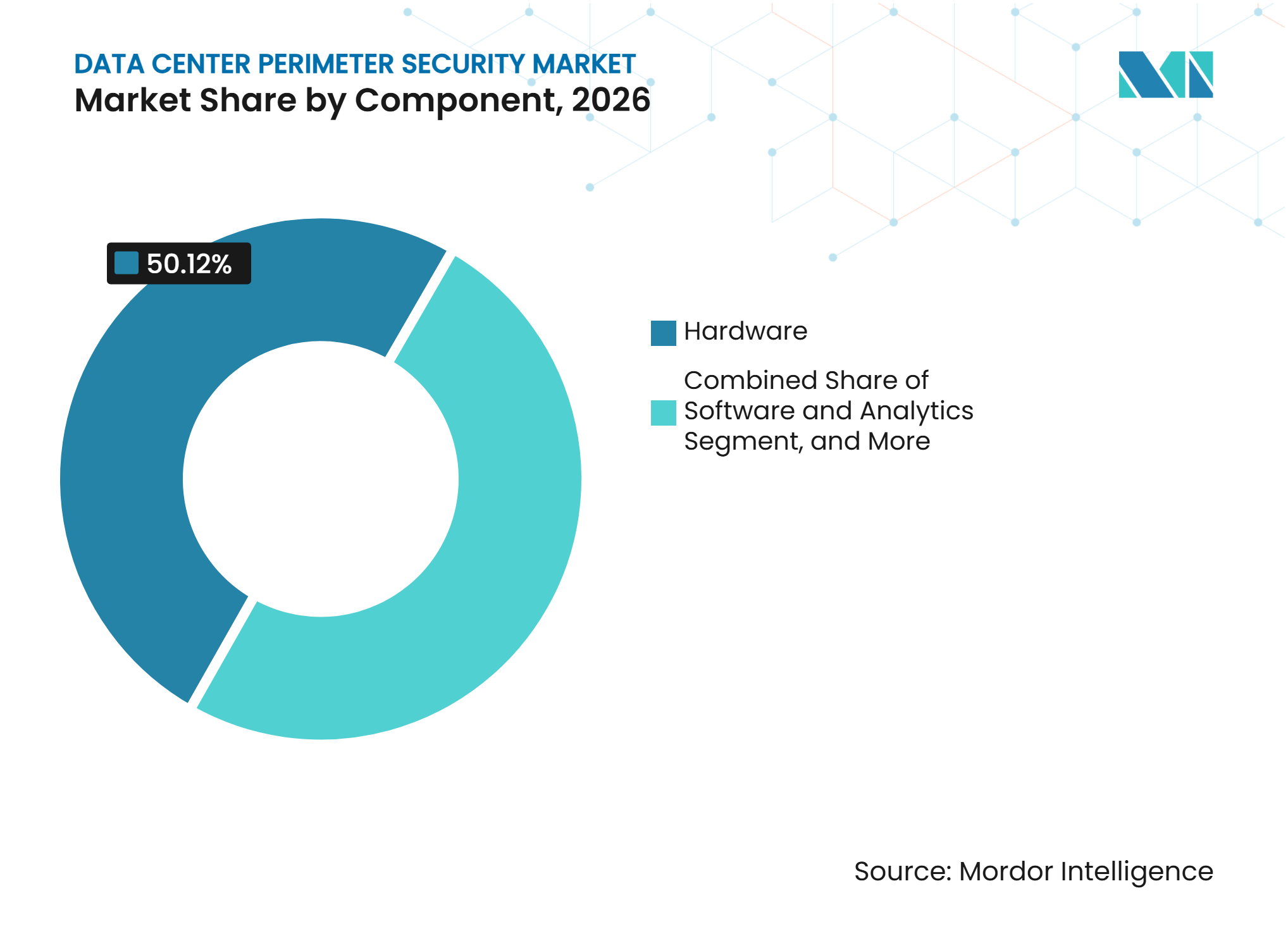
- By component, hardware held 50.12% of the Data Center Perimeter Security Market share in 2026, while software and analytics is projected to expand at an 11.29% CAGR through 2032.
- By solution type, intrusion detection systems held 25.44% of the Data Center Perimeter Security Market share in 2026, while integrated perimeter security platforms are projected to expand at an 11.82% CAGR through 2032.
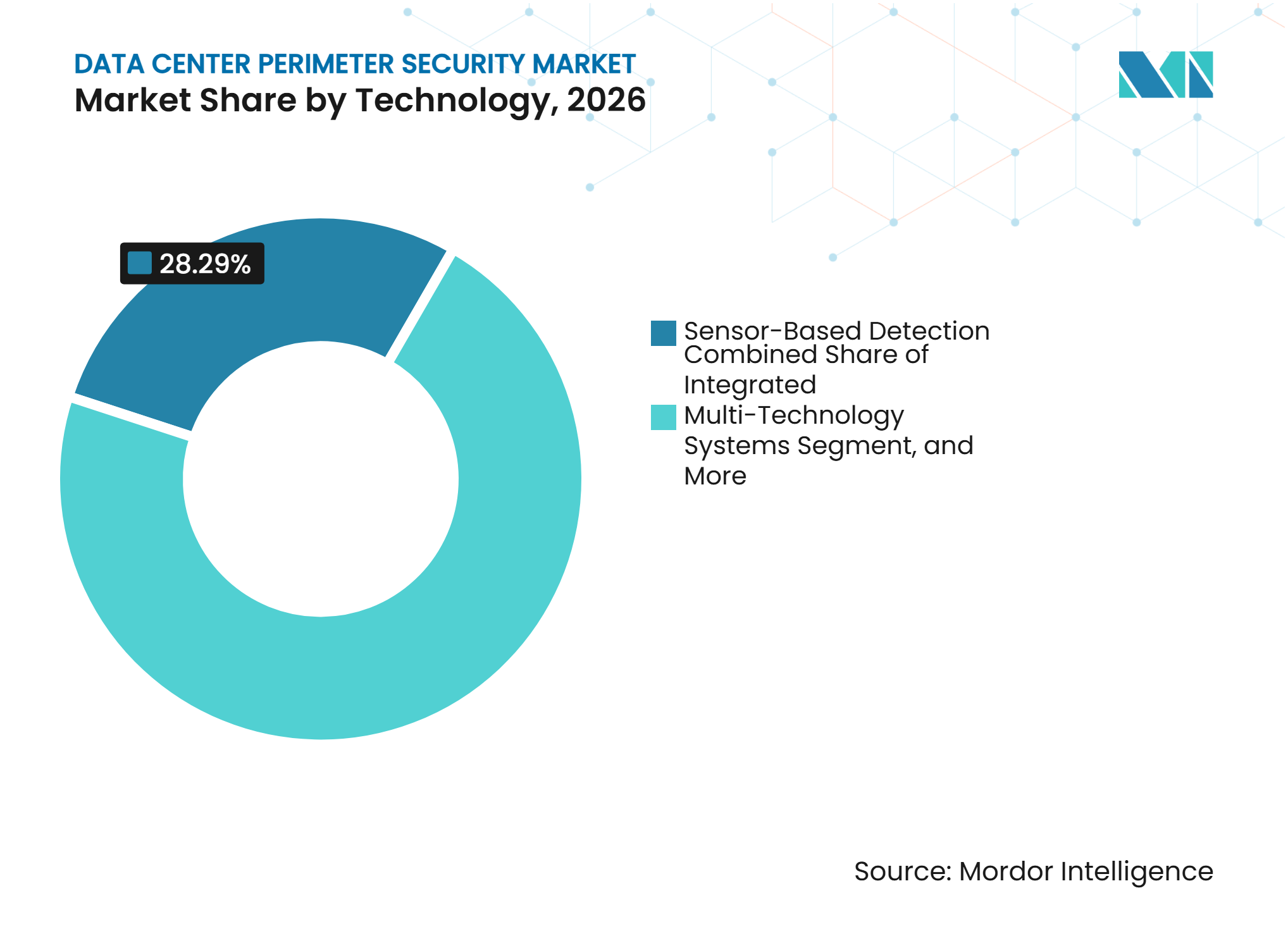
- By technology, sensor-based detection held 28.29% of the Data Center Perimeter Security Market share in 2026, while integrated multi-technology systems are projected to expand at an 11.69% CAGR through 2032.
- By deployment type, new data center construction held 70.18% of the Data Center Perimeter Security Market share in 2026, while security upgrades and retrofitting are projected to expand at an 11.76% CAGR through 2032.
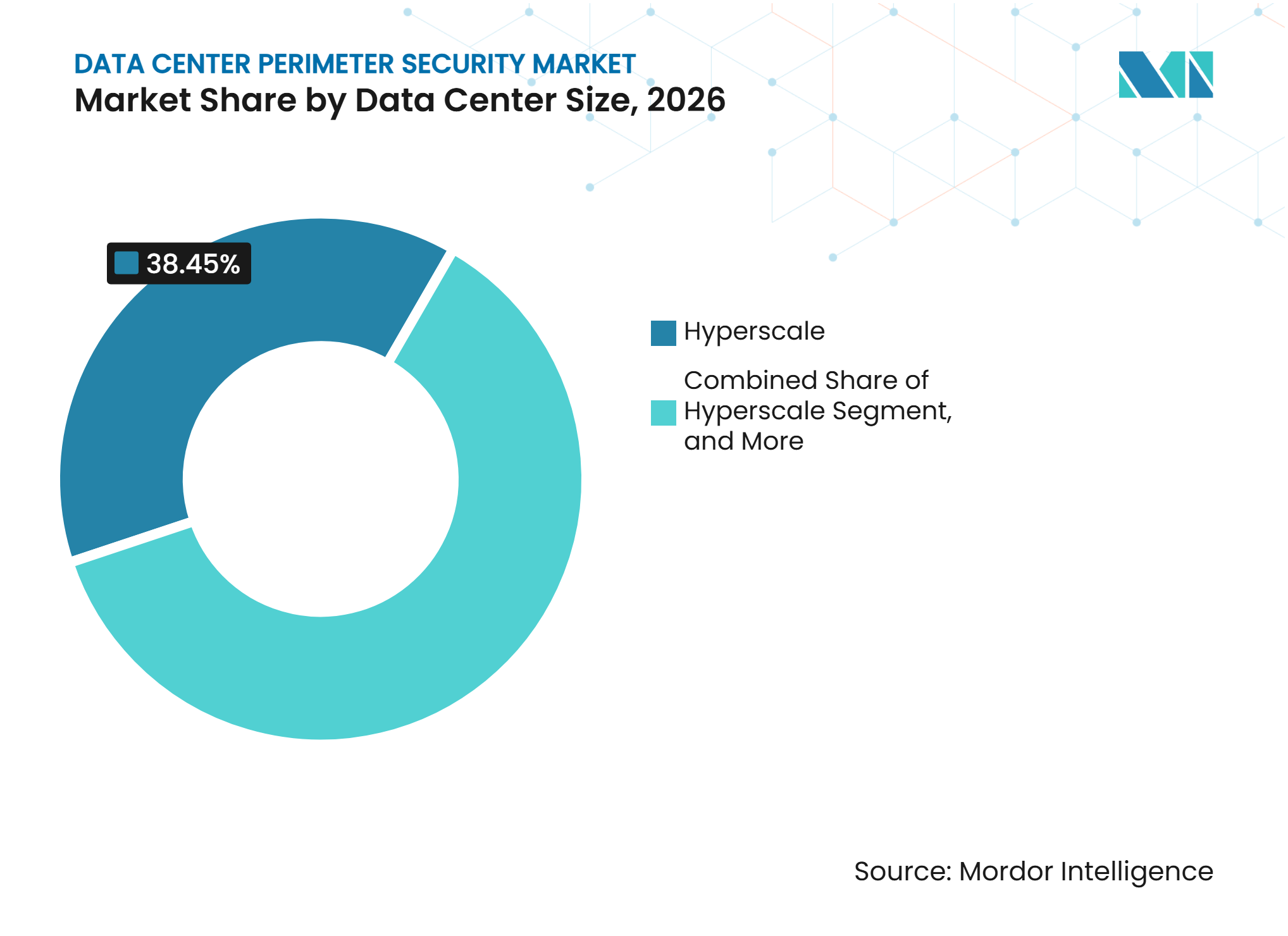
- By data center size, hyperscale held 38.45% of the Data Center Perimeter Security Market share in 2026 and is projected to expand at an 11.83% CAGR through 2032.
- By data center type, cloud service providers held 45.38% of the Data Center Perimeter Security Market share in 2026 and are projected to expand at an 11.86% CAGR through 2032.
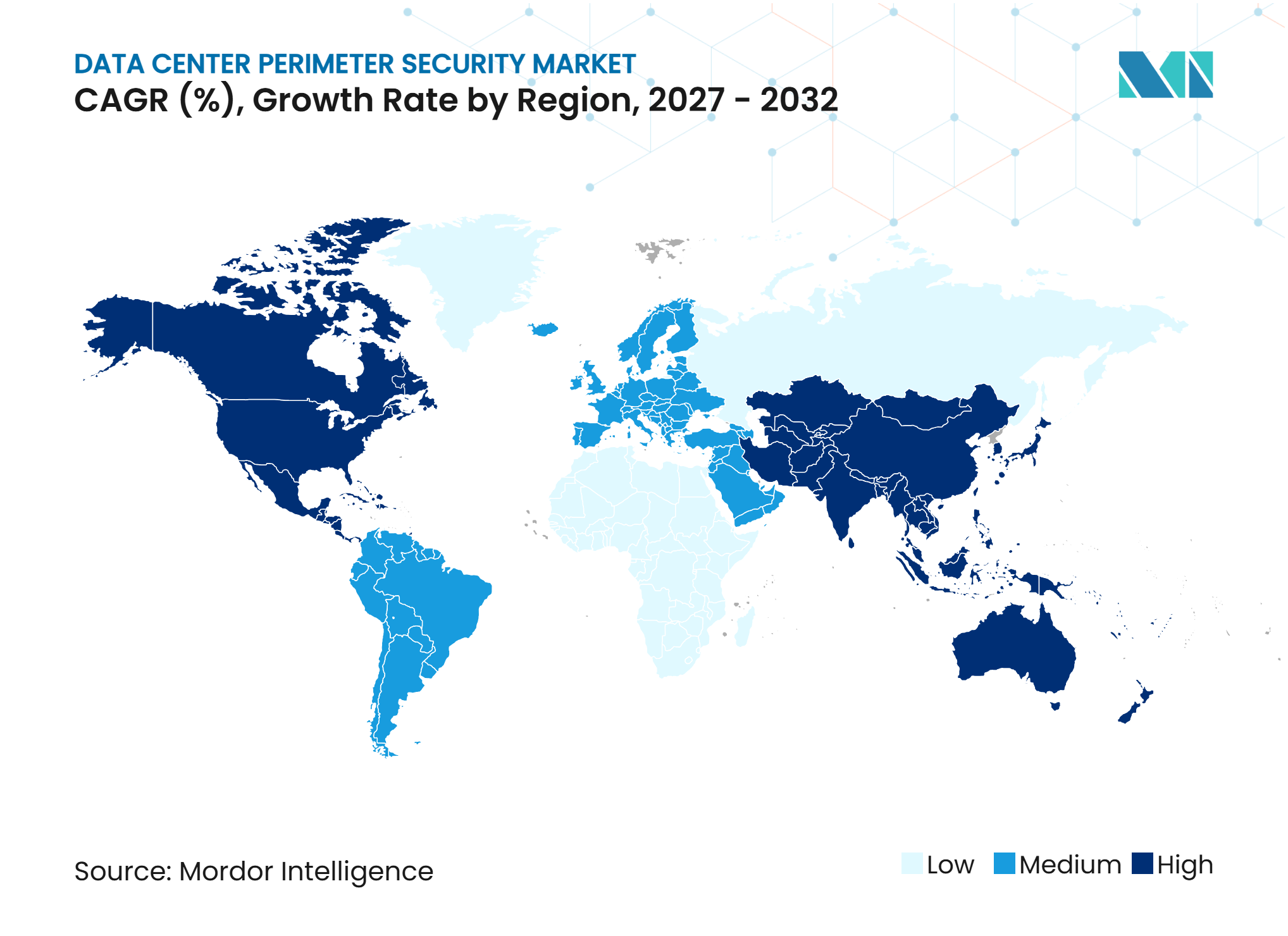
- By geography, North America held 42.86% of the Data Center Perimeter Security Market share in 2026, while Asia-Pacific is projected to expand at an 11.79% CAGR through 2032.
Note: Market numbers in this report are based on Mordor Intelligence's proprietary estimation framework, which combines nine months of actuals with Q4 projections for base year 2026.
Market Trends and Insights
Drivers Impact Analysis of Data Center Perimeter Security Market*
| Driver | (~) % Impact on CAGR Forecast | Geographic Relevance | Impact Timeline |
|---|---|---|---|
| Hyperscale and AI Campus Expansion | +3.5% | Global | Medium term (2-4 years) |
| Colocation Capacity Buildout and Customer Audit Requirements | +2.8% | North America and Europe | Medium term (2-4 years) |
| Convergence of Physical and Cybersecurity Controls | +1.9% | Global | Long term (≥ 4 years) |
| AI Video Analytics for Nuisance-Alarm Reduction | +1.2% | Global | Short term (≤ 2 years) |
| Construction-Phase Security for Live-Build Campuses | +0.8% | North America and Asia-Pacific | Short term (≤ 2 years) |
| Security Automation to Offset Guarding Constraints | +0.6% | North America and Europe | Long term (≥ 4 years) |
| Source: Mordor Intelligence | |||
Hyperscale and AI Campus Expansion
Hyperscale campuses require security programs that resemble those used for major critical infrastructure sites. Their large footprints and concentration of GPU hardware make perimeter intrusion a more material operational risk. Data Center Frontier reported a projection of 51.2 GW of global data center IT capacity additions outside China in 2027, compared with 25 GW in 2026. Senstar reported Q3 2026 revenue of USD 13.1 million, 37% higher than the prior year, while its LiDAR-based perimeter detection sales more than doubled. These programs favor multiple detection layers because a single sensor type cannot manage every condition around a large site. The Data Center Perimeter Security Market also gains recurring work when those systems require calibration, maintenance, and integration support over the facility life cycle.
Colocation Capacity Buildout and Customer Audit Requirements
Colocation providers increasingly include physical perimeter controls in customer assurance requirements. Enterprise tenants may assess these controls through SOC 2 Type II, ISO/IEC 27001, PCI DSS, and HIPAA-related processes. ConstructConnect tracked 76 U.S. data center projects that were expected to begin construction during a 24-month period, with a combined value above USD 88 billion. The Security Industry Association stated that physical security should be addressed during facility planning rather than after construction.[1] This changes demand from stand-alone hardware purchases toward documented configurations, firmware records, audit trails, and integration services. The Data Center Perimeter Security Market benefits where facility operators need evidence that controls are active and properly managed.
Convergence of Physical and Cybersecurity Controls
Cameras, access controllers, and perimeter sensors are connected devices that now sit within wider cybersecurity governance programs. A compromised device can disclose guard patterns, camera views, and access activity without creating an obvious physical breach. Fortinet reported that 50% of organizations experienced at least 1 cybersecurity incident in its 2025 operational technology survey.[2] The EU Critical Entities Resilience Directive places continuity expectations on essential services, including the systems used to protect physical operations. Secure boot, TLS 1.3 encryption, and IEC/ISA 62443 alignment are therefore becoming relevant purchasing factors for edge devices. This shift allows the Data Center Perimeter Security Market to serve both security operations and IT risk teams through more resilient system designs.
AI Video Analytics for Nuisance-Alarm Reduction
Conventional motion systems can create a high volume of alerts from wildlife, weather, vegetation, and construction activity. Unnecessary alerts weaken operator attention and increase the cost of live monitoring. Quanergy documented a data center deployment that reduced alarm volume by more than 95% through 3D LiDAR classification.[3] Hikvision stated that intelligent perimeter protection can distinguish humans and vehicles from other movement, reducing false alarms by more than 90%. Analytics can also flag loitering, approach patterns, and reconnaissance behavior before a direct intrusion occurs. These capabilities improve the operating case for the Data Center Perimeter Security Market when a smaller team must monitor a larger number of cameras.
Restraints Impact Analysis of Data Center Perimeter Security Market*
| Restraint | (~) % Impact on CAGR Forecast | Geographic Relevance | Impact Timeline |
|---|---|---|---|
| Multivendor Integration and Version-Control Complexity | -1.8% | Global | Long term (≥ 4 years) |
| High Perimeter-Length Retrofit and Maintenance Costs | -1.4% | Global | Medium term (2-4 years) |
| Privacy and Cybersecurity Exposure of Connected Sensors | -0.9% | Europe and North America | Medium term (2-4 years) |
| Weather, Wildlife, and Construction-Activity False Alarms | -0.5% | Global | Short term (≤ 2 years) |
| Source: Mordor Intelligence | |||
Multivendor Integration and Version-Control Complexity
A perimeter program may combine video management, access control, intrusion detection, radar, fiber-optic sensing, barriers, and integration software. These products can follow different firmware cycles and interoperability practices. A critical patch in 1 product can require operators to revalidate other connected products before deployment. The Security Industry Association identifies integration fragmentation as a key obstacle to lifecycle security management in data centers. ISO/IEC 27001 and SOC 2 processes also require disciplined change control, raising the administrative burden of a fragmented architecture. The Data Center Perimeter Security Market faces a slower sales cycle where customers must resolve compatibility and governance concerns before approval.
High Perimeter-Length Retrofit and Maintenance Costs
Large campuses can require several kilometers of protected boundary, which increases cabling, power, communications, calibration, and maintenance needs. Retrofitting an operating site adds further complexity because security improvements cannot interrupt tenant operations. PCI DSS requires at least 3 months of footage retention for sensitive areas, which can add storage and processing requirements to a retrofit. Senstar stated that passive fiber-optic systems can reduce outdoor power and communications needs in certain deployments. Even so, the cost difference between retrofit and greenfield installation can delay projects until a lease event, audit, or threat review forces action. This constraint remains relevant across the Data Center Perimeter Security Market, particularly for smaller enterprise facilities.
*Our forecasts treat driver/restraint impacts as directional, not additive. The impact forecasts reflect baseline growth, mix effects, and variable interactions.
Data Center Perimeter Security Market Segment Analysis
By Component:
Hardware Leads While Software and Analytics Add Operational ValueHardware held 50.12% of the Data Center Perimeter Security Market share in 2026 because every protected site needs physical equipment at the boundary. Fencing, cameras, radar units, vehicle barriers, and fiber-optic cabling establish the base layer for an effective program. These assets support detection before software can classify events or direct a response. Hardware demand remains closely linked to greenfield construction because equipment is specified during site design. The segment also includes the systems needed to maintain controlled access during construction and operation.
Software and analytics is projected to expand at an 11.29% CAGR through 2032. Operators use this layer to combine alerts, classify activity, and direct staff to the highest-priority events. The Security Industry Association identifies lifecycle management and integration services as underfunded areas of many data center security programs. Axis Communications described edge processing that lets thermal, radar, and optical sensors provide pre-classified alerts instead of raw video alone. Maintenance contracts for model updates, recalibration, and system retraining can make this part of the Data Center Perimeter Security Market more recurring than project-led hardware revenue.



By Solution Type:
Intrusion Detection Leads While Platforms Unify Security OperationsIntrusion detection systems held 25.44% of the Data Center Perimeter Security Market share in 2026. They provide the first line of detection within layered physical security designs. Security fencing and physical barriers remain essential because they delay and deter access before an intruder reaches a critical area. Vehicle access barriers protect entry points where hostile vehicle risk must be managed. Perimeter radar and sensor systems add coverage for wide or complex sites.
Integrated perimeter security platforms are projected to expand at an 11.82% CAGR through 2032. Operators are consolidating point products into unified environments that can manage alarms, video, access events, and incident response. Senstar's FlexZone-60 and FiberPatrol FP1150 received UK NPSA certification in July 2025 under the Barrier Mounted PIDS Standard. Magos reported that its radar deployment at Telehouse Staten Island supported 360-degree monitoring across the site. Buyers increasingly favor vendors that can supply or coordinate a complete solution stack.
By Technology:
Sensor-Based Detection Is Established While Multi-Technology Systems AdvanceSensor-based detection held 28.29% of the Data Center Perimeter Security Market share in 2026. The technology is mature and can support varied perimeter types and environmental conditions. Fiber-optic detection is valuable near high-voltage infrastructure because it resists electromagnetic interference. Radar-based detection provides wide-area coverage in difficult lighting and weather conditions. Video-based detection then supports verification and behavioral assessment after an alert occurs.
Integrated multi-technology systems are projected to expand at an 11.69% CAGR through 2032. A full campus perimeter needs separate capabilities for detecting, verifying, and classifying activity. Data Center Dynamics noted that AI workloads have increased the importance of security and resilience in data center design. Teledyne FLIR launched its PT-Series AI SR in June 2025 with 4K visible and thermal imaging, AI target tracking, and active threat response. Senstar launched FiberPatrol FP1500 in September 2026 with IEC/ISA 62443 and EU Cyber Resilience Act alignment.

By Deployment Type:
New Construction Provides Volume While Retrofits Need More ServicesNew data center construction held 70.18% of the Data Center Perimeter Security Market share in 2026. Every greenfield project needs protection from the start of contractor access and equipment staging. BloombergNEF reported 23.1 GW of data center capacity under construction across 831 sites in 2026. Perimeter systems can be designed alongside the wider site layout, utilities, and access roads. This makes new construction the clearest route for installing integrated systems without operational disruption.
Security upgrades and retrofitting are projected to expand at an 11.76% CAGR through 2032. Existing enterprise facilities often predate current AI-era expectations for layered detection, analytics, and documented security controls. Retrofit work is more services-intensive because systems must be added to a live environment without disrupting tenants. Large campus projects can take more than 36 months to build, so construction-phase protection is also required well before operations begin. This creates a longer demand window for the Data Center Perimeter Security Market than a system installed only at commissioning.
By Data Center Size:
Hyperscale Sites Set the Security SpecificationHyperscale held 38.45% of the Data Center Perimeter Security Market share in 2026 and is projected to expand at an 11.83% CAGR through 2032. These sites combine very large land areas with high-value computing infrastructure. Data Center Frontier reported a projected 51.2 GW of 2027 capacity additions outside China, supporting a sustained pipeline for major campuses. Their specifications often include multi-layer detection, vehicle barriers, AI video analytics, and counter-drone capabilities from the design stage. These systems become a reference point for other operators assessing their own risk controls.
Large data centers share many of the same technical needs at a smaller scale. Medium and small sites also face ISO/IEC 27001 and SOC 2 requirements, although their historic security investment has often been lower. This creates an upgrade opportunity for system integrators serving the broader data center perimeter security industry. Remote edge facilities have a particular need for automated detection because on-site guarding may be limited. Solutions that reduce false alarms can make continuous monitoring more feasible at those locations.
By Data Center Type:
Cloud Service Providers Drive Volume and StandardsCloud service providers held 45.38% of the Data Center Perimeter Security Market share in 2026 and are projected to expand at an 11.86% CAGR through 2032. Their development programs create substantial demand for site-wide detection, barriers, cameras, and secure entry systems. Data Center Frontier reported that Meta's Hyperion campus in Louisiana was planned to exceed USD 50 billion in investment and span nearly 10 million square feet. Cloud service providers often define the performance standards that other facility types later adopt. Their requirements can make counter-drone detection, perimeter radar, and AI analytics more common in colocation designs.
Colocation providers follow as enterprise customer audit needs shift security responsibility to the facility operator. Enterprise and edge sites represent an important upgrade base because remote facilities need detection that can operate with less on-site staff. Automated alerts can be more economical than continuous guarding where locations are distributed. These customers also need controls that can satisfy the same compliance reviews as larger sites. The Data Center Perimeter Security Market therefore addresses both high-volume centralized campuses and distributed edge deployments.
Geography Analysis
North America: Large Campus Activity and Compliance Requirements Support Demand
North America held 42.86% of the Data Center Perimeter Security Market share in 2026. The United States combines large hyperscale, colocation, and enterprise capacity with a strong development pipeline, including 76 planned project starts valued above USD 88 billion. The Security Industry Association formed a Data Center Advisory Board in 2025 to address physical, cyber, and operational security practices. SOC 2 Type II and ISO/IEC 27001 requirements support documented control management. Long construction programs can place perimeter systems in service years before commercial operation.
Asia-Pacific: Greenfield Construction Supports Integrated Designs
Asia-Pacific is projected to expand at an 11.79% CAGR through 2032. India, Singapore, Malaysia, Australia, and Japan are supporting hyperscale and colocation construction, while Malaysia's capacity could rise from 1.26 GW in 2025 to 2.53 GW by 2030. Greenfield sites can embed sensors, barriers, and analytics without the restrictions of a live retrofit. India's SEBI business continuity requirements and Personal Data Protection framework influence physical security practices in regulated settings.
Europe, the Middle East and Africa, and South America: Regulation and New Capacity Shape Procurement
Europe concentrates activity in the United Kingdom, Germany, and the Netherlands. The EU Critical Entities Resilience Directive supports operational continuity expectations, while NPSA certification influences United Kingdom procurement. Reported 2026 attacks on cloud facilities in the UAE and Bahrain prompted reviews of hardening, counter-drone detection, and vehicle barriers. Saudi Arabia's Personal Data Protection Law and the UAE National Cybersecurity Strategy add access-governance requirements. South America is earlier in development, though ByteDance's 200 MW campus in Ceará is expected to begin operating in 2027.
Competitive Landscape
Market Concentration
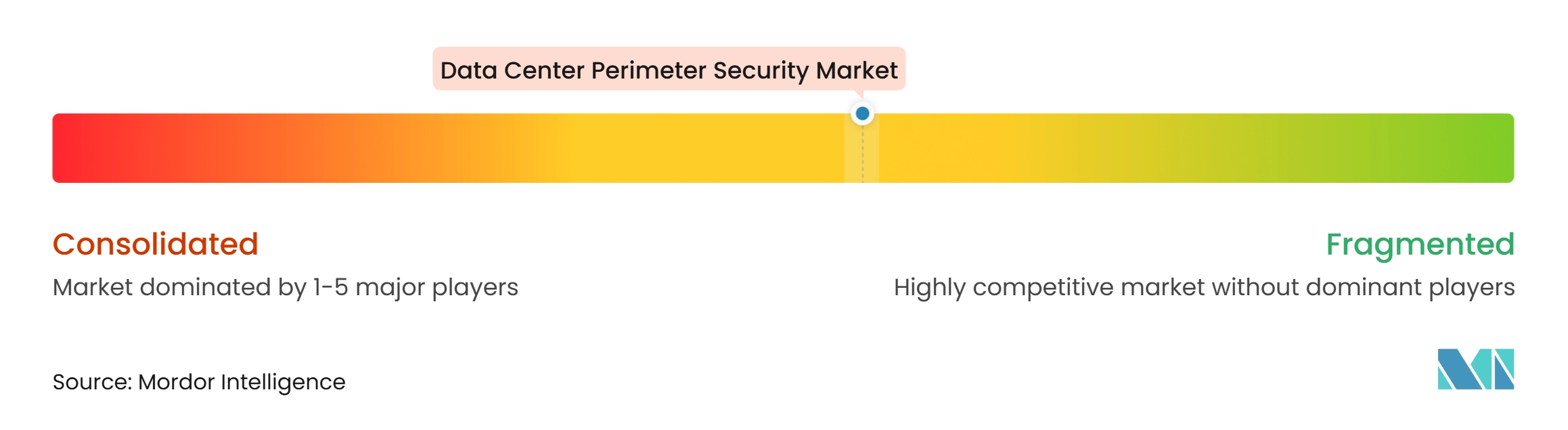
The Data Center Perimeter Security Market is moderately fragmented across diversified security groups, specialist detection providers, and platform providers. Honeywell, Johnson Controls, and Siemens compete through broad portfolios and integration capability. Senstar, Southwest Microwave, Fiber SenSys, Gallagher, and PureTech Systems compete through detection performance and certification credentials. Genetec and Milestone Systems compete through unified management environments. This structure gives customers a choice between a single-vendor approach and specialist technologies.
Johnson Controls launched C-CURE IQ 3.2 in March 2026 to combine intrusion detection, video surveillance, access control, and incident management for mission-critical environments. Senstar introduced FiberPatrol FP1500 in September 2026 with cyber-resilience features aligned with IEC/ISA 62443 and the EU Cyber Resilience Act. These moves join physical detection and cybersecurity more closely. Senstar also achieved ISO/IEC 27001 certification in October 2025.
AMAROK acquired a 45% stake in Evolon Technology in April 2026, combining electric fencing with AI-powered video monitoring in a managed platform. Securitas formalized a long-term partnership with Rohde and Schwarz in September 2025 for AI-based millimeter-wave personnel screening. These examples favor service bundles that cover design, deployment, monitoring, and ongoing support. The Data Center Perimeter Security Market rewards vendors that support a facility from construction through operation. Specialists remain relevant because large sites need multiple sensing methods.
Data Center Perimeter Security Industry Leaders
-
Honeywell International Inc.
-
Johnson Controls International plc
-
Axis Communications AB
-
Bosch Sicherheitssysteme GmbH
-
Securitas Technology
- *Disclaimer: Major Players sorted in no particular order
Data Center Perimeter Security Market Companies Covered in this Report
- Axis Communications AB
- Convergint Technologies LLC
- Securitas Technology
- Bosch Sicherheitssysteme GmbH
- Johnson Controls International plc
- Honeywell International Inc.
- Schneider Electric SE
- Siemens AG
- ABB Ltd.
- AMAG Technology, Inc.
- Brivo Systems LLC
- Suprema Inc.
- ASSA ABLOY AB
- Milestone Systems A/S
- Cisco Systems, Inc.
- Genetec Inc.
- Senstar Corporation
- Motorola Solutions, Inc.
- Gallagher Security
- Teledyne FLIR LLC
- Southwest Microwave, Inc.
- Fiber SenSys, Inc.
- Magal Security Systems Ltd.
- PureTech Systems, Inc.
Recent Industry Developments in Data Center Perimeter Security Market
- September 2026: Senstar Corporation launched the FiberPatrol FP1500 precision-locating fiber-optic perimeter sensor, capable of protecting up to 5 km of perimeter with ±3 m intrusion localization accuracy, full operability after a cable cut, and compliance with IEC/ISA 62443 and EU Cyber Resilience Act Regulation 2024/2847.
- September 2026: Senstar Corporation reported Q3 2026 revenue of USD 13.1 million, a record for the company and a 37% increase year over year, with LiDAR-based perimeter detection sales more than doubling in the same period.
- April 2026: AMAROK completed the acquisition of a 45% ownership stake in Evolon Technology Inc., merging AMAROK's electric fencing systems with Evolon's AI-powered virtual guarding into a single layered perimeter defense platform. The combined offering integrates electric fencing, AI-driven camera detection, and gate access control into 1 monitored service targeting critical infrastructure including data centers.
- March 2026: Johnson Controls launched C-CURE IQ 3.2 at ISC West 2026, integrating intrusion detection, video surveillance, access control, and incident management onto a unified platform for mission-critical environments including data centers, targeting reduction of manual investigation steps and faster incident response workflows.
Global Data Center Perimeter Security Market Report Scope
The Data Center Perimeter Security Market refers to the industry focused on solutions and services designed to protect the physical boundaries of data center facilities from unauthorized access, intrusion, vandalism, theft, and security threats.
The Data Center Perimeter Security Market Report is Segmented by Component (Hardware, Software and Analytics, Installation, Integration, and Maintenance Services), Solution Type (Intrusion Detection Systems, Security Fencing and Physical Barriers, Vehicle Access Barriers, Perimeter Radar and Sensor Systems, Integrated Perimeter Security Platforms), Technology (Sensor-Based Detection, Video-Based Detection, Fiber-Optic Detection, Radar-Based Detection, Integrated Multi-Technology Systems), Deployment Type (New Data Center Construction, Security Upgrades and Retrofitting), Data Center Size (Small, Medium, Large, Hyperscale), Data Center Type (Colocation, Cloud Service Providers, Enterprise and Edge), and Geography (North America [United States, Canada, Mexico], South America [Brazil, Argentina, Rest of South America], Europe [United Kingdom, Germany, France, Spain, Rest of Europe], Asia-Pacific [China, India, Japan, Australia, Singapore, Rest of Asia-Pacific], Middle East and Africa [Saudi Arabia, United Arab Emirates, South Africa, Rest of Middle East and Africa]). The Market Forecasts are Provided in Terms of Value (USD).
Segmentation Overview
| Hardware |
| Software and Analytics |
| Installation, Integration, and Maintenance Services |
| Intrusion Detection Systems |
| Security Fencing and Physical Barriers |
| Vehicle Access Barriers |
| Perimeter Radar and Sensor Systems |
| Integrated Perimeter Security Platforms |
| Sensor-Based Detection |
| Video-Based Detection |
| Fiber-Optic Detection |
| Radar-Based Detection |
| Integrated Multi-Technology Systems |
| New Data Center Construction |
| Security Upgrades and Retrofitting |
| Small |
| Medium |
| Large |
| Hyperscale |
| Colocation |
| Cloud Service Providers (CSPs) |
| Enterprise and Edge |
| North America | United States |
| Canada | |
| Mexico | |
| South America | Brazil |
| Argentina | |
| Rest of South America | |
| Europe | United Kingdom |
| Germany | |
| France | |
| Spain | |
| Rest of Europe | |
| Asia-Pacific | China |
| India | |
| Japan | |
| Australia | |
| Singapore | |
| Rest of Asia-Pacific | |
| Middle East and Africa | Saudi Arabia |
| United Arab Emirates | |
| South Africa | |
| Rest of Middle East and Africa |
| By Component | Hardware | |
| Software and Analytics | ||
| Installation, Integration, and Maintenance Services | ||
| By Solution Type | Intrusion Detection Systems | |
| Security Fencing and Physical Barriers | ||
| Vehicle Access Barriers | ||
| Perimeter Radar and Sensor Systems | ||
| Integrated Perimeter Security Platforms | ||
| By Technology | Sensor-Based Detection | |
| Video-Based Detection | ||
| Fiber-Optic Detection | ||
| Radar-Based Detection | ||
| Integrated Multi-Technology Systems | ||
| By Deployment Type | New Data Center Construction | |
| Security Upgrades and Retrofitting | ||
| By Data Center Size | Small | |
| Medium | ||
| Large | ||
| Hyperscale | ||
| By Data Center Type | Colocation | |
| Cloud Service Providers (CSPs) | ||
| Enterprise and Edge | ||
| By Geography | North America | United States |
| Canada | ||
| Mexico | ||
| South America | Brazil | |
| Argentina | ||
| Rest of South America | ||
| Europe | United Kingdom | |
| Germany | ||
| France | ||
| Spain | ||
| Rest of Europe | ||
| Asia-Pacific | China | |
| India | ||
| Japan | ||
| Australia | ||
| Singapore | ||
| Rest of Asia-Pacific | ||
| Middle East and Africa | Saudi Arabia | |
| United Arab Emirates | ||
| South Africa | ||
| Rest of Middle East and Africa | ||
Key Questions Answered in the Report
What is the Data Center Perimeter Security Market size?
The Data Center Perimeter Security Market was valued at USD 2.38 billion in 2026 and is estimated to reach USD 4.48 billion by 2032 at a 10.83% CAGR.
What is driving demand for data center perimeter protection?
Hyperscale construction, AI computing campuses, colocation audit requirements, and integrated physical and cybersecurity controls support demand.
Which component has the largest share of data center perimeter security spending?
Hardware held 50.12% share in 2026 because physical barriers, sensors, cameras, and cabling remain essential at every protected site.
Which data center customers are expanding spending the fastest?
Cloud service providers held 45.38% share in 2026 and are projected to expand at an 11.86% CAGR through 2032.
Which region is expanding fastest for data center perimeter protection?
Asia-Pacific is projected to expand at an 11.79% CAGR through 2032, supported by greenfield capacity in India, Singapore, Malaysia, Australia, and Japan.
Why are integrated multi-technology systems gaining adoption?
They combine detection, verification, and classification across large campuses where no single sensing technology provides complete coverage.