
Data Center Direct-to-Chip Cooling Fluids Market Size and Share
Market Overview
| Study Period | 2021 - 2031 |
|---|---|
| Market Size (2026) | USD 190.72 Million |
| Market Size (2031) | USD 546.83 Million |
| Growth Rate (2026 - 2031) | 23.45 % |
| Fastest Growing Market | Asia-Pacific |
| Largest Market | North America |
| Market Concentration | Medium |
Major Players *Disclaimer: Major Players sorted in no particular order Image © Mordor Intelligence. Reuse requires attribution under CC BY 4.0. | |
Data Center Direct-to-Chip Cooling Fluids Market Analysis by Mordor Intelligence
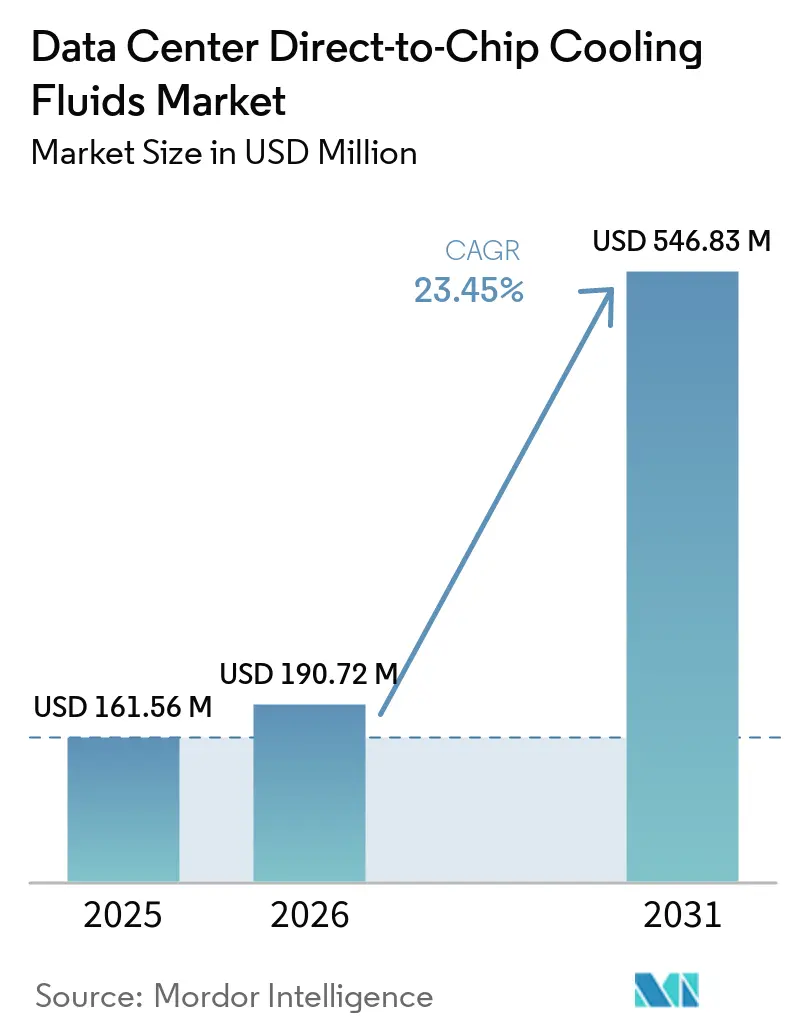
The data center direct-to-chip cooling fluids market size is estimated at USD 161.56 million in 2025 and is estimated to grow from USD 190.72 million in 2026 to USD 546.83 million by 2031, at a CAGR of 23.45% during the forecast period (2026-2031). Rising rack density is shifting cooling decisions from facility-level air management to liquid loops that remove heat at the chip level. AI server platforms are driving this transition, as their heat loads exceed the operating range of conventional air-cooling systems. Suppliers that meet Open Compute Project (OCP) specifications and complete materials testing can enter hyperscale procurement programs earlier. Low-global-warming-potential formulations can help suppliers address regulatory changes while supporting higher-density architectures. However, retrofit costs, lengthy qualification cycles, and uncertainty around fluorinated fluids can slow adoption at existing facilities.
Key Report Takeaways
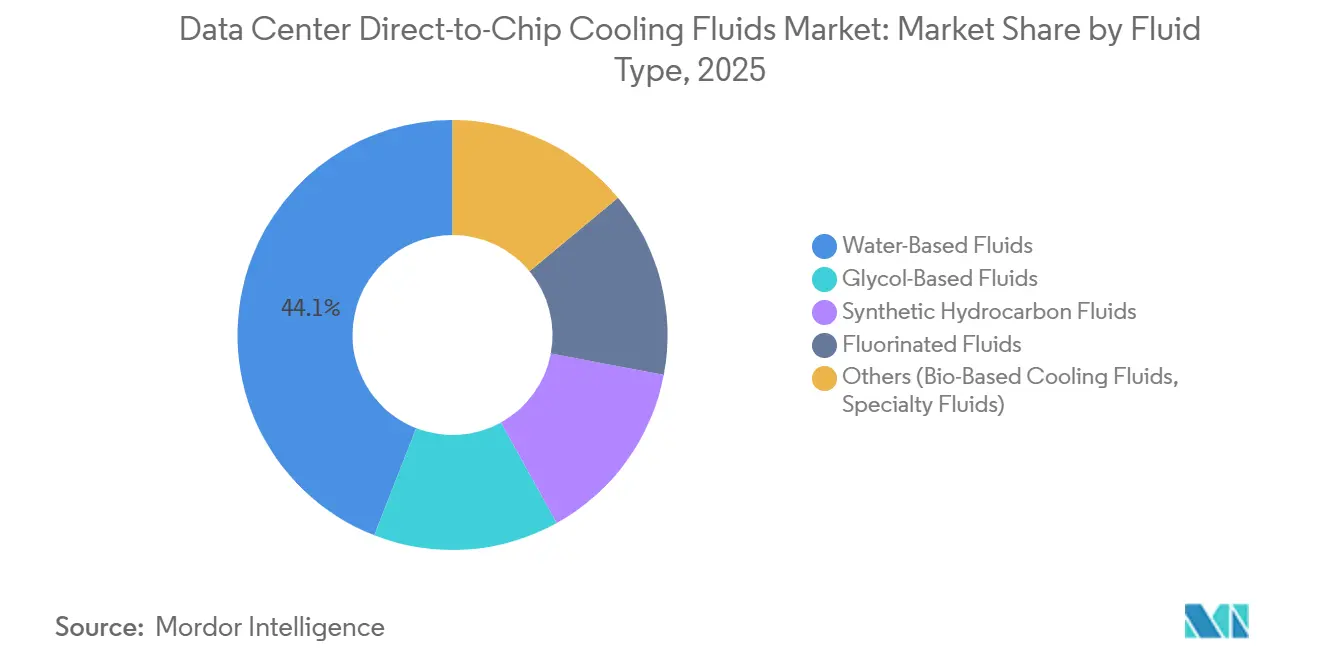
- By fluid type, water-based coolants held 44.08% of the data center direct-to-chip cooling fluids market share in 2025, while fluorinated fluids are forecast to grow at a 24.29% CAGR through 2031.
- By cooling technology, single-phase direct-to-chip cooling held 62.16% of the data center direct-to-chip cooling fluids market share in 2025, while two-phase direct-to-chip cooling is forecast to grow at a 28.08% CAGR through 2031.
- By component cooled, CPU cooling held 43.33% revenue share in 2025, while GPU and AI accelerator cooling are forecast to grow at a 27.26% CAGR through 2031.
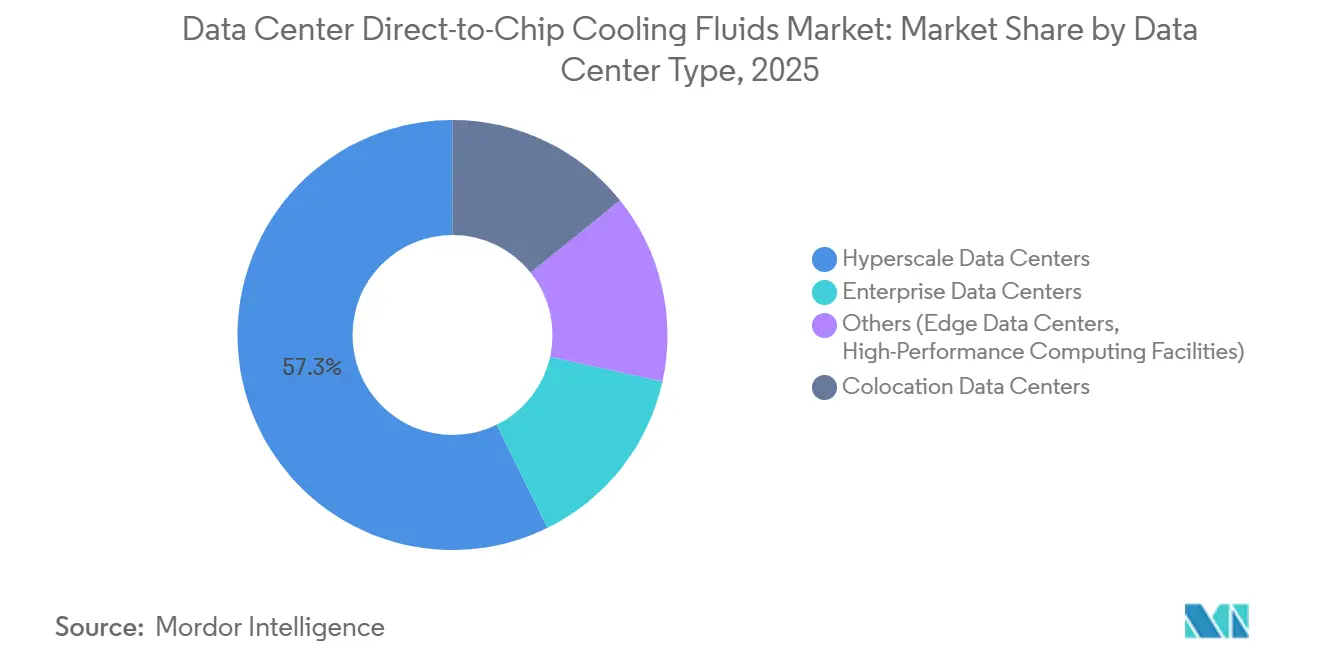
- By data center type, hyperscale data centers held 57.29% revenue share in 2025 and are forecast to grow at a 26.48% CAGR through 2031.
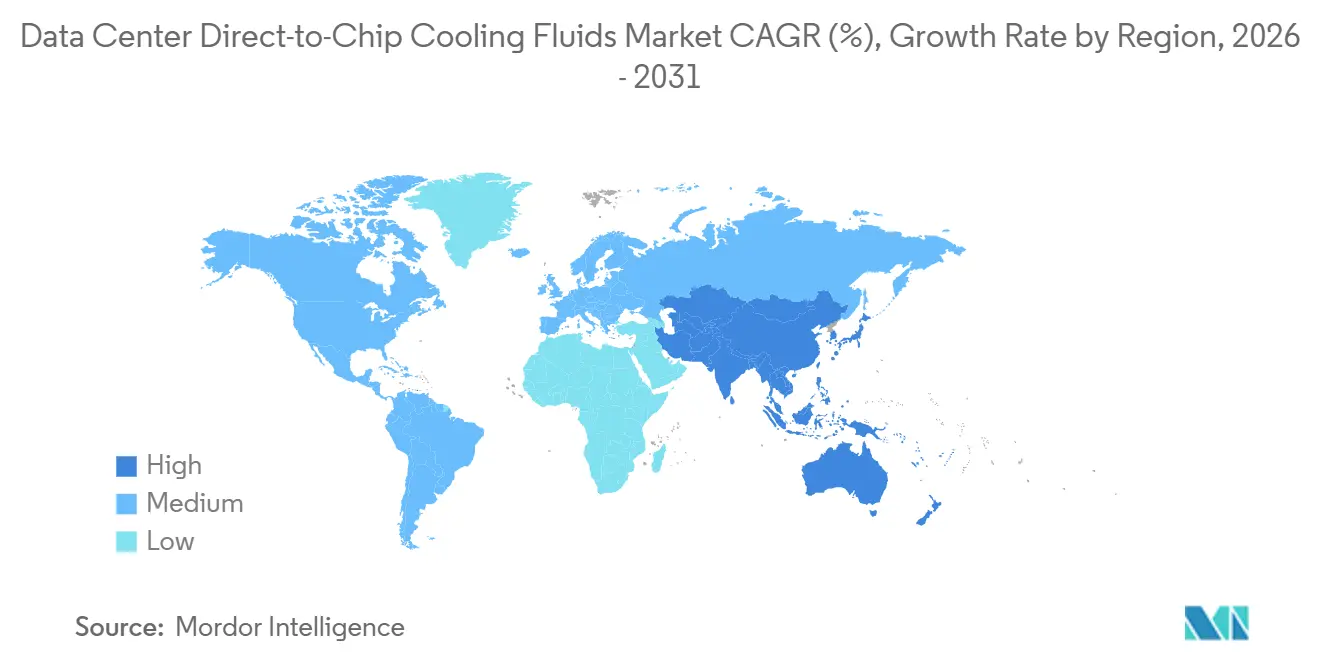
- By geography, North America held 39.78% of the data center direct-to-chip cooling fluids market share in 2025, and Asia-Pacific is forecast to grow at a CAGR of 26.45% through 2031.
Note: Market size and forecast figures in this report are generated using Mordor Intelligence’s proprietary estimation framework, updated with the latest available data and insights as of January 2026.
Market Trends and Insights
Drivers Impact Analysis of Data Center Direct-to-Chip Cooling Fluids Market*
| Drivers | (~) % Impact on CAGR Forecast | Geographic Relevance | Impact Timeline |
|---|---|---|---|
| AI and High-Performance Computing (HPC) Workload Expansion | +8.5% | Global | Short term (≤ 2 years) |
| Rising Data Center Rack Power Density | +5.5% | Global, with early concentration in North America and the Asia-Pacific | Short term (≤ 2 years) |
| Sustainability and Energy-Efficiency Mandates | +3.5% | Europe, North America | Medium term (2-4 years) |
| Open Compute Project (OCP)-Compatible Coolant Standardization | +2.5% | Global, hyperscale-led in North America | Medium term (2-4 years) |
| Warm-Water Cooling Adoption in Existing Facilities | +1.5% | North America, Europe | Medium term (2-4 years) |
| Chip-Level Thermal Bottlenecks from Advanced Packaging | +2.0% | Global, concentrated in Asia-Pacific manufacturing hubs | Long term (≥ 4 years) |
| Source: Mordor Intelligence | |||
AI and HPC Workload Expansion
AI training clusters use thousands of tightly connected GPUs and generate sustained thermal loads. NVIDIA’s B200 SXM6 GPU operates at a 1,000 W thermal design power, and an 8-GPU server can require more than 8 kW under sustained load. NVIDIA guidance does not support air cooling for B200 configurations, which rely on liquid-cooling infrastructure. This requirement increases demand in the data center direct-to-chip cooling fluids market as GPU installations expand. Colocation operators are adapting their facilities because AI tenants increasingly require direct-to-chip-compatible space. As operators create liquid-ready zones, surrounding legacy equipment may also require related cooling upgrades. This work includes distribution hardware, monitoring practices, and coolant selection, extending fluid demand beyond the initial AI server installation.
Rising Data Center Rack Power Density
According to the Association for Data Center Professionals (AFCOM)'s State of the Data Center Report 2026, average rack density reached 27 kW in 2026, up from 16 kW in 2025[1]. Rack densities above 20 kW can exceed the practical operating range of rear-door heat exchangers and chilled-aisle containment. Direct-to-chip cold plates provide a pathway for the 50-132 kW rack range, which is entering large-scale deployments. NVIDIA GB200 NVL72 systems operate at 120 kW to 132 kW rack-level thermal design power, while successor configurations are projected to reach 142 kW per rack. These operating conditions make coolant selection a key part of infrastructure planning in the data center direct-to-chip cooling fluids market. They also support new facilities designed from the outset with liquid distribution in mind. Planning for these loads changes pipe routing, cooling distribution unit sizing, and maintenance processes. It also reduces the practical value of temporary air-cooling upgrades.
Sustainability and Energy-Efficiency Mandates
The European Commission announced plans in June 2026 to develop minimum energy-efficiency performance standards for new and existing data centers. Germany requires data centers commissioned from July 1, 2026, to achieve an Energy Reuse Factor of at least 10%. The requirement rises to 20% by 2028 and supports the use of warm-water direct-to-chip loops. The U.S. Environmental Protection Agency rule will prohibit new data center equipment using R-410A and certain other high-global-warming-potential refrigerants from January 1, 2027. Shell launched DLC Fluid S3 in June 2025, stating that the product can improve Power Usage Effectiveness (PUE) by up to 27% compared with air cooling and meets OCP PG25 specifications. These rules and product requirements increase the value of compliant, energy-efficient formulas in the data center direct-to-chip cooling fluids market. They may also accelerate replacement decisions where older refrigerants no longer meet new equipment rules. Suppliers must balance thermal performance, efficiency, and formula compliance.
OCP-Compatible Coolant Standardization
OCP is extending common practices beyond cold plates to the full thermal cooling system. Its work covers cooling distribution units, manifolds, connectors, and coolant chemical specifications. Draft guidelines issued during 2024 and 2025 support an open ecosystem rather than separate hyperscaler requirements. OCP’s 30°C coolant supply standard can reduce annual chiller power consumption by 20% for each 5°C increase in temperature. Suppliers must demonstrate compatibility with copper, aluminum, brass, elastomers, and plastics before large operators approve fleet deployment. This process gives qualified suppliers a competitive position in the data center direct-to-chip cooling fluids market and reduces the range of formulas that buyers consider. Warm-water operation remains important because it lowers chiller energy use in suitable facilities. Advanced packaging also increases the need for cold-plate performance at the chip level.
Restraints Impact Analysis of Data Center Direct-to-Chip Cooling Fluids Market*
| Restraints | (~) % Impact on CAGR Forecast | Geographic Relevance | Impact Timeline |
|---|---|---|---|
| High Retrofit and Deployment Costs | -3.5% | Global, acutely felt in enterprise and colocation | Short term (≤ 2 years) |
| Integration Complexity in Air-Cooled Facilities | -2.5% | North America, Europe, legacy stock | Medium term (2-4 years) |
| Fluid Compatibility and Leakage Risk | -1.5% | Global | Long term (≥ 4 years) |
| PFAS Restrictions and Two-Phase Fluid Replacement Uncertainty | -2.5% | Europe, North America | Medium term (2-4 years) |
| Source: Mordor Intelligence | |||
High Retrofit and Deployment Costs
Retrofitting an air-cooled row for direct-to-chip liquid cooling costs USD 50,000 to USD 150,000 per row. Cooling distribution unit installation, pipe routing, manifold integration, and commissioning extend project timelines. These costs can exceed the 3- to 4-year refresh cycle that many operators use. Enterprise facilities also need staff training, leak-monitoring equipment, and fluid disposal processes. Colocation operators must fund liquid-ready zones before AI tenants commit to capacity. This timing issue can delay addressable demand for data center direct-to-chip cooling fluids at smaller facilities. Integration requires additional planning, with air-cooled equipment and operating procedures remaining in place. Operators also need validated leak detection and fluid compatibility before conversion.
Per- and Polyfluoroalkyl Substances (PFAS) Restrictions and Two-Phase Fluid Replacement Uncertainty
EU Regulation 2024/573 entered into force in March 2024 and has restricted the use of F-gases with a global warming potential of 2,500 or more in refrigeration equipment since January 2025[2]. The regulation adds planning requirements for suppliers of dielectric fluorocarbon fluids used in two-phase systems. A 2025 Nature study found that broad PFAS restrictions could limit access to high-performing heat-transfer fluids and supported science-based regulation based on persistence and bioaccumulation profiles. Chemours developed Opteon 2P50 with a global warming potential of 10 under the IPCC Sixth Assessment Report measure. Full original equipment manufacturer qualification can require 18 to 24 months of testing. Faster regulatory changes could therefore create a temporary gap in compliant two-phase supply for the data center direct-to-chip cooling fluids market. The exposure is highest where system designs depend on a qualified dielectric formula. Suppliers must manage replacement testing without interrupting current customer programs.
*Our forecasts treat driver/restraint impacts as directional, not additive. The impact forecasts reflect baseline growth, mix effects, and variable interactions.
Data Center Direct-to-Chip Cooling Fluids Market Segment Analysis
By Fluid Type:
Water-Based Coolants Lead Current Demand While Fluorinated Fluids AdvanceWater-based coolants accounted for 44.08% of the segment in 2025, supported by the established use of glycol-water loops and proven corrosion-inhibitor chemistry. Their compatibility with OCP-specified metals and elastomers supported procurement practices. Shell launched its propylene glycol-based DLC Fluid S3 in June 2025 and stated that it met all OCP PG25 requirements. The product offers a fluid life of more than six years and can improve PUE by up to 27% compared with air cooling. This installed base supports water-based formulas in the data center direct-to-chip cooling fluids market. Glycol-based and synthetic hydrocarbon fluids address overlapping thermal requirements in some installations. Bio-based and specialty fluids remain smaller options, shaped by enterprise sustainability requirements.
Fluorinated fluids are projected to record a CAGR of 24.29% through 2031. They support two-phase applications where latent heat transfer enables cold-plate heat flux above 500 W/cm². Chemours’ Opteon 2P50 was qualified by Samsung Electronics for a fourth-generation Solid-State Drive (SSD) in 2025. The qualification provides a reference point for other component and system developers. Low-global-warming-potential formulas may help suppliers address performance needs and regulatory requirements in the data center direct-to-chip cooling fluids market. Their value depends on successful qualifications across server components and fluid distribution equipment. This process can help suppliers build a differentiated product portfolio.

By Cooling Technology:
Single-Phase Remains Established While Two-Phase Serves Higher Heat LoadsSingle-phase direct-to-chip cooling held 62.16% of the segment in 2025 and remains the operating standard. It benefits from established water-glycol practices and broad compatibility with existing cooling distribution systems. Google’s Project Deschutes cooling distribution unit has been used across four Tensor Processing Unit (TPU) generations and has reported fleet-wide availability of 99.99% since 2020. OCP’s 30°C supply-temperature standard also aligns with single-phase water-glycol operating conditions. These conditions support continued demand for data center direct-to-chip cooling fluids. Operators value established reliability when planning facilities that cannot tolerate thermal interruptions. The technology also fits greenfield projects built around a common coolant temperature.
Two-phase direct-to-chip cooling is expected to grow at a CAGR of 28.08% through 2031. Operators are considering it for platforms where cold-plate heat flux exceeds 500 W/cm². The architecture can manage high GPU loads but requires vapor containment, compatible cooling distribution units, and stable fluid performance. Vertiv acquired Strategic Thermal Labs in April 2026, indicating continued investment in advanced liquid-cooling capabilities. Deployment is likely to remain concentrated at hyperscale sites with strong engineering capacity. This trend creates a specialized growth path for the data center direct-to-chip cooling fluids market. The approach is most relevant when single-phase systems cannot meet the required heat flux. It therefore serves a narrower but faster-moving group of AI deployments.
By Component Cooled:
CPUs Lead Current Installations While GPU and AI Accelerator Cooling ExpandsCPU cooling accounted for 43.33% of the component-cooled segment in 2025. This share reflects the long period in which general-purpose cloud computing shaped cold-plate designs for processor packages below 300 W. This installed base supports current demand for compatible liquid loops and fluids. Work on stacked High Bandwidth Memory (HBM)-on-GPU architecture has shown that vertical thermal resistance can push peak GPU temperature to 141.7°C without active mitigation. This finding supports the need for higher-performance cooling across the data center direct-to-chip cooling fluids market. It also shows why package design and fluid performance are becoming increasingly connected. Cooling plans must address the thermal path from the chip package to the facility loop.
GPU and AI accelerator cooling is forecast to grow at a 27.26% CAGR through 2031. NVIDIA Blackwell and Vera Rubin platforms, along with AMD MI350X systems, require direct liquid cooling at 1,000 W per chip. Advanced 2.5D CoWoS packages require fluids that work with both cooling distribution units and cold-plate surfaces. SK hynix introduced iHBM in May 2026, with integrated cooling elements that reduce thermal resistance by 30%. HBM4 is expected to require nearly twice the power of HBM3 under the Open Compute Project (OCP) coolant roadmap. These packaging changes increase performance requirements in the data center direct-to-chip cooling fluids market. Suppliers must support low thermal resistance at the cold-plate interface. They must also maintain compatibility across the wetted components of the wider system.
By Data Center Type:
Hyperscale Facilities Lead Share While Colocation Sites Build Retrofit DemandHyperscale data centers accounted for 57.29% of the segment in 2025 and are forecast to grow at a CAGR of 26.48% through 2031. These operators can negotiate large supply contracts for a single fluid type. Their greenfield sites can be designed for racks of 50 kW or higher from the start. Meta presented a 140-kW liquid-cooled rack at the Open Compute Project (OCP) Global Summit in 2024. The reference architecture helped establish requirements that influence fluid qualifications at major suppliers. Large campuses can commit to infrastructure before tenant demand becomes fully visible. This procurement scale gives them greater influence over product specifications.
Colocation centers represent the next growth area in the data center direct-to-chip cooling fluids market because AI tenants require direct-to-chip-compatible capacity. Retrofit cooling distribution units create demand where facilities already have a customer base and power access. Enterprise data centers remain behind hyperscale adoption because many of their workloads operate below 20 kW per rack. Therefore, air cooling remains workable for much of the installed enterprise base. AI inference clusters in financial services and health care can still create selective brownfield demand. This pattern leaves suppliers serving both new construction and targeted upgrades. Colocation retrofits can expand demand without requiring a new data center. Enterprise deployment remains selective where AI workloads create localized density pressure.
Geography Analysis
North America Data Center Direct-to-Chip Cooling Fluids Market
North America held 39.78% of the data center direct-to-chip cooling fluids market in 2025. The region benefits from a high concentration of U.S. hyperscale campuses. North American hyperscalers also contribute significantly to OCP cooling specifications, and their procurement requirements influence coolant qualifications worldwide. The Environmental Protection Agency (EPA) rule on certain high-global-warming-potential refrigerants is expected to spur investments in the reformulation of glycol and low-global-warming-potential synthetic fluids starting in 2027. This regulatory environment may influence fluid selection before equipment enters service and strengthen the need for documented compliance with formulations.
APAC Data Center Direct-to-Chip Cooling Fluids Market
Asia-Pacific is forecast to expand at a CAGR of 26.45% through 2031. China requires many data centers to maintain a Power Usage Effectiveness (PUE) below 1.3, supporting the adoption of direct-to-chip and immersion systems. Alibaba Cloud, Tencent Cloud, and Huawei Cloud must meet these efficiency requirements in their domestic operations. Chinese cooling distribution unit suppliers, including Envicool and Lingyi iTech, have increased production to meet domestic and export demand. Reuters reported in March 2026 that Google was in discussions with Envicool and other Chinese cooling suppliers regarding purchases. India’s capacity is projected to grow from 1.5 GW to 3 GW to 3.5 GW within five years. Closed-loop direct-to-chip systems can reduce water losses associated with evaporative cooling in water-constrained urban areas. This capability makes cooling design relevant to local water-management priorities and creates a separate rationale for liquid-loop investment beyond rack density.
EMEA and South America Data Center Direct-to-Chip Cooling Fluids Market
Europe contributes to the data center direct-to-chip cooling fluids market, with Germany, the United Kingdom, and France leading the region. Germany’s Energy Reuse Factor requirement is 10% for data centers commissioned on or after July 1, 2026. The requirement will rise to 20% in 2028, favoring warm-water direct-to-chip operation. Suppliers that maintain performance at supply temperatures of 30°C to 40°C are well positioned for these projects. South America, the Middle East, and Africa remain early-stage regions. DataVolt signed a strategic agreement with Chemours in May 2025 to develop liquid-cooling solutions using Opteon dielectric fluids. The agreement indicates that Gulf sovereign AI programs are being designed with direct-to-chip cooling from the outset. These projects can avoid some integration barriers found in older facilities and create opportunities for suppliers that enter design discussions early.
Competitive Landscape
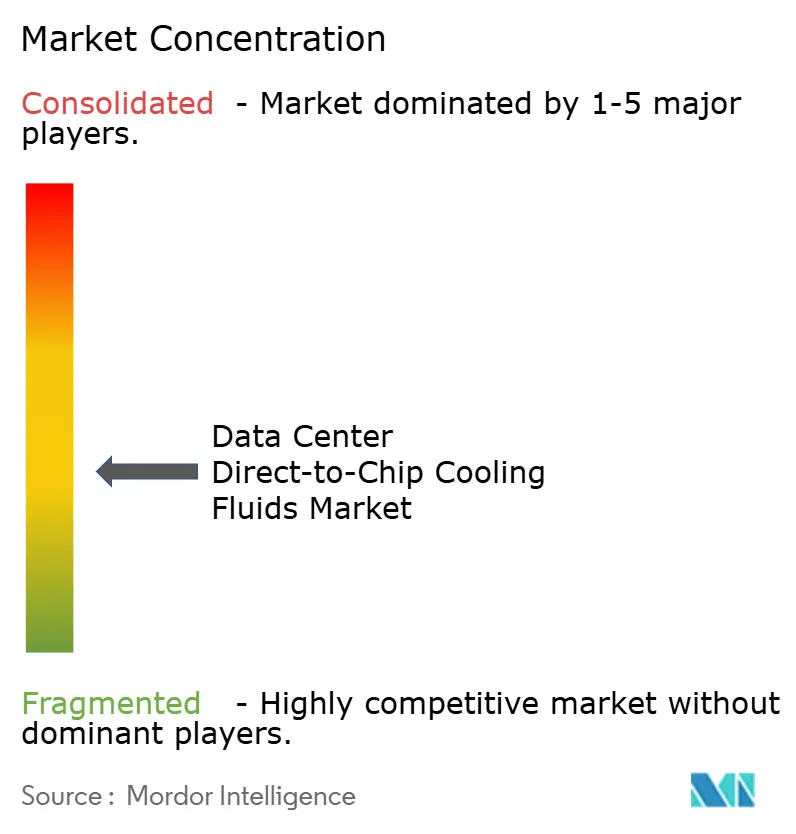
The data center direct-to-chip cooling fluids market is moderately fragmented. Large specialty chemical companies compete with dedicated data center fluid suppliers and newer entrants from the broader chemicals sector. OCP PG25 certification and original equipment manufacturer cold-plate compatibility testing serve as the primary barriers to entry. Buyers require documented testing against copper, aluminum, brass, elastomers, and plastics. Suppliers are expanding their portfolios across cooling methods and localizing supply chains for hyperscale customers. They are also adding lifecycle management services that extend their role beyond fluid supply. This approach connects formula selection with monitoring, maintenance, and replacement planning, making supplier relationships longer-term and more operationally focused.
Shell launched Direct Liquid Cooling (DLC) Fluid S3 in June 2025 with OCP PG25 compliance and a stated PUE improvement of up to 27% over air cooling. Castrol introduced a global fluid management service in June 2025, pairing product supply with ongoing operating support. Chemours entered a joint development agreement with 2CRSi in February 2026 after Opteon 2P50 qualified in current-generation 2CRSi servers. Chemours also established a manufacturing partnership with Navin Fluorine in May 2025 to begin production of Opteon 2P50 in 2026. These initiatives address the limited qualified supply of low-global-warming-potential two-phase fluids. Commercial production and system qualification must advance together for the segment to expand. Partnerships can reduce the time required to align chemistry with server deployment.
Google’s Project Deschutes specification targets a heat load of nearly 2 MW at a hydraulic capacity of 500 gallons per minute (GPM). Its open design can support fluids that meet its materials and hydraulic requirements. Suppliers included in open reference designs can gain traction when other operators adopt similar equipment. Competitors must then offer a comparable standard or complete additional qualification work. Long testing cycles and the scale of hyperscale procurement shape the data center direct-to-chip cooling fluids market. These factors support suppliers with established materials data and direct access to reference system programs. They also make the rapid displacement of approved fluids more difficult.
Data Center Direct-to-Chip Cooling Fluids Industry Leaders
-
Shell plc
-
The Chemours Company
-
Castrol Limited
-
Dow
-
Valvoline Global Operations
- *Disclaimer: Major Players sorted in no particular order
Data Center Direct-to-Chip Cooling Fluids Market Companies Covered in this Report
- Arteco
- Castrol Limited
- CLARIANT
- Dober
- Dow
- Dynalene, Inc.
- Engineered Fluids
- Hydratech
- Inventec Performance Chemicals
- Kilfrost Ltd.
- LANXESS
- Lubrizol
- Recochem Corporation
- Shell plc
- The Chemours Company
- Valvoline Global Operations
Recent Industry Developments in Data Center Direct-to-Chip Cooling Fluids Market
- April 2026: Vertiv acquired Strategic Thermal Labs, a specialist in advanced liquid-cooling technologies. The acquisition combined Coolant Distribution Unit (CDU) infrastructure with fluid-system design and supported an integrated thermal management offering for AI data centers, spanning fluid chemistry to distribution hardware.
- February 2026: The Chemours Company and 2CRSi signed a Joint Development Agreement after Chemours’ Opteon 2P50 two-phase direct-to-chip cooling fluid qualified in current-generation 2CRSi servers. The agreement covered direct-to-chip and immersion applications for high-density AI infrastructure.
Global Data Center Direct-to-Chip Cooling Fluids Market Report Scope
Data center direct-to-chip cooling fluids are specialized liquid coolants pumped through cold plates mounted directly onto high-heat processors, such as CPUs and GPUs. These fluids absorb and remove high thermal loads at the source, supporting modern, high-density AI workloads where traditional air cooling may not meet requirements.
The data center direct-to-chip cooling fluids market is segmented by fluid type, cooling technology, component cooled, data center type, and geography. By fluid type, the market is segmented into water-based fluids, glycol-based fluids, synthetic hydrocarbon fluids, fluorinated fluids, and others (bio-based cooling fluids, specialty fluids). By cooling technology, the market is segmented into single-phase direct-to-chip cooling and two-phase direct-to-chip cooling. By component cooled, the market is segmented into CPU cooling, GPU and AI accelerator cooling, memory and storage cooling, and others (ASICs, FPGAs, power electronics). By data center type, the market is segmented into hyperscale data centers, colocation data centers, enterprise data centers, and others (edge data centers, high-performance computing facilities). The report also covers market size and forecasts for data center direct-to-chip cooling fluids across 15 countries in major regions. The market sizes and forecasts are provided in terms of value (USD).
Segmentation Overview
| Water-Based Fluids |
| Glycol-Based Fluids |
| Synthetic Hydrocarbon Fluids |
| Fluorinated Fluids |
| Others (Bio-Based Cooling Fluids, Specialty Fluids) |
| Single-Phase Direct-to-Chip Cooling |
| Two-Phase Direct-to-Chip Cooling |
| CPU Cooling |
| GPU and AI Accelerator Cooling |
| Memory and Storage Cooling |
| Others (ASICs, FPGAs, Power Electronics) |
| Hyperscale Data Centers |
| Colocation Data Centers |
| Enterprise Data Centers |
| Others (Edge Data Centers, High-Performance Computing Facilities) |
| Asia-Pacific | China |
| India | |
| Japan | |
| South Korea | |
| Rest of Asia-Pacific | |
| North America | United States |
| Canada | |
| Mexico | |
| Europe | Germany |
| United Kingdom | |
| France | |
| Italy | |
| Rest of Europe | |
| South America | Brazil |
| Argentina | |
| Rest of South America | |
| Middle East and Africa | Saudi Arabia |
| South Africa | |
| Rest of Middle East and Africa |
| By Fluid Type | Water-Based Fluids | |
| Glycol-Based Fluids | ||
| Synthetic Hydrocarbon Fluids | ||
| Fluorinated Fluids | ||
| Others (Bio-Based Cooling Fluids, Specialty Fluids) | ||
| By Cooling Technology | Single-Phase Direct-to-Chip Cooling | |
| Two-Phase Direct-to-Chip Cooling | ||
| By Component Cooled | CPU Cooling | |
| GPU and AI Accelerator Cooling | ||
| Memory and Storage Cooling | ||
| Others (ASICs, FPGAs, Power Electronics) | ||
| By Data Center Type | Hyperscale Data Centers | |
| Colocation Data Centers | ||
| Enterprise Data Centers | ||
| Others (Edge Data Centers, High-Performance Computing Facilities) | ||
| By Geography | Asia-Pacific | China |
| India | ||
| Japan | ||
| South Korea | ||
| Rest of Asia-Pacific | ||
| North America | United States | |
| Canada | ||
| Mexico | ||
| Europe | Germany | |
| United Kingdom | ||
| France | ||
| Italy | ||
| Rest of Europe | ||
| South America | Brazil | |
| Argentina | ||
| Rest of South America | ||
| Middle East and Africa | Saudi Arabia | |
| South Africa | ||
| Rest of Middle East and Africa | ||
Key Questions Answered in the Report
What is current market size of Data Center Direct-To-Chip Cooling Fluids Market?
The data center direct-to-chip cooling fluids market size is estimated at USD 161.56 million in 2025 and is estimated to grow from USD 190.72 million in 2026 to USD 546.83 million by 2031, at a CAGR of 23.45% during the forecast period (2026-2031).
Which fluid type currently has the largest share?
Water-based coolants held 44.08% of the fluid-type segment in 2025, supported by established glycol-water loops and Open Compute Project (OCP) compatibility. Fluorinated fluids are projected to grow faster as two-phase systems are evaluated for high heat loads.
Which cooling technology is growing fastest?
Two-phase direct-to-chip cooling is projected to grow at a 28.08% CAGR through 2031, as it can meet higher heat-flux requirements. Single-phase cooling remains the established operating technology.
Why are hyperscale data centers important to this sector?
Hyperscale facilities held 57.29% of demand in 2025 and are projected to grow at a 26.48% CAGR through 2031. Their volume commitments and technical requirements shape supplier qualification priorities.