
Corporate Blended Learning Market Size and Share
Market Overview
| Study Period | 2021 - 2031 |
|---|---|
| Market Size (2026) | USD 66.67 Billion |
| Market Size (2031) | USD 95.12 Billion |
| Growth Rate (2026 - 2031) | 7.37 % |
| Fastest Growing Market | Asia-Pacific |
| Largest Market | North America |
| Market Concentration | Low |
Major Players *Disclaimer: Major Players sorted in no particular order Image © Mordor Intelligence. Reuse requires attribution under CC BY 4.0. | |
Corporate Blended Learning Market Analysis by Mordor Intelligence
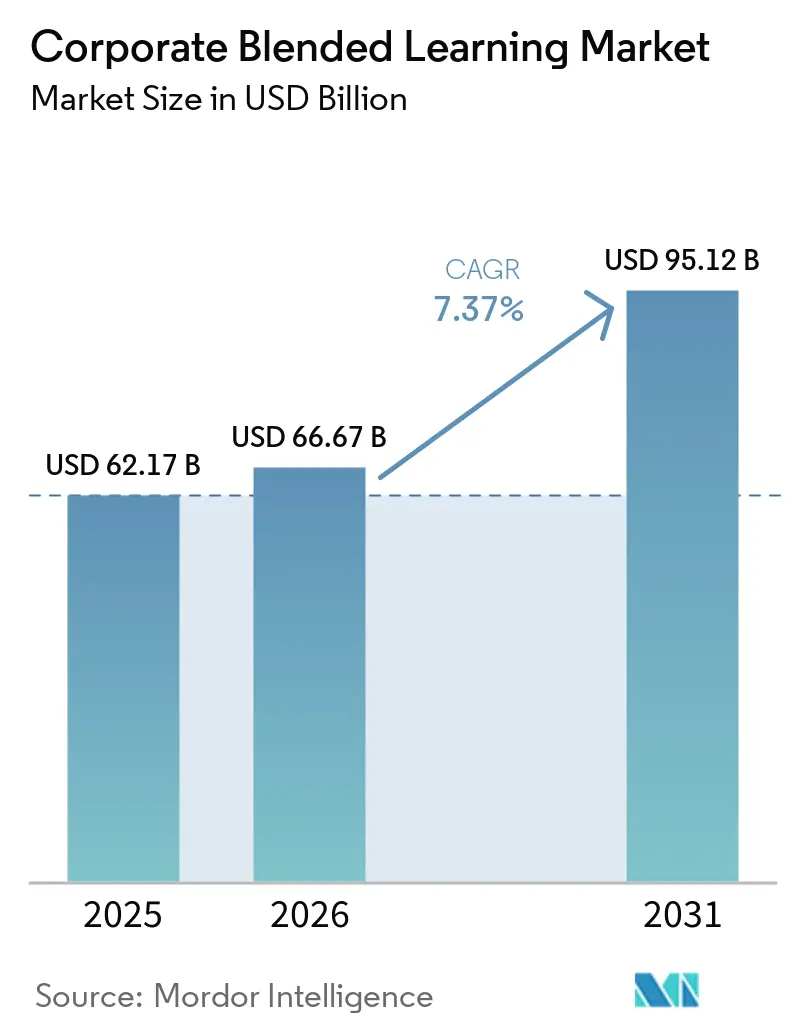
The corporate blended learning market size stood at USD 66.67 billion in 2026, up from USD 62.17 billion in 2025, and is projected to reach USD 95.12 billion by 2031, with a 7.37% CAGR. The corporate blended learning market is expanding because employers are treating skills development as a business continuity issue rather than a periodic HR activity, especially as skill gaps remain a major barrier to transformation, and upskilling plans stay high through 2030[1]. The corporate blended learning market also benefits from the shift toward measurable learning systems that combine digital delivery, instructor guidance, skills mapping, and audit-ready records in a single environment, which meets the needs of large enterprises operating across functions and geographies. AI-assisted authoring and platform bundling are lowering content production friction and raising the value of integrated subscriptions, which supports wider adoption across enterprise learning programs. At the same time, the corporate blended learning market still faces pressure from budget normalization after the post-pandemic surge, from localization demands in multilingual deployments, and from privacy obligations that favor larger vendors with stronger compliance capabilities. The corporate blended learning market is therefore moving toward platforms that demonstrate business relevance, reduce buyer fatigue, and protect learning data while linking training activities to workforce capability outcomes.
Key Report Takeaways
- By component, platform solutions held a 45.1% share of the corporate blended learning market size in 2025, while services are projected to expand at a 9.6% CAGR through 2031.
- By organization size, large enterprises held 68.8% of the corporate blended learning market in 2025, while SMEs are forecast to record the fastest CAGR of 9.2% through 2031.
- By learning mode, online self-paced learning led with a 35.1% share of the corporate blended learning market in 2025, while experiential learning is projected to expand at a 10.6% CAGR through 2031.
- By industry vertical, IT and telecom accounted for a 24.5% share of the corporate blended learning market size in 2025, while healthcare and life sciences are expected to expand at a 9.8% CAGR through 2031.
- By geography, North America held a 38.4% share of the corporate blended learning market size in 2025, while Asia-Pacific is projected to expand at a 9.9% CAGR through 2031.
Note: Market size and forecast figures in this report are generated using Mordor Intelligence’s proprietary estimation framework, updated with the latest available data and insights as of January 2026.
Global Corporate Blended Learning Market Trends and Insights
Drivers Impact Analysis*
| Driver | (~) % Impact on CAGR Forecast | Geographic Relevance | Impact Timeline |
|---|---|---|---|
| Rising Need For Scalable Upskilling Among Dispersed Workforces | +1.8% | Global, the highest in North America and the Asia-Pacific | Short term (≤ 2 years) |
| Demand For Analytics-Driven Personalized Learning Pathways | +1.5% | North America and Europe, expanding to the Asia-Pacific | Medium term (2-4 years) |
| Corporate ESG Commitments Pushing Sustainability and DEI Training | +0.8% | EU-led, spill-over to North America and Asia-Pacific | Medium term (2-4 years) |
| Adoption Of AI Generative Content Authoring Cuts Course Costs | +1.4% | Global, particularly large enterprises in North America | Short term (≤ 2 years) |
| Gamified Micro-Learning Boosts Completion in Compliance Courses | +0.9% | Global, notably BFSI and healthcare verticals | Short term (≤ 2 years) |
| Vendor Bundling of LMS And Content Via Subscriptions | +0.7% | Global, led by North America and Europe | Medium term (2-4 years) |
| Source: Mordor Intelligence | |||
Rising Need for Scalable Upskilling Among Dispersed Workforces
The corporate blended learning market is gaining momentum amid a widening mismatch between workforce skill needs and the pace at which conventional training models can respond. The World Economic Forum reported in 2025 that 63% of employers viewed skill gaps as the main barrier to business transformation, and 85% planned to prioritize workforce upskilling over 2025-2030. The same report stated that 59 out of every 100 workers will need reskilling or upskilling by 2030, underscoring that classroom-only delivery is too limited for large, dispersed workforces. That is why the corporate blended learning market is moving toward models that automate foundational learning digitally and reserve live time for application, coaching, and exception handling. ATD also reported average direct learning expenditure of USD 1,054 per employee and 13.7 formal learning hours in 2025, which underlines how tightly enterprise learning time is rationed and why always-available digital layers remain necessary[2].
Demand for Analytics-Driven Personalized Learning Pathways
The corporate blended learning market is also being shaped by a clear change in buyer expectations around proof of value. Learning leaders are under pressure to show how training connects with business performance, which makes simple completion tracking less useful than competency mapping and adaptive recommendation engines. SAP SuccessFactors states in its 1H 2026 release that its learning suite now includes intelligent Q&A and more dynamic personalization based on career level, skills, location, and organizational priorities[3]. Docebo reinforces the same direction through its January 2026 acquisition of 365Talents for USD 54.6 million, plus an earn-out of up to USD 5.1 million, to embed skills intelligence and workforce analytics more directly into learning workflows. As a result, the corporate blended learning market is shifting toward systems that prescribe learning before gaps become visible in performance reviews, compliance incidents, or productivity metrics.
Adoption of AI Generative Content Authoring Cuts Course Costs
The corporate blended learning market is benefiting from the reduced content-creation burden enabled by generative AI tools. The user-supplied draft noted that traditional custom e-learning development can cost USD 10,000 to USD 50,000 per course hour, and the direction of travel now favors tools that shorten production cycles and let learning teams review and refine rather than build every module from the ground up. A 2026 peer-reviewed study in Applied Sciences presented a framework for using generative AI across script generation, assessment design, and media creation in the e-learning workflow. This makes it easier for the corporate blended learning market to support broader course libraries and more role-specific pathways without the same level of historical production cost. It also raises quality control demands in regulated settings, where buyers still need human review and validation before AI-generated content can be deployed in production programs.
Gamified Micro-Learning Boosts Completion in Compliance Courses
The corporate blended learning market continues to find demand in compliance-heavy settings where learner attention is often limited but training completion is mandatory. Shorter learning units are easier to fit into work schedules, and gamified structures can improve engagement when the training topic is procedural or repetitive. The corporate blended learning market benefits from this pattern because healthcare, BFSI, and industrial employers must keep running refresher programs tied to regulatory obligations even when budgets are under scrutiny. France's 2026 enterprise training survey reported that blended learning accounted for 65% of all training delivered in French enterprises during 2025, and micro-learning with gamification was identified as a key accelerator of adoption in that mix, as reflected in the user-supplied draft. This supports continued demand for modular learning design in the corporate blended learning market, especially where the goal is consistent completion rather than long-form classroom participation.
Restraints Impact Analysis*
| Restraint | (~) % Impact on CAGR Forecast | Geographic Relevance | Impact Timeline |
|---|---|---|---|
| Content Localization Across Multi-Lingual Enterprises | -0.6% | Asia-Pacific core, spill-over to the Middle East and Africa, and South America | Medium term (2-4 years) |
| Cyber-Security and Data-Privacy Concerns with Cloud LMS | -0.5% | Global, especially the EU and India | Short term (≤ 2 years) |
| Over-Saturation Of LMS Vendors Causing Decision Paralysis | -0.4% | North America and Europe | Short term (≤ 2 years) |
| Post-Pandemic Training-Budget Normalization | -0.5% | Global, concentrated in large enterprises | Short term (≤ 2 years) |
| Source: Mordor Intelligence | |||
Content Localization Across Multi-Lingual Enterprises
The corporate blended learning market still faces significant adoption barriers in multinational organizations, where language is only one part of the localization problem. Training content often includes examples, scenarios, tone, and regulatory references that do not transfer well across markets, even when the translation itself is accurate. That raises maintenance costs when companies need to keep dozens of versions current while preserving instructional quality and audit consistency. The corporate blended learning market, therefore, favors service providers that can pair translation tools with in-market instructional review and compliance adaptation. This also helps explain why services are expanding faster than some buyers initially expected, because localization work remains difficult to standardize across large cross-border learning programs.
Cyber-Security and Data-Privacy Concerns with Cloud LMS
The corporate blended learning market is also constrained by the fact that learning systems now store sensitive employee records, assessment histories, and skill profiles in one place. Under GDPR, learner activity data creates formal processing obligations around legal basis, access rights, and breach notification, which pushes enterprise buyers to scrutinize learning vendors more closely[4]. In the United States, regulated sectors such as healthcare also link learning environments to data protection and training control expectations under HIPAA and FDA electronic record requirements. These compliance layers raise costs for smaller vendors and strengthen the position of platforms that can show stronger security governance and audit readiness. The corporate blended learning market, therefore, remains favorable to well-resourced providers as privacy rules and cloud security standards become more visible in procurement decisions.
*Our forecasts treat driver/restraint impacts as directional, not additive. The impact forecasts reflect baseline growth, mix effects, and variable interactions.
Segment Analysis
By Component: Platform Dominance Tested by Services-Led Growth
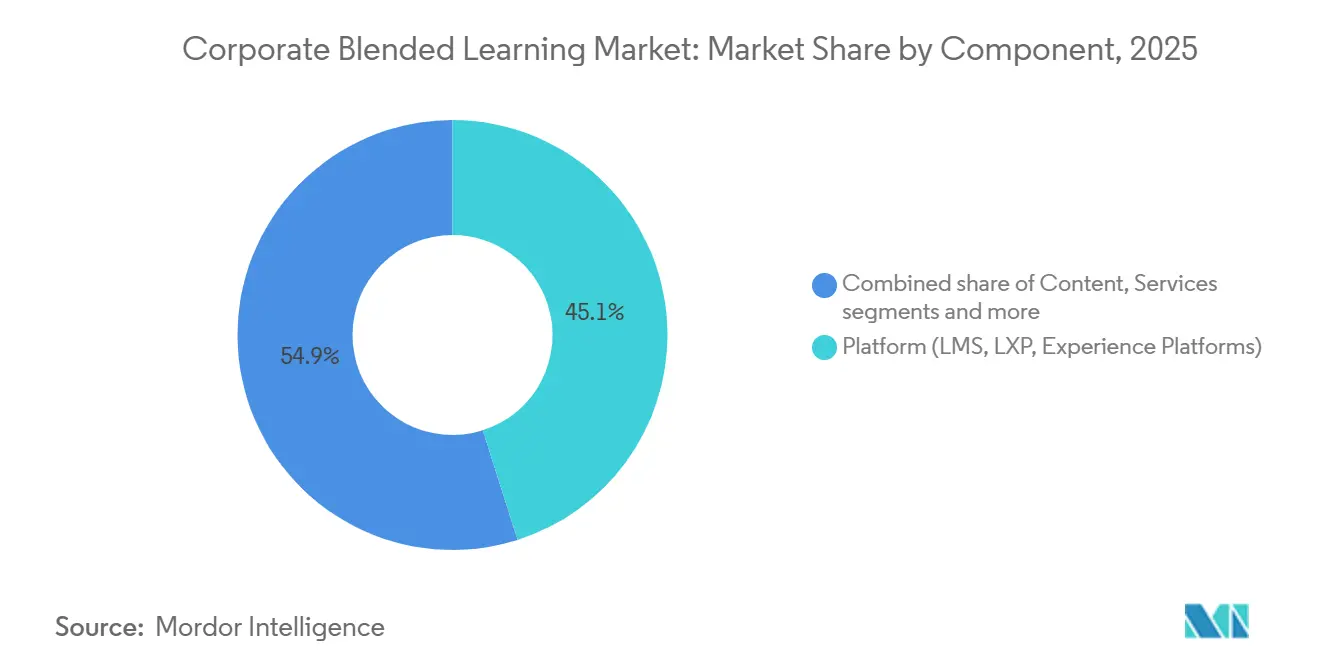
Platform solutions accounted for 45.1% of component revenue in 2025, which keeps them at the center of the corporate blended learning market. Enterprises continue to favor LMS, LXP, and integrated experience platforms because they simplify administration, audit trails, reporting, and content delivery under a single contract. This preference is especially strong when buyers need one system of record for compliance documentation and workforce capability tracking across large employee bases. The services segment, while smaller, is projected to post the fastest CAGR of 9.6% through 2031, indicating that buyers increasingly want help with deployment, localization, curation, and outcomes management rather than software alone.
This shift matters because the corporate blended learning industry is moving away from clean boundaries between platforms, content, and services. Skillsoft states that its next-generation Percipio Platform, launched in February 2026, combines skills mapping, gap detection, assessment, and measurement into a single interface. Cornerstone makes a similar move in 2026 by more tightly unifying learning, content, and workforce intelligence within a single platform. Content libraries remain relevant, but they face pressure when AI tools lower the cost of custom course creation and shift value toward curation, specialization, and validated content in regulated areas. In the corporate blended learning market, which means specialist libraries for GxP, cybersecurity, or regulated financial training are better placed to preserve pricing power than generalist course catalogs.

By Organization Size: Large Enterprises Lead, SMEs Close the Gap
Large enterprises accounted for 68.8% of 2025 revenue, reflecting the current structure of the corporate blended learning market. Their spending power, larger headcounts, multi-year contracts, and stronger compliance obligations make them the natural buyers of integrated learning suites. They also have a clearer need for standardized delivery across departments and regions, which supports enterprise-wide rollouts. SMEs, however, are forecast to grow faster at a 9.2% CAGR through 2031 as SaaS pricing, template-led authoring, and ready-made content reduce adoption friction.
The opportunity inside the corporate blended learning market is tied to the skills gap that still exists at smaller firms. TÜV-Verband reported in April 2026 that only 21% of small German companies with 20 to 49 employees had trained staff in AI skills, compared with 49% among large companies. ATD also reported in 2025 that small companies in the United States spent USD 1,091 per learner, while large corporations spent USD 468, which suggests that smaller firms often invest more per seat even when their total budgets remain lower. Bitkom Akademie found in 2025 that 48.8% of surveyed companies saw digital learning as a core part of their training strategy, which supports the view that SME demand should continue to widen as skill needs rise. For the corporate blended learning industry, which creates room for bundles built around speed of deployment, compliance tracking, and prebuilt role-based content rather than deep customization.
By Learning Mode: Self-Paced Remains Foundational, Experiential Accelerates
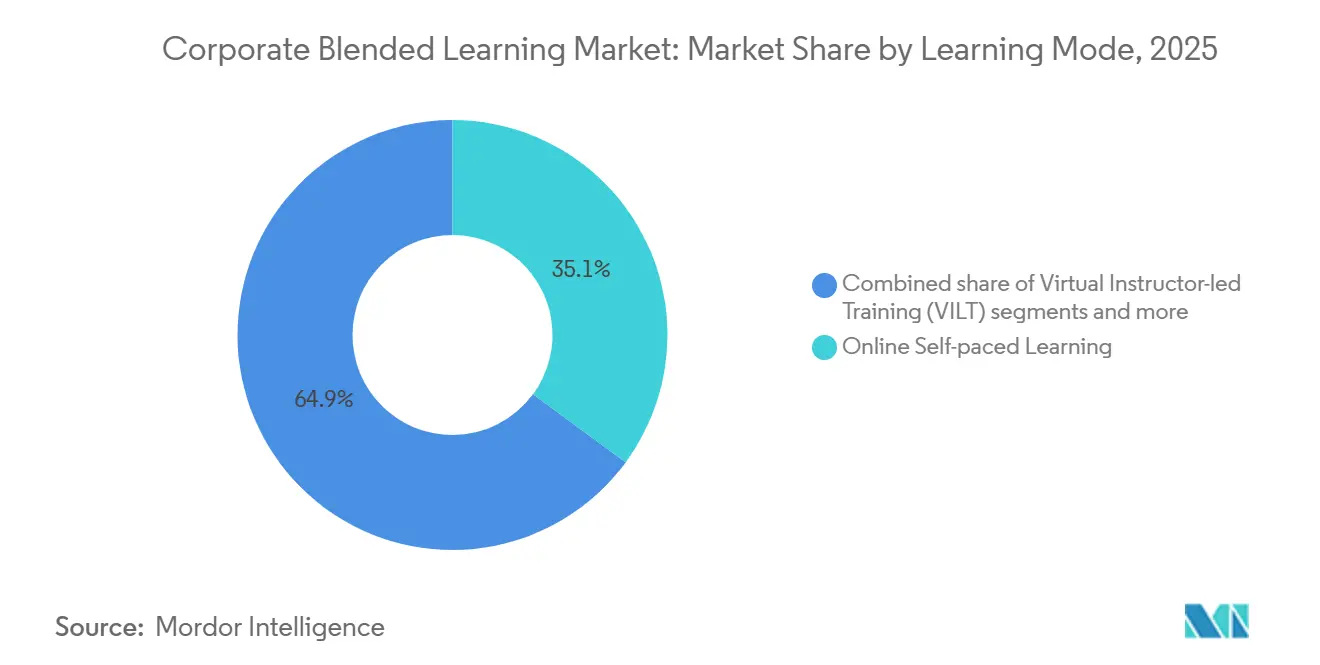
Online self-paced learning held 35.1% of 2025 revenue and remains the broadest base of the corporate blended learning market. Its position comes from simple advantages, including learner-controlled pacing, anytime access, and scalable delivery across dispersed teams. Instructor-led training still matters where collaboration, leadership development, or higher-touch facilitation are necessary, but digital and hybrid formats have diluted its relative share. Virtual instructor-led training and collaborative modes sit between the two ends of the spectrum and help enterprises preserve interaction without reverting to fully classroom-based delivery.
Experiential learning is the fastest-growing mode, with a 10.6% CAGR through 2031, making it the standout growth pocket in the corporate blended learning market. The demand is strongest where procedural accuracy matters, including healthcare, manufacturing, and other safety-sensitive settings. Absorb Software states in its May 2026 product announcement that its Aura engine is designed to support personalized learning paths, automation, simulation, and mentorship within a more agentic learning system, which reflects the growing overlap between experiential and standard digital learning flows as described in the user draft. This direction suggests that self-paced and experiential formats are becoming less distinct in practice, as simulation, guided decision-making, and AI-assisted role-play can now be built into broader learning journeys. For the corporate blended learning market, this supports higher-value deployments where the outcome depends on applied capability rather than content exposure alone.
By Industry Vertical: IT and Telecom Anchors Demand, Healthcare Fastest Growing
IT and telecom accounted for 24.5% of 2025 revenue, making it the largest vertical in the corporate blended learning market. The sector needs constant skill refresh in cloud, cybersecurity, AI, machine learning, and DevOps, so training cycles are frequent and often tied directly to business capability. Pluralsight states in its March 2026 release that its AI Academy is structured across AI literacy, AI productivity, and agentic AI, and is designed to scale from 500 to 100,000 participants. BFSI remains another major buyer because regulatory competency requirements create recurring demand for documented training, regardless of broader budgetary conditions.
Healthcare and life sciences are forecast to grow at the fastest pace, with a 9.8% CAGR through 2031, and unusually stringent compliance requirements support this segment of the corporate blended learning market. Healthcare providers must manage HIPAA training obligations, while regulated life sciences settings also rely on FDA electronic record controls and validation practices, underscoring the importance of audit-ready learning systems. The combination of high compliance density and continuous onboarding needs keeps training volumes elevated compared with many other verticals. Manufacturing and energy are also becoming more important as automation, safety demands, and decarbonization programs require structured workforce transitions. In the corporate blended learning market, the retail and consumer-facing sectors remain smaller today, but frontline digital skills training still creates a clear long-term opportunity.
Geography Analysis
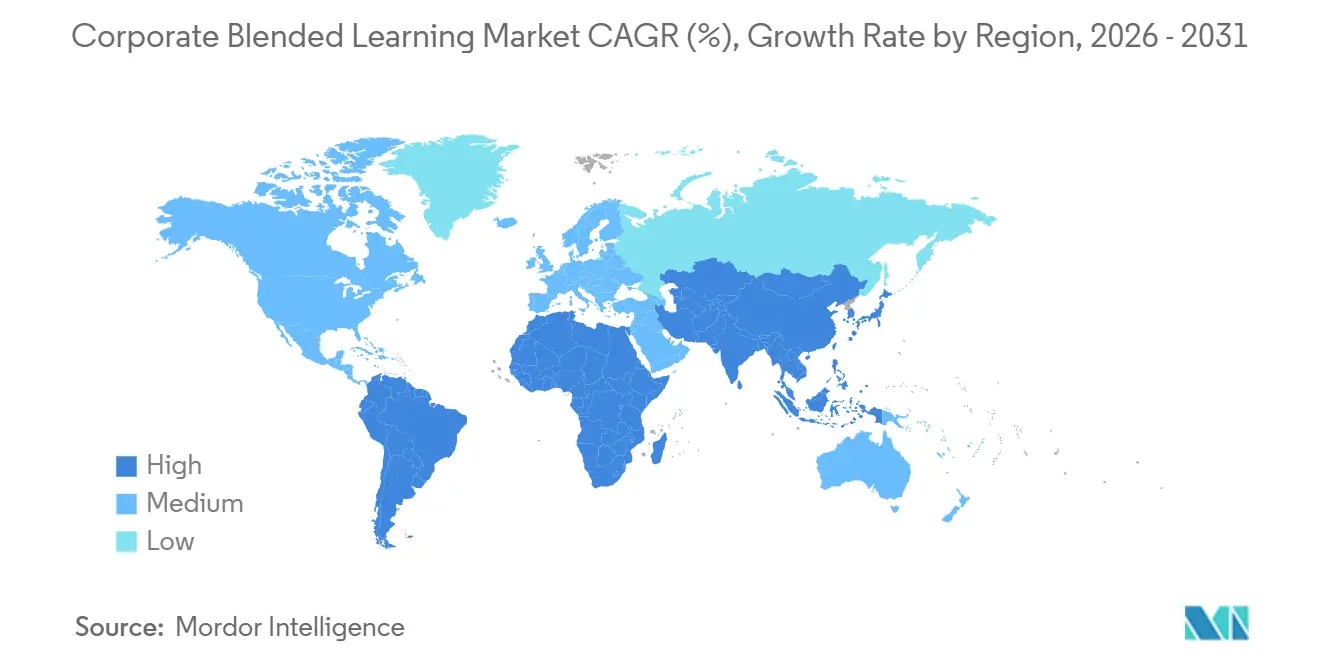
North America held 38.4% of the corporate blended learning market share in 2025 and is projected to grow at a 7.0% CAGR through 2031. The region remains the largest part of the corporate blended learning market because LMS adoption is already deep, and enterprise buyers face layered compliance needs across healthcare, financial services, and government-linked contracting. ATD reported that 89% of U.S. companies used an LMS in 2025, which supports the maturity argument behind North America's scale. Skillsoft also reported that AI benchmark completions rose 994% year over year through fiscal 2026, while AI content completions increased 261%, showing how quickly AI-focused learning demand is moving into mainstream enterprise programs. Canada and Mexico add depth to the region's demand base, with bilingual and cross-border training requirements helping sustain blended deployment models.
Europe is projected to expand at a 6.2% CAGR through 2031, and the corporate blended learning market there is supported by established training cultures and widening digital skills needs. TÜV-Verband reported in 2026 that 27% of German companies had already trained employees in AI, up from 12% in 2024, although 45% still saw no need for AI training, suggesting a split adoption curve rather than a uniform one. France's national professional training expenditure reached EUR 33 billion, or USD 35.6 billion, in 2024, according to the annex to the French 2026 budget law, and the same user-supplied draft shows blended learning accounted for 65% of all training delivered in French enterprises during 2025. EU sustainability reporting changes also support demand for ESG-related workforce education, keeping training activities relevant even in a more measured growth environment.
Asia-Pacific is forecast to grow at a 9.9% CAGR through 2031, making it the fastest-growing regional block in the corporate blended learning market. The region benefits from a large working-age population, active reskilling agendas, and demographic scale. The corporate blended learning market in Asia-Pacific also features a more open vendor landscape than in North America, allowing regional providers to compete alongside global platforms. Japan and South Korea offer high-value corporate learning demand, while emerging markets in Southeast Asia expand the buyer base through digital infrastructure development and workforce modernization programs. South America, with an 8.5% CAGR, and the Middle East and Africa, with Africa at 9.0% and Western Asia at 7.4%, also offer attractive growth potential. However, the complexity of localization and uneven infrastructure continues to slow broader platform-scale adoption.
Competitive Landscape
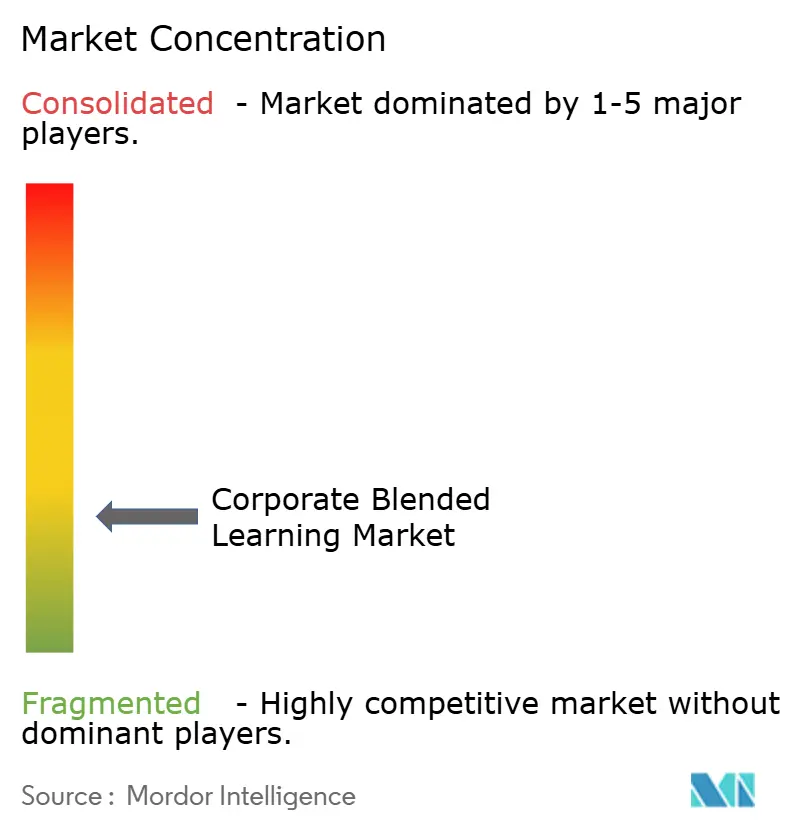
The corporate blended learning market is moderately fragmented, with the top 5 vendors accounting for 38% of 2025 revenue. Skillsoft led with 11%, LinkedIn Learning with Microsoft held 9%, Cornerstone OnDemand held 8%, SAP SuccessFactors held 6%, and Docebo held 4%. This leaves the corporate blended learning market without a single company that can set pricing or product standards on its own. The main competitive pattern is platform expansion through skills intelligence, content integration, analytics, and workflow simplification. Vendors are trying to make their systems harder to replace by reducing the need for external integrations and packaging more capabilities into a single subscription relationship.
Skillsoft illustrates this direction through product sharpening and portfolio restructuring in 2025 and 2026. The company announced a strategic partnership with edX in December 2025 to expand university-led learning within Percipio, and it also sold the Global Knowledge instructor-led training business in May 2026 to focus more closely on its AI-native platform direction, according to the user-supplied draft and company disclosures. Cornerstone is making a parallel push by embedding AI assistants and adaptive agents more directly into course creation and learning workflows. Docebo's 365Talents acquisition adds another example, showing how vendors are using M&A to place competency intelligence closer to the learning workflow.
The corporate blended learning market also has room for AI-native challengers that compete on program creation speed and workflow simplicity rather than on catalog breadth alone. Smaller players are increasingly positioning themselves within larger ecosystems rather than trying to replace established enterprise systems outright. Pluralsight's April 2026 release deepened connections with Workday, Cornerstone LMS, and SAP SuccessFactors, which reflects this ecosystem strategy as described in the user draft. Interoperability standards such as SCORM 2004 and xAPI remain important because enterprise buyers still expect content, assessment, and reporting to be portable across systems. In the corporate blended learning market, that means vendors with weaker interoperability or deeper compliance gaps can still lose at the shortlist stage, even when their user experience is strong.
Corporate Blended Learning Industry Leaders
-
Skillsoft
-
LinkedIn Learning (Microsoft)
-
Cornerstone OnDemand
-
SAP SuccessFactors
-
Docebo
- *Disclaimer: Major Players sorted in no particular order
Recent Industry Developments
- May 2026: Cornerstone OnDemand launched Cornerstone Workforce AI, a consolidated intelligence platform for workforce readiness integrating learning management, content subscription, role-readiness academies, and full-suite AI learning assistants, representing the company's most comprehensive platform overhaul to date.
- May 2026: Skillsoft sold its Global Knowledge instructor-led training business to Enduring Ventures for an initial consideration of USD 10 million plus a deferred consideration of USD 8 million, payable over five quarterly installments. The divestiture allows Skillsoft to concentrate capital and product investment in its AI-native Percipio Platform.
- April 2026: SAP SuccessFactors released its 1H 2026 update, delivering more than 400 product innovations, including intelligent Q&A powered by Joule AI that surfaces answers from within enterprise learning content, and enhanced personalized learning recommendations adapting dynamically by career level, location, skills, and organizational priorities.
- March 2026: Cornerstone OnDemand launched its Adaptive Learning Agent and AI-Powered Course Assistant as part of the Spring 2026 Innovation release, embedding contextual AI intelligence directly into course creation and individual learning-path development.
Global Corporate Blended Learning Market Report Scope
| Platform (LMS, LXP, etc.) |
| Content |
| Services (Implementation, Consulting, Managed) |
| Large Enterprises |
| Small & Medium Enterprises |
| Instructor-led Training (ILT) |
| Online Self-paced Learning |
| Virtual Instructor-led Training (VILT) |
| Collaborative learning |
| Experiential learning |
| Others |
| IT & Telecom |
| BFSI |
| Healthcare & Life Sciences |
| Manufacturing |
| Retail & Consumer Goods |
| Energy & Utilities |
| Others (Hospitality, etc.) |
| North America | United States |
| Canada | |
| Mexico | |
| South America | Brazil |
| Peru | |
| Chile | |
| Argentina | |
| Rest of South America | |
| Europe | United Kingdom |
| Germany | |
| France | |
| Spain | |
| Italy | |
| BENELUX | |
| NORDICS | |
| Rest of Europe | |
| Asia-Pacific | India |
| China | |
| Japan | |
| Australia | |
| South Korea | |
| South-East Asia | |
| Rest of Asia-Pacific | |
| Middle East & Africa | United Arab Emirates |
| Saudi Arabia | |
| South Africa | |
| Nigeria | |
| Rest of Middle East & Africa |
| By Component | Platform (LMS, LXP, etc.) | |
| Content | ||
| Services (Implementation, Consulting, Managed) | ||
| By Organization Size | Large Enterprises | |
| Small & Medium Enterprises | ||
| By Learning Mode | Instructor-led Training (ILT) | |
| Online Self-paced Learning | ||
| Virtual Instructor-led Training (VILT) | ||
| Collaborative learning | ||
| Experiential learning | ||
| Others | ||
| By Industry Vertical | IT & Telecom | |
| BFSI | ||
| Healthcare & Life Sciences | ||
| Manufacturing | ||
| Retail & Consumer Goods | ||
| Energy & Utilities | ||
| Others (Hospitality, etc.) | ||
| By Geography | North America | United States |
| Canada | ||
| Mexico | ||
| South America | Brazil | |
| Peru | ||
| Chile | ||
| Argentina | ||
| Rest of South America | ||
| Europe | United Kingdom | |
| Germany | ||
| France | ||
| Spain | ||
| Italy | ||
| BENELUX | ||
| NORDICS | ||
| Rest of Europe | ||
| Asia-Pacific | India | |
| China | ||
| Japan | ||
| Australia | ||
| South Korea | ||
| South-East Asia | ||
| Rest of Asia-Pacific | ||
| Middle East & Africa | United Arab Emirates | |
| Saudi Arabia | ||
| South Africa | ||
| Nigeria | ||
| Rest of Middle East & Africa | ||
Key Questions Answered in the Report
What is the size of the corporate blended learning market in 2026?
The corporate blended learning market is valued at USD 66.7 billion in 2026 and is forecast to reach USD 95.1 billion by 2031 at a 7.4% CAGR.
Which segment leads the corporate blended learning space by component?
Platform solutions led by a component with a 45.1% revenue share in 2025, reflecting buyer preference for integrated systems that combine administration, content delivery, and analytics.
Which learning mode is growing the fastest through 2031?
Experiential learning is the fastest-growing learning mode with a 10.6% CAGR through 2031, supported by demand for simulation-based and application-focused training.
Which industry vertical creates the strongest growth opportunity?
Healthcare and life sciences are growing at the fastest pace, with a 9.8% CAGR through 2031, driven by compliance density, validated systems, and continuous onboarding, which keep training demand elevated.
Which region is expanding the fastest?
Asia-Pacific is the fastest-growing region with a 9.9% CAGR through 2031, supported by workforce scale, reskilling demand, and broader digital learning adoption.
Why are larger vendors gaining an edge in enterprise buying decisions?
Larger vendors are better positioned because privacy, security, and compliance expectations are rising, and buyers increasingly prefer platforms that combine learning delivery, analytics, and audit-ready controls.