
Concrete Floor Coatings Market Size and Share
Market Overview
| Study Period | 2022 - 2032 |
|---|---|
| Market Size (2027) | USD 5.90 Billion |
| Market Size (2032) | USD 8.10 Billion |
| Growth Rate (2027 - 2032) | 6.57 % |
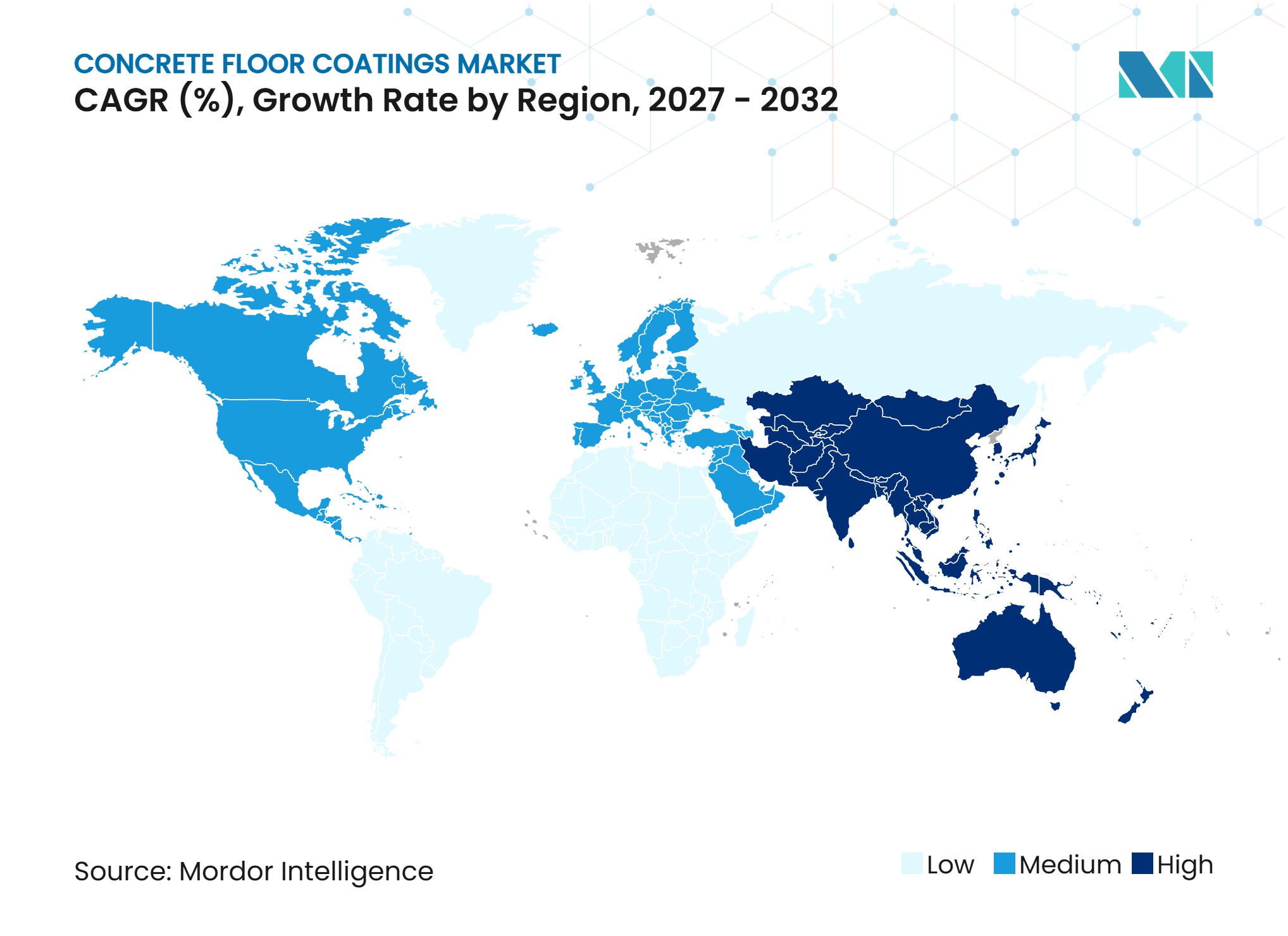
| Fastest Growing Market | Asia-Pacific |
| Largest Market | Asia-Pacific |
| Market Concentration | Low |
Major Players *Disclaimer: Major Players sorted in no particular order Image © Mordor Intelligence. Reuse requires attribution under CC BY 4.0. | |
Concrete Floor Coatings Market Analysis by Mordor Intelligence
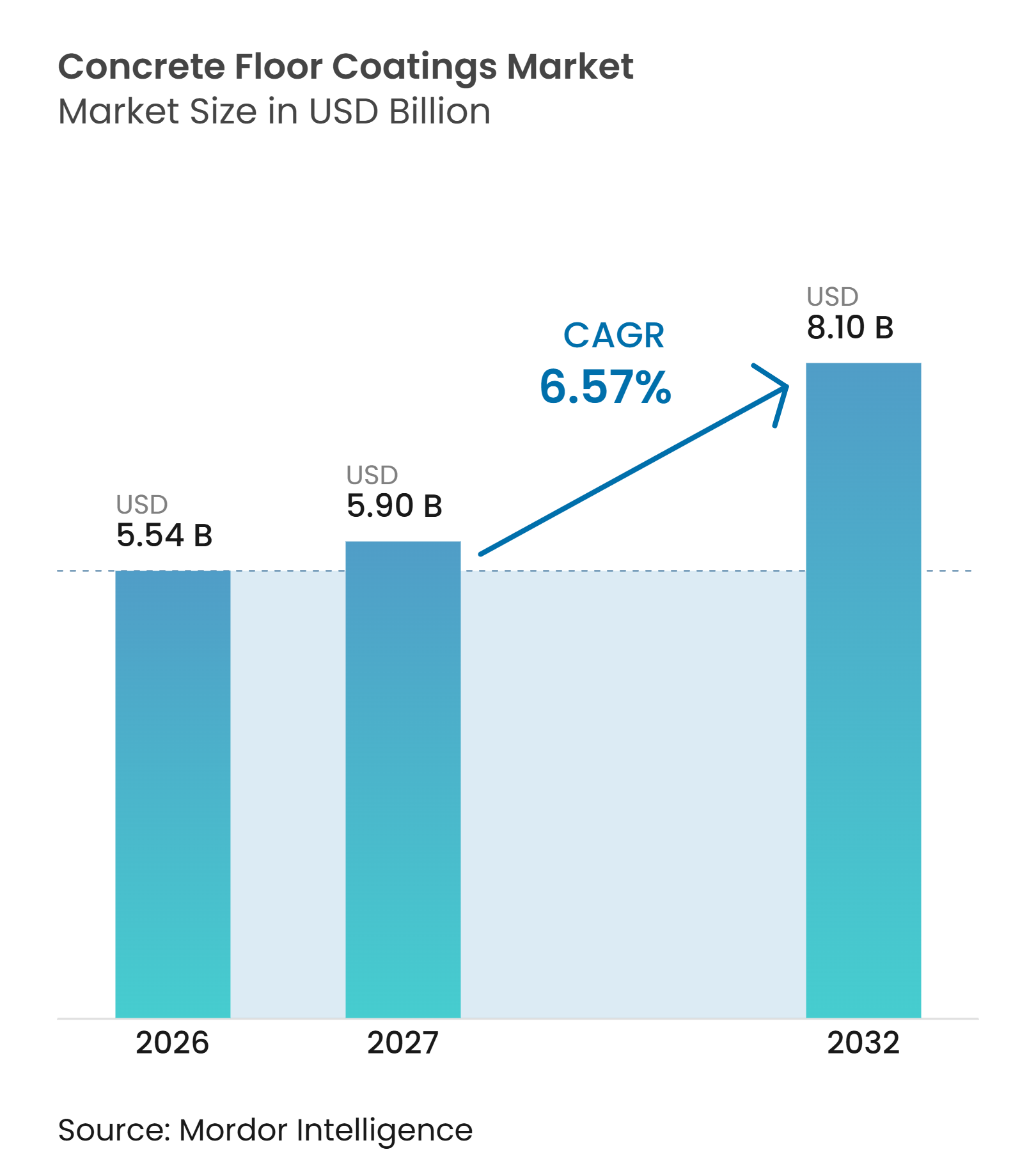
The Concrete Floor Coatings Market size was valued at USD 5.54 billion in 2026 and is estimated to grow from USD 5.90 billion in 2027 to reach USD 8.10 billion by 2032, at a CAGR of 6.57% during the forecast period (2027-2032). The concrete floor coatings market is supported by new industrial construction in emerging economies and by higher performance requirements in operating facilities. Environmental rules are changing product specifications, especially where volatile organic compound limits rule out older solvent-borne systems. Investment in electric vehicle battery plants and semiconductor facilities is also increasing demand for chemical-resistant and electrostatic-dissipative floor systems. These projects require several coating types within one site, which raises the value of a complete system sale. The concrete floor coatings market also benefits when operators choose durable systems to avoid repeated shutdowns and repairs.
Key Report Takeaways
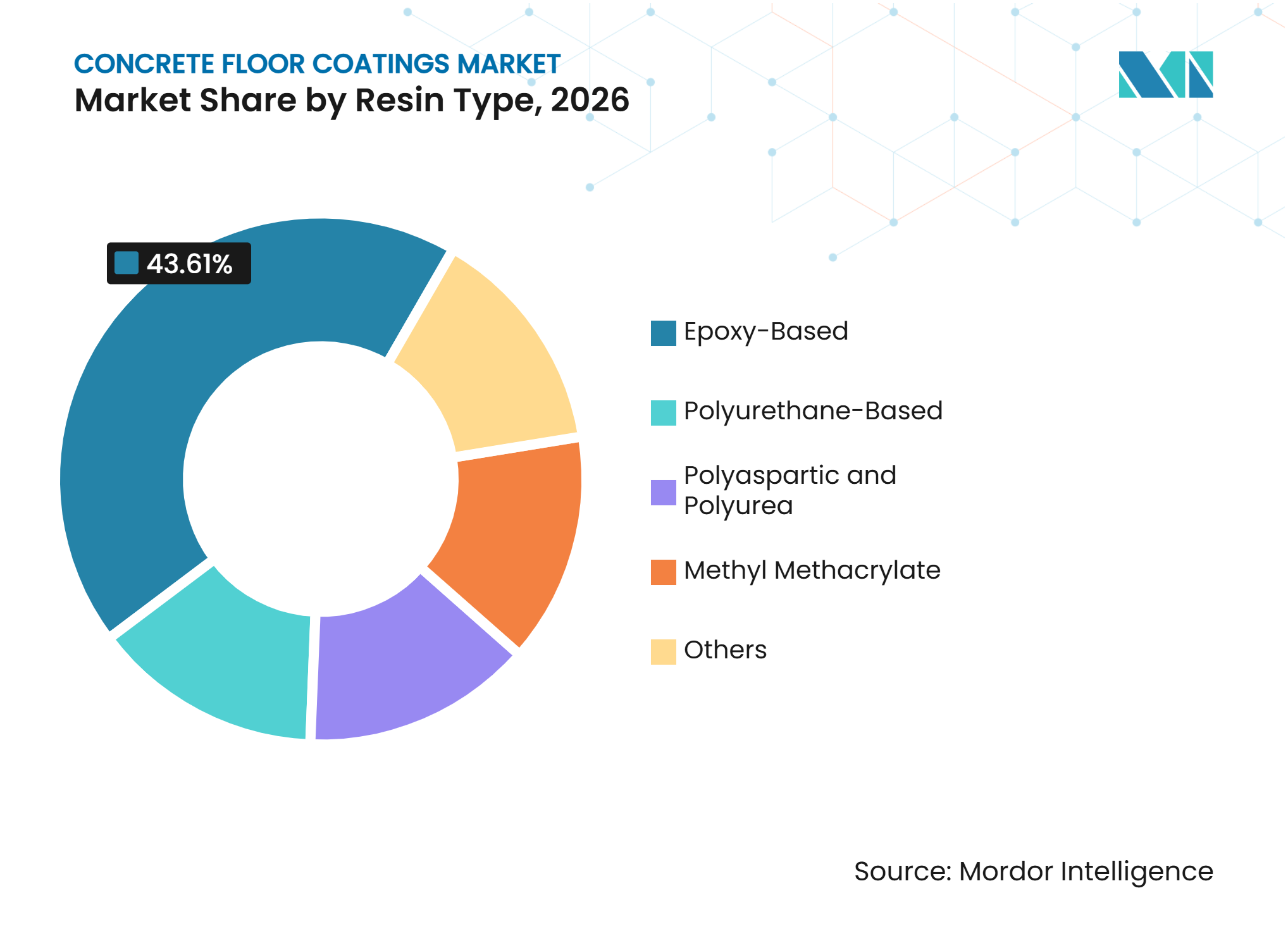
- By resin type, epoxy-based held 43.61% of the concrete floor coatings market share in 2026, while polyaspartic and polyurea are projected to advance at a 7.28% CAGR through 2032.
- By application, indoor held 66.78% of the concrete floor coatings market share in 2026, while outdoor is projected to advance at a 7.45% CAGR through 2032.
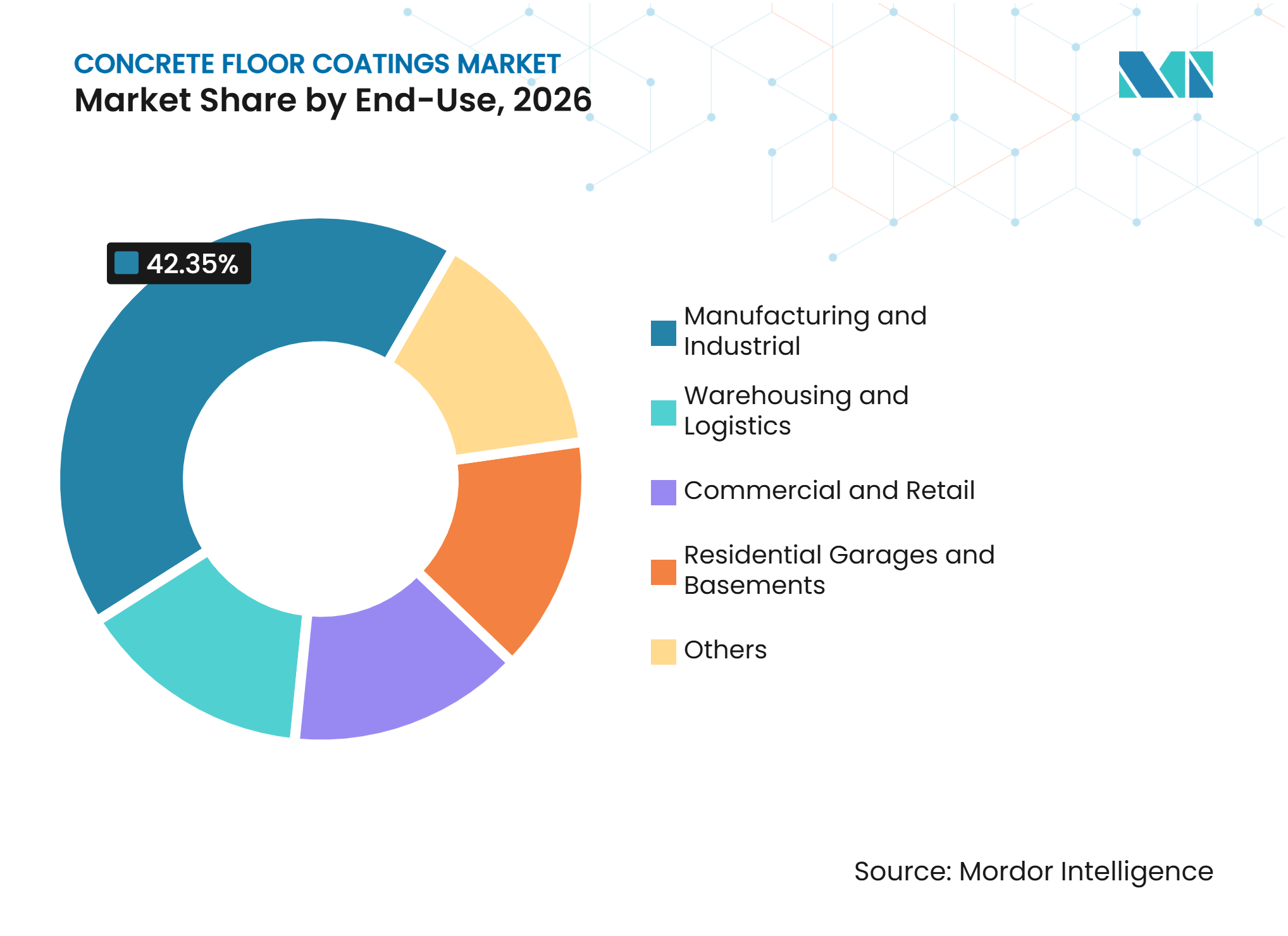
- By end-use, manufacturing and industrial held 42.35% of the concrete floor coatings market share in 2026, while warehousing and logistics are projected to advance at a 7.77% CAGR through 2032.
- By geography, Asia-Pacific held 38.11% of the concrete floor coatings market share in 2026 and is projected to advance at a 7.62% CAGR through 2032.
Note: Market numbers in this report are based on Mordor Intelligence's proprietary estimation framework, which combines nine months of actuals with Q4 projections for base year 2026.
Market Trends and Insights
Drivers Impact Analysis of Concrete Floor Coatings Market*
| Driver | (~) % Impact on CAGR Forecast | Geographic Relevance | Impact Timeline |
|---|---|---|---|
| Industrial and Logistics Facility Expansion | +2.3% | Global, concentrated in APAC and North America | Medium term (2-4 years) |
| EV Battery and Semiconductor Facility Construction | +1.6% | APAC core, spillover to North America and EU | Medium term (2-4 years) |
| Hygiene and Safety Requirements in Regulated Facilities | +1.0% | Global, led by North America and EU | Short term (≤ 2 years) |
| Facility Renovation and Lifecycle Protection Demand | +0.8% | Global, with early gains in mature markets | Long term (≥ 4 years) |
| Green-Building and Low-VOC Specification Requirements | +0.5% | EU, North America, and high-income APAC markets | Medium term (2-4 years) |
| Source: Mordor Intelligence | |||
Industrial and Logistics Facility Expansion
Private fixed investment in U.S. structures reached USD 213.8 billion in 2025, sustaining a large pipeline of industrial floor area that requires protection at commissioning. New plants and logistics buildings create demand for epoxy and polyurethane systems because newly placed concrete needs protection from traffic, abrasion, and chemical exposure. The concrete floor coatings market is moving toward longer-life systems when owners expect production sites to operate for 10 to 20 years. A high-build resin system can reduce lifecycle costs when compared with multiple cycles of lower-cost coatings. This pattern favors premium specifications even where total installed floor area is rising.
EV Battery and Semiconductor Facility Construction
Electric vehicle battery plants require different flooring systems across cleanrooms, cell assembly, formation, and testing areas. Electrostatic-dissipative epoxy is used where surface resistivity must meet American National Standards Institute/ESD Association (ANSI/ESD) S20.20 requirements, while solvent-handling areas may require novolac epoxy. Dry rooms and cell assembly areas also operate within cleanroom requirements set by ISO 14644-1. These layered requirements make specialized floor systems materially more valuable than a standard industrial epoxy installation. The concrete floor coatings market, therefore, gains from a project type that needs chemical resistance, static control, and thermal-shock performance in the same facility.
Hygiene and Safety Requirements in Regulated Facilities
Occupational Safety and Health Administration (OSHA) rules require industrial walking-working surfaces to be kept clean, sanitary, and dry[1]. Pharmaceutical, food and beverage, and healthcare facilities use seamless, chemical-resistant surfaces because wet processes and cleaning regimes make floor failure costly. These requirements generate renovation demand even when new construction weakens. Facility managers also replace damaged floors before they create compliance or safety problems. Green Seal updated its GS-40 standard in 2025 to prohibit intentionally added per- and polyfluoroalkyl substances in certified floor finishes from March 2027, adding another specification consideration for institutional flooring.
Green-Building and Low-VOC Specification Requirements
The U.S. Environmental Protection Agency (EPA) limits volatile organic compound content for floor coatings under 40 Code of Federal Regulations (CFR) Part 59[2]. China implemented GB 30981.1-2025 and GB 30981.2-2025 on June 1, 2026, with tighter limits for harmful substances in architectural and industrial coatings. These rules encourage waterborne and ultraviolet-cured formulations, although reformulation can raise product costs. Low-emission products can also support Leadership in Energy and Environmental Design (LEED) and Building Research Establishment Environmental Assessment Method certification goals. This creates an advantage for suppliers with documented environmental product data and established research capabilities.
Restraints Impact Analysis of Concrete Floor Coatings Market*
| Restraint | (~) % Impact on CAGR Forecast | Geographic Relevance | Impact Timeline |
|---|---|---|---|
| Raw Material Price Volatility | -0.8% | Global | Short term (≤ 2 years) |
| VOC Reformulation and Compliance Costs | -0.5% | EU, North America, and high-growth APAC markets | Medium term (2-4 years) |
| Shortage of Qualified Flooring Applicators | -0.4% | North America, EU, and high-income APAC markets | Long term (≥ 4 years) |
| Source: Mordor Intelligence | |||
Raw Material Price Volatility
Epoxy resins depend on bisphenol-A and epichlorohydrin, which are petrochemical derivatives exposed to supply disruption and oil-price movements. Floor coating suppliers cannot always pass higher input costs to customers with fixed-price construction contracts. This can narrow margins, particularly in standardized product lines sold to smaller contractors. The problem is acute when resin prices rise after a project price has been agreed. Suppliers are responding through formulation capability, selective procurement, and the use of alternative chemistries where specifications allow.
VOC Reformulation and Compliance Costs
Reformulating solvent-borne epoxy and polyurethane systems requires continuing research, testing, regulatory documentation, and revised technical data sheets. Larger companies can spread this work across global product lines, while smaller producers may need to limit their portfolios or leave regulated categories. The cost of third-party testing and local approvals can be significant for each product family. The concrete floor coatings market can therefore become more concentrated in jurisdictions that tighten compliance rules. This pressure also encourages global suppliers to use their compliant portfolios as a competitive barrier.
*Our forecasts treat driver/restraint impacts as directional, not additive. The impact forecasts reflect baseline growth, mix effects, and variable interactions.
Concrete Floor Coatings Market Segment Analysis
By Resin Type:
Epoxy-Based Retains Scale, While Polyaspartic and Polyurea ExpandEpoxy-based held 43.61% of the concrete floor coatings market share in 2026. Their leading position reflects strong chemical resistance, adhesion, and cost performance in heavy-duty industrial facilities. Epoxy remains embedded in specification documents and procurement templates that change slowly. This installed specification base supports continued demand in factories, warehouses, and regulated facilities. Polyaspartic and polyurea are projected to advance at a 7.28% CAGR through 2032 because their cure time can reduce the shutdown period that conventional epoxy systems require. This benefit matters in e-commerce fulfillment centers and food manufacturing plants, where production interruptions carry direct operating costs.
Polyurethane-based coatings provide ultraviolet stability and flexibility for spaces exposed to temperature changes or daylight. Methyl methacrylate systems serve applications that need rapid curing at low temperatures, including cold-storage facilities. Other resin types include cementitious polyurethane, acrylic, and hybrid systems used where thermal shock resistance or traffic-deck performance is needed. LATICRETE International, Inc. offers SPARTACOTE polyaspartic systems, while Sika AG markets Sikafloor polyaspartic products for rapid-return applications. Moisture mitigation is increasingly included with the floor system, as shown by LATICRETE International, Inc.’s VAPOR BAN Primer W launch in September 2025. The product combined moisture control and priming in one water-based step, increasing the value of an integrated installation system.



By Application:
Indoor Provides Revenue, While Outdoor ExpandsIndoor held 66.78% of the concrete floor coatings market share in 2026. Their scale comes from the number of interior spaces that require hygienic, seamless, and durable surfaces. Pharmaceutical cleanrooms, food plants, warehouses, and commercial facilities all support indoor demand. Renovation cycles within these locations help maintain demand through changes in the broader construction cycle. Occupational Safety and Health Administration requirements reinforce the need to maintain safe indoor walking-working surfaces. The concrete floor coatings market size for outdoor applications is projected to expand at a 7.45% CAGR through 2032.
Outdoor demand is rising as infrastructure projects extend coating use beyond enclosed industrial floors. Stadiums, parking structures, rooftop terraces, and logistics yards need surfaces that can tolerate ultraviolet exposure, freeze-thaw cycles, and de-icing chemicals. Polyaspartic and polyurea systems are well positioned because they offer stronger ultraviolet stability than conventional epoxy products. Semi-enclosed areas, including loading docks and automotive service spaces, also combine weather exposure with heavy vehicle traffic. ASTM International requirements and EN 13813 requirements give specifiers a basis for selecting documented systems. These requirements favor suppliers with tested products rather than suppliers competing only on price.
By End-Use:
Manufacturing and Industrial Provide the Largest Base, While Warehousing and Logistics Advance FasterManufacturing and industrial held 42.35% of the concrete floor coatings market share in 2026. These locations need coatings that withstand chemicals, mechanical traffic, and frequent cleaning. Electric vehicle battery plants and semiconductor fabrication facilities require higher-value systems because different zones have distinct static-control and chemical-resistance requirements. This raises the value of the installed floor even when the area is not unusually large. The concrete floor coatings market is also supported by commercial and retail renovations, where decorative resin floors combine protection with a finished appearance. RPM International Inc.’s Flowcrete brand supplies decorative epoxy terrazzo systems for these locations.
Warehousing and logistics are projected to advance at a 7.77% CAGR through 2032. Automated fulfillment centers place concentrated loads on floors through forklifts, automated guided vehicles, and dense storage patterns. U.S. private fixed investment in warehouse structures reached USD 57.9 billion in 2025, maintaining a high base of activity despite moderation from the 2023 peak. Residential garages and basements are a smaller use case served through simplified two-coat polyaspartic kits. These systems lower the technical barrier for property owners by curing within hours. Other uses include bridges, parking structures, and sports facilities that need traffic-deck or high-durability formulations.

Geography Analysis
Asia-Pacific
Asia-Pacific held 38.11% of the concrete floor coatings market share in 2026 and is projected to advance at a 7.62% CAGR through 2032. China, India, South Korea, and Association of Southeast Asian Nations (ASEAN) countries are adding industrial parks, logistics hubs, and electric vehicle supply-chain sites. This construction supports demand across commodity epoxy, specialized electrostatic-dissipative systems, and chemical-resistant floors. China’s GB 30981.1-2025 and GB 30981.2-2025 standards took effect in June 2026 and tightened restrictions on harmful substances in coating products. The regulatory change reduces the scope for older solvent-borne systems and supports waterborne and ultraviolet-cured alternatives. India’s manufacturing expansion also adds factory floor area, while Nippon Paint Holdings Co., Ltd. and Asian Paints compete for industrial specifications.
North America
North America is a major value center because it has high specification value per square foot and a growing need to renovate facilities built during the 2020 to 2023 industrial expansion. U.S. investment in private nonresidential structures reached USD 213.8 billion in 2025, supporting demand at new facilities and later renovation cycles. Electric vehicle battery projects have made the region an important testing ground for static-control and chemical-resistant flooring systems. The Sherwin-Williams Company markets Poly-Crete and electrostatic-dissipative urethane systems for these applications, while Sika AG offers Sikafloor electrostatic-dissipative products. U.S. Environmental Protection Agency rules, California Air Resources Board rules, and local measures in Arizona maintain pressure for low-volatile-organic-compound portfolios. These compliance factors raise entry requirements for basic products and favor companies with tested, documented systems.
Europe, South America, and Middle East and Africa
Europe is supported by pharmaceutical, food and beverage, and automotive facilities that require premium floor systems under EN 13813 and EN 13892. The European Union Decopaint framework supports a shift away from solvent-borne systems, while Nordic building requirements have encouraged waterborne products. South America is supported by logistics and food processing investment in Brazil, with more specialized demand in Argentina’s pharmaceutical facilities. The Middle East and Africa are adopting high-performance outdoor and parking coatings for new infrastructure. Saudi Arabia’s Vision 2030 pipeline is supporting this demand, while Hempel A/S reported infrastructure growth and project wins in the Middle East during 2025. These regions show how compliance standards, maintenance needs, and climate exposure can shape product selection differently across the concrete floor coatings market.
Competitive Landscape
Market Concentration
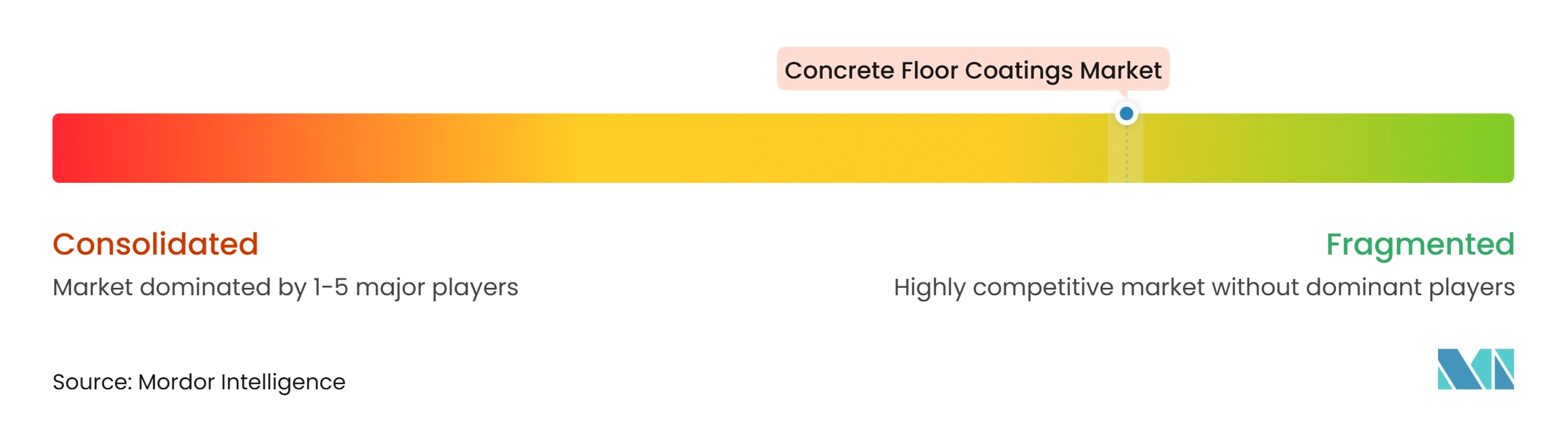
The concrete floor coatings market is highly fragmented, with top players including Sika AG, RPM International Inc., The Sherwin-Williams Company, MAPEI S.p.A., and Akzo Nobel N.V. Global suppliers compete for industrial and commercial contracts where technical documentation, installation support, and system warranties matter. Regional producers retain relevance where they can respond quickly to local climatic conditions and applicator needs. Sika AG, RPM International Inc., and The Sherwin-Williams Company have broad portfolios that address industrial flooring requirements. This scale supports continued investment in floor-system development, including water-based, bio-based, electrostatic-dissipative, and industrial products.
Competition increasingly centers on complete systems rather than a single coating layer. Sika AG, MAPEI S.p.A., and LATICRETE International, Inc. combine substrate preparation, moisture control, primers, body coats, and topcoats within one supplier offering. Sika AG completed the acquisition of HPS North America, Inc. in March 2025, adding the Schönox brand and widening its floor preparation capabilities. Sika AG also completed its acquisition of Finja in February 2026, strengthening its Nordic floor leveling and dry mortar presence. RPM International Inc. reported record fiscal 2025 Performance Coatings Group sales, with turnkey flooring demand supporting performance in high-performance buildings. These moves help suppliers offer a single source from substrate preparation to the finished surface.
Environmental documentation is becoming a competitive factor alongside cure speed and durability. The American Coatings Association published Product Category Rules for resinous floor coatings in February 2026, giving suppliers a common basis for environmental product declarations. Companies with verified lifecycle data can respond more effectively to specifications linked to green-building certifications. Akzo Nobel N.V. and Axalta Coating Systems Ltd. signed a merger agreement in November 2025, and both companies continue to operate independently pending approvals. The proposed combination could strengthen distribution and technology resources across protective and industrial coatings. Training networks also remain important because correct installation is essential for high-performance resin floors.
Concrete Floor Coatings Industry Leaders
-
Sika AG
-
RPM International Inc.
-
The Sherwin-Williams Company
-
MAPEI S.p.A.
-
Akzo Nobel N.V.
- *Disclaimer: Major Players sorted in no particular order
Concrete Floor Coatings Market Companies Covered in this Report
- Akzo Nobel N.V.
- Ardex Group
- Asian Paints
- Axalta Coating Systems Ltd.
- Hempel A/S
- Jotun
- LATICRETE International, Inc.
- MAPEI S.p.A.
- Nippon Paint Holdings Co., Ltd.
- PPG Industries, Inc.
- RPM International Inc.
- Sika AG
- Sto SE & Co. KGaA
- Tennant Company
- The Sherwin-Williams Company
Recent Industry Developments in Concrete Floor Coatings Market
- September 2026: Master Builders Solutions launched MasterCoat ULTRA, a next-generation polyurethane concrete flooring system in Turkey, designed for food and beverage, pharmaceutical, healthcare, chemical, and heavy manufacturing facilities. The product offers chemical and mechanical resistance, thermal-shock protection, slip-resistant and antistatic options, supporting the concrete floor coatings market through advanced flooring solutions for demanding industrial environments.
- March 2025: BASF and Sika AG jointly introduced Baxxodur EC 151, a new amine-based epoxy hardener designed for high-performance flooring applications in production facilities, warehouses, assembly halls and parking decks. The formulation improved color stability and application at temperatures as low as 5 °C, supporting the concrete floor coatings market through more efficient and lower-emission epoxy flooring systems.
Global Concrete Floor Coatings Market Report Scope
Concrete floor coatings are protective and decorative surface treatments applied to concrete floors to improve durability, chemical resistance, abrasion resistance, and appearance. These coatings help protect concrete surfaces from moisture, heavy foot traffic, mechanical wear, and chemical exposure. They are widely used in industrial facilities, warehouses, commercial spaces, and residential buildings.
The Concrete Floor Coatings Market is segmented by resin type, application, end-use, and geography. By resin type, the market is segmented into epoxy-based, polyurethane-based, polyaspartic and polyurea, methyl methacrylate, and other resin types. By application, the market is segmented into indoor and outdoor. By end-use, the market is segmented into manufacturing and industrial, warehousing and logistics, commercial and retail, residential garages and basements, and others. The report also covers the market size and forecasts for concrete floor coatings in 15 countries across major regions. For each segment, the market sizing and forecasts have been done on the basis of value (USD).
Segmentation Overview
| Epoxy-Based |
| Polyurethane-Based |
| Polyaspartic and Polyurea |
| Methyl Methacrylate |
| Others |
| Indoor |
| Outdoor |
| Manufacturing and Industrial |
| Warehousing and Logistics |
| Commercial and Retail |
| Residential Garages and Basements |
| Others |
| Asia-Pacific | China |
| India | |
| Japan | |
| South Korea | |
| ASEAN Countries | |
| Rest of Asia-Pacific | |
| North America | United States |
| Canada | |
| Mexico | |
| Europe | Germany |
| United Kingdom | |
| France | |
| Italy | |
| NORDIC Countries | |
| Rest of Europe | |
| South America | Brazil |
| Argentina | |
| Rest of South America | |
| Middle East and Africa | Saudi Arabia |
| South Africa | |
| Rest of Middle East and Africa |
| By Resin Type | Epoxy-Based | |
| Polyurethane-Based | ||
| Polyaspartic and Polyurea | ||
| Methyl Methacrylate | ||
| Others | ||
| By Application | Indoor | |
| Outdoor | ||
| By End-Use | Manufacturing and Industrial | |
| Warehousing and Logistics | ||
| Commercial and Retail | ||
| Residential Garages and Basements | ||
| Others | ||
| By Geography | Asia-Pacific | China |
| India | ||
| Japan | ||
| South Korea | ||
| ASEAN Countries | ||
| Rest of Asia-Pacific | ||
| North America | United States | |
| Canada | ||
| Mexico | ||
| Europe | Germany | |
| United Kingdom | ||
| France | ||
| Italy | ||
| NORDIC Countries | ||
| Rest of Europe | ||
| South America | Brazil | |
| Argentina | ||
| Rest of South America | ||
| Middle East and Africa | Saudi Arabia | |
| South Africa | ||
| Rest of Middle East and Africa | ||
Key Questions Answered in the Report
What is the size of the concrete floor coatings market?
The concrete floor coatings market size was valued at USD 5.54 billion in 2026 and is estimated to grow from USD 5.90 billion in 2027 to reach USD 8.10 billion by 2032, at a CAGR of 6.57% during the forecast period (2027-2032).
Which resin type held the largest share in 2026?
Epoxy-based resin held 43.61% of the market share in 2026 because it offered established chemical resistance, adhesion, and cost performance.
Which resin type is projected to advance fastest through 2032?
Polyaspartic and polyurea coatings are projected to advance at a 7.28% CAGR through 2032 because they reduce installation downtime.
Why do electric vehicle battery plants need specialized floor coatings?
Battery plants need static-control, chemical-resistant, and thermal-shock-resistant systems across different production zones.