
Compute Express Link (CXL) Memory Market Size and Share
Market Overview
| Study Period | 2020 - 2031 |
|---|---|
| Market Size (2026) | USD 2.47 Billion |
| Market Size (2031) | USD 12.86 Billion |
| Growth Rate (2026 - 2031) | 39.09 % |
| Fastest Growing Market | Asia-Pacific |
| Largest Market | North America |
| Market Concentration | Medium |
Major Players *Disclaimer: Major Players sorted in no particular order Image © Mordor Intelligence. Reuse requires attribution under CC BY 4.0. | |
Compute Express Link (CXL) Memory Market Analysis by Mordor Intelligence
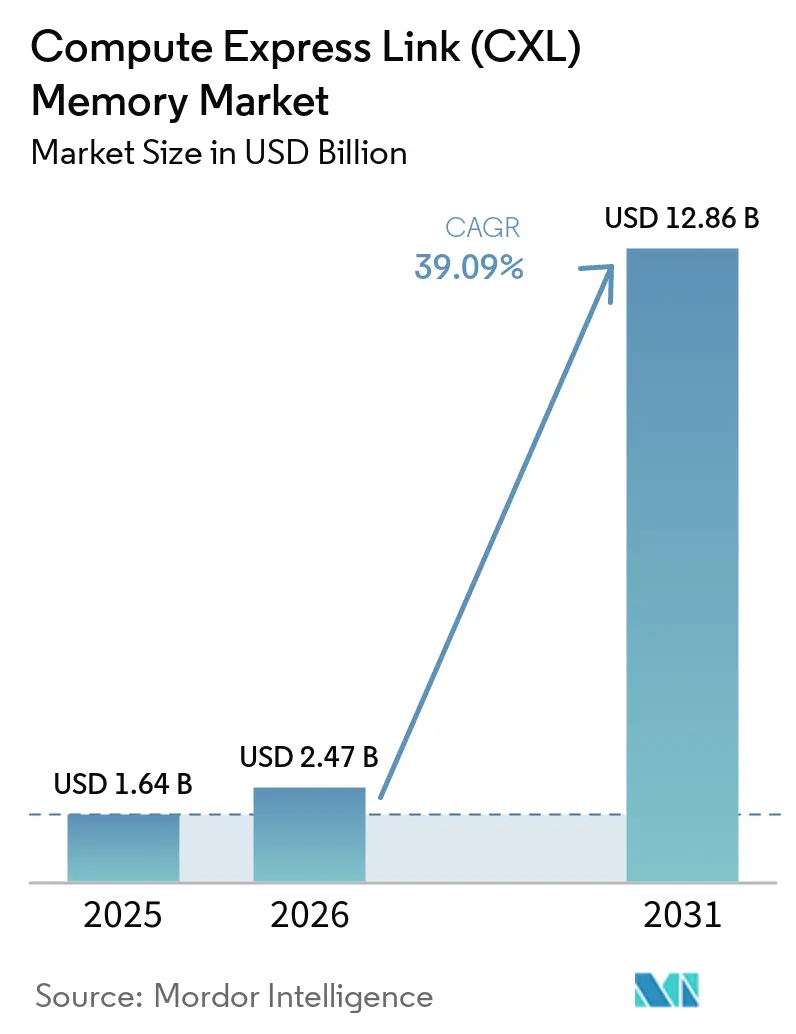
The Compute Express Link (CXL) Memory market size is projected to be USD 1.64 billion in 2025, USD 2.47 billion in 2026, and reach USD 12.86 billion by 2031, growing at a CAGR of 39.09% from 2026 to 2031. Growth is tied to memory bandwidth limits in AI training and inference workloads. Operators need more usable memory without adding compute in equal measure. CXL uses the PCIe physical layer to provide a low-latency, cache-coherent connection for pooled memory. This makes node-local DRAM less central to large AI deployments and supports memory disaggregation at scale. The Compute Express Link (CXL) Memory market also benefits when validated systems improve GPU utilization and reduce the cost of serving tokens.
Key Report Takeaways
- By product type, CXL Memory Modules held 43.82% of the Compute Express Link (CXL) Memory market share in 2025, while CXL Memory Appliances are projected to grow at a 40.76% CAGR through 2031.
- By memory type, Volatile Memory held 92.18% of revenue in 2025, while Persistent Memory is projected to grow at a 41.92% CAGR through 2031 in the Compute Express Link (CXL) Memory Market.
- By application, AI Infrastructure accounted for 48.67% of revenue in 2025 and is projected to grow at a 39.98% CAGR through 2031 in the Compute Express Link (CXL) Memory Market.
- By end user, Hyperscale Cloud Providers held 58.94% of revenue in 2025 and are projected to grow at a 39.76% CAGR through 2031 in the Compute Express Link (CXL) Memory Market.
- By geography, North America held 42.73% of revenue in 2025, while Asia-Pacific is projected to grow at a 40.88% CAGR through 2031 in the Compute Express Link (CXL) Memory Market.
Note: Market size and forecast figures in this report are generated using Mordor Intelligence’s proprietary estimation framework, updated with the latest available data and insights as of January 2026.
Global Compute Express Link (CXL) Memory Market Trends and Insights
Drivers Impact Analysis*
| Driver | (~) % Impact on CAGR Forecast | Geographic Relevance | Impact Timeline |
|---|---|---|---|
| AI-Driven Memory Bottlenecks in Heterogeneous Compute | +12.5% | Global, with highest intensity in North America and Asia-Pacific AI infrastructure clusters | Short term (≤ 2 years) |
| Memory Disaggregation for Better Utilization and Lower TCO | +8.3% | Global, with early commercial adoption in North American hyperscalers and Asia-Pacific enterprise data centers | Medium term (2-4 years) |
| CXL 3.x Ecosystem Readiness Across CPUs, Memory, and Switches | +6.2% | North America and Asia-Pacific, with spillover to Europe as AI data center investment advances | Medium term (2-4 years) |
| Hyperscale Demand for Composable Infrastructure | +5.1% | North America, China, Japan, South Korea, Taiwan, and Europe | Medium term (2-4 years) |
| Software-Defined Memory Tiering in Enterprise Data Centers | +3.8% | North America and Europe, with early gains in Asia-Pacific financial-services clusters | Long term (≥ 4 years) |
| Rack-Scale and Multi-Host Memory Sharing Requirements | +2.4% | Global, led initially by hyperscalers and followed by enterprises | Long term (≥ 4 years) |
| Source: Mordor Intelligence | |||
AI-Driven Memory Bottlenecks in Heterogeneous Compute
Enterprise AI inference pipelines were commonly memory-driven rather than compute-driven, leaving GPUs idle when KV cache requirements exceeded available DRAM. CXL-attached memory extends capacity beyond CPU-attached DIMM slots and helps serve longer context windows. It also allows higher inference concurrency without a proportional rise in GPU nodes. Research identifies CXL memory disaggregation as an architectural response to the widening compute-memory imbalance in intelligent computing centers. Larger models increase this mismatch because their parameter and cache requirements rise with workload complexity. The Compute Express Link (CXL) Memory market, therefore, serves training and inference workloads rather than a temporary hardware replacement cycle.
Memory Disaggregation for Better Utilization and Lower TCO
Static provisioning leaves memory underused when compute-intensive and memory-intensive workloads run on separate nodes. A shared CXL pool lets capacity move to workloads that need it rather than remaining assigned to a single server. Astera Labs stated that its Leo controllers running on Microsoft Azure M-series virtual machines achieved more than 1.5 times the server-memory scaling on Intel Xeon 6 platforms.[1] Meta's Vistara project showed that reused DDR4 memory can be attached to newer hosts through CXL. The Compute Express Link (CXL) Memory Market can therefore align lower infrastructure demand with the reuse of memory that would otherwise be retired. This combination broadens the case for procurement across performance, cost, and sustainability priorities.
CXL 3.x Ecosystem Readiness Across CPUs, Memory, and Switches
CXL developed from single-host expansion in version 1.1 to pooling in version 2.0 and multi-rack connectivity in version 3.x. CXL 3.x adds Port-Based Routing and uses PCIe Gen 6 to support 64 GT/s bandwidth. The CXL Consortium reported that CXL 2.0 memory pooling was in production and expected wider deployment as CXL 3.x platforms became available. Marvell introduced its Structera S 30260 switch in March 2026 with 260 lanes and 4 TB/s of aggregate bandwidth. Broad deployment still depends on compatible host processors, including Intel Diamond Rapids and AMD EPYC Venice. The Compute Express Link (CXL) Memory Market may grow rapidly as these platforms become more widely available.
Hyperscale Demand for Composable Infrastructure
Hyperscale operators manage varied workloads that often create memory shortages and leave DRAM on nearby systems underused. Composable infrastructure lets operators allocate pooled capacity across tenants and workloads in real time. Astera Labs reported fiscal 2025 revenue of USD 852.5 million, up 115% from the prior year, while identifying memory connectivity as a core product area. Liqid's EX-5410C SmartStack supports up to 20 TB per chassis and can scale beyond 100 TB within a single LIQID fabric. The Compute Express Link (CXL) Memory Market enables cloud operators to better match virtual-machine memory allocations to customer demand. Higher virtual-machine density can also support premium pricing for memory-intensive instances.
Restraints Impact Analysis*
| Restraint | (~) % Impact on CAGR Forecast | Geographic Relevance | Impact Timeline |
|---|---|---|---|
| Legacy Server Upgrade Complexity | -3.2% | Global, especially enterprise environments with multiyear refresh cycles | Short term (≤ 2 years) |
| Interoperability and Validation Friction Across Vendors | -2.8% | Global, particularly enterprise and telecom deployments with heterogeneous hardware | Medium term (2-4 years) |
| High Initial Deployment Cost for Controllers, Modules, and Fabric Software | -2.1% | Global, with greater effects on midmarket enterprises and regional data centers | Medium term (2-4 years) |
| Security and Memory Isolation Concerns in Shared Pools | -1.4% | Global, especially multitenant cloud, BFSI, and government workloads | Long term (≥ 4 years) |
| Source: Mordor Intelligence | |||
Legacy Server Upgrade Complexity
Most installed servers use DDR4 or DDR5 DIMMs and lack the PCIe 5.0 lanes and firmware needed for CXL devices. An IEEE study found that CXL deployment outside targeted programs remained limited and that announced cloud configurations commonly used Intel Xeon 6 hosts. Enterprises with 4-5-year refresh cycles often must replace hardware before adopting CXL. Operating-system tiering, hypervisor NUMA awareness, and memory allocation libraries also need coordinated updates. These requirements create an adoption lag for the Compute Express Link (CXL) Memory Market among enterprise and midmarket buyers. The limitation is transitional, but it can constrain deployments through 2027.
Interoperability and Validation Friction Across Vendors
A production CXL configuration links host CPUs, controllers, memory modules, switches, retimers, operating systems, and application runtimes. The resulting qualification work can compete with other modernization priorities and delay purchases until scheduled server refreshes occur. Each layer can add qualification work before the system is ready for deployment. The IEEE study describes practical challenges in incrementally scaling CXL deployments across cloud environments. Intel's guidance also requires alignment with CXL, ACPI, UEFI, and SNIA Persistent Memory Programming standards. Smaller operators may not have the resources to conduct simultaneous validation across multiple suppliers. This places early Compute Express Link (CXL) Memory Market adoption with hyperscalers that maintain dedicated hardware validation teams.
*Our forecasts treat driver/restraint impacts as directional, not additive. The impact forecasts reflect baseline growth, mix effects, and variable interactions.
Segment Analysis
By Product Type: Modules Lead Early Revenue While Appliances Support Shared Memory Fabrics
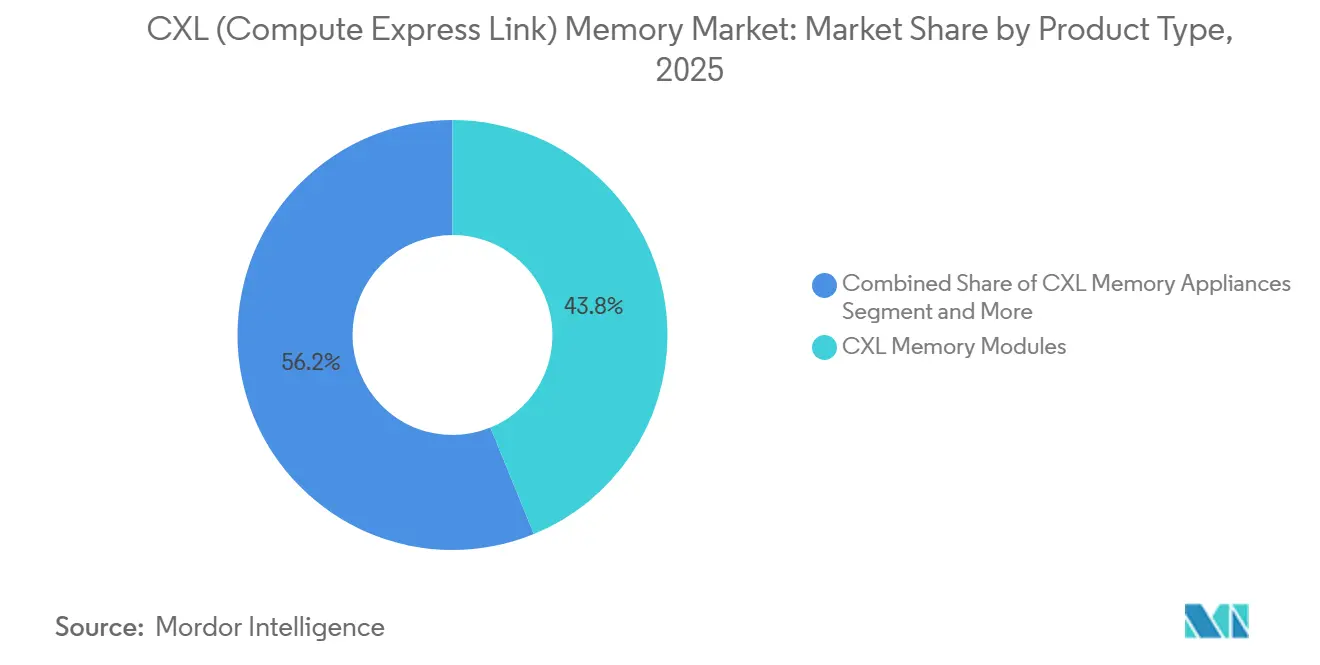
CXL Memory Modules held 43.82% of the Compute Express Link (CXL) Memory Market share in 2025. Their lead reflected compatibility with E3.S and EDSFF server form factors already used in data centers. Modules offer a lower integration barrier than chassis-level systems and are well-suited to early CXL deployments. CXL Memory Appliances are projected to grow at a 40.76% CAGR through 2031. They combine switches, device bays, and management software to enable operators to share pools across multiple hosts.
Samsung's Pangea v2 appliance achieved 10.2 times higher data transfer throughput than conventional RDMA solutions and reduced bottlenecks by up to 96%. The company planned Pangea v3, based on CXL 3.2, for 2026. CXL Memory Expanders remain useful where a single host needs more capacity without switching. Netlist's NVvault uses CXL Global Persistent Flush to support DRAM-to-NAND backup after power loss. CXL Switches, controllers, and retimers remain essential because they enable memory fabrics, mapping, cache coherence, and signal conditioning. The Compute Express Link (CXL) memory industry depends on these components even when buyers deploy modules or appliances.

By Memory Type: Volatile Memory Retains Scale While Persistent Memory Addresses Durability Needs
Volatile Memory accounted for 92.18% of revenue in 2025. This concentration reflects capacity and bandwidth expansion use cases based on established DRAM technology. In 2025, commercial CXL modules from Samsung Electronics, SK hynix, and Micron Technology were DRAM-based. These products let operators add memory without changing the application's memory access model. CXL 2.0 deployments also centered on DRAM capacity pooling, which favored volatile configurations.
The CXL Consortium's reliability whitepaper discussed volatile-memory reliability across CXL 2.0 and CXL 3.1.[2] Persistent Memory is forecast to grow at a 41.92% CAGR through 2031 within the CXL memory market size. It targets in-memory databases, AI checkpoint recovery, and distributed caches that need data to survive a power event. The Global Persistent Flush protocol supports ordered persistence across power loss and can pair DRAM-like access with NAND-backed durability. Research presented at HPCA 2026 addressed reliability and security methods for CXL memory HPCA. These technical foundations support broader enterprise use of persistent configurations.
By Application: AI Infrastructure Holds the Largest Role as Data Center Uses Broaden
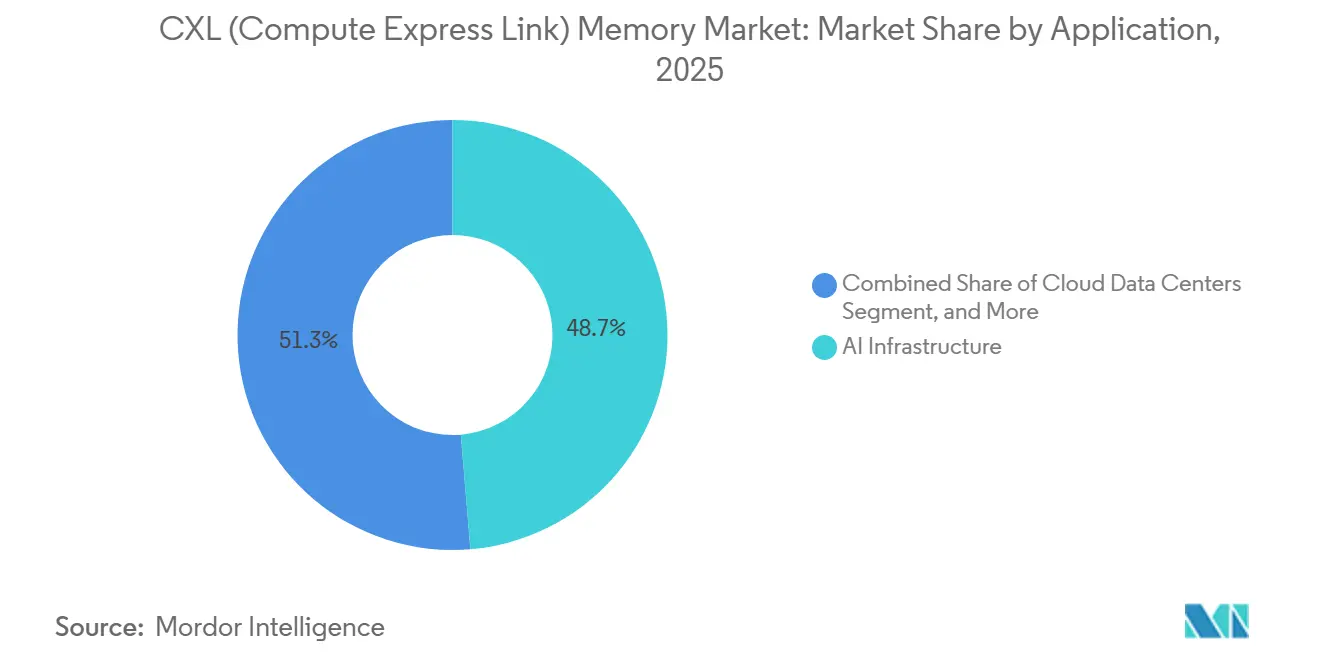
AI Infrastructure accounted for 48.67% of the Compute Express Link (CXL) Memory market size in 2025. It is also projected to grow at a 39.98% CAGR through 2031. Large language model inference requires growing DRAM capacity as context windows and model sizes increase. CXL can expand available memory without requiring additional compute nodes. This makes AI infrastructure the central application for early CXL deployments.
Cloud and enterprise data centers are the next-largest application groups because disaggregation can improve memory utilization in mixed workloads. Alibaba Cloud research on PolarDB showed the use of CXL pooling for cloud-native databases without performance degradation. HPC users also need high memory capacity for simulation and genomics work. Edge infrastructure remains in its early stages because power and thermal limits constrain hardware choices. Compact CXL 3.x switching may improve its long-term fit for edge systems. The Compute Express Link (CXL) Memory Market supports these applications with a common memory-fabric approach.
By End User: Hyperscalers Set the Adoption Pace While Enterprise Verticals Form Future Demand
Hyperscale Cloud Providers held 58.94% of the Compute Express Link (CXL) memory market share in 2025. They are projected to grow at a 39.76% CAGR through 2031. Their scale allows them to absorb early technology risk and fund specialized validation work. Microsoft Azure made CXL-attached memory available on M-series virtual machines during a private preview in November 2025. Meta's Vistara project also showed that major operators can treat CXL architecture as a proprietary capability.
Enterprise IT and telecom buyers seek more memory for database modernization and real-time analytics. BFSI organizations can use pooled memory for risk-calculation and fraud-detection workloads. Healthcare users can hold larger genomics and medical imaging datasets without upgrading every server. Manufacturing and public-sector users are earlier-stage adopters who need AI systems with performance, isolation, and sovereign infrastructure. Consequently, the Compute Express Link (CXL) memory market has a growing pipeline beyond its hyperscale base.
Geography Analysis
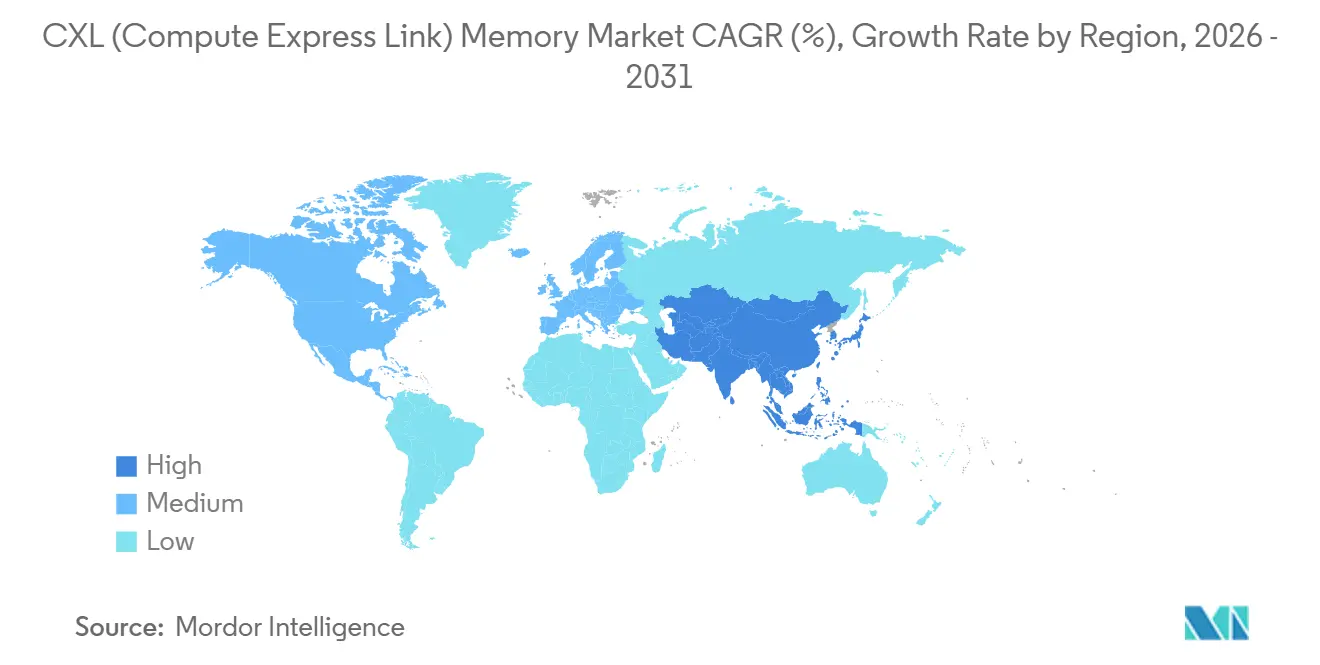
North America held 42.73% of the Compute Express Link (CXL) memory market share in 2025. The region combines hyperscale cloud operators with early production of controllers and retimer by U.S. semiconductor companies. Microsoft Azure's CXL private preview and Intel Granite Rapids support helped move the technology into commercial infrastructure. Astera Labs reported USD 852.5 million in revenue for fiscal 2025, driven by demand for rack-scale AI connectivity.[3] Dell Technologies, Hewlett Packard Enterprise, Super Micro Computer, and Liqid add system integration capacity. These conditions support North American leadership during the forecast period.
Asia-Pacific is projected to grow at a 40.88% CAGR through 2031. South Korean memory suppliers, Taiwan's semiconductor and ODM ecosystem, and the expansion of Chinese and Japanese AI data centers support this pace. Samsung Electronics and SK hynix are competing to develop CXL 3.2-based memory modules. SK hynix presented a second-generation 256 GB CMM-DDR5 based on CXL 3.2 in June 2026. Its Inference Memory Tier Expansion architecture places a CXL hybrid tier between HBM or DDR and SSD for AI inference workloads. Montage Technology also highlights the Asia-Pacific's expanding role in CXL controller supply.
Europe was the third-largest regional area, with adoption centered on BFSI, manufacturing, and HPC clusters. The European Commission's Cloud and AI Development Act proposal aims to triple EU data center capacity by 2035 and simplify project approvals. The rest of the world's demand includes the Middle East, South America, and Africa, where sovereign-cloud programs can support later adoption.
Competitive Landscape
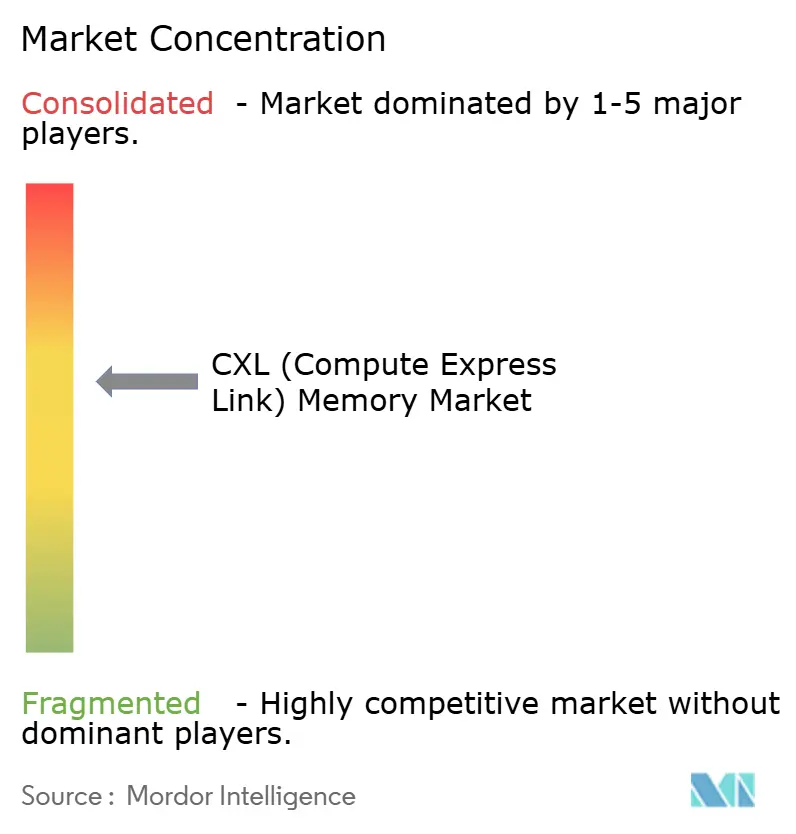
The Compute Express Link (CXL) memory market is moderately concentrated, but competitive positions differ across value-chain layers. Samsung Electronics, SK hynix, and Micron Technology lead the memory manufacturing industry. Astera Labs, Marvell Technology, Montage Technology, and Rambus are key suppliers of controllers and retimer. Liqid, GigaIO, H3 Platform, Dell Technologies, Hewlett Packard Enterprise, and Super Micro Computer compete in the appliance integration market. Memory manufacturers have moved away from in-house controller design, creating a role for specialized fabless suppliers. This structure can support recurring controller design wins as new server platforms reach production.
Astera Labs described Leo CXL Memory Connectivity Controllers and Scorpio Smart Fabric Switches as rack-scale AI infrastructure products in its fiscal 2025 annual report. Marvell launched the Structera S 30260 in March 2026 to support rack-level memory pooling with a 260-lane CXL 3.0 switch.[4] Samsung has pursued patent work on per-host memory encryption for CXL multitenant pools. H3 Platform completed real-world validation of its CXL memory-sharing and pooling system with pilot partners before its 2025 FMS debut. These moves show competition around component performance and deployable systems.
Software for tiering, monitoring, and workload-aware allocation remains an open area in the Compute Express Link (CXL) memory market. MemVerge and Liqid are working on control planes, while Meta and Microsoft are developing systems for their own infrastructure. Panmnesia and XConn indicate emerging competition in the fabric hardware space. PCIe Gen 6 provides CXL 3.x with 64 GT/s per lane, creating room for AI-focused memory fabrics. Competitive intensity is likely to rise as CXL 3.x systems reach volume production.
Compute Express Link (CXL) Memory Industry Leaders
-
SK hynix Inc.
-
Samsung Electronics Co., Ltd.
-
Micron Technology, Inc.
-
Astera Labs, Inc.
-
Montage Technology.
- *Disclaimer: Major Players sorted in no particular order
Recent Industry Developments
- July 2026: Samsung Electronics announced that its next-generation CXL Memory Module, CMM-D 3.0, has been upgraded from CXL 3.1 to CXL 3.2, with mass production targeted for year-end 2026. The CMM-D 3.0 introduces the CXL Hot Page Monitoring Unit (CHMU) function, which optimizes data flow among multiple memory devices by monitoring usage frequency, and doubles the bandwidth of the second-generation product. Samsung aims to become the first manufacturer to mass-produce a CXL 3.2-based module, building on its earlier CMM-D 1.0 (CXL 1.1, 2022) and CMM-D 2.0 (CXL 2.0, 2023) lineage.
- June 2026: SK hynix unveiled a sample of its second-generation CMM-DDR5 memory module, applying CXL 3.2 for the first time and offering 256 GB capacity, double that of the first-generation 128 GB, at the HPED 2026 international exhibition, and began commercial sales. The module was separately demonstrated running in a pooled-memory server from AI infrastructure firm Liqid at HPE's Discover conference in Las Vegas, the first public demonstration of a CXL 3.2 module operating in a production-class pooled-memory environment.
- March 2026: Marvell Technology launched the Structera S 30260, a 260-lane CXL switch device supporting CXL 3.0 with 4 TB/s aggregate bandwidth, at OFC 2026. The switch enables rack-level memory pooling by connecting CPUs, GPUs, and memory devices across server boundaries, and is expected to begin sampling to customers in Q3 2026.
- November 2025: Astera Labs announced that its Leo CXL Smart Memory Controllers are deployed in Microsoft Azure M-series virtual machines, marking the industry's first hyperscale cloud deployment of CXL-attached memory. The controllers support CXL 2.0 with up to 2 TB of memory capacity per controller, enabling cloud service providers to scale server memory by more than 1.5 times for AI and in-memory database workloads.
Global Compute Express Link (CXL) Memory Market Report Scope
The Compute Express Link (CXL) Memory Market Report is Segmented by Product Type (CXL Memory Expanders, CXL Memory Modules, CXL Switches, CXL Controllers and Retimers, CXL Controllers and Retimers, and CXL Memory Appliances), Memory Type (Volatile, and Persistent), Application (AI Infrastructure, Cloud Data Centers, Enterprise Data Centers, High Performance Computing, and Edge Infrastructure), End User (Hyperscale Cloud Providers, Enterprise IT and Telecom, Banking, Financial Services, and Insurance, Healthcare, Manufacturing, and Government and Public Sector), and Geography (North America, Europe, Asia Pacific, and Rest of the World). The Market Forecasts are Provided in Terms of Value (USD).
| CXL Memory Expanders |
| CXL Memory Modules |
| CXL Switches |
| CXL Controllers and Retimers |
| CXL Controllers and Retimers |
| CXL Memory Appliances |
| Volatile Memory |
| Persistent Memory |
| AI Infrastructure |
| Cloud Data Centers |
| Enterprise Data Centers |
| High Performance Computing |
| Edge Infrastructure |
| Hyperscale Cloud Providers |
| Enterprise IT and Telecom |
| Banking, Financial Services, and Insurance |
| Healthcare |
| Manufacturing |
| Government and Public Sector |
| North America | |
| Europe | |
| Asia-Pacific | China |
| Japan | |
| South Korea | |
| Taiwan | |
| Rest of Asia Pacific | |
| Rest of the World |
| By Product Type | CXL Memory Expanders | |
| CXL Memory Modules | ||
| CXL Switches | ||
| CXL Controllers and Retimers | ||
| CXL Controllers and Retimers | ||
| CXL Memory Appliances | ||
| By Memory Type | Volatile Memory | |
| Persistent Memory | ||
| By Application | AI Infrastructure | |
| Cloud Data Centers | ||
| Enterprise Data Centers | ||
| High Performance Computing | ||
| Edge Infrastructure | ||
| By End User | Hyperscale Cloud Providers | |
| Enterprise IT and Telecom | ||
| Banking, Financial Services, and Insurance | ||
| Healthcare | ||
| Manufacturing | ||
| Government and Public Sector | ||
| By Geography | North America | |
| Europe | ||
| Asia-Pacific | China | |
| Japan | ||
| South Korea | ||
| Taiwan | ||
| Rest of Asia Pacific | ||
| Rest of the World | ||
Key Questions Answered in the Report
What is driving CXL memory adoption and what will be the market size in 2031?
AI inference has increased demand for KV cahe capacity and higher memory utilization. CXL pooling helps operators expand usable memory without matching compute additions and can reduce idle time caused by constrained memory capacity. This matters particularly where longer context windows raise cache demand faster than available DIMM capacity. Buyers also examine whether memory pooling can improve throughput before expanding GPU fleets, because the cost of underused accelerators can outweigh the incremental cost of additional CXL-connected memory. The outcome depends on the workload, platform, software configuration, memory topology, and the operator's ability to validate a production deployment across suppliers, workloads, and operating environments reliably over time. The CXL (Compute Express Link) Memory Market size is projected to be USD 1.64 billion in 2025, USD 2.47 billion in 2026, and reach USD 12.86 billion by 2031, growing at a CAGR of 39.09% from 2026 to 2031
Which product category leads CXL memory revenue?
CXL Memory Modules held 43.82% of revenue in 2025 because they fit established E3.S and EDSFF server form factors and can be integrated with fewer changes than chassis-level systems. They are useful where operators first need host-attached expansion before moving to shared fabrics.
Why are CXL memory appliances growing quickly?
Appliances are projected to grow at a significant CAGR through 2031 because they package switches, device bays, and management software for shared memory pools that can serve several compute hosts. This reduces the engineering burden of assembling switches, modules, management tools, and physical infrastructure separately.
Which users are adopting CXL memory first?
Hyperscale Cloud Providers held 58.94% of end-user revenue in 2025 and have resources for complex platform validation across processors, memory devices, fabric hardware, and system software. Their ability to validate several vendor combinations makes them natural early users of technology with demanding interoperability requirements.
Which region is growing most quickly?
Asia-Pacific is forecast to grow at a 40.88% CAGR through 2031, supported by memory suppliers, Taiwanese server manufacturing, and AI data-center development across China, Japan, and South Korea. Regional suppliers also participate in module, controller, semiconductor, and original-design-manufacturing parts of the value chain.
What slows enterprise adoption of CXL memory?
Older servers often lack the required PCIe lanes and firmware, while multi-vendor systems need substantial hardware and software validation across host platforms, operating systems, and application runtimes. The resulting qualification work can compete with other modernization priorities and delay purchases until scheduled server refreshes occur.