
Commercial Heat Pump Water Heater Market Size and Share
Market Overview
| Study Period | 2021 - 2032 |
|---|---|
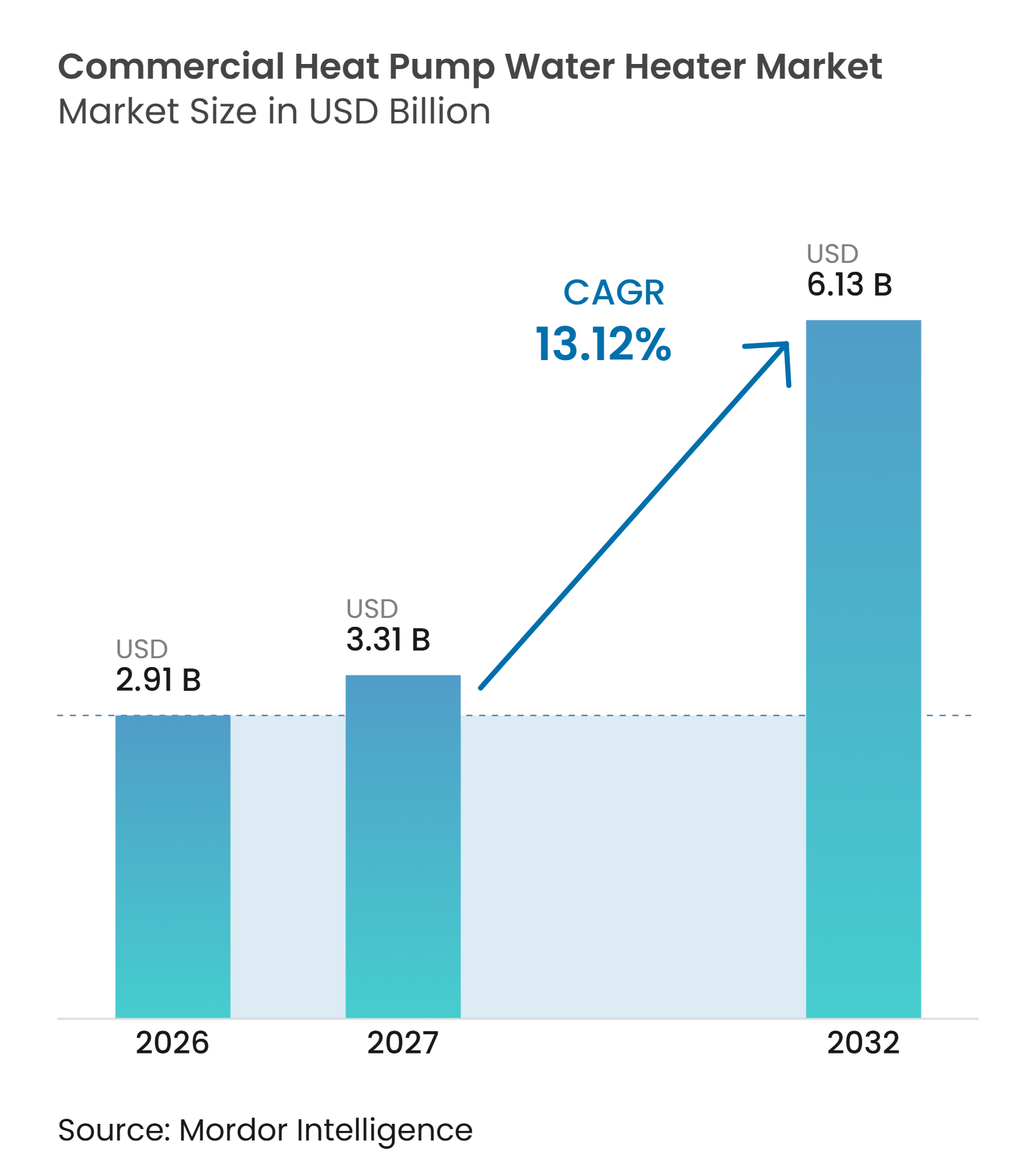
| Market Size (2027) | USD 3.31 Billion |
| Market Size (2032) | USD 6.13 Billion |
| Growth Rate (2027 - 2032) | 13.12 % |
| Fastest Growing Market | North America |
| Largest Market | Asia-Pacific |
| Market Concentration | Medium |
Major Players *Disclaimer: Major Players sorted in no particular order Image © Mordor Intelligence. Reuse requires attribution under CC BY 4.0. | |
Commercial Heat Pump Water Heater Market Analysis by Mordor Intelligence
The commercial heat pump water heater market size is projected to expand from USD 2.91 billion in 2026 to USD 6.13 billion by 2032, registering a CAGR of 13.12% between 2027 and 2032. The commercial heat pump water heater market is benefiting from tighter building-efficiency rules, higher operating costs for conventional water heating, and electrification plans in large facilities. Replacement activity is likely to become more important as U.S. efficiency requirements reshape procurement decisions in hotels, universities, and healthcare facilities. Natural refrigerants and high-temperature systems are widening the use of heat pumps in sanitation-sensitive settings. Performance contracting is also making projects more accessible to owners that do not want to carry all upfront risk. The commercial heat pump water heater market remains exposed to retrofit costs, refrigerant compliance changes, and shortages of qualified technicians.
Key Report Takeaways
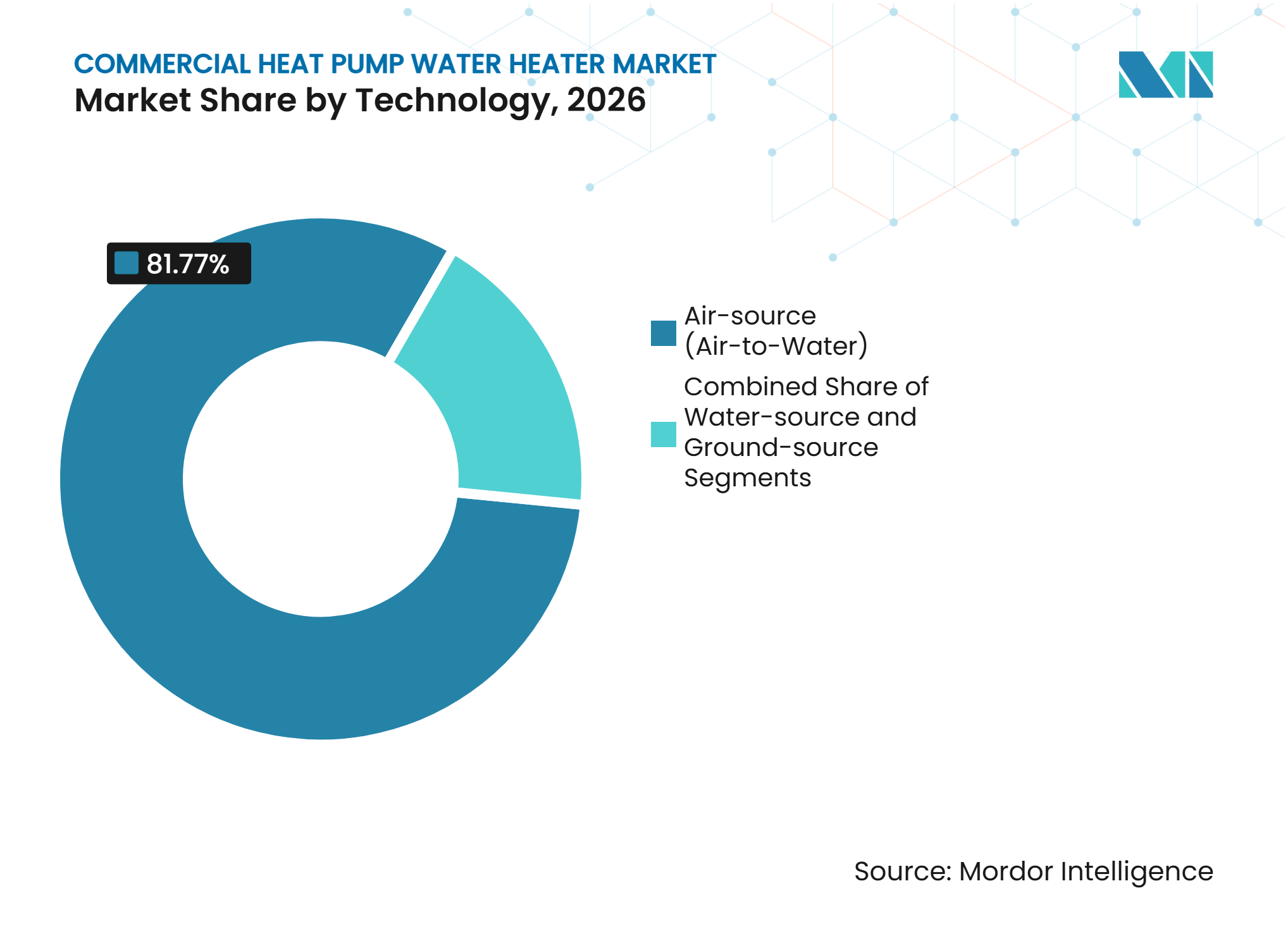
- By technology, air-source systems held 81.77% of the commercial heat pump water heater market share in 2026, while water-source systems are projected to expand at a 13.72% CAGR through 2032.
- By capacity, 200-500 L systems accounted for 38.16% of the commercial heat pump water heater market size in 2026, while above-500 L systems are projected to expand at a 13.69% CAGR through 2032.
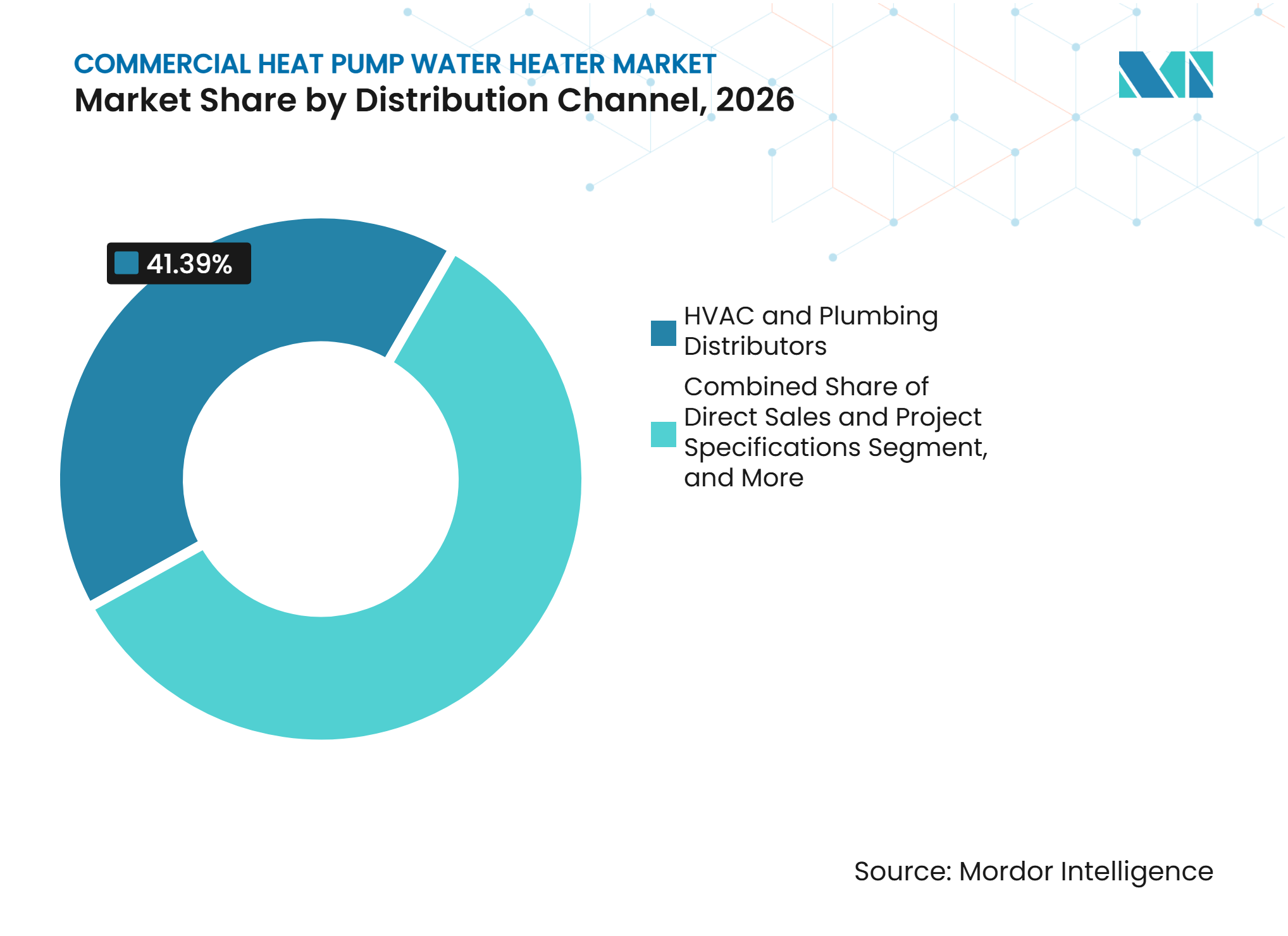
- By distribution channel, HVAC and plumbing distributors held 41.39% of commercial heat pump water heater market revenue in 2026, while ESCOs and performance-contracting channels are projected to expand at a 13.91% CAGR through 2032.
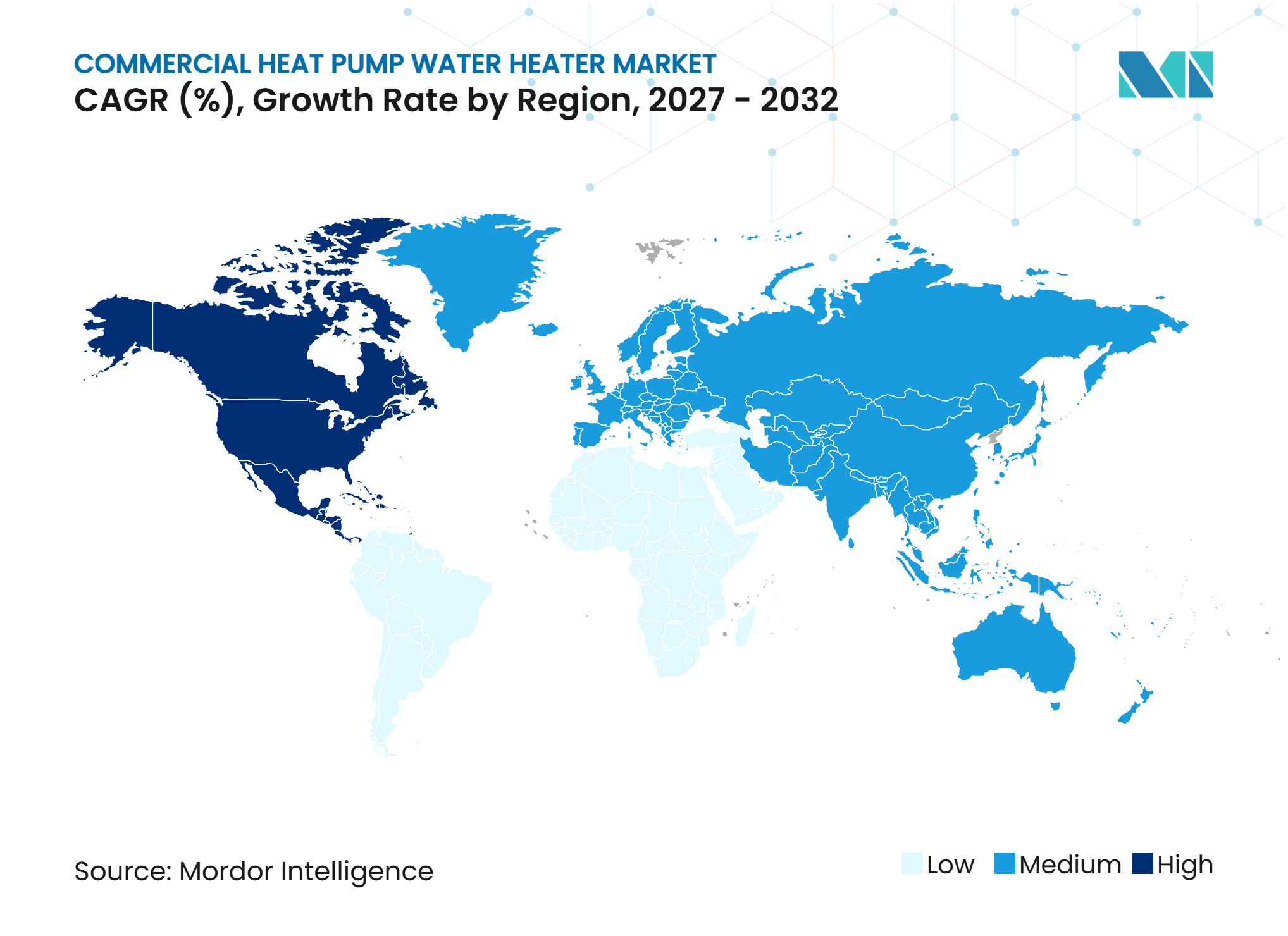
- By geography, Asia-Pacific held 44.62% of the commercial heat pump water heater market share in 2026, while North America is projected to expand at a 14.09% CAGR through 2032.
Note: Market numbers in this report are based on Mordor Intelligence's proprietary estimation framework, which combines nine months of actuals with Q4 projections for base year 2026.
Market Trends and Insights
Drivers Impact Analysis of Commercial Heat Pump Water Heater Market*
| Driver | (~) % Impact on CAGR Forecast | Geographic Relevance | Impact Timeline |
|---|---|---|---|
| Commercial Building Electrification and Fossil-Fuel Displacement | +2.8% | Global, with stronger acceleration in North America and Western Europe | Short term (≤ 2 years) |
| Building Efficiency Codes, Incentives, and Decarbonization Policies | +2.5% | North America and Europe, with spillover to Asia-Pacific | Medium term (2-4 years) |
| Commercial Energy-Cost Savings and Lifecycle Economics | +2.2% | Global, with strong relevance in Japan and Western Europe | Medium term (2-4 years) |
| High-Temperature CO₂ and R-290 Systems for Sanitation-Critical Loads | +1.5% | Asia-Pacific, with emerging adoption in North America and Europe | Long term (≥ 4 years) |
| Grid-Interactive Demand Response and Thermal-Storage Monetization | +1.1% | North America and Western Europe | Long term (≥ 4 years) |
| Modular Cascading for Resilient High-Volume Hot-Water Supply | +0.7% | Global, led by North American institutional facilities | Long term (≥ 4 years) |
| Source: Mordor Intelligence | |||
Commercial Building Electrification and Fossil-Fuel Displacement
The October 6, 2026, U.S. compliance date required commercial water heating equipment manufactured or imported for sale to meet updated efficiency standards.[1] This requirement is changing replacement choices for conventional electric-resistance and standard gas-fired equipment. An ENERGY STAR-rated commercial heat pump water heater is expected to save at least 10 MWh each year when compared with an electric-resistance alternative. Fewer than 15% of U.S. commercial buildings had heat pumps installed, leaving a large base of facilities that can replace older systems. California Title 24 requirements and local limits on natural gas use add another reason for facilities to consider electric water heating. These conditions favor suppliers that can support retrofit design, commissioning, and ongoing service.
Building Efficiency Codes, Incentives, and Decarbonization Policies
The phaseout of the Section 179D deduction for projects beginning after June 30, 2026, changed the timing of some commercial upgrade decisions. Some owners moved forward with specifications before the deadline, which shortened the decision cycle for planned projects. Utility and local programs continue to support project economics after the federal change. EnergizeCT offers incentives of up to USD 1,400 per qualifying commercial unit through December 31, 2026. City of Palo Alto Utilities offers rebates of up to USD 7,000 for qualifying commercial units above 100 gallons. New York’s HFC rule, effective January 9, 2025, sets a GWP₂₀ limit of 10 for commercial heat pump water heater equipment and establishes a January 1, 2034 prohibition date.
Commercial Energy-Cost Savings and Lifecycle Economics
Lifecycle savings are becoming a clearer part of the commercial heat pump water heater purchase case. Rheem introduced its Torin commercial air-to-water unit in September 2026 with a stated coefficient of performance of up to 4.5 and operation down to -13°F, or -25°C. Higher efficiency can improve the economics of hotel laundry, hospital preheating, and large foodservice loads. EnergizeCT estimates USD 3,750-10,000 in lifetime savings per unit over 10 years for eligible installations. These figures give facility teams a defined basis for comparing installed cost and expected operating savings. ESCO arrangements can further reduce the capital burden by tying payments to guaranteed savings. The commercial heat pump water heater market can therefore reach owners that would otherwise delay an efficiency investment.
High-Temperature CO₂ and R-290 Systems for Sanitation-Critical Loads
Hospitals, foodservice kitchens, and laundries need dependable high-temperature water for sanitation-sensitive tasks. CO₂ transcritical and R-290 systems are designed to meet outlet temperature requirements that can reach 60-90°C. Noritz and Nihon Itomic established a 2025 partnership to develop a commercial CO₂ heat pump water heater for North America, with product development led by Nihon Itomic and distribution led by Noritz America. Japan’s Eco Cute platform had close to 15% penetration in residential water heating, offering a mature regional reference point for CO₂ equipment. Rinnai Australia’s CHP025 and CHP050 products use R-290, have stated coefficients of performance of 4.2-4.4, and use a refrigerant with a GWP below 3. California’s restrictions on virgin refrigerants with GWP of 2,200 or higher also redirect product development toward lower-GWP designs.
Restraints Impact Analysis of Commercial Heat Pump Water Heater Market*
| Restraint | (~) % Impact on CAGR Forecast | Geographic Relevance | Impact Timeline |
|---|---|---|---|
| High Upfront Cost and Retrofit Design Complexity | -1.5% | Global, with stronger effects in North America and Europe for existing buildings | Short term (≤ 2 years) |
| Shortage of Qualified Installers and Service Technicians | -1.2% | Global, with a near-term gap in North America and Western Europe | Medium term (2-4 years) |
| Refrigerant Transition, Safety Certification, and Code Uncertainty | -0.9% | North America and Europe, with spillover to Asia-Pacific | Long term (≥ 4 years) |
| Cold-Climate Capacity Derating and Legionella-Control Integration | -0.6% | Northern Europe, Canada, and the northeastern United States | Medium term (2-4 years) |
| Source: Mordor Intelligence | |||
High Upfront Cost and Retrofit Design Complexity
CalNEXT identified upfront cost and building-specific retrofit complexity as leading barriers in California commercial applications.[2] Electrical panel replacement and service entrance work can equal or exceed the equipment price in older buildings. EnergizeCT places the initial equipment cost at USD 2,100-7,000 per unit before rebates. The full project cost can be higher when electrical work, controls, and installation changes are required. CalNEXT identified 71,000 small offices and 74,000 warehouses in California as a large opportunity by site count. These owners may have limited access to the capital needed for a complex retrofit. The commercial heat pump water heater market needs simpler design packages and effective incentive support to reach these sites.
Shortage of Qualified Installers and Service Technicians
CalNEXT identified contractor familiarity with sizing and recirculation-loop integration as a major adoption barrier. CO₂ transcritical systems may operate at 100-130 bar, requiring capabilities beyond standard HVAC and refrigeration credentials. ACEEE research noted that demand-response performance can suffer without staff trained to commission CTA-2045-B controls. The California Market Transformation Administrator submitted workforce development programs for funding consideration in 2026. This action recognizes workforce capacity as a system-level obstacle rather than an isolated contractor issue. Manufacturers that pair equipment sales with training and commissioning support can address a practical point of buyer concern.
*Our forecasts treat driver/restraint impacts as directional, not additive. The impact forecasts reflect baseline growth, mix effects, and variable interactions.
Commercial Heat Pump Water Heater Market Segment Analysis
By Technology:
Air-Source Systems Lead While Water-Source Systems Gain GroundAir-source, or air-to-water, systems held 81.77% of the commercial heat pump water heater market share in 2026. Their position reflects lower installed costs, broad suitability across climates, and an established distributor base. These features reduce specification risk for facilities managers who are replacing familiar heating equipment. Water-source, or water-to-water, systems are projected to expand at a 13.72% CAGR through 2032. They are suitable for larger mixed-use projects where waste-heat recovery loops can provide a useful source of energy for sanitary water heating. Ground-source systems remain concentrated in new construction where site conditions justify the capital required for borehole drilling. Rheem launched the Torin air-to-water product in September 2026 with R-454B refrigerant and a stated coefficient of performance of up to 4.5. Its cold-climate operating range indicates continued product development in the dominant air-source category.
ENERGY STAR requirements establish a technical threshold for commercial units over 119 gallons. These units must meet a minimum coefficient of performance of 3.6 to qualify. This requirement encourages replacement of legacy electric-resistance and lower-efficiency gas equipment. Lochinvar expanded its Veritus family in September 2025 with a 208V model designed for retrofits with constrained electrical infrastructure. CTA-2045-B compatibility is becoming a relevant specification consideration for institutional buyers that need demand-response capability. As early installations reach the end of their service lives, replacement demand can continue independently of new building electrification rules. This combination of standards, retrofit flexibility, and replacement needs supports demand across the commercial heat pump water heater industry.



By Capacity:
Mid-Scale Systems Lead While Centralized Systems AdvanceThe 200-500 L category accounted for 38.16% of the commercial heat pump water heater market size in 2026. It serves mid-scale installations in hotels, schools, healthcare facilities, and similar properties. Above-500 L systems are projected to expand at a 13.69% CAGR through 2032, making them the fastest-growing capacity category. Hospitals, university campuses, and large hospitality properties use these systems for centralized hot-water plants. Storage at this scale can also provide a thermal resource for managing periods of peak electricity demand. ACEEE field work in Seattle and San Francisco found that centralized systems with large storage achieved nearly 97% peak demand reduction through load-shifting controls.[3] Lochinvar’s modular Veritus design can be manifolded, allowing installations to move across capacity requirements from a standardized equipment base.
Up-to-200 L systems serve lighter commercial needs in small offices, kiosks, and foodservice counters. These applications are still contested by electric-resistance equipment and gas-fired tankless systems. CalNEXT identified 71,000 small offices and 74,000 warehouses in California as large opportunity groups by facility count. This supports near-term attention on both the up-to-200 L and 200-500 L categories. New 120-volt unitary designs reduce barriers in locations with limited electrical service capacity. Efficiency requirements continue to influence how these smaller systems are specified. Capacity selection also depends on recirculation needs, daily demand patterns, and the ability to use stored hot water during peak periods. The commercial heat pump water heater market size for larger systems is supported by institutional demand, while smaller systems depend more on practical retrofit conditions.
By Distribution Channel:
Distributors Lead While ESCOs ExpandHVAC and plumbing distributors held 41.39% of channel revenue in the commercial heat pump water heater market in 2026. They support the contractor base through specification, logistics, and commissioning assistance. Their role is particularly important when a project requires coordinated equipment selection and delivery. ESCOs and performance-contracting providers are projected to expand at a 13.91% CAGR through 2032. Their model shifts some capital and performance risk from building owners to specialist intermediaries. Heat pump water heater savings can be measured and verified, which aligns with energy savings performance contracts. Direct sales remain relevant for technically complex installations. Online and e-procurement channels are emerging for standardized unitary products.
A. O. Smith highlighted investment in digital tools, training, and customer support in its 2025 annual report. This investment reflects the importance of channel support as buyers manage efficiency codes and refrigerant changes. The Ariston-Lennox joint venture added more than 300 North American stores to the heat pump water heater distribution footprint in its first year. The arrangement combines Ariston product technology with Lennox distribution reach. Building owners that cannot self-finance an upgrade can use ESCO structures to pursue a project based on expected savings. Distributors remain central to the current commercial heat pump water heater market, but performance contracting is widening access to projects with more difficult capital decisions. These channel patterns make installation support and customer service important parts of competitive performance.

Geography Analysis
Asia-Pacific: Manufacturing Scale and Policy Support Sustain Demand
Asia-Pacific held 44.62% of the commercial heat pump water heater market share in 2026. China’s manufacturing scale, domestic suppliers such as Guangdong Tongyi, PHNIX, and SPRSUN, and their export reach support cost-competitive equipment. Japan’s CO₂-based Eco Cute platform had close to 15% residential water-heating penetration, while hospitality development and tier-1 commercial construction support adoption in India. Copeland launched Sensi Hydro in Southeast Asia in October 2025 in 6HP-20HP configurations and stated savings of up to 70% compared with traditional electric heating. STIEBEL ELTRON’s 2026 distribution agreement with Hunt Heating in Australia reflects a shift toward locally supported equipment as gas-transition policies and electricity costs influence procurement.
North America: Regulations and Channel Investment Support Faster Expansion
North America is projected to expand at a 14.09% CAGR through 2032. The U.S. standard, effective October 6, 2026, created an important replacement base among hotels, healthcare facilities, and institutional buildings. State and utility rebates in Connecticut, California, and the Pacific Northwest range from USD 600-7,000 per unit, helping sustain project economics. The Ariston-Lennox venture completed its first year with sales above plan, more than 300 distribution locations, and ownership split between Ariston USA at 50.1% and Lennox at 49.9%. Low heat-pump penetration in U.S. commercial buildings leaves room for further uptake as DOE and ENERGY STAR compliance factors shape regional demand.
Europe, South America, the Middle East, and Africa: Policy and Climate Create Different Adoption Paths
Europe is shaped by the EU F-gas phase-down, building renovation, and new capacity from STIEBEL ELTRON’s 2,300 m² Poprad plant and Ariston’s Albacina factory, while Germany, France, and the United Kingdom benefit from green finance and energy-performance certificate requirements.[4] South America is an early-stage market in which hospitality construction supports trials of imported European and Asian equipment. Saudi Arabia and the UAE offer favorable conditions for air-source units, although low-cost gas heating constrains uptake. South Africa and Nigeria are the largest African opportunities, mainly in premium hotels and private hospitals, showing why regulation, building stock, and fuel economics require different regional approaches.
Competitive Landscape
Market Concentration
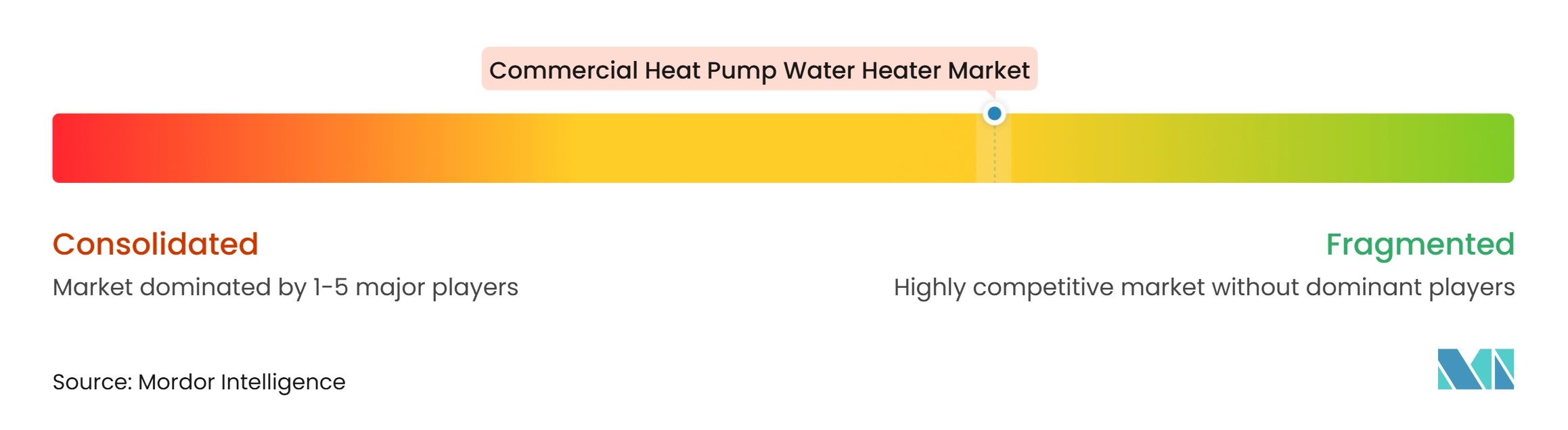
The commercial heat pump water heater market is moderately fragmented. Rheem, A. O. Smith, Mitsubishi Heavy Industries Thermal Systems, and STIEBEL ELTRON hold important positions through established brands, distribution networks, and cold-climate equipment capabilities. Guangdong Tongyi, PHNIX, SPRSUN, and Hiseer compete primarily through price-performance and export breadth. Leading suppliers are differentiating products through R-290, R-454B, and CO₂ refrigerants. Grid-interactive controls are also becoming a more visible product feature. The Ariston-Lennox venture shows how a supplier can combine product technology with established regional distribution. Its dealer sales exceeded the first-year plan in June 2026.
Small offices, warehouses, and foodservice facilities remain a less-developed area between residential-scale and large central systems. Mitsubishi’s CO₂-refrigerant HEAT2O system, used with SkyCentrics EcoPort and CTA-2045-B controls, achieved nearly 97% peak demand reduction in ACEEE field studies across 3 U.S. sites. The result establishes a functional reference point for utilities and large commercial buyers. ENERGY STAR Version 2.0 requirements and DOE minimum efficiency standards create compliance demands for manufacturers. These requirements favor suppliers with the engineering resources to manage efficiency and refrigerant transitions. The commercial heat pump water heater industry also faces a service challenge, because advanced equipment needs reliable installation and commissioning support.
Rheem’s September 2026 Torin launch added an air-to-water product with a stated coefficient of performance of up to 4.5 and building management system integration. Noritz and Nihon Itomic announced their North American CO₂ product development partnership in November 2026. A. O. Smith identified digital tools, training, and customer support as priorities in its 2025 annual report. These moves show that equipment efficiency alone is not enough for suppliers competing in the commercial heat pump water heater market. Customers also evaluate product availability, installer capability, controls, and after-sales support.
Commercial Heat Pump Water Heater Industry Leaders
-
A. O. Smith Corporation
-
Rheem Manufacturing Company
-
Nyle Systems, LLC
-
Noritz Corporation
-
Sanden Holdings Corporation
- *Disclaimer: Major Players sorted in no particular order
Commercial Heat Pump Water Heater Market Companies Covered in this Report
- A. O. Smith Corporation
- Rheem Manufacturing Company
- Mitsubishi Heavy Industries Thermal Systems, Ltd.
- STIEBEL ELTRON GmbH and Co. KG
- Nyle Systems, LLC
- Nihon Itomic Co., Ltd.
- Noritz Corporation
- Sanden Holdings Corporation
- Guangdong Tongyi Heat Pump Science and Technology Corp.
- PHNIX Eco-Energy Solutions Co., Ltd.
- Guangdong SPRSUN New Energy Technology Development Co., Ltd.
- Colmac Industries, Inc.
- Solareast Holdings Co., Ltd.
- Hiseer Group
- Zhejiang Zhongneng Technology Co., Ltd.
- Zhejiang Peakway Pump Co., Ltd.
- Viessmann Manufacturing Company Inc.
- Lochinvar Corporation
- Bradford White Corporation
- Glen Dimplex Thermal Solutions
- Ariston Holding N.V.
Recent Industry Developments in Commercial Heat Pump Water Heater Market
- November 2026: Noritz Corporation and Nihon Itomic Co., Ltd. announced a partnership to develop the first commercial CO₂ heat pump water heater for the North American market, with Nihon Itomic leading product development, RB Corporation, a Noritz Group company, manufacturing the unit, and NORITZ AMERICA CORPORATION overseeing North American sales and distribution. The collaboration builds on a prior Japanese commercial hybrid water heating partnership from July 2025 and targets electrification-driven demand in North American commercial buildings.
- November 2026: Noritz America has enhanced its Hybrid Hot Series by incorporating the recently upgraded, ENERGY STAR-rated NCC199CDV Pro Commercial Condensing Water Heater into the tankless-storage tank system.
- October 2026: The U.S. DOE’s amended energy conservation standards for commercial water heating equipment became effective on October 6, 2026, establishing updated minimum efficiency requirements that effectively require new commercial water heating systems to adopt condensing or heat pump technology. The compliance milestone triggered deferred replacement decisions across hospitality, healthcare, and institutional sectors.
- August 2026: A. O. Smith introduced the Voltex® X Outdoor Split Heat Pump Water Heater (HPWH), made in partnership with Panasonic. The Voltex X unit will be joining A. O. Smith’s Voltex family of high-efficiency, sustainable products.
Global Commercial Heat Pump Water Heater Market Report Scope
A commercial heat pump water heater is a high-capacity, energy-efficient water heating system that transfers heat from a surrounding low-temperature source, such as ambient air, water, or the ground, into a large storage tank to heat potable water.
The Commercial Heat Pump Water Heater Market Report is Segmented by Technology (Air-source [Air-to-Water], Water-source [Water-to-Water], and Ground-source [Geothermal]), Capacity [Tank Volume] (Up to 200 L, 200-500 L, and Above 500 L), Distribution Channel (Direct Sales and Project Specifications, HVAC and Plumbing Distributors, Energy-Service Companies and Performance Contracting, and Online and E-Procurement), and Geography (North America, South America, Europe, Asia-Pacific, Middle East, and Africa). The Market Forecasts are Provided in Terms of Value (USD).
Segmentation Overview
| Air-source (Air-to-Water) |
| Water-source (Water-to-Water) |
| Ground-source (Geothermal) |
| Up to 200 L |
| 200-500 L |
| Above 500 L |
| Direct Sales and Project Specifications |
| HVAC and Plumbing Distributors |
| Energy-Service Companies and Performance Contracting |
| Online and E-Procurement |
| North America | United States |
| Canada | |
| Mexico | |
| South America | Brazil |
| Argentina | |
| Rest of South America | |
| Europe | Germany |
| France | |
| Italy | |
| United Kingdom | |
| Russia | |
| Rest of Europe | |
| Asia-Pacific | China |
| Japan | |
| South Korea | |
| India | |
| ASEAN | |
| Rest of Asia-Pacific | |
| Middle East | Saudi Arabia |
| United Arab Emirates | |
| Turkey | |
| Rest of Middle East | |
| Africa | South Africa |
| Nigeria | |
| Rest of Africa |
| By Technology | Air-source (Air-to-Water) | |
| Water-source (Water-to-Water) | ||
| Ground-source (Geothermal) | ||
| By Capacity (Tank Volume) | Up to 200 L | |
| 200-500 L | ||
| Above 500 L | ||
| By Distribution Channel | Direct Sales and Project Specifications | |
| HVAC and Plumbing Distributors | ||
| Energy-Service Companies and Performance Contracting | ||
| Online and E-Procurement | ||
| By Geography | North America | United States |
| Canada | ||
| Mexico | ||
| South America | Brazil | |
| Argentina | ||
| Rest of South America | ||
| Europe | Germany | |
| France | ||
| Italy | ||
| United Kingdom | ||
| Russia | ||
| Rest of Europe | ||
| Asia-Pacific | China | |
| Japan | ||
| South Korea | ||
| India | ||
| ASEAN | ||
| Rest of Asia-Pacific | ||
| Middle East | Saudi Arabia | |
| United Arab Emirates | ||
| Turkey | ||
| Rest of Middle East | ||
| Africa | South Africa | |
| Nigeria | ||
| Rest of Africa | ||
Key Questions Answered in the Report
What is the commercial heat pump water heater market size?
The commercial heat pump water heater market size is USD 2.91 billion in 2026 and is projected to reach USD 6.13 billion by 2032 at a 13.12% CAGR.
Which technology leads commercial heat pump water heater installations?
Air-source systems lead with an 81.77% share in 2026 because they have lower installed costs, broad suitability, and established distributor support.
Which commercial heat pump water heater capacity category is expanding fastest?
Above-500 L systems are projected to expand at a 13.69% CAGR through 2032, supported by hospitals, campuses, and large hospitality facilities.
Why are ESCOs important for commercial heat pump water heater projects?
ESCOs are projected to expand at a 13.91% CAGR through 2032 because they can shift capital and performance risk through guaranteed-savings structures.
Which region has the largest commercial heat pump water heater demand?
Asia-Pacific holds 44.62% of demand in 2026, supported by China’s manufacturing scale, Japan’s CO₂ technology base, and rising regional hospitality activity.
Why is North America expanding quickly for commercial heat pump water heaters?
North America is projected to expand at a 14.09% CAGR through 2032 as updated U.S. efficiency standards and utility rebates encourage equipment replacement.