
Commercial Dishwasher Market Size and Share
Market Overview
| Study Period | 2021 - 2032 |
|---|---|
| Market Size (2027) | USD 2.92 Billion |
| Market Size (2032) | USD 3.77 Billion |
| Growth Rate (2027 - 2032) | 5.25 % |
| Fastest Growing Market | Middle East and Africa |
| Largest Market | North America |
| Market Concentration | Medium |
Major Players *Disclaimer: Major Players sorted in no particular order Image © Mordor Intelligence. Reuse requires attribution under CC BY 4.0. | |
Commercial Dishwasher Market Analysis by Mordor Intelligence
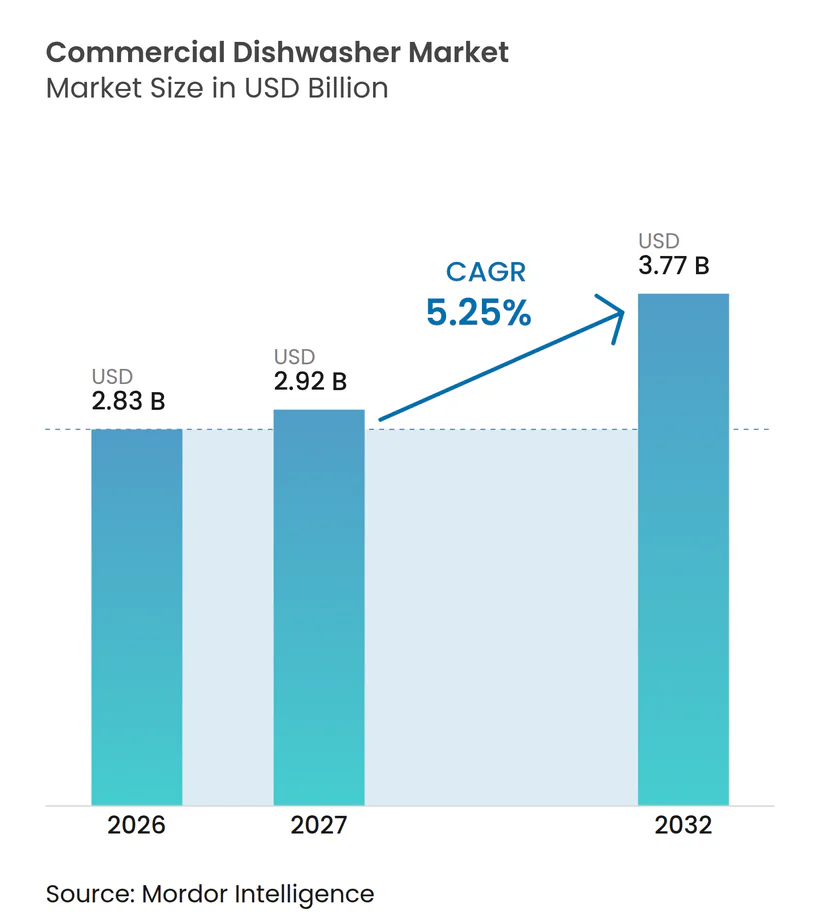
The global commercial dishwasher market is expected to grow from USD 2.83 billion in 2026 to USD 2.92 billion in 2027 and is forecast to reach USD 3.77 billion by 2032 at a 5.25% CAGR over 2027-2032. Growth is driven by rising labor costs, stringent food hygiene requirements, and the need for greater operational efficiency across commercial kitchens. Expanding foodservice infrastructure in emerging economies is generating incremental equipment demand, while rising utility costs are encouraging investments in energy- and water-efficient systems. Manufacturers are strengthening their offerings through advanced washing technologies, digital monitoring, and integrated service solutions. However, regional growth remains uneven, shaped by differences in regulatory requirements, capital investment capacity, and replacement cycles, with mature markets benefiting from equipment upgrades and emerging markets from new commercial kitchen installations.
Key Report Takeaways
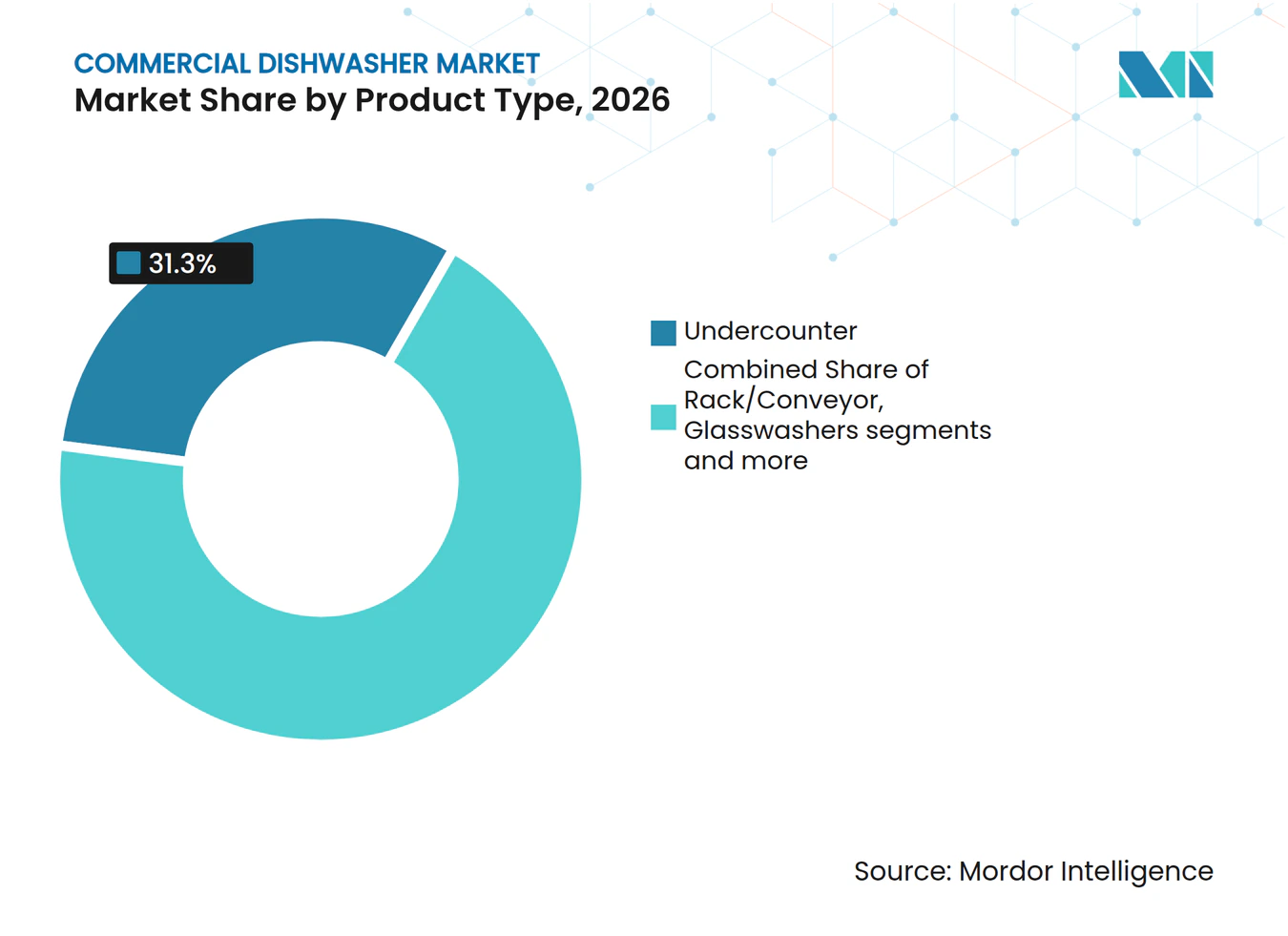
- By product type, undercounter dishwashers held 31.25% of the global commercial dishwasher market in 2026, while flight-type or continuous conveyor dishwashers are projected to record the highest CAGR of 6.58% through 2032.
- By installation configuration, free-standing units accounted for 70.25% of the market in 2026, while built-in or under-counter units are projected to register a CAGR of 6.34% through 2032.
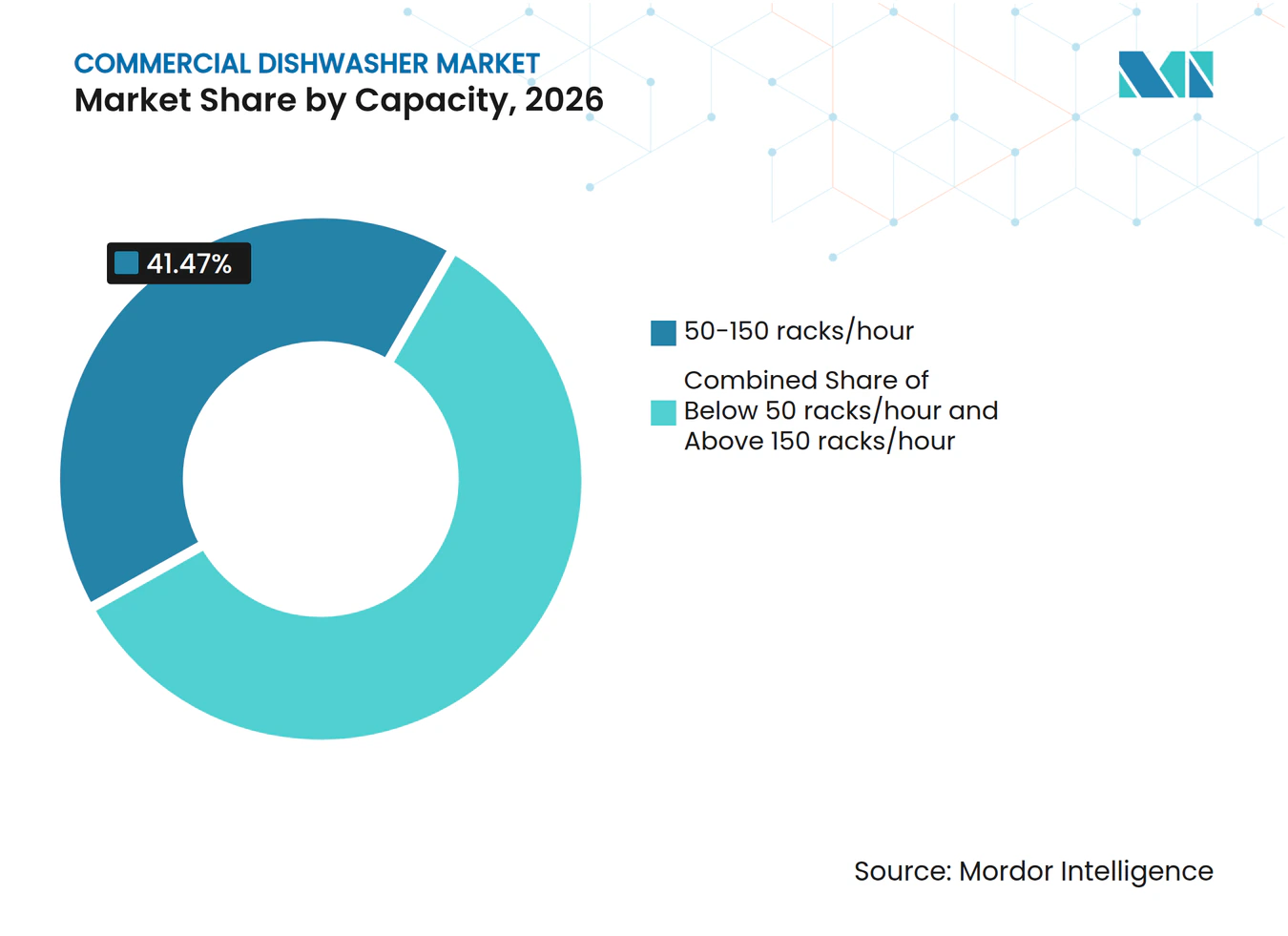
- By capacity, the 50–150 racks-per-hour category held 41.47% of market revenue in 2026, while units processing more than 150 racks per hour are projected to record a CAGR of 6.23% through 2032.
- By price range, mid-range equipment accounted for 45.56% of market revenue in 2026, while premium equipment is projected to achieve a CAGR of 7.26% through 2032.
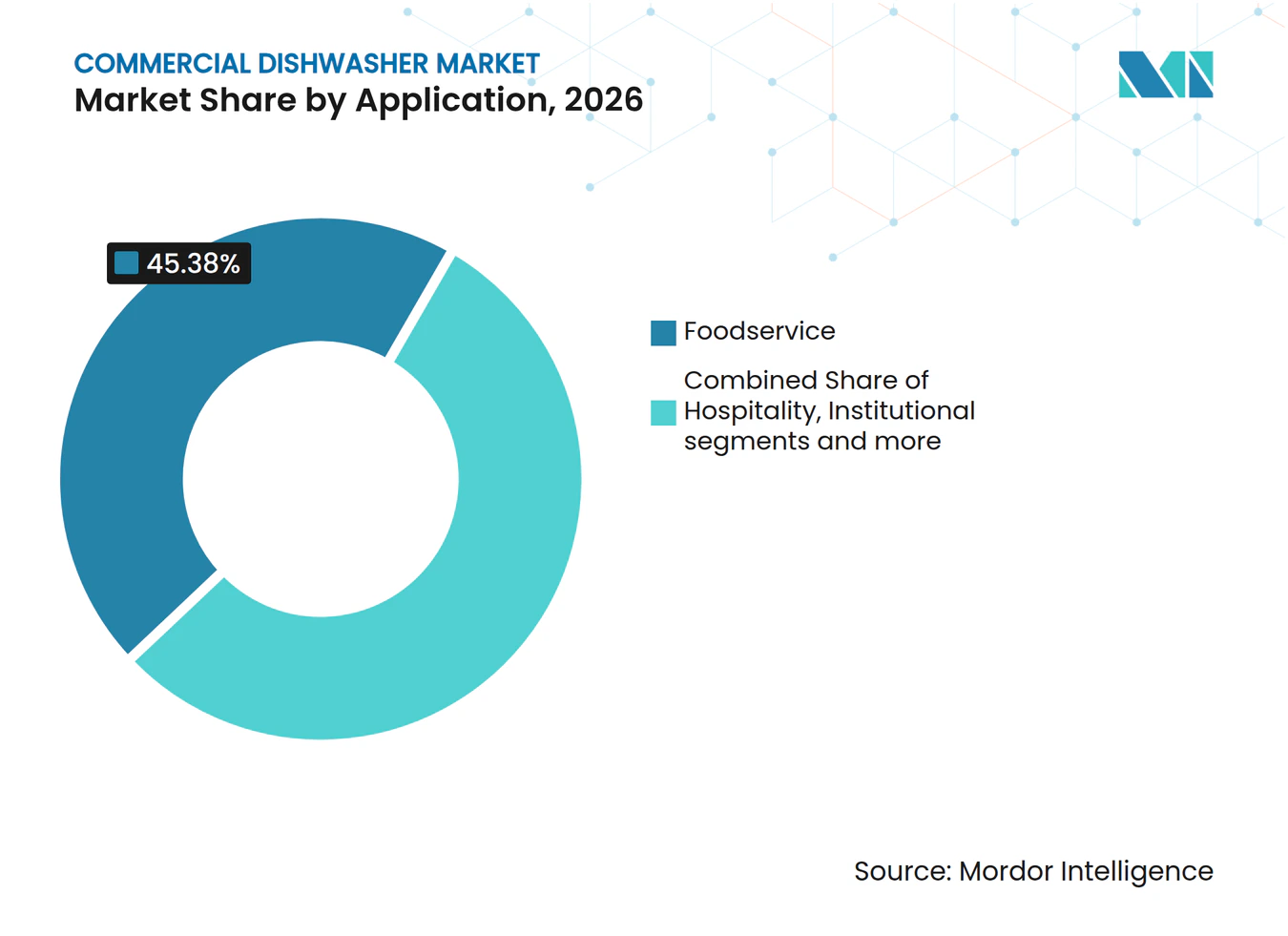
- By application, foodservice accounted for 45.38% of market demand in 2026, while institutional applications are projected to register a CAGR of 6.67% through 2032.
- By distribution channel, dealers and distributors accounted for 72.52% of procurement in 2026, while direct sales are projected to record a CAGR of 6.76% through 2032.
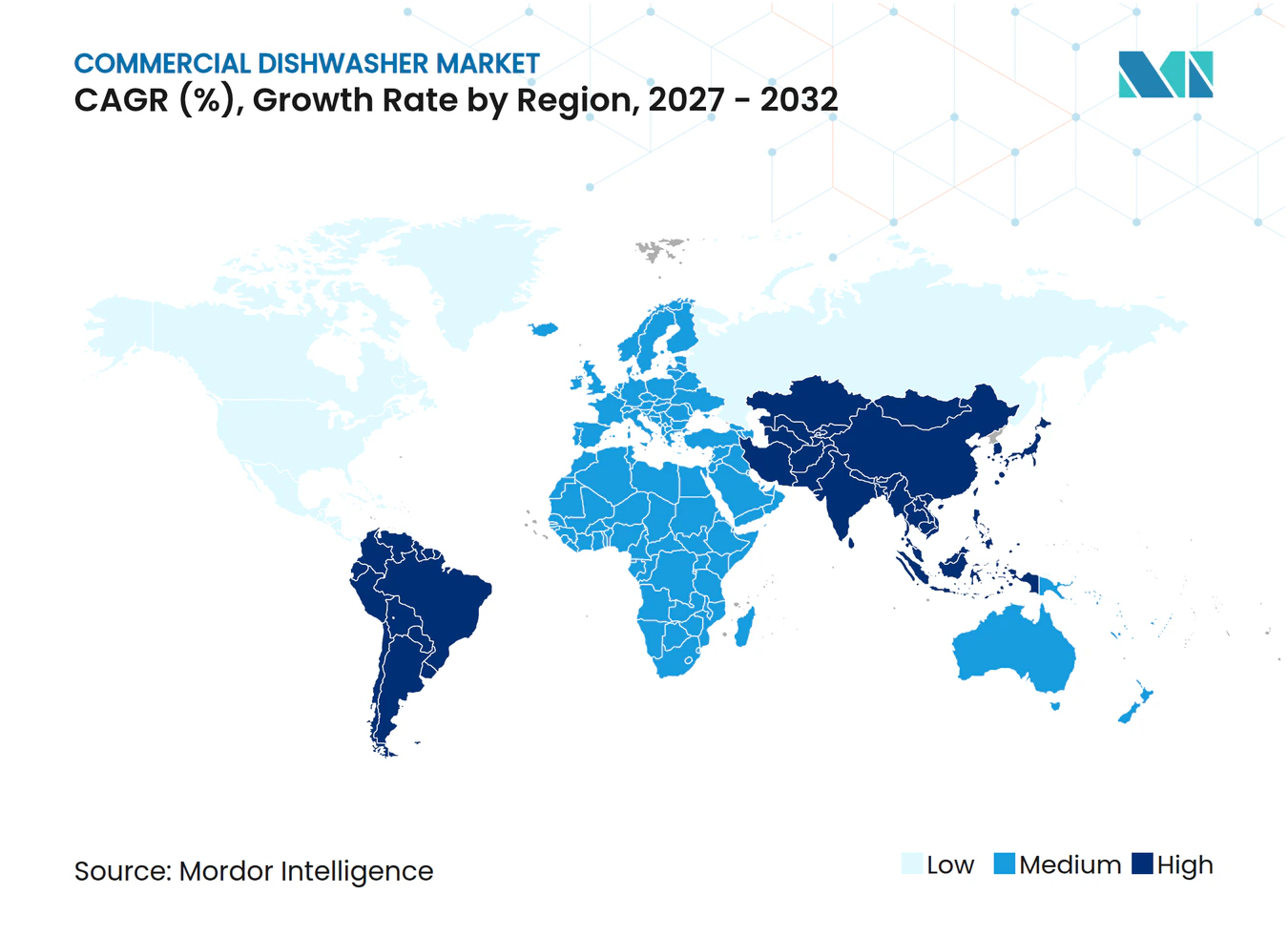
- By geography, North America held 31.14% of demand in 2026, while the Middle East & Africa is forecast to grow at a 6.78% CAGR through 2032.
Note: Market numbers in this report are based on Mordor Intelligence's proprietary estimation framework, which combines nine months of actuals with Q4 projections for base year 2026.
Market Trends and Insights
Drivers Impact Analysis of Commercial Dishwasher Market*
| Driver | (~) % Impact on CAGR Forecast | Geographic Relevance | Impact Timeline |
|---|---|---|---|
| Rising Food-Safety and Hygiene Compliance Requirements | +1.1% | Global, concentrated in North America, Europe, and Asia-Pacific regulatory markets | Short term (≤ 2 years) |
| Hospitality and Foodservice Labor Shortages | +1.0% | North America and Europe, with spillover to Asia-Pacific urban centers | Medium term (2-4 years) |
| Expansion of Quick-Service Restaurants and Cloud Kitchens | +0.9% | Asia-Pacific core, with spillover to the Middle East and Africa and Latin America | Medium term (2-4 years) |
| Energy- and Water-Efficiency Regulations | +0.7% | Europe, North America, and China | Medium term (2-4 years) |
| Connected Warewashing and Predictive Maintenance Adoption | +0.5% | Global, with early gains in North America, Germany, and Australia | Long term (≥ 4 years) |
| Replacement of Legacy Warewashing Equipment | +0.4% | North America, Europe, and Japan | Short term (≤ 2 years) |
| Source: Mordor Intelligence | |||
Rising Food-Safety and Hygiene Compliance Requirements
Stringent food-safety and sanitation requirements are making hygiene performance a key consideration in commercial dishwasher procurement. NSF/ANSI 3 and HACCP frameworks make temperature control and cycle documentation important for healthcare and education kitchens[1]. High-temperature dishwashers rely on specified final-rinse temperatures, while low-temperature models require appropriate chemical sanitization to achieve the intended hygiene outcomes. As a result, operators are increasingly prioritizing equipment that can maintain consistent washing performance and support compliance monitoring. Modern dishwashers with automated temperature tracking and cycle-recording capabilities also simplify documentation and reduce reliance on manual checks. These requirements strengthen demand for compliant, technologically advanced equipment and can accelerate the replacement of older machines that struggle to maintain consistent performance under demanding operating conditions.
Hospitality and Foodservice Labor Shortages
Labor shortages and high staff turnover are increasing the importance of operational simplicity in commercial dishwashing equipment. Restaurants, hotels, and institutional kitchens are prioritizing machines that minimize manual intervention, simplify routine tasks, and reduce the training required for new employees. For example, Hobart developed its FLOW Line Collection in response to commercial kitchen challenges, including staff turnover, training gaps, and labor availability. Its SmartVisionControl system is designed to identify the type of ware and its soil level, reducing the need for operators to select washing programs manually. Such features help maintain consistent operating procedures in kitchens where staffing levels and employee experience vary. Consequently, purchasing decisions increasingly consider not only washing capacity and cleaning performance but also ease of operation and the ability to manage dishwashing activities with limited staff.
Expansion of Quick-Service Restaurants and Cloud Kitchens
Quick-service restaurants and delivery-focused kitchens are adding demand for standardized warewashing equipment. McDonald’s planned approximately 2,200 restaurant openings in 2025 and set a target of 50,000 locations by 2027. These openings create demand for equipment packages that can be used across comparable restaurant sites[2]. Yum! Brands reported 1,131 gross new units in the third quarter of 2025. Cloud kitchens favor compact equipment because their urban sites often have limited back-of-house space. The commercial dishwasher market gains from these formats because they support repeatable equipment specifications across multiple locations.
Energy- and Water-Efficiency Regulations
Efficiency requirements are moving equipment selection beyond voluntary utility savings. The United States Environmental Protection Agency states that ENERGY STAR commercial dishwashers use 50% less water and 12% less energy than standard models. Institutional buyers that follow federal purchasing requirements can therefore favor certified equipment[3]. In August 2025, China issued GB 38383-2025, with tighter Grade 1 water and energy thresholds than the previous edition. The standard applies to built-in, free-standing, and countertop configurations[4]. The commercial dishwasher market benefits when efficiency compliance and food-safety performance are considered together in replacement plans.
Restraints Impact Analysis of Commercial Dishwasher Market*
| Restraint | (~) % Impact on CAGR Forecast | Geographic Relevance | Impact Timeline |
|---|---|---|---|
| High Capital Expenditure and Total Cost of Ownership | -0.7% | Global, most acute for independent operators in South America and Southeast Asia | Medium term (2-4 years) |
| Skilled-Technician Shortages | -0.5% | Middle East and Africa, Southeast Asia, and secondary North American markets | Long term (≥ 4 years) |
| Hard-Water and Scale-Buildup Conditions | -0.3% | Middle East and Africa, Southern Europe, and parts of Asia-Pacific | Medium term (2-4 years) |
| Installation Constraints in Legacy Kitchens | -0.3% | Europe, Japan, and established urban North American markets | Short term (≤ 2 years) |
| Source: Mordor Intelligence | |||
High Capital Expenditure and Total Cost of Ownership
High upfront investment and ongoing operating expenses can delay equipment upgrades, particularly among independent restaurants and smaller foodservice operators. Commercial dishwashers with higher throughput typically require substantial capital outlays, with installed door-type and conveyor systems potentially costing USD 15,000–30,000, while flight-type systems can exceed USD 60,000. Beyond the initial purchase, operators must account for water and energy consumption, detergents and sanitizing chemicals, maintenance contracts, and periodic descaling throughout the equipment's operating life. These recurring expenses can make replacement decisions more difficult for businesses with limited capital budgets or informal procurement processes. In addition, connected dishwashers may involve higher upfront prices and recurring software or service fees, which can be harder to justify for single-site operators with relatively simple monitoring needs. Consequently, cost sensitivity can extend equipment replacement cycles and limit the adoption of premium, high-efficiency, and connected models, even when these systems offer potential long-term operating savings.
Skilled-Technician Shortages
Service coverage can constrain adoption of advanced equipment in developing and secondary markets. Connected machines need trained technicians for installation, commissioning, and preventive maintenance. This capacity is concentrated in major metropolitan areas. In the Middle East & Africa, uneven service coverage and hard-water conditions can favor mechanically simpler equipment. Remote diagnostics and self-diagnostic tools can reduce some service burdens. However, thin third-party service networks remain a practical constraint for equipment suppliers serving dispersed locations.
*Our forecasts treat driver/restraint impacts as directional, not additive. The impact forecasts reflect baseline growth, mix effects, and variable interactions.
Commercial Dishwasher Market Segment Analysis
By Product Type:
Undercounter Leads Installed Base, Flight-Type Captures Growth PremiumUndercounter dishwashers held 31.25% of the commercial dishwasher market share in 2026, giving the category the broadest reported product position. Cafés, bars, cloud kitchens, small quick-service outlets, and casual dining venues use these machines where usable kitchen space is limited. Their installed base is spread across many operator formats rather than concentrated in a few large facilities. These buyers generally value a compact footprint and practical placement near beverage or preparation areas. The category remains suitable for operators that require commercial washing capability without a substantial kitchen redesign.
Flight-type and continuous conveyor dishwashers are forecast to grow at a 6.58% CAGR through 2032, reflecting demand from large-volume kitchens. Hotels, airline caterers, hospital systems, and central production kitchens need uninterrupted washing for sustained service volumes. Batch equipment can require more labor as the number of racks rises during peak operating periods. Door and hood machines, together with rack conveyor systems, continue to meet mid-volume requirements. Glasswashers remain relevant where careful glass handling and finished appearance are essential to the venue’s service model.



By Installation Configuration:
Free-Standing Commands the Market, Built-In Grows with New Foodservice FormatsFree-standing configurations accounted for 70.25% of the commercial dishwasher market size in 2026, reflecting the large base of existing commercial kitchens. Retrofitted sites in North America, Europe, and established Asia-Pacific economies often use this format because kitchen structures and utility lines are already in place. Operators can deploy, service, and replace a free-standing unit without changing the surrounding kitchen structure. That flexibility matters when a replacement purchase must fit known dimensions and operating conditions. Free-standing equipment consequently remains the practical option for many established restaurants, hotels, and institutional kitchens.
Built-in and under-counter integrated dishwashers are projected to register a CAGR of 6.34% through 2032, supported by demand from new commercial kitchen developments and planned facility upgrades. Quick-service restaurants, cloud kitchens, and institutional facilities can incorporate these units into kitchen layouts during the design and construction phase, allowing equipment placement to be optimized for available space and workflow efficiency. This is particularly relevant for delivery-focused foodservice operators establishing new kitchens or expanding through standardized locations. By selecting integrated equipment at the planning stage, operators can avoid some of the layout constraints and modification costs associated with installing new systems in existing kitchens.
By Capacity:
Mid-Volume Systems Anchor Revenue, High-Throughput Equipment AcceleratesThe 50–150 racks per hour category held 41.47% of commercial dishwasher market revenue in 2026, making it the largest reported capacity group. Full-service restaurants, hotel dining rooms, mid-sized institutional cafeterias, and catering kitchens commonly operate within this throughput range. These sites need more output than compact equipment can provide during regular service periods. At the same time, many do not require the capital investment, floor area, or operating scale of flight-type systems. The category therefore suits buyers seeking a workable balance between output, installation demands, and operating costs.
Equipment above 150 racks per hour is forecast to grow at a 6.23% CAGR through 2032. High-volume hospitality venues, airline caterers, large hospitals, and central production kitchens use this equipment to manage concentrated warewashing volumes. Consolidating warewashing from multiple satellite locations can increase the need for this capacity. In June 2025, Hobart launched its FLOW Line Collection with SmartVisionControl, which detects ware type and soil level and adjusts wash settings. Hobart reports up to 40% lower rinse-water use than its previous flight-type machines, showing why water use and automated controls matter at high throughput.

By Price Range:
Mid-Range Anchors Volume, Premium Leads Value GrowthMid-range equipment accounted for 45.56% of revenue in 2026, which made it the largest reported price range. The category gives buyers access to code-compliant commercial machines with practical feature sets and lower cost than connected premium systems. Independent restaurants and smaller hospitality sites often need dependable performance while keeping upfront spending controlled. Mid-range products also give manufacturers a way to make efficiency and service features available to a broader customer base. Their position reflects the need for a capable commercial machine without the full cost of advanced connected equipment.
Premium equipment is forecast to expand at a 7.26% CAGR through 2032, the highest growth rate among reported segments. Enterprise operators, hotel groups, and institutions assess premium machines against labor needs and the potential cost of noncompliance. Removing one dishroom labor hour per shift can support the purchase of a higher specification. Connected monitoring and advanced controls are common features in this tier. The commercial dishwasher industry is separating lower-cost equipment from machines that can provide recorded operating performance and stronger service support.
By Application:
Foodservice Commands Scale, Institutional Segment Compounds FastestFoodservice accounted for 45.38% of commercial dishwasher market demand in 2026, making it the largest reported application. Full-service restaurants, quick-service chains, cafés, bars, and casual dining venues support this broad demand base. The application benefits from new outlets in emerging economies and replacement activity in established economies. Individual sites need equipment suited to different meal periods, service intensity, and kitchen layouts. Foodservice includes compact machines as well as larger door-type and conveyor equipment, which gives the application considerable breadth.
Institutional applications are forecast to grow at a 6.67% CAGR through 2032. Schools, universities, healthcare facilities, and government catering operations are included within this application group. These buyers place greater emphasis on temperature records and cycle documentation. NSF/ANSI 3 and HACCP frameworks increase the value of connected machines for verification and recordkeeping. Hotels, resorts, catering operations, and central kitchens also maintain demand for high-throughput equipment as warewashing activities are concentrated in hub kitchens.
By Distribution Channel:
Dealer Networks Hold Structural Advantage, Direct Sales Builds Enterprise ShareDealers and distributors represented 72.52% of procurement in 2026, making them the leading reported channel. Their position reflects buyers’ need for local specification support, installation assistance, and service availability. Many foodservice operators do not have dedicated facilities teams that can manage those requirements internally. Dealers can help assess water supply, utilities, available space, and service needs before installation. This channel remains important where a responsive local service relationship is part of the equipment purchase decision.
Direct sales are forecast to grow at a 6.76% CAGR through 2032. Multi-unit chains, large institutions, and hotel groups have enough scale to negotiate directly with manufacturers. These accounts can seek bundled equipment pricing and lifecycle service agreements. Equipment-as-a-service and direct leasing can shift spending from capital budgets to operating budgets. The commercial dishwasher market will retain a dealer role because manufacturers pursuing direct accounts must still address the local service coverage that dealers provide.
Geography Analysis
North America held 31.14% of the commercial dishwasher market share in 2026, which made it the largest reported regional market. The region has a dense foodservice base and labor costs that make automated warewashing economically useful across operator sizes. Federal institutional purchasing preferences can favor equipment with measured water and energy performance. The United States Environmental Protection Agency states that ENERGY STAR commercial dishwashers use 50% less water and 12% less energy than standard models. State efficiency requirements can add replacement demand beyond the ordinary end-of-life replacement cycle. These conditions support a substantial installed base and continuing equipment purchases across restaurant, hospitality, and institutional locations.
Europe is the second-largest reported region, supported by established replacement cycles in Germany, France, the United Kingdom, and Italy. Operators in these countries consider food safety, efficiency, service access, and local equipment specifications during replacement decisions. The commercial dishwasher market in Europe is therefore supported by recurring demand from mature foodservice and institutional kitchens. Asia-Pacific is the second-fastest-growing major region, driven by formalizing foodservice activity across India, Southeast Asia, and China. Japan, Australia, and South Korea contribute more stable hospitality investment and efficiency-focused replacement demand. China’s GB 38383-2025 tightened Grade 1 energy and water requirements, creating a compliance-led reason to replace equipment that no longer meets the standard. India’s cloud kitchen expansion in tier-1 and tier-2 cities supports demand for compact, modular undercounter equipment rather than only large institutional systems.
Middle East & Africa is forecast to grow at a 6.78% CAGR through 2032, making it the fastest-growing reported region. Luxury hotel and resort construction in the United Arab Emirates and Saudi Arabia supports premium conveyor and flight-type equipment for large food and beverage kitchens. South Africa and Nigeria anchor demand from urban healthcare, education, and organized hospitality venues. In locations with uneven grid reliability, hybrid dual-fuel electric-gas configurations are gaining traction. South America has contrasting conditions, as Brazil and Chile support demand through organized foodservice and hotel development while affordability pressures delay replacements elsewhere. Investment in organized hospitality across the Middle East and Africa and South America is bringing first-purchase demand to new venues that previously had no commercial warewashing infrastructure.
Competitive Landscape
Market Concentration
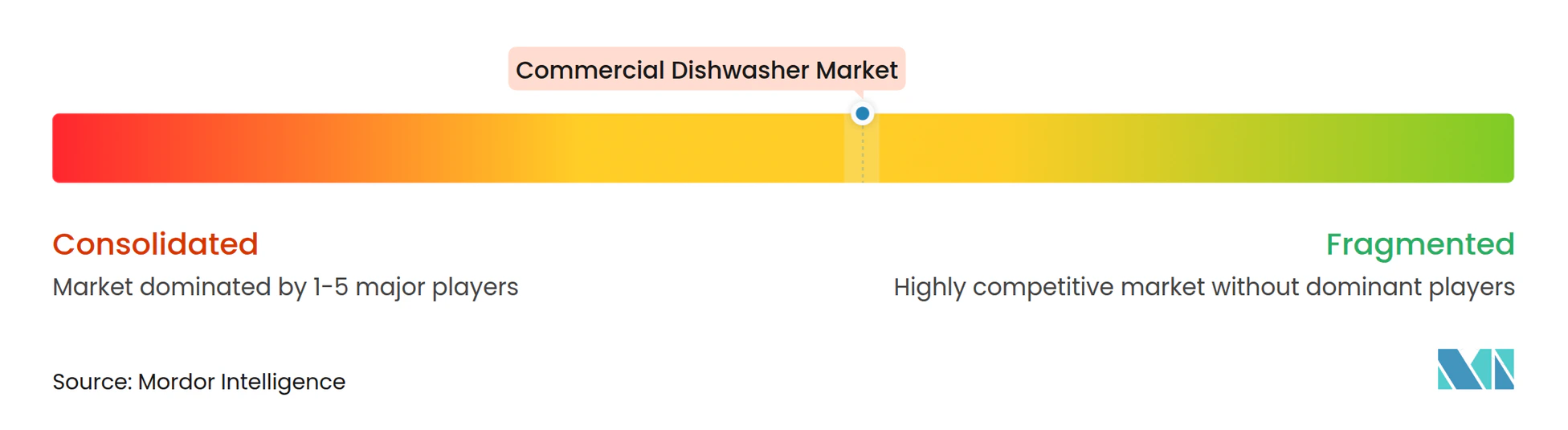
The commercial dishwasher market is moderately consolidated in premium equipment, where European specialists and multinational suppliers compete for enterprise, institutional, and large-hospitality accounts. Winterhalter Gastronom, MEIKO Maschinenbau, Wexiödisk, Electrolux Professional, Hobart, and Ali Group have positions in these higher-value customer groups. Their offering can combine equipment, chemistry, monitoring, and service contracts. This combination supports customer relationships that continue after the initial equipment sale. The broader mid-to-lower price range is more fragmented, with CMA Dishmachines, Jackson Warewashing Systems, Champion Industries, Fagor Industrial, Sammic, and JEMI competing through price, service proximity, and local specification relationships.
Connected wash platforms are becoming an important part of competitive strategy in the commercial dishwasher market. Winterhalter’s Connected Wash, Hobart’s SmartVisionControl-equipped FLOW Line, and Ecolab’s DishIQ program show the move toward equipment, chemistry, monitoring, and service offered together. Ecolab launched DishIQ in September 2025 with equipment, chemistry, and 24/7 remote monitoring through its Global Intelligence Center. The program uses data models intended to identify machine problems before service disruption. This shifts the maintenance model toward earlier intervention and supports a closer post-sale relationship with operators.
The connected mid-market tier remains open because operators want monitoring and compliance records without premium equipment pricing. In October 2025, Diversey launched IntelliDish CONTROL to add cloud connectivity, dispenser monitoring, and multi-site management to existing machines. This model allows a chemistry supplier to participate in connected warewashing without requiring the operator to replace the dishwasher. NSF/ANSI 3 certification and HACCP documentation can further differentiate suppliers serving enterprise accounts. Suppliers that can provide auditable temperature and cycle records have an advantage where compliance needs are central to procurement.
Commercial Dishwasher Industry Leaders
-
Winterhalter Gastronom GmbH
-
Hobart Corporation
-
MEIKO Maschinenbau GmbH and Co. KG
-
Ali Group S.r.l.
-
Electrolux Professional AB
- *Disclaimer: Major Players sorted in no particular order
Commercial Dishwasher Market Companies Covered in this Report
- Hobart Corporation, ITW Food Equipment Group
- Winterhalter Gastronom GmbH
- MEIKO Maschinenbau GmbH and Co. KG
- Ali Group S.r.l.
- Electrolux Professional AB
- Miele and Cie. KG
- Jackson Warewashing Systems LLC
- Fagor Industrial, Onnera Group
- Hoshizaki Corporation
- CMA Dishmachines
- Champion Industries, Champion Moyer Diebel
- Insinger Machine Co.
- MVP Group Corp., Jet-Tech
- Smeg S.p.A., Smeg Professional
- Sammic S.L.
- Teikos S.r.l.
- Comenda Ali Group
- LVO Manufacturing, Inc.
- Moffat Group, Washtech
- Wexiödisk AB
- JEMI, S.A.
- Stero, an Illinois Tool Works Brand
Recent Industry Developments in Commercial Dishwasher Market
- October 2025: Diversey, a Solenis company, launched IntelliDish™ CONTROL, a patent-pending IoT solution integrating cloud connectivity, dispenser monitoring, and a multi-site management app for foodservice, hospitality, and catering operations, repositioning dishwashing telemetry as a hygiene compliance and cost-management asset.
- September 2025: Ecolab launched its DishIQ program, combining equipment, chemistry, and 24/7 remote monitoring through a Global Intelligence Center. Proprietary data-science models predict machine failures before service disruption, converting warewashing maintenance from a reactive to a predictive model.
- August 2025: China’s State Administration for Market Regulation issued mandatory standard GB 38383-2025, tightening Grade 1 energy consumption by 36% and water consumption by 20% versus the prior edition, and expanding scope to built-in, free-standing, and countertop configurations with new noise and cleaning-index requirements.
- June 2025: Hobart unveiled the FLOW Line Collection featuring patented SmartVisionControl AI that detects ware type and soil level automatically, selecting the wash program with up to a 40% reduction in rinse water consumption versus prior-generation flight-type machines.
- April 2026: LG Electronics showcased its redesigned built-in dishwasher lineup at EuroCucina 2026 in Milan, Italy. The lineup featured a one-hour wash-and-dry cycle, QuadWash Pro, Dynamic Heat Dry+, TrueSteam, and AI SenseClean technology to improve cleaning performance, drying efficiency, and convenience for European households.
Global Commercial Dishwasher Market Report Scope
Segmentation Overview
| Rack/Conveyor |
| Undercounter |
| Door or Hood Type |
| Glasswashers |
| Flight-type / Continuous Conveyor Dishwashers |
| Below 50 racks/hour |
| 50–150 racks/hour |
| Above 150 racks/hour |
| Free-Standing |
| Built-in / under-counter integrated |
| Pass-through / line-integrated |
| Economy |
| Mid-Range |
| Premium |
| Foodservice |
| Hospitality |
| Institutional |
| Catering and Central Kitchens |
| Others |
| Direct Sales |
| Dealers and Distributors |
| North America | Canada |
| United States | |
| Mexico | |
| South America | Brazil |
| Peru | |
| Chile | |
| Argentina | |
| Rest of South America | |
| Europe | United Kingdom |
| Germany | |
| France | |
| Spain | |
| Italy | |
| BENELUX (Belgium, Netherlands, Luxembourg) | |
| NORDICS (Denmark, Finland, Iceland, Norway, Sweden) | |
| Rest of Europe | |
| Asia-Pacific | India |
| China | |
| Japan | |
| Australia | |
| South Korea | |
| South-East Asia | |
| Rest of Asia-Pacific | |
| Middle East & Africa | United Arab Emirates |
| Saudi Arabia | |
| South Africa | |
| Nigeria | |
| Rest of Middle East & Africa |
| By Product Type | Rack/Conveyor | |
| Undercounter | ||
| Door or Hood Type | ||
| Glasswashers | ||
| Flight-type / Continuous Conveyor Dishwashers | ||
| By Capacity | Below 50 racks/hour | |
| 50–150 racks/hour | ||
| Above 150 racks/hour | ||
| By Installation Configuration | Free-Standing | |
| Built-in / under-counter integrated | ||
| Pass-through / line-integrated | ||
| By Price Range | Economy | |
| Mid-Range | ||
| Premium | ||
| By Application | Foodservice | |
| Hospitality | ||
| Institutional | ||
| Catering and Central Kitchens | ||
| Others | ||
| By Distribution Channel | Direct Sales | |
| Dealers and Distributors | ||
| By Geography | North America | Canada |
| United States | ||
| Mexico | ||
| South America | Brazil | |
| Peru | ||
| Chile | ||
| Argentina | ||
| Rest of South America | ||
| Europe | United Kingdom | |
| Germany | ||
| France | ||
| Spain | ||
| Italy | ||
| BENELUX (Belgium, Netherlands, Luxembourg) | ||
| NORDICS (Denmark, Finland, Iceland, Norway, Sweden) | ||
| Rest of Europe | ||
| Asia-Pacific | India | |
| China | ||
| Japan | ||
| Australia | ||
| South Korea | ||
| South-East Asia | ||
| Rest of Asia-Pacific | ||
| Middle East & Africa | United Arab Emirates | |
| Saudi Arabia | ||
| South Africa | ||
| Nigeria | ||
| Rest of Middle East & Africa | ||
Key Questions Answered in the Report
What is the projected value of the commercial dishwasher sector by 2032?
The commercial dishwasher sector is projected to reach USD 3.77 billion by 2032, after increasing from USD 2.92 billion in 2027. The forecast CAGR is 5.25% for 2027–2032.
Which commercial dishwasher product type is growing fastest?
Flight-type and continuous conveyor equipment is forecast to grow at a 6.58% CAGR through 2032. It is used where hotels, airline caterers, hospitals, and central production kitchens need continuous processing.
Why are foodservice operators replacing commercial dishwashers?
Operators are replacing commercial dishwashers to improve food-safety documentation, reduce manual operating steps, and comply with efficiency requirements. Newer equipment can provide temperature records, cycle information, automated wash settings, and lower water use.
Which application is expanding fastest for commercial dishwashers?
Institutional applications are forecast to grow at 6.67% CAGR through 2032. The group includes schools, universities, healthcare sites, and government catering operations.
Which region has the strongest commercial dishwasher demand?
North America held 31.14% of demand in 2026, supported by a large foodservice base, labor costs, and efficiency-focused institutional purchasing. ENERGY STAR commercial dishwashers use 50% less water and 12% less energy than standard models according to the U.S. EPA.