
Market Overview
| Study Period | 2020 - 2031 |
|---|---|
| Forecast Data Period | 2026 - 2031 |
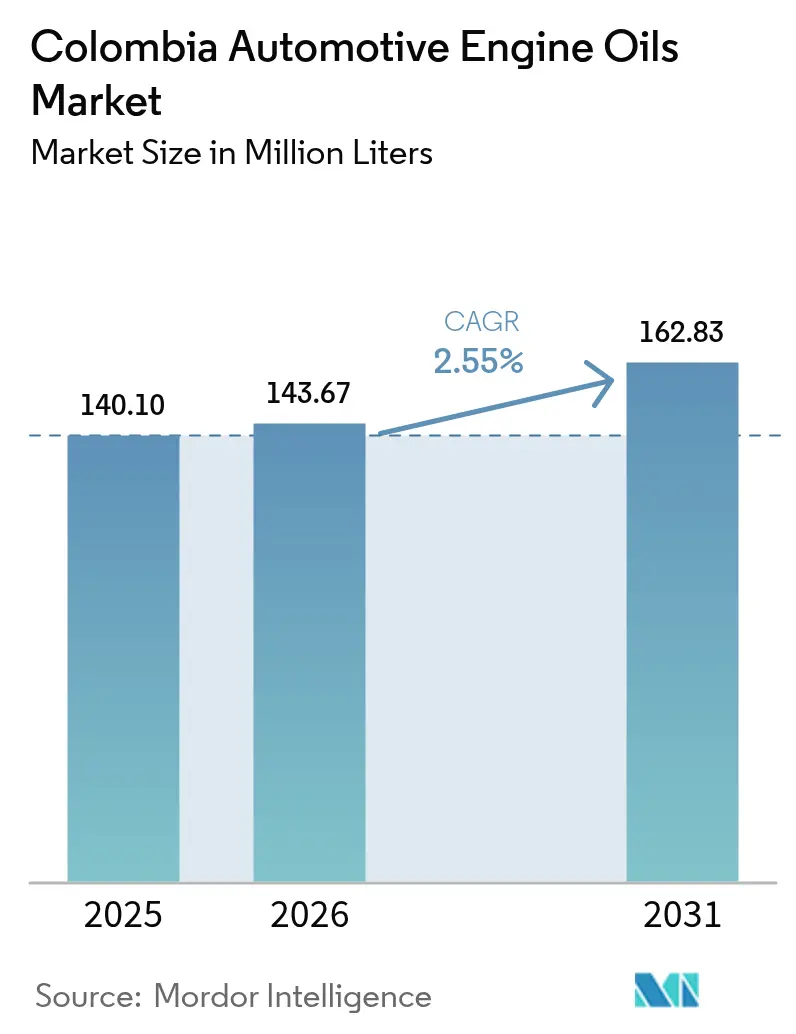
| Base Year Market Size (2025) | 140.10 Million Liters |
| Market Volume (2026) | 143.67 Million Liters |
| Market Volume (2031) | 162.83 Million Liters |
| Growth Rate (2026 - 2031) | 2.55 % |
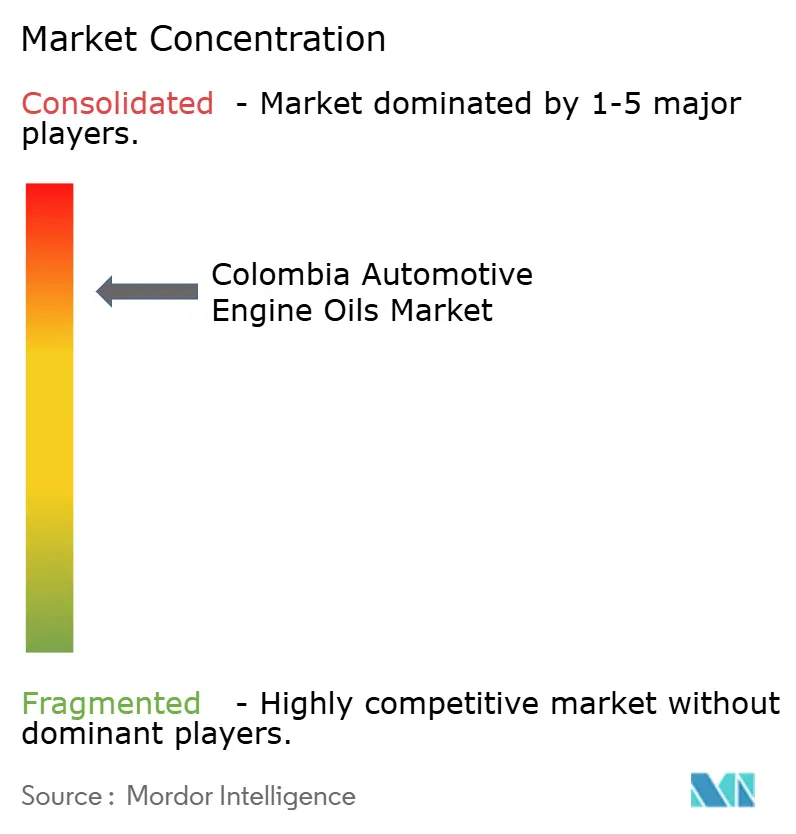
| Market Concentration | High |
Major Players *Disclaimer: Major Players sorted in no particular order Image © Mordor Intelligence. Reuse requires attribution under CC BY 4.0. | |
Colombia Automotive Engine Oils Market Analysis by Mordor Intelligence
The Colombia Automotive Engine Oils Market size was valued at 140.10 million liters in 2025 and estimated to grow from 143.67 million liters in 2026 to reach 162.83 million liters by 2031, at a CAGR of 2.55% during the forecast period (2026-2031). This growth trajectory is shaped by the motorcycle-centric mobility boom, gradual electrification of commercial fleets, and peso depreciation that extends vehicle replacement cycles and sustains lubricant consumption[1]. Demand patterns diverge across passenger car motor oil, heavy-duty motor oil, and motorcycle engine oil, with motorcycle registrations up 35.32% year over year in October 2024. Base-stock preferences remain skewed toward mineral formulations even as OEMs specify low-viscosity synthetics for fuel-efficiency gains. Consolidation activity, exemplified by Saudi Aramco’s USD 3.5 billion acquisition of Primax’s Colombian network, intensifies competitive pressures and underscores the importance of distribution reach.
Key Report Takeaways
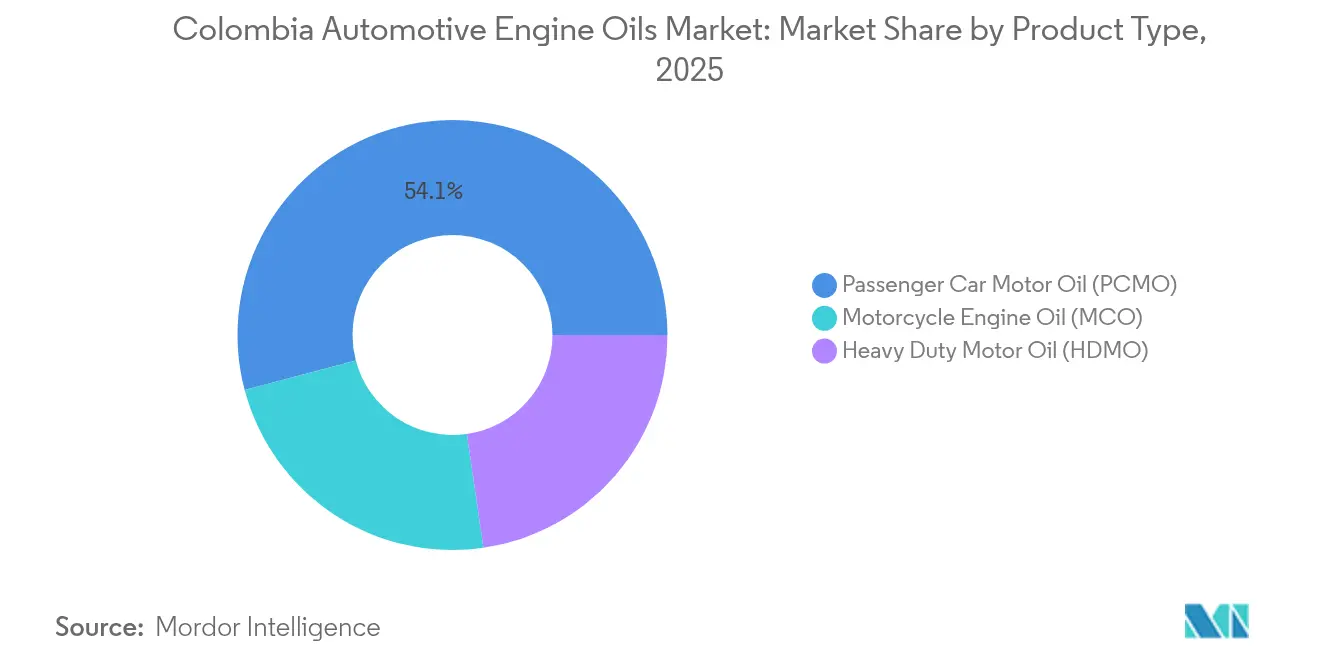
- By product type, passenger car motor oil accounted for 54.12% of the Colombia automotive engine oils market share in 2025, while motorcycle engine oil is forecast to expand at a 2.74% CAGR through 2031.
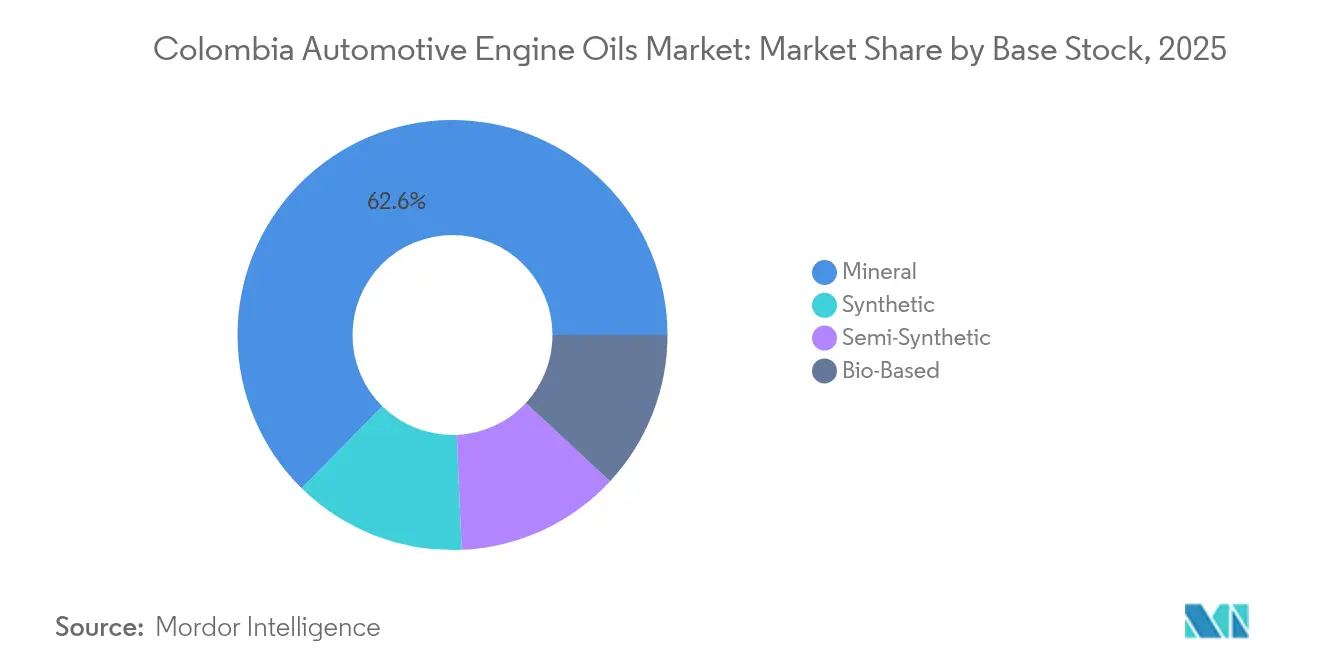
- By base stock, mineral formulations held 62.63% of the Colombia automotive engine oils market size in 2025; synthetic variants are projected to grow at a 2.86% CAGR to 2031.
Note: Market size and forecast figures in this report are generated using Mordor Intelligence’s proprietary estimation framework, updated with the latest available data and insights as of 2026.
Colombia Automotive Engine Oils Market Trends and Insights
Drivers Impact Analysis*
| Driver | (~) % Impact on CAGR Forecast | Geographic Relevance | Impact Timeline |
|---|---|---|---|
| Motorcycle-centric mobility boom | +0.80% | Bogotá, Medellín, Cali corridors | Medium term (2-4 years) |
| Aging passenger-car and light-truck parc | +0.60% | Nationwide; stronger in secondary cities | Long term (≥4 years) |
| Expansion of quick-lube and retail chains | +0.40% | Major urban centers | Medium term (2-4 years) |
| OEM pivot to low-viscosity synthetics | +0.30% | Nationwide | Long term (≥4 years) |
| SUV & pickup local assembly increasing sump volumes | +0.20% | Manufacturing hubs: Bogotá, Medellín regions | Short term (≤ 2 years) |
| Source: Mordor Intelligence | |||
Motorcycle-centic Mobility Boom
Motorcycle registrations climbed 16.71% year over year to 658,637 units through October 2024, underscoring a structural shift toward two-wheel mobility in congested cities. The installed base expansion amplifies demand for motorcycle engine oils because service intervals range from 3,000–4,000 km for mineral grades to up to 10,000 km for synthetics under Colombian conditions. Quick-lube operators target this high-frequency maintenance segment, prompting lubricant marketers to tailor pack sizes and additive packages for wet-clutch performance. Extended idling in heavy traffic accelerates thermal degradation, further elevating change frequency. As a result, the Colombia automotive engine oils market experiences volume uplift that offsets slower passenger-car growth.
Aging Passenger-Car and Light-Truck Parc
Peso depreciation and limited inventory inflate new-vehicle prices, pushing consumers to keep older cars longer and escalating oil-change frequency relative to factory recommendations. Vehicles exceeding 10 years dominate secondary cities, where cost sensitivity promotes mineral or semi-synthetic oils. High-viscosity PCMO grades remain prevalent because older engines have broader clearances and higher consumption rates. Service providers leverage the aging parc by bundling oil and filter promotions to capture repeat business. This behavior preserves base volume even as synthetic penetration increases in premium urban fleets, reinforcing resilience in the Colombia automotive engine oils market.
Expansion of Quick-Lube and Retail Chains
Retailers such as Terpel plan 60 new sites, while Coéxito rolls out Energiteca bays that integrate fuel sales with quick-lube services. The standardized model trims service times and elevates product credibility through brand visibility. Urban consumers value convenience, encouraging recurring visits that lift throughput and lubricant pull-through. Franchise formats like Grease Monkey exploit established traffic flows, enabling scale efficiencies in inventory management. Distribution partnerships become decisive as chains mandate assured stock and OEM-approved products, deepening competitive moats for suppliers with robust logistics. These factors buoy annual volumes across the Colombia automotive engine oils market.
OEM Pivot to Low-Viscosity Synthetics
Global emission and fuel-efficiency mandates push automakers to recommend 0W-20 or even 0W-16 grades for import models. Transitioning from 15W-40 to 10W-30 delivers fuel savings near 1% and supports extended drain intervals of 7,000–10,000 km, partially offsetting higher product cost. High retail premiums restrict adoption to warranty-sensitive buyers and fleet operators with total cost-of-ownership metrics, yet gradual penetration improves profitability mix. Blenders respond with semi-synthetic hybrids to bridge cost gaps. As OEMs align Colombian specifications with global platforms, synthetics’ share edges upward, enriching the value pool of the Colombia automotive engine oils market.
Restraints Impact Analysis*
| Restraint | (~) % Impact on CAGR Forecast | Geographic Relevance | Impact Timeline |
|---|---|---|---|
| Taxi and bus electrification programs | -0.30% | Bogotá, Medellín | Medium term (2-4 years) |
| Base-oil price volatility | -0.20% | National | Short term (≤2 years) |
| Informal re-use / extended-drain culture | -0.10% | Rural and secondary urban markets | Long term (≥ 4 years) |
| Source: Mordor Intelligence | |||
Taxi and Bus Electrification Programs
Pilot e-taxi projects in Bogotá and Medellín reveal annual maintenance costs of USD 97 for battery-electric powertrains versus USD 588–619 for internal-combustion equivalents, accelerating adoption in high-utilization fleets. Public-sector procurement guidelines favor zero-emission buses, eroding heavy-duty motor oil volumes in the Colombia automotive engine oils market. Nonetheless, infrastructure gaps and acquisition costs temper the shift, ensuring a prolonged ICE–EV mix. Lubricant marketers explore EV-thermal-management fluids to offset volume attrition. Training programs for mixed fleets create cross-selling moments during the transition period.
Base-Oil Price Volatility
Imported base oils expose local blenders to crude-price swings and currency risk, with Brent projected near USD 73 per barrel through 2026[2]. Small-scale players face margin squeezes when peso depreciation bumps input costs faster than retail prices. Distributors adjust inventory cycles to hedge exposure, but abrupt pricing shifts can prompt consumers to defer maintenance, briefly denting volume in the Colombia automotive engine oils market. Diverse sourcing from the U.S. Gulf Coast and Caribbean refineries softens single-point disruptions. Larger firms capitalize on volatility through forward-buying strategies, reinforcing competitive hierarchy.
*Our forecasts treat driver/restraint impacts as directional, not additive. The impact forecasts reflect baseline growth, mix effects, and variable interactions.
Segment Analysis
By Product Type: Demand Resilience in PCMO Amid Rapid MCO Uptick
Passenger Car Motor Oil anchored 54.12% of the Colombia automotive engine oils market share in 2025, mirroring the entrenched 6.9 million-unit light-vehicle parc. Routine city driving on congested routes accelerates oil oxidation, prompting 6-month change intervals despite OEM guidance on extended drains. Mineral 10W-30 and 15W-40 grades dominate for vehicles older than 8 years, while 5W-30 synthetics rise in late-model imports. Motorcycle Engine Oil advances at a 2.74% CAGR to 2031, underpinned by sustained two-wheel adoption that multiplies oil events. Motorcycles average 8,000 km annually and demand formulations compatible with wet clutches and air-cooled engines. HDMO remains steady as freight activity grows around logistical hubs, yet faces gradual displacement from urban bus electrification. Altogether, these forces preserve diversified demand within the Colombia automotive engine oils market and create channel-specific opportunities for bundled service offerings.
Widening viscosity spectrum within PCMO illustrates OEM divergence: turbocharged gasoline direct-injection engines favor 0W-20 synthetics for piston deposit control, whereas legacy engines persist with 20W-50 monogrades in budget-sensitive regions. The Colombia automotive engine oils market size for PCMO is forecast to rise modestly, buoyed by aftermarket promotions in quick-lube chains. MCO gains share through sachet packs tailored to daily commuters. Advanced additive chemistries that manage sludge during repetitive cold-start cycles receive growing attention. The interplay of price sensitivity and performance expectations guides product tiering, ensuring overlapping mineral, semi-synthetic, and synthetic sub-segments that cater to distinct consumer cohorts in urban and peri-urban areas.

By Base Stock: Mineral Majority Holds as Synthetics Strengthen Value Mix
Mineral oils retained a 62.63% share of the Colombia automotive engine oils market size in 2025, a testament to affordability in a price-conscious landscape. Semi-synthetic blends bridge cost and performance, capturing incremental upgrades from consumers influenced by OEM endorsements but constrained by budgets. Full synthetics, expanding at 2.86% CAGR, cater to warranty-protected vehicles and fleets seeking longer drain intervals that cut downtime. Resolución 2238 de 2023 mandates used-oil collection targets that favor durable formulations, indirectly accelerating synthetic adoption through lifecycle cost benefits. Bio-based stocks remain experimental but gain interest from sustainability-minded corporate fleets.
Cost premiums, often reaching threefold the mineral benchmark, keep synthetic penetration below 30% in rural and secondary markets. However, bundled service packages at chain garages reduce perceived price gaps by amortizing oil cost across wider maintenance menus. The Colombia automotive engine oils market integrates group II+ and group III imports to formulate low-volatility multi-grades, improving oxidation stability in high-ambient coastal provinces. Strategic alliances with additive suppliers expedite API SQ updates, positioning blenders for incoming specification cycles. Over the forecast horizon, mineral dominance erodes gradually yet continues to provide foundational volume, ensuring balanced growth across the value spectrum.
Geography Analysis
Colombia’s three principal metros—Bogotá, Medellín, and Cali—represent more than half of national consumption because high vehicle density, short trip frequency, and elevation induce accelerated oil aging. Premium synthetics achieve double-digit penetration in these markets thanks to franchised service chains that educate consumers on extended drains. Traffic congestion leads to average driving speeds below 25 km per hour, magnifying idling and thermal stress that shorten oil life and heighten purchase frequency.
Secondary cities such as Barranquilla, Bucaramanga, and Pereira exhibit different dynamics where the Colombia automotive engine oils market maintains mineral predominance. Here, prolonged vehicle ownership periods and informal workshop networks cultivate demand for budget-focused formulations sold in bulk drums or five-liter canisters. Distribution relies on regional wholesalers capable of navigating mountainous roadways that inflate transport costs. Suppliers with localized depots outperform import-dependent rivals during peak harvest seasons when road congestion intensifies lubricants’ last-mile challenges.
The Caribbean coastal belt experiences average ambient temperatures exceeding 30 °C, making volatility control and oxidation stability critical formulation parameters. Meanwhile, Andean highlands impose altitude-related stress that necessitates optimized detergency to counter incomplete combustion. National regulations on used-oil recovery, carbon pricing under the PNCTE, and EV adoption targets converge across regions, prompting blenders to promote circular-economy solutions that reinforce brand equity. Collectively, these geographic variances ensure nuanced demand profiles that preserve balance within the Colombia automotive engine oils market.
Regulatory Landscape
Colombia’s automotive engine oils market operates under a compliance stack that covers product quality norms, tax and customs rules, and environmental obligations for the collection and handling of used oils. Product performance and conformity commonly reference Colombian Technical Norms (NTC) and related conformity assessment frameworks under national standardization and market surveillance bodies such as the Superintendencia de Industria y Comercio (SIC), while DIAN-administered tax and customs treatment for petroleum-derived products shapes how importers and distributors manage compliance.
On the environmental side, used-oil management requirements influence aftermarket practices and supplier programs. The market also continues to align with tightening vehicle and fuel quality requirements overseen by the Ministry of Mines and Energy (MME) and environmental authorities. Resolution 40444 of 2023 is one of the anchor instruments tied to current quality parameters for fuels and additives that interact with engine and aftertreatment performance, which increases the need for compliant formulations and traceable supply chains across formal channels.
Value Chain Analysis
The value chain starts with base oils and additive supply, moves through local blending and packaging, and ends in a fragmented service ecosystem spanning dealer workshops, quick-lube bays, fuel-station retail, and independent garages. Colombia has domestic base oil availability alongside meaningful dependence on imported Group II and Group III base stocks, and local blending capacity supports packaged oil availability for PCMO, HDMO, and MCO across mineral, semi-synthetic, and synthetic tiers.
Downstream, distribution reach and point-of-service execution are decisive, given the prominence of large retail and fuel-station networks and the rise of standardized quick-lube formats in major metros. Conformity assessment and quality frameworks administered through bodies such as ICONTEC and ONAC affect procurement and labeling discipline in formal channels. In parallel, emissions-driven technology shifts (for example, Euro VI-equivalent requirements for new heavy-duty vehicles) raise the bar for additive performance and the technical support delivered by marketers and blenders.
Competitive Landscape
The Colombia automotive engine oil is consolidated, with Terpel leveraging its fueling network to dominate packaged-oil distribution and command shelf visibility across 2,400 service stations. Saudi Aramco’s acquisition of Primax’s 914 stations extends vertical integration and injects a new global entrant armed with proprietary base oils, intensifying bargaining dynamics along the supply chain. International majors—Shell, ExxonMobil, and Chevron—retain brand equity through OEM approvals and technical training while partnering with local bottlers to mitigate logistics risk.
Domestic companies such as Coéxito, Biomax, and Petromil differentiate through agile regional distribution and culturally attuned marketing. Fuchs’s joint venture expansion into neighboring Peru signals ambitions for Andean synergy, foreshadowing cross-border competition in Colombia. Product innovation accelerates around low-SAPs additive packages and EV thermal-fluid lines, areas where early mover status confers OEM recommendation advantages. Marketing spends pivot toward digital channels that resonate with younger motorcycle owners.
Distribution alliances with quick-lube chains become pivotal because standardized service protocols favor single-brand supply contracts. Suppliers offering comprehensive technical support, used-oil collection programs, and lubricant-related training gain preferential access. While price sensitivity persists, rising synthetic uptake lifts average revenue per liter, enriching margins. These vectors collectively shape a dynamic yet orderly Colombia automotive engine oils market that rewards scale, technical acumen, and network depth.
Colombia Automotive Engine Oils Industry Leaders
-
BP p.l.c.
-
Chevron Corporation
-
Shell plc
-
Terpel
-
TotalEnergies
- *Disclaimer: Major Players sorted in no particular order
Market Opportunities and Future Outlook
The main opportunity sits at the intersection of OEM-driven low-viscosity specifications and the still mineral-heavy installed base, with mineral at 62.63% share in 2025. This supports supplier expansion in semi-synthetic and synthetic upgrade paths that keep affordability in focus while meeting newer engine protection needs. Quick-lube and fuel-station service formats, which can bundle oil, filters, and labor, provide a workable channel for translating these product upgrades into higher maintenance frequency.
The API SQ standard taking effect on May 31, 2025 is a concrete inflection point for product refresh cycles and retailer assortment resets. Another practical opportunity is operational, improving local blending, packaging, and logistics responsiveness to reduce exposure to currency and imported input volatility, while meeting formal-channel compliance and used-oil collection expectations. Established in-country manufacturing and blending footprints, including ExxonMobil’s lubricant factory complex in Bucaramanga and Chevron’s lubricant operations in Bogota, support supply assurance and faster adaptation to Colombia-specific driving conditions and grade demand, including high-frequency motorcycle maintenance. Suppliers that pair technical training with collection programs and maintain consistent availability across Bogotá, Medellin, and Cali benefit as chain service networks expand their footprint.
Recent Industry Developments
- March 2026: Terpel highlighted lubricants as a continuing pillar within its multi-business ecosystem while discussing 2025 performance and diversification across mobility and energy solutions. The positioning reinforces the role of its station network and service formats as a primary route-to-market lever for packaged engine oils and related services.
- May 2025: The American Petroleum Institute (API) SQ engine oil standard came into force effective May 31, 2025, prompting LIQUI MOLY to update several Special Tec AA and Molygen New Generation products to comply. The specification change accelerates portfolio turnover and increases the importance of documented performance claims in retail and workshop channels.
- April 2024: Shell Lubricants introduced three new products under the Shell Helix Ultra brand aligned to updated industry standards and OEM specifications. The launch supports premiumization in passenger car motor oil and adds competitive pressure on brands to maintain approvals and visibility in high-traffic urban service outlets.
Research Methodology Framework and Report Scope
Market Definition and Coverage
For this report, the market is defined as finished engine oil consumed in Colombia for on-road vehicles, measured as the volume sold into the aftermarket and service-fill channels across the study period.
Scope exclusions: It excludes industrial engine oils, marine and aviation lubricants, and non-engine automotive fluids such as transmission fluids, brake fluids, and greases.
Segmentation Overview
- By Product Type
- Passenger Car Motor Oil (PCMO)
- 0W-XX
- 5W-XX
- 10W-XX
- 15W-XX
- Monogrades
- Other Grades
- Heavy Duty Motor Oil (HDMO)
- 0W-XX
- 5W-XX
- 10W-XX
- 15W-XX
- Monogrades
- Other Grades
- Motorcycle Engine Oil (MCO)
- 0W-XX
- 5W-XX
- 10W-XX
- 15W-XX
- Monogrades
- Other Grades
- Passenger Car Motor Oil (PCMO)
- By Base Stock
- Mineral
- Synthetic
- Semi-Synthetic
- Bio-Based
Data Sources, Market Sizing, and Validation
Desk Research
Desk research helped us set the demand backbone and the operating context before we started any modeling. We reviewed public sources such as Colombia vehicle registration and fleet indicators from the national statistics system, trade and customs releases, and technical standards and viscosity guidance published by bodies such as SAE and API. We also used broader signals like fuel demand and mobility trends from energy statistics, plus safety and emissions updates where they affect drain intervals and oil grades.
To anchor the market to real-world supply, we also reviewed import and export data for lubricants and base oils, distributor announcements, and publicly available company disclosures such as annual reports and investor decks. A paid import and export shipment-level database and a paid company financials and intelligence source were used selectively to cross-check product flows and revenue reasonableness when public detail was thin. The sources listed above are illustrative, and many other public and paid references were used for data collection, validation, and clarification during the study.
Primary Interviews and Surveys
Primary work was used to pressure-test the desk assumptions and fill gaps that are common in lubricants, especially around channel mix and pack size behavior. We spoke with a mix of blenders, distributors, workshops, retail-linked sellers, and fleet maintenance stakeholders across Colombia, and then reconciled differences through follow-up calls when reported volumes did not match the expected vehicle parc or drain interval logic.
Distribution of primary research fieldwork respondents
| Company type | Respondent position |
|---|---|
| Top tier: 39% | CXOs: 12% |
| Mid tier: 47% | Functional/Unit leaders: 42% |
| Smaller Players: 14% | Managers: 46% |
Market-Sizing & Forecasting
Sizing was built using a top-down demand reconstruction, where the vehicle parc by type in Colombia is converted into annual oil consumption using average sump size, typical drain interval, and service behavior for each vehicle group. Those volumes were then adjusted for differences in usage intensity (for example, motorcycles used for daily commuting versus private passenger cars) and for the share of oils meeting newer viscosity and performance specifications, which influences replacement patterns.
To keep the totals realistic, we corroborated the output with selective bottom-up checks such as distributor and workshop channel checks, sampled pack size splits (bulk versus packaged), and price-band logic applied to observed product grades. Key inputs that were tracked during modeling included the vehicle parc trajectory, new vehicle sales and import patterns, average annual kilometers by vehicle type, oil drain interval shifts, and the mineral versus synthetic mix that affects volumes sold per service event. Where direct observations were missing for a niche sub-market, we handled the gap using a proxy based on the closest vehicle class, then confirmed the proxy through primary responses.
Forecasting relied on scenario analysis, since the market is sensitive to macro factors that influence vehicle usage and maintenance timing. The scenarios were tied to expected changes in parc growth, affordability of higher-grade oils, and workshop activity, and then refined using what interviewees shared about near-term demand and channel stocking behavior.
Data Validation & Update Cycle
Validation was done by checking the modeled totals against independent signals, including lubricant trade flows, vehicle parc direction, and whether implied oil change frequency stayed within realistic bounds. If a sub-segment looked too high or too low, we re-checked the assumptions step by step, starting from the parc input, then the drain interval, and then the channel split, before it was signed off.
A second analyst review is completed to confirm that arithmetic, units, and year-to-year movement are consistent, and any large variance triggers a targeted re-contact with industry participants. The report is refreshed annually, and interim updates are made when material events occur that can shift pricing, channel structure, or demand. Before delivery, a final analyst pass is performed so clients receive the most current view available.
Mordor Intelligence's Colombia Automotive Engine Oils Market Size Versus Other Published Estimates
Published market sizes for engine oils can vary even when they talk about the same country, because the included vehicle categories, measurement units, and pricing assumptions often differ. The timing of currency conversion, the year used as the base, and whether service-fill is counted can also shift the final number.
The main gap comes from mixing value and volume views and then applying a broad average price, where Mordor Intelligence keeps the headline sizing tied to in-country consumption volume and aligns it with drain intervals and vehicle parc logic instead of assuming a uniform ASP across grades and channels.
Benchmark comparison
| Source | Market Size | Gaps in Research Methodology |
|---|---|---|
| Mordor Intelligence | 140.10 Million Liters (2025) | |
| Trade Journal A | USD 260.00 M (2024) | Often presented as a value estimate built from broad retail price points, with limited clarity on bulk versus packaged mix, tax treatment, and whether motorcycles are fully included. |
| Regional Consultancy B | USD 310.00 M (2025) | Typically uses an aggressive synthetic mix and higher assumed price progression, and may convert currency using a different timing window, which can inflate the USD total in a volatile FX environment. |
Across the three figures, the spread is explained mainly by unit choice and pricing logic rather than a sudden change in how much oil is actually consumed. By anchoring the model to parc, drain interval, and channel checks, the estimate stays traceable to simple demand drivers that can be re-tested as conditions change.
Key Questions Answered in the Report
How large is the Colombia automotive engine oils market in 2026?
It reached 143.67 million liters in 2026 and is projected to grow at a 2.55% CAGR to 2031.
Which product segment leads lubricant demand in Colombia?
Passenger Car Motor Oil retained leadership with 54.12% share in 2025, driven by the sizable light-vehicle fleet.
What is the fastest-growing segment in the country?
Motorcycle Engine Oil is forecast to expand at 2.74% CAGR through 2031, reflecting sustained two-wheel adoption.
How are mineral and synthetic oils positioned?
Mineral oils still dominate at 62.63%, but synthetics are growing 2.86% annually due to OEM fuel-efficiency requirements.
Which regions consume the most engine oil?
Bogotá, Medellín, and Cali account for the bulk of demand because of dense traffic and frequent maintenance cycles.
How is electrification affecting lubricant sales?
Taxi and bus electrification trims heavy-duty volumes, but overall impact remains modest as EV parc penetration is still low.