
Cold-Pressed Oil Market Size and Share
Market Overview
| Study Period | 2021 - 2031 |
|---|---|
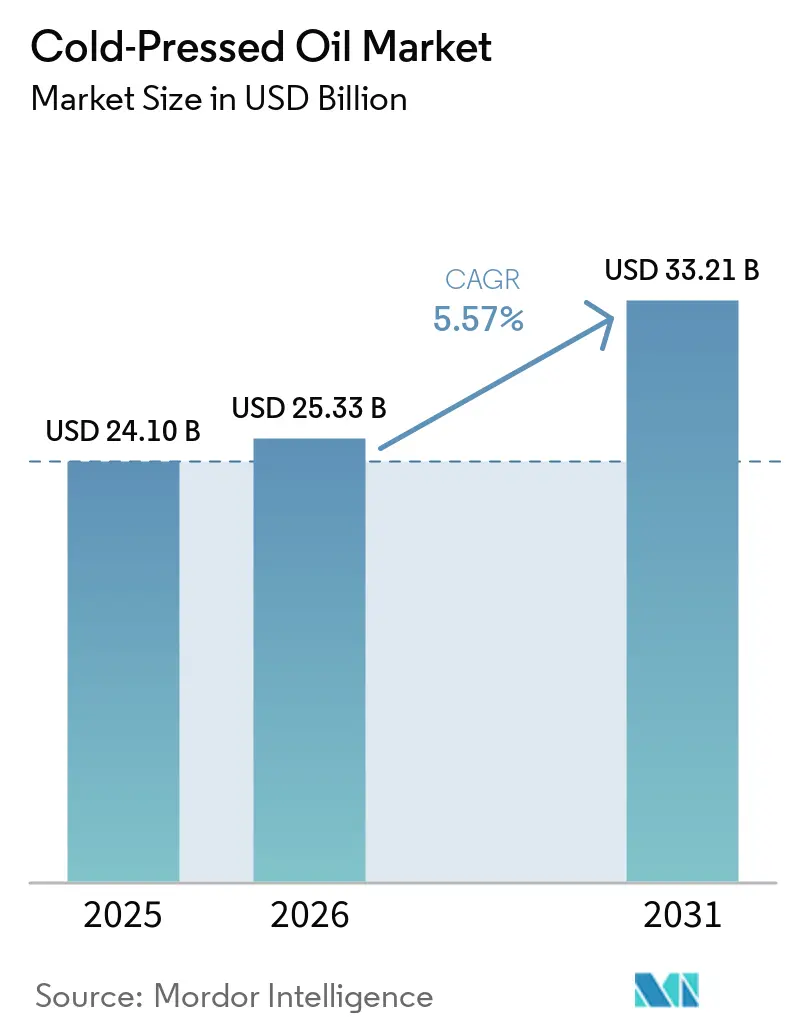
| Market Size (2026) | USD 25.33 Billion |
| Market Size (2031) | USD 33.21 Billion |
| Growth Rate (2026 - 2031) | 5.57 % |
| Fastest Growing Market | Asia-Pacific |
| Largest Market | Asia-Pacific |
| Market Concentration | Medium |
Major Players *Disclaimer: Major Players sorted in no particular order Image © Mordor Intelligence. Reuse requires attribution under CC BY 4.0. | |
Cold-Pressed Oil Market Analysis by Mordor Intelligence
The cold-pressed oil market size was valued at USD 24.10 billion in 2025 to USD 25.33 billion in 2026, and is forecast to reach USD 33.21 billion by 2031 at a 5.57% CAGR during the forecast period (2026-2031). Demand is shifting toward oils that undergo minimal processing and retain naturally occurring compounds, including polyphenols, essential fatty acids, and heat-sensitive vitamins. This preference supports premium pricing for products with credible information on origin, extraction, and quality. It also increases the value of extraction systems that preserve product quality while ensuring consistent output. Larger retailers and wholesale channels are gaining importance as the category expands beyond specialist health stores. Supply conditions remain critical, as disruptions in olive, coconut, seed, and nut feedstocks can quickly affect prices and purchasing decisions.
Key Report Takeaways
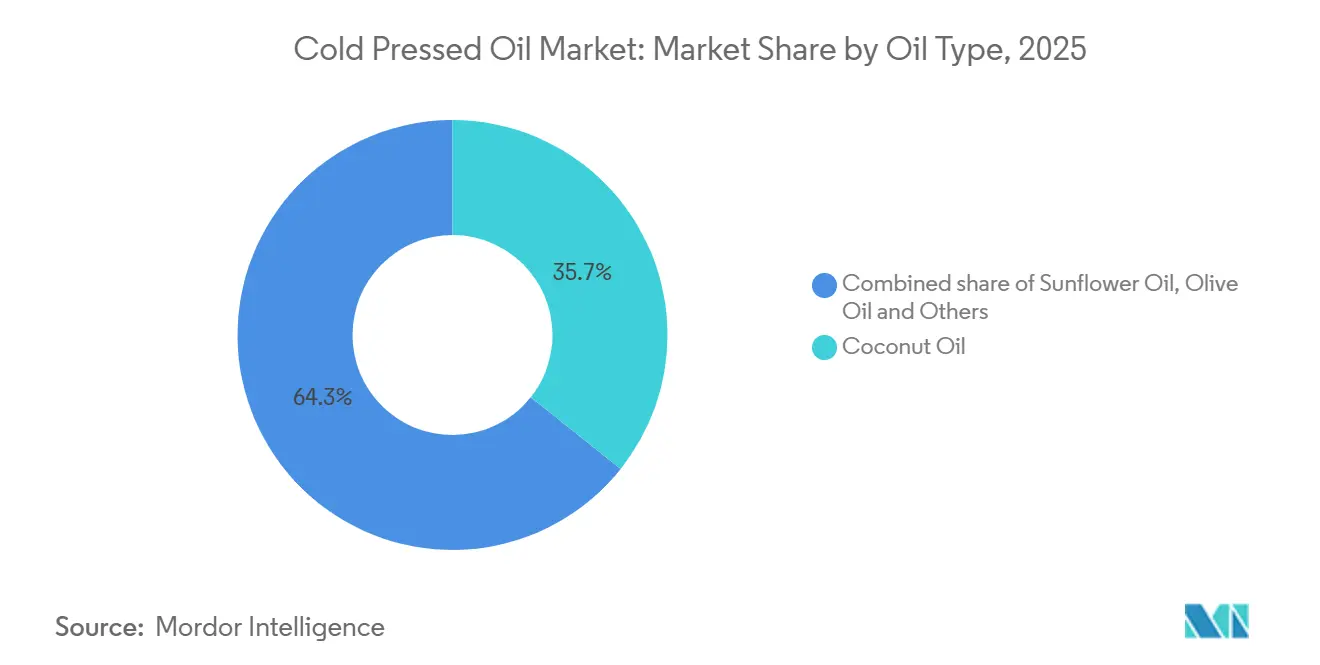
- By oil type, coconut oil led the cold-pressed oil market with a share of 35.70% in 2025, while olive oil is anticipated to register the fastest CAGR of 6.83% during 2026-2031.
- By nature, conventional retained a 72.10% share in 2025, whereas organic is forecast to expand at a 7.35% CAGR through 2031.
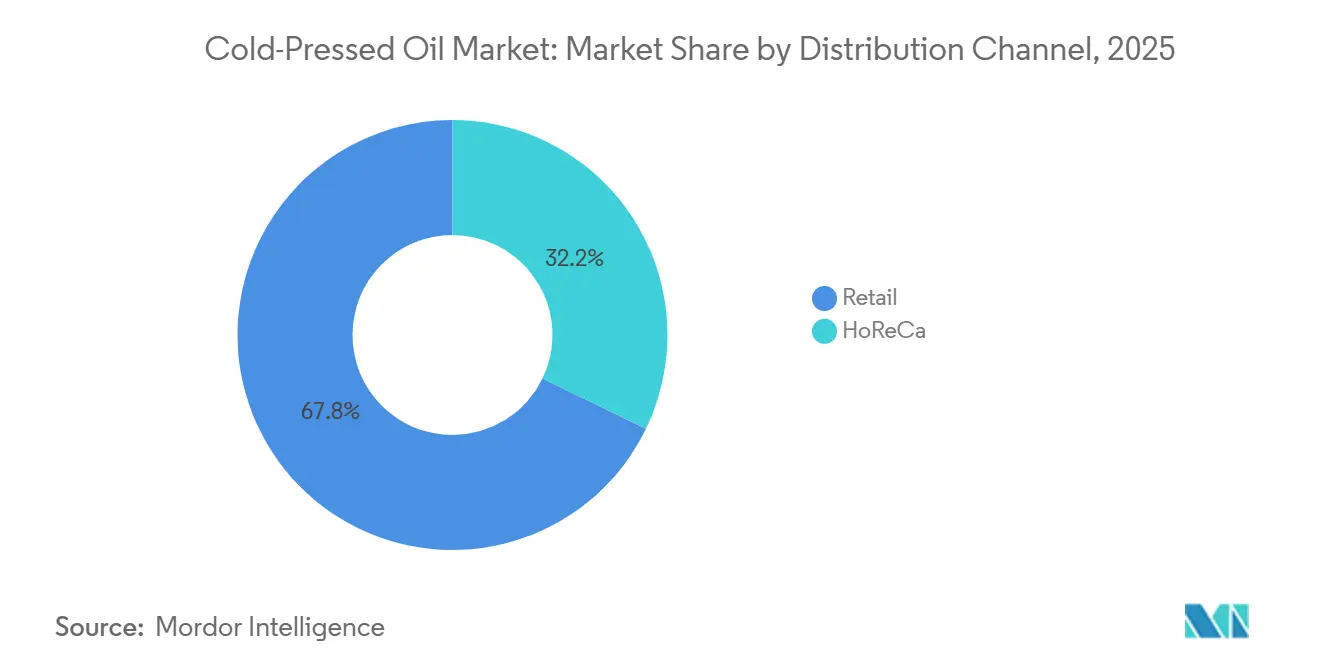
- By distribution channel, retail led the market with a share of 67.82% in 2025, while HoReCa is anticipated to register the fastest CAGR of 6.43% during 2026-2031.
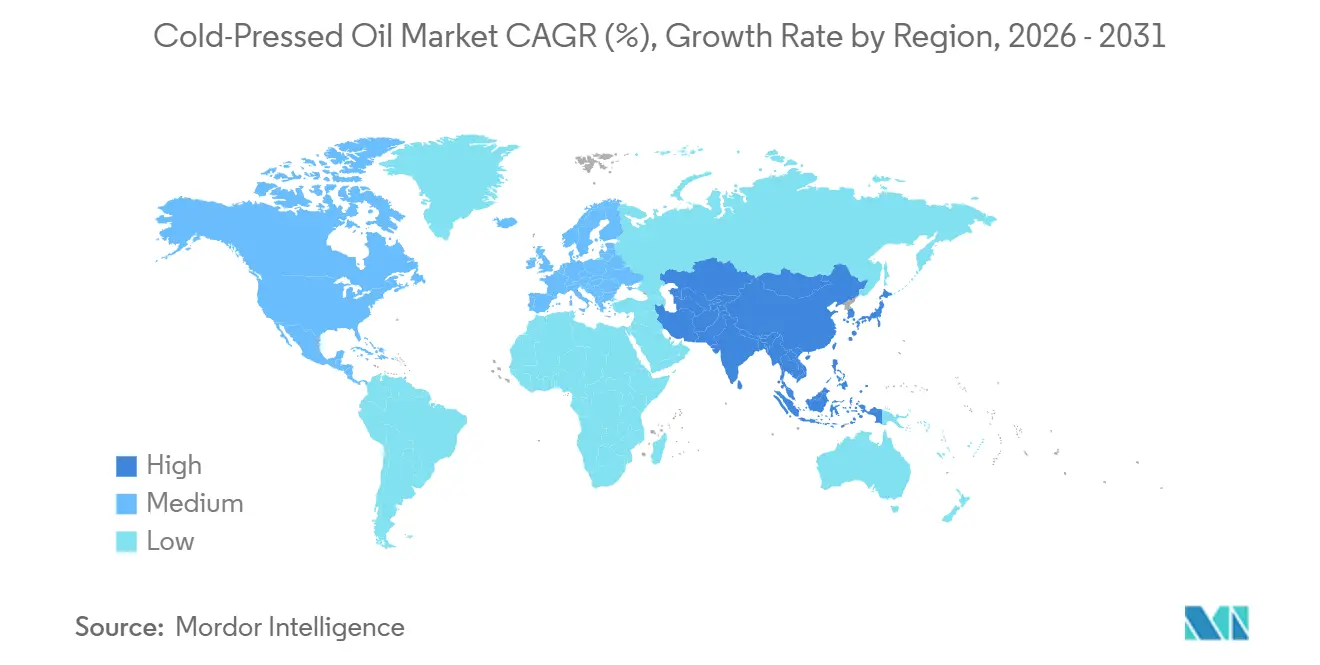
- By geography, Asia-Pacific led the cold-pressed oil market in 2025 with a 43.78% share, projected to advance at a 6.30% CAGR through 2031.
Note: Market size and forecast figures in this report are generated using Mordor Intelligence’s proprietary estimation framework, updated with the latest available data and insights as of January 2026.
Market Trends and Insights
Drivers Impact Analysis of Cold-Pressed Oil Market*
| Driver | (~) % Impact on CAGR Forecast | Geographic Relevance | Impact Timeline |
|---|---|---|---|
| Rising consumer preference for minimally processed edible oils | +1.2% | Global | Short term (≤ 2 years) |
| Product innovation through specialty seed and nut-based cold-pressed oils | +0.7% | North America, Europe, Asia-Pacific | Medium term (2-4 years) |
| Growing adoption of plant-based oils in natural personal care | +0.6% | North America, Europe | Medium term (2-4 years) |
| Growing demand for functional foods rich in natural nutrients | +0.8% | Global, concentrated in Asia-Pacific and North America | Medium term (2-4 years) |
| Increasing preference for sustainable and chemical-free extraction methods | +0.5% | Europe, North America | Long term (≥ 4 years) |
| Rising demand for specialty culinary oils in premium foodservice | +0.4% | Europe, North America, Asia-Pacific urban centers | Long term (≥ 4 years) |
| Source: Mordor Intelligence | |||
Rising Consumer Preference For Minimally Processed Edible Oils
Consumers are choosing cold-pressed oils due to their perceived health benefits and closer connection to ingredients and processing methods. A 2024 study conducted by the International Journal of Agriculture Extension and Social Development in Hyderabad found that health benefits received a mean score of 4.34 out of 5 as a purchase driver, while 75% of respondents purchased these oils every 10 to 15 days[1]. This pattern indicates that repeat purchasing is becoming established among some households rather than remaining an occasional wellness-driven purchase. As the cold-pressed oil market reaches a wider buyer base, supermarket shelf space and reliable supply are becoming more important. This shift may benefit processors that can maintain quality at scale, while smaller brands may face closer price comparisons in mainstream retail. The category can gain volume through broader availability while becoming more competitive in the middle price range, where buyers still expect a clear difference in quality and processing.
Growing Demand For Functional Foods Rich In Natural Nutrients
Producers increasingly position cold-pressed oils as ingredients that offer nutritional properties in addition to cooking applications. The framework provides producers with a basis for communicating product value when their products meet applicable requirements. This positioning is especially relevant in markets where preventive health considerations influence food purchases. Specialty seed and nut oils can also help producers create a more differentiated product range when they document composition and quality. Therefore, the cold-pressed oil market can support product tiers that differentiate traceable, nutrient-focused formats from standard refined edible oils, while requiring brands to align health-related communication with the evidence and labeling requirements applicable to each product.
Increasing Demand For Specialty Culinary Oils In Premium Foodservice
Premium restaurants use cold-pressed oils to communicate origin, harvest timing, and varietal characteristics in menu presentations. This approach positions the oil as part of the dining experience, rather than only as a kitchen input. The International Olive Council in July 2026 stated that they would expect worldwide consumption of quality extra virgin olive oil to rise by 14% to 20% by 2050[2]. Buyers in these settings may prioritize certified grades and reliable supply relationships over the lowest available spot price. This trend creates opportunities for producers that can offer consistent quality, provenance records, and formats suited to professional table service, particularly when kitchen teams require product details that they can clearly share with guests.
Product Innovation Through Specialty Seed And Nut-Based Cold-Pressed Oils
Specialty seed and nut oils allow brands to move beyond familiar culinary oils. Varieties such as pumpkin seed, black seed, hemp, and avocado oils offer distinct flavor profiles and applications across food and personal care products. Their smaller production base can support premium positioning when brands clearly communicate sourcing and extraction practices. The cold-pressed oil market also benefits when brands use product formats and origin information to help consumers better understand these oils. Innovation in this area depends on a stable raw material supply and careful handling, as these products can be sensitive to quality variations. These oils also allow processors to diversify revenue beyond high-volume conventional oils. However, successful launches require consumers to understand the intended use, flavor, and storage needs of unfamiliar varieties.
Restraints Impact Analysis of Cold-Pressed Oil Market*
| Restraint | (~) % Impact on CAGR Forecast | Geographic Relevance | Impact Timeline |
|---|---|---|---|
| High production costs compared to refined edible oils | -0.8% | Global, most acute in price-sensitive emerging markets | Short term (≤ 2 years) |
| Limited shelf life without chemical refining | -0.4% | Global, most acute in long-distribution-chain markets | Medium term (2-4 years) |
| Oilseed and nut raw material price volatility | -0.6% | Global, concentrated in Mediterranean and Southeast Asian supply chains | Short term (≤ 2 years) |
| Stringent labeling and authenticity regulations for virgin and cold-pressed oils | -0.3% | Europe, India, North America | Medium term (2-4 years) |
| Source: Mordor Intelligence | |||
High Production Costs Compared To Refined Edible Oils
Cold pressing typically yields less oil from a given quantity of raw material than solvent extraction and heat-based refining. Fresh, high-quality seeds and nuts also carry higher costs, as contamination or poor handling can affect the finished product. These higher costs can limit adoption among price-sensitive households and restrict mass retail penetration in lower-income markets. They can also reduce the funds available to smaller producers for automation, storage, and quality control. Unlike refined oils, cold-pressed oils require careful processing, filtration, and storage to preserve their natural nutrients and oxidative stability, which further increases production and logistics costs. As a result, product consistency may vary, making it more challenging for smaller producers to achieve economies of scale and expand into mainstream retail channels.
Stringent Labeling And Authenticity Regulations For Virgin And Cold-Pressed Oils
In 2024, the European Union stated that labeling and authenticity requirements require producers to maintain clear records, testing processes, and product controls. Regulation 2022/2104 sets standards for olive oil categories, including requirements that apply to extra virgin olive oil quality and sensory assessment[3]. These requirements create ongoing compliance obligations and can increase participation costs for smaller businesses. Larger companies can spread testing, audit, and quality assurance expenses across higher production volumes. As a result, the regulatory environment can favor established producers and well-funded regional specialists. It may also drive demand for third-party certification and traceability systems that help buyers verify product claims before listing products in more demanding retail and foodservice channels.
*Our forecasts treat driver/restraint impacts as directional, not additive. The impact forecasts reflect baseline growth, mix effects, and variable interactions.
Cold-Pressed Oil Market Segment Analysis
By Oil Type:
Coconut Oil Anchors Revenue, Olive Oil Leads Value GrowthCoconut oil accounted for 35.70% of the cold-pressed oil market size in 2025. Its position reflects its widespread use as a household cooking oil in South and Southeast Asia and as a base ingredient in natural personal care products. In India, long-standing food traditions and wellness practices continue to support regular household purchases. Sunflower oil and groundnut oil hold secondary positions in the oil type mix. Rapeseed oil remains relevant in European markets, particularly where local producers sell directly to consumers. This also identifies pumpkin seed, black seed, hemp, and avocado oils as an emerging group within the Others category. These varieties broaden the category beyond staple cooking oils and allow smaller producers to compete more effectively through product identity.
Olive oil is expected to record the highest CAGR, at 6.83%, through 2031 within the oil type segmentation. Its growth is tied to recovering Mediterranean supply and rising demand for traceable, single-origin products. Products with clear varietal and harvest information help consumers and foodservice buyers assess quality more easily. European Union olive oil rules also provide established standards that support category definitions and quality communication. Olive oil producers can use these controls to support a premium retail position when they consistently meet the relevant standards. The cold-pressed oil industry has a wider product base than olive oil alone, but olive oil remains important in setting quality expectations in premium culinary formats.

By Nature:
Conventional Volume Meets Organic Value PremiumConventional products account for 72.10% of revenue in 2025, making them the largest contributor to category sales. Their wide availability and lower prices make them accessible to more households and foodservice operators. Conventional supply chains also enable larger processors to source oilseeds at scale and manage procurement more efficiently. This supports volume sales, even as consumers closely compare products by price. The segment remains particularly important in Asia-Pacific, where many buyers use these oils for regular cooking rather than occasional specialty purchases. Large producers can also maintain distribution across supermarkets, independent stores, and foodservice customers.
Organic oils are projected to expand at a CAGR of 7.35% through 2031. Their appeal stems from the combination of organic ingredient sourcing and minimally processed extraction methods. KLF Nirmal lists European Union Organic certification and approval under India’s National Programme for Organic Production for its organic virgin coconut oil. Such certifications can help producers serve export-oriented retail accounts and domestic buyers seeking documented natural products. However, organic production faces higher input costs, along with the lower oil yields associated with cold pressing. These factors make margins sensitive to raw material cost fluctuations and can constrain supply growth.
By Distribution Channel:
Retail Leads, HoReCa AcceleratesRetail captured 67.82% of distribution revenue in 2025, giving it the leading share of the cold-pressed oil market. Hypermarkets and supermarkets offer strong product visibility, enable product comparison, and attract high consumer footfall. Online retail also enables brands to build direct customer relationships and drive repeat orders through subscriptions. In August 2025, Graza expanded its Drizzle and Sizzle products into glass bottles at Whole Foods Market and Kroger after building recognition with its squeeze-bottle format. Retail, therefore, remains central to high-volume sales and the wider adoption of premium oil formats. Shelf placement allows consumers to compare labels and extraction claims, while retail scale supports regular replenishment for frequently purchased products.
HoReCa is forecast to grow at a CAGR of 6.43% through 2031, making it the fastest-growing distribution channel. Restaurants and hospitality operators use traceable oils to add specificity to dishes and table service. In this channel, quality grades, origin information, and dependable delivery can matter more than the lowest purchase price. Convenience stores, grocery stores, and specialty outlets hold smaller shares, but they remain useful entry points for emerging brands. These channels can introduce boutique producers to consumers who actively seek health-focused or specialty food products.
Geography Analysis
APAC Cold-Pressed Oil Market
Asia-Pacific accounts for 43.78% of regional revenue in 2025 and is forecast to grow at a CAGR of 6.30% through 2031. The region combines established household consumption in South and Southeast Asia with rising demand for premium oils in urban markets. Indonesia and the Philippines are key sources of coconut oil feedstock, with supply chains serving local food applications and international demand from the personal care market. India remains significant, as traditional oil use is closely linked to cooking and wellness practices.
North America and Europe Cold-Pressed Oil Market
North America and Europe are the second- and third-largest geographies, respectively, in the supplied research. Clean-label preferences, online sales, and specialty food retail channels support demand in North America. Europe benefits from Mediterranean olive oil production, a strong food culture, and established quality regulations. In addition, rising consumer demand for minimally processed, nutrient-rich edible oils and the growing adoption of organic food products continue to support market growth across both regions.
South America and MEA Cold-Pressed Oil Market
South America and the Middle East and Africa remain smaller opportunities within the cold-pressed oil market. Brazil’s demand for functional foods and Argentina’s edible oil production base support regional potential. Chile and Peru offer potential sources for avocado and specialty seed oils. Gulf Cooperation Council markets show demand for imported extra virgin olive oil, while purchasing power constraints and premium product prices limit broader adoption.
Competitive Landscape
The market concentration of the cold-pressed oil is medium. Deoleo, Sovena Group, and Salov Group compete through recognizable brands, broad distribution networks, and supply chain scale. Regional companies, such as KLF Nirmal, Gramiyum Wood Pressed Oils, FreshMill Oils, and Sky Organics, focus more on origin, traditional extraction methods, and organic credentials. These positions appeal to consumers who prioritize traceability and familiar production methods. This structure allows multinational brands and regional specialists to compete across different parts of the category.
Packaging remains an important competitive tool, as it can improve convenience without requiring price reductions. Pompeian’s March 2026 investment in a high-speed production line in Baltimore is aimed at meeting demand from wholesale clubs and other large retailers. Cobram Estate Olives also expanded its United States production base through the acquisition of California Olive Ranch in March 2026. These actions address the need for reliable availability in a premium category.
Quality verification is becoming a stronger competitive factor in the cold-pressed oil market. Producers can differentiate products through batch information, documented origin, and compliance with product standards. European Union rules raise minimum quality and testing expectations for regulated olive oil products. New machinery and more continuous extraction processes may reduce the cost of producing high-quality oils over time.
Cold-Pressed Oil Industry Leaders
-
Statfold Natural Products
-
FreshMill Oils
-
Borges International Group
-
Deoleo S.A.
-
The Hain Celestial Group
- *Disclaimer: Major Players sorted in no particular order

Cold-Pressed Oil Market Companies Covered in this Report
- Deoleo S.A.
- Borges International Group
- La Tourangelle
- Statfold Natural Products
- Wilmar International Ltd
- Archer Daniels Midland Company
- Sovena Group
- Salov Group
- Pompeian
- Cobram Estate Olives
- Brightland
- Graza
- Gramiyum Wood Pressed Oils
- Country Life, LLC
- Orgatma
- Sky Organics
- FreshMill Oils
- The Hain Celestial Group
- KLF Nirmal
- Green Gold International Ltd.
Recent Industry Developments in Cold-Pressed Oil Market
- June 2026: Marico Limited entered the cold-pressed oil segment by launching its Saffola Cold Pressed Oils range, expanding its existing Saffola edible oil portfolio. The range includes single-seed and dual-seed variants.
- March 2026: Cobram Estate Olives acquired California Olive Ranch from Solum Partners, more than doubling its Californian grove footprint to 8,135 acres and creating a vertically integrated transatlantic producer of cold-pressed olive oil. The deal reshapes the domestic United States premium EVOO supply by consolidating two of the largest California-origin producers under one ownership structure.
- March 2026: Pravek Naturals launched a premium range of cold-pressed yellow mustard oil, black mustard oil, and coconut oil. The company manufactures these products without preservatives or additives, targeting consumers who seek minimally processed cooking oils.
- January 2026: Flamingo Estate launched its olive oil portfolio, including the limited-edition Olio Nuovo and Heritage Extra Virgin Olive Oil. The company produces both oils from freshly harvested olives using cold extraction methods. A fourth-generation olive farmer in Ojai, California, presses Flamingo Estate’s California olive oils from the fruit of 150-year-old trees.
Global Cold-Pressed Oil Market Report Scope
Cold-pressed oil is extracted mechanically from seeds, nuts, or fruits at low temperatures without using chemical solvents or intensive heat. This process helps preserve the oil’s natural nutrients, antioxidants, flavor, aroma, and other bioactive compounds.
The cold-pressed oil market is segmented by oil type, nature, distribution channel, and geography. By oil type, the market is segmented into coconut oil, sunflower oil, rapeseed oil, groundnut oil, olive oil, and others. By nature, the market is segmented into organic and conventional. By distribution channel, the market is segmented into HoReCa and retail (supermarkets/hypermarkets, convenience/grocery stores, online retail channel, and other distribution channels). Based on geography, the market is classified into North America, Europe, South America, Asia-Pacific, and Middle East and Africa. The market forecasts are provided in terms of value (USD).
Segmentation Overview
| Coconut Oil |
| Sunflower Oil |
| Rapeseed Oil |
| Groundnut Oil |
| Olive Oil |
| Others |
| Organic |
| Conventional |
| HoReCa | |
| Retail | Hypermarkets/Supermarkets |
| Convenience/Grocery Stores | |
| Online Retail Channel | |
| Other Distribution Channels |
| North America | United States |
| Canada | |
| Mexico | |
| Rest of North America | |
| Europe | Germany |
| United Kingdom | |
| Italy | |
| France | |
| Spain | |
| Netherlands | |
| Poland | |
| Belgium | |
| Sweden | |
| Rest of Europe | |
| Asia-Pacific | China |
| India | |
| Japan | |
| Australia | |
| Indonesia | |
| South Korea | |
| Thailand | |
| Singapore | |
| Rest of Asia-Pacific | |
| South America | Brazil |
| Argentina | |
| Colombia | |
| Chile | |
| Peru | |
| Rest of South America | |
| Middle East and Africa | South Africa |
| Saudi Arabia | |
| United Arab Emirates | |
| Nigeria | |
| Egypt | |
| Morocco | |
| Turkey | |
| Rest of Middle East and Africa |
| By Oil Type | Coconut Oil | |
| Sunflower Oil | ||
| Rapeseed Oil | ||
| Groundnut Oil | ||
| Olive Oil | ||
| Others | ||
| By Nature | Organic | |
| Conventional | ||
| By Distribution Channel | HoReCa | |
| Retail | Hypermarkets/Supermarkets | |
| Convenience/Grocery Stores | ||
| Online Retail Channel | ||
| Other Distribution Channels | ||
| By Geography | North America | United States |
| Canada | ||
| Mexico | ||
| Rest of North America | ||
| Europe | Germany | |
| United Kingdom | ||
| Italy | ||
| France | ||
| Spain | ||
| Netherlands | ||
| Poland | ||
| Belgium | ||
| Sweden | ||
| Rest of Europe | ||
| Asia-Pacific | China | |
| India | ||
| Japan | ||
| Australia | ||
| Indonesia | ||
| South Korea | ||
| Thailand | ||
| Singapore | ||
| Rest of Asia-Pacific | ||
| South America | Brazil | |
| Argentina | ||
| Colombia | ||
| Chile | ||
| Peru | ||
| Rest of South America | ||
| Middle East and Africa | South Africa | |
| Saudi Arabia | ||
| United Arab Emirates | ||
| Nigeria | ||
| Egypt | ||
| Morocco | ||
| Turkey | ||
| Rest of Middle East and Africa | ||
Key Questions Answered in the Report
What is the projected size of the cold-pressed oil market by 2031?
The cold-pressed oil market is projected to grow from USD 25.33 billion in 2026 to USD 33.21 billion by 2031, registering a CAGR of 5.57% during the forecast period.
Which oil type accounted for the largest share of the cold-pressed oil market in 2025?
Coconut oil was the leading oil type in 2025, accounting for 35.70% of the cold-pressed oil market due to its extensive use in food, personal care, and wellness applications.
Which nature segment dominated the cold-pressed oil market in 2025?
The conventional segment held the largest market share of 72.10% in 2025, driven by its wider availability and relatively lower prices compared to organic alternatives.
Which distribution channel led the cold-pressed oil market in 2025?
The retail distribution channel dominated the market with a 67.82% share in 2025, supported by strong sales through supermarkets, hypermarkets, specialty stores, and online retail platforms.
Which region held the largest share of the cold-pressed oil market in 2025?
Asia-Pacific accounted for the largest regional share, representing 43.78% of the cold-pressed oil market in 2025, owing to high consumption of coconut, groundnut, mustard, and sesame oils across major economies.