
Coconut Testa Oil Market Size and Share
Market Overview
| Study Period | 2021 - 2031 |
|---|---|
| Market Size (2026) | USD 488.15 Million |
| Market Size (2031) | USD 575.85 Million |
| Growth Rate (2026 - 2031) | 3.36 % |
| Fastest Growing Market | Asia-Pacific |
| Largest Market | Asia-Pacific |
| Market Concentration | Low |
Major Players
*Disclaimer: Major Players sorted in no particular order Image © Mordor Intelligence. Reuse requires attribution under CC BY 4.0. |
|
Coconut Testa Oil Market Analysis by Mordor Intelligence
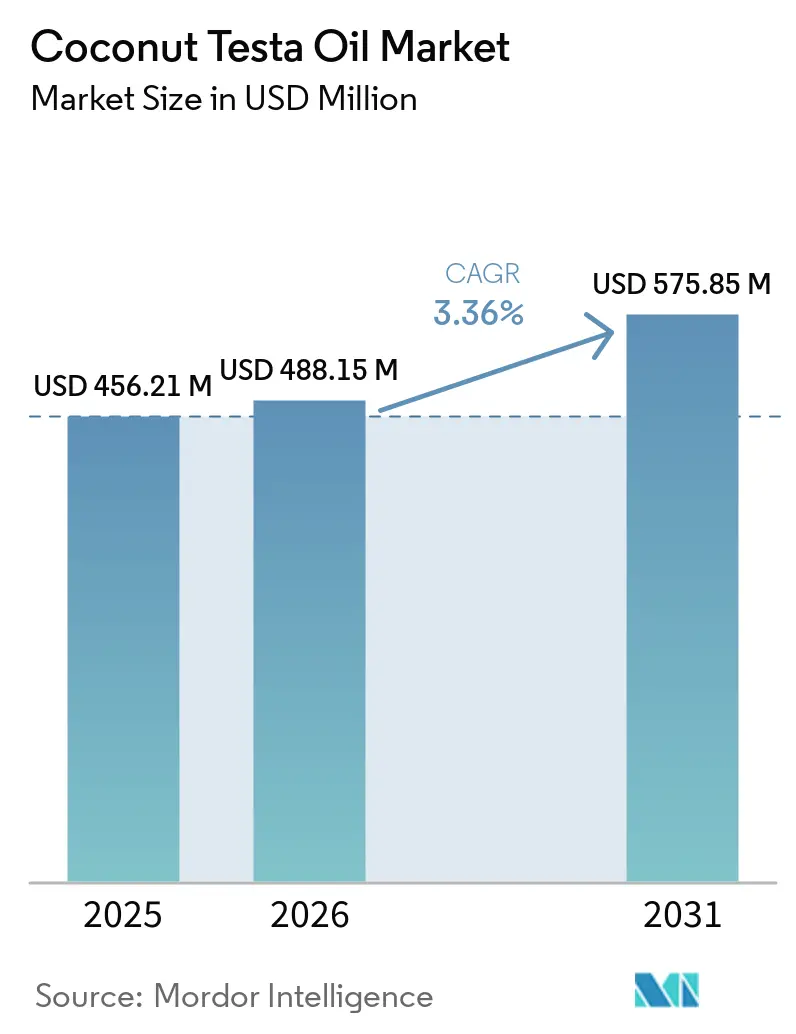
The coconut testa oil market size is expected to grow from USD 456.21 million in 2025 to USD 488.15 million in 2026 and is forecast to reach USD 575.85 million by 2031 at a 3.36% CAGR over 2026-2031. The global coconut testa oil market is evolving from a niche by-product segment into a specialized market, supported by growing interest in sustainable resource utilization and value-added coconut ingredients. Demand is driven by expanding applications across industrial, food, personal care, and nutraceutical sectors, alongside increasing emphasis on circular economy practices and cleaner-label formulations. Asia-Pacific remains the primary production and consumption hub due to its well-established coconut processing industry and abundant feedstock availability. The market remains fragmented, with numerous regional processors and specialty manufacturers, though ongoing advancements in extraction technologies and improved utilization of coconut processing by-products are expected to support steady market development over the forecast period.
Key Report Takeaways
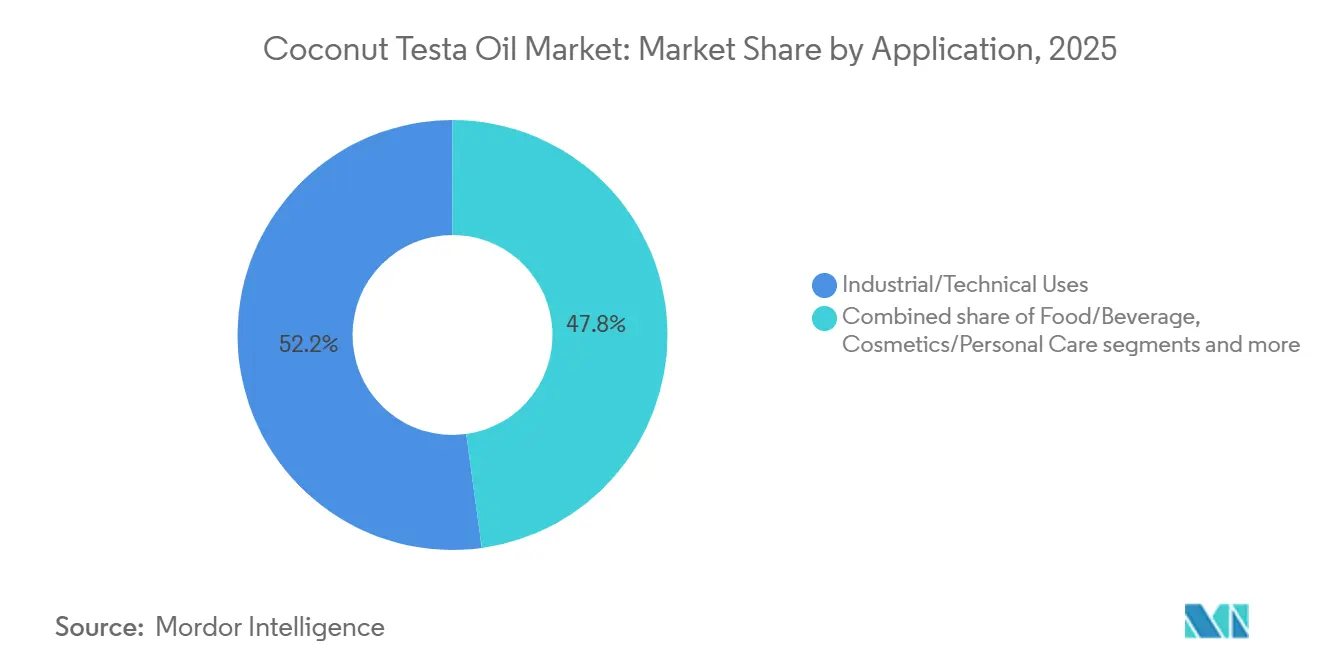
- By application, industrial/technical uses held 52.18% of the coconut testa oil market share in 2025, while food/beverages is forecast to grow at a 4.42% CAGR from 2026 to 2031.
- By geography, Asia-Pacific held 46.17% of the coconut testa oil market share in 2025 and is forecast to grow at a 6.16% CAGR from 2026 to 2031.
Note: Market size and forecast figures in this report are generated using Mordor Intelligence’s proprietary estimation framework, updated with the latest available data and insights as of January 2026.
Global Coconut Testa Oil Market Trends and Insights
Drivers Impact Analysis*
| Driver | (~) % Impact on CAGR Forecast | Geographic Relevance | Impact Timeline |
|---|---|---|---|
| Rising demand for upcycled food-grade oils | +0.7% | Global, led by Europe and North America | Medium term (2–4 years) |
| Cleaner-label positioning versus conventional coconut oil | +0.5% | North America, Europe | Medium term (2–4 years) |
| Functional ingredient use in premium food and personal care formulations | +0.6% | Global | Medium term (2–4 years) |
| Improved valorization of coconut processing by-products | +0.5% | Asia-Pacific core, spill-over to Middle East and Africa | Short term (≤2 years) |
| Expansion of small-scale specialty oil extraction capacity in Asia-Pacific | +0.4% | Asia-Pacific (India, Sri Lanka, Philippines, Indonesia) | Short term (≤2 years) |
| Growing interest in high-value fractionation and refining routes | +0.3% | Europe, North America | Long term (≥4 years) |
| Source: Mordor Intelligence | |||
Rising Demand for Upcycled Food-Grade Oils
Growing emphasis on circular economy practices and sustainable resource utilization is encouraging manufacturers to recover value from agricultural by-products and processing residues. Coconut testa, generated during the production of desiccated coconut, virgin coconut oil, and coconut-based ingredients, represents an underutilized resource that can be converted into food-grade oil. Increasing focus on waste reduction, resource efficiency, and sustainable sourcing is supporting the development of specialty oils derived from previously discarded or low-value materials. This shift is creating new opportunities for coconut testa oil as food manufacturers seek ingredients aligned with sustainability and clean-label objectives.
Cleaner-Label Positioning Versus Conventional Coconut Oil
Growing consumer preference for natural, minimally processed, and sustainably sourced ingredients is supporting demand for specialty oils with cleaner-label attributes. Coconut testa oil benefits from this trend, as it is derived from a natural coconut processing stream and can be positioned as a value-added ingredient with functional and sustainability benefits compared with conventional coconut oil. According to the International Food Information Council (IFIC) 2024 Food & Health Survey, 39% of United States consumers identified "fresh" as an attribute associated with healthy foods, reflecting continued interest in natural and less processed food characteristics[1]Source: International Food Information Council,"2024 IFIC Food & Health SURVEY", ific.org. The survey also indicates that consumers increasingly evaluate food choices based on ingredient quality and processing attributes, supporting opportunities for differentiated specialty oils such as coconut testa oil. As manufacturers continue to reformulate products around transparent sourcing and simpler ingredient profiles, cleaner-label positioning is expected to support wider adoption of premium coconut-derived oils.
Functional Ingredient Use in Premium Food and Personal Care Formulations
Growing adoption of functional botanical ingredients in premium food, nutraceutical, and personal care formulations is supporting demand for specialty oils with antioxidant and bioactive properties. Coconut testa oil is gaining attention due to its naturally occurring phenolic compounds and potential functional benefits, positioning it beyond conventional coconut oil applications. According to NSF International's 2025 consumer research on organic personal care ingredients, 74% of consumers consider organic ingredients important in personal care products, reflecting increasing preference for naturally derived and transparent ingredient profiles[2]Source: NSF International,"74% of Consumers Consider Organic Ingredients Important in Personal Care Products", nsf.org. The research highlights growing consumer attention toward ingredient quality and sourcing attributes, supporting the shift toward plant-based functional ingredients in premium formulations. These trends are encouraging formulators to explore specialty oils such as coconut testa oil for higher-value cosmetic, wellness, and food applications.
Improved Valorization of Coconut Processing By-Products
Growing emphasis on resource efficiency and circular processing is encouraging the global coconut industry to extract greater value from processing by-products that were traditionally discarded or used in low-value applications. Coconut testa, generated during the production of desiccated coconut, coconut milk, and virgin coconut oil, represents an underutilized residue with potential for conversion into higher-value products such as specialty oils. India illustrates the scale of this opportunity, with its confectionery and baking industry consuming around 40,000 tonnes of desiccated coconut annually, resulting in an estimated 4,000 tonnes of underutilized coconut testa[3]Source: Frontiers, "Valorization of coconut (Cocos nucifera L.) testa as a biocolourant", frontiersin.org. India also has more than 150 desiccated coconut powder production units with approximately 0.1 million metric tonnes of production capacity, while the annual production potential for coconut testa is estimated at around 88,000 tonnes[4]Source: Frontiers, "Valorization of coconut (Cocos nucifera L.) testa as a biocolourant", frontiersin.org. As processors globally seek to improve raw material utilization and develop additional value streams from coconut residues, increasing investment in extraction and processing technologies is expected to support the commercialization of coconut testa oil.
Restraints Impact Analysis*
| Restraint | (~) % Impact on CAGR Forecast | Geographic Relevance | Impact Timeline |
|---|---|---|---|
| Limited commercial feedstock availability and collection infrastructure | -0.8% | Global, acute in India and Sri Lanka | Short to medium term (≤4 years) |
| Low consumer and buyer awareness of coconut testa oil | -0.5% | North America, Europe, Middle East | Medium term (2–4 years) |
| Quality variability across testa supply lots | -0.4% | Asia-Pacific core, with spill-over to importing regions | Short to medium term |
| Higher processing cost versus bulk coconut oil | -0.5% | Global | Medium term (2–4 years) |
| Source: Mordor Intelligence | |||
Limited Commercial Feedstock Availability and Collection Infrastructure
The limited availability of consistently collected coconut testa feedstock remains a key challenge for the commercialization of coconut testa oil. As a by-product generated across multiple coconut processing activities, testa is often dispersed among small and medium-scale processors, making aggregation and standardized collection difficult. Variations in processing practices, geographic distribution of suppliers, and limited dedicated supply chains restrict access to sufficient quantities of suitable-quality raw material. These infrastructure constraints increase procurement complexity and create challenges for scaling production, particularly for manufacturers seeking reliable year-round feedstock availability. Inconsistent collection volumes can also make production planning and inventory management more difficult. Establishing more organized aggregation and handling systems may require additional coordination and investment across the supply chain.
Low Consumer and Buyer Awareness of Coconut Testa Oil
Limited consumer and industrial buyer awareness remains a barrier to wider adoption of coconut testa oil. Unlike conventional coconut oil, which has established recognition across food, personal care, and wellness applications, coconut testa oil remains a niche ingredient with limited market visibility. Unfamiliarity with its functional properties, applications, and sustainability benefits can slow product acceptance, requiring manufacturers to invest additional effort in customer education and ingredient differentiation. This limited awareness also constrains demand among formulators and end users, hindering broader commercialization of the market. Limited availability of product information and application guidance can further delay trial and adoption among potential buyers. Building familiarity across different end-use industries may therefore take time and consistent market communication.
*Our forecasts treat driver/restraint impacts as directional, not additive. The impact forecasts reflect baseline growth, mix effects, and variable interactions.
Segment Analysis
By Application: Industrial Dominance Persists; Food/Beverages Poised for Growth
Industrial/technical uses accounted for the largest share of the coconut testa oil market in 2025, representing 52.18% of market value. This is supported by established applications in oleochemical inputs, industrial formulations, and other non-food uses. The segment benefits from existing processing infrastructure and the ability to utilize coconut-derived oils across multiple industrial applications. Demand is also supported by the versatility of coconut-derived fatty acids and other oil components in technical formulations. Established industrial processing and formulation practices can further facilitate the integration of coconut testa oil into existing applications.
Food/beverages represented the fastest-growing application segment, projected to expand at a 4.42% CAGR from 2026 to 2031, driven by increasing interest in upcycled ingredients, functional oils, and clean-label formulations. Cosmetics and personal care accounted for a growing share of demand, supported by rising adoption of naturally derived oils and bioactive ingredients in premium formulations. Pharmaceuticals and nutraceuticals represented a smaller portion of the market, with future growth dependent on further validation of functional properties and the availability of standardized, high-quality supply.



Geography Analysis
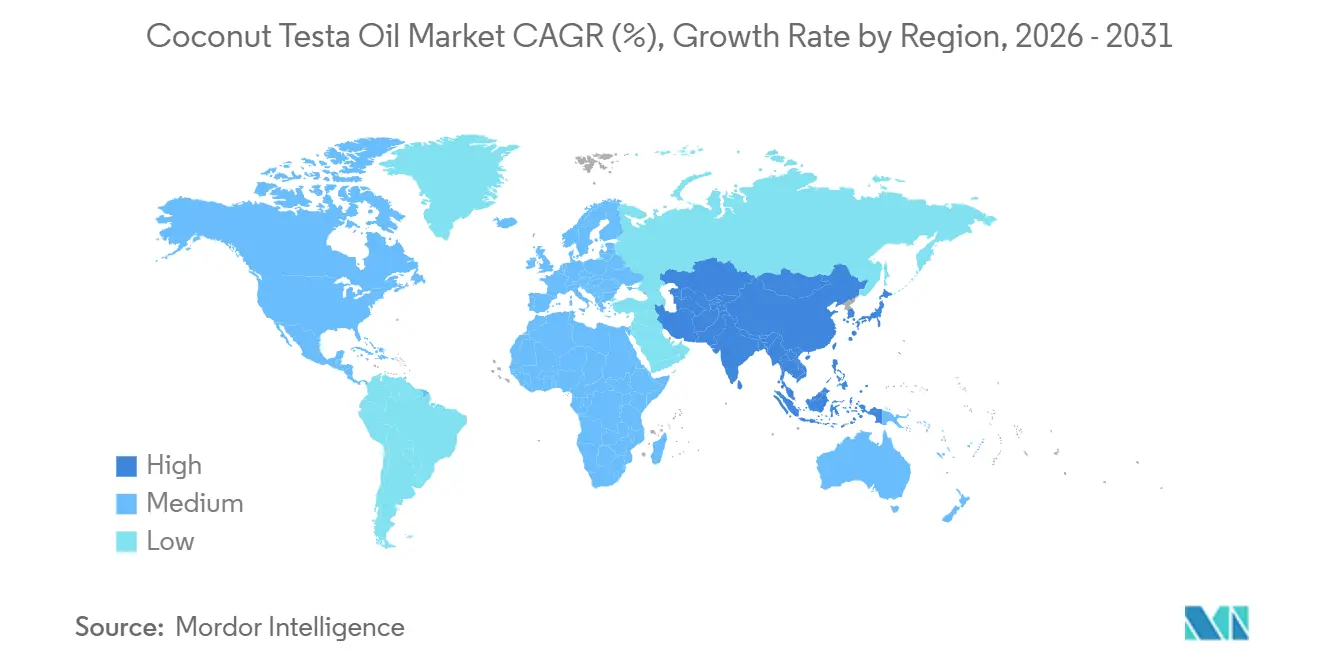
Asia-Pacific accounted for the largest share of the global coconut testa oil market in 2025, representing 46.17% of market value, and is projected to register the fastest regional growth at a CAGR of 6.16% from 2026 to 2031. The region's position is supported by its established coconut cultivation and processing ecosystem, which provides a significant base of testa by-products for oil extraction. Countries such as India, Indonesia, and Thailand benefit from strong coconut processing activity, while expanding specialty oil production capabilities and rising demand for functional food and personal care ingredients are supporting regional market development.
North America and Europe represent established markets for specialty coconut-derived oils, driven by demand from food, cosmetics, and personal care manufacturers. The United States, Canada, Germany, the United Kingdom, France, Italy, and the Netherlands are key markets due to their developed ingredient distribution networks and consumer preference for natural and sustainable formulations. Growth in these regions is expected to be driven by increasing adoption of specialty oils, clean-label ingredients, and value-added botanical extracts, although market awareness of coconut testa oil remains relatively limited compared with conventional coconut oil.
South America and the Middle East and Africa represent emerging markets for coconut testa oil, with adoption primarily supported by expanding interest in specialty oils across food, cosmetics, and wellness applications. Brazil offers opportunities due to its established coconut and oleochemical industries, while South Africa and the United Arab Emirates serve as regional markets for imported specialty ingredients. Future growth in these regions will depend on greater product awareness, improved distribution networks, and consistent supply availability from coconut-producing markets.

Competitive Landscape
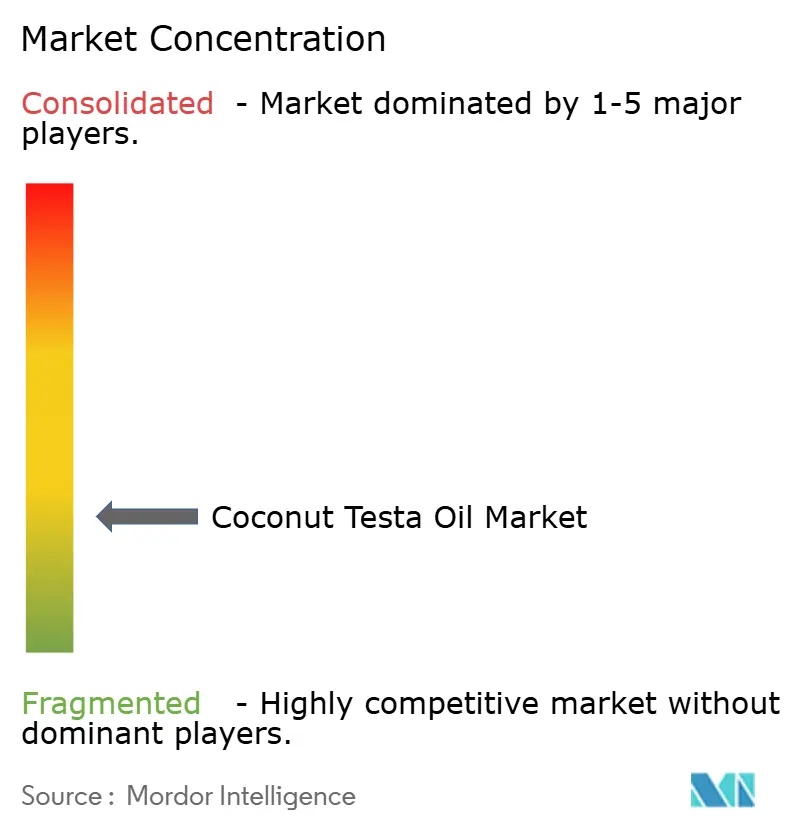
The coconut testa oil market remains highly fragmented, with competition primarily concentrated among specialized coconut processors and integrated coconut ingredient manufacturers. Key players such as Franklin Baker, Sambu Group, Celebes Coconut Corporation, Primex Group of Companies, and Hayleys Fibre compete through established coconut processing capabilities, access to coconut-derived by-products, and regional supply networks. These companies compete based on raw material sourcing, processing expertise, product quality consistency, and the ability to develop value-added applications from coconut processing residues. Smaller specialty producers also contribute to market development by focusing on niche applications and differentiated coconut-based ingredients.
Competitive activity is increasingly centered on improving the utilization of coconut processing by-products and expanding into higher-value specialty applications across food, cosmetics, and nutraceutical markets. Companies with integrated coconut processing operations are better positioned to secure consistent feedstock availability and develop scalable extraction capabilities, while specialty producers compete through product differentiation, traceability, and targeted market applications. The growing focus on circular processing and value-added coconut ingredients is expected to encourage further investment in by-product recovery technologies and strengthen the position of integrated coconut processors in the market.
The market is expected to witness gradual consolidation as established coconut processors leverage their production infrastructure, export networks, and technical capabilities to expand into specialty oil segments. Emerging opportunities are likely to arise from companies that can improve extraction efficiency, standardize product quality, and develop food-grade and cosmetic-grade coconut testa oil offerings. As demand increases for sustainable and functional plant-based ingredients, companies capable of converting coconut processing residues into commercially viable products are expected to gain competitive advantages.
Coconut Testa Oil Industry Leaders
-
Franklin Baker
-
Sambu Group
-
Celebes Coconut Corporation
-
Primex Group of Companies
-
Hayleys Fibre
- *Disclaimer: Major Players sorted in no particular order

Recent Industry Developments
- April 2026: Researchers published a comparative study evaluating coconut testa oil alongside coconut and corn oils in sodium alginate-stabilized nanoemulsions. The study found that testa oil produced favorable emulsion characteristics after microfluidization, supporting its potential use in functional food formulations and expanding research into higher-value applications for coconut testa oil.
- October 2025: Researchers published a comparative study on coconut testa oil extraction using dry and wet processing methods. The study evaluated oil quality characteristics, fatty acid composition, and antioxidant capacity, supporting the development of improved extraction approaches for producing higher-value coconut testa oil.
- June 2025: A study explored enzymatic extraction of oil from coconut testa and other coconut processing by-products using cellulase-assisted methods. The research demonstrated the potential of enzymatic extraction to improve the recovery and quality of oils from coconut waste streams, supporting the use of coconut testa as a value-added oil source.
- November 2024: Researchers developed a coconut testa-based biocolourant using extraction techniques that leveraged the antioxidant compounds present in coconut testa. While focused on colourant applications, the study strengthened the broader valorization of coconut testa into higher-value food ingredients and supported increased interest in coconut testa-derived products.


Global Coconut Testa Oil Market Report Scope
The coconut testa oil market covers oil extracted from the thin brown outer layer (testa) of coconut kernels, a by-product of coconut processing. The oil is used across food, personal care, pharmaceutical, and industrial applications due to its functional properties and potential as an upcycled coconut-derived ingredient. The market is segmented by application, including food and beverages, cosmetics and personal care, pharmaceuticals and nutraceuticals, and industrial and technical uses. It is also segmented by geography, covering North America, Europe, Asia-Pacific, South America, and the Middle East and Africa. For each segment, the market sizing and forecasting have been done in value terms (USD million).
| Food/Beverages |
| Cosmetics/Personal Care |
| Pharmaceuticals/Nutraceuticals |
| Industrial/Technical Uses |
| North America | United States |
| Canada | |
| Rest of North America | |
| Europe | Germany |
| United Kingdom | |
| Italy | |
| France | |
| Netherlands | |
| Rest of Europe | |
| Asia-Pacific | China |
| India | |
| Japan | |
| Australia | |
| Indonesia | |
| Thailand | |
| Rest of Asia-Pacific | |
| South America | Brazil |
| Rest of South America | |
| Middle East and Africa | South Africa |
| United Arab Emirates | |
| Rest of Middle East and Africa |
| By Application | Food/Beverages | |
| Cosmetics/Personal Care | ||
| Pharmaceuticals/Nutraceuticals | ||
| Industrial/Technical Uses | ||
| By Geography | North America | United States |
| Canada | ||
| Rest of North America | ||
| Europe | Germany | |
| United Kingdom | ||
| Italy | ||
| France | ||
| Netherlands | ||
| Rest of Europe | ||
| Asia-Pacific | China | |
| India | ||
| Japan | ||
| Australia | ||
| Indonesia | ||
| Thailand | ||
| Rest of Asia-Pacific | ||
| South America | Brazil | |
| Rest of South America | ||
| Middle East and Africa | South Africa | |
| United Arab Emirates | ||
| Rest of Middle East and Africa | ||


Key Questions Answered in the Report
What is driving growth in the coconut testa oil market?
The market is projected to grow at a 3.36% CAGR from 2026 to 2031, supported by upcycled sourcing, clean-label formulation, and use in functional food and personal care products. Food-grade approvals, better collection systems, and extraction capacity in producing countries can further support supply.
What is the coconut testa oil market size in 2026?
The market stands at USD 488.15 million in 2026 and is projected to reach USD 575.85 million by 2031.
Which application held the largest share in 2025?
Industrial/technical uses held 52.18% of demand in 2025, supported by biodiesel, oleochemicals, lubricants, and other industrial uses. These outlets have a long-standing role in absorbing testa-derived oil from coconut processors.
Which region leads coconut testa oil demand?
Asia-Pacific held 46.17% of demand in 2025 and is forecast to grow at a 6.16% CAGR through 2031 because it combines coconut processing capacity with rising specialty-oil demand.
Page last updated on:


 Your data is secure and never sold or shared.


