
Maracuja Oil Market Size and Share
Market Overview
| Study Period | 2021 - 2031 |
|---|---|
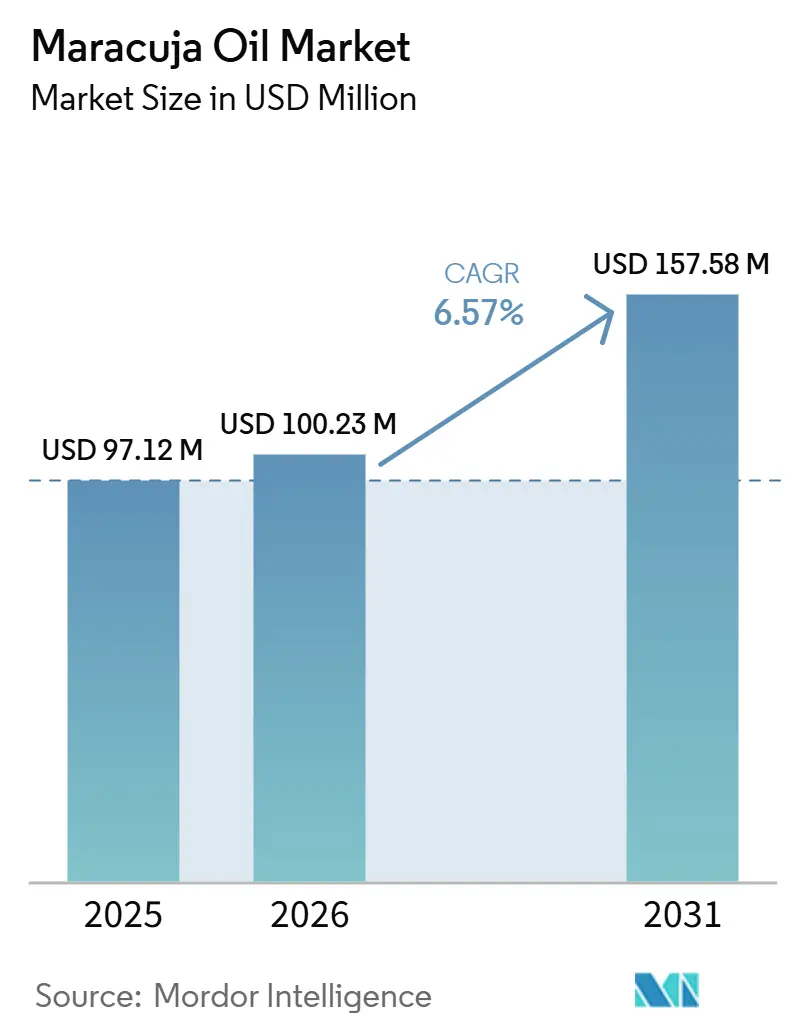
| Market Size (2026) | USD 100.23 Million |
| Market Size (2031) | USD 157.58 Million |
| Growth Rate (2026 - 2031) | 6.57 % |
| Fastest Growing Market | Asia-Pacific |
| Largest Market | North America |
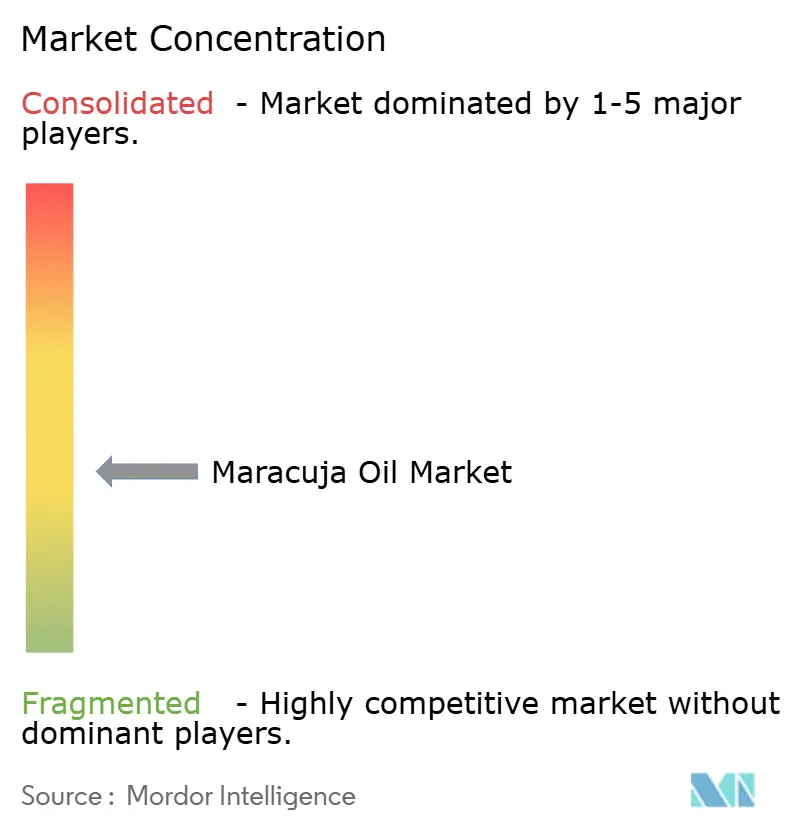
| Market Concentration | Medium |
Major Players *Disclaimer: Major Players sorted in no particular order Image © Mordor Intelligence. Reuse requires attribution under CC BY 4.0. | |
Maracuja Oil Market Analysis by Mordor Intelligence
The Maracuja Oil Market size is projected to expand from USD 97.12 million in 2025 and USD 100.23 million in 2026 to USD 157.58 million by 2031, registering a CAGR of 6.57% between 2026 to 2031. The market is supported by formulators moving from synthetic emollients toward botanical oils that can support skin-barrier and antioxidant positioning. Maracuja seed oil, obtained from Passiflora edulis seeds, fits this shift because it provides linoleic acid and can be used in clean-label formulations. Documentation, traceability, and certification are becoming more important in ingredient purchasing, particularly in cosmetics. The Maracuja Oil Market also faces pressure from variable seed supply, high extraction costs, and competing botanical oils. Suppliers that can offer consistent grades, certification support, and dependable delivery are better placed to serve premium and regulated applications.
Key Report Takeaways
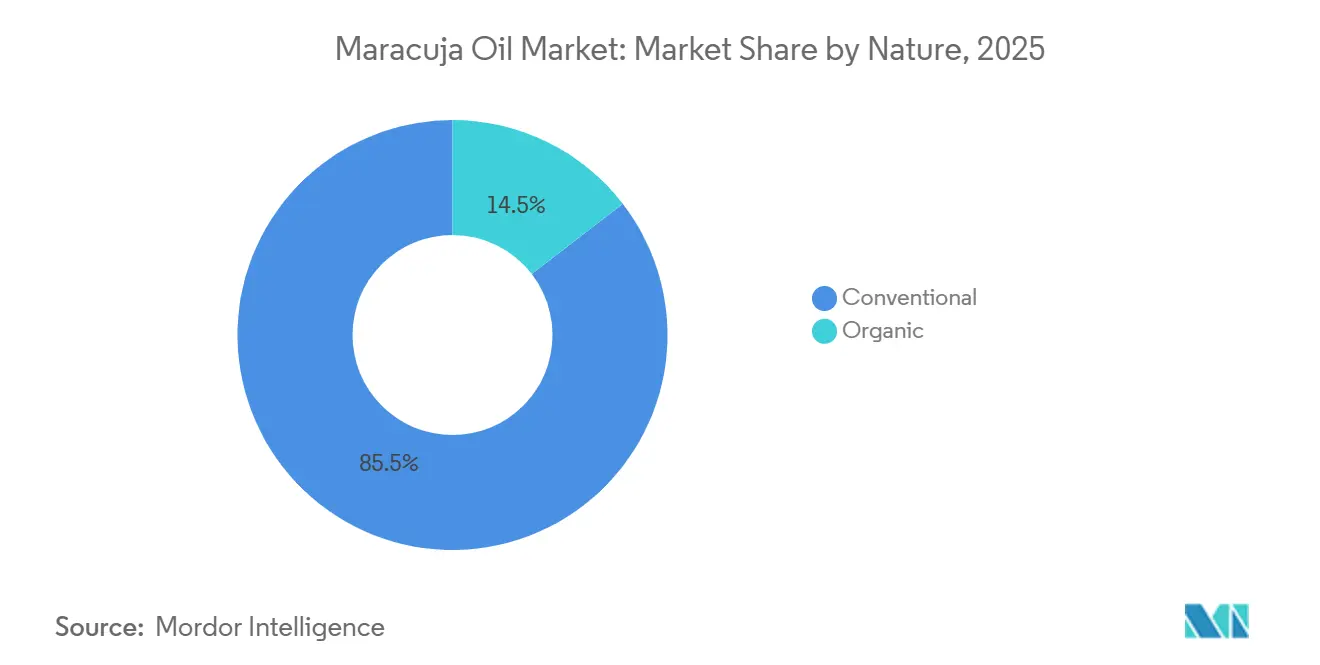
- By nature, conventional maracuja oil held 85.46% of the Maracuja Oil Market share in 2025, while organic maracuja seed oil is forecast to grow at a 7.74% CAGR through 2031.
- By grade, unrefined oil accounted for 75.49% of the Maracuja Oil Market size in 2025, while refined oil is projected to advance at a 7.03% CAGR through 2031.
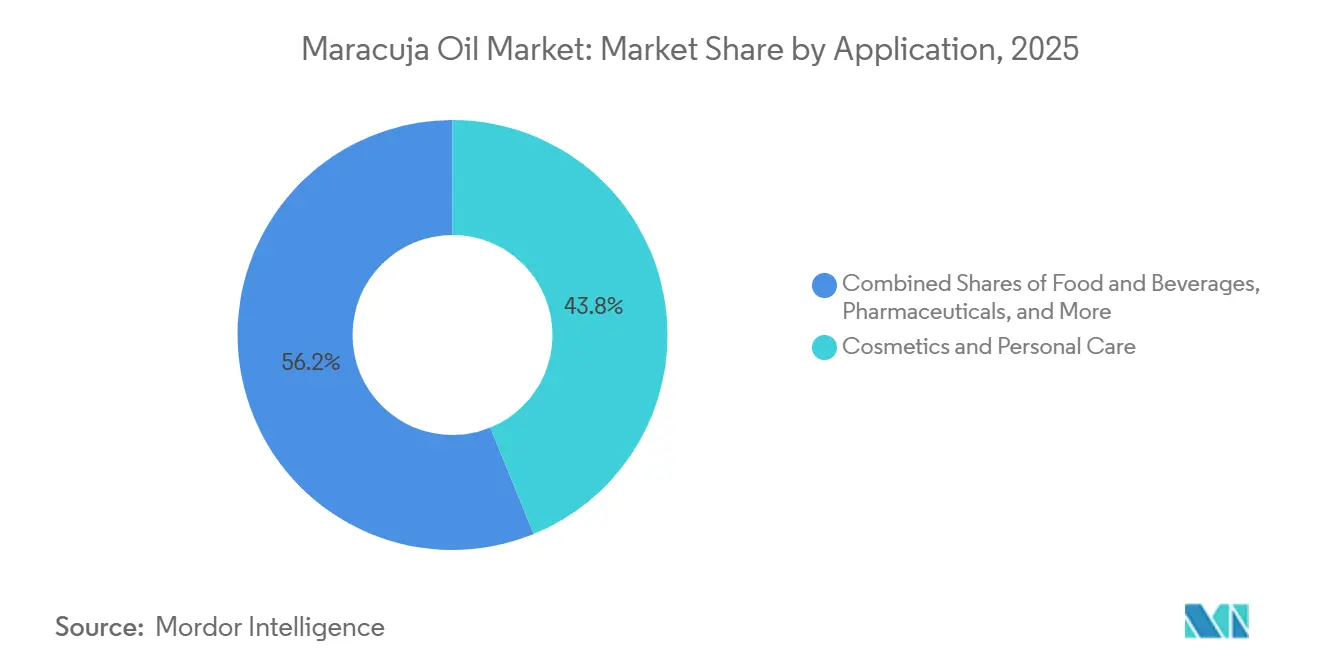
- By application, cosmetics and personal care held 43.84% of the Maracuja Oil Market share in 2025, while food and beverages is forecast to expand at a 7.25% CAGR through 2031.
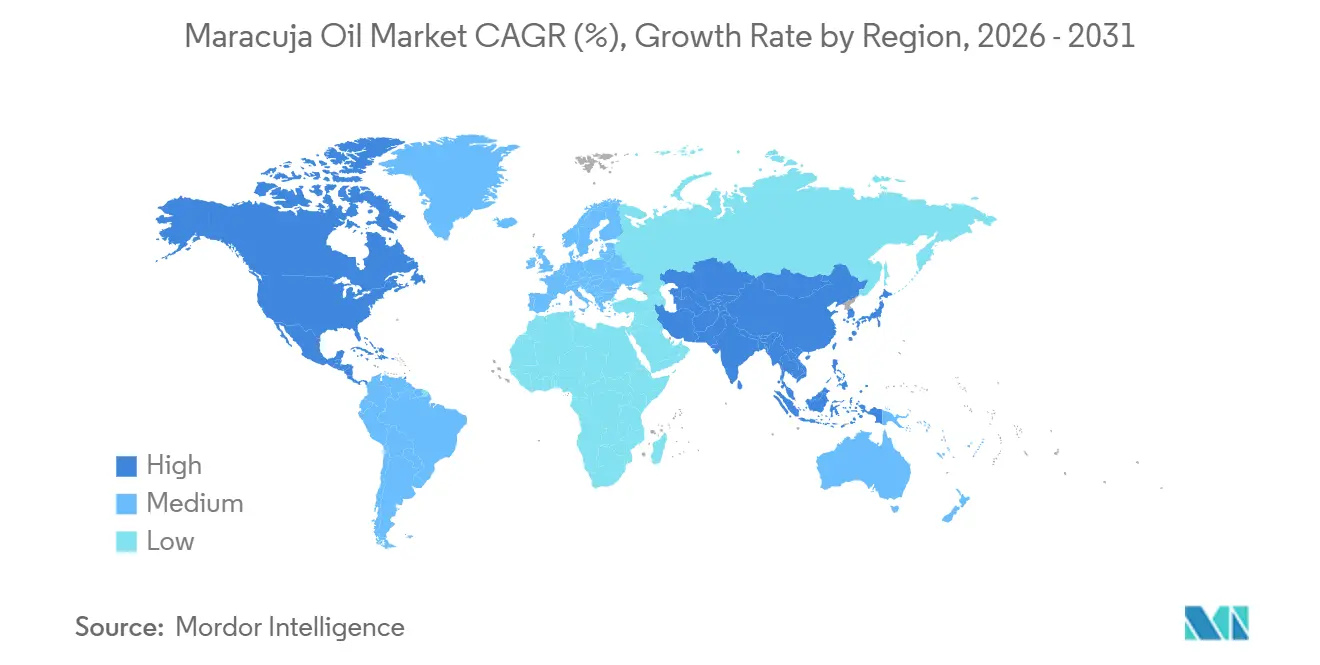
- By geography, North America accounted for 38.16% of market value in 2025, while Asia-Pacific is forecast to grow at a 7.68% CAGR through 2031.
Note: Market size and forecast figures in this report are generated using Mordor Intelligence’s proprietary estimation framework, updated with the latest available data and insights as of January 2026.
Global Maracuja Oil Market Trends and Insights
Drivers Impact Analysis*
| Drivers | (~) % Impact on CAGR Forecasts | Geographic Relevance | Impact Timeline |
|---|---|---|---|
| Growing Demand for Natural and Botanical Cosmetic Ingredients | +2.5% | Global, with highest intensity in North America and Europe | Medium term (2-4 years) |
| Increasing Adoption of Clean-Label and Sustainable Beauty Products | +1.5% | North America & EU core, spill-over to APAC | Medium term (2-4 years) |
| Rising Demand for Cold-Pressed Specialty Oils | +0.8% | North America, Europe, East Asia | Short term (≤ 2 years) |
| Growing Availability of Passion Fruit Processing By-Products | +0.5% | South America core, spill-over to APAC | Long term (≥ 4 years) |
| Technological Advancements in Oil Extraction | +0.4% | Global (Brazil, France, Australia R&D clusters) | Medium term (2-4 years) |
| Maracuja Oil Gaining Popularity in Hair Care Products | +0.8% | North America, Brazil, Asia-Pacific | Short term (≤ 2 years) |
| Source: Mordor Intelligence | |||
Growing Demand for Natural and Botanical Cosmetic Ingredients
Demand for plant-derived cosmetic ingredients is changing how formulators select oils and actives. The Maracuja Oil Market benefits because maracuja seed oil can support natural-origin and botanical product claims. Croda reported that its Beauty Actives sales increased 6% and Beauty Care sales increased 4% at constant currency in 2025. Its patented ingredients delivered 9% growth, showing that beauty brands continue to seek differentiated ingredients for specialized product lines. Large formulators are placing greater weight on clinical support, clear provenance, and supplier documentation when they review botanical ingredients. This makes traceability and quality control as important as the oil’s sensory or formulation properties. Passion fruit seed oil can meet these expectations when the supply chain records the origin and processing method of the material. ISO 16128 natural-origin positioning helps suppliers explain how the ingredient fits a natural formulation. The value of this designation depends on the supporting records available to the buyer. Brazilian juice processors, extraction companies, and cosmetic ingredient distributors therefore need closer coordination. Better coordination can reduce differences in quality between batches. It can also make the Maracuja Oil Market more accessible to premium skincare brands that need reliable technical files before approving a new oil.
Increasing Adoption of Clean-Label and Sustainable Beauty Products
Sustainability requirements have become part of supplier qualification in North American and European cosmetics supply chains. The Maracuja Oil Market is affected because certification and auditing can shape which oils are accepted for new formulations. COSMOS reported more than 31,100 certified products in 80 countries and more than 11,800 certified raw materials. These figures show the scale of the certification ecosystem used by beauty brands and ingredient suppliers. Maracuja seed oil can be considered for COSMOS-certified formulations when its sourcing and processing meet the relevant requirements[1]Source: COSMOS-standard AISBL, “COSMOS Natural and Organic Certification for Cosmetics,” COSMOS-standard, cosmos-standard.org. The Maracuja Oil Market benefits when suppliers prepare certification records early in the purchasing cycle. Buyers can then assess the oil with less uncertainty during reformulation or product development. Ingredient naming and labeling rules also affect botanical oil suppliers. Commission Implementing Decision (EU) 2025/1175 added 348 ingredient entries to the EU glossary, and use of the updated glossary becomes mandatory from July 30, 2026. The change increases the importance of accurate INCI documentation for suppliers serving European customers. It does not make maracuja oil a substitute for compliance work. Instead, it favors suppliers that already maintain orderly product data and labeling support.
Rising Demand for Cold-Pressed Specialty Oils
Cold-pressed grades remain important for premium products that highlight extraction methods and natural composition. The Maracuja Oil Market is supported by demand from skincare brands that want to preserve the oil’s tocopherols, phytosterols, and phenolic compounds. These characteristics are relevant to oil-based serums, facial treatments, and other premium cosmetics. Buyers often associate cold pressing with reduced processing and stronger natural positioning. The oil can therefore carry a different commercial role from a refined grade that is selected mainly for neutral color and odor. The extraction method is increasingly visible in consumer-facing product descriptions. This gives brands a reason to specify cold-pressed oil rather than treating the method as only a technical production detail. The result is a clearer distinction between premium specialty oils and lower-cost commodity alternatives. For the Maracuja Oil Market, this distinction can support suppliers that invest in careful pressing, storage, and batch control. It also increases the importance of maintaining an oil profile that matches the product specification issued to the customer.
Maracuja Oil Gaining Popularity in Hair Care Products
Hair care provides another route for use of maracuja oil in personal care formulations. The Maracuja Oil Market can benefit when brands use lightweight botanical oils for shine, frizz control, cuticle conditioning, and leave-in treatments. Brazil’s hair treatment oil category grew 68% in 2024. This growth indicates strong consumer interest in oil-based hair products within a major passion fruit-producing country. Hair oils, scalp serums, and shine products offer practical formats for maracuja oil use. The application is relevant because it can broaden demand beyond facial skincare. Product developers may use maracuja oil in blends where sensory performance matters as much as the ingredient story. Hair care formulations also often require oils that avoid a heavy or sticky feel. This places attention on grade selection, dosage, and the supporting ingredients in the final formula. The Maracuja Oil Market can benefit when suppliers provide technical guidance on these formulation issues.
Restraints Impact Analysis*
| Restraint | (~) % Impact on CAGR Forecasts | Geographic Relevance | Impact Timeline |
|---|---|---|---|
| Limited Availability of Raw Materials | -0.6% | South America core, cascades to global supply | Long term (≥ 4 years) |
| Competition from Other Botanical Oils | -0.5% | Global, intensified in North America and Europe | Short term (≤ 2 years) |
| High Production and Extraction Costs | -0.5% | Global; most acute for APAC importers | Medium term (2-4 years) |
| Stringent Regulatory Requirements for Cosmetic Ingredients | -0.3% | EU, North America, China (NMPA/IECIC) | Medium term (2-4 years) |
| Source: Mordor Intelligence | |||
Limited Availability of Raw Materials
Raw material availability is a central limitation for the Maracuja Oil Market. Passion fruit cultivation is concentrated in tropical and subtropical locations, and yields can change with seasonal rainfall. This makes supply less predictable than for major oilseed crops with broader production bases. Seed availability is also tied to juice processing activity because the seed is a by-product of the fruit. Suppliers must therefore coordinate with fruit processors to secure enough material for extraction. Embrapa reported that passion fruit seeds account for 4.00% of total fruit weight. It also identified potential production of 2,500.00 tons of high-value oil per year from Brazil’s juice-industry waste streams. The available material is not fully captured because processing remains fragmented and extraction capacity is limited. This gap shows why access to seeds is not the same as a dependable oil supply. The Maracuja Oil Market needs better collection, drying, storage, and extraction systems to convert more by-products into consistent commercial volumes.
High Production and Extraction Costs
High production and extraction costs limit adoption in lower-priced applications. Seeds need to be separated, cleaned, and dried before pressing. These steps add labor, equipment, and time when compared with more established oil crops. The Maracuja Oil Market therefore competes at a cost disadvantage in products where buyers primarily select an oil by price. The issue is more pronounced in mass-market personal care and commodity food formulations. A 2025 study in the Journal of Agri-Food Research found that passion fruit seed oil content and quality are sensitive to seed moisture and provenance. This means that suppliers need controlled pre-processing to obtain a dependable oil. Such controls can improve quality, but they also add cost per batch. The commercial result is a continuing difference between premium-grade maracuja oil and lower-cost alternatives. Jojoba, sunflower, and argan oils have more established supply and processing systems that can support larger volumes.
*Our forecasts treat driver/restraint impacts as directional, not additive. The impact forecasts reflect baseline growth, mix effects, and variable interactions.
Segment Analysis
By Nature: Conventional Supply Supports Current Demand
Conventional maracuja oil is expected to account for 85.46% of the total market value in 2025, reflecting the costs and certification timelines required to transition agricultural production to organic standards. The dominance of conventional grades does not indicate consumer indifference to sustainability. Instead, it reflects the reality that certified organic passion fruit cultivation remains concentrated among smallholder South American cooperatives, where certification pipelines trail demand by 18 to 24 months.
Organic maracuja seed oil is forecast to register a CAGR of 7.74% from 2026 to 2031, the fastest growth rate across all segmentation types. COSMOS v4.2 compliance is tightening the definition of organic content in EU-certified finished products and pushing brands to source upstream certified raw materials. The COSMOS standard’s December 2025 transition deadline has already increased demand for COSMOS-CERTIFIED raw materials, with more than 11,800 ingredients carrying that designation globally. In Brazil, FEA Unicamp, through its spinout Rubian Extratos, has demonstrated commercially viable supercritical CO₂ extraction of organic passion fruit bioactives and plans international expansion in 2026, signaling that upstream innovation in certified production is accelerating.


By Grade: Unrefined Strength, Refined Growth Optionality
Unrefined maracuja oil is expected to represent 75.49% of the market value in 2025, supported by strong demand from the premium cosmetics channel for grades that preserve the oil’s native tocopherol, phytosterol, and phenolic matrix. Although smaller in scale, the refined segment is projected to record a CAGR of 7.03% from 2026 to 2031, driven by the expansion of food and pharmaceutical applications and the need among mass-market personal care brands for odor- and color-neutral grades suitable for large-batch blended formulations.
Beraca Ingredientes Naturais SA (now part of Clariant) offers a refined passion fruit oil variant with an ISO 16128 natural content of 1, COSMOS approval, NMPA registration, and China IECIC listing. These certifications enable a single product to address compliance requirements across the EU, the United States, and China. Refined maracuja seed oil does not directly challenge the premium positioning of unrefined oil; rather, it creates a separate application opportunity across functional foods, nutraceuticals, and pharmaceutical-grade lipid matrices, where the sensory profile of unrefined oil could limit adoption. Grades supported by Pharmacopoeia-class purity documentation are expected to secure higher margins in these emerging applications.
By Application: Cosmetics Leads, Food and Beverages Accelerates
Cosmetics and personal care are expected to remain the leading segment, representing 43.84% of the total market value in 2025. The segment benefits from the oil’s dual function as a cosmetic active, offering antioxidant properties and linoleic acid delivery, and as a formulation emollient. Within cosmetics, hair care is emerging as the fastest-growing sub-channel. Pharmaceuticals and dietary supplements support demand due to the oil’s documented hypolipidemic properties. A 2025 study in the Journal of Agri-Food Research described passion fruit seed oil as having “excellent hypolipidemic activity,” positioning it as a botanical lipid candidate for cardiovascular support formulations.
Food and beverages are expected to record the fastest growth among applications, with a CAGR of 7.25% from 2026 to 2031, driven by nutraceutical blends, premium culinary oils, and functional beverage enrichment. Other industries, including aromatherapy and animal feed, remain niche but broaden the overall demand base. MDPI Foods (2025) research specifically documented passion fruit seed by-product applications in lipid-lowering, hypoglycemic, and gut microbiota-modulating food products, strengthening the food segment’s growth thesis.

Geography Analysis
North America held 38.16% of the Maracuja Oil Market size in 2025, making it the largest regional market. Premium skincare retail, clean-beauty distribution, and active product development support regional demand. The region also places greater emphasis on safety records and ingredient documentation under MoCRA[2]Source: European Commission, “Commission Implementing Decision (EU) 2025/1175,” EUR-Lex, eur-lex.europa.eu. This favors suppliers that can provide traceable botanical oils and formal technical information. North American buyers may also value established distribution relationships when they need reliable access to specialty oils. The revised United States import tariffs in 2025 raised landed costs for some specialty oil buyers by 15.00%. This pressure encouraged closer sourcing relationships with Latin American growers and prompted formulation reviews. Suppliers with established regional distribution can benefit if they reduce uncertainty for customers. North America will remain important because it has both strong premium beauty demand and a mature supplier qualification process. These conditions support high-value, documented maracuja oil grades.
Europe is the second-largest regional market. The region’s importance is tied to certification, ingredient naming, and cosmetics compliance standards. Commission Regulation (EU) 2025/877 changed restrictions relating to certain substances in cosmetic products.The updated INCI glossary also becomes mandatory in 2026[3]Source: U.S. Food and Drug Administration, “Modernization of Cosmetics Regulation Act of 2022,” U.S. Food and Drug Administration, fda.gov. These rules raise the value of suppliers that can maintain complete product and safety documentation. European beauty brands also use COSMOS certification in natural and organic product programs. This makes certification capability an important commercial factor for the Maracuja Oil Market. Suppliers that can support certified formulas have a clearer route to selected customers. At the same time, smaller suppliers may find the audit and recordkeeping requirements difficult. This can concentrate opportunities among firms that combine botanical sourcing with organized compliance support.
Asia-Pacific is projected to grow at a 7.68% CAGR from 2026 to 2031. It is the fastest-growing geography. Demand is linked to K-beauty-influenced formulation trends in South Korea and growing interest in natural ingredients in India. China’s NMPA and IECIC pathways also make formal product registration more relevant for suppliers seeking access to the country. Clariant’s refined Beraca Passion Fruit Oil has NMPA registration and China IECIC listing. The region offers growth, but buyers may have different cost and grade requirements. Suppliers need to decide whether they are serving premium cosmetics, food, or mass-market personal care. Documentation, local distribution, and stable supply will influence this choice. The Maracuja Oil Market may gain in Asia-Pacific through products that match regional formulation trends while satisfying local requirements. A single global product specification may not be sufficient for all customers.

Competitive Landscape
The Maracuja Oil Market has a fragmented competitive structure, with no single supplier holding decisive pricing power or global supply control. Companies operate at different points in the value chain, including raw material processing, ingredient formulation, distribution, and retail. This structure limits direct overlap between many participants. Beraca and Clariant, Henry Lamotte Oils GmbH, The Kerfoot Group, and Jedwards International operate in raw materials or trading. Hallstar Beauty, Croda International, and Jarchem Industries are associated with specialty cosmetic ingredients, while Bella Terra Oils, Natural Sourcing LLC, and Praan Naturals operate in carrier oils or retail-oriented supply.
Competition depends less on scale alone than on the ability to meet technical and regulatory requirements. Certification breadth matters because a supplier may need to support COSMOS, ISO 16128, NMPA, IECIC, and halal requirements across different customer groups. A product that can meet several regional requirements may be easier for a multinational buyer to approve. This creates an advantage for firms with formal regulatory, quality, and distribution capabilities. Smaller firms can still compete when they offer distinct sourcing or a specialized extraction method.
Croda reported 9.00% growth in patented ingredients during 2025 and targeted 3.00% to 6.00% organic Consumer Care CAGR through 2028. Its approach shows how large specialty ingredient companies place botanical materials within broader performance and evidence-based product platforms. This approach differs from selling an oil only as a generic input. It can increase the importance of formulation support, claims support, and documented performance. The Maracuja Oil Market may see more suppliers present botanical oils in this way. Supply chain integration is a key opportunity. There is room for operators that can connect certified feedstock, extraction, testing, and finished certified ingredient supply. This is particularly relevant for organic material, where a break in documentation can limit market access. Integrated suppliers may offer better visibility over seed sourcing and batch quality. They may also respond more quickly when buyers request audit information. This can support stronger customer relationships in premium and regulated applications.
Maracuja Oil Industry Leaders
Beraca Ingredientes Naturais SA
Henry Lamotte Oils GmbH
Natural Sourcing LLC
AAK AB
Avril Group
- *Disclaimer: Major Players sorted in no particular order

Recent Industry Developments
- May 2026: Rubian Extratos announced planned international expansion for its cosmetic-grade maracuja ingredient portfolio. The Unicamp spinout licensed supercritical carbon dioxide extraction technology for passion fruit bioactives. The technology recovers tocopherols, tocotrienols, and phenolic compounds from passion fruit processing waste.
- February 2026: Beraca Passion Fruit Oil Refined received updated regulatory compliance documentation, including NMPA registration for China and IECIC listing, as well as confirmed COSMOS-approved status under Version 4.2 of the COSMOS standard, enabling global multi-market distribution from a single certified SKU.


Global Maracuja Oil Market Report Scope
| Conventional |
| Organic |
| Refined |
| Unrefined |
| Food and Beverages |
| Cosmetics and Personal Care |
| Pharmaceuticals |
| Dietary Supplements |
| Other Industries (Aromatherapy, Animal Feed) |
| North America |
| Europe |
| Asia-Pacific |
| South America |
| Middle East and Africa |
| By Nature | Conventional |
| Organic | |
| By Grade | Refined |
| Unrefined | |
| By Application | Food and Beverages |
| Cosmetics and Personal Care | |
| Pharmaceuticals | |
| Dietary Supplements | |
| Other Industries (Aromatherapy, Animal Feed) | |
| By Geography | North America |
| Europe | |
| Asia-Pacific | |
| South America | |
| Middle East and Africa |


Key Questions Answered in the Report
What is the forecast growth rate for maracuja oil?
The Maracuja Oil Market is forecast to grow at a 6.57% CAGR from 2026 to 2031, rising from USD 100.23 million in 2026 to USD 157.58 million in 2031.
Which maracuja oil type has the largest share?
Conventional oil led with 85.46% of market value in 2025 because it has broader availability and avoids organic certification transition timelines.
Which application is expected to grow fastest?
Food and beverages is projected to grow at a 7.25% CAGR through 2031, supported by nutraceutical, premium culinary oil, and functional food uses.
Why is North America important for maracuja oil suppliers?
North America held 38.16% of value in 2025 and has strong demand for premium, traceable botanical ingredients with organized safety documentation.
Page last updated on:





