
Virgin Coconut Oil Market Size and Share
Market Overview
| Study Period | 2021 - 2031 |
|---|---|
| Market Size (2026) | USD 2.96 Billion |
| Market Size (2031) | USD 4.32 Billion |
| Fastest Growing Market | North America |
| Largest Market | Europe, Middle East, and Africa |
| Market Concentration | Low |
Major Players
*Disclaimer: Major Players sorted in no particular order Image © Mordor Intelligence. Reuse requires attribution under CC BY 4.0. |
|
Virgin Coconut Oil Market Analysis by Mordor Intelligence
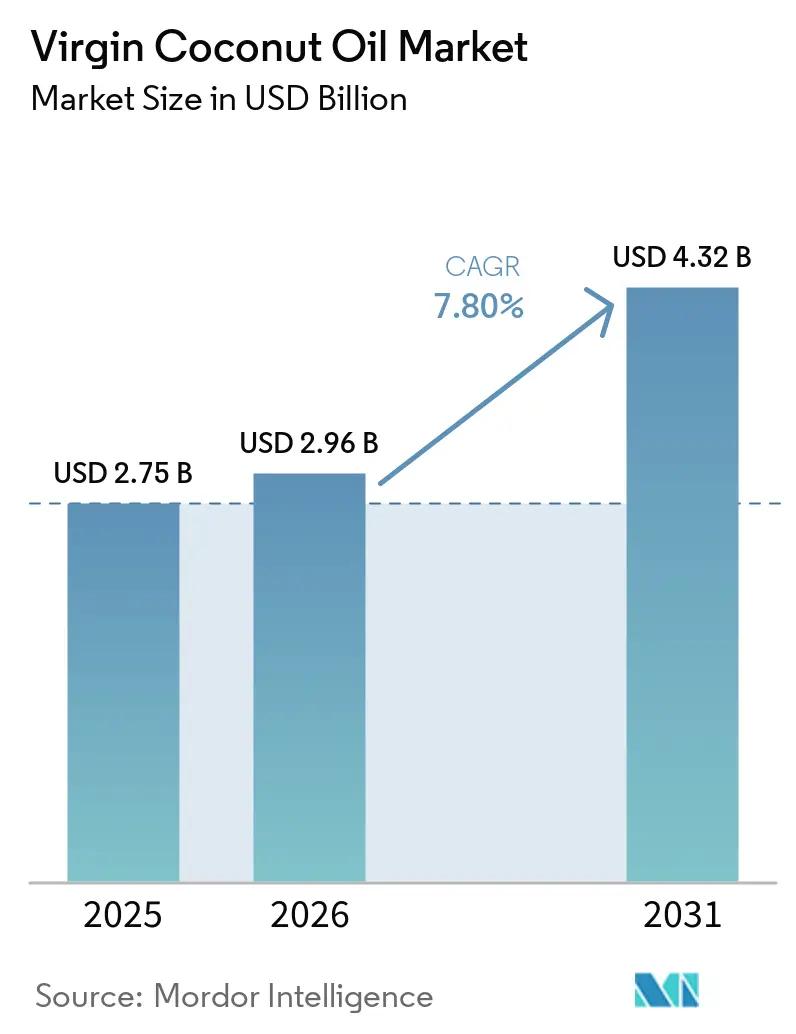
The virgin coconut oil market was valued at USD 2.75 billion in 2025 and is estimated to grow from USD 2.96 billion in 2026 to USD 4.32 billion by 2031, at a CAGR of 7.80% during the forecast period (2026-2031). The market is supported by demand for minimally processed plant-based fats across food, personal care, and wellness products. Higher coconut oil prices in 2025 indicated that downstream demand remained firm even as supply conditions tightened. The market also faces a divided value chain, as coconut cultivation is concentrated in producing countries while many premium brands sell in North America and Europe. This structure makes traceability, reliable procurement, and product verification important competitive requirements. Climate stress and enforcement against unregistered products raise costs for smaller suppliers, while certified and integrated producers can use these requirements to strengthen customer relationships.
Key Report Takeaways
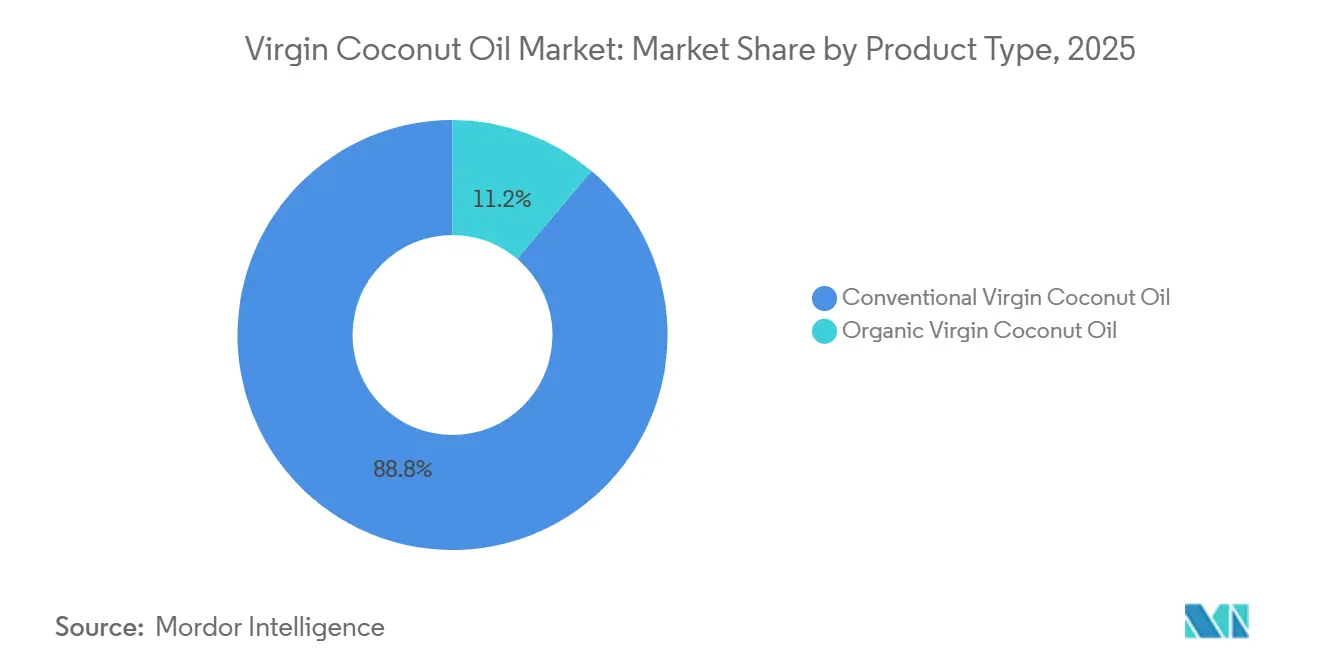
- By product type, conventional virgin coconut oil held 88.81% of the virgin coconut oil market share in 2025, while organic virgin coconut oil is forecast to grow at a 9.83% CAGR during 2026-2031, supported by premium demand in North America and Europe.
- By extraction method, cold-pressed oil accounted for 58.12% of the virgin coconut oil market size in 2026, while expeller-pressed oil is forecast to expand at a 9.93% CAGR through 2031, with processing growth centered in Southeast Asia.
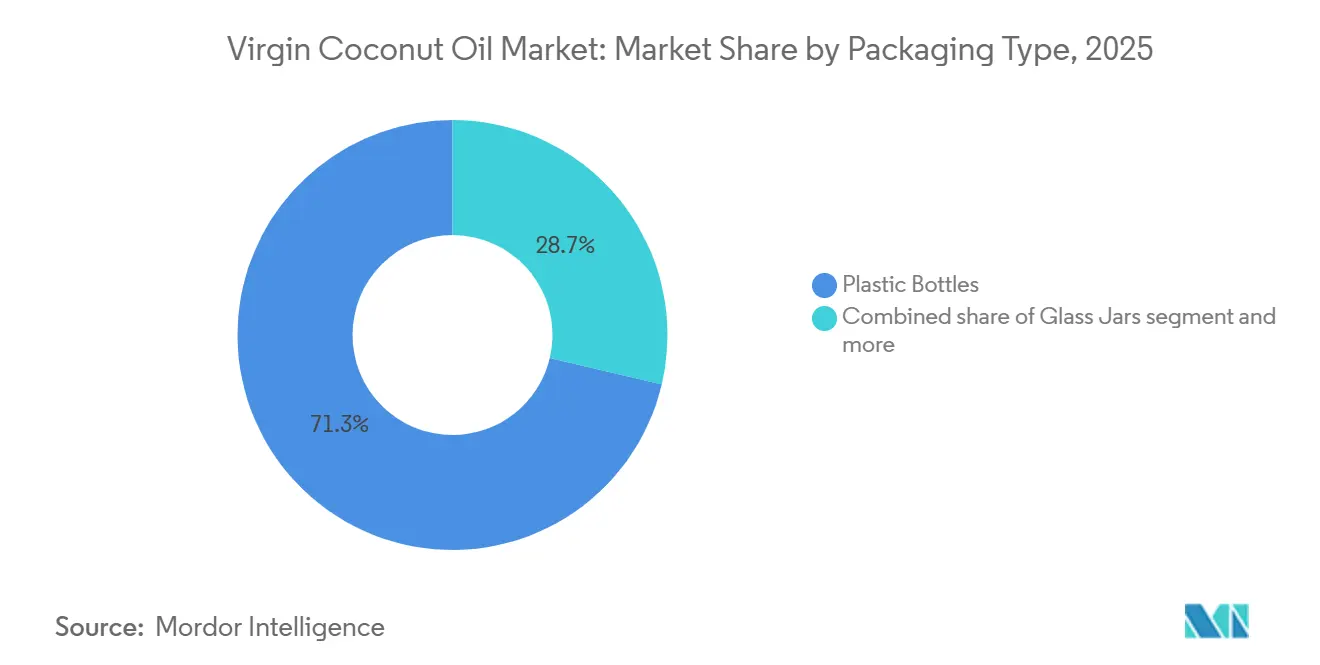
- By packaging type, plastic bottles captured 71.31% of packaging demand in 2025, while glass jars are forecast to advance at a 9.56% CAGR during 2026-2031, led by premium retail demand in North America and Europe.
- By end user, industrial users held 77.23% of the virgin coconut oil market size in 2025, while retail is forecast to grow at an 8.95% CAGR through 2031, driven by e-commerce and natural-product retail channels.
- By geography, North America held 21.68% of the virgin coconut oil market in 2025, while Europe is forecast to expand at a 9.08% CAGR during 2026-2031, supported by clean-label demand and supply-chain documentation requirements
Note: Market size and forecast figures in this report are generated using Mordor Intelligence’s proprietary estimation framework, updated with the latest available data and insights as of January 2026.
Global Virgin Coconut Oil Market Trends and Insights
Drivers Impact Analysis*
| Driver | (~) % Impact on CAGR Forecast | Geographic Relevance | Impact Timeline |
|---|---|---|---|
| Rising consumer demand for natural and minimally processed oils | +1.4% | Global | Short term (≤ 2 years) |
| Expanding use in cosmetics and personal care | +1.2% | North America, Europe, Asia-Pacific | Medium term (2-4 years) |
| Increasing adoption of functional foods and wellness products | +1.3% | North America and Europe, with spill-over to Asia-Pacific | Short term (≤ 2 years) |
| Growing emphasis on sustainable and traceable sourcing | +0.7% | Europe and North America | Long term (≥ 4 years) |
| Growth of vegan, plant-based, and keto-oriented consumption | +0.8% | North America and Europe | Short to Medium term (1-3 years) |
| Technological advancements in manufacturing and quality assurance | +0.6% | Global, with early gains in Southeast Asia | Medium term (2-4 years) |
| Source: Mordor Intelligence | |||
Rising consumer demand for natural and minimally processed oils
Growing consumer preference for natural and minimally processed foods is supporting demand for virgin coconut oil, which is commonly positioned as a natural oil produced through minimal processing while retaining its characteristic flavor and nutritional properties. This preference is reflected in the 2025 IFIC Food & Health Survey, where 28% of Americans identified "minimal or no processing" and 24% identified "natural" as criteria for defining a healthy food [1]Source: International Food Information Council (IFIC), "2025 IFIC Food & Health Survey", ific.org. As consumers increasingly associate naturalness and minimal processing with healthier and more authentic food choices, virgin coconut oil benefits from its positioning as a less-refined alternative to conventional refined oils. This trend is encouraging manufacturers and brands to emphasize virgin, unrefined, organic, cold-pressed, and minimally processed attributes, strengthening demand among health-conscious consumers seeking natural cooking and wellness oils.
Increasing adoption of functional foods and wellness products
Growing consumer interest in foods and products that provide benefits beyond basic nutrition is creating new opportunities for virgin coconut oil, particularly as an ingredient in functional foods, wellness products, and nutraceutical formulations. VCO's medium-chain fatty acid profile and naturally occurring bioactive compounds have contributed to its positioning as a functional ingredient, with applications expanding into emulsions, food formulations, and other value-added wellness products. As consumers increasingly seek natural ingredients for everyday diets and wellness routines, manufacturers are developing more value-added VCO products, including nutraceutical and portable formats, broadening the oil's applications beyond conventional cooking.
Growing emphasis on sustainable and traceable sourcing
Growing consumer demand for transparency, ingredient simplicity, and responsible sourcing is supporting the growth of the virgin coconut oil market, as consumers increasingly associate traceable and sustainably sourced oils with higher quality and authenticity. This trend is reflected in clean-label purchasing behavior, with Gen Z and Millennials willing to pay 20–30% more for products carrying claims such as organic, natural, high protein, and no artificial ingredients. Claims including "simple ingredients," "short ingredient list," and "traceable sourcing" are also increasingly influencing purchase decisions in 2025 [2]Source: Ingredion, "Less mystery, more meaning: Clean labels win consumer preference", ingredion.com. For virgin coconut oil brands, this creates opportunities to differentiate through organic certification, transparent coconut sourcing, farmer traceability, sustainable cultivation, and minimal processing, while strengthening consumer trust and supporting premium positioning. As sustainability and provenance become more important purchase considerations, manufacturers with verifiable and transparent supply chains are likely to gain a competitive advantage in the virgin coconut oil market.
Growth of vegan, plant-based and keto-oriented consumption
Growth of Vegan, Plant-Based, and Keto-Oriented Consumption: The increasing adoption of vegan, plant-based, and low-carbohydrate dietary patterns is supporting demand for virgin coconut oil, which is naturally plant-based and can be incorporated into a range of vegetarian, vegan, and keto-oriented foods and recipes. This opportunity is particularly relevant in India, where statistics from the Vegan Society indicate that in 2025 around 25% of the population identified as vegetarian and 9% as vegan, making India one of the largest markets for non-meat diets globally [3]Source: THE VEGAN SCHOOL, "Veganism in India: A Historical and Cultural Perspective", theveganschool.org. As consumers increasingly seek plant-derived alternatives aligned with health, lifestyle, and sustainability preferences, virgin coconut oil is gaining relevance as a versatile plant-based oil for cooking, baking, beverages, and functional food applications. Its compatibility with vegan and keto-oriented diets broadens its potential consumer base and supports demand across health-conscious and specialty-diet segments.
Restraints Impact Analysis*
| Restraint | (~) % Impact on CAGR Forecast | Geographic Relevance | Impact Timeline |
|---|---|---|---|
| Substitution by olive, avocado, sunflower, canola, and specialty oils | -0.9% | North America and Europe | Short to Medium term (1-3 years) |
| Climate-driven coconut yield and price volatility | -0.8% | Global; most acute in Southeast Asia origin markets | Short term (≤ 2 years) |
| Adulteration and authenticity risk in premium virgin claims | -0.5% | Global | Medium term (2-4 years) |
| High price relative to conventional coconut and edible oils | -0.6% | Asia-Pacific and emerging markets | Short to Medium term (1-3 years) |
| Source: Mordor Intelligence | |||
Substitution by olive, avocado, sunflower, canola, and specialty oils
The availability of a wide range of alternative cooking and specialty oils is a key restraint for the virgin coconut oil market, as consumers can readily switch to products that offer different nutritional profiles, flavors, cooking characteristics, and price points. Olive, avocado, canola, and sunflower oils are commonly used across cooking, baking, frying, and salad dressing applications, while specialty oils provide additional choices for health-focused and premium consumers. The relatively neutral flavor and versatility of canola and sunflower oils make them suitable for everyday cooking, while olive and avocado oils appeal to consumers seeking oils perceived as healthier or premium alternatives. This broad substitution base limits virgin coconut oil's ability to capture a larger share of household oil consumption and increases competitive pressure on brands to differentiate through quality, natural processing, distinctive flavor, sustainability, and functional positioning.
Adulteration and authenticity risk in premium virgin claims
The premium positioning of virgin coconut oil makes adulteration a significant market restraint. Consumers paying higher prices for virgin, pure, or minimally processed products expect verifiable quality and provenance. Research has shown that VCO can be adulterated with lower-value oils, including refined coconut oil and other vegetable oils, which can compromise quality and undermine premium claims. Such practices erode consumer trust, create unfair competition for authentic producers, and increase pressure on manufacturers to invest in laboratory testing, certification, traceability, and quality-control systems. These verification requirements raise operating costs for legitimate brands and make consumers more cautious about paying a premium for products marketed as 100% pure, virgin, cold-pressed, or authentic.
*Our forecasts treat driver/restraint impacts as directional, not additive. The impact forecasts reflect baseline growth, mix effects, and variable interactions.
Segment Analysis
By Product Type: Conventional Volume Leads While Organic Builds Premium Demand
Conventional virgin coconut oil accounted for 88.81% of the product type mix in 2025. This share reflects the purchasing needs of food manufacturers, cosmetic formulators, and other large-volume buyers. Conventional supply meets price-sensitive requirements where buyers need consistent bulk availability. The virgin coconut oil market continues to depend on conventional volume as industrial users prioritize supply continuity and agreed specifications. Large processors use this segment to maintain utilization across their extraction and packaging operations.
Organic virgin coconut oil is forecast to grow at a CAGR of 9.83% during 2026-2031. This higher growth rate reflects demand for products that carry recognized certification and a clear sourcing story. European buyers increasingly assess organic credentials, traceability, and social or environmental assurances when selecting coconut oil suppliers. Sri Lanka is relevant to European organic supply, as certified producers serve buyers seeking differentiated products. This segment gives processors an opportunity to earn premium margins, though certification limits the supplier pool and raises compliance requirements.


By Extraction Method: Cold-Pressed Oil Retains the Lead While Expeller-Pressed Capacity Expands
Cold-pressed oil accounted for 58.12% of the extraction method mix in 2026. Consumers commonly associate this method with minimal processing and retention of natural product characteristics. This perception supports a premium position in natural food, cosmetic, and wellness channels. The virgin coconut oil market rewards suppliers that link cold-pressed production with traceability and clear processing claims. It remains a central extraction method for producers competing on purity and aroma.
Expeller-pressed oil is forecast to grow at a 9.93% CAGR through 2031. This method offers processors a practical route to scaling production while avoiding the profile of fully refined oil. It can suit mid-volume producers that require more throughput than artisanal methods can provide. Wet-milled and fermented methods remain important for smaller Southeast Asian producers, as they require less complex equipment. Centrifugation retains a premium role where clarity and aroma are priorities, particularly in cosmetics and specialty retail.
By Packaging Type: Plastic Bottles Hold Volume While Glass Builds a Premium Position
Plastic bottles accounted for 71.31% of packaging demand in 2025. They remain widely used due to their lighter weight, lower cost, and suitability for large retail and food-service formats. Their practicality makes them relevant to brands serving value-oriented consumers and buyers who prioritize distribution efficiency. Plastic also supports the high-volume operating model used by many food manufacturers and retail suppliers. This format is likely to remain the primary volume carrier in the market during the forecast period.
Glass jars are forecast to grow at a 9.56% CAGR during 2026-2031. The format supports premium shelf positioning and can reinforce product messaging around purity and responsible packaging. Natural-product retailers may favor glass for brands seeking a stronger visual association with certified or minimally processed products. Pouches serve institutional and food-service buyers that require cost-effective dispensing. Bulk drums, intermediate bulk containers, and flexitanks remain important for industrial procurement, while metal cans retain use in selected retail and cosmetic applications.

By End User: Industrial Buyers Anchor Demand While Retail Gains Value
Industrial users accounted for 77.23% of demand in 2025. Food and beverage, cosmetics and personal care, and pharmaceutical and nutraceutical manufacturers purchase significant volumes for production use. This share confirms that virgin coconut oil functions primarily as a functional input rather than a consumer retail product. Contract supply, batch consistency, and cost control are particularly important to these buyers. These requirements give integrated processors an advantage when raw material markets become volatile.
The retail segment is forecast to grow at an 8.95% CAGR through 2031. E-commerce, natural-product stores, and direct-to-consumer brands provide premium offerings with greater visibility than conventional retail channels alone. These channels add value to the virgin coconut oil market by building consumer recognition around organic credentials, packaging, and sourcing practices. Marico reported that its Parachute brand held 63% domestic volume share in India's coconut oil category, demonstrating the value of broad retail distribution and brand familiarity. Food service and institutional customers form a middle tier, while nutraceutical and pharmaceutical buyers represent a specialized, higher-value segment within industrial demand.
Geography Analysis
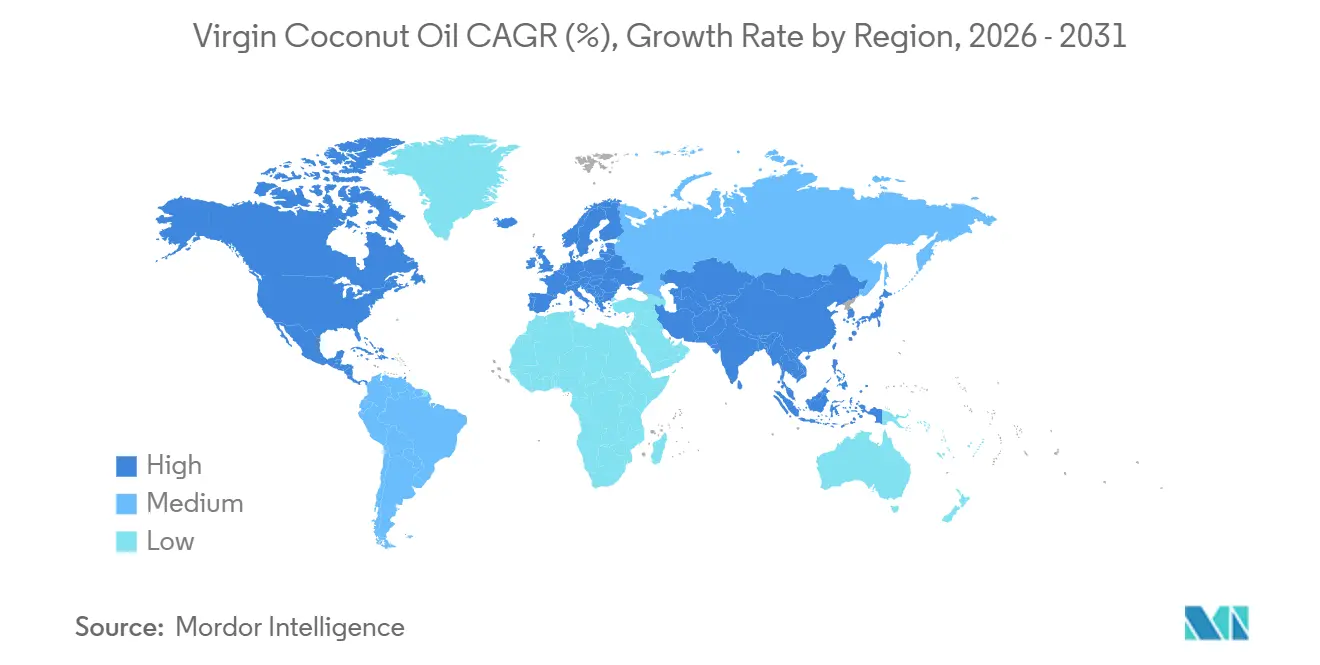
North America held 21.68% of the virgin coconut oil market share in 2025. The region remains a major demand center, supported by well-established natural-product retail, e-commerce, and wellness purchasing. The United States accounts for most regional consumption and import demand. Its dependence on imports makes supply continuity from producing countries important. Premium retail channels can sustain demand during price increases more effectively than price-sensitive industrial customers. Canada provides a smaller but growing retail base, while Mexico plays a role in value-oriented consumption and regional trade flows.
Europe is forecast to grow at a 9.08% CAGR during 2026-2031. Clean-label demand, organic purchasing, and supply-chain compliance are key drivers of this growth. The Netherlands and Germany serve as important entry and re-export hubs for coconut oil in the European market. The United Kingdom, France, Spain, and Italy contribute direct retail demand. Buyers increasingly require suppliers that can support sustainability and origin claims with verifiable records, which favors processors with credible certification and dependable documentation.
The virgin coconut oil market in Asia-Pacific combines major producing countries with growing consumer demand. The Philippines, Indonesia, India, and Thailand remain central to supply, while Australia and New Zealand are established premium import markets. India also faces raw material volatility, as Marico reported a 48% year-over-year rise in copra prices in FY2024. Japan, South Korea, and Singapore provide demand for beauty and functional food formulations. South America, the Middle East, and Africa remain early-stage consumption regions, where premium food retail and modern trade channels are still developing. Philippine producer Axelum has stated that it is pursuing expansion outside the United States, reflecting interest in underserved regions.

Competitive Landscape
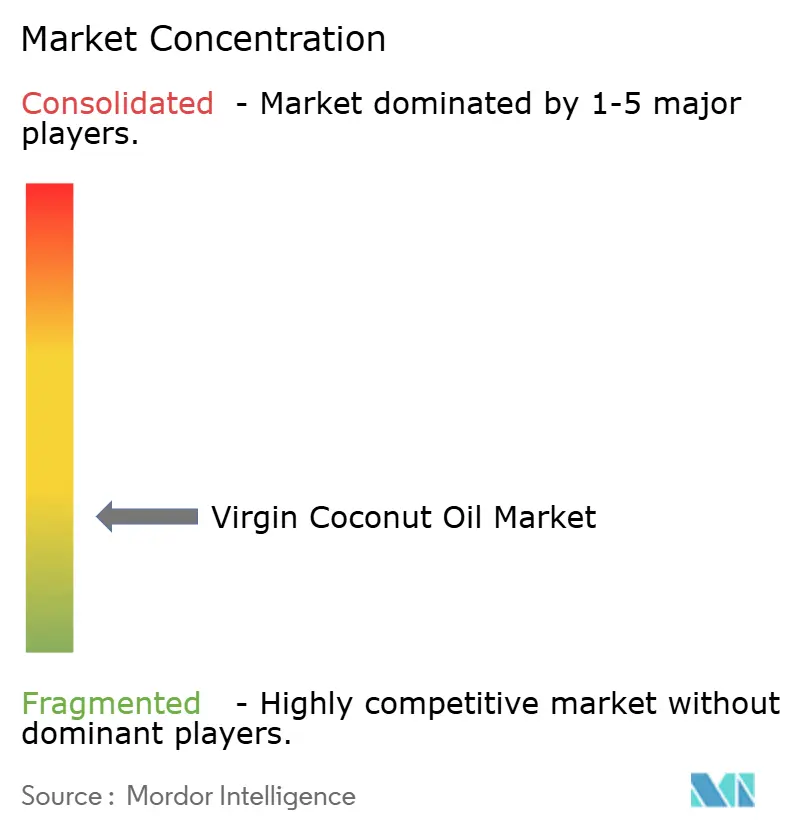
The virgin coconut oil market has a fragmented structure, with no single producer dominating global supply. Competition varies by position in the value chain. Integrated processors, including Axelum Resources, Thai Coconut Public Company, PT Harvard Cocopro, Celebes Coconut Corporation, and Greenville Agro Corporation, compete on processing capacity, export reach, and supply control. Health-food and supplement brands, including NOW Foods, Nature's Way, Jarrow Formulas, Viva Naturals, and Barlean's Organic Oils, compete on organic, non-GMO, and quality credentials.
Premium brands such as Nutiva, Garden of Life, and Hain Celestial use sourcing narratives, natural retail access, and product differentiation to compete. The most attractive gaps are in specification-grade supply for pharmaceutical and nutraceutical buyers and in early-stage retail markets in the Middle East, Africa, and South America. These buyers may value documented purity, stable supply, and application-specific quality over a generic retail oil offering.
Integrated suppliers can use offtake agreements and new capacity to reduce investment risk during periods of supply pressure. Axelum's new filling line and its manufacturing agreement renewal with The Vita Coco Company demonstrate how capacity and customer commitments can be aligned. The Sustainable Coconut Partnership's assurance work also provides companies with a route to strengthen chain-of-custody and origin claims. Competitive success will depend on balancing branded retail differentiation with reliable access to certified raw material.
Virgin Coconut Oil Industry Leaders
-
Nutiva Inc.
-
The Hain Celestial Group, Inc.
-
Barlean’s Organic Oils, LLC
-
Celebes Coconut Corporation
-
Greenville Agro Corporation
- *Disclaimer: Major Players sorted in no particular order

Recent Industry Developments
- January 2026: CBL Group Acquires Indonesian Coconut Processor TJT: CBL Group announced the acquisition of PT Tri Jaya Tangguh Indonesia (TJT), a major Indonesian coconut processing facility, through an investment of more than USD 25 million. The acquisition expands CBL's coconut processing and manufacturing capabilities, strengthens supply chain resilience, and supports its expansion into value-added coconut products and international markets.
- October 2025: Century Pacific Expands Coconut Processing Capacity: Century Pacific Food expanded its presence in the coconut market by acquiring a fully integrated processing facility in South Cotabato, Philippines, through its subsidiary Coco Harvest. The company plans to invest approximately USD 45 million to acquire and upgrade the facility, which produces virgin coconut oil, coconut cream, coconut milk, and coconut water concentrate.
- July 2025: Metro Pacific Agro Ventures Acquires Franklin Baker to Expand Coconut Platform: Metro Pacific Agro Ventures (MPAV) announced its agreement to acquire Franklin Baker Group, one of the Philippines' established coconut processors, strengthening its position in the global coconut products industry. Franklin Baker produces value-added coconut products, including virgin coconut oil, desiccated coconut, coconut water, and coconut cream, serving customers in more than 50 countries.


Global Virgin Coconut Oil Market Report Scope
| Organic Virgin Coconut Oil |
| Conventional Virgin Coconut Oil |
| Cold-Pressed |
| Expeller-Pressed |
| Wet-Milled and Fermented |
| Centrifuged and Separated |
| Plastic Bottles |
| Glass Jars |
| Pouches |
| Metal Cans |
| Bulk Drums, IBCs and Flexitanks |
| Industrial | Food and Beverage Manufacturers |
| Cosmetics and Personal Care Manufacturers | |
| Pharmaceutical and Nutraceutical Manufacturers | |
| Food Service and Institutional Buyers | |
| Retail |
| North America | United States |
| Canada | |
| Mexico | |
| Rest of North America | |
| Europe | United Kingdom |
| Germany | |
| France | |
| Italy | |
| Spain | |
| Russia | |
| Sweden | |
| Belgium | |
| Poland | |
| Netherlands | |
| Rest of Europe | |
| Asia-Pacific | China |
| Japan | |
| India | |
| Thailand | |
| Singapore | |
| Indonesia | |
| South Korea | |
| Australia | |
| New Zealand | |
| Rest of Asia-Pacific | |
| South America | Brazil |
| Argentina | |
| Colombia | |
| Chile | |
| Rest of South America | |
| Middle East and Africa | United Arab Emirates |
| South Africa | |
| Saudi Arabia | |
| Nigeria | |
| Egypt | |
| Morocco | |
| Turkey | |
| Rest of Middle East and Africa |
| By Product Type | Organic Virgin Coconut Oil | |
| Conventional Virgin Coconut Oil | ||
| By Extraction Method | Cold-Pressed | |
| Expeller-Pressed | ||
| Wet-Milled and Fermented | ||
| Centrifuged and Separated | ||
| By Packaging Type | Plastic Bottles | |
| Glass Jars | ||
| Pouches | ||
| Metal Cans | ||
| Bulk Drums, IBCs and Flexitanks | ||
| By End-User | Industrial | Food and Beverage Manufacturers |
| Cosmetics and Personal Care Manufacturers | ||
| Pharmaceutical and Nutraceutical Manufacturers | ||
| Food Service and Institutional Buyers | ||
| Retail | ||
| Geography | North America | United States |
| Canada | ||
| Mexico | ||
| Rest of North America | ||
| Europe | United Kingdom | |
| Germany | ||
| France | ||
| Italy | ||
| Spain | ||
| Russia | ||
| Sweden | ||
| Belgium | ||
| Poland | ||
| Netherlands | ||
| Rest of Europe | ||
| Asia-Pacific | China | |
| Japan | ||
| India | ||
| Thailand | ||
| Singapore | ||
| Indonesia | ||
| South Korea | ||
| Australia | ||
| New Zealand | ||
| Rest of Asia-Pacific | ||
| South America | Brazil | |
| Argentina | ||
| Colombia | ||
| Chile | ||
| Rest of South America | ||
| Middle East and Africa | United Arab Emirates | |
| South Africa | ||
| Saudi Arabia | ||
| Nigeria | ||
| Egypt | ||
| Morocco | ||
| Turkey | ||
| Rest of Middle East and Africa | ||


Key Questions Answered in the Report
What is the forecast for the virgin coconut oil market?
The virgin coconut oil market is forecast to reach USD 4.32 billion by 2031 from USD 2.96 billion in 2026, growing at a 7.80% CAGR.
Which product type is growing fastest?
Organic virgin coconut oil is the fastest-growing product type, with a forecast CAGR of 9.83% during 2026-2031.
Why does cold-pressed virgin coconut oil lead extraction demand?
Cold-pressed oil held 58.12% of extraction demand in 2026 because buyers associate the method with limited processing and natural product characteristics.
Which region is expected to grow fastest?
Europe is forecast to grow at a 9.08% CAGR during 2026-2031, supported by clean-label demand and traceability requirements.
Page last updated on:






