
CNG Compressor Market Size and Share
Market Overview
| Study Period | 2022 - 2032 |
|---|---|
| Market Size (2027) | USD 5.86 Billion |
| Market Size (2032) | USD 7.40 Billion |
| Growth Rate (2027 - 2032) | 4.78 % |
| Fastest Growing Market | Asia-Pacific |
| Largest Market | Asia-Pacific |
| Market Concentration | Medium |
Major Players *Disclaimer: Major Players sorted in no particular order Image © Mordor Intelligence. Reuse requires attribution under CC BY 4.0. | |
CNG Compressor Market Analysis by Mordor Intelligence
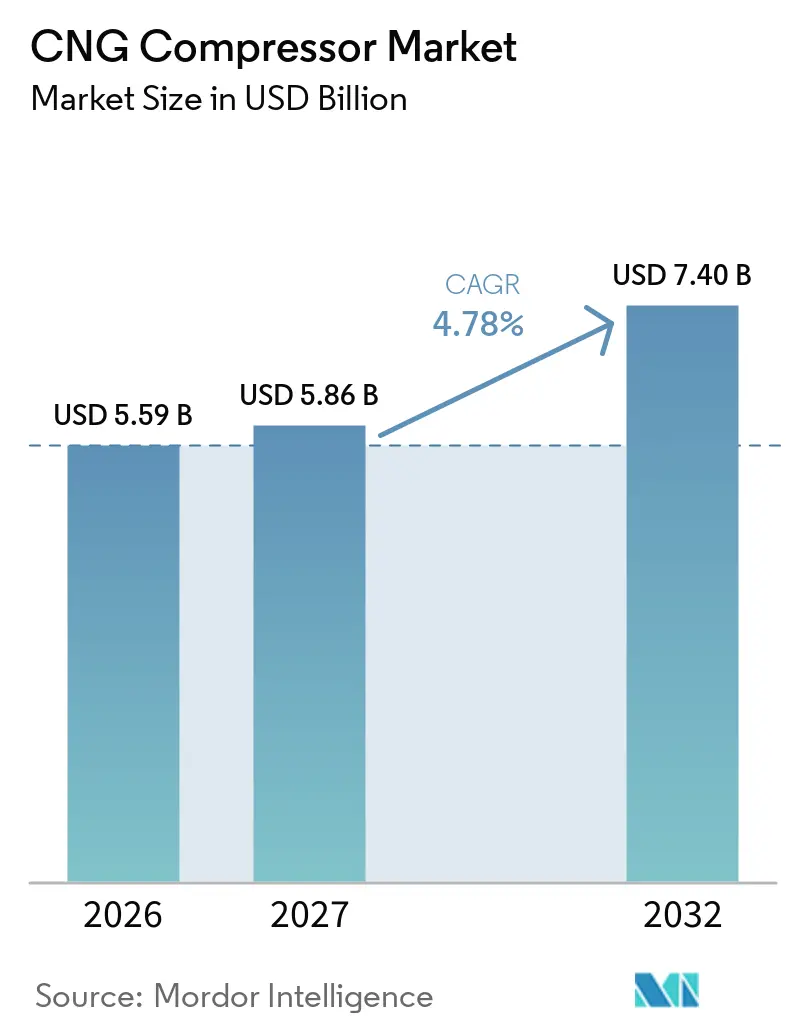
The CNG Compressor Market size is projected to be USD 5.59 billion in 2026, USD 5.86 billion in 2027, and reach USD 7.40 billion by 2032, growing at a CAGR of 4.78% from 2027 to 2032. The CNG compressor market is supported by new refueling infrastructure, industrial gas networks, and virtual pipeline projects. Fleet conversion policies and the wider use of renewable natural gas, or RNG, are sustaining equipment demand across several operating conditions. Suppliers are responding with integrated packages that combine compression, storage, controls, cooling, and maintenance services. The CNG compressor market also faces uneven conditions because investment depends on gas prices, public support, permitting, and the availability of large fleet customers. Competition from battery-electric, hydrogen, and liquefied natural gas vehicles is shifting demand toward regions where CNG has a clear operating-cost advantage.
Key Report Takeaways
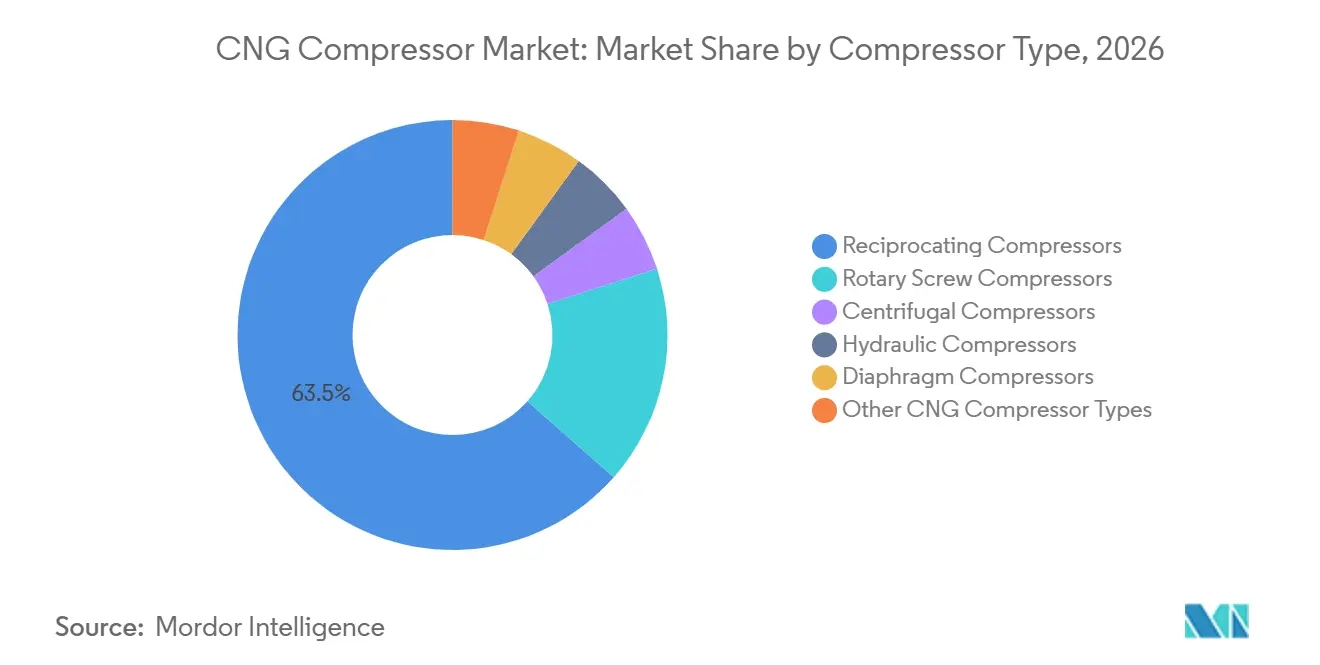
- By compressor type, reciprocating compressors held 63.5% of the CNG compressor market share in 2026, while hydraulic compressors are forecast to grow at a 5.6% CAGR through 2032.
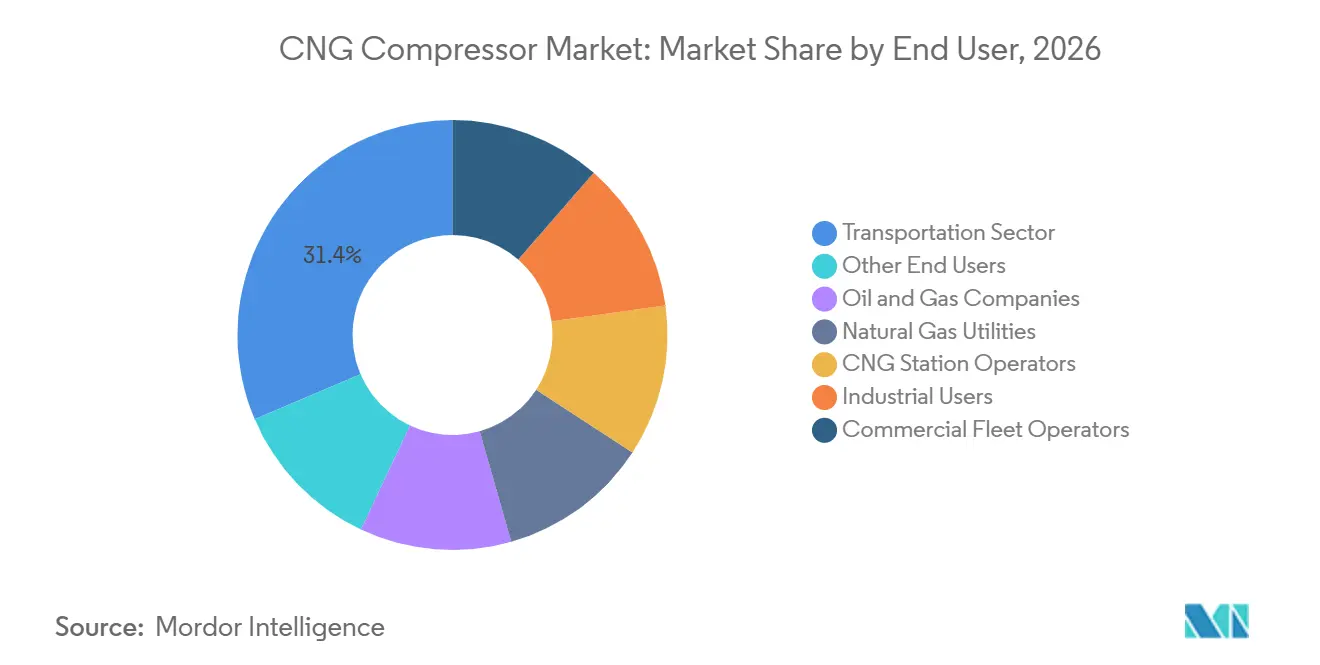
- By end user, transportation held 31.4% of end-user revenue in 2026, while commercial fleet operators are forecast to grow at a 6.1% CAGR through 2032.
- By capacity, the 500–1,000 Nm³/hr range held 32.6% of revenue in 2026, while the 1,000–2,000 Nm³/hr range is forecast to grow at a 6.2% CAGR through 2032.
- By geography, Asia-Pacific held 48.4% of revenue in 2026 and is forecast to grow at a 5.4% CAGR through 2032.
Note: Market numbers in this report are based on Mordor Intelligence's proprietary estimation framework, which combines nine months of actuals with Q4 projections for base year 2026.
Market Trends and Insights
Drivers Impact Analysis of CNG Compressor Market*
| Driver | (~) % Impact on CAGR Forecast | Geographic Relevance | Impact Timeline |
|---|---|---|---|
| CNG Refueling Network Expansion | +1.2% | Global, led by Asia-Pacific, Sub-Saharan Africa, and North America | Short term (≤ 2 years) |
| Municipal and Heavy-Duty Fleet Conversion | +1.1% | Asia-Pacific, South America, and Middle East and Africa | Medium term (2-4 years) |
| Clean-Fuel Policies and Incentives | +0.8% | Global, with gains in Europe, India, and the Middle East and North Africa | Medium term (2-4 years) |
| High-Pressure, High-Availability Compression | +0.6% | North America, Europe, and Asia-Pacific commercial hubs | Medium term (2-4 years) |
| Modular and Mobile Virtual Pipeline Compression | +0.5% | Sub-Saharan Africa, Middle East and North Africa, and Southeast Asia | Long term (≥ 4 years) |
| RNG and Biogas Grid Injection | +0.5% | North America and Europe | Long term (≥ 4 years) |
| Source: Mordor Intelligence | |||
Accelerating CNG Refueling-Network Build-Out
The CNG compressor market depends on station development because each new site requires compression capacity. The United States had 1,385 active CNG stations in the fourth quarter of 2025, and 46% could serve heavy-duty Class 8 trucks. This installed base rose 2% from the prior year, which shows that additions continued even in a mature fueling network.[1] New locations often need equipment that can support both conventional CNG and renewable gas supply arrangements. That requirement favors packages with higher throughput, storage, controls, and field service support. The CNG compressor market, therefore, gains when station developers can combine fuel availability with reliable fleet access.
Station expansion also changes the type of equipment buyers select. Public fast-fill stations need rapid delivery at the pressures required by vehicle fuel systems. Fleet depots can use time-fill systems that operate over longer periods and fit planned vehicle schedules. Virtual pipeline projects need mobile compression and storage where fixed gas grids do not reach customers. These different designs let suppliers serve markets with distinct demand density and site conditions. The CNG compressor market benefits when manufacturers can configure one core platform for several of these uses. Certified equipment also matters because ASME B31.3 process-piping requirements and ISO 15403 gas-quality requirements raise the qualification threshold for public infrastructure projects.
Municipal and Heavy-Duty Fleet Conversion
Municipal bus operators, logistics companies, and large delivery fleets provide a predictable demand for CNG compression systems. India’s Commission for Air Quality Management required new additions by qualifying aggregators, delivery platforms, and e-commerce operators in Delhi-NCR to use CNG or electric vehicles under Direction No. 94 in 2025.[2] The measure applies to organizations with 25 or more vehicles and expands the base of fleets that may need dependable fueling access. Tamil Nadu also awarded contracts in 2025 to convert 1,000 state transport buses to CNG. Such conversions make depot-based compression a practical option for operators that want control over fueling schedules. The CNG compressor market gains from these projects when fleet duty cycles are steady enough to justify owned equipment.
A depot conversion can change procurement from a single vehicle decision into a long-term site investment. The 500–1,000 Nm³/hr range suits many bus depots and medium-sized logistics facilities. Time-fill systems can reduce peak demand on equipment because vehicles are fueled during idle periods. Public station use remains important, but dedicated fleet systems can improve availability where public stations are congested. This approach shifts some demand toward packages that prioritize dependable operation and manageable capital costs. Suppliers also benefit from maintenance contracts because fleet operators require safe and consistent service. Suppliers that can support commissioning, operator training, and preventive maintenance are better positioned for these orders.
Emissions-Reduction Policies and Clean-Fuel Incentives
Vehicle policy and renewable-gas rules affect both equipment volumes and technical specifications. The U.S. Federal Motor Vehicle Safety Standard No. 303 was updated in May 2025 and addresses fuel-system integrity for CNG vehicles. Equipment suppliers must support consistent and safe fueling outcomes as vehicle requirements evolve. In Europe, renewable gas injections into transmission and distribution networks reached 43.2 TWh in the 2024–2025 gas year. That total was 12% higher than the previous gas year. The CNG compressor market is therefore linked to policy frameworks that expand both vehicle fueling and gas-grid injection projects.
France injected 13.1 TWh of renewable gas in the reported period, while Germany injected 12.0 TWh. Grid-injection projects need compression systems that manage gas quality and pressure requirements. These requirements can be stricter than those for standard vehicle fueling. As a result, mid-sized reciprocating and rotary screw equipment can move into applications with more demanding technical requirements. The CNG compressor market has an opportunity where biomethane developers need a reliable interface with gas networks. Suppliers must also maintain compliance documentation, testing, and service capability to compete for these projects.
RNG and Biogas Grid-Injection Integration
RNG supports compressor investment in mature vehicle-fuel markets where fossil CNG demand is less certain. In 2025, 51% of U.S. CNG stations dispensed RNG, and RNG represented 86% of natural gas motor fuel used for transportation. This fuel mix gives station owners a way to link CNG infrastructure with lower-carbon fuel programs. California bio-CNG recorded a carbon intensity of negative 218.9 gCO2e/MJ in the second quarter of 2025 under the Low Carbon Fuel Standard. The CNG compressor market can retain relevance in areas where renewable-gas supply supports fleet economics. Compression equipment must still handle feedstock quality variations and meet required purity standards.
Bauer Compressors and Prodeval delivered a biogas compression system for the Dicklands Farms RNG project in British Columbia in July 2026. The system is designed to increase output from 500 Nm³/h to 700 Nm³/h as digester production grows. This type of expandable design can reduce the need for a full equipment replacement when gas volumes rise. Oil-free and biogas-ready designs are important because contaminants can shorten the life of seals and valves. The CNG compressor market gains where suppliers can manage these operating conditions without compromising reliability. Suppliers are also using these projects to serve grid injection, vehicle fueling, and industrial gas applications from related technology platforms.
Restraints Impact Analysis of CNG Compressor Market*
| Restraint | (~) % Impact on CAGR Forecast | Geographic Relevance | Impact Timelin |
|---|---|---|---|
| High Upfront Cost and Slow Station Payback | -0.9% | Global, especially Sub-Saharan Africa, Middle East and North Africa, and Southeast Asia | Short term (≤ 2 years) |
| Safety, Permitting, and Pressure-Equipment Compliance | -0.5% | North America, Europe, and ASEAN countries | Medium term (2-4 years) |
| Competition from Battery-Electric, Hydrogen, and LNG Fleets | -0.7% | Western Europe, East Asia, and North America | Long term (≥ 4 years) |
| Downtime from Gas-Quality Variability | -0.3% | India, Southeast Asia, and European bio-CNG sites | Medium term (2-4 years) |
| Source: Mordor Intelligence | |||
High Upfront Cost and Slow Station Payback
Capital cost remains a material restraint for the CNG compressor market. A fast-fill CNG station with compression and storage can require USD 400,000 to USD 2 million or more, depending on capacity and site design.[3] Compression equipment is often the largest individual equipment cost at a station. Developers also face civil works, utility connections, permitting, gas storage, and safety-system expenses. These costs can be difficult to finance where public credit support or equipment leasing is limited. The CNG compressor market grows more slowly when developers cannot match early capital outlays with committed fueling volume.
Payback depends on utilization, gas pricing, fleet contracts, and local policy. A station with large captive fleets has a clearer revenue base than a public site that depends on uncertain traffic. Equipment suppliers can respond through modular designs that allow station owners to add capacity as volumes increase. Mobile fueling and virtual pipeline services can also reduce the need for immediate fixed-site investment. However, these alternatives do not remove the need for compression equipment and specialized operations. The CNG compressor market remains exposed to financing constraints in regions where station developers bear the full project risk. Service agreements and predictable spare-parts support can help owners protect utilization after commissioning.
Competition from Battery-Electric, Hydrogen, and LNG Fleets
Alternative drivetrains are changing where the CNG compressor market can grow. Battery-electric buses and light commercial vehicles are gaining attention in cities with charging infrastructure and public procurement support. Hydrogen is being evaluated for some heavy-duty applications, while LNG retains an energy-density advantage on long-distance freight routes. These technologies can limit CNG station investment in specific urban and developed-market corridors. The effect is not uniform because fleet economics, local infrastructure, and fuel availability differ by location. The CNG compressor market remains more attractive where fleets need practical fueling capacity before electric or hydrogen infrastructure is widely available.
Westport Fuel Systems presented a 700-bar high-pressure CNG system at ACT Expo 2026 for freight applications. The product development signals that equipment providers are responding to competition through higher-pressure and more specialized CNG solutions. In the near term, CNG demand is likely to remain centered on corridors where fuel costs and fleet utilization favor gas vehicles. Renewable gas availability can further support this position in North America and parts of Europe. The CNG compressor market must still compete for capital against charging and hydrogen infrastructure. Suppliers that address fuel quality, uptime, and operating cost will have the strongest position in mixed-fuel transport systems.
*Our forecasts treat driver/restraint impacts as directional, not additive. The impact forecasts reflect baseline growth, mix effects, and variable interactions.
CNG Compressor Market Segment Analysis
By Compressor Type:
Reciprocating Technology Retains the Largest PositionReciprocating compressors held 63.5% of CNG compressor market share in 2026. They can provide the high discharge pressures needed for fast-fill vehicle fueling, typically 200–250 bar. Their multi-stage piston design can accommodate varied inlet pressures in city gas distribution networks. This makes them suitable for public fast-fill stations and larger fleet depots. Rotary screw systems retain a role in continuous low-pressure boosting and industrial applications. Centrifugal, diaphragm, and hydraulic equipment serve more specialized operating requirements. Diaphragm compressors are used for smaller oil-free installations where gas purity is important. These alternatives give buyers choices where pressure, flow, noise, or purity requirements differ from standard station needs.
Hydraulic compressors are forecast to grow at a 5.6% CAGR through 2032, the highest rate among compressor types. Their lower noise profile supports use in urban settings. Their oil-free operating characteristics can also suit bio-CNG applications that require tight gas-quality control. A 2025 study reported a 12.3% reduction in compressor-specific energy use through the optimization of station pressure and storage parameters. This finding supports interest in designs that provide better control over operating conditions. Atlas Copco continues to offer CNG and RNG compression systems for fueling and gas applications.[4] Demand for specialized compressor configurations is influenced by urban noise limits, gas quality, and the need for efficient load management.

By End User:
Transportation Holds the Largest Revenue PositionTransportation accounted for 31.4% of end-user revenue in 2026. Public transit agencies, intercity bus operators, and heavy-duty truck fleets provide recurring equipment demand. CNG station operators and utilities also deploy compression assets for vehicle fueling and gas-network uses. Oil and gas companies use CNG systems in virtual pipeline operations that move gas beyond fixed networks. Industrial users include manufacturing, ceramics, glass, and power-related facilities that need process gas compression. This broad end-user base reduces dependence on any single transport application. It also requires suppliers to provide equipment packages that meet different flow, reliability, and site requirements. The sector serves these customers through both standardized equipment and configured systems.
Commercial fleet operators are forecast to grow at a 6.1% CAGR through 2032. These operators often choose dedicated compression equipment to control fuel costs and improve fueling availability. Certarus launched a Mobile CNG Fleet Fueling service in Houston in August 2026 and signed an initial contract to fuel 100 Class 8 natural gas trucks. The model delivers CNG and RNG to fleet locations without requiring permanent station infrastructure. India’s 2025 CAQM direction also supports conversion among qualifying commercial fleets in Delhi-NCR. The CNG compressor market, therefore, has a route to growth through depot systems and mobile supply models. Service support is particularly important because fleet utilization depends on equipment availability every day.
By Capacity:
Mid-Range Systems Lead Current DemandThe 500–1,000 Nm³/hr category accounted for 32.6% of the CNG compressor market size in 2026. This range fits the needs of mid-scale public stations and fleet depots. It can support transit buses and regional logistics operations without the cost of a much larger mother station. Units below 100 Nm³/hr serve smaller private fueling locations and residential dispensing uses. The 100–500 Nm³/hr category supports light commercial fleets and daughter stations. Skid-mounted equipment in these ranges can reduce site preparation needs. Sub-500 Nm³/hr equipment remains relevant where demand density is limited or capacity needs to be added gradually. These applications keep a varied base of demand within the CNG compressor market.
The 1,000–2,000 Nm³/hr category is forecast to grow at a 6.2% CAGR through 2032. It supports mother stations, virtual pipeline networks, and high-throughput truck fueling sites. CIMC Enric describes modular CNG compressor stations for gas transport, industrial supply, and fueling applications. Higher-capacity systems are useful when one site serves several daughter stations or industrial customers. Capacity above 2,000 Nm³/hr remains a smaller category because its use is concentrated in pipeline interconnection and large renewable-gas injection projects. These projects need significant site demand and more complex engineering. Demand for large systems will depend on the scale of virtual pipelines and biomethane projects. Suppliers with modular designs can improve delivery time for buyers that need rapid capacity additions.
Geography Analysis
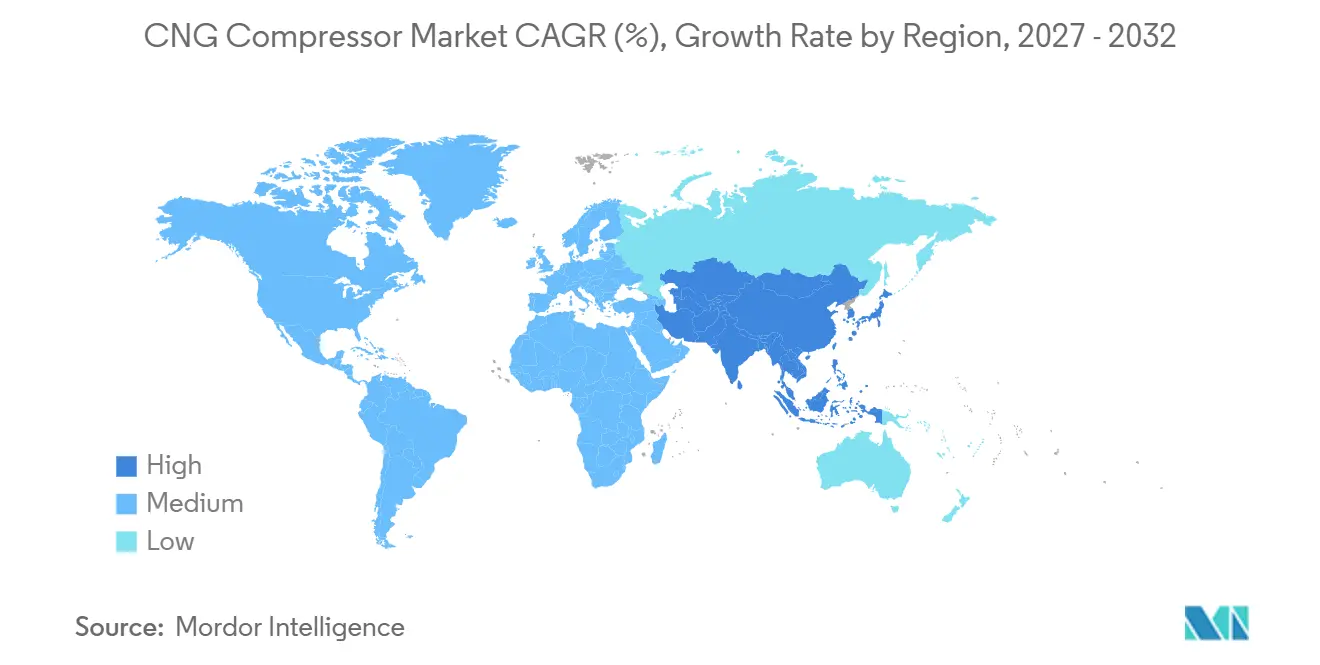
Asia-Pacific held 48.4% of global revenue in 2026 and is forecast to grow at a 5.4% CAGR through 2032. China and India support the region through transport demand, gas distribution expansion, and fleet activity. India’s city gas distribution development directly supports additional fueling locations and related compression demand. The region also needs equipment for truck corridors, public buses, and industrial gas users. Southeast Asian countries add volumes through Indonesia, Vietnam, and Thailand. However, urban electrification policies can limit some CNG opportunities in city centers. Pakistan’s large CNG vehicle base supports replacement and capacity-expansion needs. The CNG compressor market is strongest in this region, where gas supply and fleet demand develop together.
North America maintained an established base in 2025, supported by 1,385 active U.S. CNG stations. RNG economics provide an added reason for fleets to use existing CNG infrastructure. The Texas Natural Gas Vehicle Grant Program provides funding for the replacement of eligible medium- and heavy-duty vehicles with natural gas vehicles. Europe has a mixed profile because biomethane projects create demand for grid-injection compression while fossil CNG vehicle numbers decline in some cities. France, Germany, Italy, Spain, and the United Kingdom have opportunities related to renewable gas. The EU target of 35 billion cubic meters of biomethane production by 2030 supports the broader project pipeline. Demand in these regions is increasingly connected to renewable-gas infrastructure rather than conventional vehicle fueling alone.
South America and the Middle East and Africa start from smaller bases but retain meaningful project potential. Argentina has a long-established CNG vehicle fleet and a domestic supplier base led by companies such as Galileo Technologies. Brazil, Chile, and Colombia continue to assess public CNG networks where fuel policy supports the economics of gas vehicles. In Nigeria, CIMC Enric shipped 150 CNG tube trailers in September 2026 to support virtual pipeline development. Mobile gas delivery can serve locations that lack pipeline connections. Saudi Arabia and the UAE are developing gas monetization projects that include industrial and transport uses. Egypt and Morocco also have fleet conversion programs that can support demand. The CNG compressor market in these regions depends on project finance, gas availability, and the pace of public infrastructure plans.
Competitive Landscape
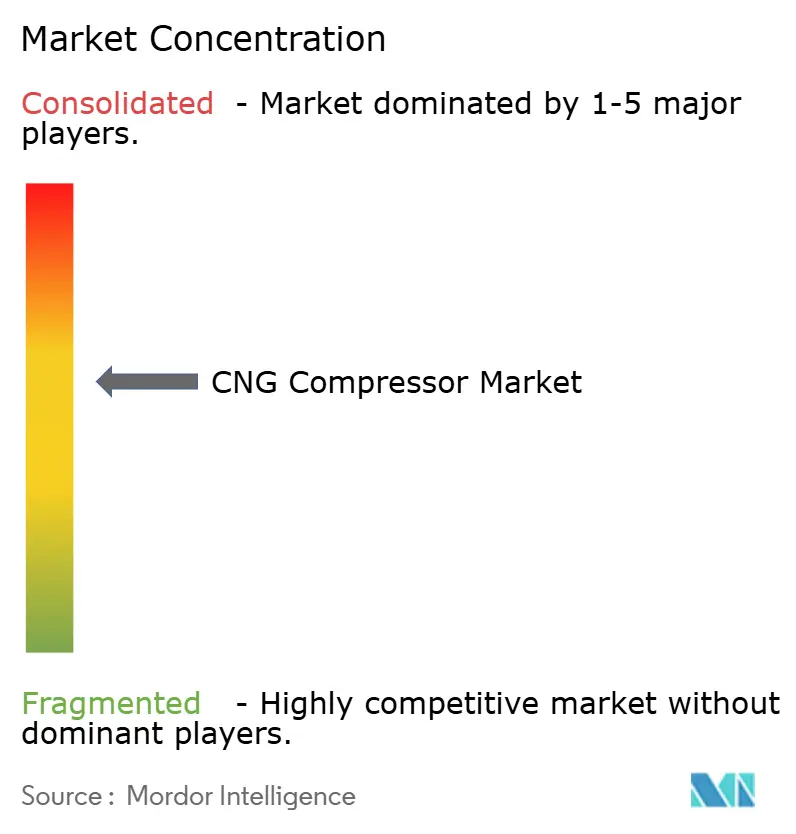
The CNG compressor market is moderately concentrated. Ariel Corporation, Atlas Copco, Siemens Energy, Ingersoll Rand, and Burckhardt Compression compete for larger turnkey and platform contracts. ANG I Energy Systems, Galileo Technologies, CIMC Enric, SAFE S.p.A., and Bauer Kompressoren compete through modular designs and project delivery. Suppliers increasingly offer integrated packages that combine compression, storage, cooling, controls, and service. This approach can support recurring aftermarket revenue and make equipment changes more complex for customers. Ariel introduced its Smart Compressor platform in July 2026 with monitoring and protection capabilities for compressor operations. The move reflects a wider focus on maintenance data and equipment uptime. The CNG compressor market favors suppliers that can pair equipment supply with responsive field service.
Burckhardt Compression completed its acquisition of Fornovo Gas in July 2026. The acquisition added a CNG and biogas compression business with a mid-sized reciprocating product range. It also added around 120 employees and annual sales in the double-digit million Swiss franc range. The transaction shows how scale and a broader product line can matter in configured compression projects. Ingersoll Rand also expanded its gas compression offerings through its 2026 acquisition activity and product rollout. These actions increase competitive pressure in applications that need higher flow and more specialized engineering. The sector is also seeing Chinese suppliers compete on price and delivery for modular and mobile systems. Certification remains an advantage for firms that have established approvals in several regions.
ISO 15403 sets gas-quality requirements for natural gas used as a vehicle fuel. Regional approvals such as ATEX and India’s PESO requirements can slow entry for firms without established testing and documentation. This makes technical qualification important alongside price and delivery time. Leading companies are therefore focusing on product breadth, modular systems, service coverage, and compliance support. Clean Energy Fuels opened 6 new RNG stations across the United States in May 2026, supporting heavy-duty truck routes. Such network growth creates opportunities for equipment suppliers, station operators, and service providers. The CNG compressor market will continue to reward companies that can serve both fueling and renewable-gas applications.
CNG Compressor Industry Leaders
-
Ariel Corporation
-
Atlas Copco AB
-
Siemens Energy AG
-
Ingersoll Rand Inc.
-
Bauer Compressors, Inc.
- *Disclaimer: Major Players sorted in no particular order
CNG Compressor Market Companies Covered in this Report
- ANGI Energy Systems LLC
- Ariel Corporation
- Aspro
- Atlas Copco AB
- Bauer Kompressoren GmbH
- Burckhardt Compression AG
- CIMC Enric Holdings Limited
- Clean Energy Compression Corp.
- CompAir
- Corken, Inc.
- Fornovo Gas S.p.A.
- Galileo Technologies S.A.
- Howden
- Ingersoll Rand Inc.
- J.P. Sauer & Sohn Maschinenbau GmbH
- J-W Power Company
- MAN Energy Solutions SE
- SAFE S.p.A.
- Siemens Energy AG
- Wartsila Corporation
Recent Industry Developments in CNG Compressor Market
- September 2026: CIMC Enric ships 150 CNG tube trailers to Nigeria. The equipment supports virtual pipeline deployment from gas sources to CNG refueling terminals across Nigeria, providing the backbone for mobile compression and storage in pipeline-absent regions.
- August 2026: Certarus launches Mobile CNG Fleet Fueling service. The company commissioned a CNG supply hub in Houston, Texas, and secured a multi-year contract to fuel 100 Class 8 natural gas trucks.
- July 2026: Bauer Kompressoren and Prodeval deliver an RNG compression system for Dicklands Farms in British Columbia. The installation produces 500 Nm³/h of pipeline-quality RNG and is designed to expand to 700 Nm³/h.
Global CNG Compressor Market Report Scope
A CNG compressor is a specialized mechanical device that increases the pressure of natural gas from a low-pressure source, such as a pipeline, to a high-pressure output, typically ranging from 200 to 250 bar (3,000 to 3,600 psi). This process enables the storage and use of natural gas as compressed natural gas (CNG).
The global CNG compressor market is segmented by compressor type, end user, capacity, and geography. By compressor type, the market is segmented into reciprocating compressors, rotary screw compressors, centrifugal compressors, hydraulic compressors, diaphragm compressors, and other CNG compressor types. By end user, the market is segmented into oil and gas companies, natural gas utilities, transportation sector, CNG station operators, industrial users, commercial fleet operators, and other end users. By capacity, the market is segmented into below 100 Nm³/hr, 100–500 Nm³/hr, 500–1,000 Nm³/hr, 1,000–2,000 Nm³/hr, and above 2,000 Nm³/hr. The report also covers the market size and forecasts for the global CNG compressor market across 26 countries in the key regions. For each segment, market sizing and forecasts are provided in terms of value (USD).
Segmentation Overview
| Reciprocating Compressors |
| Rotary Screw Compressors |
| Centrifugal Compressors |
| Hydraulic Compressors |
| Diaphragm Compressors |
| Other CNG Compressor Types |
| Oil and Gas Companies |
| Natural Gas Utilities |
| Transportation Sector |
| CNG Station Operators |
| Industrial Users |
| Commercial Fleet Operators |
| Other End Users |
| Below 100 Nm³/hr |
| 100-500 Nm³/hr |
| 500-1,000 Nm³/hr |
| 1,000-2,000 Nm³/hr |
| Above 2,000 Nm³/hr |
| North America | United States |
| Canada | |
| Mexico | |
| Europe | Germany |
| France | |
| Italy | |
| Spain | |
| United Kingdom | |
| Poland | |
| Russia | |
| Rest of Europe | |
| Asia-Pacific | China |
| India | |
| Japan | |
| South Korea | |
| Australia | |
| Indonesia | |
| Vietnam | |
| Thailand | |
| Rest of Asia-Pacific | |
| South America | Brazil |
| Argentina | |
| Chile | |
| Rest of South America | |
| Middle East and Africa | Saudi Arabia |
| United Arab Emirates | |
| Egypt | |
| South Africa | |
| Morocco | |
| Rest of Middle East and Africa |
| By Compressor Type | Reciprocating Compressors | |
| Rotary Screw Compressors | ||
| Centrifugal Compressors | ||
| Hydraulic Compressors | ||
| Diaphragm Compressors | ||
| Other CNG Compressor Types | ||
| By End User | Oil and Gas Companies | |
| Natural Gas Utilities | ||
| Transportation Sector | ||
| CNG Station Operators | ||
| Industrial Users | ||
| Commercial Fleet Operators | ||
| Other End Users | ||
| By Capacity | Below 100 Nm³/hr | |
| 100-500 Nm³/hr | ||
| 500-1,000 Nm³/hr | ||
| 1,000-2,000 Nm³/hr | ||
| Above 2,000 Nm³/hr | ||
| By Geography | North America | United States |
| Canada | ||
| Mexico | ||
| Europe | Germany | |
| France | ||
| Italy | ||
| Spain | ||
| United Kingdom | ||
| Poland | ||
| Russia | ||
| Rest of Europe | ||
| Asia-Pacific | China | |
| India | ||
| Japan | ||
| South Korea | ||
| Australia | ||
| Indonesia | ||
| Vietnam | ||
| Thailand | ||
| Rest of Asia-Pacific | ||
| South America | Brazil | |
| Argentina | ||
| Chile | ||
| Rest of South America | ||
| Middle East and Africa | Saudi Arabia | |
| United Arab Emirates | ||
| Egypt | ||
| South Africa | ||
| Morocco | ||
| Rest of Middle East and Africa | ||
Key Questions Answered in the Report
What is the 2026 value of the CNG compressor market?
The CNG Compressor Market size is projected to be USD 5.59 billion in 2026, USD 5.86 billion in 2027, and reach USD 7.40 billion by 2032, growing at a CAGR of 4.78% from 2027 to 2032.
Which compressor type has the largest revenue share?
Reciprocating compressors held 63.5% of revenue in 2026 because they support the high pressures required for fast-fill vehicle fueling.
Which end user is expected to grow fastest?
Commercial fleet operators are forecast to grow at a 6.1% CAGR through 2032 as more fleets install or use dedicated fueling capacity.
Which capacity range is growing fastest?
The 1,000-2,000 Nm³/hr range is forecast to grow at a 6.2% CAGR through 2032, supported by mother stations and high-throughput sites.
Which region leads CNG compressor demand?
Asia-Pacific held 48.4% of revenue in 2026 and is forecast to grow at a 5.4% CAGR through 2032.
What limits adoption of CNG compression systems?
High station capital costs, permitting needs, variable gas quality, and competition from electric, hydrogen, and LNG options can delay projects.