
Cloud-Native Network Function Migration Services Market Size and Share
Market Overview
| Study Period | 2020 - 2031 |
|---|---|
| Market Size (2026) | USD 3.24 Billion |
| Market Size (2031) | USD 6.29 Billion |
| Growth Rate (2026 - 2031) | 14.19 % |
| Fastest Growing Market | Asia-Pacific |
| Largest Market | North America |
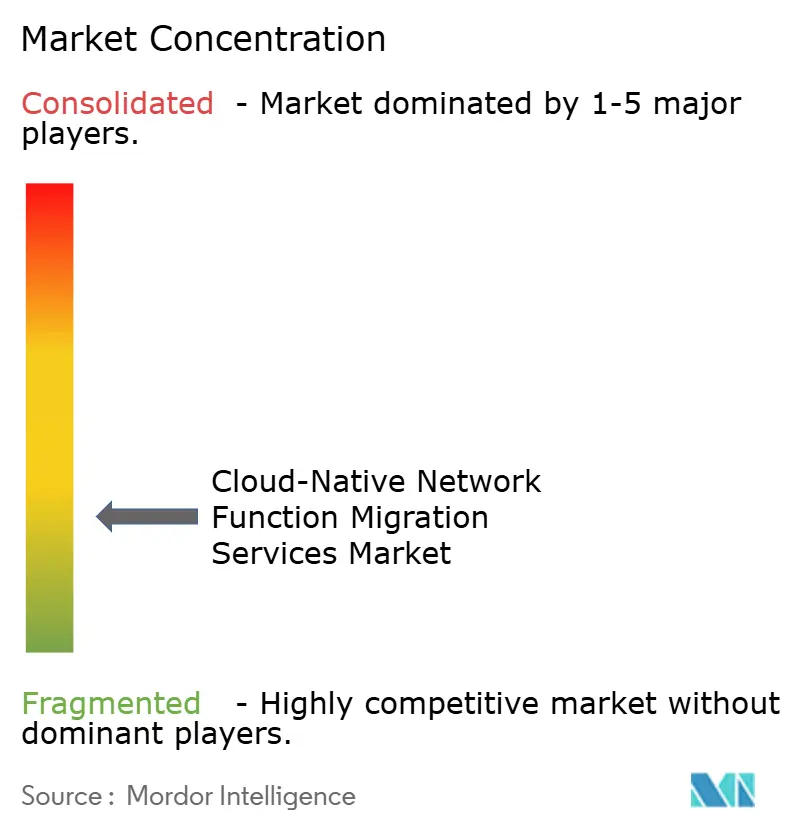
| Market Concentration | Low |
Major Players *Disclaimer: Major Players sorted in no particular order Image © Mordor Intelligence. Reuse requires attribution under CC BY 4.0. | |
Cloud-Native Network Function Migration Services Market Analysis by Mordor Intelligence
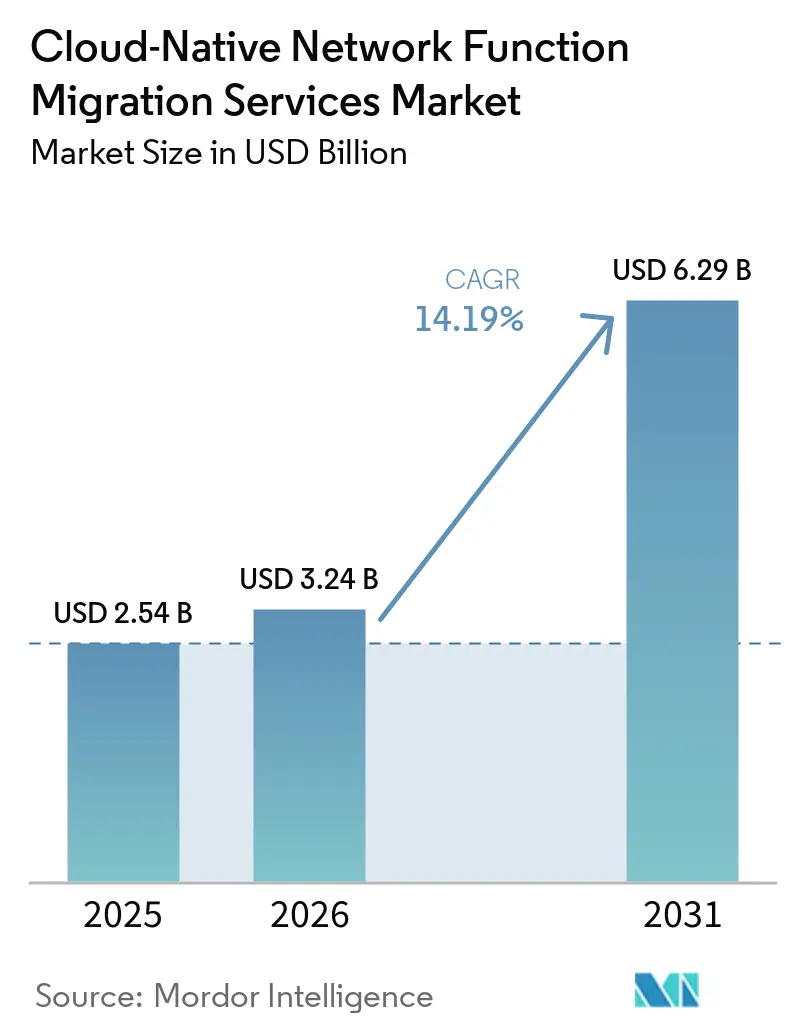
The cloud-native network function migration services market size is projected to be USD 2.54 billion in 2025, USD 3.24 billion in 2026, and reach USD 6.29 billion by 2031, growing at a CAGR of 14.19% from 2026 to 2031. The cloud-native network function migration services market is being shaped by operators replacing virtual network functions with containerized network functions as 5G standalone networks expand. This work is becoming part of core network investment programs because standalone architecture supports network slicing, edge computing, and new automated services. Operators are also moving from isolated cloud projects toward multi-cloud operating models, which increases the need for platform-neutral migration and orchestration support. Vendors are responding by combining software, cloud infrastructure, and integration services, while systems integrators remain important where legacy operating and billing systems are involved. The cloud-native network function migration services market also has room to grow as migration activity moves beyond the core into radio access, user plane, and edge environments.
Key Report Takeaways
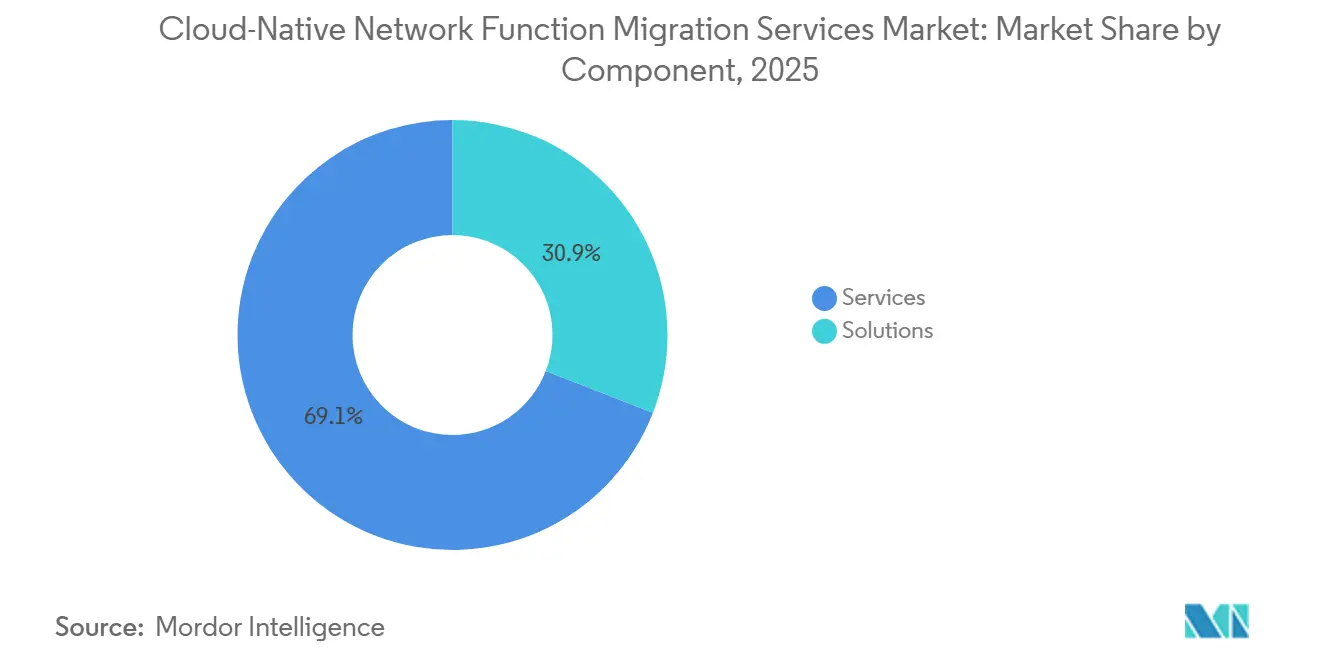
- By component, services held 69.12% of revenue in 2025, while solutions are projected to expand at a 16.11% CAGR through 2031.
- By deployment model, cloud service providers held 53.62% of revenue in 2025 and are expected to expand at a 15.98% CAGR through 2031.
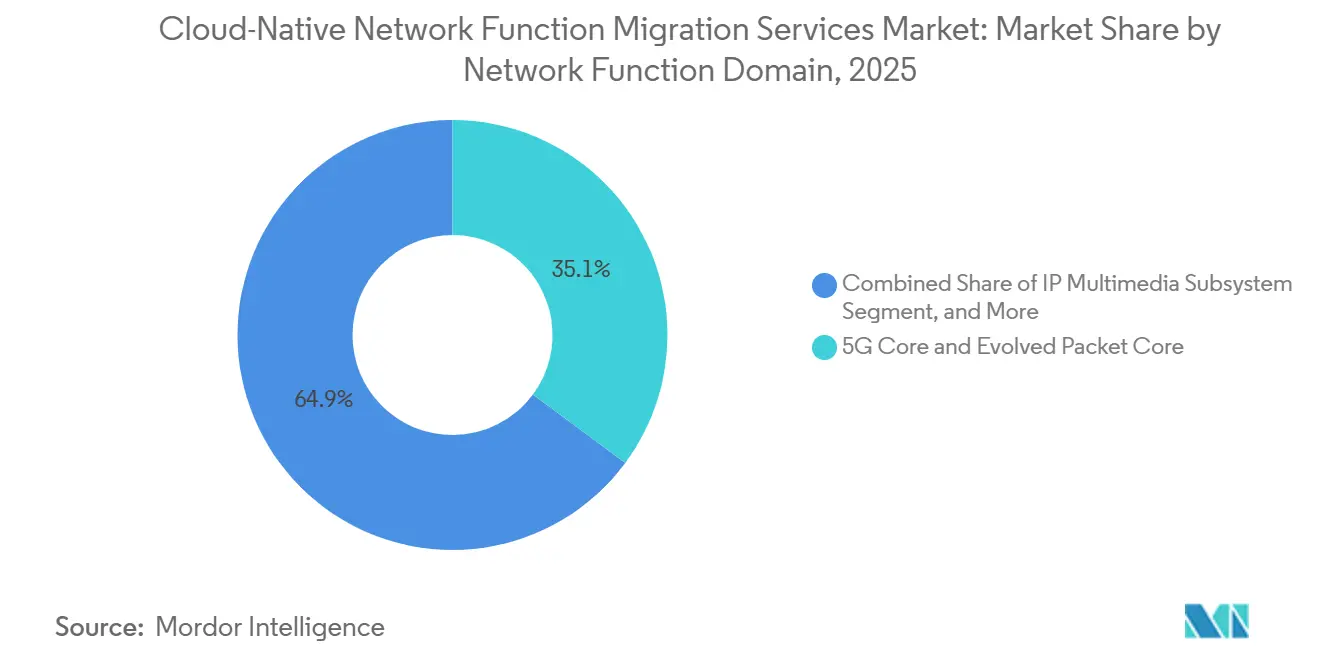
- By network function domain, 5G Core and Evolved Packet Core held 35.14% of revenue in 2025, while Radio Access Network and Open RAN are projected to grow at a 16.08% CAGR through 2031.
- By end user, telecom service providers held 49.91% of cloud-native network function migration services market revenue in 2025, while cloud service providers are expected to expand at a 15.89% CAGR through 2031.
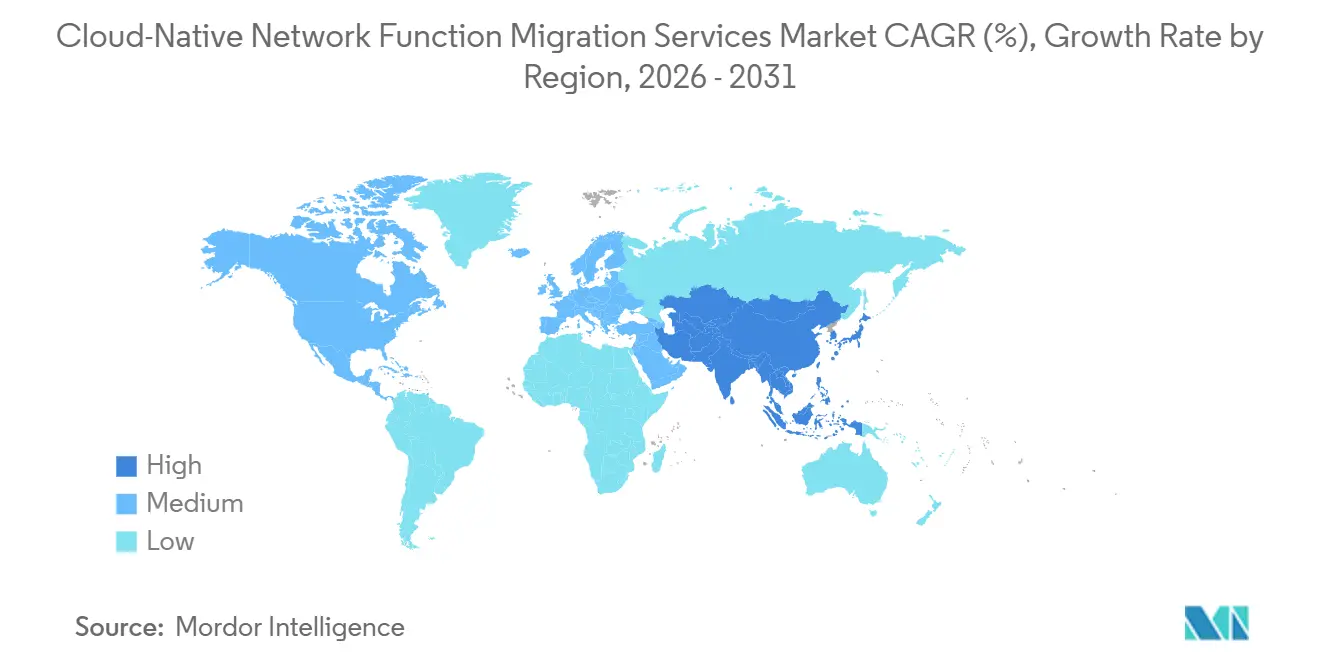
- By geography, North America held 34.90% of revenue in 2025, while Asia-Pacific is projected to advance at a 16.13% CAGR through 2031.
Note: Market size and forecast figures in this report are generated using Mordor Intelligence’s proprietary estimation framework, updated with the latest available data and insights as of January 2026.
Market Trends and Insights
Drivers Impact Analysis of Cloud-Native Network Function Migration Services Market*
| Driver | (~) % Impact on CAGR Forecast | Geographic Relevance | Impact Timeline |
|---|---|---|---|
| 5G Standalone Core and Network Slicing Rollouts | +3.2% | Global, with peak intensity in North America, Europe, and Asia-Pacific | Medium term (2-4 years) |
| Hybrid and Multi-Cloud Telco Modernization | +2.8% | Global, particularly North America and Europe | Medium term (2-4 years) |
| OPEX Optimization Through VNF-to-CNF Transformation | +2.3% | Global | Short term (≤ 2 years) |
| Edge Cloud Deployment for Low-Latency Services | +1.9% | Asia-Pacific, North America, Europe | Medium term (2-4 years) |
| AI-Assisted Orchestration and Service Assurance | +1.6% | Global, led by North America and East Asia | Long term (≥ 4 years) |
| Open, Kubernetes-Based Platforms Reduce Migration Lock-In | +1.2% | Global | Short term (≤ 2 years) |
| Source: Mordor Intelligence | |||
5G Standalone Core and Network Slicing Rollouts
5G standalone cores require cloud-native functions and therefore create direct demand for migration work. Telia Norge launched nationwide commercial 5G standalone service in 2026 and reported latency below 10 milliseconds, compared with 15-18 milliseconds on non-standalone 5G. Proximus launched 5G+ in Belgium in April 2026, adding another commercial rollout that requires cloud-native core capabilities. Network slicing depends on standalone architecture because it needs dynamic allocation of network resources across users and services. The cloud-native network function migration services market benefits when operators bring these capabilities into commercial use rather than maintaining non-standalone networks. ETSI standards provide a shared technical framework for validating service-based network architecture during these migrations.[1]
Hybrid and Multi-Cloud Telco Modernization
Operators increasingly use both public cloud resources and infrastructure inside their own data centers. O2 Telefónica deployed a 5G cloud core on Nokia software running on AWS Outposts in its data centers in March 2026, while serving 1 million customers through this hybrid model. This model combines public-cloud operating tools with local control over sensitive network workloads in the cloud-native network function migration services market. It also makes platform portability more important because operators need functions to operate across different locations and cloud environments. The cloud-native network function migration services market gains from this complexity because migration partners must design, test, and operate the links between cloud platforms. China Telecom identified cloud-native network element evolution and edge AI integration as pillars of its 2026-2030 cloud-network fusion phase.
OPEX Optimization Through VNF-to-CNF Transformation
Operators are looking for a lower-cost operating model as they move from virtual network functions to containerized functions. Containerized functions can scale more easily and can reduce the fixed capacity that operators keep for peak traffic. The cloud-native network function migration services market is supported when automation shortens deployment cycles and reduces manual lifecycle work. China issued YD/T 6719-2026 in March 2026, setting technical requirements for the container-layer operations and maintenance northbound interface, with the standard taking effect in June 2026.[2] The standard gives providers and operators a clearer operational reference for container-layer management. Repeatable operating practices can reduce migration risk, especially for operators managing large multi-vendor estates.
Edge Cloud Deployment for Low-Latency Services
Edge deployments extend migration work beyond the mobile core and into distributed network locations. NEC expanded its user plane function support for second-generation AWS Outposts in February 2026 and reported 200 Gbps throughput using 20% of total CPU cores. This performance profile supports the use of cloud-native user plane functions alongside other workloads at edge sites. ETSI’s Multi-access Edge Computing group provides specifications for multi-provider and multi-technology edge deployments. The cloud-native network function migration services market can therefore address user plane functions and application hosting, not only central core functions. These projects require local performance testing and coordinated deployment across edge and central sites.
Restraints Impact Analysis of Cloud-Native Network Function Migration Services Market*
| Restraint | (~) % Impact on CAGR Forecast | Geographic Relevance | Impact Timeline |
|---|---|---|---|
| Legacy OSS and BSS Integration Complexity | -2.1% | Global, particularly acute in Europe and North America | Short term (≤ 2 years) |
| Telco-Grade Interoperability and Performance Gaps | -1.5% | Global | Medium term (2-4 years) |
| Migration Freeze Risk During VNF and CNF Coexistence | -1.0% | Global | Medium term (2-4 years) |
| Scarcity of Cross-Domain Cloud-Native Operations Talent | -0.7% | Global, with regional labor market variations | Long term (≥ 4 years) |
| Source: Mordor Intelligence | |||
Legacy OSS and BSS Integration Complexity
Legacy operating support systems and billing support systems remain a practical barrier to cloud-native migration. Established operators often run several OSS and BSS platforms because of earlier acquisitions and separate network deployments. These systems can contain proprietary interfaces and undocumented dependencies that are difficult to connect to containerized network functions. The cloud-native network function migration services market needs experienced integration teams when network provisioning, billing, and service assurance must remain active throughout a cutover. Manual steps can remain necessary when the legacy layer lacks usable programmatic interfaces. This weakens the speed and cost benefits that operators expect from cloud-native automation.
Telco-Grade Interoperability and Performance Gaps
Cloud platforms designed for general enterprise workloads do not automatically meet all carrier network requirements. Operators require consistent availability, deterministic packet processing, and reliable real-time behavior across the full service chain. They must test cloud infrastructure, network functions, and management tools together before carrying production traffic. The cloud-native network function migration services market is affected because these validation cycles can prolong migration schedules. Hybrid operation of VNF and CNF environments also creates a risk that operators delay a cutover to avoid service disruption. A shortage of staff with both cloud and network operations experience can make these tasks harder to complete at scale.
*Our forecasts treat driver/restraint impacts as directional, not additive. The impact forecasts reflect baseline growth, mix effects, and variable interactions.
Cloud-Native Network Function Migration Services Market Segment Analysis
By Component:
Services Support Current Programs, While Solutions Lead GrowthServices held 69.12% of the cloud-native network function migration services market share in 2025, reflecting operators’ continuing need for integration, consulting, validation, and managed migration support. Migration programs commonly require detailed function inventories, transition planning, dependency mapping, parallel operation, and production validation. Those requirements favor service engagements when a network includes multiple vendors and older operating platforms. Professional services providers also help operators coordinate network operations teams, application owners, security teams, and cloud infrastructure partners.
Solutions are projected to expand at a 16.11% CAGR through 2031, faster than the overall cloud-native network function migration services market. The segment includes migration automation tools, lifecycle management software, and platforms that support containerized network functions. Productized tools can make deployments more repeatable across separate clusters, release cycles, and technology vendors. They can also reduce the amount of bespoke configuration needed during later migration waves and routine software updates. Deutsche Telekom’s Operator-based Cloud Automation Solution uses Kubernetes operator patterns and GitOps principles for lifecycle management. Its approach shows why operators are seeking tools that can manage stateful functions and cross-cluster dependencies in a more standardized way.
By Deployment Model:
Cloud Service Providers Lead the TransitionCloud service providers held 53.62% of revenue in 2025 and are projected to expand at a 15.98% CAGR through 2031. Public-cloud deployment gives operators access to elastic infrastructure without the full cost and timing of building new data center capacity. It can also provide managed platform services that support Kubernetes-based deployment and operations. This makes cloud-hosted environments attractive for new standalone core programs that need rapid capacity changes. The cloud-native network function migration services market therefore requires services that connect network-specific functions to public-cloud operating models, security controls, and operating procedures.
Tune Talk became ASEAN’s first fully cloud-native mobile network operator in February 2026 through a Mavenir deployment of cloud-native core, OSS, and BSS solutions on AWS infrastructure. Nokia and Citymesh also brought a commercial mobile service using 5G Core SaaS into operation on AWS in February 2026.[3] These deployments indicate that public cloud can support commercial mobile workloads when the required performance, security, and operational safeguards are in place. On-premise environments still matter for latency-sensitive functions, data sovereignty needs, and operators with substantial existing data center capacity. As a result, hybrid orchestration remains a central requirement rather than a temporary transition stage for many established operators.
By Network Function Domain:
Core Functions Lead Revenue, Open RAN Grows Faster5G Core and Evolved Packet Core held 35.14% of revenue in 2025. This position reflects the need to establish cloud-native core functions before operators can fully use standalone 5G capabilities. Mavenir migrated the first 100,000 Telefónica Germany customers to cloud-native IMS on AWS in May 2026. Nokia’s cloud-native IMS and subscriber data management functions became commercially active at Rakuten Mobile on Rakuten Cloud in March 2026.
Radio Access Network and Open RAN are projected to record a 16.08% CAGR through 2031. The domain expands the scope of the cloud-native network function migration services market from central core workloads into access-network functions. Rakuten Mobile’s cloud-native Open RAN network provides an operating example for this approach across a large population footprint. Open RAN migration requires detailed interoperability testing because it brings together radios, software, cloud infrastructure, and management layers from different suppliers. Edge and multi-access edge computing are also relevant because user plane functions must operate close to users for low-latency services. Other functions, including policy control and signaling, are commonly migrated as part of wider standalone-network programs and coordinated service releases.
By End User:
Telecom Providers Remain the Main BuyersTelecom service providers held 49.91% of revenue in 2025, making them the principal buyer group. Large operators have complex network estates and undertake migration over several years, often across core, voice, access, edge, and service-management functions. Their programs require coordination between network equipment suppliers, cloud providers, systems integrators, and internal operating teams. Telecom service providers also need to preserve service continuity while moving live subscribers and applications. These needs sustain demand for planning, implementation, and managed operations services.
Cloud service providers are expected to grow at a 15.89% CAGR through 2031 as they embed CNF workloads into managed platform services. Ericsson and Google Cloud introduced Ericsson On-Demand in June 2025 as a fully managed 5G Core SaaS offering built on Google Kubernetes Engine. This model changes the buyer landscape because a platform provider can package network functions with cloud operations, billing, and managed support. Large enterprises and government and defense organizations add demand where private-network reliability and security needs are important. Small and medium-sized enterprises typically obtain CNF-based capabilities through managed providers rather than buying migration services directly. That reseller model gives cloud providers a larger role in the cloud-native network function migration services market.
Geography Analysis
North America Cloud-Native Network Function Migration Services Market
North America held 34.90% of the cloud-native network function migration services market share in 2025. The region has large operators that are moving from initial standalone core deployment into voice, edge, enterprise service, and service-assurance work. A dedicated 5G standalone core for FirstNet shows the role of cloud-native architecture in public safety networks. The region also benefits from an active ecosystem of cloud providers, network vendors, and systems integrators. Interoperability testing by the O-RAN Alliance gives operators a basis for validating multi-vendor access-network deployments.
Europe Cloud-Native Network Function Migration Services Market
Europe has mature migration programs in Germany, the United Kingdom, France, and other Western European markets, while Central and Eastern European operators remain earlier in deployment cycles. O2 Telefónica’s hybrid cloud core deployment illustrates how regional data sovereignty requirements can coexist with public-cloud operating methods. The European Commission published the Telco Cloud Reference Architecture in September 2025, providing a regional reference for interoperable and sovereign telco cloud design. Proximus’s April 2026 5G+ launch and Telia Norge’s nationwide commercial 5G standalone rollout indicate continued momentum.
APAC, MEA and South America Cloud-Native Network Function Migration Services Market
Asia-Pacific is projected to expand at a 16.13% CAGR through 2031, the highest regional growth rate in the cloud-native network function migration services market. NTT DOCOMO and NEC launched Japan’s first commercial 5G core on AWS in March 2026, using agentic AI and GitOps automation that reduced design and construction time by 80%. China’s YD/T 6386-2025 standard established design and management principles for cloud-native telecom network elements. SK Telecom released an autonomous network Level 4 blueprint in June 2026 that includes next-generation OSS transformation and AI agent standardization. India’s Open RAN expansion and Southeast Asia’s greenfield operators broaden regional demand, while the Middle East, South America, and Africa remain earlier-stage areas with selected cloud-native projects and targeted international partnerships.
Competitive Landscape
The cloud-native network function migration services market is moderately fragmented across network equipment vendors, cloud-native software providers, cloud infrastructure providers, and global systems integrators with distinct delivery roles. Ericsson, Nokia, Huawei, Cisco, Juniper Networks, ZTE, Mavenir, Red Hat, VMware, Accenture, IBM, Infosys, and Tech Mahindra participate through different parts of the delivery chain. In the cloud-native network function migration services market, this structure means operators can select a full-stack vendor or combine specialized suppliers for infrastructure, software, integration, and operations. Network equipment providers increasingly package migration capabilities with their core, automation, and infrastructure products. Systems integrators remain relevant when a program involves extensive process change, older operational systems, and multi-vendor accountability.
Nokia and AWS expanded their collaboration in June 2026 to deploy Nokia Autonomous Networks Fabric on AWS for cloud-based operational stacks and Level 4 autonomous operations. Mavenir moved the first 100,000 Telefónica Germany customers onto cloud-native IMS in May 2026, providing a production example of subscriber migration on public cloud infrastructure.[4] Ericsson’s managed 5G Core SaaS collaboration with Google Cloud shows how equipment vendors are using cloud partnerships to offer a consumption-based model. These examples show that competition increasingly combines network expertise with cloud operations and automation.
The cloud-native network function migration services market continues to leave room for vendors that can link containerized network functions with legacy OSS and BSS environments. Open and Kubernetes-based platforms can reduce dependence on a single supplier, but interoperability, operational visibility, and service assurance remain central concerns. Red Hat and VMware compete through platform capabilities that can support VNF and CNF coexistence. Vendors that can demonstrate reliable multi-vendor testing, documented recovery procedures, and operational continuity are likely to have an advantage in complex brownfield programs. The competitive structure remains consistent with a fragmented field because no single group controls every layer of a migration program.
Cloud-Native Network Function Migration Services Industry Leaders
-
Telefonaktiebolaget LM Ericsson
-
Nokia Corporation
-
Mavenir Systems, Inc.
-
Cisco Systems, Inc.
-
International Business Machines Corporation
- *Disclaimer: Major Players sorted in no particular order
Cloud-Native Network Function Migration Services Market Companies Covered in this Report
- Accenture plc
- Cisco Systems, Inc.
- Dell Technologies Inc.
- Ericsson
- Fujitsu Limited
- Google LLC
- Hewlett Packard Enterprise Company
- Huawei Investment & Holding Co., Ltd.
- International Business Machines Corporation
- Infosys Limited
- Juniper Networks, Inc.
- Mavenir Systems, Inc.
- Microsoft Corporation
- Nokia Corporation
- Oracle Corporation
- Red Hat, Inc.
- Samsung Electronics Co., Ltd.
- Tech Mahindra Limited
- VMware LLC
- ZTE Corporation
Recent Industry Developments in Cloud-Native Network Function Migration Services Market
- June 2026: Nokia and Amazon Web Services expanded their collaboration to deploy Nokia’s Autonomous Networks Fabric on AWS, enabling telecom operators to run their full operational stack in the cloud and progress toward Level 4 autonomous operations. The partnership integrates Nokia’s telecom-trained AI models with AWS Amazon Bedrock and SageMaker for closed-loop orchestration, assurance, and agentic AI-driven network management.
- May 2026: Mavenir announced that Telefónica Germany successfully migrated the first 100,000 mobile customers to 4G and 5G voice services on Mavenir’s cloud-native IMS platform hosted on AWS. Mavenir plans to migrate the first few million subscribers during 2026, with full migration scheduled for 2027. The program established Telefónica Germany as the first European mobile operator to reach this milestone with production subscribers in a public-cloud environment.
- March 2026: NTT DOCOMO and NEC launched Japan’s first commercial 5G core on AWS, using agentic AI and GitOps automation to reduce 5G core design and construction time by 80% compared with conventional methods. The companies described it as the first automated 5G core design and construction program on public cloud infrastructure.
- February 2026: Tune Talk became ASEAN’s first fully cloud-native mobile network operator through a partnership with Mavenir, deploying cloud-native core, OSS, and BSS solutions on AWS infrastructure. The deployment demonstrated end-to-end cloud-native migration viability in a cost-sensitive emerging market.
Global Cloud-Native Network Function Migration Services Market Report Scope
The Cloud-Native Network Function Migration Services Report is Segmented by Component (Solutions, and Services), Deployment Model (Cloud Service Providers, and On-Premise), Network Function Domain (5G Core and Evolved Packet Core, IP Multimedia Subsystem, Radio Access Network and Open RAN, Edge and Multi-Access Edge Computing, and More), End User (Telecom Service Providers, Cloud Service Providers, Large Enterprises, Small and Medium-Sized Enterprises, and Government and Defense Organizations), and Geography (North America, South America, Europe, Asia-Pacific, Middle East, and Africa). The Market Forecasts are Provided in Terms of Value (USD).
Segmentation Overview
| Solutions |
| Services |
| Cloud Service Providers |
| On-Premises |
| 5G Core and Evolved Packet Core |
| IP Multimedia Subsystem |
| Radio Access Network and Open RAN |
| Edge and Multi-Access Edge Computing |
| Other Network Function Domains |
| Telecom Service Providers |
| Cloud Service Providers |
| Large Enterprises |
| Small and Medium-Sized Enterprises |
| Government and Defense Organizations |
| North America | United States |
| Canada | |
| Mexico | |
| South America | Brazil |
| Argentina | |
| Colombia | |
| Rest of South America | |
| Europe | Germany |
| United Kingdom | |
| France | |
| Russia | |
| Rest of Europe | |
| Asia-Pacific | China |
| Japan | |
| South Korea | |
| India | |
| Rest of Asia-Pacific | |
| Middle East | Saudi Arabia |
| United Arab Emirates | |
| Turkey | |
| Rest of Middle East | |
| Africa | South Africa |
| Nigeria | |
| Egypt | |
| Rest of Africa |
| By Component | Solutions | |
| Services | ||
| By Deployment Model | Cloud Service Providers | |
| On-Premises | ||
| By Network Function Domain | 5G Core and Evolved Packet Core | |
| IP Multimedia Subsystem | ||
| Radio Access Network and Open RAN | ||
| Edge and Multi-Access Edge Computing | ||
| Other Network Function Domains | ||
| By End User | Telecom Service Providers | |
| Cloud Service Providers | ||
| Large Enterprises | ||
| Small and Medium-Sized Enterprises | ||
| Government and Defense Organizations | ||
| By Geography | North America | United States |
| Canada | ||
| Mexico | ||
| South America | Brazil | |
| Argentina | ||
| Colombia | ||
| Rest of South America | ||
| Europe | Germany | |
| United Kingdom | ||
| France | ||
| Russia | ||
| Rest of Europe | ||
| Asia-Pacific | China | |
| Japan | ||
| South Korea | ||
| India | ||
| Rest of Asia-Pacific | ||
| Middle East | Saudi Arabia | |
| United Arab Emirates | ||
| Turkey | ||
| Rest of Middle East | ||
| Africa | South Africa | |
| Nigeria | ||
| Egypt | ||
| Rest of Africa | ||
Key Questions Answered in the Report
What is the cloud-native network function migration services market size?
The cloud-native network function migration services market was projected at USD 3.24 billion in 2026 and is forecast to reach USD 6.29 billion by 2031 at a 14.19% CAGR. The forecast covers migration services for core, access, and related cloud-native network functions.
What is driving adoption of cloud-native network function migration services?
5G standalone rollouts, network slicing, hybrid cloud programs, and edge deployments are increasing the need to move network functions into containerized environments. These programs also require new operating and service-assurance processes.
Which component is growing fastest in cloud-native network function migration services?
Solutions are projected to grow at a 16.11% CAGR through 2031 as operators use more automation, lifecycle management, and reusable migration tooling. Services nonetheless retained the largest revenue share in 2025.
Which deployment model leads CNF migration activity?
Cloud service providers held 53.62% of revenue in 2025 and are expected to grow at a 15.98% CAGR through 2031. Hybrid models remain relevant where local control and cloud operating capabilities must be combined.
Which network domain offers the strongest growth opportunity?
Radio Access Network and Open RAN are projected to grow at a 16.08% CAGR through 2031 as cloud-native migration extends into the access layer. The work includes integration among radios, software, cloud infrastructure, and management systems.
Which region is expected to grow fastest?
Asia-Pacific is projected to expand at a 16.13% CAGR through 2031, supported by activity in Japan, China, South Korea, India, and Southeast Asia. Commercial 5G core and Open RAN programs are broadening regional demand.