
Market Overview
| Study Period | 2021 - 2031 |
|---|---|
| Forecast Data Period | 2026 - 2031 |
| Base Year Market Size (2025) | USD 1.03 Billion |
| Market Size (2026) | USD 1.09 Billion |
| Market Size (2031) | USD 1.44 Billion |
| Growth Rate (2026 - 2031) | 5.80 % |
| Market Concentration | Medium |
Major Players *Disclaimer: Major Players sorted in no particular order Image © Mordor Intelligence. Reuse requires attribution under CC BY 4.0. | |

China Whey Protein Market Analysis by Mordor Intelligence
The China whey protein market size is expected to grow from USD 1.03 billion in 2025 to USD 1.09 billion in 2026 and is forecast to reach USD 1.44 billion by 2031 at 5.8% CAGR over 2026-2031. This growth is driven by rising demand for sports nutrition, fortified infant formulas, and medical nutrition products. Increasing gym memberships, stricter infant nutrition standards, and a higher prevalence of chronic diseases are boosting demand. However, reliance on imports, feed price fluctuations, and counterfeiting pose challenges. Government efforts to modernize the dairy sector and investments in processing facilities by local and global players are supporting the adoption of whey concentrates, isolates, and hydrolysates. Urbanization, premium product demand, and preference for grass-fed or organic options are driving revenue growth, despite high raw material costs. Capacity expansions by companies like Yili, Mengniu, and global suppliers are reducing import dependency and offering more ingredient options for manufacturers.
Key Report Takeaways
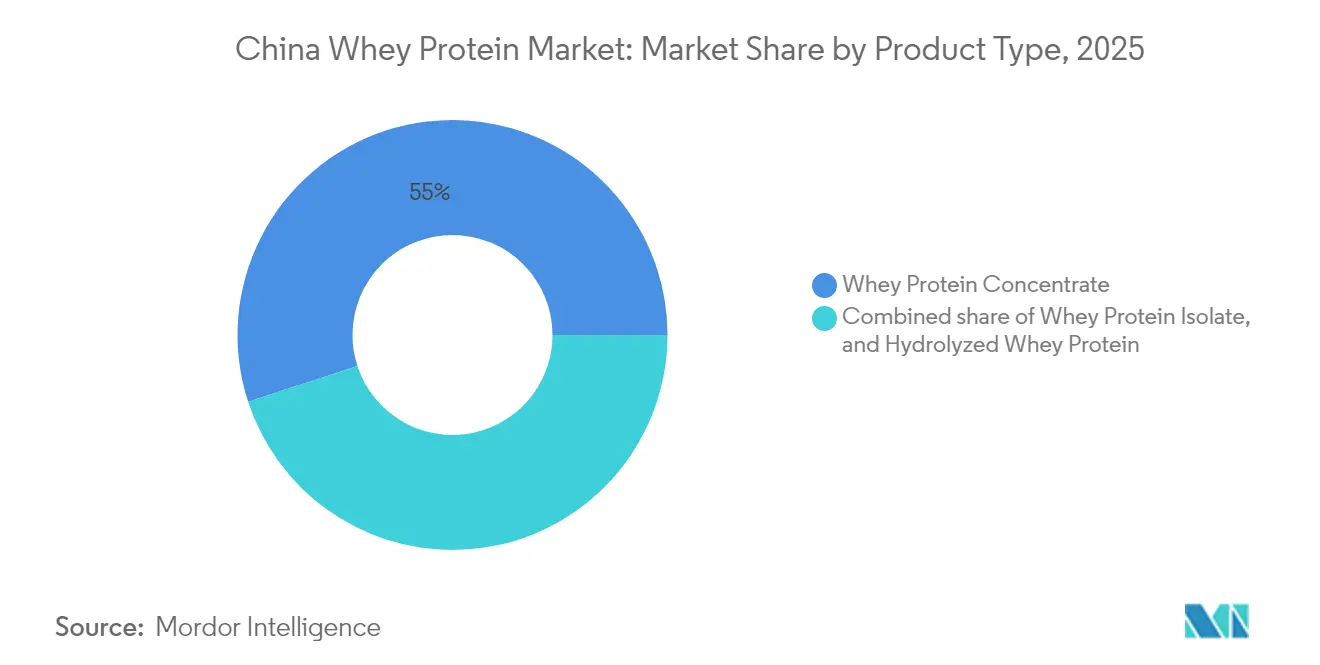
- By product type, whey protein concentrate accounted for 55.02% of China whey protein market share in 2025. and hydrolyzed whey protein is advancing at a 6.93% CAGR through 2031.
- By category, the mass segment held 60.55% of China whey protein market share in 2025, and the premium segment is expanding at a 6.54% CAGR up to 2031.
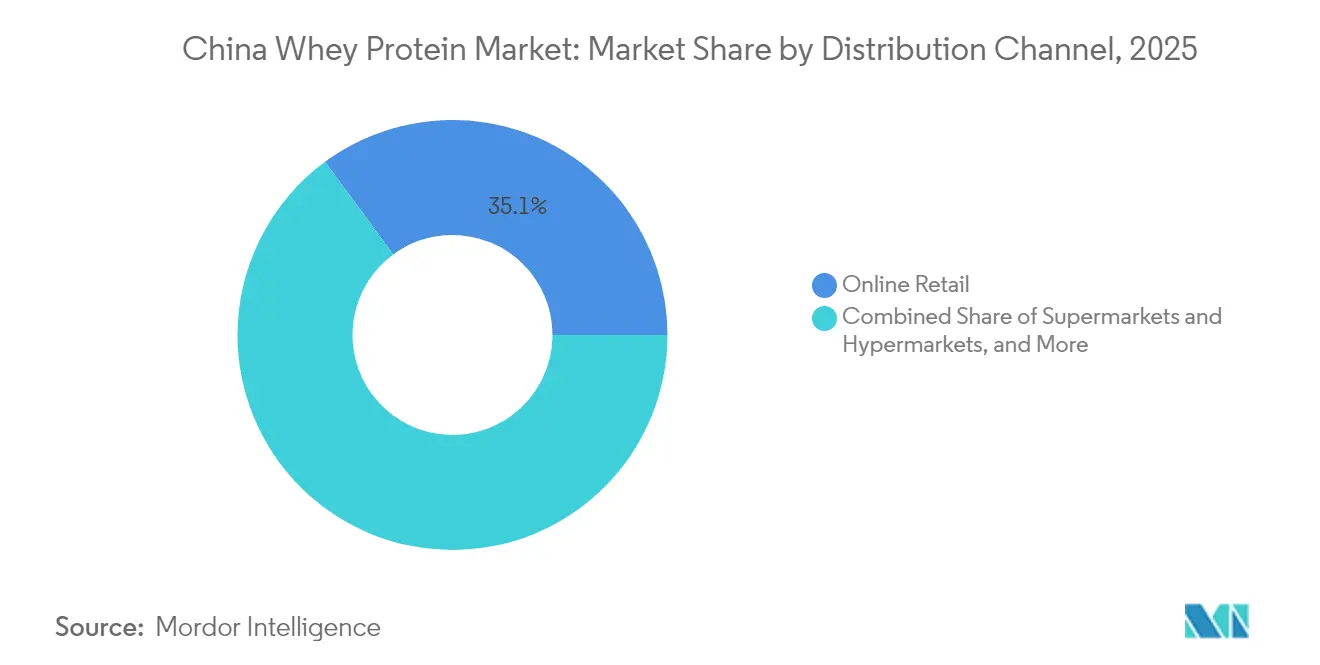
- By distribution channel, nline retail drove 35.10% of China whey protein market size in 2025, and health and wellness stores are projected to grow at a 7.42% CAGR through 2031.
Note: Market size and forecast figures in this report are generated using Mordor Intelligence’s proprietary estimation framework, updated with the latest available data and insights as of 2026.
Market Trends and Insights
Drivers Impact Analysis of China Whey Protein Market*
| Drivers | (~) % Impact on CAGR Forecast | Geographic Relevance | Impact Timeline |
|---|---|---|---|
| Expansion of fitness and gym culture | +1.2% | National, with concentration in tier-one and tier-two cities (Beijing, Shanghai, Guangzhou, Shenzhen) | Medium term (2-4 years) |
| Increasing prevalence of lifestyle diseases | +0.9% | National, higher burden in urban centers and aging provinces (Jiangsu, Zhejiang, Guangdong) | Long term (≥ 4 years) |
| Increasing adoption of whey in infant-nutrition formulas | +1.4% | National, with early gains in premium infant-formula markets (Shanghai, Beijing, Hangzhou) | Short term (≤ 2 years) |
| Government initiatives supporting dairy industry | +1.0% | National, targeted support in Inner Mongolia, Heilongjiang, Ningxia dairy belts | Medium term (2-4 years) |
| Shift toward high-protein, low-carb diets | +0.8% | Urban centers, tier-one and tier-two cities with higher disposable incomes | Medium term (2-4 years) |
| Technological advancements in processing | +0.7% | National, with R&D hubs in Jiangnan University, Northeast Agricultural University regions | Long term (≥ 4 years) |
| Source: Mordor Intelligence | |||
Expansion of Fitness and Gym Culture
China's fitness industry is experiencing rapid growth in memberships. By 2024, the country had over 140,000 gyms, including 28,683 fitness clubs and 43,232 fitness studios. In 2023, fitness club memberships reached 69.75 million[1]. The National Fitness Plan (2021-2025) targets 38.5% regular physical activity participation, boosting demand for sports nutrition products like whey protein powders and ready-to-drink protein beverages. Boutique fitness studios and cross-training centers in tier-one cities are driving this trend by offering nutritional counseling with memberships, increasing demand for premium whey isolates and hydrolysates. At Food Ingredients China 2024, Glanbia Nutritionals introduced high-protein products, including High Protein Acidified Milk (12 grams whey protein) and High Protein Electrolyte Water, catering to post-workout recovery and hydration. Government fitness initiatives and gym expansions are solidifying whey protein's role in the active lifestyle market, with younger consumers (18-35 years) driving e-commerce subscriptions for repeat purchases.
Increasing Prevalence of Lifestyle Diseases
By 2030, China is expected to have around 164 million diabetics aged 20 to 79, according to the International Diabetes Federation[2]. The Global Burden of Disease study ranks China among the top three countries globally for metabolic diseases, with type 2 diabetes closely tied to high body mass index. To tackle this, healthcare providers and policymakers are emphasizing dietary protein for better blood sugar control and weight management. Whey protein, valued for its ability to boost insulin and reduce appetite, is a key focus. The China National Nutrition Plan promotes combining plant and animal proteins to fight malnutrition and chronic diseases, driving regulatory support for whey-based functional foods. Hospitals and clinics are increasingly recommending whey protein isolates for diabetic and pre-diabetic patients, while pharmaceutical-grade whey hydrolysates are being used in Food for Special Medical Purposes (FSMP). With 14% of the population aged 65 and older in 2024, the demand for easily digestible protein sources is growing, positioning hydrolyzed whey as an essential part of clinical nutrition.
Increasing Adoption of Whey in Infant-Nutrition Formulas
The State Administration for Market Regulation has introduced stricter standards, GB 19644-2024 for milk powder and GB 25596-2025 for special medical infant formulas, emphasizing quality and traceability. Manufacturers must now use premium whey protein isolates and hydrolysates with verified origins. Hydrolyzed whey protein, processed to reduce allergens and improve digestion, is mandatory in hypoallergenic infant formulas, supported by clinical evidence of reduced gastric distress and better nitrogen retention. Yili Group's 2024 acquisition of Ausnutria Dairy highlights the growing importance of whey sourcing, as Ausnutria specializes in formulas for premature and lactose-intolerant infants. Fonterra, in partnership with Marathontime, launched a grass-fed whey protein series at the 2024 China International Import and Export Fair, reflecting the demand for certified, premium ingredients in pediatric nutrition. With stricter regulations and rising parental demand for transparency, formulas are shifting to higher whey-to-casein ratios, closely resembling human breast milk.
Government Initiatives Supporting Dairy Industry
In 2024, Beijing's Central Document No. 1 and a notice issued by seven ministries in September focused on stabilizing dairy production. The government set a target to achieve 45 million tonnes of raw milk output by 2025 and introduced subsidies to support the development of cheese and whey processing facilities. Provincial governments in Inner Mongolia, Heilongjiang, and Ningxia extended feed subsidies and insurance programs for dairy farmers. These initiatives aim to reduce fluctuations in raw milk supply and ensure a consistent whey supply for downstream processors. Additionally, the student milk program, which provides dairy products to primary and secondary schools, indirectly supports whey demand. By utilizing surplus milk powder, the program creates a stable market for fortified dairy products. In 2023, China's raw milk production reached 41.97 million tonnes, reflecting a 6.7% year-on-year growth. Fresh milk achieved a 100% quality pass rate, with an average protein content of 3.28 grams per 100 grams. These improvements in milk quality contribute to higher whey protein yields during cheese and casein production.
Restraints Impact Analysis of China Whey Protein Market*
| Restraint | (~) % Impact on CAGR Forecast | Geographic Relevance | Impact Timeline |
|---|---|---|---|
| Quality control and counterfeit issues | -0.6% | National, with higher incidence in tier-three and tier-four cities and e-commerce platforms | Short term (≤ 2 years) |
| Heavy reliance on imports | -0.8% | National, with supply-chain exposure in coastal ports (Shanghai, Ningbo, Shenzhen) | Medium term (2-4 years) |
| Competition from plant-based alternatives | -0.5% | Urban centers, tier-one cities with vegan and flexitarian populations | Medium term (2-4 years) |
| Supply chain vulnerabilities | -0.7% | National, with acute risk in cold-chain logistics and port congestion | Short term (≤ 2 years) |
| Source: Mordor Intelligence | |||
Quality Control and Counterfeit Issues
Counterfeit whey protein products are flooding e-commerce platforms and tier-three cities, shaking consumer trust and diminishing the pricing power of legitimate brands. These counterfeiters are taking advantage of the State Administration for Market Regulation's (SAMR) limited enforcement reach, especially in rural areas where testing facilities are few and far between. While SAMR has ramped up its post-market surveillance—randomly inspecting imported whey protein powders and penalizing mislabeling and adulteration—the vastness of cross-border e-commerce transactions makes traceability a daunting challenge. In response, genuine brands are turning to blockchain-based provenance systems and QR-code verifications to set their products apart. However, these protective measures come with added costs and complexities. The shadow of past scandals looms large: incidents like the 2008 melamine adulteration in dairy products have tainted the domestic perception of whey protein. As a result, many affluent consumers are gravitating towards imported brands that boast third-party certifications like NSF and Informed-Sport. This trend has effectively split the market: a premium segment that prioritizes and pays for verified quality, and a mass segment that remains susceptible to counterfeit threats.
Heavy Reliance on Imports
In 2025, China imported 652,295 tonnes of whey protein, an increase from 626,150 tonnes in 2020[3]. The United States supplied 42.1% of these imports, while the European Union contributed 30.3%, making the market vulnerable to geopolitical and logistical challenges. The average import price in early 2025 was USD 1,203 per tonne, reflecting the volatility of global dairy commodity prices. Factors such as droughts in New Zealand and rising energy costs in Europe significantly impacted prices for Chinese buyers. Additionally, the Ministry of Commerce launched an anti-subsidy investigation into EU dairy products in August 2024, creating tariff uncertainties that could raise landed costs and disrupt long-term supply agreements. Domestic whey production in China remains limited due to low cheese output, as cheese production is minimal compared to liquid milk and yogurt. This restricts the availability of whey as a by-product. To address this issue, processors are exploring partnerships with cheese manufacturers in regions like Inner Mongolia and Heilongjiang to establish whey extraction facilities near cheese production sites. However, progress is slow due to high capital requirements and a lack of technical expertise. This trade imbalance leaves Chinese buyers exposed to supply disruptions. For instance, in December 2024, port congestion delayed whey shipments, forcing manufacturers to rely on their inventory reserves to meet demand.
*Our forecasts treat driver/restraint impacts as directional, not additive. The impact forecasts reflect baseline growth, mix effects, and variable interactions.
China Whey Protein Market Segment Analysis
By Product Type:
Hydrolyzed Whey Gains Clinical TractionIn 2025, Whey Protein Concentrate (WPC) commanded a 55.02% market share, primarily due to its cost-effectiveness. WPC is favored in mass-market protein powders, bakery fortification, and beverages, where a moderate protein purity of 35-80% is adequate. Its processing, typically through ultrafiltration and not ion exchange, is less intensive, leading to competitive pricing. This makes WPC the go-to for domestic brands, especially those catering to price-sensitive consumers in tier-two and tier-three cities. Food manufacturers incorporate WPC into high-protein biscuits, noodles, and dairy drinks.
From 2026 to 2031, Hydrolyzed Whey Protein is projected to grow at a 6.93% CAGR, outpacing both WPC and WPI. Its enzymatic pre-digestion shortens peptide chains, hastening amino acid absorption. This rapid absorption is vital for infant formulas, especially for premature or lactose-intolerant infants. Hydrolyzed whey not only minimizes gastric distress and allergic reactions but also meets the GB 25596-2025 standards for special medical formulas. Sports nutrition brands are increasingly turning to hydrolyzed whey for post-workout recovery products, leveraging its swift leucine delivery to boost muscle protein synthesis.

By Category:
Premium Segment Captures Urban AffluenceIn 2025, the Mass category captured 60.55% of the market share, buoyed by its affordability and widespread presence in supermarkets, hypermarkets, and online platforms. Priced typically below CNY 200 per kilogram, mass-market whey protein powders cater to gym enthusiasts, students, and middle-income buyers. These consumers seek basic protein supplementation, often forgoing premium certifications or imported origins. Domestic brands lead this segment, capitalizing on localized flavors like red bean, taro, and matcha. They also run aggressive promotional campaigns during events like Singles' Day and the 618 shopping festival. Yet, this segment grapples with margin pressures from counterfeit products and intense price wars. Some manufacturers, in a bid to cut costs, compromise on raw material quality. This not only erodes consumer trust but also fuels a trend of premiumization among more affluent buyers.
The Premium segment is set to expand at a 6.54% CAGR from 2026 to 2031. This growth is driven by urban consumers who are increasingly willing to invest in grass-fed certifications, organic labels, and imported brands that boast third-party testing, such as NSF and Informed-Sport. A testament to this premium positioning strategy is Marathontime's collaboration with Fonterra. They unveiled a grass-fed whey protein series at the 7th China International Import and Export Fair in 2024, aiming at health-conscious consumers who equate New Zealand dairy with top-notch quality and traceability. Similarly, MuscleTech introduced a China-exclusive Longjing Milk Tea flavor whey protein in January 2024. Packaged for the Year of the Dragon, it underscores how premium brands can localize taste preferences while upholding the integrity of imported ingredients. In a strategic move, SAVAS, a renowned Japanese sports nutrition brand, rebranded itself as "Jin Bei Shi" in China in December 2024. They enhanced their whey protein isolate and hydrolyzed whey formulas, boosting protein content and fine-tuning nutritional profiles to cater to the needs of Chinese athletes.
By Distribution Channel:
Health Stores Outpace E-Commerce GrowthOnline Retail accounted for 35.10% of 2025 distribution share, leveraging Tmall, JD.com, and Pinduoduo's logistics networks and consumer-review ecosystems. E-commerce platforms enable direct-to-consumer models, subscription services, and flash sales that compress distribution costs and accelerate inventory turnover. Cross-border e-commerce facilitates imports of premium whey protein from the United States, New Zealand, and Europe, bypassing traditional importers and offering consumers access to international brands at competitive prices. However, the channel's growth is moderating as market penetration in tier-one cities approaches saturation, and logistics costs rise due to last-mile delivery challenges in rural areas. Counterfeit infiltration on third-party marketplaces remains a persistent issue, prompting platforms to implement stricter seller verification and product authentication protocols.
Health and Wellness Stores are forecast to expand at 7.42% CAGR from 2026 to 2031, the fastest among all distribution channels, driven by specialty chains' expansion into tier-two cities and their ability to offer personalized consultations, product sampling, and loyalty programs. These stores cater to affluent consumers seeking expert guidance on protein supplementation, with staff trained to recommend whey isolates for lactose intolerance, hydrolysates for clinical nutrition, and WPC for general fitness. The channel's growth is amplified by the proliferation of boutique fitness studios, which co-locate with or partner with health stores to create integrated wellness ecosystems. Glanbia Nutritionals' FIC 2024 showcase included concepts for health-store distribution, such as High Protein Immunity Melon Drink and FerriUp lactoferrin-enriched whey for women's iron balance, targeting the specialty retail segment.
Geography Analysis
In China, tier-one cities like Beijing, Shanghai, Guangzhou, and Shenzhen lead whey protein consumption due to higher incomes, advanced fitness infrastructure, and early adoption of Western nutrition trends. These cities act as testing grounds for premium imported brands, with Alibaba Health reporting that international brands dominated China's health supplement market in 2023. Coastal consumers prefer certified origins and third-party testing. Tier-two cities such as Chengdu, Hangzhou, Wuhan, and Nanjing are rapidly growing markets, driven by rising incomes and expanding boutique fitness chains. Fonterra's new Application Center in Wuhan highlights central China's increasing purchasing power and demand for localized products. These cities, with younger, educated populations, are receptive to sports nutrition and benefit from collaborations with institutions like Jiangnan University and Northeast Agricultural University on whey protein applications in functional foods.
China's northern dairy belt, including Inner Mongolia, Heilongjiang, and Ningxia, dominates raw milk production, supported by government subsidies for feed, insurance, and cheese processing (per the September 2024 seven-ministry notice). Inner Mongolia contributed significantly to the 2023 national total of 41.97 million tonnes of raw milk, with a 100% pass rate and 3.28 grams of protein per 100 grams, ensuring high-quality whey yields. Mengniu's Ningxia factory, recognized as a World Economic Forum "Lighthouse Factory" in October 2024, showcases advanced systems that optimize whey extraction and quality control, marking the region's shift to high-value ingredient manufacturing.
Coastal ports like Shanghai, Ningbo, and Shenzhen handle most whey imports, which rose 31.8% year-on-year from January to April 2025, mainly from the U.S. and EU. Cross-border e-commerce enables direct shipments to inland provinces, bypassing distributors and reducing costs. However, tier-three and tier-four cities remain underserved due to high delivery costs and low awareness of whey protein benefits. The Ministry of Commerce's August 2024 anti-subsidy investigation into EU dairy imports may lead to tariff changes, shifting sourcing to Oceania and North America. This could favor southern ports with strong trans-Pacific links. Yili Group's investments in New Zealand, Indonesia, and Thailand strengthen its supply chain, allowing it to source cost-effective whey while maintaining "imported" claims that appeal to Chinese consumers.
Regulatory Landscape
China regulates whey powder and whey protein powder primarily through national food safety standards and import controls overseen by the State Administration for Market Regulation (SAMR), the National Health Commission (NHC), and the General Administration of Customs (GACC). GB 11674-2010 sets technical definitions and quality indices for whey powder and whey protein powder (including minimum protein-content thresholds for whey protein powder categories), which influences how ingredients are specified for sports nutrition, functional foods, and dairy applications.
On market access, dairy ingredients are treated as high-risk categories for import supervision. Overseas manufacturers shipping dairy products into China must comply with GACC facility registration requirements under Decree 248 (with associated compliance expectations under Decree 249). In October 2023, whey protein was added to the Health Food Raw Materials Directory, enabling qualified health food products containing whey protein to use a filing pathway for permitted functional claims such as strengthening immunity. This shifts attention toward standardized documentation, labeling compliance, and traceability for both domestic brands and cross-border e-commerce sellers.
Value Chain Analysis
The China whey protein value chain starts with raw milk production concentrated in the northern dairy belt (notably Inner Mongolia, Heilongjiang, and Ningxia), followed by cheese and casein manufacturing that generates liquid whey as a by-product. Because domestic cheese output is comparatively limited, China stays import-dependent for whey and whey-derived ingredients, so upstream supply often begins overseas (United States, EU, and Oceania) and enters via coastal ports and bonded or cross-border e-commerce channels. From there, ingredients reach domestic blenders, sports nutrition brand owners, infant formula manufacturers, and Food for Special Medical Purposes (FSMP) producers.
Midstream processing includes concentration, isolation, and hydrolysis (ultrafiltration and enzymatic processing), alongside strict conformance to national standards. Examples in the report context include GB 11674-2010 for whey powder and whey protein powder, and GB 2760-2024 for food additive use in relevant dairy applications. Industry coordination and technical diffusion are supported by bodies such as the China Dairy Industry Association (CDIA) and its committees (including nutrition/functional dairy and dairy processing). Downstream commercialization relies on online platforms (Tmall, JD.com, Pinduoduo) and expanding specialty health and wellness stores, with recurring bottlenecks tied to import lead times, port and logistics disruption risk, and authenticity or quality-control challenges in fragmented online marketplaces.
Competitive Landscape
The China whey protein market is moderately consolidated, with a mix of global nutrition companies and strong domestic manufacturers shaping competitive dynamics across sports nutrition, functional foods, and clinical nutrition segments. Global players benefit from advanced processing technologies and consistent product quality, while local firms leverage cost-efficient production and proximity to fast-growing consumer clusters. Import regulations and quality standards also influence market structure, giving established suppliers an edge in navigating compliance and building long-term distributor partnerships. Key players in the market include Arla Foods Ingredients Group P/S, Lactalis Group, Royal FrieslandCampina N.V., Glanbia plc, and Fonterra Co-operative Group Limited.
Rising demand for high-protein beverages and healthy snacking is attracting smaller entrants, though most operate at niche levels due to limited scale. Digital retail channels, including cross-border e-commerce, further amplify the visibility of leading brands. As competition intensifies, differentiation is driven by product purity, flavor innovation, and targeted formulations for fitness, weight management, and healthy aging.
Smaller contenders are exploiting niche applications, such as Angel Yeast's July 2024 partnership with ffit8 to launch protein nougat bars, signaling ingredient suppliers' downstream integration into finished snack products. Mengniu's ownership of Bellamy's Organic and its partnership with Danone for high-end dairy products exemplify the use of international brand portfolios to capture premium segments, while its Ningxia factory's October 2024 certification as a World Economic Forum "Lighthouse Factory", the first in China's dairy industry, underscores the role of intelligent manufacturing and sustainability credentials in competitive differentiation.
China Whey Protein Industry Leaders
-
Glanbia plc
-
Fonterra Co-operative Group Limited
-
Arla Foods Ingredients Group P/S
-
Royal FrieslandCampina N.V.
-
Lactalis Group
- *Disclaimer: Major Players sorted in no particular order

China Whey Protein Market Companies Covered in this Report
- Fonterra Co?operative Group Limited
- Arla Foods Ingredients Group P/S?
- Glanbia plc
- Hilmar Cheese Company, Inc.
- Royal FrieslandCampina N.V.
- Agropur Inc.
- Lactalis Ingredients
- Saputo Inc.
- Wheyco GmbH
- Carbery Group Ltd.
- Leprino Foods Company
- Meggle Group
- Davisco Foods International
- Milk Specialties Global
- Volac International Ltd
- Inner Mongolia Yili Industrial Group Co., Ltd.
- China Mengniu Dairy Co. Ltd.
- Synutra International, Inc.
- Qinghai Wondersun Dairy Co., Ltd.
- Ausnutria Dairy Corporation Ltd.
Market Opportunities and Future Outlook
A key opportunity lies in substituting imported whey fractions with more domestic deep processing tied to China dairy hubs. By increasing cheese and dairy by-product utilization, processors can improve the availability of whey streams for fractionation into WPC, WPI, and hydrolysates. Evidence of this direction is tied to named investments: in May 2026, Inner Mongolia Yili Industrial Group held a groundbreaking ceremony at its Yili Modern Smart Health Valley (Hohhot) for two major projects, including a multifunctional nutrition products project and a milk primary deep processing project focused on high-value processing of dairy by-products, reinforcing the industrial pathway for more localized ingredient supply.
Product and channel opportunities are also linked to tighter quality and compliance expectations in infant nutrition and medical nutrition. The standards cited in the report context, GB 19644-2024 for milk powder and GB 25596-2025 for special medical infant formulas, encourage manufacturers to use higher-grade whey isolates and hydrolysates with verified origin and traceability. SAMR oversight and the Health Food Raw Materials Directory pathway (which includes whey protein) also raise the incentive to build compliant, evidence-backed formulations for functional beverages and nutrition supplements. On the demand side, expanding gym participation and specialized retail counseling supports more segmented positioning, with mass WPC for general fitness, WPI for lactose intolerance, and hydrolysates for clinical and hypoallergenic use, while strengthening authentication tools such as QR verification and provenance systems that help brands defend pricing along e-commerce-heavy routes to market.
Recent Industry Developments in China Whey Protein Market
- June 2026: Arla Foods announced the finalization of its merger with Germany-based DMK Group, expanding scale and broadening its dairy portfolio into areas such as specialized nutrition. The enlarged ingredients footprint strengthens sourcing flexibility for whey-based inputs used in infant and medical nutrition value chains that serve China.
- December 2025: FrieslandCampina acquired Wisconsin Whey Protein to strengthen its global protein position and add North American capability. The deal supports additional whey and protein-ingredient supply options for Asia-facing customers, including buyers in China managing import dependence and quality requirements.
- August 2024: Fonterra began a USD 75 million investment to expand its Studholme site in New Zealand as an advanced proteins hub for export markets. The capacity and capability upgrade supports higher-value whey protein ingredients that feed into Chinese sports nutrition, functional foods, and specialized nutrition applications.
China Whey Protein Market Report Scope and Research Methodology
Market Definition and Coverage
For this study, the China whey protein market covers the sales value of whey protein ingredients used in China, including concentrate, isolate, and hydrolysate, across common nutrition and food uses.
Scope exclusions: We exclude non-whey protein sources (such as plant proteins and casein proteins) and retail-ready finished products that bundle whey with other major ingredients.
Segments Covered in This Report
- By Product Type
- Whey Protein Concentrate
- Whey Protein Isolate
- Hydrolyzed Whey Protein
- By Category
- Mass
- Premium
- By Distribution Channel
- Online Retail
- Supermarkets and Hypermarkets
- Health and Wellness Stores
- Other Distribution Channels
Data Sources, Market Sizing, and Validation
Desk Research
Desk research was used to build the factual base around demand signals, trade flows, and pricing direction for whey proteins moving into China. We leaned on public and official sources such as China Customs import statistics, UN Comtrade trade series, FAO dairy balance data, and National Bureau of Statistics of China releases to understand how dairy processing and consumption trends were shifting.
To keep assumptions grounded, we also reviewed company annual reports and investor presentations, association updates from dairy and nutrition bodies, and reputable press coverage of capacity additions and policy changes affecting dairy modernization. In a few places, paid subscriptions for company financials and for shipment-level trade records were used to cross-check totals and reduce gaps in importer and supplier mapping. The sources listed here are illustrative only, and many other public documents were also reviewed to collect data, validate steps, and clarify open questions.
Primary Interviews and Surveys
Primary work was done through expert interviews and structured surveys with ingredient suppliers, importers and distributors, contract manufacturers, and buyers from sports nutrition and infant nutrition value chains. We used these discussions to confirm application splits, typical contract structures, and realistic price bands by grade, and then to sanity-check our assumptions on substitution with other proteins and local supply constraints across major consuming regions in China.
Distribution of primary research fieldwork respondents
| Company type | Respondent position |
|---|---|
| Top tier: 31% | CXOs: 19% |
| Mid tier: 48% | Functional/Unit leaders: 38% |
| Smaller Players: 21% | Managers: 43% |
Market-Sizing & Forecasting
Market sizing was built using a top-down approach where trade and consumption indicators were used to reconstruct the demand pool for whey proteins in China, followed by splits into the main ingredient forms and end-use baskets. To keep the totals realistic, the results were then checked with selective bottom-up approximations such as sampled importer volumes multiplied by typical realized prices, plus channel checks on how much material is routed to sports nutrition, infant formula, and functional food fortification.
Key inputs that shaped the model included import volume and value trends for whey-related categories, the mix shift between concentrate, isolate, and hydrolysate, average selling price movement by grade, downstream demand in infant formula and sports nutrition launches, and practical constraints linked to domestic dairy processing and capacity additions. Where company-level volume was not available, gaps were handled by applying conservative ranges from interview-based share bands and then validating against the overall trade total. Forecasts were built using scenario analysis, because price cycles and demand drivers (like health and fitness participation and infant nutrition reformulation) do not move in a straight line, and then the scenario path was aligned to expert consensus from primary discussions.
Data Validation & Update Cycle
Validation was done through triangulation across trade totals, implied consumption, and price bands, and then through variance checks against historical patterns that do not usually break without a clear reason. If an input moved sharply, such as a sudden jump in import value without a matching volume change, we rechecked the currency timing, unit prices, and the underlying classification assumptions before sign-off.
Before publishing, the full model is reviewed in multiple steps by another analyst so obvious inconsistencies are caught early and corrected. The report is refreshed annually, and interim updates are made when material events occur, such as policy changes affecting dairy imports or major capacity expansions. Right before delivery, a final pass is completed so clients receive the most current view possible.
Mordor Intelligence's China Whey Protein Market Size Measured Against Other Published Estimates
Published market sizes for China whey protein often do not match, even when the topic name looks identical, because the product boundary and the value point in the chain can shift from one publisher to another. Differences also show up when one estimate leans more on trade value, and another leans more on end-use revenue or uses a different price basis.
Some external estimates tend to fold in finished consumer supplement sales, premixes, or broader nutrition categories that contain whey as one ingredient. In Mordor Intelligence, the value is limited to whey protein ingredients (concentrate, isolate, and hydrolysate) sold into sports and performance nutrition, infant formula, and functional or fortified foods, which keeps pricing and volume checks traceable to trade and application signals.
Benchmark comparison
| Source | Market Size | Gaps in Research Methodology |
|---|---|---|
| Mordor Intelligence | USD 1.03 B (2025) | |
| Global Consultancy A | USD 0.31 B (2024) | Uses a smaller stated base that appears closer to a databook style revenue view with a narrower captured value pool and a different base year, which can miss ingredient volumes routed through B2B channels at contract pricing. |
| Regional Consultancy B | USD 1.20 B (2024) | Appears to apply a broader end-market treatment that can blend ingredient demand with downstream category revenue and uses different timing for price assumptions, which can lift totals in periods of higher supplement pricing. |
The spread in the table mostly comes down to what is being counted and at what price point, and then how the year and currency timing are treated. By tying the model to observable import signals, realistic grade-level pricing, and application-level allocation checks, our estimate stays easier to repeat and audit as conditions change.
Key Questions Answered in the Report
How big is the China whey protein market in 2026?
The market reached USD 1.09 billion in 2026 and is on course to hit USD 1.44 billion by 2031 at a 5.8% CAGR.
Which product type is growing fastest?
Hydrolyzed whey protein leads with a 6.93% forecast CAGR thanks to its rapid absorption and regulatory acceptance in infant and medical nutrition.
What share does online retail hold in whey protein sales?
Online platforms accounted for 35.10% of 2025 sales, leveraging cross-border e-commerce and direct-to-consumer subscriptions.
What drives premiumization in urban areas?
Rising disposable income, demand for grass-fed or organic certification, and concerns over counterfeit goods steer consumers toward higher-priced imported or certified products.