
China Soil Monitoring Market Size and Share
Market Overview
| Study Period | 2021 - 2031 |
|---|---|
| Forecast Data Period | 2026 - 2031 |
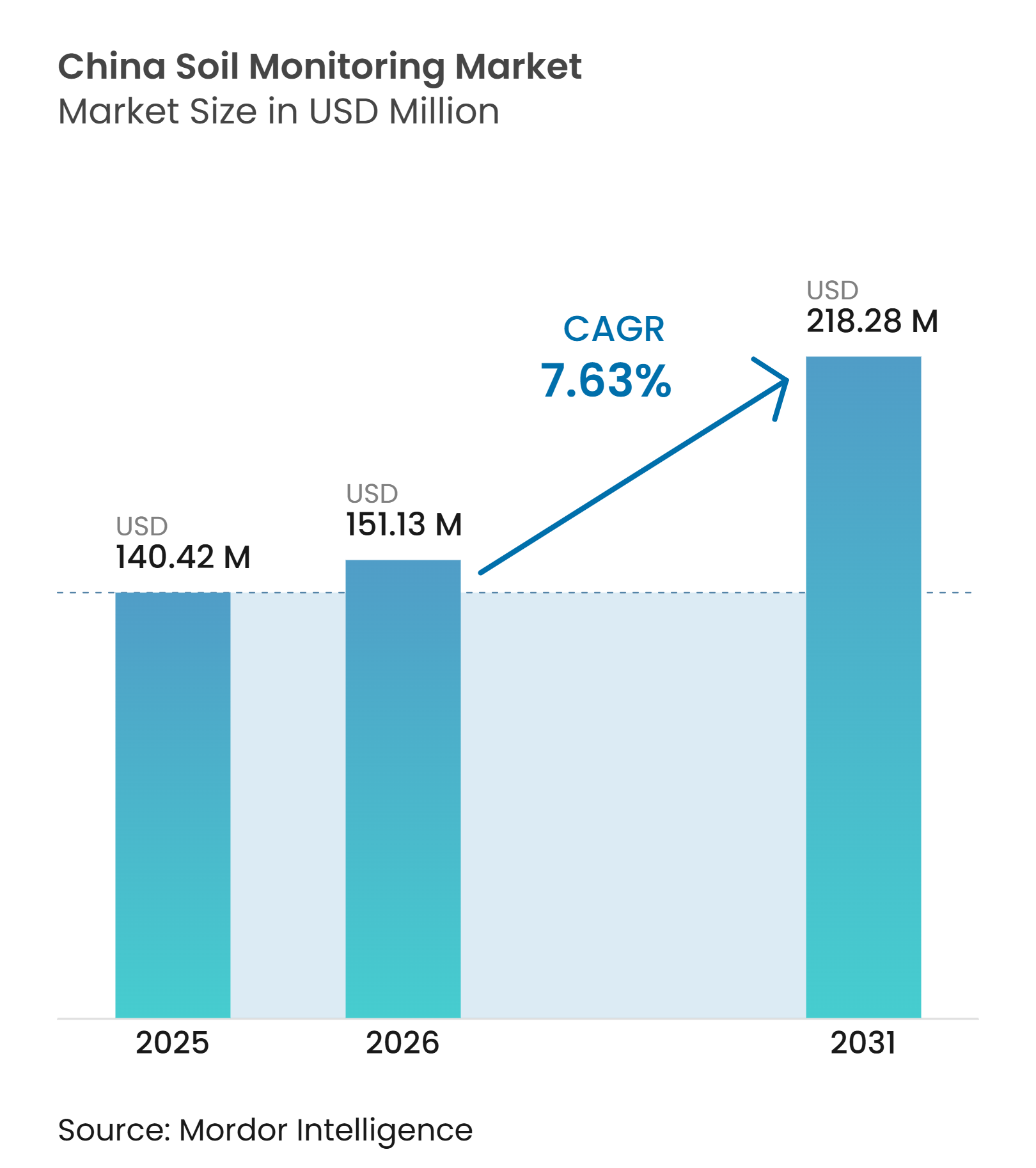
| Base Year Market Size (2025) | USD 140.42 Million |
| Market Size (2026) | USD 151.13 Million |
| Market Size (2031) | USD 218.28 Million |
| Growth Rate (2026 - 2031) | 7.63 % |
| Market Concentration | Medium |
Major Players *Disclaimer: Major Players sorted in no particular order Image © Mordor Intelligence. Reuse requires attribution under CC BY 4.0. | |
China Soil Monitoring Market Analysis by Mordor Intelligence
The China Soil Monitoring Market size was valued at USD 140.42 million in 2025 and is estimated to grow from USD 151.13 million in 2026 to reach USD 218.28 million by 2031, at a CAGR of 7.63% during the forecast period (2026-2031). China’s soil monitoring market is supported by policy priorities that link grain security, cultivated land quality, and agricultural digitalization. Policy reporting and the 2025 No. 1 Central Document reinforce the maintenance of stable grain acreage, improved yields, and soil protection, while China’s medium-term goal is to raise grain production capacity to about 725 million tonnes by 2030[1]. The National Smart Agriculture Action Plan 2024-2028 directs the optimization of the 4-level cultivated-land quality monitoring network and targets an agricultural production informatization rate above 30% by the end of 2026. This direction encourages providers to combine sensing equipment with data services, remote diagnostics, and reporting functions. Adoption remains uneven because larger operators have more capital, technical staff, and access to provincial procurement programs than smallholders.
Key Report Takeaways
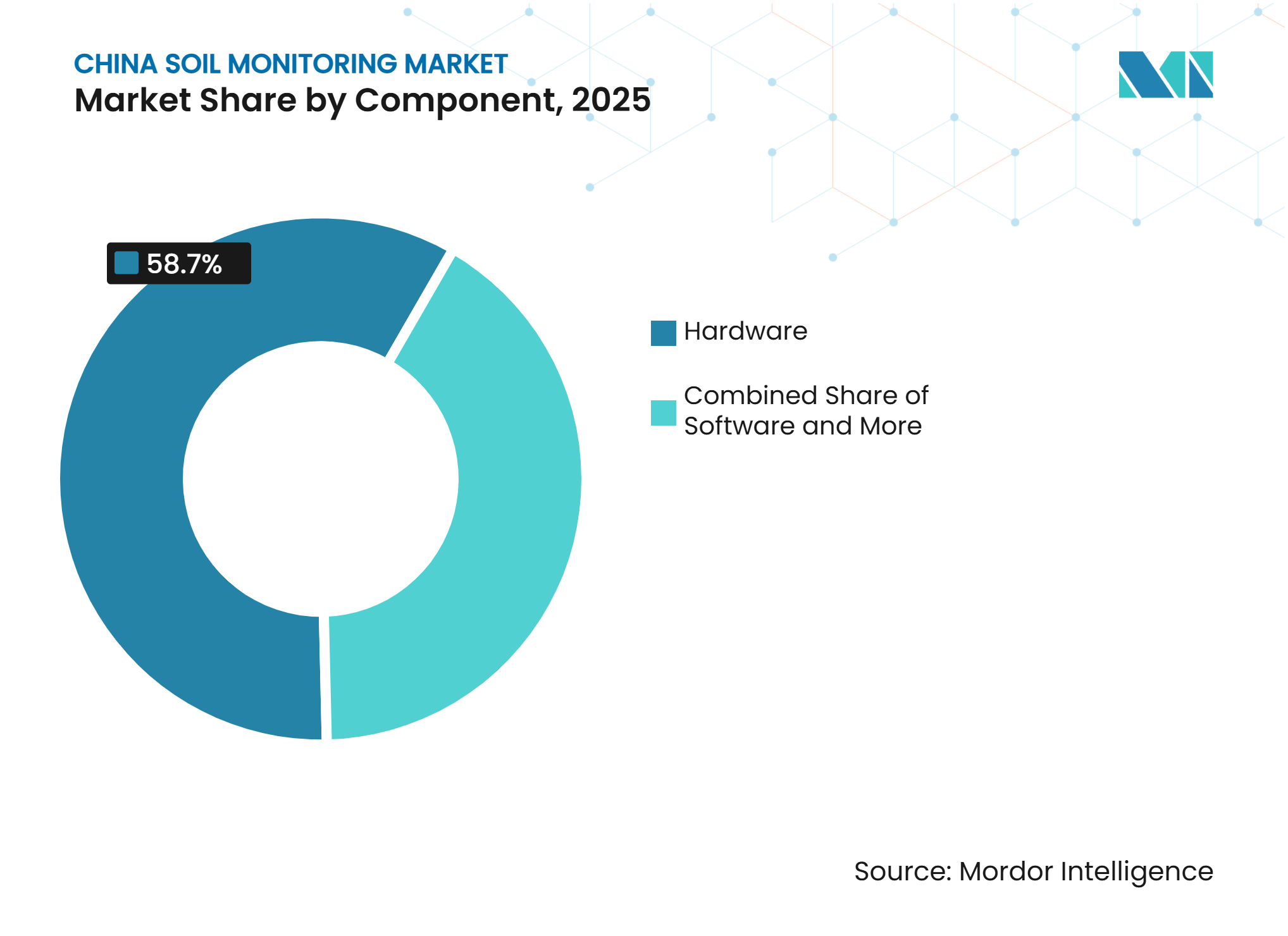
- By component, Hardware was the largest segment with 58.7% of China soil monitoring market share in 2025, while Services is forecast to grow at a 16.3% CAGR through 2031.
- By product type, In-situ Sensors were the largest segment with 46.3% of the China soil monitoring market size in 2025, while Remote-Sensing Platforms are the fastest-growing segment, forecast to expand at an 18.1% CAGR through 2031.
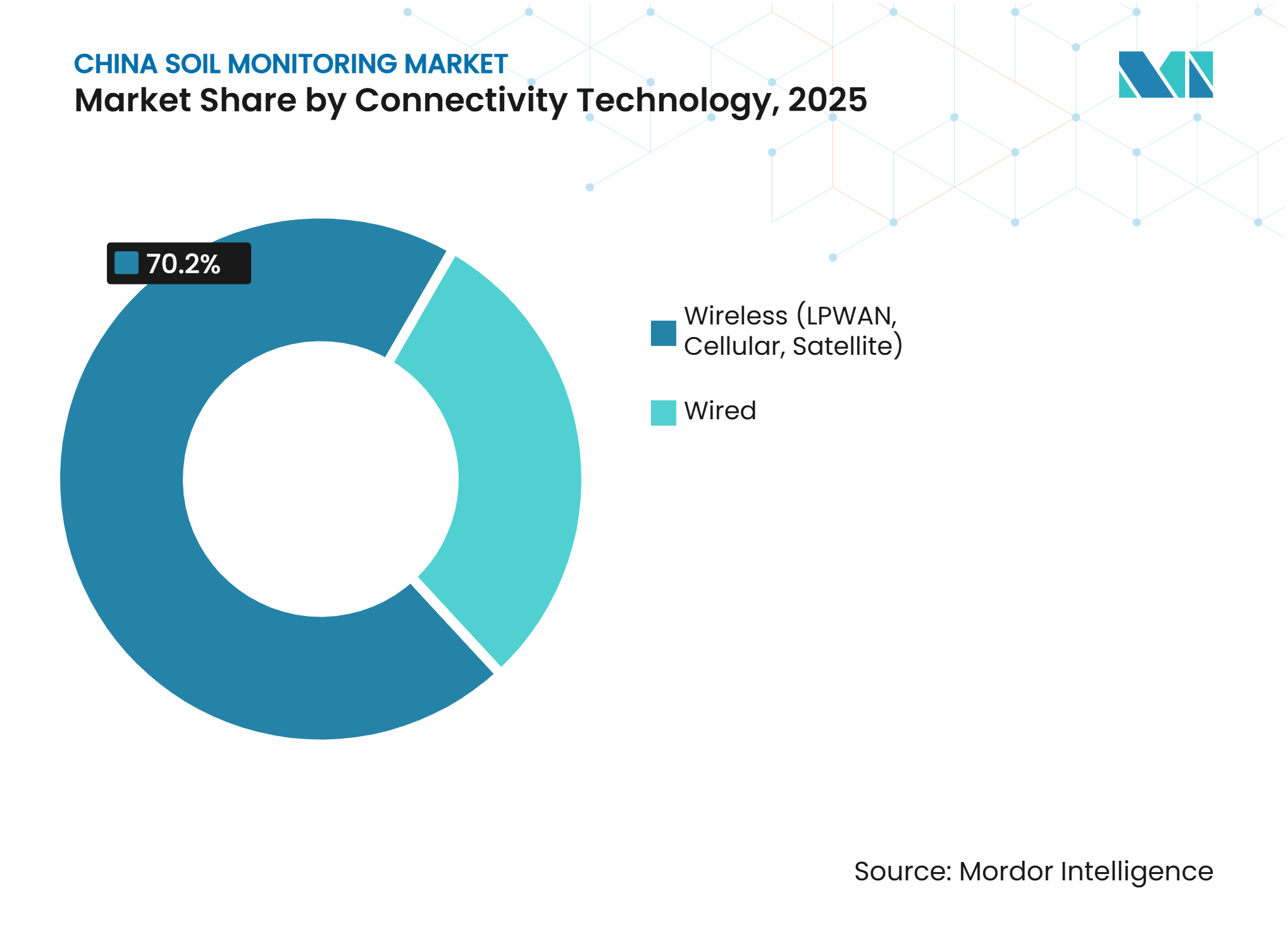
- By connectivity technology, Wireless Solutions were the largest segment with 70.2% revenue share in 2025. Wired is the fastest-growing segment with an 9.8% CAGR through 2031.
- By application, Open Field was the largest segment with 63.8% revenue share in 2025, while Protected Cultivation is the fastest-growing segment, forecast to expand with a 14.2% CAGR through 2031.
- By end user, Large Commercial Farms were the largest segment with a 42.7% revenue share in 2025, while Research Institutes and Universities are the fastest-growing segment, forecast to expand at a 14.6% CAGR through 2031.
Note: Market size and forecast figures in this report are generated using Mordor Intelligence’s proprietary estimation framework, updated with the latest available data and insights as of January 2026.
Market Trends and Insights
Drivers Impact Analysis of China Soil Monitoring Market*
| Driver | (~) % Impact on CAGR Forecast | Geographic Relevance | Impact Timeline |
|---|---|---|---|
| Precision Agriculture Adoption | +1.8% | National, with early gains in Northeast China, the Yangtze River Delta, and Zhejiang pilot zones | Medium term (2-4 years) |
| Water Conservation and Smart Irrigation Programs | +1.2% | National, with high relevance in Northwest China, the North China Plain, and the Yellow River Basin | Short term (≤ 2 years) |
| Soil Degradation and Food Security Priorities | +1.0% | Northeast Black Soil Belt, Loess Plateau, and Southwest Red Soil region | Long term (≥ 4 years) |
| Internet of Things, Artificial Intelligence, and Remote Monitoring Integration | +1.4% | National, with initial concentration in Zhejiang, Guangdong, and Jiangsu | Medium term (2-4 years) |
| Provincial Digital Agriculture Procurement | +0.9% | Provincial programs in Shandong, Heilongjiang, Jiangsu, and Xinjiang | Short term (≤ 2 years) |
| Demand for Carbon, Salinity, and Soil-Health Baselines | +0.7% | National, with concentration in carbon-sequestration priority regions and coastal saline areas | Long term (≥ 4 years) |
| Source: Mordor Intelligence | |||
Precision Agriculture Adoption
The Ministry of Agriculture and Rural Affairs of the People’s Republic of China issued its Guiding Opinion on Vigorously Developing Smart Agriculture and the National Smart Agriculture Action Plan 2024-2028 in 2024. The plan set a target of more than 30% informatization of agricultural production by the end of 2026[2]. This target changes soil monitoring purchases from optional pilot spending to defined public procurement needs. At farms operated by Beidahuang Group in Heilongjiang, more than 500 Internet of Things devices, including soil monitoring devices, covered 12,667 hectares and sent real-time information to a central control center. The China soil monitoring market, therefore, gains commercial demand beyond research buyers. Early progress can also widen the difference between well-funded eastern provinces and provinces with lower budgets.
Water Conservation and Smart Irrigation Programs
China’s Water Conservation Regulation entered into force on May 1, 2024. It requires water-scarce and groundwater-overdraft regions to prioritize efficient irrigation methods, including sprinkler irrigation, micro-irrigation, and pipeline conveyance. China is expanding high-efficiency, water-saving irrigation and improving the efficiency of farmland irrigation. The national effective utilization coefficient of farmland irrigation water reached 0.576 in 2023 and increased to 0.58 by the end of 2025, with a policy objective of 0.60 by 2030 [3]. Real-time soil moisture readings help users schedule irrigation against local field conditions. Provincial support for drip irrigation can consequently increase interest in in-situ sensors as part of an irrigation installation.
Soil Degradation and Food Security Priorities
China’s 2024 monitoring results reported a soil and water loss area of 2,601,900 square kilometers. This area was 25,700 square kilometers lower than in 2023, and the soil conservation rate reached 72.83%. Productivity risks remain acute in the Northeast Black Soil Belt, the Loess Plateau, and the mountainous Southwest Red Soil areas. A scientific study found that water erosion affected the productivity of 90.5% of typical Chinese soil series and identified an average annual rate of productivity variation of 10%. China’s second national soil census collected 3.11 million samples by November 2024. The completed census underscores the need for continuous measurements to track soil conditions after baseline sampling.
Internet of Things, Artificial Intelligence, and Remote Monitoring Integration
The Chinese soil monitoring market is moving toward systems that link field equipment to cloud platforms and farm management tools. Multi-parameter nodes can capture soil moisture, temperature, electrical conductivity, pH, and nutrient indicators through a common data flow. Zhejiang Top Cloud-agri Technology Co., Ltd. described a platform in its 2025 annual report that integrates soil moisture, pest monitoring, and intelligent irrigation into a single cloud architecture. This approach gives domestic equipment suppliers an opportunity to compete through software and data interpretation rather than equipment alone. Local processing of readings can also reduce the effects of delayed data transmission in remote areas. Providers that offer practical recommendations alongside data are better placed to address the needs of commercial farms.
Restraints Impact Analysis of China Soil Monitoring Market*
| Restraint | (~) % Impact on CAGR Forecast | Geographic Relevance | Impact Timeline |
|---|---|---|---|
| High Upfront Deployment and Maintenance Costs | -1.5% | National, with a pronounced effect in Central and Southwest China | Short term (≤ 2 years) |
| Limited Technical Skills Among Smallholder Operators | -0.8% | National, especially Sichuan, Hunan, and Guizhou | Long term (≥ 4 years) |
| Fragmented Data Standards Across Agricultural Platforms | -0.6% | National, with cross-provincial integration barriers | Medium term (2-4 years) |
| Calibration Drift in Saline, Alkaline, and Heterogeneous Soils | -0.5% | Northwest China, Inner Mongolia, and coastal reclamation areas | Medium term (2-4 years) |
| Source: Mordor Intelligence | |||
High Upfront Deployment and Maintenance Costs
A complete networked installation can include multi-depth sensors, a wireless gateway, solar power equipment, a cloud subscription, and maintenance services. This cost structure is difficult for smallholders and lower-income cooperatives to fund from farm operating margins. Service models that share infrastructure across many farms can reduce the capital requirement. These models remain more visible in Zhejiang and Jiangsu than in many other provinces. Zhejiang Top Cloud-agri Technology Co., Ltd.’s Internet of Things business is primarily deployed in comprehensive demonstration bases and other integrated agricultural applications, while its customer base is dominated by provincial, municipal, and county-level government departments and agricultural public institutions. Flooding, frost, and farm machinery can also require recurring recalibration and equipment replacement after installation.
Limited Technical Skills Among Smallholder Operators
China’s agricultural sector remains dominated by smallholder farms, with the average cultivated land area per household below 0.67 hectares, limiting many smallholders' capacity to use complex monitoring outputs. Users must translate readings from multi-parameter systems into irrigation, fertilization, and soil-management decisions. Low utilization can reduce the demonstrated return on an installed system. This can reduce service organizations' willingness to invest in farmer training. An aging rural labor base makes it harder to sustain maintenance and calibration skills at the field level. The National Smart Agriculture Action Plan recognizes the need for social service organizations to provide Internet of Things-enabled farm advisory services to smallholders.
*Our forecasts treat driver/restraint impacts as directional, not additive. The impact forecasts reflect baseline growth, mix effects, and variable interactions.
China Soil Monitoring Market Segment Analysis
By Component:
Hardware Leads Current Revenue While Services Grow FastestHardware held the largest 58.7% China soil monitoring market share in 2025. Sensor nodes, data loggers, power-management modules, and protective enclosures account for much of the initial spending at farm level. Public procurement programs commonly finance physical equipment before analytics subscriptions. Hardware also provides the installed base needed for recurring services. Software supports dashboards, agronomic recommendations, and spatial visualization. Domestic suppliers increasingly bundle these tools with equipment to distinguish similar sensor products.
Services are the fastest component category, with the China soil monitoring market size for Services projected to grow at a 16.3% CAGR from 2026 to 2031. This category includes installation, calibration, maintenance, remote diagnostics, and data interpretation. As networks move past initial deployment, users need dependable readings and operating support. Government contracts increasingly include requirements for data quality and uptime. These specifications favor providers that can deliver equipment and continuing support together. The national soil census also creates a long-term need for periodic calibration and recertification of census-linked monitoring nodes.



By Product Type:
In-situ Sensors Lead While Remote-Sensing Platforms Expand FastestIn-situ Sensors were the largest product type, with a 46.3% share of the China soil monitoring market in 2025. They provide continuous measurements of soil moisture, temperature, electrical conductivity, and pH at a specific location. These readings are essential for validating broader soil assessments. The Water Conservation Regulation supports demand for soil moisture information in smart irrigation systems. Portable Probes and Test Kits meet a different need for field technicians, census sampling teams, and cooperative agronomists. They support spot measurements without a permanent connectivity installation.
Remote-Sensing Platforms are the fastest product category, with a forecast CAGR of 18.1% from 2026 to 2031. Satellite and drone systems can cover large farm areas through multispectral and hyperspectral imagery. They provide soil moisture and organic matter indicators at a lower cost per unit coverage than a dense field network alone. Hunan Rika Electronic Tech Co., Ltd. released the RK500-05 Soil Water Potential Sensor in December 2025 with Bluetooth and Wi-Fi connectivity. This reflects the continued combination of portable sensing and wireless data access. Large state farms can use in-situ stations to validate satellite readings across a local area. The China soil monitoring industry, therefore, needs both field reference points and wide-area observation tools.
By Connectivity Technology:
Wireless Solutions Are the Largest Connectivity ChoiceWireless Solutions was the largest connectivity category, accounting for 70.2% of revenue in 2025. Low-Power Wide-Area Network, or LPWAN, standards and Narrowband Internet of Things, or NB-IoT, standards are common in open-field installations. Their low power use and long battery life suit dispersed agricultural sites. They can also reduce the need for trenching and simplify retrofits on cultivated land. Cellular fourth- and fifth-generation connections support data-intensive applications, including gateway transmissions and controlled growing systems. Satellite connectivity can support remote sites in Northwest China with limited cellular or LPWAN coverage.
Wired systems remain relevant in greenhouses and vertical farms where stable infrastructure is already available. They can provide dependable connections and a lower risk of connection failures in a controlled setting. The China soil monitoring market will continue to use wired systems for high-precision research and high-uptime applications. Wireless systems are better suited to broad open-field coverage and distributed sensor arrays. Wired are the fastest segment with an 9.8% CAGR through 2031 for the fastest connectivity category. Rural network expansion can reduce the remaining connectivity advantage of wired systems over time. Suppliers must therefore match the network design to the type of cultivation and the reliability requirements of the user.

By Application:
Open Field Is the Largest Application While Protected Cultivation Grows FastestOpen Field was the largest application, holding 63.8% revenue share in 2025. China’s extensive cultivated land and grain-security priorities create a broad need for field monitoring. Government programs focus heavily on grain and staple-crop areas. This focus channels demand toward measurements of soil moisture, temperature, and nutrients in large cultivated areas. Open-field deployments also serve irrigation planning and land-quality monitoring. Forestry is another application supported by carbon sink policies and the need to document soil moisture and organic carbon conditions.
Protected Cultivation is the fastest application, with a forecast CAGR of 14.2% through 2031. Greenhouse and indoor growing operators can justify more intensive monitoring because environmental conditions can be actively controlled. A CropX, Inc. case study published in 2025 reported a 22% yield increase from data-driven irrigation management. The China soil monitoring industry benefits from users being able to connect information directly to fertilization and irrigation decisions. Protected systems also have a higher value per cultivated area than open fields. This gives operators a clearer basis for spending on soil and environment monitoring. Limited arable land strengthens the relevance of managed production systems that seek higher output per square meter.
By End User:
Large Commercial Farms Are the Largest Users While Research Institutes and Universities Grow FastestLarge Commercial Farms were the largest end-user group with a 42.7% share in 2025. These operators have capital budgets, agronomic staff, and links to government pilot programs. State-owned farms in Northeast China are early users because they can host large trials and produce measurable operating data. The scale of their land also supports networked sensor systems and remote-sensing platforms. Smallholder and Cooperative Farms are a high-volume group with lower average order values. Equipment-sharing arrangements and service subscriptions are more relevant to these buyers than direct ownership of a full system.
Research Institutes and Universities are the fastest end-user group, with a 14.6% CAGR forecast through 2031. The completion of the national soil census increases the need for continuous monitoring sites to support calibration work. Universities and research institutions are also expanding smart agriculture research activities. Their procurement needs can include multi-parameter sensors and compatibility with application programming interfaces, or APIs. Campbell Scientific, Inc. supplies data loggers, soil sensors, and environmental monitoring equipment to research institutions and monitoring networks through its Chinese operations. Open system requirements can favor suppliers with adaptable data-loggers and documented integration capabilities. The China soil monitoring market can therefore gain value from research use even where commercial farm adoption is slower.
Geography Analysis
Northeast China had the highest soil monitoring penetration among China’s macro-regions. The black soil belt across Heilongjiang, Jilin, and Liaoning is a principal grain-production area and a focus of soil conservation efforts. Scientific research identified the Northeast Black Soil Area as one of China’s areas with the highest future erosion risk. Beidahuang Group operated more than 500 Internet of Things devices over 12,667 hectares in Heilongjiang. Large Commercial Farms are a major customer group in this region. Remote-Sensing Platforms are well-suited to large, contiguous cultivated areas because they extend coverage beyond individual in situ stations.
East China is an early technology and policy center for the China soil monitoring market. Zhejiang is designated as a national leading zone for smart agriculture and has targets of 1,000 digital agricultural factories and 100 future farms by 2027. Zhejiang, Jiangsu, and Shandong benefit from more developed public infrastructure and agricultural service organizations. Zhejiang Top Cloud-agri Technology Co., Ltd. offers systems ranging from standalone sensors to integrated sky-ground monitoring platforms with cloud analytics. North China has the largest aggregate cultivated area across the Huang-Huai-Hai Plain. Its groundwater constraints make soil moisture information important for irrigation efficiency and water management.
Northwest China offers the strongest structural growth opportunity but faces significant technical barriers. Saline and alkaline soil conditions in Xinjiang, Gansu, and Ningxia can cause calibration drift in standard soil moisture sensors. Zhejiang Top Cloud-agri Technology Co., Ltd. reported measurement retention at electrical conductivity levels up to 8 decisiemens per meter in saline farmland trials in Inner Mongolia. South China and Southwest China are developing areas where high-value protected cultivation and carbon monitoring programs support demand. Guangdong, Guangxi, Sichuan, and Yunnan have diverse applications in fruit trees, tea, and vegetables. The China soil monitoring market needs locally validated systems to serve these distinct soil and cultivation conditions.
Competitive Landscape
Market Concentration
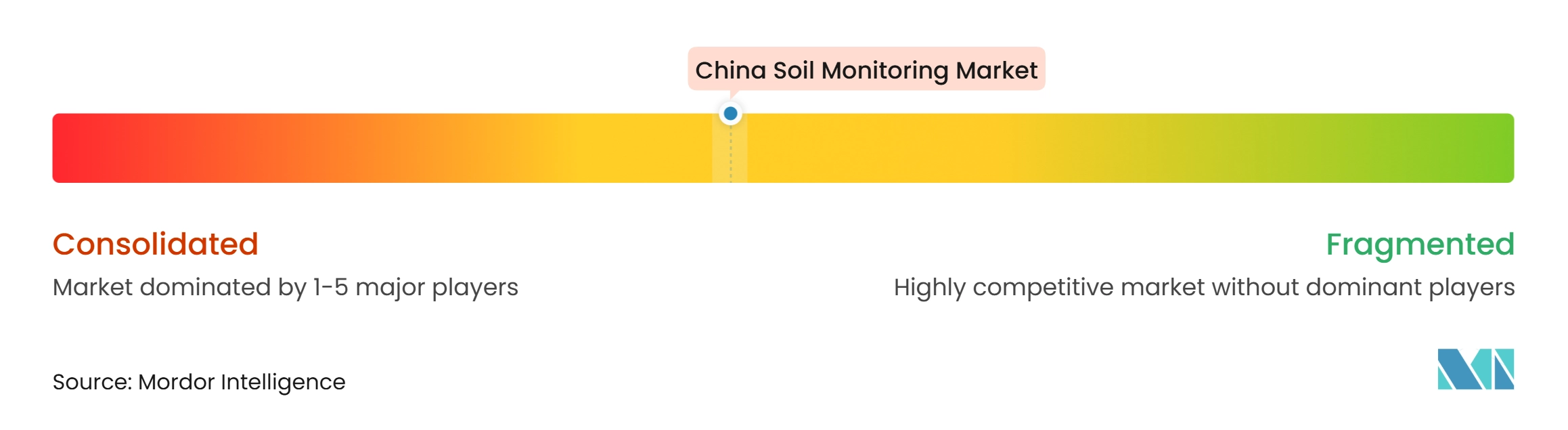
The China soil monitoring market has moderate fragmentation at the equipment level. Zhejiang Top Cloud-agri Technology Co., Ltd., Seeed Technology Co., Ltd. (Seeed Studio), Hunan Rika Electronic Tech Co., Ltd., Xiamen Zonewu Technology Co., Ltd., and Campbell Group, Inc. compete on product specifications, pricing, and provincial relationships. Hardware differentiation is narrowing as common components become more widely available. This shifts competition toward platform software and integrated Internet of Things solutions. Zhejiang Top Cloud-agri Technology Co., Ltd. described a strategy that spans frequency-domain reflectometry, or FDR, soil water sensors, multi-depth probes, cloud platforms, and artificial intelligence-supported advisory functions. Suzhou Sinuso Technology Co., Ltd. and Shandong Laiyin Photoelectric Technology Co., Ltd. focus on more specialized sensor and optoelectronic detection niches.
Campbell Scientific, Inc. has a position in premium research, meteorological, and high-standard farmland applications where data traceability and instrument performance are important. Its Chinese subsidiary supplies data loggers, soil sensors, and environmental monitoring systems. CropX, Inc. offers a digital agronomy platform linked to in-situ hardware. In September 2024, CropX, Inc. acquired EnGeniousAg, a precision nitrogen-sensing company, to expand its sensing capabilities. In March 2025, CropX, Inc. launched Strato 1, an in-field weather station that connects hyperlocal weather data with its farm-management platform. These actions show that premium providers are extending their data coverage beyond soil measurements alone.
Hunan Rika Electronic Tech Co., Ltd. released the RK500-05 Soil Water Potential Sensor with Bluetooth and Wi-Fi connectivity in December 2025. Zhejiang Top Cloud-agri Technology Co., Ltd. also expanded the artificial intelligence capabilities of its digital farmland management platform in 2025. Irrometer Company, Inc. and Shenzhen Empaer Technology Co., Ltd. serve distinct niches in tensiometry and environmental sensing. The China soil monitoring market favors suppliers that can work with provincial implementation agencies and offer Chinese-language support. Data governance and compatibility requirements are likely to become more important in public procurement.
China Soil Monitoring Industry Leaders
-
Zhejiang Top Cloud-agri Technology Co., Ltd.
-
Seeed Technology Co., Ltd. (Seeed Studio)
-
Hunan Rika Electronic Tech Co., Ltd.
-
Campbell Group, Inc.
-
Xiamen Zonewu Technology Co., Ltd.
- *Disclaimer: Major Players sorted in no particular order
China Soil Monitoring Market Companies Covered in this Report
- Zhejiang Top Cloud-agri Technology Co., Ltd.
- Shenzhen Empaer Technology Co., Ltd.
- Hunan Rika Electronic Tech Co., Ltd.
- Seeed Technology Co., Ltd. (Seeed Studio)
- Hunan MAC Sensor Co., Ltd.
- Xiamen Zonewu Technology Co., Ltd.
- Shandong Fengtu IoT Technology Co., Ltd.
- Suzhou Sinuso Technology Co., Ltd.
- Shandong Laiyin Photoelectric Technology Co., Ltd.
- Shenzhen Honde Technology Co., Ltd.
- Campbell Group, Inc.
- CropX, Inc.
- The Toro Company
- Irrometer Company, Inc.
- Transcat, Inc.
Recent Industry Developments in China Soil Monitoring Market
- December 2025: Hunan Rika Electronic Tech Co., Ltd. released the RK500-05 Soil Water Potential Sensor, featuring Bluetooth and Wi-Fi connectivity for real-time soil moisture information through a smartphone application. The product targets smaller commercial operators seeking wireless monitoring without a full investment in an LPWAN infrastructure.
- March 2025: CropX, Inc. launched Strato 1, a professional in-field weather station designed to integrate real-time hyperlocal weather data with its agronomic farm-management system. The launch extended CropX, Inc.’s hardware portfolio from soil sensing to above-canopy environmental monitoring, enabling a fuller data-from-soil-to-sky architecture for growers globally, including its Chinese users.
- September 2024: CropX, Inc. acquired EnGeniousAg, a precision nitrogen sensing startup, in its sixth acquisition. EnGeniousAg’s patented technology enables near-instantaneous in-situ measurement of nitrogen in plant tissue, drainage and irrigation water, and soil, significantly expanding CropX, Inc.’s agronomic sensing portfolio.
China Soil Monitoring Market Report Scope
Soil monitoring is the regular measurement of soil conditions such as moisture, pH, nutrients, temperature, and salinity to assess soil health. It helps farmers and agronomists make better irrigation, fertilization, and crop-management decisions. The China Soil Monitoring Market Report is Segmented by Component (Hardware, Software, and Services), by Product Type (In-Situ Sensors, Remote-Sensing Platforms, and Portable Probes and Test Kits), by Connectivity Technology (Wired and Wireless), by Application (Open Field, Protected Cultivation, and Forestry), and by End-User (Large Commercial Farms, Smallholder and Cooperative Farms, Research Institutes and Universities and Government and NGOs). The Market Forecasts are Provided in Terms of Value (USD).
Segmentation Overview
| Hardware |
| Software |
| Services |
| In-situ Sensors |
| Remote-Sensing Platforms |
| Portable Probes and Test Kits |
| Wired |
| Wireless (LPWAN, Cellular, Satellite) |
| Open Field |
| Protected Cultivation |
| Forestry |
| Large Commercial Farms |
| Smallholder and Cooperative Farms |
| Research Institutes and Universities |
| Government and NGOs |
| By Component | Hardware |
| Software | |
| Services | |
| By Product Type | In-situ Sensors |
| Remote-Sensing Platforms | |
| Portable Probes and Test Kits | |
| By Connectivity Technology | Wired |
| Wireless (LPWAN, Cellular, Satellite) | |
| By Application | Open Field |
| Protected Cultivation | |
| Forestry | |
| By End User | Large Commercial Farms |
| Smallholder and Cooperative Farms | |
| Research Institutes and Universities | |
| Government and NGOs |
Key Questions Answered in the Report
What is the China soil monitoring market size?
The China soil monitoring market was valued at USD 140.42 million in 2025 and is estimated at USD 151.13 million in 2026. It is forecast to reach USD 218.28 million by 2031.
What is the forecast growth rate for soil monitoring in China?
The forecast CAGR is 7.6% from 2026 to 2031. Services is the fastest component category, with a forecast CAGR of 16.3%.
Which component has the largest share in China?
Hardware was the largest component, accounting for 58.7% of revenue in 2025. Sensors, data loggers, and supporting field equipment drive this position.
Which product type is growing fastest?
Remote-Sensing Platforms are the fastest product category, with an 18.1% forecast CAGR through 2031. They complement in-situ sensors by extending coverage over large farm areas.
What is driving soil monitoring adoption in China?
Smart agriculture targets, water conservation rules, soil quality requirements, and provincial procurement programs are supporting adoption. The National Smart Agriculture Action Plan targets agricultural production informatization above 30% by the end of 2026.
What limits adoption among smaller farms?
High upfront installation costs, recurring maintenance needs, and limited skills for interpreting monitoring data remain key barriers for smallholders and cooperatives.