
China Agricultural Sprayers Market Size and Share
Market Overview
| Study Period | 2021 - 2031 |
|---|---|
| Forecast Data Period | 2026 - 2031 |
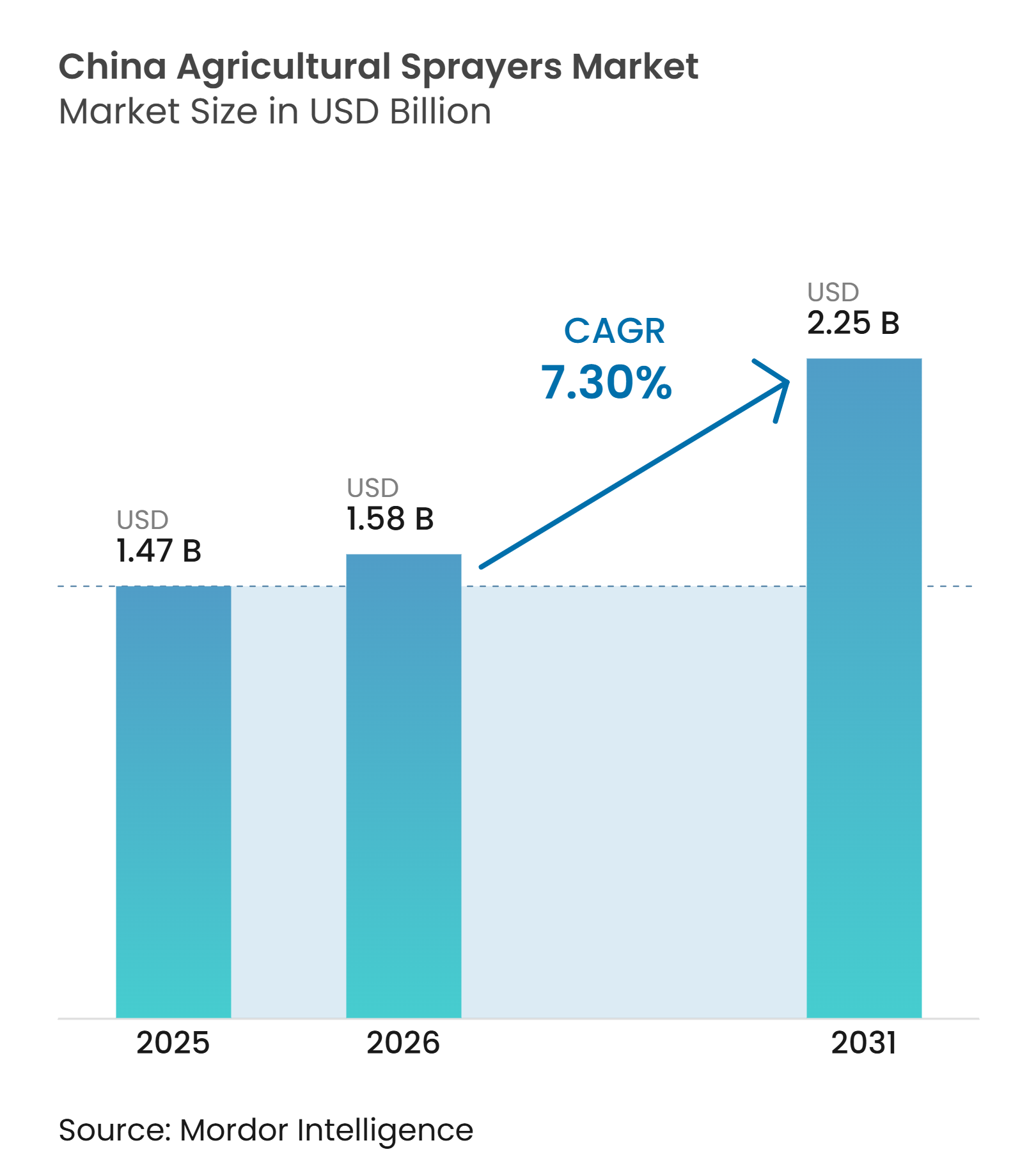
| Base Year Market Size (2025) | USD 1.47 Billion |
| Market Size (2026) | USD 1.58 Billion |
| Market Size (2031) | USD 2.25 Billion |
| Growth Rate (2026 - 2031) | 7.30 % |
| Market Concentration | Medium |
Major Players *Disclaimer: Major Players sorted in no particular order Image © Mordor Intelligence. Reuse requires attribution under CC BY 4.0. | |
China Agricultural Sprayers Market Analysis by Mordor Intelligence
The China agricultural sprayers market size is projected to reach USD 1.47 billion in 2025, increase to USD 1.58 billion in 2026, and reach USD 2.25 billion by 2031, growing at a CAGR of 7.3% during 2026-2031. The China agricultural sprayers market is expanding as farm mechanization remains a national priority, rural labor availability continues tightening, and aerial spraying shifts from niche adoption into mainstream farm operations. China’s 2026 Central No. 1 Document also elevated the policy importance of drones, Internet of Things (IoT), and robotics in agriculture, supporting continued investment in intelligent crop protection equipment. Conventional sprayers still serve a broad installed base across smallholder farming regions, although replacement demand is increasingly moving toward smarter, more precise, and more labor-efficient systems. Competition is therefore shifting toward companies capable of combining hardware, field service, operator training, and digital workflow integration rather than competing only through equipment sales.
Key Report Takeaways
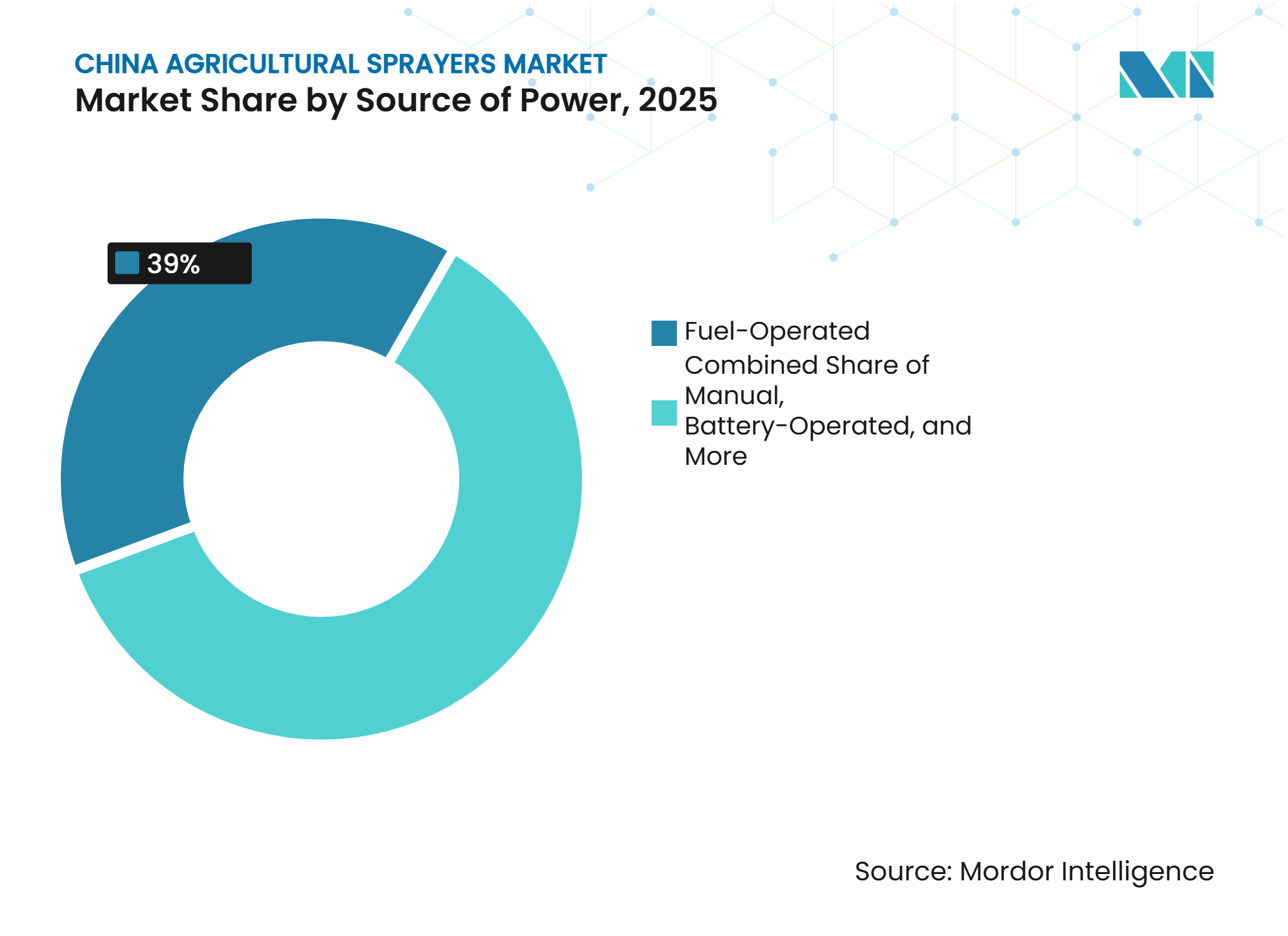
- By source of power, the agriculture sprayers market share for the fuel-operated segment accounted for the largest 39.0% in 2025, while the agriculture sprayers market size for the battery-operated segment is projected to expand at the fastest 10.9% CAGR from 2026 to 2031.
- By product type, tractor-mounted sprayers was the largest segment, accounted for 28% in 2025, while unmanned aerial vehicle sprayers were the fastest-growing segment, with a 15.8% CAGR during 2026-2031.
- By application, field crops was the largest segment, with 52% in 2025, while orchards and vineyards were the fastest-growing segment, with a 10.6% CAGR during 2026-2031.
- By spray volume capacity, low-volume systems were the largest segment, with a 47% share in 2026, while ultra-low-volume systems were the fastest-growing segment, with an 11.8% CAGR during 2026-2031.
- By technology level, conventional systems were the largest segment with 55% share in 2025, while artificial intelligence-enabled and autonomous systems were the fastest segment with a 17.2% CAGR during 2026-2031.
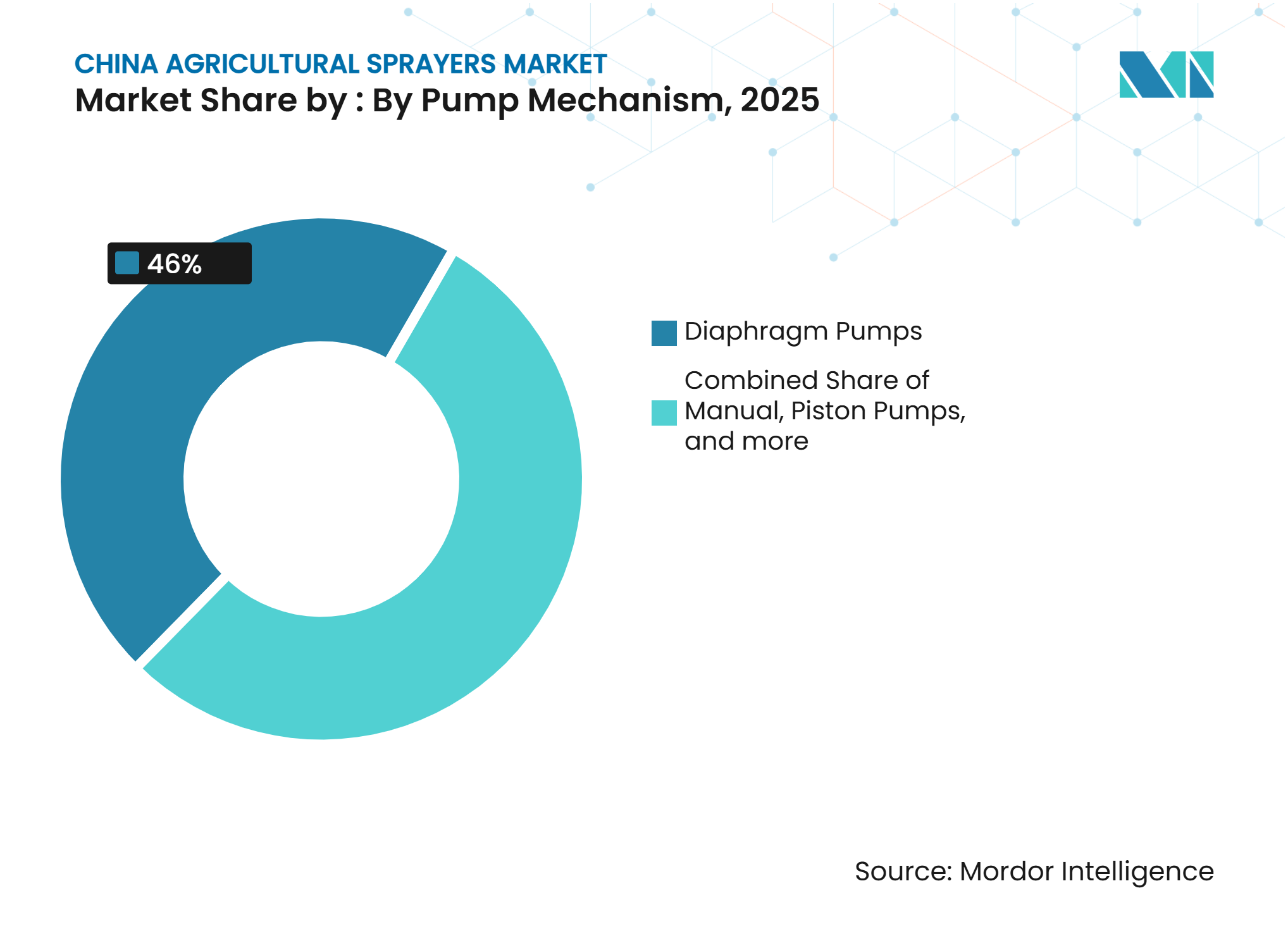
- By pump mechanism, diaphragm pumps were the largest segment with 46% share in 2025, while centrifugal pumps were the fastest segment with a 10.4% CAGR during 2026-2031.
Note: Market size and forecast figures in this report are generated using Mordor Intelligence’s proprietary estimation framework, updated with the latest available data and insights as of January 2026.
Market Trends and Insights
Drivers Impact Analysis of China Agricultural Sprayers Market*
| Driver | (~) % Impact on CAGR Forecast | Geographic Relevance | Impact Timeline |
|---|---|---|---|
| Farm mechanization subsidy support | +1.8% | National, concentrated in major grain belt provinces such as Heilongjiang, Henan, Anhui, and large-scale reclamation zones in Xinjiang | Short term (≤ 2 years) |
| Rapid agricultural drone adoption | +2.2% | National, with strongest density in Northeast China grain belts and Xinjiang cotton and wheat regions | Short term (≤ 2 years) |
| Aging and shrinking rural labor pool | +1.3% | National, with acute labor-deficit pressure in Shandong, Henan, Anhui, Jiangxi, and Sichuan | Medium term (2-4 years) |
| Precision pesticide-use and food-safety pressure | +1.1% | National, with early leadership in export-oriented provinces including Shandong, Guangdong, and Zhejiang | Medium term (2-4 years) |
| Orchard and hilly-terrain spraying needs | +0.9% | Southwest China, including Yunnan, Sichuan, and Guizhou, and South China orchard belts | Long term (≥ 4 years) |
| Low-altitude economy support for rural aerial services | +1.0% | National, with early commercial momentum in Guangdong, Jiangsu, and Zhejiang | Medium term (2-4 years) |
| Source: Mordor Intelligence | |||
Farm Mechanization Subsidy Support
The China agricultural sprayer market is benefiting from the Agricultural Machinery Purchase and Application Subsidy Policy, which provides financial assistance to farmers, cooperatives, and agricultural service providers for the purchase of approved agricultural machinery. In 2025, the Ministry of Agriculture and Rural Affairs expanded the policy to prioritize advanced, intelligent plant protection equipment, including high-efficiency sprayers, while encouraging the replacement of older, less efficient machinery. By reducing upfront investment costs, the policy accelerates mechanization and precision crop protection across major agricultural regions. It also supports the adoption of technology-oriented sprayers that improve operational efficiency, reduce labor requirements, and enhance pesticide application accuracy. During 2026-2031, the policy will continue driving demand for advanced agricultural sprayers across China.
Rapid Agricultural Drone Adoption
The China agricultural sprayer market is being reshaped by the deployment of agricultural drones at a scale rarely seen elsewhere. China operated 251,000 agricultural-service unmanned aerial vehicles in 2024, covering 2.67 billion mu, a nearly 25% increase from the previous year[1]. By 2025, the national agricultural drone fleet exceeded 300,000 units while the annual operating area surpassed 460 million mu, confirming that drones have become a core farm service tool rather than an experimental technology. A single agricultural drone can cover approximately 1,000 mu per day, compared with only 10 to 15 mu per day with manual spraying, making the labor and efficiency advantages increasingly clear even to smallholders and local cooperatives[2]. The China agricultural sprayers industry is also experiencing secondary effects as drone expansion influences chemical formulation choices, nozzle engineering, and pump-system design toward greater aerial compatibility. This means drone adoption is not only expanding one equipment category but also reshaping the broader design logic of the China agricultural sprayers industry.
Aging and Shrinking Rural Labor Pool
The China agricultural sprayers industry is gaining structural support from long-term labor shifts across rural areas. According to the National Bureau of Statistics of China, the average age of migrant workers increased to 43.2 years in 2024, while the share of workers aged 50 years and above reached 31.6%, highlighting the country's aging rural labor force. A smaller, aging farm labor base is increasing the value of equipment that reduces manual work during time-sensitive spraying periods. Field data from Xinjiang showed that drone spraying resulted in lower per-mu operating costs than manual application methods, even after accounting for operator fees and equipment amortization. This cost advantage shifts labor-saving equipment from a convenience purchase toward an economic necessity across many farming regions. The China agricultural sprayer market is therefore moving toward systems that require fewer field workers, particularly across larger operating zones and cooperative service models, while accelerating the adoption of autonomous and semi-autonomous spraying systems.
Precision Pesticide Use and Food Safety Pressure
The China agricultural sprayers landscape is also being driven by tighter expectations surrounding pesticide control, residue management, and food safety performance. Research published during 2025 showed that artificial intelligence-integrated variable-rate spraying systems could reduce pesticide use while maintaining or improving treatment effectiveness. This becomes especially important in crop systems where export compliance, domestic traceability, and application documentation carry direct commercial value. The impact is strongest in provinces such as Shandong, Guangdong, and Zhejiang, where higher-value fruits, vegetables, and specialty crops face stricter buyer and retail requirements. The China agricultural sprayers sector is therefore separating more clearly between low-cost commodity equipment and professional systems capable of delivering precision, application records, and repeatable treatment quality. During 2026-2031, these pressures are projected to continue supporting the adoption of guided and precision spraying technologies across the China agricultural sprayers market.
Restraints Impact Analysis of China Agricultural Sprayers Market*
| Restraint | (~) % Impact on CAGR Forecast | Geographic Relevance | Impact Timeline |
|---|---|---|---|
| Fragmented land plots and varied field geometry | -1.4% | National, most acute in hilly areas of Southwest China and small-plot farming regions of Central and Eastern China | Medium term (2-4 years) |
| Operator licensing and training burden | -1.0% | National, with bottlenecks most severe in rural counties distant from provincial capitals and certified training centers | Short term (≤ 2 years) |
| Battery endurance and refill downtime constraints | -0.8% | National, with greatest productivity impact in large-acreage continuous farming areas including Heilongjiang and Xinjiang | Short term (≤ 2 years) |
| Service-network and interoperability gaps | -0.7% | Rural and peri-urban counties in Central and Western China provinces with lower agricultural technology penetration | Medium term (2-4 years) |
| Source: Mordor Intelligence | |||
Fragmented Land Plots and Varied Field Geometry
The China agricultural sprayer market still faces structural limitations due to fragmented landholding patterns and irregular field geometry. According to the Ministry of Agriculture and Rural Affairs, China's agricultural sector remains dominated by smallholder farming, with over 200 million small farm households, creating highly fragmented production landscapes that limit large-scale mechanized operations. This fragmentation reduces the operational efficiency of autonomous and guided spraying systems, which perform best in large, uniform fields that are easier to map. Research published during 2025 showed that irregular canopy structure, boundary overlap, and slope variation can reduce spray quality and route efficiency in hilly farming environments. This prevents the China agricultural sprayers industry from transitioning as rapidly as underlying technology capability alone might suggest. It also preserves an important role for manual and handheld spraying equipment on smaller, less standardized plots. Until route-planning software and terrain-adaptation systems improve further, this constraint is likely to continue slowing the shift toward full autonomy across parts of the China agricultural sprayers market.
Operator Licensing and Training Burden
The China agricultural sprayers market is also constrained by the time and cost required to train and certify sufficient numbers of drone operators. Agricultural drone deployment depends on structured training and certification under the Civil Aviation Administration of China framework, adding another operational step before equipment can be fully utilized. This burden is not evenly distributed across counties with established cooperatives and stronger access to training, which are advancing more quickly than regions where individual farmers must navigate certification independently. As a result, the China agricultural sprayers commercial landscape is developing in tiers rather than through a uniform national rollout. Manufacturers that position operator training as part of customer acquisition and after-sales support are therefore better placed than companies focused only on equipment sales. Even with strong underlying demand, qualified operator availability remains a meaningful bottleneck across many rural areas within the China agricultural sprayers market.
*Our forecasts treat driver/restraint impacts as directional, not additive. The impact forecasts reflect baseline growth, mix effects, and variable interactions.
China Agricultural Sprayers Market Segment Analysis
By Source of Power:
Battery Systems Drive a Gradual Platform TransitionThe China agricultural sprayers market size was led by fuel-operated systems, which accounted for the largest share of the market at 39% in 2025. While battery-operated systems are projected to be the fastest-growing power category, with the segment forecasted to expand at a CAGR of 10.9% during 2026-2031. Fuel-based platforms remain important because they provide longer endurance and greater power output for tractor-mounted and self-propelled sprayers operating across large grain-producing regions. This keeps them highly relevant in provinces such as Heilongjiang and Henan, where extended field runs continue to favor established combustion-based systems. The large installed base of ground equipment also slows the pace of transition because agricultural machinery replacement cycles remain gradual rather than immediate.
Battery-powered systems are advancing along 2 interconnected pathways in the China agricultural sprayers industry. First, aerial spraying platforms are benefiting from improved battery designs that extend flight duration and reduce operational interruptions. Second, ground-based equipment is beginning to benefit from the broader electrification trend in Chinese agricultural machinery, as evidenced by 2025 launches such as LOVOL Corporation’s E1000 electric tractor and other new-energy platform developments. Solar-powered systems continue serving a smaller niche focused on low-intensity applications in remote smallholder regions. Manual sprayers also remain present across very small plots, although their role is likely to continue shrinking as labor shortages and intelligent equipment adoption push the China agricultural sprayers sector toward more efficient power platforms.



By Product Type:
Unmanned Aerial Vehicle Sprayers Redefine the Competitive FrontierTractor-mounted sprayers accounted for the largest China agricultural sprayers market share, representing 28% of the market in 2025. Unmanned aerial vehicle sprayers are projected to be the fastest-growing product category, with the segment projected to expand at a CAGR of 15.8% during 2026-2031. Tractor-mounted systems remain important because they fit consolidated field-crop operations across Northeast and Northwest China, where flatter terrain supports higher operating efficiency. They also continue holding strategic relevance for global manufacturers such as Deere & Company, CNH Industrial N.V., and Kubota Corporation, which remain focused on large-farm productivity and precision upgrades. The center of competitive momentum within the China agricultural sprayers market is increasingly shifting toward aerial application platforms.
This transition is visible through major product launches. SZ DJI Technology Co., Ltd. launched the Agras T100 globally in 2025 with a 100-liter spraying payload, and later introduced the Agras T55 in 2026 for orchard applications, featuring upgraded sensing capability and a dual-atomized centrifugal spray system. XAG Co., Ltd. also expanded its position during 2025 through the P150 Max for large-scale autonomous operations and the R Series rover designed for orchard and greenhouse crop protection. As unmanned aerial vehicle sprayers continue scaling, conventional product categories such as handheld, trailed, and self-propelled systems are facing greater pressure on both margins and differentiation. This is increasing the number of companies within the China agricultural sprayers market that pair equipment sales with service subscriptions, autonomy upgrades, and workflow-management software.
By Application:
Orchards and Vineyards Represent the Most Technically Demanding Growth SegmentField crops accounted for the largest share of the China agricultural sprayers market in 2025, at 52%. Orchards and vineyards are projected to be the fastest-growing application category, expanding at a CAGR of 10.6% during 2026-2031. Field crops continue to dominate because China’s grain, oilseed, and cotton acreage creates recurring demand for pesticide and fertilizer applications throughout the growing season. This keeps field applications at the center of the China agricultural sprayers market even as newer technologies spread into more specialized crop systems. Large field environments also support faster deployment of both ground-based mechanization and contracted drone-spraying services.
Orchards and vineyards are expanding more rapidly because they present operational challenges that conventional spraying systems often struggle to address effectively. Tree canopies, uneven terrain, and narrow access routes make spraying more labor-intensive and difficult to standardize, increasing the value of aerial and precision-guided platforms. Research published during 2026 identified terrain-following control and canopy mapping as important tools for autonomous orchard spraying, reinforcing the product direction visible in systems such as XAG Co., Ltd.’s R Series rover platforms. Greenhouse crops remain a specialized application segment where droplet control and enclosed-space management carry greater importance than broad acreage coverage. Turf and gardening also remain part of the China agricultural sprayers market, although demand there is smaller and influenced more by local public-use regulation than by broader agricultural mechanization trends.
By Spray Volume Capacity:
Ultra-Low Volume Growth Tracks Directly to Drone Platform ExpansionLow-volume systems accounted for the largest share and 47% of the China agricultural sprayers market in 2025. Ultra-low-volume systems are projected to be the fastest-growing category, with the segment projected to expand at a CAGR of 11.8% during 2026-2031. Low-volume spraying continues dominating because it aligns closely with the installed base of conventional ground equipment operating across much of China’s farmland. It remains the practical middle ground for broad-acre field applications, established operating routines, and familiar chemical-handling practices. This keeps low-volume formats central to the current structure of the China agricultural sprayers market.
Ultra-low-volume growth is closely linked with agricultural drone expansion rather than with a broad transition across all equipment categories. Agricultural unmanned aerial vehicles are designed to optimize chemical use per treated area, meaning every increase in aerial spraying also supports demand for ultra-low-volume application formats. This is creating a stronger connection between product category, pump engineering, and spray-capacity design across the China agricultural sprayers market. High-volume systems continue to retain relevance within selected orchard applications, enclosed structures, and specialty treatments, although their long-term growth outlook remains more limited. As food-safety expectations and drift-control requirements become more important, lower-volume and more precise spraying methods will capture a larger role within the China agricultural sprayers market.
By Technology Level:
Artificial Intelligence-Enabled Autonomy Moves Into Commercial ScalingConventional systems accounted for the largest share of the China agricultural sprayers market in 2025, at 55%. Artificial intelligence-enabled and autonomous systems are projected to be the fastest-growing technology category, expanding at a CAGR of 17.2% during 2026-2031. Conventional platforms continue dominating because the installed equipment base remains large, and many smallholders still operate relatively simple spraying systems with limited automation. This legacy structure provides the China agricultural sprayers market with a broad demand base unlikely to disappear quickly. At the same time, the widening gap in growth between conventional and advanced systems indicates that the market is moving beyond the pilot phase for smart spraying technologies.
This transition is increasingly visible through both equipment and software development. LOVOL Corporation launched an industry-level artificial intelligence model for smart agriculture in 2025 and linked it with autonomous machinery operation, field monitoring, and precision decision-support systems. During the same year, Topxgun partnered with Pix4D to enable prescription spray maps to be transferred directly from mapping software into drone flight-control systems, demonstrating how data workflows are being integrated into daily spraying operations. These developments matter because the China agricultural sprayers market is increasingly rewarding platforms capable of combining navigation, sensing, and field execution within a unified workflow. During 2026-2031, intelligent and guided systems will capture a larger share of replacement demand as farms, cooperatives, and agricultural service providers pursue higher labor productivity and more precise application control.
By Pump Mechanism:
Centrifugal Pumps Gain Structural Advantage Through Unmanned Aerial Vehicle IntegrationDiaphragm pumps accounted for the largest share of the China agricultural sprayers market in 2025, at 46%. Centrifugal pumps are projected to be the fastest-growing pump category, expanding at a CAGR of 10.4% during 2026-2031. Diaphragm pumps continue to maintain their leading position because they are durable, chemically compatible, and well-suited to tractor-mounted and self-propelled sprayers operating across large field environments. Their reliability under continuous spraying conditions makes them a practical standard across much of the existing China agricultural sprayers market, particularly in regions where downtime can disrupt narrow seasonal spraying windows.
Centrifugal pumps are gaining momentum because they align closely with rotary atomizer systems used in agricultural drones. Their ability to support fine and consistent droplet formation makes them highly suitable for ultra-low-volume aerial spraying, which remains one of the fastest-expanding demand areas within the China agricultural sprayers market. SZ DJI Technology Co., Ltd.’s 2026 launch activity also highlighted dual-atomized centrifugal spraying as a key performance feature in newer aerial systems. Piston pumps remain relevant in specialty and high-pressure applications that require deeper canopy penetration. The long-term pump mix within the China agricultural sprayers market is going to shift gradually toward centrifugal designs as aerial application systems continue expanding.

Geography Analysis
Northeast China represents the largest concentration of mechanized broad-acre demand within the Chinese agricultural sprayers market because large and relatively flat land parcels support high equipment utilization rates. Heilongjiang, Jilin, and Liaoning form the country’s core grain-producing belt and continue to favor tractor-mounted and self-propelled sprayers within conventional operations. The same operating environment also supports dense drone deployment because larger parcels improve route efficiency and daily treatment coverage. Heilongjiang was among the earliest regions to scale drone-spraying cooperatives, helping normalize service-based spraying models at the township level. This makes Northeast China a region where both the legacy installed base and the future direction of the China agricultural sprayers market remain visible at the same time.to favor
Xinjiang represents the other major large-acreage operating region within the China agricultural sprayers market, particularly across cotton and wheat production systems. Field data reported by Xinhua showed that drone spraying in Xinjiang generated lower per-mu operating costs than manual application methods, strengthening the practical case for faster adoption among both policymakers and local operators. Central China provinces such as Henan and Hubei also continue generating sustained demand because cereal and rice systems require repeated spraying cycles throughout the season. In East and South China, Zhejiang and Guangdong stand out more for application quality requirements than for field scale because producers there often serve higher-value crop chains requiring stronger traceability and more precise spraying performance. These differences show that the China agricultural sprayers market is shaped not simply by province, but by a combination of crop value, field geometry, labor availability, and agricultural service infrastructure.
Southwest China maintains the most distinct demand profile within the China agricultural sprayers market because orchards and hilly farming systems create equipment requirements very different from standard broad-acre operations. Yunnan, Sichuan, and Guizhou require spraying solutions capable of handling slopes, irregular field boundaries, and complex canopy structures more effectively than conventional field machinery. Research published during 2026 confirmed that terrain-following flight control and multispectral canopy mapping are particularly relevant for autonomous orchard spraying under these conditions[3]. This makes the region more dependent on localized service ecosystems and crop-specific technology support than on national distributor reach alone. As orchard and vineyard applications continue growing faster than other crop segments, Southwest China is projected to become a more influential testing ground for the next phase of development within the China agricultural sprayers market.
Competitive Landscape
Market Concentration

The China agricultural sprayer market is moderately concentrated. In the crop-spraying drone market, competition is concentrated among SZ DJI Technology Co., Ltd. and XAG Co., Ltd., while companies such as Topxgun, Hebi Quanfeng Biological Technology Co., Ltd., and Wuxi Hanhe Aviation Intelligent Technology Co., Ltd. hold smaller market positions. Domestic agricultural machinery groups such as LOVOL Corporation and Zoomlion Agriculture Machinery Co., Ltd. are strengthening the local competitive field through smart equipment, electrification, and broader farm-platform strategies. FJDYNAMICS PTE. LTD. also stands out as a precision specialist building a position between pure hardware manufacturing and software-led workflow integration.
A clear strategic pattern in the China agricultural sprayers market is the transition from standalone hardware toward integrated operating ecosystems. Leading companies are not only launching larger or smarter equipment, but are also building data-management tools, operator-training networks, and service relationships that keep users within their operating platforms. Another visible pattern is the precision-upgrade strategy used by global original equipment manufacturers, allowing them to defend large-farm segments without directly matching the full drone portfolios of leading aerial competitors. Workflow integration is also becoming increasingly important, demonstrated by the 2025 partnership between Topxgun and Pix4D that enabled prescription spray maps to move directly into drone flight-execution systems. This raises the competitive threshold because participation in the China agricultural sprayers market now depends on software compatibility, service quality, and regulatory readiness as much as on machine performance.
Recent company activity illustrates how competition is evolving across the China agricultural sprayers market. During 2026, SZ DJI Technology Co., Ltd. introduced the Agras T55 and the T100 Dual Battery Spraying System with stronger emphasis on orchard capability, sensing performance, and longer operating continuity. During 2025, XAG Co., Ltd. launched the P150 Max agricultural drone and the R Series agricultural rover, reinforcing its focus on autonomy, large-scale operations, and orchard crop protection. In the same year, LOVOL Corporation launched an industry-level artificial intelligence model for smart agriculture and later introduced its 2026 Smart Tractor Series, showing that domestic groups are attempting to build broader intelligent farming ecosystems rather than isolated products. These developments suggest that the China agricultural sprayers market is likely to continue rewarding suppliers capable of combining product innovation with strong field-level deployment capability. The result is a market where a concentrated drone segment operates within a broader landscape that remains moderate concentration.
China Agricultural Sprayers Industry Leaders
-
SZ DJI Technology Co., Ltd.
-
XAG Co., Ltd.
-
Deere & Company
-
Kubota Corporation
-
CNH Industrial N.V.
- *Disclaimer: Major Players sorted in no particular order
China Agricultural Sprayers Market Companies Covered in this Report
- SZ DJI Technology Co., Ltd.
- XAG Co., Ltd.
- Topxgun (Nanjing) Robotics Co., Ltd.
- FJDYNAMICS PTE. LTD.
- Hebi Quanfeng Biological Technology Co., Ltd.
- Wuxi Hanhe Aviation Intelligent Technology Co., LTD
- Zoomlion Agriculture Machinery Co., Ltd.
- LOVOL Corporation
- Deere & Company
- CNH Industrial N.V.
- AGCO Corporation
- Kubota Corporation
- Joyance Technology
- Eavision Inc.
- Nanjing Harvest Automation Technology Co., Ltd.
Recent Industry Developments in China Agricultural Sprayers Market
- February 2026: China’s 2026 Central No. 1 Document, released on February 3, 2026, for the first time explicitly included expanding the application of drones, Internet of Things technologies, and robots in agriculture, marking a national policy mandate for intelligent agricultural equipment and signaling the 15th Five-Year Plan period as a critical acceleration phase for smart farm machinery.
- November 2025: XAG Co., Ltd. unveiled the P150 Max Agricultural Drone and the R Series Agricultural Rover at Agritechnica 2025 in Hannover. The P150 Max offers increased payload capacity and full autonomy for large-scale operations, while the R Series Rover is specifically designed for precision crop protection in orchards and greenhouses with terrain-following capability. The P Series has logged over 9.3 million flight hours since 2022.
- July 2025: SZ DJI Technology Co., Ltd. globally launched the Agras T100, Agras T70P, and Agras T25P agricultural drones, reinforcing the move toward higher-capacity and more autonomous aerial spraying systems in the China agricultural sprayers market. The T100 supports 100 L spraying and 150 L spreading at 20 meters per second and uses LiDAR with millimeter-wave radar for obstacle detection. The T70P supports 70 L spraying and 100 L spreading with Safety System 3.0 and Tri-Vision obstacle avoidance. The company also expanded pilot-training programs across 15 countries in the Americas and Asia, showing how competition in the China agricultural sprayers market is increasingly extending beyond hardware into training and deployment support.
China Agricultural Sprayers Market Report Scope
The agricultural sprayers market comprises manually operated and powered equipment designed to apply crop protection chemicals and foliar fertilizers across agricultural crops. The market includes handheld, tractor-mounted, trailed, self-propelled, and UAV sprayers powered by manual, battery, solar, or fuel-based systems. These sprayers are used for the efficient application of pesticides, herbicides, fungicides, insecticides, and foliar nutrients in field crops, orchards, vineyards, plantations, and protected cultivation. The market forecasts are provided in value (USD).
Segmentation Overview
| Manual |
| Battery-Operated |
| Solar-Powered |
| Fuel-Operated |
| Handheld |
| Tractor-Mounted |
| Trailed |
| Self-Propelled |
| Unmanned Aerial Vehicle Sprayers |
| Field Crops |
| Orchards and Vineyards |
| Greenhouse Crops |
| Turf and Gardening |
| Ultra-Low Volume |
| Low Volume |
| High Volume |
| Conventional |
| Precision and GPS-Guided |
| Artificial Intelligence-Enabled and Autonomous |
| Diaphragm Pumps |
| Piston Pumps |
| Centrifugal Pumps |
| By Source of Power | Manual |
| Battery-Operated | |
| Solar-Powered | |
| Fuel-Operated | |
| By Product Type | Handheld |
| Tractor-Mounted | |
| Trailed | |
| Self-Propelled | |
| Unmanned Aerial Vehicle Sprayers | |
| By Application | Field Crops |
| Orchards and Vineyards | |
| Greenhouse Crops | |
| Turf and Gardening | |
| By Spray Volume Capacity | Ultra-Low Volume |
| Low Volume | |
| High Volume | |
| By Technology Level | Conventional |
| Precision and GPS-Guided | |
| Artificial Intelligence-Enabled and Autonomous | |
| By Pump Mechanism | Diaphragm Pumps |
| Piston Pumps | |
| Centrifugal Pumps |
Key Questions Answered in the Report
What is the size of the China agricultural sprayers market in 2026?
The China agricultural sprayers market stands at USD 1.58 billion in 2026 and is projected to reach USD 2.25 billion by 2031 at a 7.3% CAGR during 2026-2031.
Which product category is growing fastest in China’s sprayer space?
Unmanned aerial vehicle sprayers are the fastest-growing product category, with a 15.8% CAGR during 2026-2031, reflecting stronger demand for aerial, labor-saving, and precision application.
Why are agricultural drones gaining so much traction in China?
Drones reduce labor pressure, improve field coverage, and fit both cooperative and service-based spraying models. A single drone can cover 1,000 mu per day, while manual spraying covers only 10 to 15 mu.
What is the biggest constraint on faster adoption of autonomous spraying?
Fragmented land plots, operator training needs, battery downtime, and uneven service support are the main limits. These issues are more visible in hilly regions and in counties with weaker training and after-sales networks.