
Chile Commercial Greenhouse Market Size and Share
Market Overview
| Study Period | 2021 - 2031 |
|---|---|
| Forecast Data Period | 2026 - 2031 |
| Base Year Market Size (2025) | USD 370 Million |
| Market Size (2026) | USD 420 Million |
| Market Size (2031) | USD 780 Million |
| Growth Rate (2026 - 2031) | 13.18 % |
| Market Concentration | Low |
Major Players *Disclaimer: Major Players sorted in no particular order Image © Mordor Intelligence. Reuse requires attribution under CC BY 4.0. | |
Chile Commercial Greenhouse Market Analysis by Mordor Intelligence
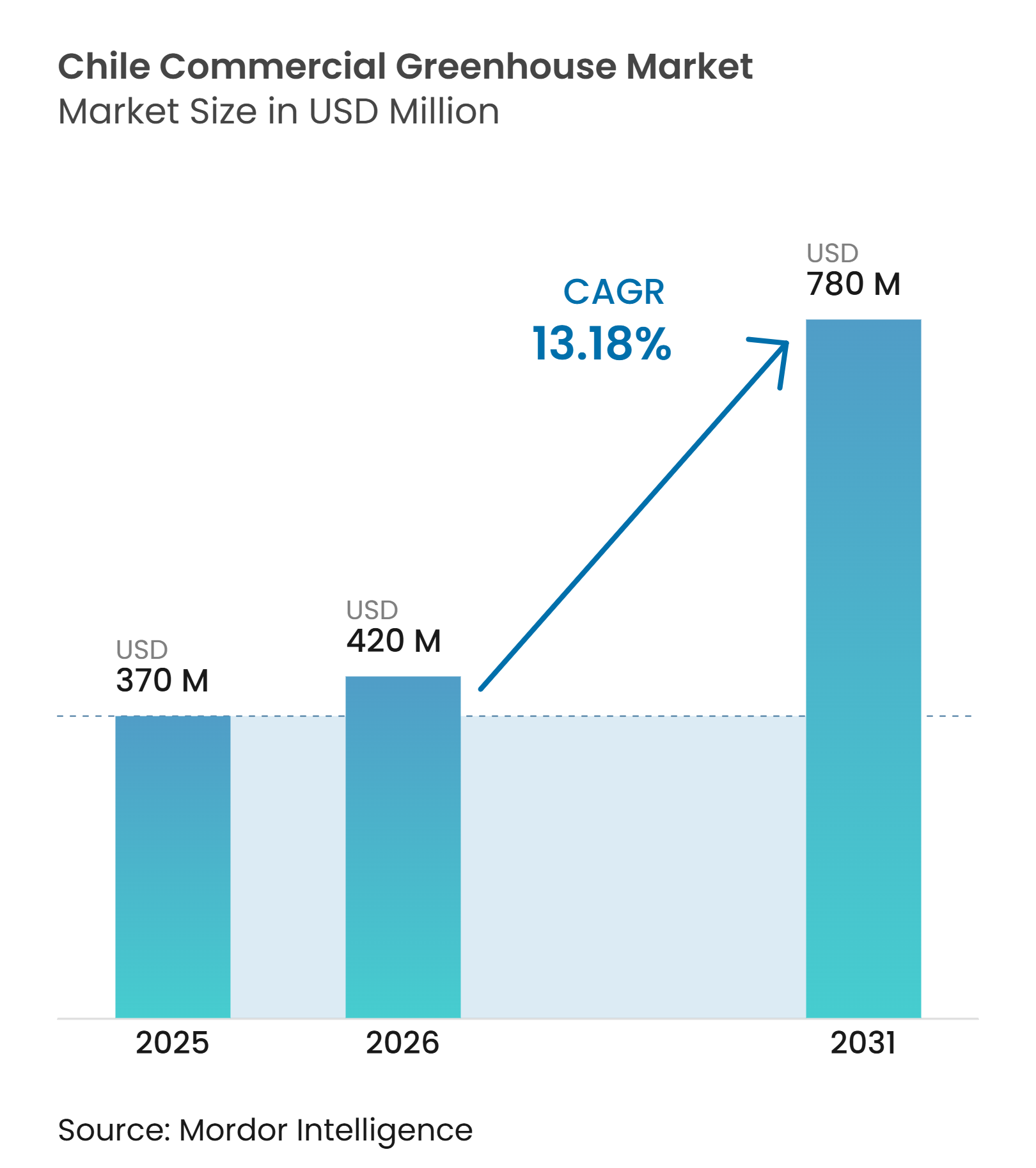
The Chile commercial greenhouse market size was USD 370.00 million in 2025 and is projected to grow from USD 420.00 million in 2026 and reach USD 780.00 million by 2031, at a CAGR of 13.18% from 2026 to 2031. Water availability, climate exposure, and the need for reliable fresh produce are shaping investment decisions in the market. Chile's elongated geography and diverse microclimates create both opportunities and challenges for agricultural production, making controlled-environment farming increasingly relevant across multiple regions. Chile's Climate Adaptation Plan for Forestry and Agriculture for 2024 to 2028 identifies protected cultivation as an adaptation tool, reflecting the government's recognition that traditional open-field farming faces growing risks from climate variability. Retail supply requirements are also strengthening the value of documented crop production and dependable delivery schedules, as domestic and export buyers demand greater consistency in quality and volume. Suppliers are responding by combining greenhouse structures, irrigation, climate management, and digital controls within single projects, offering integrated solutions that reduce operational complexity for growers. Public programs and demonstration facilities are expanding the technical base for controlled-environment agriculture (CEA), particularly in water-constrained locations, helping smaller producers access knowledge and technology that was previously limited to large commercial operations.
Key Report Takeaways
- By equipment type, LED grow lighting was the largest segment and held 30.2% of the Chile commercial greenhouse market share in 2025, while climate control and automation software is the fastest-growing segment and is anticipated to expand at a 15.2% CAGR between 2026 and 2031.
- By crop type, fruits and vegetables were the largest segment and held 55.5% of the Chile commercial greenhouse market size in 2025, while cannabis and specialty crops are the fastest-growing segment and are anticipated to expand at a 14.5% CAGR between 2026 and 2031.
- By greenhouse type, plastic-film greenhouses were the largest segment and held 61.2% of the market share in 2025, while glass greenhouses are the fastest-growing segment and are anticipated to expand at a 12.2% CAGR between 2026 and 2031.
- By cultivation technology, hydroponic was the largest segment and held 54.4% of the market share in 2025, while it is also the fastest-growing segment and is anticipated to expand at a 13.8% CAGR between 2026 and 2031.
- By end user, commercial growers were the largest segment and held 55.3% of the market share in 2025, while research and educational institutes is the fastest-growing segment and is anticipated to expand at a 13.5% CAGR between 2026 and 2031.
Note: Market size and forecast figures in this report are generated using Mordor Intelligence’s proprietary estimation framework, updated with the latest available data and insights as of January 2026.
Market Trends and Insights
Drivers Impact Analysis of Chile Commercial Greenhouse Market*
| Driver | (~) % Impact on CAGR Forecast | Geographic Relevance | Impact Timeline |
|---|---|---|---|
| Year-round fresh produce requirements | +2.3% | National, with early gains in Santiago, Valparaíso, and Concepción | Short term (≤ 2 years) |
| Water scarcity and resource-efficient cultivation | +2.8% | National, strongest in Northern Chile, including Arica and Parinacota, Atacama, and Coquimbo | Short term (≤ 2 years) |
| Climate volatility and protected production | +2.4% | National, with relevance in Southern Chile’s severe climate zones | Medium term (2-4 years) |
| Retailer demand for reliable supply and traceability | +1.8% | Central Chile, including the Santiago and Valparaíso retail corridors | Medium term (2-4 years) |
| Automation, sensors and climate-control adoption | +2.1% | National, strongest in Central and Northern Chile | Medium term (2-4 years) |
| Government support for climate-resilient agriculture | +1.6% | National, with early relevance in Northern and Southern Chile | Long term (≥ 4 years) |
| Source: Mordor Intelligence | |||
Year-Round Fresh Produce Requirements
Retailers, foodservice operators, and wholesale markets require reliable fresh-produce supplies across seasons, supporting investment in protected cultivation systems that provide greater control over growing conditions. According to Chile's Office of Agricultural Studies and Policies (ODEPA) in 2026, based on the National Agricultural Survey (ENA) 2025 conducted by the National Statistics Institute (INE), the national vegetable area reached 97,675 hectares in the 2025/26 agricultural season[1]. Weather events such as rainfall and frost can disrupt open-field production, increasing the value of greenhouse systems that provide greater control over temperature, irrigation, humidity, and crop establishment. This supports demand for commercial greenhouses as growers seek more consistent production and reduced exposure to weather-related disruptions.
Water Scarcity and Resource-Efficient Cultivation
Water scarcity is an important demand factor for the Chile commercial greenhouse market where agricultural production is concentrated and water stress has intensified. A 2025 study in Hydrology and Earth System Sciences found that several basins in central Chile experienced high to extreme water stress, with Water Stress Index levels above 40% and 70% during the megadrought period. Agriculture is also the country's largest freshwater user, accounting for around 72% of estimated consumptive water demand, according to the Organisation for Economic Co-operation and Development (OECD) in 2024[2]. Chile's water-efficiency policy further supports investment in irrigation infrastructure. Amendments to Law No. 18.450 approved in September 2023 prioritised public investment in small- and medium-scale agriculture while promoting water efficiency and environmental sustainability. In 2024, the National Irrigation Commission (CNR) also established Strategic Boards on Water Resources, convened by the General Directorate of Water (DGA), to contribute to basin-level water-resource planning. These conditions support demand for commercial greenhouse systems and resource-efficient cultivation technologies that can improve control over irrigation and water use.
Climate Volatility and Protected Production
Chile's diverse agroclimatic conditions expose growers to different production challenges, including high temperatures and solar radiation in northern regions, while cooler conditions and frost affect southern production. Variable rainfall and temperature conditions in central areas can further increase uncertainty for open-field cultivation. According to the National Institute for Agricultural Research (INIA) in May 2025, a project in the Aysén Region developed three greenhouse models adapted to different agroecological zones (Puerto Aysén, Coyhaique, and Puerto Ibáñez). The designs were developed and validated through load tests and prototype trials, with the project aimed at extending vegetable production beyond the traditional growing season and enabling year-round cultivation. Chile's 2024–2028 Sectoral Climate Change Adaptation Plan also establishes adaptation measures for the country's vulnerable agricultural sector, reinforcing the need for production systems that can improve resilience to changing climatic conditions.
Retailer Demand for Reliable Supply and Traceability
Organized retailers, food processors, and export-oriented buyers increasingly require consistent quality, food-safety controls, and traceable production records. Chile's Agricultural and Livestock Service (SAG) requires participants in the export chain for primary horticultural products to register and maintain food-safety systems, while official controls include monitoring of pesticide residues, microbiological contaminants, and heavy metals. According to SAG in 2025, Chile exported products with electronic phytosanitary certification (ePhyto) to 42 countries, representing 76% of total electronic phytosanitary certification issuance[3]. These requirements and the continued digitalization of agricultural certification increase the importance of documented production practices, input management, and traceability. Commercial greenhouse systems can support this trend by providing greater control over growing conditions and facilitating systematic recording of crop and input information, making controlled production increasingly relevant to buyers seeking reliable and traceable fresh-produce supply.
Restraints Impact Analysis of Chile Commercial Greenhouse Market*
| Restraint | (~) % Impact on CAGR Forecast | Geographic Relevance | Impact Timeline |
|---|---|---|---|
| High upfront investment and long payback periods | -2.8% | National, most acute for small and medium producers in Central and Southern Chile | Long term (≥ 4 years) |
| Energy-price exposure and power-intensive operations | -2.2% | National, most severe in Northern Chile because of grid-connectivity limits | Medium term (2-4 years) |
| Limited interoperability across imported technology platforms | -1.6% | National, amplified in regions without specialized technicians | Medium term (2-4 years) |
| Water-reuse compliance and biological-control costs | -1.4% | National, concentrated in Northern and Central Chile | Short term (≤ 2 years) |
| Source: Mordor Intelligence | |||
High Upfront Investment and Long Payback Periods
Modern commercial greenhouses require substantial upfront investment in structures, climate-control systems, irrigation, fertigation, hydroponics, and automation, which can limit adoption among small and medium-sized growers. Government support can help reduce investment barriers, but agricultural capital-support programs are distributed across multiple subsectors rather than being dedicated exclusively to greenhouse construction. Growers may therefore need to finance a significant share of project costs, particularly for advanced systems with higher levels of automation and environmental control. The capital intensity of these facilities can lengthen investment recovery periods and make larger commercial operators better positioned to adopt sophisticated protected-cultivation technologies. This financing barrier can constrain near-term market expansion, particularly among growers with limited access to capital.
Limited Interoperability Across Imported Technology Platforms
Commercial greenhouse operators in Chile often source equipment and technologies from different international suppliers, including climate-control systems, irrigation equipment, sensors, automation platforms, and greenhouse structures. Differences in communication protocols, software architectures, and equipment standards can make it difficult to integrate systems from multiple vendors into a single operating environment. This can increase installation complexity, require additional integration or control hardware, and raise maintenance and training requirements for growers. Smaller operators may be particularly affected because they have fewer resources to manage technically complex systems and may depend more heavily on supplier-specific support. Limited interoperability can therefore slow the adoption of advanced greenhouse technologies and encourage growers to remain with single-vendor systems or postpone upgrades until compatibility requirements are clearer.
*Our forecasts treat driver/restraint impacts as directional, not additive. The impact forecasts reflect baseline growth, mix effects, and variable interactions.
Chile Commercial Greenhouse Market Segment Analysis
By Equipment:
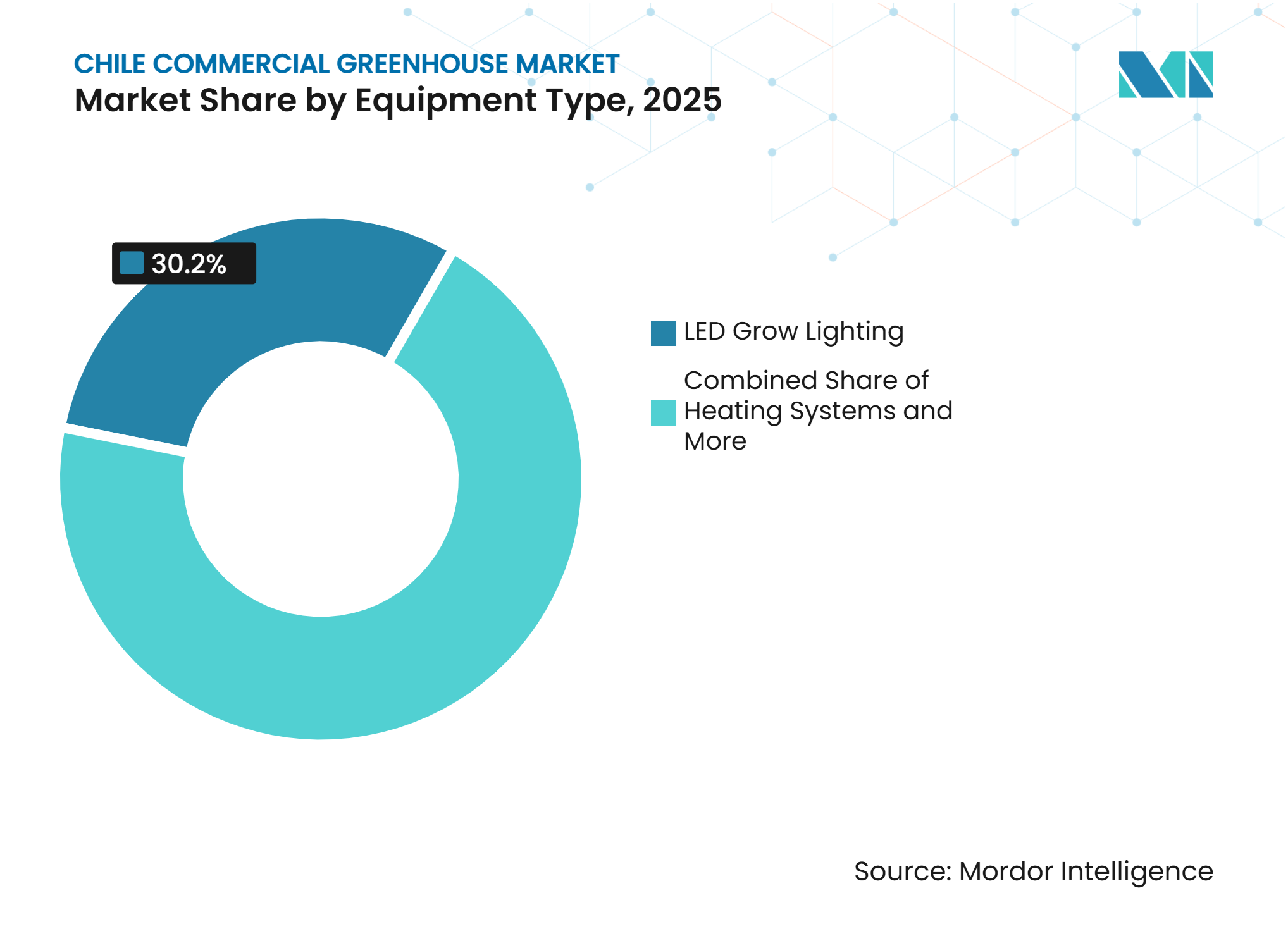
Automation Software Has the Highest Forecasted Growth RateLED grow lighting held 30.2% of the Chile commercial greenhouse market by equipment in 2025, making it the largest equipment category. Its use supports supplemental lighting and photoperiod management where natural radiation is insufficient, particularly during winter and in southern growing regions. Heating systems remain relevant for frost protection and temperature management, while irrigation and fertigation equipment support controlled water and nutrient application, particularly in water-constrained production areas. Screening and shading systems are also important in regions exposed to high solar radiation, particularly northern Chile. The equipment mix therefore varies by region according to local climate, crop type, water availability, and production requirements.
Climate-control and automation software is forecast to expand at a 15.2% CAGR between 2026 and 2031, making it the fastest-growing equipment category. Growth is supported by increasing adoption of systems that monitor and manage greenhouse temperature, humidity, irrigation, ventilation, and other production parameters. Integrated software can consolidate operational data and enable growers to respond more quickly to changes in growing conditions. As commercial greenhouse operations become more technology-driven, demand is shifting toward connected monitoring and automated control systems that improve resource management and operational consistency.



By Crop Type:
Fruits and Vegetables Anchor Production, While Specialty Crops Add ValueFruits and vegetables held 55.5% of the Chile commercial greenhouse market by crop in 2025, making them the largest crop category. Tomatoes, cucumbers, peppers, lettuce, leafy greens, and strawberries represent important greenhouse applications because controlled environments can support consistent production, crop quality, and supply across changing seasons. These crops are also suitable for hydroponic and fertigation systems, particularly where growers seek greater control over water and nutrient application. The broad range of fruit and vegetable applications provides a significant demand base for greenhouse structures, irrigation systems, climate-control equipment, and automation technologies.
Cannabis and specialty crops are forecast to expand at a 14.5% CAGR between 2026 and 2031, making them the fastest-growing crop category. The segment includes cannabis, flowers, ornamentals, and other high-value crops that can benefit from controlled growing conditions and specialized production systems. Greenhouse cultivation allows growers to manage temperature, humidity, irrigation, and light according to crop-specific requirements, supporting production of higher-value crops where controlled conditions can improve quality and consistency. Flowers and ornamentals also contribute to demand for specialized protected-cultivation facilities, while nurseries use greenhouse environments for the propagation of planting material. The growing adoption of controlled production systems for these higher-value applications is anticipated to support the expansion of the specialty-crop segment.
By Greenhouse Type:
Plastic-Film Structures Support Commercial ScalePlastic-film greenhouses held 61.2% of the Chile commercial greenhouse market by greenhouse type in 2025, making them the largest structural category. Their leading position reflects their relatively lower capital requirement and suitability for commercial production of vegetables, flowers, and other horticultural crops. Plastic-film structures can provide a practical entry point for growers seeking protected cultivation without the higher investment associated with rigid structures. Their suitability for regions with strong natural solar radiation and relatively moderate heating requirements further supports adoption across Chile. The combination of lower investment requirements and adaptable configurations is anticipated to maintain the leading position of plastic-film greenhouses in the Chile commercial greenhouse market.
Glass greenhouses are forecast to expand at a 12.2% CAGR between 2026 and 2031, making them the fastest-growing greenhouse type. Their higher light transmission, durability, and ability to support sophisticated climate-control systems make them suitable for high-value horticultural production where greater environmental control can justify higher capital investment. Rigid polycarbonate structures provide an intermediate option, combining greater durability and insulation than plastic film with lower structural requirements than glass in some applications. Hybrid and semi-closed facilities can further support growers seeking tighter control over temperature, humidity, ventilation, and other production conditions. Demand across greenhouse types therefore varies according to crop value, climate, investment capacity, durability requirements, and the level of environmental control required.
By Cultivation Technology:
Hydroponics Leads Controlled ProductionHydroponic held 54.4% of the Chile commercial greenhouse market by cultivation technology in 2025 and is forecast to expand at a 13.8% CAGR between 2026 and 2031. Its leading position reflects the ability to provide controlled nutrient delivery and precise irrigation, which is relevant in Chile's water-constrained agricultural regions. Systems such as nutrient film technique (NFT) and deep-water culture (DWC) allow growers to manage water and nutrients within controlled production environments, while recirculation can improve resource-use efficiency. Hydroponics also supports standardized crop management and can be integrated with climate-control and automation systems, making it suitable for commercial growers supplying consistent-quality produce to retail and other organized markets.
Soil and substrate-based cultivation remain important for nurseries, seedlings, flowers, and crops where direct soil or growing-media systems are more suitable. Substrate systems can provide controlled root-zone management while retaining greater flexibility across crop types and greenhouse configurations. Hybrid cultivation models combine different growing approaches according to crop requirements, water availability, and investment capacity. The continued adoption of hydroponic, substrate, soil-based, and hybrid systems gives Chilean greenhouse operators flexibility to select cultivation technologies according to crop value, resource availability, production scale, and required level of environmental control.
By End User:
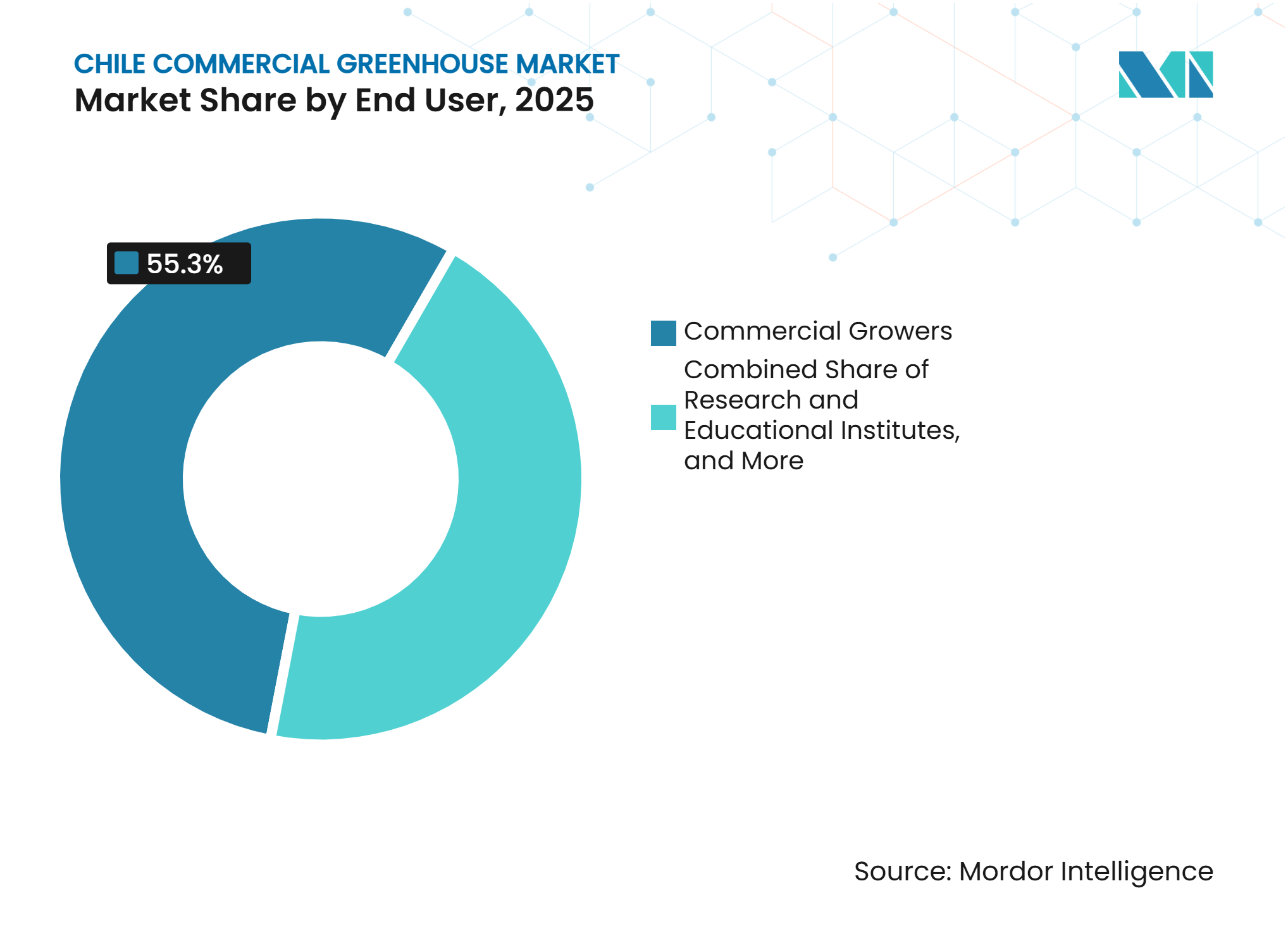
Commercial Growers Set Production and Certification StandardsCommercial growers held 55.3% of the Chile commercial greenhouse market by end user in 2025, making them the largest end-user category. Their leading position reflects the scale of commercial fresh-produce and horticultural production, which supports demand for greenhouse structures, irrigation systems, climate control, and automation. Larger operations are generally better positioned to invest in integrated greenhouse technologies and manage the operating requirements associated with controlled production. Their procurement decisions therefore influence demand for equipment configurations, automation levels, and integrated cultivation solutions in the Chile commercial greenhouse market.
Research and educational institutes are forecast to expand at a 13.5% CAGR between 2026 and 2031, making them the fastest-growing end-user category. Institutional activity includes greenhouse-based research, technology demonstration, crop trials, and controlled-environment cultivation. In May 2025, the National Institute for Agricultural Research (INIA) reported the development of three modular greenhouse models adapted to different agroclimatic conditions in the Aysén Region, demonstrating the role of institutional projects in developing locally adapted protected-cultivation technologies. Retail garden centers and nurseries also contribute to demand for greenhouse facilities for ornamental plants, propagation, and seedlings. The end-user base therefore spans commercial production, research and education, and nursery applications, with differing requirements for scale, technology integration, and environmental control.

Geography Analysis
Metropolitana de Santiago represents the largest regional market for commercial greenhouses in Chile, supported by its proximity to the country's largest urban consumption center and established demand from commercial vegetable growers, foodservice, retailers, and controlled-environment producers. The region's concentration of commercial activity supports demand for greenhouse structures, irrigation and fertigation systems, climate-control equipment, and automation. Valparaíso represents the country's largest hydroponic production base, supported by intensive horticulture and demand for efficient water and nutrient management. Its proximity to Santiago also provides access to major domestic markets, strengthening opportunities for commercial hydroponic greenhouse operations.
Arica y Parinacota is forecast to be the fastest-growing regional market, supported by its arid climate and the resulting need for protected cultivation and resource-efficient irrigation. The region has an established horticultural base, including tomato production, while Coquimbo represents an emerging opportunity as growers face increasing requirements for efficient water use and controlled production. In northern Chile, investment in hydroponic irrigation demonstrates the application of resource-efficient cultivation technologies under water-constrained conditions.
O'Higgins represents the strongest greenhouse technology-development cluster, supported by its agricultural production base and proximity to major commercial farming areas. The region provides opportunities for the adoption of automation, climate-control, irrigation, and other controlled-environment technologies. Los Ríos represents the main nursery and ornamental opportunity, supported by cooler climatic conditions and demand for protected cultivation for nurseries, flowers, and propagation. Together, these regions broaden the Chile commercial greenhouse market beyond fresh vegetables and create opportunities for suppliers serving specialized crop and production requirements.
Competitive Landscape
Market Concentration
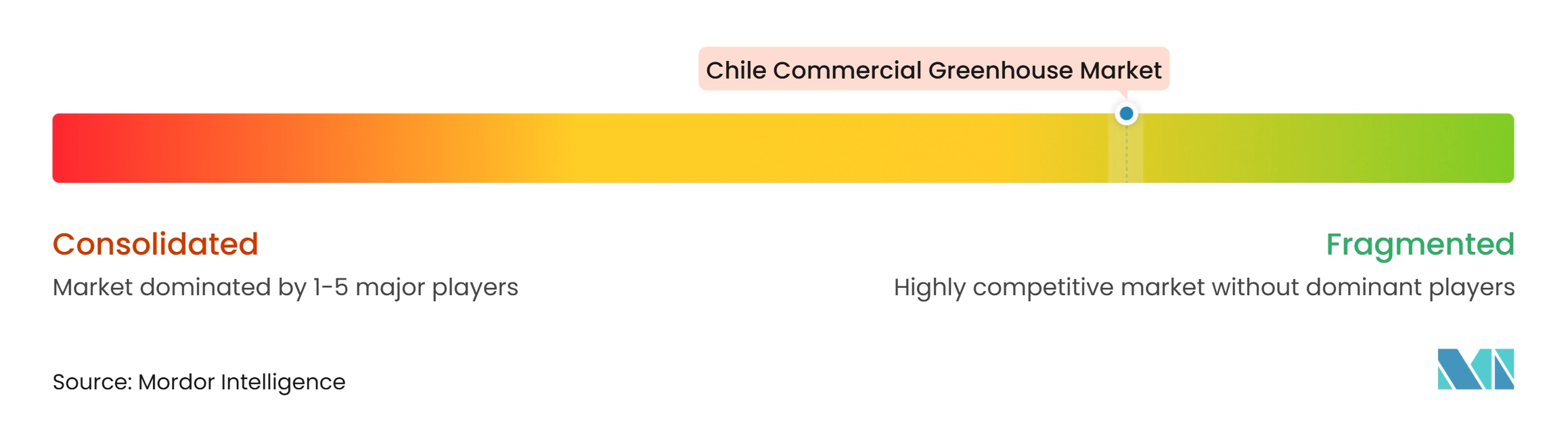
The Chile commercial greenhouse market is moderately fragmented, with Richel Group, Netafim Chile Limitada, Novedades Agrícolas, S.A. (Novagric), Sociedad de Inversiones Azimut Limitada, and AB Ludvig Svensson representing the major players in 2025. Competition is centered on greenhouse structures, irrigation and fertigation, climate control, automation, environmental monitoring, and specialized greenhouse technologies. Richel Group and Novedades Agrícolas, S.A. (Novagric) compete through greenhouse structures and integrated protected-cultivation solutions, while Netafim Chile Limitada focuses on precision irrigation and fertigation. Argus Control Systems Limited provides climate-control and automation technologies, while AB Ludvig Svensson specializes in climate-management solutions, including energy and climate screens for controlled-environment agriculture.
Competitive differentiation is increasingly shifting from greenhouse structures alone toward integrated cultivation systems. Companies are combining structural solutions with irrigation, fertigation, climate control, environmental monitoring, and automation to address a broader share of greenhouse project requirements. Novagric has completed greenhouse installations for flower production in Chile, including a hydroponic hydrangea project in Mallarauco, demonstrating demand for specialized protected-cultivation systems. Netafim Chile Limitada competes through irrigation and fertigation technologies designed to improve water and nutrient management, while Argus Control Systems Limited provides automated environmental-control solutions. AB Ludvig Svensson complements these systems through climate and energy-screening technologies that help manage greenhouse conditions. This integration trend is increasingly relevant as Chilean growers adopt hydroponic cultivation, resource-efficient irrigation, and automated environmental control.
The market also provides opportunities for these companies to adapt technologies to Chile's diverse climatic and production conditions. Northern regions create opportunities for water-efficient irrigation, fertigation, and climate-management systems, while cooler regions such as Aysén require greenhouse structures and environmental-control technologies adapted to lower temperatures and local weather conditions. Smaller growers provide opportunities for modular structures, scalable irrigation systems, and affordable environmental controls, while larger commercial operations can support demand for integrated climate-control and turnkey solutions. Consequently, competitive advantage is increasingly determined by a company's ability to combine greenhouse structures with irrigation, climate management, automation, technical support, and customized project execution rather than by supplying individual greenhouse components alone.
Chile Commercial Greenhouse Industry Leaders
-
Richel Group
-
Netafim Chile Limitada (Orbia Advance Corporation, S.A.B. de C.V.)
-
Novedades Agrícolas, S.A. (Novagric)
-
AB Ludvig Svensson
-
Sociedad de Inversiones Azimut Limitada
- *Disclaimer: Major Players sorted in no particular order
Chile Commercial Greenhouse Market Companies Covered in this Report
- Netafim Chile Limitada (Orbia Advance Corporation, S.A.B. de C.V.)
- Richel Group
- Novedades Agrícolas, S.A. (Novagric)
- AB Ludvig Svensson
- Argus Control Systems Limited (Madison Industries)
- Sociedad de Inversiones Azimut Limitada
- Proamco Agrícola SpA
- Sankalpa SpA
- Agra Tech, Inc.
- Europrogress S.r.l.
- Hortiplan BV (Arvesta)
Recent Industry Developments in Chile Commercial Greenhouse Market
- September 2026: Chile–China demonstration farm advances toward installation in Maipú, with an announced investment of USD 10 million. The project is being developed at the University of Chile's Rinconada de Maipú experimental station on 15.7 hectares and includes advanced greenhouse technology.
- January 2026: The Foundation for Agricultural Innovation (FIA) promoted an AI-enabled circular aquaponics system in Limache, Valparaíso, combining hydroponic vegetable production with trout aquaculture. The system uses sensorization and artificial intelligence to support management of the production process.
- July 2025: The University of Chile and Tianjin Nongkenjingang Co., Ltd. signed a cooperation agreement to establish the Chile–China Demonstration Farm in Maipú. The planned facility includes high-technology greenhouses incorporating vertical cultivation, hydroponics, seedling propagation, integrated water-fertilizer management, and efficient irrigation.
- July 2025: Netafim Chile and Kran announced a strategic partnership to combine Netafim's precision-irrigation technologies with Kran's nanobubble technology to improve water-use efficiency and agricultural productivity in Chile.
Chile Commercial Greenhouse Market Report Scope
A commercial greenhouse is a greenhouse that is used for the cultivation of commercial crops that will be sold in the market.
The Chile Commercial Greenhouse Market Report is Segmented by Equipment Type (Heating Systems, Cooling and Ventilation Systems, LED Grow Lighting, Irrigation and Fertigation Systems, Climate Control and Automation Software, Screening and Shading Systems, and Structural Components), by Crop Type (Fruits and Vegetables, Flowers and Ornamentals, Herbs and Microgreens, and Cannabis Specialty Crops), by Greenhouse Type (Glass Greenhouse, Plastic-film Greenhouses, Rigid Polycarbonate Greenhouses, Hybrid and Semi-closed Greenhouses), by Cultivation Technology (Hydroponic, Non-hydroponic Soil and Substrate, and Hybrid and Vertical Integration), and by End User (Commercial Growers, and Research and Educational Institutes, Retail Garden Centers and Nurseries). The Market Forecasts are Provided in Terms of Value (USD).
Segmentation Overview
| Heating Systems | |
| Cooling and Ventilation Systems | |
| LED Grow Lighting | |
| Irrigation and Fertigation Systems | |
| Climate-Control and Automation Software | |
| Screening and Shading | |
| Structural Components | Glazing Systems |
| Frames and Trusses |
| Fruits and Vegetables | Tomatoes |
| Cucumbers | |
| Lettuce and Leafy Greens | |
| Peppers | |
| Strawberries and Berries | |
| Flowers and Ornamentals | Cut Flowers |
| Potted and Bedding Plants | |
| Herbs and Microgreens | |
| Cannabis and Specialty Crops | Medical Cannabis |
| Seedlings and Propagation Crops |
| Glass Greenhouses |
| Plastic-Film Greenhouses |
| Rigid Polycarbonate Greenhouses |
| Hybrid and Semi-Closed Greenhouses |
| Hydroponic | Nutrient Film Technique |
| Deep Water Culture | |
| Drip Hydroponics | |
| Non-Hydroponic Soil and Substrate | Soil-Based |
| Coco Coir and Rockwool Substrate | |
| Hybrid and Vertical Integration |
| Commercial Growers |
| Research and Educational Institutes |
| Retail Garden Centers and Nurseries |
| Europe | Netherlands |
| Spain | |
| Germany | |
| United Kingdom | |
| France | |
| Russia | |
| Rest of Europe |
| By Equipment Type | Heating Systems | |
| Cooling and Ventilation Systems | ||
| LED Grow Lighting | ||
| Irrigation and Fertigation Systems | ||
| Climate-Control and Automation Software | ||
| Screening and Shading | ||
| Structural Components | Glazing Systems | |
| Frames and Trusses | ||
| By Crops | Fruits and Vegetables | Tomatoes |
| Cucumbers | ||
| Lettuce and Leafy Greens | ||
| Peppers | ||
| Strawberries and Berries | ||
| Flowers and Ornamentals | Cut Flowers | |
| Potted and Bedding Plants | ||
| Herbs and Microgreens | ||
| Cannabis and Specialty Crops | Medical Cannabis | |
| Seedlings and Propagation Crops | ||
| By Greenhouse Type | Glass Greenhouses | |
| Plastic-Film Greenhouses | ||
| Rigid Polycarbonate Greenhouses | ||
| Hybrid and Semi-Closed Greenhouses | ||
| By Cultivation Technology | Hydroponic | Nutrient Film Technique |
| Deep Water Culture | ||
| Drip Hydroponics | ||
| Non-Hydroponic Soil and Substrate | Soil-Based | |
| Coco Coir and Rockwool Substrate | ||
| Hybrid and Vertical Integration | ||
| By End User | Commercial Growers | |
| Research and Educational Institutes | ||
| Retail Garden Centers and Nurseries | ||
| By Geography | Europe | Netherlands |
| Spain | ||
| Germany | ||
| United Kingdom | ||
| France | ||
| Russia | ||
| Rest of Europe | ||
Key Questions Answered in the Report
What is the Chile commercial greenhouse market size?
The Chile commercial greenhouse market size was USD 370.00 million in 2025 and is projected to grow from USD 420.00 million in 2026 to reach USD 780.00 million by 2031.
Which equipment category is growing fastest in Chile?
Climate-control and automation software is forecasted to grow at a 15.2% CAGR between 2026 and 2031.
Why is hydroponic system relevant in Chile?
Hydroponic greenhouses help growers optimize water and nutrient use while providing greater control over growing conditions. This makes them particularly relevant to Chile, where water availability and climate variability are important considerations for agricultural production.
What constrains greenhouse adoption by smaller Chilean growers?
High upfront costs, long payback periods, energy exposure, technology interoperability issues, and compliance costs limit adoption.