
Central Asia Oil And Gas Upstream Market Size and Share
Market Overview
| Study Period | 2021 - 2031 |
|---|---|
| Forecast Data Period | 2026 - 2031 |
| Historical Data Period | 2021 - 2024 |
| Growth Rate | 3.38 % |
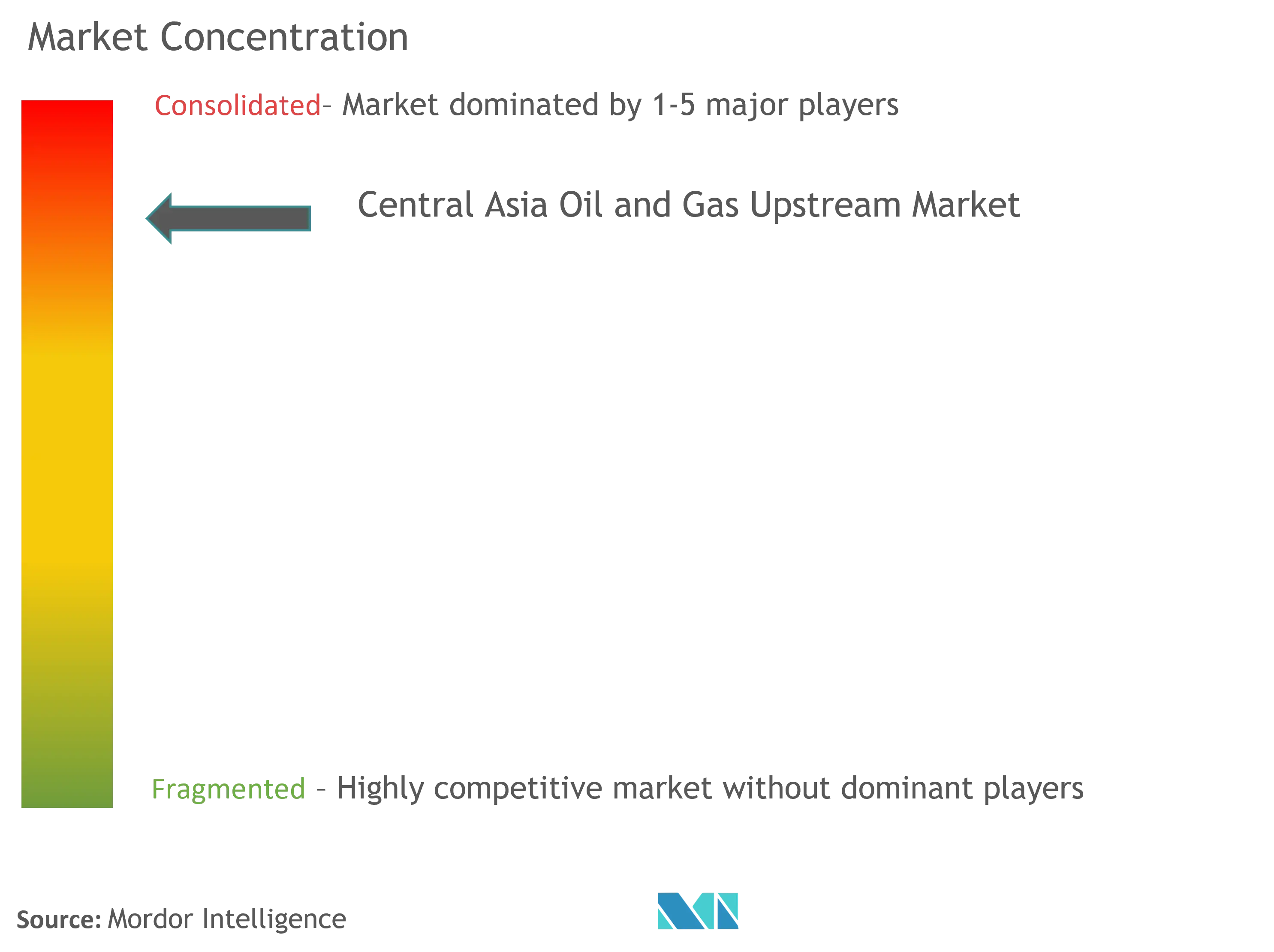
| Market Concentration | Medium |
Major Players *Disclaimer: Major Players sorted in no particular order Image © Mordor Intelligence. Reuse requires attribution under CC BY 4.0. | |
Central Asia Oil And Gas Upstream Market Analysis by Mordor Intelligence
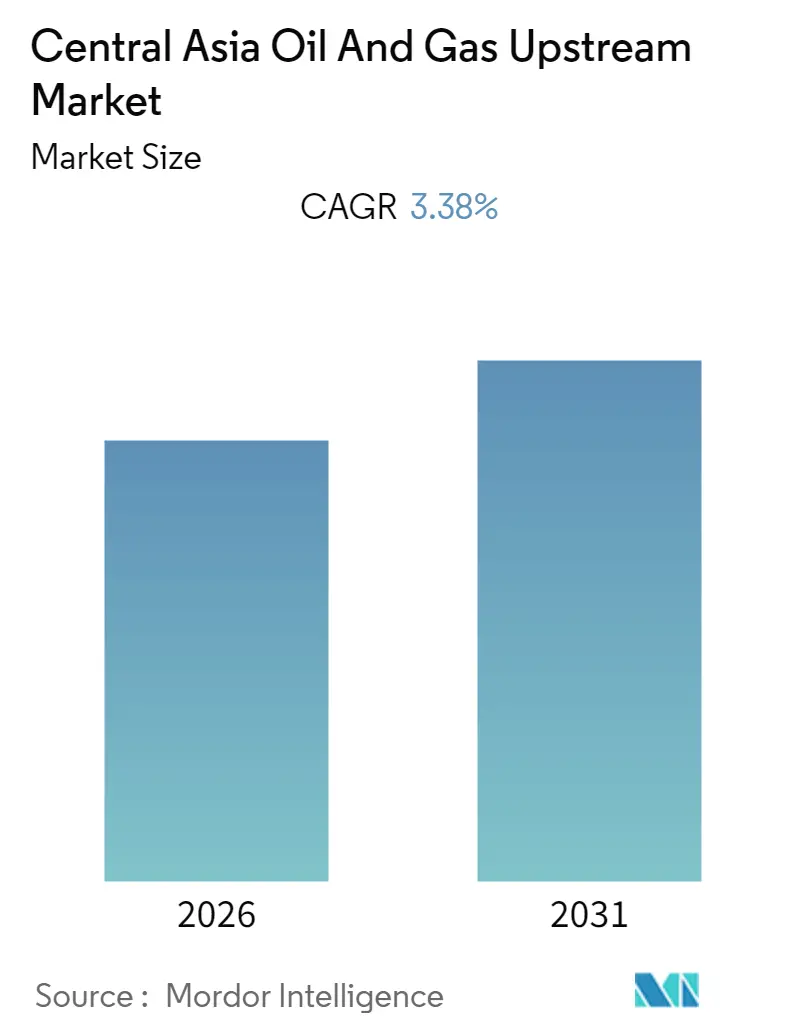
The Central Asia Oil and Gas Upstream Market size is expected to register a CAGR of 3.38% during the forecast period.
- Onshore projects are expected to remain the most utilized of the deployment locations as they provide for cheaper access to the oil resources.
- There have been significant oil discoveries in countries like Turkmenistan and Kazakhstan. Economically feasible oil extraction may become an opportunity for the companies and may lead to a boom in oil production.
- Kazakhstan is expected to dominate the market, owing to the increase in oil and natural gas productions.
Note: Market size and forecast figures in this report are generated using Mordor Intelligence’s proprietary estimation framework, updated with the latest available data and insights as of 2026.
Market Trends and Insights
Onshore Segment to Dominate the Market
- In Central Asia, most of the economically viable oil and gas fields in the country are situated inland. Many countries, such as Kazakhstan, is the largest economy in Central Asia and home to more than 18 million people. The country is rich in coal, oil, natural gas, and uranium. The country has seen significant growth in its exploration and production activities in recent days.
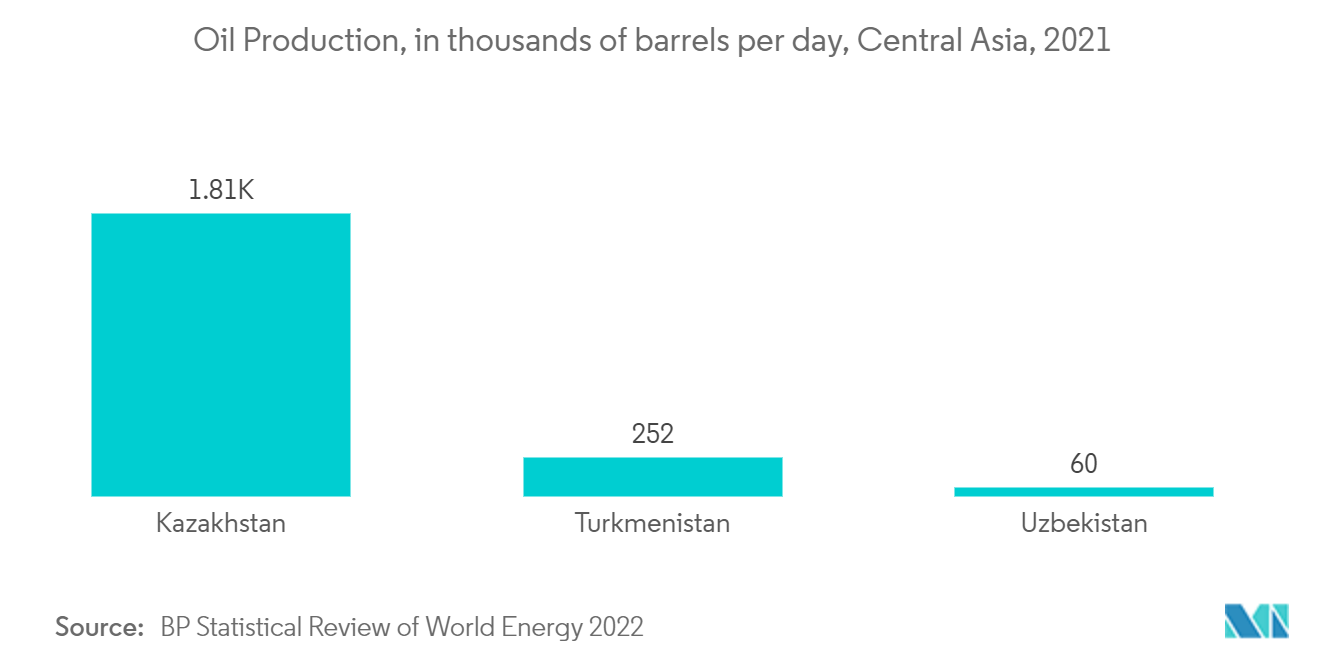
- Oil production in the region has grown around 2.4% respectively, in the past five years. Although Kazakhstan produces some gas, most of it is re-injected to enhance oil recovery locally. On the contrary, most of the gas produced by Turkmenistan and Uzbekistan is exported to China, Russia, and Azerbaijan.
- Moreover, Kazakhstan's primary export oil grade is the Caspian Pipeline Consortium (CPC) Blend. CPC Blend is of light quality with an API (American Petroleum Institute) gravity of 45.3° and sweet crude (0.56% sulfur), which is of high value for its high yield of gasoline and light distillates. Most of the CPC blend is produced from the Tengiz field.
- In November 2021, the Chevron-led consortium that operates the Tengiz Oil field had begun an early production from a USD 45 billion expansion project intended to lift output to 850,000 b/d. Tengizchevroil consortium had brought on stream three metering stations producing 100,000 b/d connected to new wells drilled as part of this expansion.
- Owing to the above points onshore segment is expected to dominate the market during the forecast period.
Kazakhstan is Expected to Dominate the market
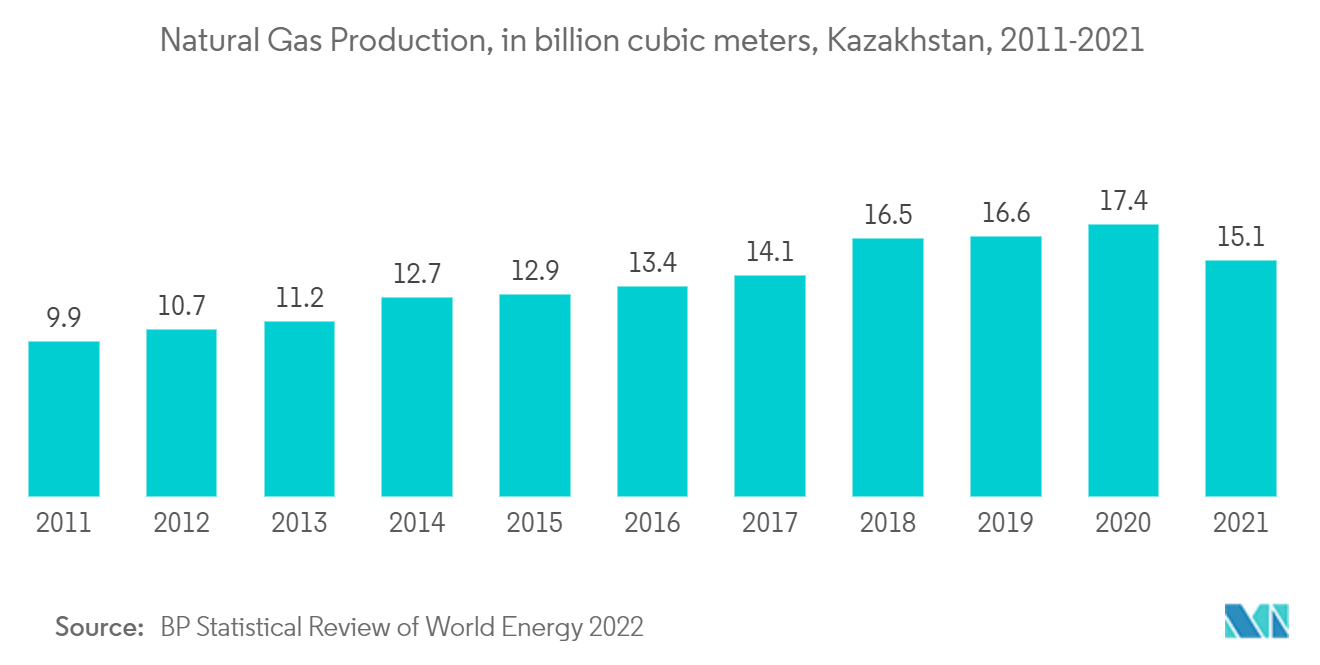
- Kazakhstan was the world's ninth-largest exporter of crude oil and 12th of natural gas as of 2021. As of december 2021, natural gas exported by Kazakhstan was 15,101.000 million cubic meters. The increase was primarily due to demand from Russian Federation and China.
- Natural gas production increased by 14.03%, i.e., from 27.8 billion cubic meters in 2010 to 32.7 billion cubic meters in 2021. Consumption of natural gas increased by 22.06%, i.e., from 9.5 bcm in 2010 to 15.1 bcm in 2021. Therefore, increasing demand for natural gas is boosting the investments within the country.
- In 2021, the Ministry of Energy, Kazakhstan announced USD 116.8 million for the implementation of 146 oil and gas projects across the country. The allocated budget is utilized for the extension of gas networks, providing access to gas for around 10,388 thousand people within the country.
- Moreover, in June 2021, Kazakhstan started the construction of a new gas processing plant in the Makat district in the Atyrau region, near the existing onshore Bolashak oil and gas treatment complex. The project has an investment cost of USD 860 million and has a capacity to process 1 billion cubic meter/year of sulfur dioxide from the Kashagan field.
- Hence, increasing investments in the oil and gas industry are expected to drive the market due to the addition of fresh capacity. An increase in the demand from neighboring countries like the Russian Federation and China is also expected to boost the market during the forecast period.
Regulatory Landscape
In Kazakhstan, upstream regulation is centered on the authorized body, the Ministry of Energy, alongside the competent body for subsurface use administration, the Ministry of Industry and Construction. Together, they shape licensing, subsoil use contracts, and compliance requirements that affect activity across the region, given Kazakhstan's dominant position in Central Asia. Amendments to Kazakhstan's Subsoil Use Code effective March 2, 2026 introduced electronic auctions for hydrocarbons and created a new contract category for underexplored areas, including a participation requirement tied to the national company. This affects bidder structures and partnership models.
Fiscal and operational compliance has also been updated through Kazakhstan's new Tax Code effective January 1, 2026. It unified elements of subsoil taxation and revised mineral extraction tax calculations, including treatment of flared gas (at production cost plus 20%) and alignment of export duties for crude and petroleum products with domestic regimes. The 2026 framework sets a five-year statute of limitations for tax compliance for major businesses and oil and gas companies, which changes record-keeping and audit readiness requirements for upstream operators and contractors.
Competitive Landscape
The Central Asia Oil and Gas Upstream Market is moderately consolidated. The major companies include National Company JSC (KazMunayGas), Chevron Corporation, Karachaganak Petroleum Operating BV, Gazprom International Limited, and PJSC Lukoil Oil Company.
Central Asia Oil And Gas Upstream Industry Leaders
-
KazMunayGas
-
Chevron Corporation
-
Gazprom International Limited
-
PJSC Lukoil Oil Company
-
Sinopec Oilfield Service Corporation (SSC)
- *Disclaimer: Major Players sorted in no particular order
Central Asia Oil And Gas Upstream Market Companies Covered in this Report
- JSC Turkmengaz
- Sinopec Oilfield Service Corporation
- Gazprom International Limited
- PJSC Lukoil Oil Company
- Chevron Corporation
- KazMunayGas Grid Solutions SAS
Read Analysis of Central Asia Oil And Gas Upstream Companies
Market Opportunities and Future Outlook
A near-term opportunity area in Central Asia upstream is earlier-stage exploration partnering in Kazakhstan, supported by mechanisms that broaden access to acreage while shaping consortium design. The direction is reinforced by the shift toward electronic auctions for hydrocarbons and new contract formats for underexplored areas. KazMunayGas has continued to engage with multiple international counterparts on exploration and project advancement, and new ventures involving Chinese partners have been positioned around geological exploration and surveying work, supporting demand for seismic and related subsurface services.
Gas-linked upstream development and export corridor dynamics also create room for field development activity across the region. The Central Asia-China Gas Pipeline system has been discussed alongside an additional Line D targeting 30 bcm per year of capacity addition, complementing the existing 55 bcm system. This reinforces the strategic importance of upstream supply and processing reliability in Turkmenistan and Uzbekistan alongside Kazakhstan's liquids-led growth. At the same time, operator attention to export route resilience, including continued review of alternatives to the Caspian Pipeline Consortium route such as the Baku-Tbilisi-Ceyhan pathway, keeps upstream planning tied to market access and crude evacuation optionality.
Recent Industry Developments in Central Asia Oil And Gas Upstream Market
- July 2026: KMG and Chevron held discussions in Astana regarding ongoing Tengiz field operations and potential joint geological exploration opportunities in Kazakhstan; export diversification via CPC and BTC reviewed. The discussions reinforce collaboration with a major Western partner and could broaden Kazakhstan's upstream exploration and export routes. Progress on joint exploration aligns with market moves to diversify supply and enhance asset utilization.
- July 2026: KMG and Sinopec reviewed progress on the Berezovsky joint exploration project in West Kazakhstan, with 2D seismic exploration scheduled to commence by end-2026. The review expands Asian partner engagement in upstream activity and accelerates seismic program planning. This supports resource development and potential production timing.
- July 2026: KMG and CNPC reviewed the Urikhtau project, with Central Urikhtau gas condensate section commissioning targeted by end-2026. The update advances gas condensate development timelines and deepens CNPC collaboration in Kazakh upstream. This alignment strengthens project execution and future output prospects.
Central Asia Oil And Gas Upstream Market Report Scope and Research Methodology
Market Definition and Coverage
For this study, the market includes the value generated from upstream oil and gas activities in Central Asia, covering exploration, field development, and production work across onshore and offshore assets.
Scope exclusions: We exclude midstream transport and storage, refining, petrochemicals, retail fuel distribution, and power generation.
Segments Covered in This Report
- Type of Deployment
- Onshore
- Offshore
- Geography
- Kazakhstan
- Turkmenistan
- Uzbekistan
- Rest of Central Asia
Data Sources, Market Sizing, and Validation
Desk Research
Desk work started with building a fact base on upstream activity levels and operator plans across Kazakhstan, Turkmenistan, Uzbekistan, and the rest of Central Asia. Public sources helped us anchor production and reserve context, and then refine it using project and licensing disclosures.
We referred to non-paywalled sources such as the Energy Information Administration, International Energy Agency, OPEC and OPEC+ publications, World Bank macro series, and government energy ministry statistics where available. We also used company annual reports and investor presentations, national regulator updates, and reputed press for capex timing, project milestones, and development plans. In a few places, paid subscriptions for company financials and intelligence, news and financials, and patent databases were used to speed up cross-checks and reduce missing fields. These sources are illustrative and not exhaustive, and many other public documents were used for data collection, validation, and clarification.
Primary Interviews and Surveys
Primary work was used to confirm assumptions that are hard to read from public data, such as typical cost splits between drilling, facilities, and field services, and how work programs are being phased by operators. We spoke with a mix of E&P operators, upstream service providers, advisers, and local subject experts, and then validated points across the main producing areas in the region so the model reflects real operating conditions.
Distribution of primary research fieldwork respondents
| Company type | Respondent position |
|---|---|
| Top tier: 38% | CXOs: 20% |
| Mid tier: 42% | Functional/Unit leaders: 29% |
| Smaller Players: 20% | Managers: 51% |
Market-Sizing & Forecasting
Sizing was built using a top-down activity and spend reconstruction, where country level upstream investment intent is converted into market value using drilled well activity, development phase timing, and typical cost stacks by asset type. Once this was in place, selective bottom-up checks were run using sampled project budgets, service spend ratios, and simple ASP times volume approximations for drilling and completion work, and then totals were adjusted when the two views showed consistent gaps.
Key inputs used in the model included crude oil and natural gas production trends, planned wells and rigs (onshore versus offshore), reserve replacement priorities, upstream capex guidance and fiscal terms that affect investment pace, and the timing of large field development milestones. Forecasting relied mainly on scenario analysis supported by expert views, because project sanctioning and export route constraints can shift activity quickly. Where data gaps existed for smaller fields, we used peer field analogs and conservative utilization assumptions, which were then rechecked during interviews.
Data Validation & Update Cycle
Outputs were checked through multiple passes that compare modeled values with independent signals such as upstream capex direction, production volumes, and publicly visible development schedules. When a country or deployment type produced an unusual jump, the drivers were unpacked and assumptions were either corrected or flagged for re-contact with experts.
Before sign-off, another analyst reviews the build, the key equations, and the final tables for variance and logic consistency. The report is refreshed annually, and interim updates are made when material events occur, such as a major project sanction, a sharp price shift that changes drilling plans, or a policy move that alters licensing. Right before delivery, we do a final check so clients receive the most current view.
Mordor Intelligence's Central Asia Oil and Gas Upstream Market Size Compared With Other Published Estimates
Published market values for Central Asia upstream often differ, and the spread usually comes from what each publisher counts as upstream value, the countries included under Central Asia, and how capex and activity are converted into revenue.
Some estimates bundle a broader set of countries and add adjacent upstream-support items that are not consistently disclosed across the region. In Mordor Intelligence, the sizing is limited to upstream exploration, development, and production value for Kazakhstan, Turkmenistan, Uzbekistan, and the rest of Central Asia, and it is kept separate from midstream and downstream money flows so the totals stay tied to observable upstream activity.
Benchmark comparison
| Source | Market Size | Gaps in Research Methodology |
|---|---|---|
| Mordor Intelligence | USD 28.52 B (2025) | |
| Trade Journal A | USD 19.64 B (2026) | Uses a different base year and extends coverage to additional Central Asian countries, and its 2026 starting value is sensitive to how it spreads multi-year project spend into a single year. |
| Regional Consultancy B | USD 30.57 B (2035) | Longer forecast window and a higher growth path can raise the terminal year, and the estimate is more exposed to assumptions on sanction timing and capex escalation in late-cycle years. |
Taken together, the comparison shows that timing and scope choices drive most of the variation, not a single right or wrong number. By keeping the inputs tied to country activity, deployment mix, and practical spend drivers that can be rechecked, the final market size stays transparent and repeatable for decision-making.
Key Questions Answered in the Report
What is the current Central Asia Oil and Gas Upstream Market size?
The Central Asia Oil and Gas Upstream Market is projected to register a CAGR of 3.38% during the forecast period (2026-2031)
Who are the key players in Central Asia Oil and Gas Upstream Market?
KazMunayGas, Chevron Corporation, Gazprom International Limited, PJSC Lukoil Oil Company and Sinopec Oilfield Service Corporation (SSC) are the major companies operating in the Central Asia Oil and Gas Upstream Market.
What years does this Central Asia Oil and Gas Upstream Market cover?
The report covers the Central Asia Oil and Gas Upstream Market historical market size for years: 2020, 2021, 2022, 2023, 2024 and 2025. The report also forecasts the Central Asia Oil and Gas Upstream Market size for years: 2026, 2027, 2028, 2029, 2030 and 2031.